Matthew 22:15-22— 15 Then the Pharisees went and plotted how to entangle him in his words. 16 And they sent their disciples to him, along with the Herodians, saying, “Teacher, we know that you are true and teach the way of God truthfully, and you do not care about anyone’s opinion, for you are not swayed by appearances. 17 Tell us, then, what you think. Is it lawful to pay taxes to Caesar, or not?” 18 But Jesus, aware of their malice, said, “Why put me to the test, you hypocrites? 19 Show me the coin for the tax.” And they brought him a denarius. 20 And Jesus said to them, “Whose likeness and inscription is this?” 21 They said, “Caesar’s.” Then he said to them, “Therefore render to Caesar the things that are Caesar’s, and to God the things that are God’s.” 22 When they heard it, they marveled. And they left him and went away.
In the name of Jesus. Amen.
Do you find your actions result in unintended consequences?
In 1912, we learned a lesson from the sinking of the Titanic – you need to have enough lifeboats for everyone on the ship. When the “unsinkable” Titanic launched on its maiden voyage there were 2,223 people on board, but the ship had enough lifeboats for just under 1,200 people. Because of this in 1915, the federal “Seamen’s Act” was passed in the United States which required all ships to have enough lifeboats for all its passengers.
Well, there was a boat in Chicago called the Eastland. When it was built, the Eastland had a design flaw – it was top-heavy, its center of gravity was way too high causing the boat to list. When the “Seamen’s Act” passed, the Eastland had to add more heavy lifeboats to accommodate the number of passengers. But this, of course, made the ship even more top-heavy. Anyway, on July 24, 1915, the Eastland was chartered by a company to take its workers on their annual picnic. As the passengers boarded, they stood on the deck to take in the morning air. But suddenly the boat tipped over on its side, and 848 people died because the boat had been made “safer,” but that safety resulted in unintended consequences.
Good intentions do not always equal good results. Sometimes unintended consequences cause more mayhem like in the case of the Eastland. But sometimes unintended consequences produce unexpected benefits. Something like that happens in our text today.
In this Gospel text, the Pharisees are out for blood. Jesus is a threat to their authority, so they want Jesus dead. The Pharisees are looking for a way to trap Jesus in His words. They wanted to set a trap for Him so they could accuse Him of a capital crime. So the Pharisees worked together with the Herodians to lay out their trap. This would be similar to the farthest left liberal and the farthest right conservative joining forces to achieve something together. It’s almost unbelievable that something like this would happen.
The Herodians represented the Roman occupation of Israel. Herod’s dynasty had come to power only because Rome had given it to them. The Pharisees and the people living in Israel hated the fact that they were under the Herod’s and Roman rule, but they couldn’t really do anything about it. Both the Herodians and the Pharisees viewed Jesus as a threat to their way of life, and as the saying goes, “The enemy of my enemy is my friend.”
They lay a snare for Jesus. They are going to ask Jesus a question that will catch Him in His words. But first they try to disguise their trap. They lather their trap in honeyed words. “Teacher, we know that You are true and teach the way of God truthfully, and You do not care about anyone’s opinion, for You are not swayed by appearances.” Thinking they have Jesus fooled and off His guard, they set the trap. ”Should we pay taxes to Caesar or not?”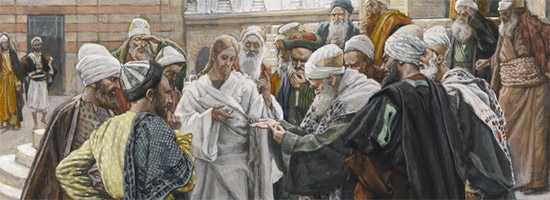
Now, if Jesus says, “No,” the Herodians, the representatives of Rome, will think He is stirring up a rebellion. About 25 years before this, in 6 AD, a man named Simon the Galilean lead a revolt because of this very same tax resulting in a civil war. The Herodians would kill to stop another rebellion like this. But if Jesus says, “Yes,” the crowds who are following Him will be disgusted with Him seeing Him as a traitor to God the Jewish state.
But Jesus sees right through them. “Hypocrites. You evil, conniving, two-faced hypocrites. I’m going to ask you a question. Show Me the coin you use to pay the tax.” Someone in the group pulls a denarius out of his pocket and shows it to Jesus. And Jesus asks, “Whose likeness and inscription is on this coin? Whose icon and writing is this?”
They answer, “Caesar’s.” Jesus says, “Render to Caesar the things that are Caesar’s and to God the things that are God’s.” In other words, Jesus tells these nefarious hypocrites, “Since that coin has Caesar’s icon and writing on it, give it back to Caesar if he asks for it. But any other ‘currency,’ any other thing, that has God’s icon and writing on it, when God asks for it, render it to Him.”
With this answer, Jesus makes those hypocrites look like Wiley Coyote trying to catch Roadrunner. They marvel and go away.
 But, fast-forward a couple of days. These hypocrites will do exactly what Jesus says. They will render to God the things that are God’s. They will render to God Jesus. Desperate to get rid of Him, the hypocrites will arrest Jesus and bring Him before Pilate saying, “This Man is forbidding us to give tribute to Caesar, and saying that He Himself is Christ, a king” (Lk. 23:2). They make sure that Jesus gets placed on the cross, and in doing so, they render to God Jesus, the Son of God.
Just as the denarius bared the icon and words of Caesar, Jesus is the icon and Word of God (Col. 1:15; Jn. 1:1-4). But these hypocrites call for Jesus’ death thinking it will benefit them and their way of living. But killing Jesus will have unintended consequences with eternal benefits. They offer to God the Lamb of God who takes away the sin of the world – even their own sin.
Your actions also have unintended consequences. When we complain about our political leaders, we sin – not only against them, but also against God. Those in authority over us are placed there by God. If you resist the authorities, you resist and rebel against God (Ro. 13:1-7). You and I are sinners, descendants of Adam. We bear the icon of original sin (1 Co. 15:49) from the time we are conceived. Everything we do, even our righteous deeds fall apart in our hands producing sin and death.
 However, God has given you the icon of Christ (1 Cor. 15:49). When you were baptized into Christ, you put on Christ (Gal. 3:27). When you were baptized in the name of the Father, Son, and Holy Spirit, God put His words, His name, on you.
In allowing Himself to be offered to God, Jesus offered to God the things that are God’s. Through His death and resurrection, Jesus redeemed you and all of creation and presents it back to God. Our evil toward God has resulted in the best unintended consequence – eternal life with Him. Amen.
The peace of God, which surpasses all understanding, will guard your hearts and minds in Christ Jesus. Amen.
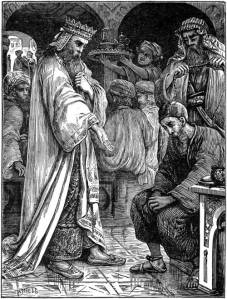 8 Then he says to his servants, ‘The wedding feast is ready, but those who had been called were not worthy. 9 Go therefore to the main roads and call to the wedding feast as many as you find.’ 10 And those servants went out into the roads and gathered all whom they found, both bad and good. So the wedding hall was filled with guests. 11 But when the king came in to look at the guests, he saw there a man who had no wedding garment. 12 And he says to him, ‘Friend, how did you get in here even though you do not have a wedding garment?’ And he was speechless. 13 Then the king said to the attendants, ‘Bind him hand and foot and cast him into the outer darkness. In that place there will be weeping and gnashing of teeth.’ 14 For many are called, but few are chosen.”
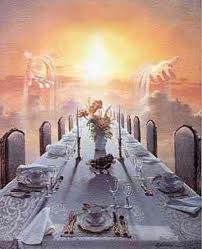 You see, God has prepared a table for you. He accepts you. He accepts you not because of who you are or what you have done. He accepts you because of what Jesus Christ has done. God simply wants you at His party. He has laid it all out with the best food, the most expensive china, and the finest wine. He will dress you in the righteousness of His Son.
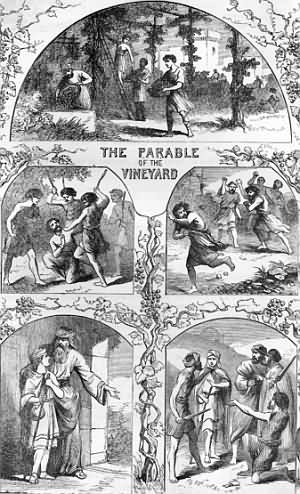 “If you want it done right, you have to do it yourself,” we say. But that is not God’s way. He doesn’t set Himself up in the watchtower and manage the vineyard Himself. He lets the tenants figure it out for themselves. When the harvest is over and the wine is made, He expects those tenants to give Him His portion so that He and His tenants can eat, drink, and be merry together.
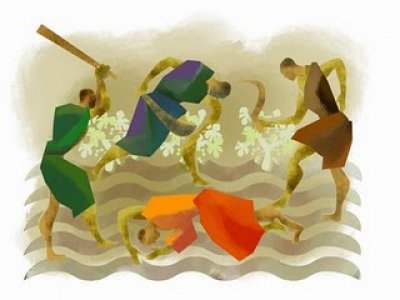 By acting with evil towards the vineyard Owner, His servants, and His Son, the tenants show that they viewed the Owner as evil.
 Pastorsamwise
You must be logged in to post a comment.