Genesis 22:1-18
1 After these things God tested Abraham and said to him, “Abraham!” And he said, “Here I am.” 2 He said, “Take your son, your only son Isaac, whom you love, and go to the land of Moriah, and offer him there as a burnt offering on one of the mountains of which I shall tell you.” 3 So Abraham rose early in the morning, saddled his donkey, and took two of his young men with him, and his son Isaac. And he cut the wood for the burnt offering and arose and went to the place of which God had told him. 4 On the third day Abraham lifted up his eyes and saw the place from afar. 5 Then Abraham said to his young men, “Stay here with the donkey; I and the boy will go over there and worship and come again to you.” 6 And Abraham took the wood of the burnt offering and laid it on Isaac his son. And he took in his hand the fire and the knife. So they went both of them together. 7 And Isaac said to his father Abraham, “My father!” And he said, “Here I am, my son.” He said, “Behold, the fire and the wood, but where is the lamb for a burnt offering?” 8 Abraham said, “God will provide for himself the lamb for a burnt offering, my son.” So they went both of them together.
9 When they came to the place of which God had told him, Abraham built the altar there and laid the wood in order and bound Isaac his son and laid him on the altar, on top of the wood.  10 Then Abraham reached out his hand and took the knife to slaughter his son. 11 But the angel of the Lord called to him from heaven and said, “Abraham, Abraham!” And he said, “Here I am.” 12 He said, “Do not lay your hand on the boy or do anything to him, for now I know that you fear God, seeing you have not withheld your son, your only son, from me.” 13 And Abraham lifted up his eyes and looked, and behold, behind him was a ram, caught in a thicket by his horns. And Abraham went and took the ram and offered it up as a burnt offering instead of his son. 14 So Abraham called the name of that place, “The Lord will provide”; as it is said to this day, “On the mount of the Lord it shall be provided.”
15 And the angel of the Lord called to Abraham a second time from heaven 16 and said, “By myself I have sworn, declares the Lord, because you have done this and have not withheld your son, your only son, 17 I will surely bless you, and I will surely multiply your offspring as the stars of heaven and as the sand that is on the seashore. And your offspring shall possess the gate of his enemies, 18 and in your offspring shall all the nations of the earth be blessed, because you have obeyed my voice.”
In the name of Jesus. Amen.
This text draws you in. The details paint a vivid picture that makes you wonder what it was like for the characters in the story. I wonder what Abraham’s wife, Isaac’s mother, Sarah, thought of this father-son trip. Did she know why they were leaving? Or was it the shock of hearing what happened that killed her? (She dies six verses after this text). What about the servants who accompany Abraham and Isaac? What kind of conversations did they have with their master and his son on the three-day journey? Or were the daily marches and nightly campfires morbidly quiet? And how did Isaac get on top of the wood; did Abraham have to wrestle with him? Probably not, but the text doesn’t say; or how did Abraham go about explaining to Isaac what the plan was?
But what is usually the biggest question, how could Abraham go through all of this? That question is what makes this story so mesmerizing and etches it into our minds.
Listen to how God starts this whole circus – He says, “Take your son, your only son Isaac, whom you love, and go to the land of Moriah, and offer him there as a burnt offering.” God Himself pours on the sentimental words and phrases then says, “Slit his throat and burn him to a charred crisp – reduce him to ashes.”
And Abraham rises early in the morning, saddles his donkey, takes his two servants and his son, and cuts the wood for the offering.
On the third day – those words are so precious wherever they come up in Scripture – on the third day, Abraham saw the place from afar. Abraham tells his servants to stay with the donkey, but then listen carefully to what Abraham says. One subject governs all the verbs, but I’m going to supply the subject before every verb, “I and the boy will go over there. I and the boy will worship. And I and the boy will come again to you.”
 Abraham takes the wood and lays it on his son, and Isaac carries his own location of death.
Abruptly, Isaac speaks up, “My father!”
“Here I am, my son.”
“Behold, the fire and the wood, but where is the lamb for a burnt offering?” A poignant, touching question.
But we need to interrupt the text. We need to slow down and gaze at Abraham’s answer and ponder it. The Hebrew word here in v. 8 which gets translated ‘provide’ is a really bad translation. The Hebrew word actually means ‘to see’ But basically every English version you can get your hands on will translate it as ‘provide.’ They say that the verb ‘to see’ here has the sense of ‘will see to it’ as in, “God will see to it Himself that there is a lamb.” But to translate it that way makes us miss something big.
Because there is one other part of Abraham’s words here that we miss in English. The most literal, wooden translation of Abraham’s response to Isaac is, “God will see Himself – a lamb” (Dr. John Saleska) God will see Himself – a lamb. Are you beginning to see?
Now, the story slows way down giving every excruciating detail. They come to the place. Abraham built the altar. He laid the wood in order. He bound his son. He laid him on top of the wood. Abraham reaches out his hand. He takes the knife to slaughter his son.
And the angel of Yahweh steps in. You can ask me about this sometime, I’m not going to take the time to fully explain it in this sermon, but the “angel of Yahweh” in the Old Testament is Jesus. For now, the only proof I’ll offer is that the angel of Yahweh speaks as God Himself with God’s same words earlier. Notice He says, “You have not withheld your son, your only son, from Me.”
Abraham lifts up his eyes and “looked” (same word that means ‘see’ but gets translated ‘provide’ earlier) and there is a ram crowned with thorns in a thicket.
 Abraham offers up the ram as a burnt offering instead of his son. And Abraham names that place, “Yahweh will see.” And it became a saying, “On the mount of Yahweh it will be seen.”
Again, do you see? The Son is slaughtered, but not in this text. Jesus stops this sacrifice because He will be the sacrifice. Isaac could not bear the sins of the world. But Jesus could. In Jesus, God did see Himself – the Lamb, the Lamb of God who takes away the sins of the world.
Jesus, the son of God, the only begotten Son of God, the Son in whom the Father is well pleased came. Jesus, the Son, was offered by the Father as a burnt offering for your sins. Jesus carried His own wood, His own place of death. Jesus was caught in a crown of thorns. Jesus willingly let Himself be slaughtered. And God did not stop Himself.
What does that mean for you? Romans 8:32 says, “He who did not spare his own Son but gave him up for us all, how will he not also with him graciously give us all things?”
 On Mount Calvary, God saw Himself – the lamb. On the mount of Yahweh, God saw. And now, when He looks at you, all He sees is Jesus. Amen.
The peace of God, which surpasses all understanding, will guard your hearts and minds in Christ Jesus. Amen.
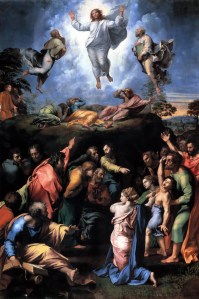 Today, it is important for us to go to the top of the mountain. Today, it is important for us to see this event in Christ’s life, to see Jesus transfigured, metamorphosized. Today, it is important for us to see His clothes turn radiantly white – brighter than the sun glaring off of freshly fallen snow. Today, it is important for us to see Jesus’ face shining more brightly than if He had swallowed the sun. As Peter said, “It is good that we are here.”
 Only when you hear the whole story does the happily ever after mean something. “Once upon a time, there was a girl named Cinderella. After her mother died, her dad married a wicked woman who had two nasty, ugly daughters. Then Cinderella’s dad died too. Her step-mother and step-sisters made Cinderella their slave. But then Cinderella gets a taste of the good life – she is given beautiful coach with magnificent horses. She gets beautiful shoes, mascara, and a stunning evening gown. She dances all night with the prince. But then – bong, bong, bong, bong. Back down she goes. But the prince eventually finds her, marries her, and she lives happily ever after.
 Your loved ones will die. Your kids will make bad choices and cause you all sorts of heartache. And you can shake your fist at God and be angry with Him. Or you can endure the suffering. And you can even rejoice in your suffering. Rejoice in suffering? Yes. Rejoice in suffering, knowing that suffering produces endurance, and endurance produces character, and character produces hope, and hope does not put us to shame, because God’s love has been poured into your hearts through the Holy Spirit who has been given to you (Ro. 5:3-5).
 The Gospel of Mark moves along at a frantic pace. No time to stop and look at the scenery in Mark. No time to take a selfie. In last week’s text, Jesus preached in Capernaum’s synagogue and immediately a demon shows up. Jesus silenced the demon and cast it out of the man. The people were left astonished and wondering who this Jesus is.
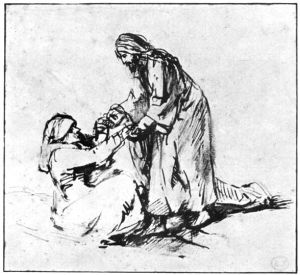 Here is the Messiah, the Holy One of God, who is preaching about the reign of God – whose presence is the reign of God. Straight to the bed and to the feverish, flustered women He comes. “There is nothing more important in all the world than for Jesus to be there for the sick woman” (Nagel). Sent with the task of redeeming the whole world, Jesus is there just for her.
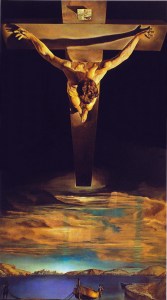 He has one goal in mind. He has come to do His Father’s will. He has come to die. Jesus dies for the same reason you will die – because of sin. Jesus raises you up because He was raised up from the earth on the cross with the sins of the world on Himself. Because of His death, your sins have left you. Because He rose again from the dead, you can know that you too will rise from the dead. In your baptism you were united with Jesus’ death so you too can rise again (Ro. 6:4-5).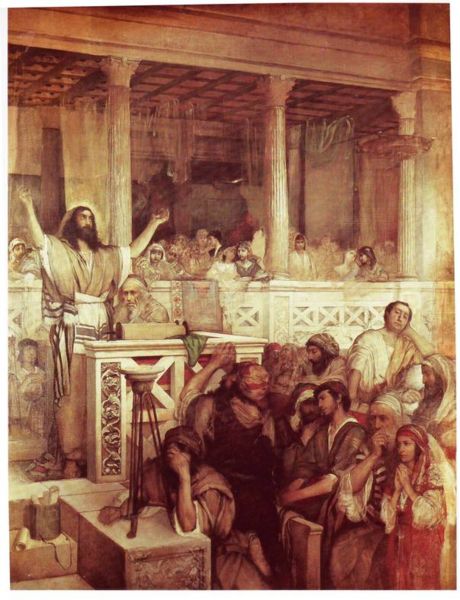
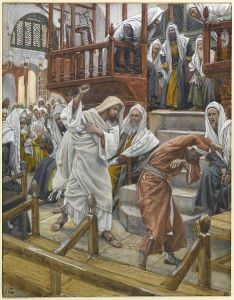 But Jesus keeps right on preaching. He preaches directly to the demon. He doesn’t use swift spiritual ninja moves to shut the demon up. He simply uses words, “Be silent, and come out of Him.” And the evil, unclean spirit obeys. The demon threw the man into convulsions. And the screaming – can you imagine how violent this would have looked? And all of this is happening right in the middle of church! But the evil spirit leaves and the man is unharmed (Lk. 4:35).
 Pastorsamwise
You must be logged in to post a comment.