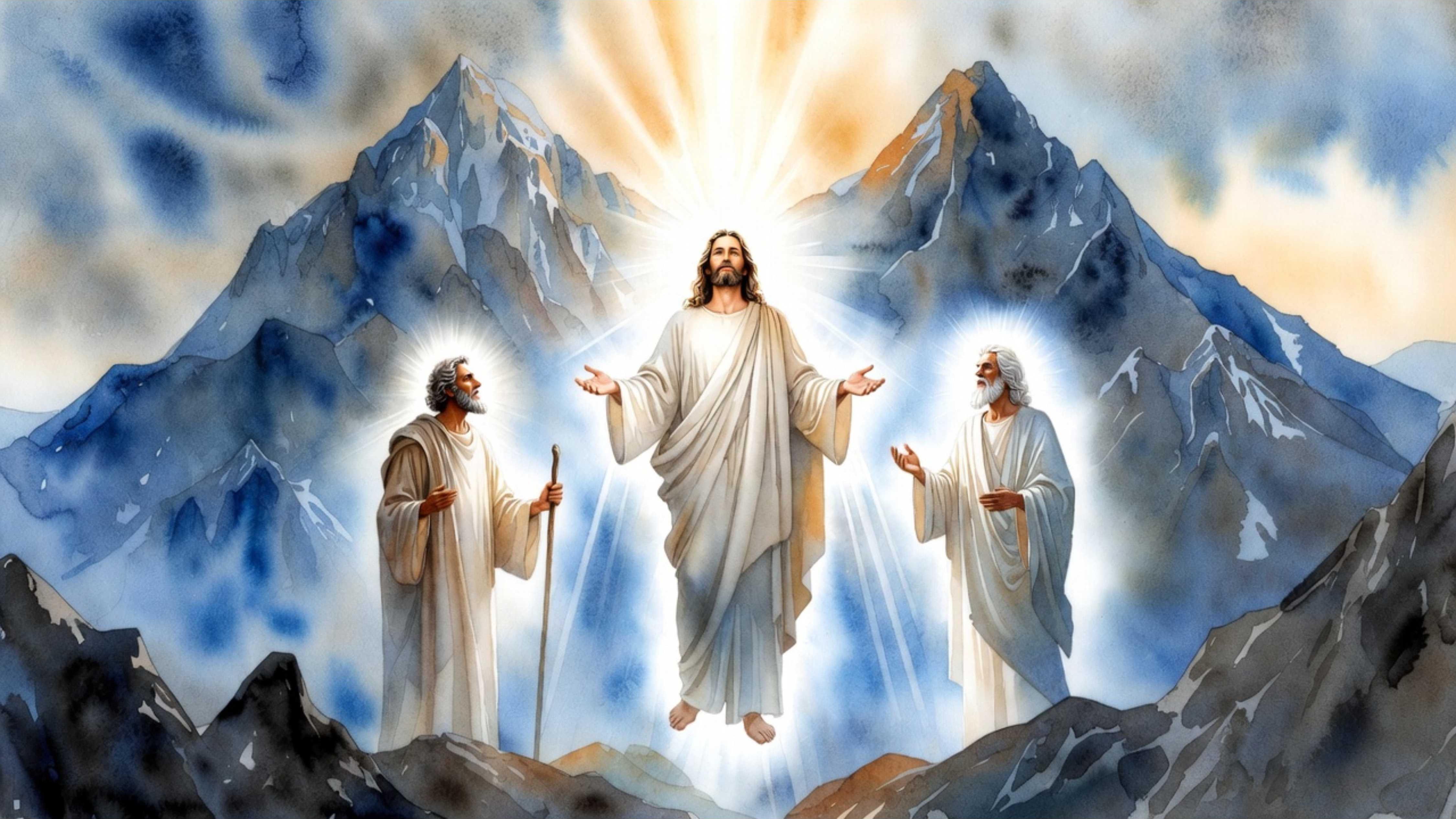
Timing – Sermon on Matthew 17:1-9 for the Transfiguration of Our Lord

Matthew 17:1-9

In the name of Jesus. Amen.

The Transfiguration is unique. It is the only time that the curtain gets pulled back and Jesus’ glory, His divine splendor, is allowed to shine through His human nature. Sure, the night Jesus was born, the glory of the Lord shined, but it was in a field outside of Bethlehem to a bunch of shepherds (Lk. 2:8-9). But when the shepherds found newly-born Jesus, the glory of the Lord wasn’t radiating from baby Jesus. Instead, He was surrounded by animals, wrapped in swaddling cloths, and lying in a feeding trough. In last week’s Gospel lesson, Jesus turned water into wine at the wedding at Cana, and John says that miracle is how Jesus manifested His glory (Jn. 2:1-11). But it was with and through the sign. Jesus didn’t start shining like He does here in the Transfiguration. Probably, the bride would’ve been upset by that. Brides don’t want to be one-upped in appearance at their wedding.

The amazing thing about the Transfiguration isn’t that Jesus gets all shiny and glorious. Instead, the amazing thing is that Jesus wasn’t always like that during His time on earth. Jesus is the only-begotten Son of God, God of God, Light of Light, very God of very God, and He was able to conceal His glory when He came to earth. That’s miraculous, and unfortunately, we (myself included) are a little numb to that. The infinite, eternal, glorious God wrapped Himself in human flesh so thoroughly that He looked like a normal 1st century Jewish son of a carpenter (Mt. 13:55).

Jesus only let His glory shine forth once, and it’s here before the small audience of Peter, James, and John. If I were God (and thank God I’m not), I probably would have timed the Transfiguration differently.

Maybe, I would have done it when the 5,000 men plus women and children are surrounding Jesus in the wilderness (Mt. 14:13-21). That’s when Jesus was at the height of popularity and had the most people following Him. There, the day is coming to an end, and the crowds have been listening to Him teach all day. They are hungry and far from home. To me, that seems like a good time for Jesus to get shiny. Pull back the curtain and let everyone in that massive throng see Jesus’ divinity before He feeds them. But Jesus didn’t time His Transfiguration then.

Maybe, I would have had it happen during the trial before all the religious leaders (Mt. 26:58-68). Seventy of the most important priests and leaders, who were all legal experts and oversaw civil matters. It’s like a presidential cabinet meeting; they’re all gathered together. It’s like a presidential cabinet meeting. And the high priest says, “I adjure you by the living God, tell us if you are the Christ, the Son of God.” To me, that seems like good timing for the Transfiguration. That seems like a good time to shine brighter than the sun. But Jesus didn’t time His Transfiguration then.

Maybe, I would have done it when Pilate was asking whom he should release instead of crucify (Mt. 27:15-23). Pilate walks out on the balcony of the palace with Jesus and Barabbas there standing before the crowd, and Pilate asks, “Which of the two do you want me to release for You?” And the crowds keep crying for Barabbas to be released and for Jesus to be crucified. To me that seems like a good time to show the hidden glory and have clothes as white as light. But Jesus didn’t time His Transfiguration then.

Maybe I would have timed the Transfiguration to happen right before the beating and whipping. Or, maybe, while Jesus was laid on the cross and right as the soldier held the nail in one hand and raised the hammer in his other hand. Imagine that for the timing of the Transfiguration. The soldiers would’ve dropped the hammer and nails and run for the hills. But Jesus didn’t time His Transfiguration then. In all of those instances, Jesus keeps His majesty concealed.

Well, I’m not God. You and I can be thankful for that because, if any of those instances were when Jesus was Transfigured, people would have ran away from Him. In God’s infinite wisdom, Jesus’ Transfiguration happens here in Mt. 17. He does it when only three of the twelve disciples are with Him. Jesus chooses this as the timing of His Transfiguration so we sinners can approach Him unafraid.

Let’s get a little more context for the timing. Later today, go back and read the last half of Mt. 16. There, Jesus asks the disciples, “Who do people say that the Son of Man is?” The disciples answer, “Some say John the Baptizer, others say Elijah, and others Jeremiah or one of the prophets.” Then Jesus turns the question, “But who do you say that I am?” Peter makes his great confession, “You are the Christ, the Son of the living God.” And Jesus goes on to promise that upon Peter’s confession He will build His Church, which the gates of hell will never overcome (Mt. 16:13-20).

Right after that, Jesus starts telling the disciples that He must go to Jerusalem to suffer, die, and rise again. Then, Peter takes Jesus aside and rebukes Him saying, “That will never happen to You.” But Jesus rebukes Peter, “Get behind me, Satan! You are a hindrance to Me. For you are not setting your mind on the things of God, but on the things of man”(Mt. 16:21-23). That’s the context for the Transfiguration.

Peter’s just been praised for confessing Christ as the Son of God. Then, Peter is harshly rebuked for saying that Jesus isn’tgoing to die and rise again. So, the disciples are wrestling with these two things that seem to contradict each other. On the one hand, they have heard that Jesus is the Messiah, and on the other hand, they’ve heard that He’s going to die. So, the disciples are probably starting to wonder if all the Old Testament prophecies about the Messiah wasn’t going to be nearly as great as they thought. They’re wondering if all that talk about glory and triumph and thrones and scepters is totally wrong. Well, if that’s what they were thinking, they were wrong.

To be the Christ means to suffer. To be the Christ means that God comes to bear the sins of the world (Jn. 1:29). To be the Christ means that God comes down to be rejected (Jn. 1:9-13). To be the Christ means that God comes down to go to the cross, shed His Own blood, die, and rise again. That is how the Christ enters into His glory (Lk. 24:26) and through that suffering Jesus grants to sinners, who believe in Him, the same glory that He had in the Transfiguration (Jn. 17:22Ro. 8:1729-30Php. 3:211 Jn. 3:2).

All of this is to say that the timing of the Transfiguration is exactly when it needed to be, and it occurred before the exact audience who needed to see it. Peter, James, and John needed to see it then so they would know that while Jesus suffered all those horrific things in His Passion, God was working to redeem them (Act. 2:363:14-151 Co. 2:8).

This is also why the church has decided to place the Transfiguration on this Sunday to prepare us for Lent and Holy Week. Starting next week, the names of the Sundays orient our hearts and minds toward Easter. Today as we turn our focus toward the Resurrection, we are grounded in the fact that Jesus is God of God, Light of Light, very God of very God who suffers the wrath of God that should have been reserved for us. But Jesus has humbled Himself to be our Friend and Savior.

Dear saints, Jesus hid His glory for most of His ministry, but it was always there. Yes, it was hidden, but it was certainly there. Just because something is hidden doesn’t mean that it doesn’t exist. Remember that. Remember that especially when you face difficult times, when you are suffering, when you feel distant from God. Jesus still has that full glory that is revealed in the Transfiguration – which is the same glory that He had throughout His time here on earth. The day is coming when He will once again put it on full display at the proper time. And that day is the same day when you will share in His glory.

Your glorious Savior is coming again soon. Until then, listen to Him and hold fast to His Word. In 1 Tim. 6:14-16, God encourages you to cling to His Word until the appearing of our Lord Jesus Christ who will be revealed at the proper time. The text goes on to say that Christ is the blessed and only Sovereign, the King of kings and Lord of lords, who alone has immortality and dwells in unapproachable light. 

And dear saints, you share that glory. As you wait for Christ’s return, humble yourselves under the mighty hand of God so that at the proper time He may exalt you (1 Pet. 5:6). Know that God’s timing is always good. When it fits God’s purpose, when it will benefit others, and when it will benefit you most, God will pull back the curtain again. Jesus promises that the day is coming when you who are righteous by grace through faith will shine like the sun in the kingdom of your Father (Mt. 13:43). May that day come soon. Amen.

The peace of God, which surpasses all understanding, will guard your hearts and minds in Christ Jesus (Php. 4:7). Amen.

Unblemished – Sermon on Ephesians 5:22-33 for the Second Sunday after Epiphany

Ephesians 5:22-33

In the name of Jesus. Amen.

This is a sermon on marriage. When I’ve preached on marriage in the past, I’ve offered a disclaimer, and I’m going to do that again today. This sermon isn’t intended to address all the different aspects of marriage. We’d be here for days and weeks. And this is a mixed audience. Many of you are currently married. Some have been through divorce. Some of you aren’t married, at least not yet. Some of you might never get married; know that Scripture says that remaining single is a good gift from God (see 1 Co. 7). And some of you have been married but are now widowed. You’ll hear in a minute that the reason being widowed is so hard is that you have, very literally, lost a part of yourself. To you, be comforted by Christ and the fact that your spouse will rise again (Jn. 11:23).

My intention with this sermon is show how marriage is God’s idea. Then, I’ll make four assertions about marriage to show how it is a good gift from God. Also, with those four assertions, I’d like to offer some Biblical advice for your marriage. If you have any questions about things I don’t address, feel free to ask me. So, with that said, are you ready?

When God created man (singular) in His image, He created them (plural) male and female (Gen. 1:27). Part of man (and here, please think ‘mankind’ or ‘humanity’) is to have a duality – two parts, or even better two persons. Scripture teaches that there is one God (Dt. 6:4), but three Persons – Father, Son, and Holy Spirit (Mt. 3:16-17Mt. 28:19). The creation of man (again think ‘mankind) in the image of God is that man has a plurality which we see in Adam, the male, and the woman,[1] the female.

In Gen. 2:18-25, Scripture gives us the play-by-play of the creation of mankind as man and woman. But before the play-by-play we learn how in Gen. 1, God gave Himself a grade each day of creation. Day 1, God sees the light He created and sees that it is good – A+ (Gen. 1:4). Then, Days 2, 3, 4, and 5, God sees what He makes and it’s all good. A+’s all around (Gen. 1:1012182125). Finally, on Day 6 God creates mankind to be the crown of His creation and sees that it was very good (Gen. 1:31) – A+++! But, again, Gen. 2:18-25 gives a little more insight into Day 6. God created Adam and decided it wasn’t good for Adam to be alone (Gen. 2:18). God wasn’t saying that because He made a mistake. He was saying that to show Adam the goodness of what He was about to do.

God put Adam to sleep, removes Adam’s rib (in Hebrew it’s literally Adam’s ‘side’), and from that chunk of Adam, God created Adam’s bride (Gen. 2:21-22). And Adam was really happy when he saw his bride. He said, “This at last is bone of my bones and flesh of my flesh; she shall be called Woman because she was taken out of Man” (Gen. 2:23). Then, we have the statement that gets quoted in this text from Eph., “Therefore a man shall leave his father and his mother and hold fast to his wife, and they shall become one flesh” (Gen. 2:24Eph. 5:31).

So, from its beginning and institution, God made marriage to be one man, who has given of himself, to have a bride who is literally from his own flesh. Dear saints, this is what marriage is, and it doesn’t matter how the world might try to redefine it. This one man and one woman union, this way that husband and wife complement and complete each other is God’s design, God’s invention, and God’s very good gift to all mankind.

In a real way, we can say that everyone who has ever lived and will ever live is here because of marriage. Even if the conception and birth of a child happened without a marriage (and instead a distortion of it), that individual is procreated by a man and a woman engaging in an act that God gave as a gift for marriage. I’m keeping this sermon PG, but, again, if you have any questions about what I said there, feel free to talk with me.

Keeping in mind what marriage is, we can talk about these four assertions that Scripture makes about marriage.

First, every marriage is God’s work, God’s joining. Jesus plainly says this about marriage. He talks about a man leaving his parents and being joined to his wife and becoming one flesh. Then our Lord says, “What God has joined together, let not man separate” (Mt. 19:6Mk. 10:9). To you who are married, remember this. Even when things get tough, even when you get into fights and arguments, even when you struggle, remind yourself, “God joined me to that person. My husband/my wife is God’s good gift to me.”

Second assertion, marriage is good. We already know this because God created the institution of marriage before He saw that everything He had made was very good – again that A+++ grade. But can we also see that marriage is good because of how the devil attacks it. I could spend weeks on how he attacks it, but I won’t. The devil hates marriage because he envies humans because we have the ability to procreate and he doesn’t (Mt. 22:30). Satan hates all marriages because they remind him of Christ and the Church. He also hates them because they are how children are procreated, which reminds him of God becoming flesh to crush his head (Gen. 3:15). So, the devil attacks marriage from all directions. Because marriage is good, Scripture’s advice to you who are married is this: defend your marriage against all attacks. Be in God’s Word together as a family. Be quick to forgive each other when you do wrong. Because of the Fall, marriages are built on the foundation of forgiveness. If your spouse does something wrong and apologizes, don’t just say, “Oh, that’s ok.” Instead, say, “I forgive you.” The words ‘sorry’ and ‘I forgive’ need to be normal, regular vocabulary in marriages.

That leads me to the third assertion. Marriage is hard work, but even that is good. It’s an delusion to think that the best marriages happen when a couple is ‘completely compatible’ with each other. It’s a delusion because we are sinners, and no two sinners are completely compatible. Sinners look out for their own interests and not the interests of others. So, in your marriages, sacrifice for each other and for your children. Don’t insist on your own way. Just as God took a chunk of Adam to create marriage, marriages are still a continual, sacrificial giving of self for the benefit of the spouse (Eph. 5:25).

Finally, fourth. Marriage is a mystery (Eph 5:32). We think we know what marriage is, but we can only scratch the surface of the mystery of marriage. Remember, God is the One who joins (Mt. 19:6Mk. 10:9) a husband and wife together in marriage. It isn’t them making a choice to get married. God joins them, and God continues to join you to your spouse each and every day.

But the greatest mystery of marriage is that marriage is one of the ways that God manifests Himself. In marriage, God manifests Himself as the Groom of you, believer. You, the Church, are His bride. He gives Himself up for you. He sanctifies you, making you holy. He cleanses you by Baptism, by washing of water with His Word.

Dear Charlotte, today in your Baptism, God washed and cleansed you so that you would be His. Because of your Baptism, you are completely and totally unblemished. All you believers here today, God did that for you as well in your Baptism.

Dear saints, you are the unblemished Bride of Christ. The reason you are unblemished is that He has made you unblemished, and God doesn’t make mistakes. He doesn’t cut any corners. So, rejoice that you are His Bride. And strive to make His love for you the foundation upon which you build your marriage. The marriage feast of the Lamb is coming soon. Come, Lord Jesus. Amen.

The peace of God, which surpasses all understanding, will guard your hearts and minds in Christ Jesus (Php. 4:7). Amen.

[1] She isn’t given the name “Eve” until after the Fall in Gen. 3:20.

Chosen – Sermon on 1 Corinthians 1:26-31 for the Baptism of Our Lord

1 Corinthians 1:26-31

In the name of Jesus. Amen.

How did you become a Christian? I bet, if we gave everyone a chance to share their story, that we we’d be sitting here for a really long time – and not just because of the number of you here. The one thing this text makes clear is that you didn’tbecome a Christian because of your own doing. You are a Christian because you were both called and chosen by God. It’s because of God that you are in Christ Jesus (1 Co. 1:30). Salvation belongs to God (Jon. 2:9Ps. 3:8Rev. 7:1019:1). It is His work, His doing.

Today, let me slightly reword the question “How did you become a Christian” to this: How did you get onto God’s team? I’m rewording it that way because this text reminds me of a schoolyard pick where two captains chose their teams. I’m guessing that most of you, at some point in your lives, have been involved in a schoolyard pick. You awkwardly stand around waiting to be called and chosen by a captain so you can go join the team and give everyone high fives and celebrate your victory before the game even begins. Being the last one chosen in a schoolyard pick stinks.

At the beginning of my 8th grade year, a friend invited me to a back to school event at his church. The other kids who were there were, basically, all people who were in my class or the classes above and below me. We were going to divide into teams to play kickball. Kristen was one of the team captains, and I don’t remember who the other captain was. Kristen and the other captain alternated picking individuals. The first kids picked were strong, fast, and good athletes. They were the kind of people I would have picked first to assemble a good kickball team, but I just stood there in the pool of kids waiting for my name to be called.

As the pool of kids shrunk, some people were chosen before me who were slow and completely unathletic. And I knew that Kristen didn’t like me very much, so I comforted myself, “She’s just picking them because she hates me.” (I wasn’t very popular in Junior High.) Anyway, it ended up that I was the final kid left. I wasn’t chosen at all. So, I was automatically on Kristen’s team, and she was greatly annoyed by that. But it was her response that hurt the most. She realized that I would be on her team and said, “Great, we’re stuck with ‘String-Bean.’” It was a severe blow to my adolescent pride to be so unwanted.

Dear saints, in the eyes of the world, not many of you are wise or powerful or influential or noble. In the eyes of the world, there isn’t much that is appealing about us citizens of the kingdom of heaven. On top of that, if God were to measure us according to the standards of His Law, He wouldn’t pick any human to be on His team, except Jesus. But that is exactly why Christ has come.

Because of our sin, we are all in opposition to God. But Jesus came to be the Lamb of God who takes away the sin of the world (Jn. 1:29). He takes undesirable sinners who recognize their sinfulness and repent. He makes them His children and heirs. God chose the foolish, the weak, the low and despised – even things that are not (1 Co. 1:28). God calls, chooses, and puts them on His team. And He chooses them for a purpose. And that purpose is to remove any reason or cause of boasting.

Now, I need to pause for a second because whenever we talk about why some people are saved and some are not, we need to recognize that those must remain two, separate questions. On the one hand, people are saved because of God’s doing, God’s choosing (Tit. 3:5). Again, salvation belongs to God, and He freely gives that salvation by grace through faith, which is not of our doing (Eph. 2:8-9). On the other hand, people who are not saved, they are condemned because of their own hardness of heart. Because of their refusal to repent. Because of their rejection of what Jesus has done. Because of their unbelief.

So, with that analogy about a schoolyard pick, don’t imagine for one second that the other captain is the devil and that he picked some before God picked them. That’s not the case – not at all. Jesus died for the sins of the world (Jn. 1:291 Jn. 2:2) and is the Savior of the world (1 Jn. 4:14).

The picture is this: When God chooses His team, the world laughs at every one of God’s selections because it looks like it’s going to be a losing team. But this is how God has always done His choosing.

In Dt. 7:7-8, God reminds His people through Moses that they are going to take over the Promised Land by saying, “It was not because you were more in number than any other people that the Lord set His love on you and chose you, for you were the fewest of all peoples, but it is because the Lord loves you,” that He chose you.

When God chose Gideon to defeat the Midianites, He chose Gideon because he was part of the weakest clan and the lowest son in his father’s house (Jdg. 6:11-16). And then, remember how God whittled down Gideon’s army before they fought against the enemy. Gideon started with 32,000 men, but God had him reduce it to the 300 soldiers who lapped water like dogs (Jdg. 7:1-25). God did that so His people wouldn’t dare to even imagine that their own strength had delivered them. All the glory for their victory would go to God alone.

Remember the people Jesus chose to be disciples and apostles. Most of them were fishermen and tax collectors, people who were viewed as normal, working-class laborers and people who were despised in their culture. Later, Jesus called Paul to be an apostle after he had persecuted the Church of Christ (1 Co. 15:9). The world sees these picks and laughs at God’s calling and choosing because it looks like a losing team.

Even Jesus Himself looked like a foolish pick to the world. He was a Man of griefs and acquainted with sorrows. He was despised and not esteemed (Is. 53:2). Even Nathanael, one of Jesus’ disciples, balked at the idea that Jesus could be the Messiah because He came from Nazareth, saying, “Can anything good could come from Nazareth?” (Jn. 1:46). God’s choosing always looks utterly foolish to the world. But that is so God can bring to nothing the things that are (1 Co. 1:28).

Dear saints, God has called and chosen you even though you are completely unattractive to the world. And He made His choosing sure and certain. He doesn’t leave that calling to chance or to your own efforts. No, He has placed you firmly in Christ (1 Co. 1:30) through the waters of your Baptism.

In Gal. 3:27, Scripture says, “For as many of you as were Baptized into Christ have put on Christ.” In those waters, God wrapped you in His Son. You were clothed with Jesus Himself – with His perfect life, His atoning death, His victorious resurrection. Baptism is not some symbolic thing. No! It is God’s doing; it is His choosing in action. There, He called you by name (Is. 43:1), washed away your sins (Act. 22:16), and chose you to be on His team – not because you were worthy, but because He is faithful (Tit. 3:5-8).

So, as you live each day in this reality of having been chosen and placed into Christ, God calls you to grow in this faith. Growing in faith is not to become stronger in yourself or more impressive to the world’s eyes. It’s the opposite. To grow in Christ is to become more and more dependent on Him because He promises to be your all in all. To grow in Christ is to trust more and more deeply in what He has done for you.

And yes, the world will see you as foolish, weak, low, and despised (1 Co. 1:26-27). But in Christ, you are none of those things because Jesus has become for you wisdom from God, righteousness and sanctification and redemption (1 Cor. 1:30). Jesus is your everything. He is your wisdom when the world calls you foolish. He is your righteousness when the Law accuses you. He is your sanctification when sin clings closely. He is your redemption when the grave opens its jaws to claim you. But it can’t because you, through faith, are in Jesus who is the Resurrection and the Life (Jn. 11:25).

This is why your worth, dear saints, is not found in your achievements or your status in the world’s eyes. No. Your worth is fixed and seen in the wounds of Christ.

God loves you. He loves you in such a way that He sent His beloved Son to take on your flesh and blood, to live under the Law in your place, to suffer your condemnation, and to shed His holy Blood for you on that cross (Jn. 3:16). In the wounds of Christ, God declared your value and shouted it into all creation. God determined that you are worth His own precious blood (Act. 20:28). The world may laugh at the fact that you are on God’s team, but heaven rejoices when you are chosen as a citizen of the kingdom of God (Lk. 15:710).

So dear saints, go ahead and boast. Boast loudly and without shame. But boast only in the Lord (1 Cor. 1:31). Do not boast in anything in yourself – not in your wisdom, not in your strength, not in your goodness. Instead, boast that your value was fixed at Christ’s cross. Boast that the God who chose the weak things of the world to shame the strong has also chosen you. Boast that the One who called all things into existence by His almighty Word (Ps. 33:69Heb. 11:3) has called you His own child by that same Word. He has placed you in Christ. And He promised you eternal life.

This is the wisdom of God that the world will always consider foolish. This is the weakness that overcomes the world. This is the choosing that silences all boasting except in the cross of Christ. And because He chose you, you are His – now and forever. Amen.

The peace of God, which surpasses all understanding, will guard your hearts and minds in Christ Jesus (Php. 4:7). Amen.