Acts 2:1-21 – These Last Days

Listen here.

Acts 2:1-21—When the day of Pentecost arrived, they were all together in one place. 2 And suddenly there came from heaven a sound like a mighty rushing wind, and it filled the entire house where they were sitting. 3 And divided tongues as of fire appeared to them and rested on each one of them. 4 And they were all filled with the Holy Spirit and began to speak in other tongues as the Spirit gave them utterance.

5 Now there were dwelling in Jerusalem Jews, devout men from every nation under heaven. 6 And at this sound the multitude came together, and they were bewildered, because each one was hearing them speak in his own language. 7 And they were amazed and astonished, saying, “Are not all these who are speaking Galileans? 8 And how is it that we hear, each of us in his own native language? 9 Parthians and Medes and Elamites and residents of Mesopotamia, Judea and Cappadocia, Pontus and Asia, 10 Phrygia and Pamphylia, Egypt and the parts of Libya belonging to Cyrene, and visitors from Rome, 11 both Jews and proselytes, Cretans and Arabians—we hear them telling in our own tongues the mighty works of God.” 12 And all were amazed and perplexed, saying to one another, “What does this mean?” 13 But others mocking said, “They are filled with new wine.”

14 But Peter, standing with the eleven, lifted up his voice and addressed them: “Men of Judea and all who dwell in Jerusalem, let this be known to you, and give ear to my words. 15 For these people are not drunk, as you suppose, since it is only the third hour of the day. 16 But this is what was uttered through the prophet Joel:

17 “‘And in the last days it shall be, God declares,

that I will pour out my Spirit on all flesh,

and your sons and your daughters shall prophesy,
and your young men shall see visions,
and your old men shall dream dreams;

18 even on my male servants and female servants
in those days I will pour out my Spirit, and they shall prophesy.

19 And I will show wonders in the heavens above
and signs on the earth below,
blood, and fire, and vapor of smoke;

20 the sun shall be turned to darkness
and the moon to blood,
before the day of the Lord comes, the great and magnificent day.

21 And it shall come to pass that everyone who calls upon the name of the Lord shall be saved.’

In the name of the Father, Son, and Holy Spirit. Amen.Pentecost Spirit

Today is Pentecost Sunday which marks the beginning of the last days. God’s Spirit who was there at the beginning of creation hovering over the face of the waters is now sent spreading the Good News of the Gospel of Jesus to all mankind which comes through the waters of baptism (Act. 2:38).

Pentecost, as you have heard in years past, was initially a Jewish festival which remembered when God descended on Mt. Sinai in fire and cloud in order to give the Ten Commandments which was God’s covenant with the people of Israel. In our text, God again descends in fire with the New Covenant to God’s people which replaces the old covenant. God gives this New Covenant in Christ’s blood to all humanity So the disciples speak about Jesus and the Gospel.

The Jewish festival of Pentecost was celebrated fifty days after Passover. At Passover, the people of Israel remembered how God had protected them from the angel of death by the blood of the lamb smeared on their doorposts. They remembered how Pharaoh and his army had been defeated by drowning in the Red Sea. Fifty days later on the day of Pentecost, the Israelites remembered how they assembled before Mt. Sinai which was covered in fire and smoke. They stood far off from the mountain out of fear of God’s command to not touch the mountain. They remembered how God’s terrifying voice spoke to them the words of His law, His Torah.

In our text, it has been fifty days since Christ’s Passover. The Lamb of God who takes away the sin of the world has been slain. Fifty days before this day the angel of death descended upon Christ as He hung on the cross. Now the voice of God comes again to His people assembled around His holy mountain – Mt. Zion. The enemies of sin, death, and the devil have been defeated. The voice of God comes to them, and they cannot help but spread the Good News of the voice of God to all the people assembled in Jerusalem.

Jesus had promised the disciples, “Repentance and forgiveness of sins should be proclaimed in [My] name to all nations, beginning from Jerusalem” (Lk. 24:47). Now we see how easy God made it for this to happen. Rather than the disciples having to travel to every corner of the earth, God brings “devout men from every nation under heaven” to Jerusalem to stand right before the disciples so they can hear. Paul reaffirms this in Ro. 10:18 saying that the Gospel of Christ has indeed gone throughout the earth even to the ends of the world.

Peter, and those who were with him, were accused of being drunk with new wine because of how they prophesied, preaching about the mighty acts of God which Christ had done.

Peter says that what is happening at the Pentecost is that the last days have come. God has poured His Spirit out on all flesh. So all sorts of people are prophesying about what God has done with sin – He has condemned sin in the flesh (Ro. 8:3) of Jesus.

Peter uses these words from Joel 2:28-32 to say that the events of Pentecost are God’s activity in the last days. A new age has arrived (I. H. Marshall).

To understand all of this, it is important to know context of the verses from Joel. In Joel, a plague of locusts has come and gone, and Joel is now calling the people to repentance before the day of the Lord comes.

Jesus spoke about how the judgment of the world had come in His cross (Jn. 12:31). God’s judgment against the sin of the world all falls on Christ as God pours out all His wrath against sin upon Christ. That’s why, as Peter continues his sermon after our text (which will be one of our texts next week), Peter speaks about Christ and the cross.

Peter speaks about how Christ did many miraculous signs among the people, yet He was delivered to sinful men to be crucified and killed. However, God did not allow Jesus to see corruption, but raised Him from the dead. Jesus then ascended to the Father where He sits ruling as Lord over all creation.

The people are “cut to the heart” because of this message. So the Holy Spirit directs Peter to prophesy the forgiveness of sins in Jesus’ name.

Jesus takes and becomes sinThis message is for you here today. God gives an urgency to this message because these are the last days. God’s final attack on sin has occurred in the person of Jesus Christ. Therefore, be united with Him through baptism. Are you already baptized? Good; remember the promise God made to you there. His promise is that He has forgiven your sins, made you His child, and ushered you into His presence now and forever. Amen.

The peace of God, which surpasses all understanding, will guard your hearts and minds in Christ Jesus. Amen.

John 14:15-21 – Because I Live, You Also Will Live

Listen here.

John 14:15–21 15“If you love me, you will keep my commandments. 16 And I will ask the Father, and he will give you another Helper, to be with you forever, 17 even the Spirit of truth, whom the world cannot receive, because it neither sees him nor knows him. You know him, for he dwells with you and will be in you.

18“I will not leave you as orphans; I will come to you. 19 Yet a little while and the world will see me no more, but you will see me. Because I live, you also will live. 20 In that day you will know that I am in my Father, and you in me, and I in you. 21 Whoever has my commandments and keeps them, he it is who loves me. And he who loves me will be loved by my Father, and I will love him and manifest myself to him.”

In the name of Jesus. Amen.

Jesus gives a hard word here. “If you love me, you will keep My commandments.” Ouch. Doesn’t Jesus know we’re all sinners? Doesn’t He knew that we all fall short of God’s glory? Doesn’t He know that this statement shows that no one really loves Him? Yes, He does.

Jesus doesn’t care how many e-mails you forward or Facebook statuses you repost saying that you love Him. If you want to show that you love Jesus, it’s pretty simple – keep His commandments.

By your own actions – your every thought, word, and deed – you show that you don’t love Jesus. You aren’t devoted to Him. You aren’t ‘s-o-u-l-e-d out’ for Jesus. Your actions reveal that you disregard Jesus and His Word.

“If you love me.” We are wary of statements that begin like this and rightly so. Kids say this type of thing to their parents, “If you really loved me, you would let me stay out later.” Or, “If you really loved me, you wouldn’t make me do so many chores.” Spouses use this type of phrase as coercion. Have you said the phrase, “If you really loved me…” (or some similar statement) before making a selfish request of your spouse?

But simply because we sinners abuse phrases like the one Jesus makes here, that doesn’t mean that Jesus is abusing the statement. Jesus’ statement is simple: “If you love Me, obey Me.”

Yet, we don’t obey Jesus, and therefore, we don’t love Jesus. And that is not ok. Jesus meant what He said, and it is not good for you to somehow work your way around His clear statement.

Of course we know that Jesus forgives. Jesus is in the forgiveness business. You can always come to Him and say, “I have shown that I have not loved you because I have not obeyed you.” And Jesus will always meet that confession by saying, “I forgive you.”

But He doesn’t detract His statement. He doesn’t have this command struck from the record of Scripture. The law stands, “If you love Me, obey Me. Love God. Love your neighbor.”

But this command isn’t the only word He gives in these verses. He promises to send a Helper. Jesus promises to send the Holy Spirit. Jesus promises that He will not leave us as orphans. Then He speaks an even stronger word than “If you love me, you will keep my commandments.” He says, “Because I live, you also will live.”Thomas Sees Jesus

I like stories. There are good stories and bad stories. Bad stories fix all the problems of the characters. Even worse stories fix all the problems of everyone. Good stories imitate life – in this life there is no “happily ever after.” The best stories don’t tie up all the loose ends – instead, they leave you hanging a little bit.

In the parable of the Prodigal Son (arguably Jesus’ most beloved parable), you are left hanging. The son who left home and wasted away his inheritance is showered with forgiveness and welcomed home with a banquet. But the story ends with older son, the son who stayed, hearing the invitation to join the celebration; however, you aren’t told how the story ends. Does he swallow his pride and join party? We aren’t told. We are left in the dark.

The story of Jesus’ ministry is the best story ever, and frankly it leaves you hanging too.

Imagine Jesus as a lifeguard. He strolls the beach carefully watching the swimmers. He realizes that there is a strong undertow, so He calls everyone out of the water. People complain, but they comply. Instead of an afternoon of swimming in the cool waves, they settle for playing Frisbee and volleyball on the beach.

Suddenly, a young boy cries out, “Hey look out there! There’s a girl drowning!” Sure enough, a girl is struggling in the waves and getting pulled further and further out. Lifeguard Jesus dashes across the sand and dives into the breakers. The girl flails her arms trying to stay above the water. The crowds wonder if Jesus will make it in time.

Finally, He reaches her. But He too begins to flounder in the waves. Suddenly, he goes under and doesn’t come up again. The girl is now alone and helpless, and she too sinks for the last time below the rough surf.

The people on the beach can’t believe it. The lifeguard gave His life trying to save the girl, but now both are dead.

The police show up. They get the whole story from the crowds on the beach. People are dumbstruck. How could this have happened?

One officer searches the lifeguard’s stand. He finds a clipboard where the lifeguard had written on a small slip of paper, “Everything is ok. The girl is safe in My death.”

The whole town is talking about the tragedy. It leads the evening news. People admire the Lifeguard for doing His job, but they begin to wonder if He really had the qualifications to be a lifeguard in the first place. He should have been able to rescue her. He shouldn’t have drowned.

Three days later, people are still shocked, but they are timidly coming back to the beach. Who do they find there, but the very Lifeguard who had drowned. He is back on the stand. They all ask Him, “What happened? Where have You been? Where’s the girl?” He insists, “The girl is fine. Didn’t you get My note? She is safe in My death.”

The Lifeguard shows up on the beach every now and then for a month. People still ask Him the same question, “What happened?” But He gives the same answer. And then one day, He is just gone.Jesus Coming out of the Tomb

This Thursday marks 40 days after Easter when Jesus Christ physically ascended to heaven. Jesus is sitting there with His nail-scarred hands and feet. He is seated at the right hand of the Father with His pierced side. There He lives. Death has done its worst to Him. Death got even worse than it gave. Death could not hold Jesus. And death was defeated by Christ’s death.

As surely as He is raised, you too will rise.

Jesus dies, rises, and sticks around just long enough to prove beyond a shadow of a doubt that He is really, truly risen. Then, He leaves. But His life is your life. If Jesus lives, you too will live.

Jesus no longer appears like He did during the forty days after His resurrection. This is a good thing. If Jesus continued to appear here and there like He did during those forty days after His resurrection, we would have to wonder if He was really with us whenever we didn’t see Him. The ascension of Jesus proves what He said on the cross, “It is finished.” Jesus doesn’t have any work left to do. His work of reconciling you with the Father is complete.

Because He lives, you also will live. Amen.[1]

The peace of God, which surpasses all understanding, will guard your hearts and minds in Christ Jesus. Amen.


[1] I am thankful to Robert F. Capon for the lifeguard illustration which he uses in a couple of his books.

John 14:1-14 – Let Not Your Hearts Be Troubled

Listen here.

John 14:1-14—“Let not your hearts be troubled. Believe in God; believe also in me. 2 In my Father’s house are many rooms. If it were not so, would I have told you that I go to prepare a place for you? 3 And if I go and prepare a place for you, I will come again and will take you to myself, that where I am you may be also. 4 And you know the way to where I am going.”

5Thomas said to him, “Lord, we do not know where you are going. How can we know the way?” 6 Jesus said to him, “I am the way, and the truth, and the life. No one comes to the Father except through me. 7 If you had known me, you would have known my Father also. From now on you do know him and have seen him.”

8Philip said to him, “Lord, show us the Father, and it is enough for us.” 9 Jesus said to him, “Have I been with you so long, and you still do not know me, Philip? Whoever has seen me has seen the Father. How can you say, ‘Show us the Father’? 10 Do you not believe that I am in the Father and the Father is in me? The words that I say to you I do not speak on my own authority, but the Father who dwells in me does his works. 11 Believe me that I am in the Father and the Father is in me, or else believe on account of the works themselves.

12“Truly, truly, I say to you, whoever believes in me will also do the works that I do; and greater works than these will he do, because I am going to the Father. 13 Whatever you ask in my name, this I will do, that the Father may be glorified in the Son. 14 If you ask me anything in my name, I will do it.”

In the name of Jesus. Amen.

I want to tell you a little bit about how I prepare my sermons.

The first couple of days in my work week are spent studying the text. I read it often. I read the other texts appointed for the week trying to see how they shed light on the sermon text. I plow through the original language trying to find some of the major words and phrases that are being highlighted. I read commentary after commentary after commentary. I read and listen to sermons on the text as well.

I try to find things in the text that shed new light on the passage. My goal in all of this is to write a sermon that will deliver Jesus to you and to me. I am always blessed by all the studying and grappling with the text. I need to hear these sermons, and I am blessed by them.

Sinful Tree PersonAs your pastor, I covet your prayers, and I know that many of you are very faithful about praying for me and my family. This was an extremely hectic and rough week for me personally. And this sermon, more than any of the 289 others I have preached here in the past four years and five months, is what I need to hear today.

My prayer, as always, is that it is a blessing for you as well.

“Let not your hearts be troubled,” Jesus says to the disciples. But why would the disciples’ hearts be troubled? They are troubled because of what Jesus said just a few moments before in Jn. 13:33, “Little children, yet a little while I am with you and where I am going you cannot come.” Where is He going? He is going away. He is going to the cross, to His death, to His tomb, to the resurrection.

The disciples cannot go with Jesus. He is going the way in which they cannot go. He is going to accomplish the salvation that they need and that you and I need.

So Jesus comforts them. “Let not your hearts be troubled.”

Jesus promises that He is going to prepare a place for the disciples. The first seven verses of our text have been read at almost every funeral I have done. They are comforting words that Jesus gives. The words promise God’s protection and abiding care through eternity.

But Jesus goes on. “Let not your hearts be troubled,” because Jesus promises the disciples that He is in the Father. The words that He has spoken in the past and that He is speaking now are the words that God the Father wants Him to speak.

But Jesus still goes on. “Let not your hearts be troubled,” because Jesus promises that the disciples will do even greater works than He has done during His ministry. He invites them to remember that He has healed the sick, opened the ears of the deaf, restored sight to the blind, and even raised the dead. But the disciples will still do even greater works. How foolish we often are looking and waiting for spectacular things to happen while we close our eyes and neglect to see the works Jesus is doing right here – delivering words of forgiveness, life, and salvation.

But Jesus still doesn’t stop there. “Let not your hearts be troubled.” Jesus makes a reckless promise that whatever His disciples ask in His name – whatever they ask – He will do it so that God will be glorified. Do we really believe that whatever we ask in Jesus’ name He will give us? We should. Jesus is not a liar; He is a man of His word.

Temptations of the world and MonastacismThis world is filled with troubles and sin and death. This world throws all sorts of sufferings and crosses that trouble our hearts. But Jesus’ words in this text show that no matter what comes our way, God is using them to conform us, His chosen, elect children, into the image of His Son. “For neither death nor life, nor angels nor rulers, nor things present nor things to come, nor powers, nor height nor depth, nor anything else in all creation, will be able to separate us from the love of God in Christ Jesus our Lord (Ro. 8:38-39).”

“Let not your hearts be troubled.” Jesus wants us to know that He will lead us to His presence. Jesus wants us to know God’s loving heart which was willing to sacrifice His only Son for us. Jesus wants us to know that because of His grace all is well for us both in this life and the next.

“Let not your hearts be troubled.” Believe in God; believe in Jesus. Those are His words for us today. In the name of the Father and of the Son and of the Holy Spirit. Amen.

The peace of God, which surpasses all understanding, will guard your hearts and minds in Christ Jesus. Amen.

John 10:1-21 – In Christ, Your Cup Overflows with Life

Listen here.

John 10:1-21—“Truly, truly, I say to you, he who does not enter the sheepfold by the door but climbs in by another way, that man is a thief and a robber. 2 But he who enters by the door is the shepherd of the sheep. 3 To him the gatekeeper opens. The sheep hear his voice, and he calls his own sheep by name and leads them out. 4 When he has brought out all his own, he goes before them, and the sheep follow him, for they know his voice. 5 A stranger they will not follow, but they will flee from him, for they do not know the voice of strangers.” 6 This figure of speech Jesus used with them, but they did not understand what he was saying to them.

7So Jesus again said to them, “Truly, truly, I say to you, I am the door of the sheep. 8 All who came before me are thieves and robbers, but the sheep did not listen to them. 9 I am the door. If anyone enters by me, he will be saved and will go in and out and find pasture. 10 The thief comes only to steal and kill and destroy. I came that they may have life and have it abundantly.”

11 “I am the good shepherd. The good shepherd lays down his life for the sheep. 12 He who is a hired hand and not a shepherd, who does not own the sheep, sees the wolf coming and leaves the sheep and flees, and the wolf snatches them and scatters them. 13 He flees because he is a hired hand and cares nothing for the sheep.

14 “I am the good shepherd. I know my own and my own know me, 15 just as the Father knows me and I know the Father; and I lay down my life for the sheep. 16 And I have other sheep that are not of this fold. I must bring them also, and they will listen to my voice. So there will be one flock, one shepherd.

17 “For this reason the Father loves me, because I lay down my life that I may take it up again. 18 No one takes it from me, but I lay it down of my own accord. I have authority to lay it down, and I have authority to take it up again. This charge I have received from my Father.”

19 There was again a division among the Jews because of these words. 20 Many of them said, “He has a demon, and is insane; why listen to him?” 21 Others said, “These are not the words of one who is oppressed by a demon. Can a demon open the eyes of the blind?”

In the name of Jesus. Amen.

The most important rule in real estate is, “Location, location, location.” The same rule applies to interpreting Scripture, but since Scripture’s location isn’t geographical but the written word, we need to tweak the rule. The most important rule in interpreting Scripture is, “Context, context, context.”

So what is the context for our passage this morning? I’m glad you asked. The context is Jesus’ healing of the man born blind which begins at Jn. 9:1 and continues through all forty-one verses of that chapter. But the passage shouldn’t be broken at 10:1. Sometimes the chapter breaks in the Bible do you no favors. The story of the man born blind doesn’t end until 10:21.

It has been six weeks since our sermon text was Jn. 9 where Jesus heals the man born blind. So let me give you a summary of that chapter. Jesus heals the man born blind. The Pharisees accuse the man of lying that Jesus healed him; they say he must have never been blind at all. The Pharisees summon the man’s parents. They confirm that he is their son who was born blind. But they are fearful of the Pharisees so they make their son tell his own story of how his sight was restored. The man repeatedly says that Jesus opened his eyes. The Pharisees say that Jesus is a nobody and a sinner, and they try to get the man to accuse Jesus of being guilty of sin, but he refuses. So they throw him out of the synagogue. After he is thrown out, Jesus finds the man and tells him that He is the Christ. And the man believes.

The last three verses of Jn. 9 quote Jesus speaking some of the harshest Law recorded in all the Gospels and are an important lead-up to our text. Jn. 9:39–41 39 Jesus said, “For judgment I came into this world, that those who do not see may see, and those who see may become blind.” 40 Some of the Pharisees near Him heard these things, and said to Him, “Are we also blind?” 41 Jesus said to them, “If you were blind, you would have no guilt; but now that you say, ‘We see,’ your guilt remains.”

After these harsh words of law, the scene continues with our sermon text which is the heart of the Gospel message. Jesus speaks about this Good Shepherd stuff. Jesus tells this little parable – a “figure of speech” – about the sheep and how desperately they need the shepherd to lead them safely into the sheepfold.

However, as the Pharisees and the crowds listen to this figure of speech, they don’t understand, so Jesus explains it more fully. Jesus says that He is the Door through which the sheep enter safety. Only by entering through Jesus will a person be saved and find good, green pasture, still waters, and restoration of the soul.

Blessings from the CrossJesus says that He is the Good Shepherd of Ps. 23 who provides security in the valley of the shadow of death, He prepares the table, and He pours into your cup so that it overflows.

Only in Jesus does your cup flow over with life.

Your Good Shepherd says, “I have come that they may have life.” If Jesus has come so that you can have life, than what did you have before? You had the absence of life – you owned death.

Because of our sin, we all are the owners and creators of death. We are born dead, and we perpetuate death. We spread death through our words and actions which are all sinful and unclean. Even though we live, we are the walking dead.

Annalise and Naomi, and our boys for that matter, love singing the song “In Summer” from the new Disney movie Frozen. The song is sung by a snowman, Olaf, who is magically alive. Olaf has never experienced summer, but he really, really wants to. Olaf sings about how he can’t wait for summer to come so he can go lie down in the burning sand and get a tan. He wants to see “what happens to solid water when it gets warm.” As Olaf sings about summer he imagines walking through the green grass and sings, “Winter’s a good time to stay in and cuddle, but put me in summer and I’ll be a… happy snowman!”

The song is actually a good picture of us in our sin. We live our lives in a blissful, sinful ignorance. Because of sin, our days are numbered. We will all melt in the coming judgment of God.

But your Good Shepherd says, “I have come that you may have life and have it abundantly.” This is much more holistic than you or I can possibly imagine. Because of the Good Shepherd and His work, He gives you life. This is the reason Jesus, the Son of God, the Good Shepherd, entered creation.

Passion of Christ on the CrossHow does the Good Shepherd give this life? By lying down His life for you, the sheep. Five times in v. 11-18 Jesus says that He is the Good Shepherd because He lays down His life for you sheep. The Good Shepherd gives up His life for you. “He overcomes the wolf by filling the wolf’s mouth with His own body and thus saves the sheep from being lost” (Rev. David Petersen).

Your Good Shepherd lays down His life for you. No one took Jesus’ life from Him; He laid it down Himself so that He could take it up again,.

Brother and sister, in your Good Shepherd, you have abundant life. Even death becomes life in the hands of the Good Shepherd because He conquered death by rising from the grave. The sting of death is sin and the power of sin is the law, but your Good Shepherd has given His life so that you too have victory over the law and sin and death (1 Cor. 15:56).

Easter season is not just about celebrating the fact that Jesus is risen from the dead, but that you also are risen with Him. Just as your Good Shepherd has risen so you too have risen. Where your Good Shepherd is, there you are also. Amen.

The peace of God, which surpasses all understanding, will guard your hearts and minds in Christ Jesus. Amen.

Luke 24:13-35 – He Was Known to Them in the Breaking of the Bread

Listen here.

Luke 24:13-35—That very day two of them were going to a village named Emmaus, about seven miles from Jerusalem, 14 and they were talking with each other about all these things that had happened. 15 While they were talking and discussing together, Jesus himself drew near and went with them. 16 But their eyes were kept from recognizing him. 17 And he said to them, “What is this conversation that you are holding with each other as you walk?”

And they stood still, looking sad. 18 Then one of them, named Cleopas, answered him, “Are you the only visitor to Jerusalem who does not know the things that have happened there in these days?”

19And he said to them, “What things?”Jesus meets the disciples on the road to Emmaus

And they said to him, “Concerning Jesus of Nazareth, a man who was a prophet mighty in deed and word before God and all the people, 20 and how our chief priests and rulers delivered him up to be condemned to death, and crucified him. 21 But we had hoped that he was the one to redeem Israel. Yes, and besides all this, it is now the third day since these things happened. 22 Moreover, some women of our company amazed us. They were at the tomb early in the morning, 23 and when they did not find his body, they came back saying that they had even seen a vision of angels, who said that he was alive. 24 Some of those who were with us went to the tomb and found it just as the women had said, but him they did not see.”

25And he said to them, “O foolish ones, and slow of heart to believe all that the prophets have spoken! 26 Was it not necessary that the Christ should suffer these things and enter into his glory?” 27 And beginning with Moses and all the Prophets, he interpreted to them in all the Scriptures the things concerning himself. 28 So they drew near to the village to which they were going. He acted as if he were going farther, 29 but they urged him strongly, saying, “Stay with us, for it is toward evening and the day is now far spent.”

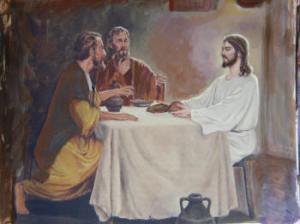
Jesus eats with the Emmaus disciplesSo he went in to stay with them. 30 When he was at table with them, he took the bread and blessed and broke it and gave it to them. 31 And their eyes were opened, and they recognized him. And he vanished from their sight. 32 They said to each other, “Did not our hearts burn within us while he talked to us on the road, while he opened to us the Scriptures?”

33And they rose that same hour and returned to Jerusalem. And they found the eleven and those who were with them gathered together, 34 saying, “The Lord has risen indeed, and has appeared to Simon!” 35 Then they told what had happened on the road, and how he was known to them in the breaking of the bread.

In the name of the Father, Son, and Holy Spirit. Amen.

Eating is a significant part of our lives. We have to eat to live. We connect eating with important events in our lives. We’re going to have a potluck after completing a year of Sunday School in a couple of weeks. Most weddings and funerals are followed by eating together with the other guests. Who ever heard of going to a graduation open house where there wasn’t food? Just try to think of a time when you had guests over to your house or you were someone else’s guest when food wasn’t at least offered.

The average person spends about six years of their life eating. Our son, Elijah, turns seven tomorrow. It is hard to imagine that if you broke up his life into activities, he would still be clearing his place from the six years of eating.

Eating is significant in Scripture too. Significant events in the Bible are centered around food and eating. Jacob bought Esau’s birthright in exchange for soup. After God changed Jacob’s name to Israel, he and his sons moved to Egypt because they needed food to eat. God’s act of delivering the nation of Israel out of Egypt was connected with the Passover meal. When the nation of Israel was in the wilderness, they were concerned about food, so God gave them manna and quail. When Jesus raised Jairus’ daughter from death, He commanded that she be given something to eat (Mk. 5:43). Jesus fed the multitudes. And almost every time Jesus appears after the resurrection you see people eating.

Scripture tells us about two meals that define our existence. The first meal that defines our existence is the devastatingly fatal meal in the Garden of Eden (Gen. 3ff).

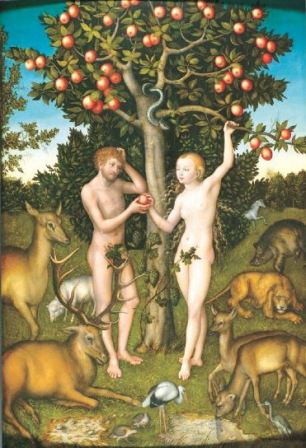
Adam and EveGod had instructed Adam, “Do not eat from the tree of the knowledge of good and evil, for in the day that you eat of it you shall surely die.” Satan came. He came disguised as a scaly, slithery serpent. He taught Adam and Eve a different lesson than God had taught them.

The devil said that they were blind to what that forbidden fruit would do for them. Satan promised, “You will not surely die. For God knows that when you eat of it your eyes will be opened, and you will be like God, knowing good and evil.” Eve ate, and so did Adam. Their eyes were opened for sure, but they saw that they were naked. Their eyes were open to evil and death. Then they saw God and tried to hide themselves from His sight because they saw too much. “The parents of the human race – and we in and with them were left – with a belly full of food, but a life empty of God” (Chad Bird).

Because they ate, God has hidden Himself from humanity. God’s existence and presence is visible everywhere we look in creation (Ro. 1:19-21), but we do not see God Himself. And even though we see God’s presence, we sinfully do everything we can to ignore Him. We do not fear and love Him. Because of our sin, which we have inherited and constantly commit, we cannot see God and live.

But look at what God does here for the disciples on the road to Emmaus – Jesus Himself walks with them. But Cleopas and the other disciple do not recognize Jesus. They were just like you, “Their eyes were kept from recognizing Him.” Their hopes for deliverance and redemption were dashed to pieces as the man who was mighty in deed and word before God and all the people was smashed on the cross and killed. Cleopas goes on lamenting, “Some of the women who are with us went to the tomb this morning, but they didn’t see Jesus’ body. They said they saw a vision of angels who said that Jesus is alive. But we haven’t seen Him.”

Cleopas said all this looking sad (v. 17). He is still mourning even though He is looking straight at the risen Savior. You have to love Jesus’ response, “O foolish ones, and slow of heart to believe all that the prophets have spoken! Was it not necessary that the Christ should suffer these things and enter into his glory?”

Then look at what Jesus does. He teaches them, but unlike Satan’s tricksy and false lesson about how to become like God, Jesus teaches the disciples a lesson about how God became like them. Jesus teaches them that His suffering was necessary for His own glory and for theirs too. Beginning with Moses and all the Prophets, He interpreted to them in all the Scriptures the things concerning Himself. What a Bible study that must have been. You would think that with His mastery of teaching the Scriptures, the disciples would have recognized Him, but they still don’t.

They reach the village they were going to, and beg Jesus to stay with them as a guest. But look at what happens – the Guest becomes the Host. As He was at the table with them, Jesus took bread, blessed it, broke it, and gave it to them. (Sound familiar?)

Just as Adam and Eve’s eyes were opened to their nakedness and their sin and their death after eating the forbidden fruit, the disciples’ eyes were opened to see Jesus – real Jesus in whom is Life. It was only after receiving that bread from the hand of Jesus that Cleopas and the other disciple recognize Him. They recognize Jesus, and what does He do? He does a disappearing act and vanishes! Why? Where did He go?

You know what? He didn’t go anywhere. He wasn’t visible, but He was still there. Before He died, Jesus had blessed bread, broke it, and gave it to His disciples saying, “This is My body.” Cleopas and the other disciple were still holding that bread. They still had Jesus physically present with them in the bread.

Communion Cross with JesusFaith is a gift of God, and you can’t get it until God gives it to you. God gives you faith through the teaching of the Scriptures and through His Supper. You see, Jesus wants us to connect His teaching with this Sacrament. He wants you to know Him as the suffering Savior with His body broken and His blood shed – for you.

He is here now teaching you His Word and revealing Himself to you in His Supper.

Do you want to want to know Jesus better? Learn from Him in His Word.

Do you want to see Jesus? Open your mouth. Take, eat the body of Christ given unto death for your sins. Take, drink the blood of Christ, shed for the forgiveness of your sins. Amen.

The peace of God, which surpasses all understanding, will guard your hearts and minds in Christ Jesus.  Amen.

Matthew 28:1-10 – The King Raised

Listen here.

Matthew 28:1–10

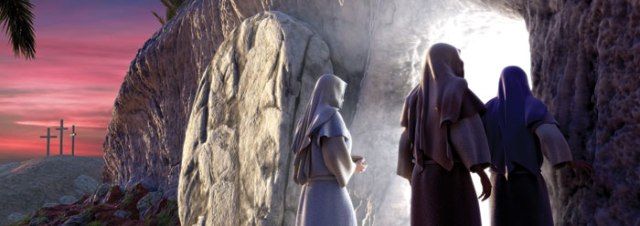
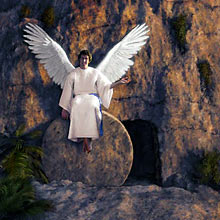
1Now after the Sabbath, toward the dawn of the first day of the week, Mary Magdalene and the other Mary went to see the tomb. 2 And behold, there was a great earthquake, for an angel of the Lord descended from heaven and came and rolled back the stone and sat on it. 3 His appearance was like lightning, and his clothing white as snow. 4 And for fear of him the guards trembled and became like dead men. 5 But the angel said to the women, “Do not be afraid, for I know that you seek Jesus who was crucified. 6 He is not here, for he has risen, as he said. Come, see the place where he lay. 7 Then go quickly and tell his disciples that he has risen from the dead, and behold, he is going before you to Galilee; there you will see him. See, I have told you.”

8So they departed quickly from the tomb with fear and great joy, and ran to tell his disciples. 9 And behold, Jesus met them and said, “Greetings!” And they came up and took hold of his feet and worshiped him. 10 Then Jesus said to them, “Do not be afraid; go and tell my brothers to go to Galilee, and there they will see me.”Empty Tomb 1

In the name of the Father, Son, and Holy Spirit.  Amen.

P:  He is risen!

C:  He is risen indeed.  Alleluia!

In the beginning, God created the heavens and the earth. God created light, the atmosphere, land, seas, and plants. God created the sun, moon, and stars. He created the birds of the air, the fish of the sea, and every animal that moves about on the face of the earth. Last of all on the sixth day, God created man. God formed Adam out of the dust of the ground.

God made Adam king of all creation. God told Adam to have dominion over everything that moves on the earth. God made a queen for Adam, his wife Eve. God placed Adam and Eve in paradise. God told Adam and Eve to have lots of children and fill the earth and subdue it. Adam and Eve began a glorious reign over creation.Adam and Eve

But Satan came. Satan came and the preacher from hell preached to Eve that she should not be content. The devil deceitfully said that Adam and Eve could rise above simply being king and queen of creation. The father of lies told them that, if they ate from the tree of the knowledge of good and evil, they could be like God. Adam didn’t step in and tell Satan to go away. Even though God had graciously warned Adam that the day he ate of that tree he would surely die, Queen Eve ate and gave the fruit to King Adam as well.

They believed the lie and ate the fruit. The legacy of Adam and Eve’s reign is death. Because the king of creation fell into death, all of creation is subject to death. Adam’s legacy is hospitals, funeral homes, tombs, and graves.

They believed the lie of Satan and disbelieved the truth of God’s word. Adam and Eve now lived in terror of the God they had sinned against. God drove Adam and Eve out of the Garden of Eden, and set angels with flaming swords to guard the way to the tree of life.

But before God did that, He made a promise to Adam and Eve. God promised to send a new King. God promised that the Seed of the woman would come and fight against Satan. In that battle Satan would bruise the heel of the King, but the King would conquer and crush the head of Satan.

That very battle took place on Good Friday. Jesus, the holy Son of God who knew no sin, willingly walked among us sinners. He willingly walked through this creation filled with Adam’s legacy of death and fear. Jesus, too, heard Satan preach to Him. However, Jesus knew that the devil’s sermons were full of lies.

Everywhere King Jesus went, He walked all over Satan’s false promises. Jesus stomped on the legacy of Adam. Instead of sickness and death, Jesus brought health and life.

Jesus strolled through this world full of graves and cemeteries taking all the sin and death upon Himself. Even though King Jesus was whipped and beaten, even though He was carrying the load of the sin of the world, Jesus willingly walked to the cross.

There devil hurled every accusation of sin at Jesus, and Christ has answered for all of it. Because of that, Satan has nothing left. The devil has no more strength.

Jesus hung on the tree, and Satan took a bite from that Fruit. Satan saw the fruit of the Son of God hanging on the tree and took a bite. Satan thought he got what he wanted. King Jesus was crucified, dead, and buried. Satan had bruised Christ’s heel.

But in taking that bite, Satan’s head was crushed.

Angel Sitting on the Stone of Christ's Tomb Matthew 28King Jesus has risen, just as He said. Jesus has taken you back. You belong to Him. Jesus has once again opened the way to paradise. There are no more angels with flaming swords guarding the way to life. The angels now simply sit on the futile stone which had guarded a grave that now stands empty. The angel sits there laughing at death and the devil.

Just as the grave cannot hold Jesus, it will not hold you who have died with Jesus in your baptism.

The King is risen, and you are risen with Him. Amen.[1]

The peace of God, which surpasses all understanding, will guard your hearts and minds in Christ Jesus.  Amen.


[1] I am thankful for Rev. David Petersen’s and Rev. Ralph Tausz’s homilies on this text as inspiration for this sermon.

John 12:12-43 – A Strange King Indeed

Listen here.

John 12:12–43

12 The next day the large crowd that had come to the feast heard that Jesus was coming to Jerusalem. 13 So they took branches of palm trees and went out to meet him, crying out, “Hosanna! Blessed is he who comes in the name of the Lord, even the King of Israel!” 14 And Jesus found a young donkey and sat on it, just as it is written,

15 “Fear not, daughter of Zion;

behold, your king is coming,

sitting on a donkey’s colt!”

16 His disciples did not understand these things at first, but when Jesus was glorified, then they remembered that these things had been written about him and had been done to him. 17 The crowd that had been with him when he called Lazarus out of the tomb and raised him from the dead continued to bear witness. 18 The reason why the crowd went to meet him was that they heard he had done this sign. 19 So the Pharisees said to one another, “You see that you are gaining nothing. Look, the world has gone after him.”

20 Now among those who went up to worship at the feast were some Greeks. 21 So these came to Philip, who was from Bethsaida in Galilee, and asked him, “Sir, we wish to see Jesus.” 22 Philip went and told Andrew; Andrew and Philip went and told Jesus. 23 And Jesus answered them, “The hour has come for the Son of Man to be glorified. 24 Truly, truly, I say to you, unless a grain of wheat falls into the earth and dies, it remains alone; but if it dies, it bears much fruit. 25 Whoever loves his life loses it, and whoever hates his life in this world will keep it for eternal life. 26 If anyone serves me, he must follow me; and where I am, there will my servant be also. If anyone serves me, the Father will honor him.

27 “Now is my soul troubled. And what shall I say? ‘Father, save me from this hour’? But for this purpose I have come to this hour. 28 Father, glorify your name.” Then a voice came from heaven: “I have glorified it, and I will glorify it again.” 29 The crowd that stood there and heard it said that it had thundered. Others said, “An angel has spoken to him.” 30 Jesus answered, “This voice has come for your sake, not mine. 31 Now is the judgment of this world; now will the ruler of this world be cast out. 32 And I, when I am lifted up from the earth, will draw all people to myself.” 33 He said this to show by what kind of death he was going to die. 34 So the crowd answered him, “We have heard from the Law that the Christ remains forever. How can you say that the Son of Man must be lifted up? Who is this Son of Man?” 35 So Jesus said to them, “The light is among you for a little while longer. Walk while you have the light, lest darkness overtake you. The one who walks in the darkness does not know where he is going. 36 While you have the light, believe in the light, that you may become sons of light.”

When Jesus had said these things, he departed and hid himself from them. 37 Though he had done so many signs before them, they still did not believe in him, 38 so that the word spoken by the prophet Isaiah might be fulfilled:

“Lord, who has believed what he heard from us,

and to whom has the arm of the Lord been revealed?”

39 Therefore they could not believe. For again Isaiah said,

40 “He has blinded their eyes

and hardened their heart,

lest they see with their eyes,

and understand with their heart, and turn,

and I would heal them.”

41 Isaiah said these things because he saw his glory and spoke of him. 42 Nevertheless, many even of the authorities believed in him, but for fear of the Pharisees they did not confess it, so that they would not be put out of the synagogue; 43 for they loved the glory that comes from man more than the glory that comes from God.

In the name of Jesus. Amen.

What would you do if a king were coming to your house? If you’re like me, you’d sin and wish you had a bigger, better house. But you’d quickly realize you can’t afford one and would do everything you could to clean up your place as much and as fast as possible. You would want to present your home in the most hospitable way possible.

What would you do if a thief were coming to your house? You’d probably do everything you could to barricade every possible point of entry. You’d probably make sure that you got all of your valuables in a safe place. And you’d probably situate yourself in front of all your prized possessions so that you could protect them.

Well, there are two ways of looking at Jesus’ triumphal entry into Jerusalem – one is right and one is wrong. You can look at Jesus’ entry the way the people do – as a king, or you can look at it the way Jesus does – as a strange, thieving King. (You can probably guess who is right.)

Jesus' Triumphal Entry Palm SundayThe people in Jerusalem that Palm Sunday looked at Jesus’ entry as the coming of their King. They did everything they could to spiff the place up for the King who was riding in on a donkey. They cut the palm branches and laid them and their cloaks on the road in homage to this King. They shouted royal praise to Jesus who was coming “in the name of the Lord, even the King of Israel.”

The crowd did all of this because they had heard that Jesus had raised Lazarus from the dead. A King who can overcome the power of death sounds like a good kind of King to have. If your King could undo death, well then, life will be good.

The people welcoming Him thought Jesus would establish an earthly reign and overthrow their enemies. They thought He would set up a kingdom that would last forever and ever. They thought He would bring a kingdom full of glory. They had visions of “a chicken in every pot and a car in every garage.” Maybe to update that, they had visions of tenderloin on every high-end stainless steel grill and Beamers in every slot of their four-stall garage.

But that is not how Jesus looks at His coming to Jerusalem. Jesus has come to be King, but He has come to be a strange King. He has come to be anointed not with oil, but with His own blood. He has come to be crowned not with gold and jewels, but with thorns. He has come to be enthroned not on a throne of glory, but the throne of a splintered cross. Jesus has come to be a thieving King who steals their sins in His death on the cross.

Jesus hadn’t kept this a secret either. He had repeatedly said that He was going to Jerusalem to be handed over, suffer, and die. Jesus knew that He was coming to His coronation as the suffering, crucified, sin-stealing King.

Even as Phillip and Andrew tell Jesus there are some Greeks who wish to see Him, Jesus says, “The hour has come for the Son of Man to be glorified. The hour has come for the grain of wheat to die and fall to the earth. The hour has come for the Son of Man to be lifted up from the earth.” Jesus says these things, and His soul is troubled.

Jesus’ soul is so troubled at the type of King He has come to be that He asks, “What shall I say, ‘Father, save me from this hour, this kingship’?”

“No,” Jesus says, “for this purpose I have come.”

Jesus will not deny His coronation as the strange King who is the Lamb of God who takes away the sin of the world.

Jesus is the King who bore your sins in His body on the tree (1 Pet. 2:24). Jesus, the King of sorrows, came in order to bear your grief and carry your sorrows; He was a King who came to be pierced for your transgressions and crushed for your iniquities (Is. 52:13-53:12). The Son of God came to humble Himself, to die a sinner’s death, and to suffer the wrath of God. This strange King came to wrap Himself in your sin. The sinless One came to become sin (2 Cor. 5 21). God laid on Christ the iniquity of us all.

Blessings from the CrossOn the cross is Christ’s glory; on the cross, Christ is lifted up. On the cross, your strange King won your freedom from sin and death that separates you from God. On the cross, Jesus pulled off the greatest caper of all time by stealing the sin of the whole world. Because of the cross, your sin is no longer yours. Through this strange King’s death, there is forgiveness, life, and salvation.

Dear friends, this Holy Week let us follow this strange King to His death so that through His death we may be with Him and live eternally in His blessed kingdom (Jn. 12:25-26). Amen.

The peace of God, which surpasses all understanding, will guard your hearts and minds in Christ Jesus. Amen.

John 11:17-27, 38-53

Listen here.

John 11:17-27, 38-53—Now when Jesus came, he found that Lazarus had already been in the tomb four days. 18 Bethany was near Jerusalem, about two miles off, 19 and many of the Jews had come to Martha and Mary to console them concerning their brother. 20 So when Martha heard that Jesus was coming, she went and met him, but Mary remained seated in the house. 21 Martha said to Jesus, “Lord, if you had been here, my brother would not have died. 22 But even now I know that whatever you ask from God, God will give you.” 23 Jesus said to her, “Your brother will rise again.” 24 Martha said to him, “I know that he will rise again in the resurrection on the last day.” 25 Jesus said to her, “I am the resurrection and the life. Whoever believes in me, though he die, yet shall he live, 26 and everyone who lives and believes in me shall never die. Do you believe this?” 27 She said to him, “Yes, Lord; I believe that you are the Christ, the Son of God, who is coming into the world.”


38
Then Jesus, deeply moved again, came to the tomb. It was a cave, and a stone lay against it. 39 Jesus said, “Take away the stone.” Martha, the sister of the dead man, said to him, “LorJesus Raises Lazarusd, by this time there will be an odor, for he has been dead four days.” 40 Jesus said to her, “Did I not tell you that if you believed you would see the glory of God?” 41 So they took away the stone. And Jesus lifted up his eyes and said, “Father, I thank you that you have heard me. 42 I knew that you always hear me, but I said this on account of the people standing around, that they may believe that you sent me.” 43 When he had said these things, he cried out with a loud voice, “Lazarus, come out.” 44 The man who had died came out, his hands and feet bound with linen strips, and his face wrapped with a cloth. Jesus said to them, “Unbind him, and let him go.”

45Many of the Jews therefore, who had come with Mary and had seen what he did, believed in him, 46 but some of them went to the Pharisees and told them what Jesus had done.

47So the chief priests and the Pharisees gathered the council and said, “What are we to do? For this man performs many signs. 48 If we let him go on like this, everyone will believe in him, and the Romans will come and take away both our place and our nation.” 49 But one of them, Caiaphas, who was high priest that year, said to them, “You know nothing at all. 50 Nor do you understand that it is better for you that one man should die for the people, not that the whole nation should perish.” 51 He did not say this of his own accord, but being high priest that year he prophesied that Jesus would die for the nation, 52 and not for the nation only, but also to gather into one the children of God who are scattered abroad. 53 So from that day on they made plans to put him to death.

In the name of Jesus. Amen.

How hard was it to confess that you believe in the resurrection of the dead?

Some of you have buried friends. Some of you have buried grandparents, and some parents. Some of you have buried brothers and sisters. Some of you have buried spouses. Some of you have buried children. Maybe in those moments, believing in the resurrection of the dead was more difficult.

Just a few blocks from here is a place called Resurrection Cemetery. When you drive by, all you see is a bunch of headstones sticking out of the ground. It looks like a trophy case for death. How many times have you been in a cemetery and watched a coffin containing the corpse of someone you knew and loved being lowered into the ground? How often has death deceived you into believing that he has the last word?

That is where Martha and Mary were. They had called for their friend Jesus to come because their brother, Lazarus, was sick. But Jesus didn’t come right away. He waited, and He came too late. Lazarus had been in the tomb four days.

Martha and Mary didn’t know that Jesus purposely waited for Lazarus to die. They didn’t know that Jesus allowed death take their brother and to pay a personal visit to them.

Three times in this chapter – first Martha, then Mary, then the whole crowd – says, “If only Jesus had come sooner, Lazarus would not have died.” Martha still holds on to a little hope, “Even now I know that whatever You ask from God, God will give You.”

Jesus tells her, “Your brother will rise again.” She responds, “I know that he will rise again on the resurrection on the last day.”

IMG_0492Martha is right, but she isn’t right enough. All the dead will rise on the last day. But Jesus wants to take Martha to a fuller, better understanding of the Resurrection. Standing there before Martha is the Resurrection. The Resurrection isn’t some future event that will come “a week from some Tuesday” (Capon). The Resurrection is flesh and blood Jesus.

Jesus says, “I am the resurrection and the life. Whoever believes in me, though he die, yet shall he live, and everyone who lives and believes in Me shall never die.”

Sadly, we are no different than Martha. Our faith is too often incomplete like Martha’s. We separate Jesus from the gifts that He gives. We wrongly think that Jesus gives salvation, forgiveness, and life on some day that is still in the distant future. But we are wrong.

Jesus gives Himself, now. Jesus is salvation, forgiveness, and life. Jesus is the Resurrection and the Life then, now, and always. In the pages of the New Testament, Jesus never meets a corpse that He doesn’t raise up right on the spot; Jesus simply has that effect on the dead (Capon).

Jesus doesn’t make you wait for “some day.” Do you see what Jesus says there in v. 26? “Everyone who lives and believes in Me shall never die.” In the strongest language possible, Jesus removes even the possibility and potentiality of death for you who believe in Him.

The Resurrection isn’t something you have to wait for in the future. The Resurrection is the person of Jesus. But because of our sin we are short-sighted, and we miss the present reality of Jesus and what He gives.

Jesus is the Resurrection because He has died and risen again. He is here because you are here gathered around His Word. He here standing victorious on the neck of death, your enemy.

“Since you have been raised with Christ, set your hearts on things above, where Christ is, seated at the right hand of God” (Col. 3:1 NIV). He is here giving you salvation, forgiveness, and life. He is here giving Himself to you in bread and wine. Here is salvation. Here is forgiveness. Here is Life.

You who are dead, come and receive so that you may never die. Amen.[1]

The peace of God, which surpasses all understanding, will guard your hearts and minds in Christ Jesus. Amen.


[1] I am indebted to a blog post by Chad Bird “Clothing for the Naked Eye: Seeing Things as They Really Are” as inspiration for this sermon (http://birdchadlouis.wordpress.com/2014/01/21/clothing-for-the-naked-eye-seeing-things-as-they-really-are/).

John 9:1-41 – Look, You Blind!

Listen here.

John 9:1-41—As he [Jesus] passed by, he saw a man blind from birth. 2 And his disciples asked him, “Rabbi, who sinned, this man or his parents, that he was born blind?” 3 Jesus answered, “It was not that this man sinned, or his parents, but that the works of God might be displayed in him. 4 We must work the works of him who sent me while it is day; night is coming, when no one can work. 5 As long as I am in the world, I am the light of the world.” 6 Having said these things, he spit on the ground and made mud with the saliva. Then he anointed the man’s eyes with the mud 7 and said to him, “Go, wash in the pool of Siloam” (which means Sent). So he went and washed and came back seeing.

8The neighbors and those who had seen him before as a beggar were saying, “Is this not the man who used to sit and beg?” 9 Some said, “It is he.” Others said, “No, but he is like him.” He kept saying, “I am the man.” 10 So they said to him, “Then how were your eyes opened?” 11 He answered, “The man called Jesus made mud and anointed my eyes and said to me, ‘Go to Siloam and wash.’ So I went and washed and received my sight.” 12 They said to him, “Where is he?” He said, “I do not know.”

13They brought to the Pharisees the man who had formerly been blind. 14 Now it was a Sabbath day when Jesus made the mud and opened his eyes. 15 So the Pharisees again asked him how he had received his sight. And he said to them, “He put mud on my eyes, and I washed, and I see.” 16 Some of the Pharisees said, “This man is not from God, for he does not keep the Sabbath.” But others said, “How can a man who is a sinner do such signs?” And there was a division among them. 17 So they said again to the blind man, “What do you say about him, since he has opened your eyes?” He said, “He is a prophet.”

18The Jews did not believe that he had been blind and had received his sight, until they called the parents of the man who had received his sight 19 and asked them, “Is this your son, who you say was born blind? How then does he now see?” 20 His parents answered, “We know that this is our son and that he was born blind. 21 But how he now sees we do not know, nor do we know who opened his eyes. Ask him; he is of age. He will speak for himself.” 22 (His parents said these things because they feared the Jews, for the Jews had already agreed that if anyone should confess Jesus to be Christ, he was to be put out of the synagogue.) 23 Therefore his parents said, “He is of age; ask him.”

24So for the second time they called the man who had been blind and said to him, “Give glory to God. We know that this man is a sinner.” 25 He answered, “Whether he is a sinner I do not know. One thing I do know, that though I was blind, now I see.” 26 They said to him, “What did he do to you? How did he open your eyes?” 27 He answered them, “I have told you already, and you would not listen. Why do you want to hear it again? Do you also want to become his disciples?” 28 And they reviled him, saying, “You are his disciple, but we are disciples of Moses. 29 We know that God has spoken to Moses, but as for this man, we do not know where he comes from.” 30 The man answered, “Why, this is an amazing thing! You do not know where he comes from, and yet he opened my eyes. 31 We know that God does not listen to sinners, but if anyone is a worshiper of God and does his will, God listens to him. 32 Never since the world began has it been heard that anyone opened the eyes of a man born blind. 33 If this man were not from God, he could do nothing.” 34 They answered him, “You were born in utter sin, and would you teach us?” And they cast him out.

35Jesus heard that they had cast him out, and having found him he said, “Do you believe in the Son of Man?” 36 He answered, “And who is he, sir, that I may believe in him?” 37 Jesus said to him, “You have seen him, and it is he who is speaking to you.” 38 He said, “Lord, I believe,” and he worshiped him.

39Jesus said, “For judgment I came into this world, that those who do not see may see, and those who see may become blind.” 40 Some of the Pharisees near him heard these things, and said to him, “Are we also blind?” 41 Jesus said to them, “If you were blind, you would have no guilt; but now that you say, ‘We see,’ your guilt remains.”

In the name of Jesus. Amen.

The Pharisees sure claim to “know” a lot of things. Most importantly, they know that Jesus can’t be from God since He breaks the Sabbath. They know that Jesus is a sinner, a nobody.

The formerly blind man doesn’t know very much. He doesn’t know where Jesus is. He doesn’t know exactly how Jesus opened his eyes. He doesn’t know whether or not Jesus is a sinner. The only thing he knows is that he was blind, but now he sees.

The formerly blind man knows that Jesus has done something great for him. Something that had never been done before. “Never since the world began (from eternity/the aeons) has it been heard that anyone opened the eyes of a man born blind” (v. 32).

He is right. Nowhere in the Old Testament does any blind person have their sight restored. None of God’s prophets had ever done this before. Think of Moses, Joshua, Elijah, Elisha. They did some amazing things – parting seas, causing the sun to stand still, cleansing lepers, even raising the dead – but none of them opened the eyes of the blind.

EyeIsaiah prophesized that the Messiah would open blind eyes (Is. 29:18, 35:5, 42:7, 18). The Pharisees knew these passages. But now, standing before them plain to see, is a man who had been blind from birth, but now, his eyes are opened.

But what do the Pharisees do? They blind themselves to what that means. Because of the hardness of their hearts they refuse to see what is going on. Their knowledge blinds them so that they cannot see who Jesus is. Even though they see, they chose to be blind.

As the Pharisees press the formerly blind man with their knowledge. They try to get him to accuse Jesus of being a sinner. But the blind man will not say that Jesus is a sinner. He says, “We know that God does not listen to sinners. And if this [Jesus] were not from God, He could do nothing” (v. 31, 33).

The Pharisees then accuse the formerly blind man of having been born in sin and throw him out of the synagogue. But in rejecting the formerly blind man, they reject Jesus, the only one who can cure their blindness.

But if you reject the only one who can help you, what hope is left for you?

Fellow sinners, we are not the man born blind; we are the Pharisees. God’s miracles constantly surround us, but we blind ourselves to them.

Husbands and wives, God has given you the perfect help mate. God has blessed you with a companion. But you blind yourself to that. You only see your spouse’s shortcomings.

Parents, God has given you the miracle of children. God has given you the responsibility to care for and raise His creation. But you blind yourself to that. You only see parasites.

Children, God has given you parents to care for you, provide for you, and protect you. God has given you a loving home. But you blind yourself to that. You only see tyrants.

God gives you all wonderful vocations so that you can serve and love your neighbor. But you blind yourself to that. You see drudgery.

Look, you blind!

Look at all the blessings God gives. Everything you see is from God your Father who always gives what is best. Everything you have is gift. Everything is grace. Yet, what do you do? You whine. You complain. You sin.

Body of Christ CommunionBut that is precisely why Christ came and died. Jesus came to have mercy on sinners – even blind Pharisees like you. He has room at His table – especially for you blind sinners. Amen.

The peace of God, which surpasses all understanding, will guard your hearts and minds in Christ Jesus. Amen.

John 4:5-26 – Well, Well, Well

Listen here.

John 4:5–26 5 So he came to a town of Samaria called Sychar, near the field that Jacob had given to his son Joseph. 6 Jacob’s well was there; so Jesus, wearied as he was from his journey, was sitting beside the well. It was about the sixth hour.

7 A woman from Samaria came to draw water. Jesus said to her, “Give me a drink.” 8 (For his disciples had gone away into the city to buy food.) 9 The Samaritan woman said to him, “How is it that you, a Jew, ask for a drink from me, a woman of Samaria?” (For Jews have no dealings with Samaritans.) 10 Jesus answered her, “If you knew the gift of God, and who it is that is saying to you, ‘Give me a drink,’ you would have asked him, and he would have given you living water.” 11 The woman said to him, “Sir, you have nothing to draw water with, and the well is deep. Where do you get that living water? 12 Are you greater than our father Jacob? He gave us the well and drank from it himself, as did his sons and his livestock.” 13 Jesus said to her, “Everyone who drinks of this water will be thirsty again, 14 but whoever drinks of the water that I will give him will never be thirsty again. The water that I will give him will become in him a spring of water welling up to eternal life.” 15 The woman said to him, “Sir, give me this water, so that I will not be thirsty or have to come here to draw water.”

16 Jesus said to her, “Go, call your husband, and come here.” 17 The woman answered him, “I have no husband.” Jesus said to her, “You are right in saying, ‘I have no husband’; 18 for you have had five husbands, and the one you now have is not your husband. What you have said is true.” 19 The woman said to him, “Sir, I perceive that you are a prophet. 20 Our fathers worshiped on this mountain, but you say that in Jerusalem is the place where people ought to worship.” 21 Jesus said to her, “Woman, believe me, the hour is coming when neither on this mountain nor in Jerusalem will you worship the Father. 22 You worship what you do not know; we worship what we know, for salvation is from the Jews. 23 But the hour is coming, and is now here, when the true worshipers will worship the Father in spirit and truth, for the Father is seeking such people to worship him. 24 God is spirit, and those who worship him must worship in spirit and truth.” 25 The woman said to him, “I know that Messiah is coming (he who is called Christ). When he comes, he will tell us all things.” 26 Jesus said to her, “I who speak to you am he.”

In the name of Jesus. Amen.

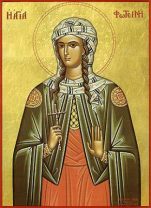
ImageI want to begin today with a side note: Church tradition has some interesting information about this Samaritan woman. Her name is Photini which means “enlightened one.” Just after our text, Photini goes back to her village and invites everyone to come and meet Jesus who she says, “He told me all that I ever did.” The Samaritans meet Jesus and He stays there for two days. The many from the town believe in Jesus as the Savior of the world because Jesus’ words.

Church tradition then says that Photini traveled to Carthage where she continued to tell people about Jesus Christ. Apparently, she even spoke to the Roman emperor Nero’s daughter about Jesus, and Nero’s daughter became a Christian. However, Photini died as a martyr by Nero’s hand in AD 66.

Let’s look at the text:

Last week, we saw Nicodemus, a ruler of the Pharisees, coming to Jesus in the darkness of night. Nicodemus was respectable man; he would be the equivalent of a Supreme Court justice in our time. But Nicodemus comes to Jesus secretly.

Contrast that with this Samaritan woman. First of all, Samaritans integrated the worship of other false, pagan gods with worship of Yahweh (2 Kgs. 17:29-32). Secondly, she was a woman. Rabbis in Jesus’ day taught that men were not to talk to women in public – even their own wives. Third, this particular woman was also an outcast; she comes to the well well [sic] after all the other women would have been there in the cool morning to draw water. She was likely tired of everyone talking about her personal life with her five failed marriages and her current live-in boyfriend.

She comes to the well around noon, in the heat of the day to draw her water. She comes around the bend and finds Jesus sitting there on the well alone, dusty, and tired from His walking. “Give Me a drink,” Jesus says.

Jesus and the Samaritan WomanThe woman is surprised that Jesus, a Jewish man, would even speak to her. The Samaritans and the Jews didn’t get along. They are your typical Hatfield and McCoy feud. The Samaritans’ temple on Mt. Gerizim (the mountain that the woman refers to later) was destroyed by the Jews in 128 BC. The Samaritans retaliated a few years before Jesus was born by attacking Jerusalem and filling the temple area with the corpses of the dead. The only dealings Jews and Samaritans had were bitter and morbid.

Yet, Jesus says to the Samaritan woman, “Give Me a drink.” But Jesus is more interested in giving this woman the living water she needs than receiving the drink that His tired body needs. Jesus uses His own need to get this woman to realize her need to receive from Him. “If you knew the gift of God, and who it is that is saying to you, ‘Give Me a drink,’ you would have asked Him, and He would have given you living water.”

If she knew the gift of God, she wouldn’t be looking for fulfillment in man after man after man. If she knew the gift of God, she wouldn’t care that her neighbors had cast her out socially and that she was a complete loser in their eyes. If she knew the gift of God, nothing in this whole world would matter, except having Jesus, who gives everything.

John means for us to see this scene as a courtship scene. Now, Jesus isn’t seeking to marry this woman as we think of marriage. He wants this woman to become part of the Church which is His bride. Our marriages aren’t pictures of Christ’s relationship to us, instead the reverse is true. Jesus’ perfect, holy, faithful, grace-filled marriage to the Church is a picture of what our marriages should look like.

Sitting there on Jacob’s well is Jesus – the One greater than Jacob. Jacob had first met his beautiful bride to be, Rachel, at a well (Gen. 29:1ff; also see Gen. 24ff and Ex. 2:15-22). When Jacob saw Rachel, he wept because of her beauty. Jesus sees this woman with all of her sins and flaws, and wants her to believe in Him as the Messiah.

Jacob ended up having to work for fourteen years to marry Rachel. But Jesus, the One greater than Jacob, worked even harder enduring God’s wrath for this Samaritan woman’s sin – and all of mankind’s sin, even yours – to gain for Himself a bride, His Church.

You see, you have been more adulterous than this woman. In fact, you have whored yourself out to all sorts of sins thinking that in them you will find happiness. You are a slut seeking a husband in all the wrong places.

But there is Jesus who is always seeking to be your Husband. He is always true and faithful to you no matter how many other suitors you seek. Jesus has pledged His undying love and faithfulness to you. He invites you to drink from the well of living water which He has dug with His own hands. Though you are a sinner, in the eyes of Jesus you are the bride He desires most. He invites you to “dine at His table and drink from His cup. [In His eyes], you are the fairest of them all, for His kisses of grace have healed your scars, brightened your eyes, and transformed you from a beast to a beauty” (Chad Bird). Amen.[1]

The peace of God, which surpasses all understanding, will guard your hearts and minds in Christ Jesus. Amen.



[1] I am thankful to both a blog post by Chad Bird “Mirror, Mirror on the Wall: Jesus and the ‘Bad’ Samaritan Woman” http://birdchadlouis.wordpress.com/2014/03/18/mirror-mirror-on-the-wall-jesus-and-the-bad-samaritan-woman/ and an article by Dr. Peter J. Scaer “Jesus and the Woman at the Well: Where Mission Meets Worship” Concordia Theological Quarterly Vol. 67:1 January 2003 as inspiration for this sermon.