Ezekiel 37:1-14 – O Spirit, Breathe on These Slain, That They May Live

Listen here.

Ezekiel 37:1-14

1 The hand of the Lord was upon me, and he brought me out in the Spirit of the Lord and set me down in the middle of the valley; it was full of bones. 2 And he led me around among them, and behold, there were very many on the surface of the valley, and behold, they were very dry. Valley of Dry Bones Skeleton Ezekiel3 And he said to me, “Son of man, can these bones live?” And I answered, “O Lord God, you know.” 4 Then he said to me, “Prophesy over these bones, and say to them, O dry bones, hear the  word of the Lord. 5 Thus says the Lord God to these bones: Behold, I will cause breath to enter you, and you shall live. 6 And I will lay sinews upon you, and will cause flesh to come upon you, and cover you with skin, and put breath in you, and you shall live, and you shall know that I am the Lord.”

7 So I prophesied as I was commanded. And as I prophesied, there was a sound, and behold, a rattling, and the bones came together, bone to its bone. 8 And I looked, and behold, there were sinews on them, and flesh had come upon them, and skin had covered them. But there was no breath in them. 9 Then he said to me, “Prophesy to the breath; prophesy, son of man, and say to the breath, Thus says the Lord God: Come from the four winds, O breath, and breathe on these slain, that they may live.” 10 So I prophesied as he commanded me, and the breath came into them, and they lived and stood on their feet, an exceedingly great army.

11 Then he said to me, “Son of man, these bones are the whole house of Israel. Behold, they say, ‘Our bones are dried up, and our hope is lost; we are indeed cut off.’ 12 Therefore prophesy, and say to them, Thus says the Lord God: Behold, I will open your graves and raise you from your graves, O my people. And I will bring you into the land of Israel. 13 And you shall know that I am the Lord, when I open your graves, and raise you from your graves, O my people. 14 And I will put my Spirit within you, and you shall live, and I will place you in your own land. Then you shall know that I am the Lord; I have spoken, and I will do it, declares the Lord.”

In the name of Jesus. Amen.

Femurs, tibias, and fibulas. Humeri, radiuses, and ulnas. Carpals, metacarpals, tarsals, metatarsals, and phalanges. Pelvises, ribs, sternums, and skulls. The valley was full of them – many of them. And they were dry – very dry. Frozen in death, the bones cried out, “Our bones are dried up and our hope is lost. We are indeed cut off.” Dead. Dry. No resources, no motivation, no plan, no hope. Only despair.

Surrounded by the dead, dry, and dusty skeletons, Ezekiel must have asked God, “Why have You brought me to this defiled valley? Where did all these dry bones come from? What happened here and why?” But one question rose above his own. In the presence of all that decay and deadness, the most haunting question comes from God Himself, “Son of man, can these bones live?”

Miracle MaxIf you have seen the movie, The Princess Bride, you will remember Miracle Max talking about different categories of deadness. Miracle Max was able to revive “mostly dead” Wesley, but he said there is only one thing you can do when someone is all dead – go through their pockets for loose change.

God asks, “Son of man, can these bones live?” Well, God had raised the widow’s son through the prophet Elijah. But he was “recently dead.” These bones before Ezekiel were really dead, hopelessly dead. “Son of man, can these bones live? Is there still hope for even these bones?”

“O, Yahweh God, You know.”

“Preach over the bones. Tell those bones to hear the word of Yahweh.”

Preach to bones? This would not be a sermon to a sleeping congregation. This worse than Isaiah’s call to preach to people who had ears but could not hear. This goes beyond any of that. Preach to a bunch of empty, hollow skulls. What if they don’t listen? This congregation is hopeless.

“Preach over the bones. Tell them, ‘Thus says the Lord God to these bones: I will join your bones with sinews and ligaments. I will put muscle over your bones. I will fill your torso with organs. I will cause blood to flow through your veins. I will cover you with flesh and skin. I will cause breath to enter you, and you shall live. And you shall know that I am the Lord.”

Ezekiel preaches. As that sermon echoed through that dead, dry valley, the Word of God came to those dry bones. The bones were changed through that Word. A loud sound, a rattling fills the valley. Before Ezekiel is a bunch of perfectly formed yet lifeless bodies. “Well God, it kinda worked.”

Yahweh says, “I’m not done, keep preaching. Prophesy to the breath (A quick side note, ‘spirit,’ ‘wind’ and ‘breath’ are all the same Hebrew word in this text); prophesy, son of man, and say to the breath, Thus says the Lord God: Come from the four winds, O breath, and breathe on these slain, that they may live.” Ezekiel preaches as God tells him, and the breath, the spirit, came into them. They lived and stood on their feet, an exceedingly great army.

Life comes to the valley of bones. Out of despair and hopelessness comes a fighting force. Strange event. Strange sermon. Strange congregation. But as odd and peculiar as this passage from Ezekiel is, it is  not unique. In fact, you essentially heard the same story twice today.

In our text from Acts [2:1-21], the day of Pentecost arrived. People from every tribe, language, and nation were visiting Jerusalem. They came together when they heard the sound of the coming of the Holy Spirit. Peter PreachingThey all stood there as people who were alive with bones, sinews, organs, muscles, skin, and flesh. But there was no Spirit within them. But as the apostles spoke in other languages, the living dead heard the mighty acts of God in their native tongues. And the Holy Spirit gave Peter a sermon to preach. He preached to those people who lived but were dead. Each of them heard in their own language of the death and resurrection of Christ. The end result that day was that more than 3,000 souls were added to the number of God’s army.
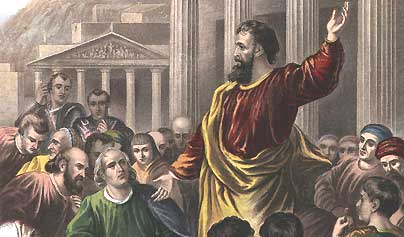
But God still isn’t done. There are still more dead to raise. There are more soldiers to be added to God’s army. God still has more sermons to preach to the dead so they can be raised to life.

You and I are dead in our trespasses and sins. We have dead hands that have clicked on images and videos that fill our skulls with death. Those dead hands have neglected to help our neighbors when possible.  We have dead jawbones that have been used to speak gossip and lies about others. We have dead feet that have brought us to places we should not have gone. We have dead hearts that coldly withhold love and forgiveness.

Yet, here is God once again. He has sent a preacher with nothing but a sermon. Let me tell you something, this preacher often wonders if a sermon is able to bring life out of death. A preacher who, when asked if these bones can live, has no answer but, “O Lord God, You know.”

Yet, as the Word of God is proclaimed here in this valley of death, the Spirit of God is at work to create. The Word of God is always creative. The Word carries with it the power to call into existence that which does not exist.

The ResurrectionSo hear again, you bones, the Word of God. Your Savior has atoned for your sin. Christ Jesus has passed from death to life. Through God’s Word, He breathes on you today. His breath is His life-giving Spirit. By your own reason and strength, you cannot believe in Jesus Christ, your Lord. But the Holy Spirit is here now calling you through the Gospel, enlightening you with His gifts, and sanctifying and preserving you in the one true faith. He daily forgives abundantly all your sins. And at the last day, He will raise up you and all the dead and will grant everlasting life to you and to all who believe in Christ. This is most certainly true. Amen.

The peace of God, which surpasses all understanding, will guard your hearts and minds in Christ Jesus. Amen.

John 17:11-19 – Holy Aliens, Batman!

Listen here.

John 17:11-19

Jesus is the Vine11 “And I am no longer in the world, but they are in the world, and I am coming to you. Holy Father, keep them in your name, which you have given me, that they may be one, even as we are one. 12 While I was with them, I kept them in your name, which you have given me. I have guarded them, and not one of them has been lost except the son of destruction, that the Scripture might be fulfilled. 13 But now I am coming to you, and these things I speak in the world, that they may have my joy fulfilled in themselves. 14 I have given them your word, and the world has hated them because they are not of the world, just as I am not of the world. 15 I do not ask that you take them out of the world, but that you keep them from the evil one. 16 They are not of the world, just as I am not of the world. 17 Sanctify them in the truth; your word is truth. 18 As you sent me into the world, so I have sent them into the world. 19 And for their sake I consecrate myself, that they also may be sanctified in truth.”

In the name of Jesus. Amen.

Christ is risen!
He is risen indeed! Alleluia!

Make a list of the most important days in the Church. Make a ListYou probably start with Christmas Good Friday, and Easter, of course. Maundy Thursday might come next. Throw Pentecost in there too. But then what? Tap your pencil on your notepad a few of times, and scratch your head. Think through the Apostle’s Creed. You confess that Jesus was “born of the Virgin Mary, suffered under Pontius Pilate, was crucified, dead, and buried. On the third day, He rose again from the dead.” Well, you’ve hit all those, and Pentecost comes up when you get to the Third Article, “I believe in the Holy Spirit.” But notice that your list has skipped over the Ascension. “[Jesus] ascended into heaven and sits at the right hand of God the Father Almighty.”

The Ascension is easy to miss as an important day in the Church year because it occurs f Jorty days after Easter and always falls on a Thursday. I will admit that the celebration of the Ascension wasn’t on my radar until the last few of years, but that was my loss. I hope, after today, the last scene of Jesus’ ministry recorded in the Scriptures will rise in importance for you because the Ascension is an amazing but fitting end to Jesus first visit to earth.

The New Testament shows us an odd Savior – an other-worldly Savior. If Jesus were a lifeguard, the story would go something like this: A lifeguard, sitting up in his stand sees a body floating lifeless in the surf. He jumps off his stand and quickly swims out to the victim. But instead of rescuing the person and swimming back to the shore, he drowns. Three days later, the lifeguard rises from the dead and proclaims that everything – including the now-buried, drowned victim – is hunky-dory. Forty days later, the lifeguard disappears.[1] If you don’t like that, I’m sorry. It doesn’t make sense to me either. But it is the Jesus we have been given.

All of Jesus’ ministry makes no worldly sense at all. The Savior of the world is born to a peasant, teenage virgin, raised as a carpenter, baptized in the sin-filled waters of the Jordan, tempted by the devil, and rejected by the religious people of His day. Jesus is condemned under a provincial Roman governor, nailed to a piece of wood. He is deader than dead and buried in a tomb. But then, after three days, He rises again from the dead. Jesus appears for forty days to His disciples to prove that He is truly risen from the dead. But resurrected Jesus doesn’t stay around. He does not go on a publicity tour appearing on Meet the Press, The Tonight Show, and Oprah. Instead, Jesus ascends into heaven, where He now sits at the right hand of God. A strange, other-worldly ministry to save you and make you an other-worldly people.

As strange and other-worldly as it is, Jesus’ ascension does not mean that Jesus is absent from us. To say that would contradict Jesus. “All authority in heaven and on earth has been given to Me. Go therefore and make disciples of all nations, baptizing them in the name of the Father and of the Son and of the Holy Spirit, teaching them to observe all that I have commanded you. And behold, I am with you always, to the end of the age” (Mt. 28:18-20). The Ascension means that Jesus is with us even more powerfully now than when people could physically see Him.

Ascension of JesusRisen Jesus is now at the right hand of God the Father. God’s right hand is not a particular place that we can think of. Instead, it is representative of the whole power of the omnipotent God. Jesus is where all God’s power and authority is, and He promises that He is with you. He is with you always. And He is with you even to the end of the age. Because He is going to the Father, Jesus prays this prayer, He speaks these things, for you so that you may have His joy fulfilled in you – even while you live as an alien in this sin-filled, hostile world.

This prayer of Jesus is for your encouragement. Jesus prays, “I am no longer in the world, but they are in the world, and I am coming to You. Holy Father, keep them in Your name.” Because of your sin, you are prone to wonder and stray from God. But you are kept in God’s name by the Word Jesus has given you. Jesus prays that you would be sanctified, made holy, in God’s truth. God’s Word is truth which has made and continues to make you holy. Once you were in darkness but now you are in Christ, the light of the world. Once you were not a people, now you are a people holy and blameless in the sight of the Lord. Your old has passed away and the forgiveness of Jesus has made you new. All of this is pure gift, a gift given you when you were baptized into the triune name of the Father, Son, and Holy Spirit.

And the world hates you because of it. Yet, Jesus does not ask the Father to take you out of the world but that you would be kept safe from the evil one. The devil and the world hate you and attack you because you are alien and holy. The devil and the world want to destroy you and your faith which makes you holy. Sin has corrupted this world, and even your presence makes the world hate you because you have been made holy. Holiness reminds the world of their sinfulness. The world doesn’t like that, so the world is going to persecute you. Persecution is coming and it is here. We should not be surprised when we meet it.

Blessings from the CrossBrothers and sisters, Jesus says we are in the world, but we are not of the world – an important distinction. Jesus does not call you to change the world. The only thing that can change this world is Christ’s death and resurrection which has already redeemed us and all of creation. But that doesn’t mean that we can just sit back and relax either. We must speak out against sin. But even more importantly, we must announce the forgiveness that Jesus’ death and resurrection has won. We are kept in this world to be evidence of God’s forgiveness. Our lives are witness to the grace and mercy we have received in Christ. The Word which makes us holy is the Word of forgiveness that we are left in this world to proclaim.

And through all of this, Jesus asks the Father that you be kept in the world safe from the evil one. And you will be kept safe. You are Christ’s holy aliens left here to do holy work. Amen.

Christ is risen!
He is risen indeed! Alleluia! Amen.

The peace of God, which surpasses all understanding, will guard your hearts and minds in Christ Jesus. Amen.

[1] Illustration from R. F. Capon.

John 15:9-17 – Abide in My Love

Listen here.

John 15:9-17

Blessings from the Cross9 “As the Father has loved me, so have I loved you. Abide in my love. 10 If you keep my commandments, you will abide in my love, just as I have kept my Father’s commandments and abide in his love. 11 These things I have spoken to you, that my joy may be in you, and that your joy may be full. 12 “This is my commandment, that you love one another as I have loved you. 13 Greater love has no one than this, that someone lay down his life for his friends. 14 You are my friends if you do what I command you. 15 No longer do I call you servants, for the servant does not know what his master is doing; but I have called you friends, for all that I have heard from my Father I have made known to you. 16 You did not choose me, but I chose you and appointed you that you should go and bear fruit and that your fruit should abide, so that whatever you ask the Father in my name, he may give it to you. 17 These things I command you, so that you will love one another.”

In the name of Jesus. Amen.

Christ is risen!
He is risen indeed! Alleluia!

Husbands, when was the last time you told your bride, “You are my wife, if you keep the house spotless, have supper ready at 6:00, and let me go fishing on Mother’s Day”? Wives, when was the last time you told your groom, “You are my husband, if you let me go shopping every day, send me for weekly spa treatments, and do everything I tell you”? Parents, when was the last time you told your children, “You are my kids, if you make your bed every morning, keep your room clean, and do your homework on your own”? Hopefully, the answer is, “Never. I’d never say something like that to my spouse or kids.” If you have, let me know after the service. We’ll set up a time for private confession and absolution.

Jesus’ words in v. 13, are well-known, “Greater love has no one than this, that someone lay down his life for his friends.” But did you catch what Jesus said In v. 14? “You are my friends, if you do what I command you.” If anyone besides Jesus ever said this to us, we would ask, “How petty can you be? What kind of friendship is that?”

Last year, one of my children (who shall remain nameless so I don’t have to pay her for using this illustration), this child had a lot of ”girl drama” in her four-year-old preschool class. The girls in the class would get on each other’s nerves one way or another, and the constant threat was, “If you keep doing [whatever],” or, “If you don’t do [whatever], I won’t invite you to my birthday party.” Many tears were shed at our house over all hostage parties. But I am sure my child was not innocent either.

“You are My friends, if you do what I command you.” Those words should be enough to scare us straight. Jesus – the Man who can cast out demons, heal diseases, feed the hungry, and raise the dead – He’s a good friend to have. And He only gives one command, “This is my commandment, that you love one another as I have loved you.” You would think we would trip over ourselves to obey Him. “Sure Jesus, whatever You say, I’ll do it. You want me to love others, I’ll do that. I will obey Your command so that I can be Your friend.” And yet, we don’t obey Jesus. We do not love one another.

Sinful Tree PersonThe disciples didn’t either. Remember, Jesus is speaking these words to the disciples just moments before He is betrayed and delivered to be crucified. The disciples did a poor job of loving Jesus that night. They did not stay awake and watch with Jesus even one hour as He prayed. The disciples all fled, abandoning Jesus when He was arrested. When a little servant girl asked Peter if he was one of Jesus’ disciples, he denied it three times.

Did that cause Jesus to wipe His hands of the disciples? Did Jesus refuse to go to the cross for those unloving, faithless disciples? No! Jesus knew all of this would happen. In fact, moments before Jesus spoke these words of our text, He told the disciples they would all fall away (Mt. 26:31).

Moments before the disciples’ greatest failure, Jesus says to them, “I have called you friends.” Some friends they proved to be. Their friendship failed Jesus, and they fell away. But Jesus loved the disciples. He called them friends. He laid His life down for them, and He lays down His life for you because He loves you. And Jesus makes sure He puts this love in the proper order, “As the Father has loved Me, so I have loved you. Abide in My love.”

With these words, Jesus is calling both the disciples and us to faith. These verses are all about faith, even though Jesus doesn’t say the word ‘faith’ a single time. We hear Jesus talking about commandments, and our sinful minds can only think about all the, “Thou shalt,” and, “Thou shalt not’s.” But all God’s commands are first eternal truths that must be believed.

Actions are the fruit of belief. We first must believe God’s word in His commandments before we can obey. Adam and Eve failed to believe God when He said, “In the day you eat of the tree of the knowledge of good and evil, you will surely die.” It was their unbelief that resulted in the action of eating.

When God created Adam and Eve, He said that they were good and needed nothing more to be complete. But Satan told them that they could be something more, something better – they could be like God. They believed Satan rather than God. They took from the tree and ate. They did become something more. After they ate, they knew what evil was, but it was not better.

Look at all the wonderful things Jesus says to you. He says, “Already you are clean because of the word that I have spoken to you. As the Father has loved Me, so I have loved you. Abide in My love. Remain connected to me, connected to My love and My promises.”

“Abide in My love.” Jesus does not say, “Work really hard, do everything I command you. Then and only then will you earn My love.” Jesus says we are already in His love. He is the vine; you are the branches. But we do not believe Him. We think that we have to do all sorts of things to earn the love of God. We think that God’s love of us is contingent on our actions.

Lamb of God who takes away the sins of the wolrdGod’s love for us is not contingent upon our actions. Jesus has already laid down His life for you. Because He was crucified for you, you know that He loves you. He loved you while you were still His enemy. While you were a sinner, Christ died for you (Ro. 5:8). Jesus commands you to do nothing more than believe that His death is for you. Jesus commands you to do nothing more than abide in His love.

When our epistle text (1 Jn. 5:1-8) says that God’s commands are not burdensome, it is true. All of God’s commands are simply to believe what is He says is true.

So believe Jesus when He says that you are His friends, even when you don’t see yourself being especially friendly to Jesus. Believe Jesus when He tells you that already you are clean because of the word that He has spoken to you because God’s word always creates what it says. Believe Jesus when He tells you that He loves you as the Father loves Him because it is true. Believe Jesus when He tells you that you did not chose Him, but that He chose you and appointed you to bear fruit, fruit that would abide.

All these things Jesus has spoken. He has promised and you can believe. That faith will result in the fruit of love for one another because it is the natural fruit of abiding in His love. Amen.

Christ is risen!
He is risen indeed! Alleluia! Amen.

The peace of God, which surpasses all understanding, will guard your hearts and minds in Christ Jesus. Amen.

John 15:1-8 – Abide, Bear Fruit, & the Father is Glorified

Listen here.

John 15:1-8

1 “I am the true vine, and my Father is the vinedresser. 2 Every branch in me that does not bear fruit he takes away, and every branch that does bear fruit he prunes, that it may bear more fruit. 3 Already you are clean because of the word that I have spoken to you. 4 Abide in me, and I am in you. As the branch cannot bear fruit by itself, unless it abides in the vine, neither can you, unless you abide in me. 5 I am the vine; you are the branches. Whoever abides in me and I in him, he it is that bears much fruit, for apart from me you can do nothing. 6 If anyone does not abide in me he is thrown away like a branch and withers; and the branches are gathered, thrown into the fire, and burned. 7 If you abide in me, and my words abide in you, ask whatever you wish, and it will be done for you. 8 By this my Father is glorified, that you bear much fruit and so prove to be my disciples.”

In the name of Jesus. Amen.

Christ is risen!
He is risen indeed! Alleluia!

VinesVines, vines, vines all over the place. Scripture is literally crawling with vines. Jesus is making a big statement in these verses – calling Himself the “true vine.” So we’re going to take a little time  to see how God speaks about His vine in the Old Testament.

First, Psalm 80:8-18 talks about the people of Israel as a vine. This vine was brought out of Egypt, and God drove out the pagan people to plant it. The vine took deep root in the ground and filled the land. Isaiah 5:1-7 picks up the imagery and talks about the vine. God planted Israel on a very fertile hill. God cleared the ground of stones and put a watchtower to guard it. But when God looked for His vine to yield grapes, it produced a bunch of wild, garbage grapes.

So you have this picture of Israel being a choice vine, planted in the perfect place. But they did not produce fruit like they should. God says that He was looking for the fruit of justice, but found bloodshed. He looked for the fruit of righteousness, but there was an outcry (Is. 5:7). So God destroys the vineyard. The vine is reduced to a stump. God breaks down the walls of protection, allows thorns and briers grow up, and commands that the clouds do not send rain upon the vineyard.

But later in Isaiah 11:1, God promised that a shoot would come from that stump. And in Isaiah 53:2, God said that His servant would grow up like a young plant, and like a root out of dry ground.

So when Jesus says, “I am the true vine” He is saying that He is the fulfillment of what Israel failed to be. Jesus is the vine who grows where nothing should be able to grow.

Around the dead stump of the cross, Jesus was wrapped like a vine. The bark of Jesus’ skin was torn by a whip. His growth was strangled by a crown of thorns. Jesus was scorched and blackened by God’s wrath against your sin. And His lifeless body was tossed into the ground. But, of course, Jesus, the true vine, grew up from the earth. He rose again.

Jesus, the true vine, has continued to grow and spread out His branches to all the earth. And now, Jesus, the true vine, bears and sustains the branches that do bear good fruit.

“I am the true vine,” says Jesus, “you are the branches.” Jesus speaks about two types of branches – branches that bear fruit and branches that do not bear fruit. According to Jesus, there is only life and death. Either you are alive, joined to Jesus, and bearing fruit, or you are dead, apart from Jesus, and withering.

Carry this analogy out: There are no plants that have branches that are sometimes connected and sometimes not connected. You cannot be connected to Jesus sometimes and disconnected other times. You either are connected or not connected – no middle ground. Unless you are connected to Jesus and His gifts, you wither and die.

Jesus is the VineBut Jesus promises, “Whoever abides in me and I in him, he it is that bears much fruit.” Seven times in these nine verses, Jesus uses that word ‘abide.’ We don’t use that word very often anymore. But Jesus, your source of life, your true vine, invites you to abide in Him. Grow in and with Him as He delivers everything you need for life. Remain connected to Him where you receive nourishment. Stick with Him through the good and bad seasons of life. And you absolutely will bear fruit.

If you abide in Jesus, you are bearing fruit. Maybe you are having a hard time seeing your fruit. That doesn’t matter. You are not the judge of your own fruit, neither is anyone else. God the Father will take care of that.

But notice that all branches do get cut. Branches that do not bear fruit are cut off and taken away because they are dead. They wither and are thrown into the fire and burned. Branches that bear fruit are pruned. I’m not a plant (obvious statement of the day). But I would assume that getting pruned isn’t the most pleasant experience for a branch. Being pruned might not be pleasant, but it will cause you to bear more fruit. Jesus says the Father prunes you. He cuts off all your sinful dead weight so that you will produce even more fruit.

This pruning takes place through the Word of Christ. If you want to abide in Jesus, abide in His Word. The Father uses that Word to clean you so that you will bear more fruit. And this is so cool. Please, if you haven’t listened to anything else in this sermon, listen to this. Jesus says that every branch that does bear fruit the Father prunes. Then, Jesus says, “Already you are clean because of the word I have spoken to you.” The word ‘clean’ there in v. 3 is the same word Jesus uses that gets translated ‘prune’ in v. 2.

Blessings from the CrossSoak up the Word of God. Read it daily. Come here and drink God’s Word as it comes through the songs, hymns, liturgy, readings, and sermons. Let the rain of your baptism, which is water connected with the Word, precipitate through your whole life. Open your lips to receive the nourishing sap of Christ’s body and blood given in bread and wine.

You will bear fruit. Jesus promises. And this fruit brings glory to your Heavenly Father. Amen.

Christ is risen!
He is risen indeed! Alleluia! Amen.

The peace of God, which surpasses all understanding, will guard your hearts and minds in Christ Jesus. Amen.

John 10:11-18 – The Good, Fitting, Crucified Shepherd

Listen here.

John 10:11-18

11 “I am the good shepherd. images (1)The good shepherd lays down his life for the sheep. 12 He who is a hired hand and not a shepherd, who does not own the sheep, sees the wolf coming and leaves the sheep and flees, and the wolf snatches them and scatters them. 13 He flees because he is a hired hand and cares nothing for the sheep. 14 I am the good shepherd. I know my own and my own know me, 15 just as the Father knows me and I know the Father; and I lay down my life for the sheep. 16 And I have other sheep that are not of this fold. I must bring them also, and they will listen to my voice. So there will be one flock, one shepherd. 17 For this reason the Father loves me, because I lay down my life that I may take it up again. 18 No one takes it from me, but I lay it down of my own accord. I have authority to lay it down, and I have authority to take it up again. This charge I have received from my Father.”
In the name of Jesus. Amen.

Christ is risen!
He is risen indeed! Alleluia!

Death died when Jesus rose. The stone is rolled away. The tomb is empty. The grave’s strength is spent. The guards could not keep Him. Death could not hold Him.

Jesus is the Good Shepherd. As Jesus takes this title for Himself, all sorts of Scriptural imagery comes to mind. Psalm 23 naturally connects to these words from Jesus. Yahweh is our Shepherd who leads us to green pastures and still waters, who brings us safely through the valley of the shadow of death, who pours oil on our head and fills our cups until they run over.

Luke 15:3-7 is, of course, another picture of Jesus. The shepherd leaves his 99 sheep to search high and low for that one lost sheep. Then, when he finds it, he calls all his friends and neighbors to rejoice with him.

Other places in Scripture, like Ezekiel 34, God says that the shepherds He sent to His people are not doing their jobs and so God Himself will come to shepherd His sheep. Or in Micah 5 where it is prophesized that God’s appointed Shepherd would be raised and shepherd His flock and make them dwell in security. The Shepherd Himself shall be the peace of the flock.

So when Jesus applies the title of Good Shepherd to Himself, He is claiming to be God – God for you.

Being a shepherd isn’t a glamorous job. Remember that David, the youngest son of Jesse, tended the flock while his brothers were off fighting in the war. Shepherds were on the edge of society. Where were the shepherds were when Jesus was born? Out in the fields in the cold, dark night. Shepherding is a lowly, humble task. But being humble and lowly never stops Jesus.

Jesus says He is a Shepherd who is even more lowly and humble than your average shepherd. Jesus says, “I am the Good Shepherd.” The word ‘good’ there also means right, fitting, true, competent. What makes Jesus the good, right, fitting, competent Shepherd? Jesus tells us, “The Good Shepherd lays down his life for the sheep.”

Sometimes, for us to understand what Jesus is saying, it is good for us to see what Jesus is not saying. Jesus does not say, “I am the good shepherd. I give the sheep everything they want.” Jesus does not say, “I am the good shepherd, and I make sure my sheep are comfortable and enjoy a great life.” He doesn’t say, “I am the good shepherd, and I am here to be your best friend, to be there for you when you are lonely.” Jesus does not say, “I am the good shepherd, and I am here to have a close, personal relationship with the sheep.”

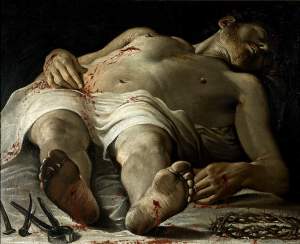
Jesus Laid in the Tomb 1Jesus does say, “I am the good shepherd. The good shepherd lays down his life for the sheep.” What makes Jesus the Good Shepherd is that He dies – nothing less. He dies for His sheep. The Good Shepherd has blood, His own blood, on Him. The Good Shepherd has holes in His hands and feet, wounds that He suffered on the cross for you. Jesus, the good, fitting, competent Shepherd suffered, bled, and died so that He could be your Shepherd. The kind of shepherd you needed. You needed a shepherd to be really, truly abandoned and condemned by God because of your sin. Jesus, your Shepherd, died a real death and was buried in a real tomb. Your sin was that serious of a problem.

Many Christians will use this phrase: “You need to have a personal relationship with Jesus.” Now, that phrase isn’t untrue, but it is (at best) only half true. You do need to have faith in Jesus in order to be saved, and you can, I suppose, characterize faith as a relationship. But doing that tends to make you focus on yourself. You have to wonder, “Am I holding up my end of the relationship?”

With as often as Christians talk about a personal relationship with Jesus, you would think the Bible would be talking about it all the time. But do you know how many times the Bible uses the word ‘relationship’? I’ll give you a hint – it’s equal to the times that the Vikings have won the Super Bowl. That’s right, a goose egg, zero. Scripture never says that you need a “personal relationship” with Jesus.

If your biggest need is to have a “personal relationship” with Jesus, then Jesus didn’t need to die. Jesus could have just come and hung out with us. He could just sit on the couch and watch Jeopardy or the NFL Draft while eating chips with us or something. Ask yourself this: If a relationship with Jesus is the solution, what is the problem?

You see, our biggest problem is not loneliness. If that were the case, any number of individuals could help us. Our biggest problem is not a lack of companionship. Our problem isn’t even that we have a hole in our hearts that only Jesus can fill. We don’t need a buddy, a chum, or a pal. We need a Savior from sin.

Crying to GodOur problem is that we poor, wretched sinners dash ourselves to pieces against the holy, righteous God. We cannot avoid Him. And the only solution for our true problem – our sin – is the death and resurrection of Jesus, the Good Shepherd. The good news is that the good, fitting Shepherd does lay down His life for the sheep.
Why would Jesus be willing to lay down His life for us? He tells us in the closing sentence of our text. “This charge (lit. ‘command’) I have received from My Father.” Jesus willingly lays down His life for you because the Father commanded and He obeyed. And because Jesus obeyed, He is exactly the kind of shepherd you needed.

When Jesus is your good, fitting, crucified Shepherd, He knows you and you know Him. You’re as close to Jesus as the Father is to Jesus because He lays down His life for you. And Jesus is eternally your Good Shepherd because:

Christ is risen!
He is risen indeed! Alleluia! Amen.

The peace of God, which surpasses all understanding, will guard your hearts and minds in Christ Jesus. Amen.

Luke 24:36-49 – It Is Necessary

Listen here. (Please note, we had a power outage that lasted until right before the sermon, so the flock was a little more cantankerous than usual.)

Luke 24:36-49

36 As they were talking about these things, Jesus himself stood among them, and said to them, “Peace to you!” 37 But they were startled and frightened and thought they saw a spirit. 38 And he said to them, “Why are you troubled, and why do doubts arise in your hearts? 39 See my hands and my feet, that it is I myself. Touch me, and see. For a spirit does not have flesh and bones as you see that I have.” 40 And when he had said this, he showed them his hands and his feet. 41 And while they still disbelieved for joy and were marveling, he said to them, “Have you anything here to eat?” 42 They gave him a piece of broiled fish, 43 and he took it and ate before them. 44 Then he said to them, “These are my words that I spoke to you while I was still with you, that everything written about me in the Law of Moses and the Prophets and the Psalms must be fulfilled.”

45 Then he opened their minds to understand the Scriptures, 46 and said to them, “Thus it is written, that the Christ should suffer and on the third day rise from the dead, 47 and that repentance and forgiveness of sins should be proclaimed in his name to all nations, beginning from Jerusalem. 48 You are witnesses of these things. 49 And behold, I am sending the promise of my Father upon you. But stay in the city until you are clothed with power from on high.”

In the name of Jesus. Amen.

Christ is risen!
He is risen indeed! Alleluia!

Death died when Jesus rose. The stone is rolled away. The tomb is empty. The grave’s strength is spent. The guards could not keep Him. Death could not hold Him.

Our Gospel text today is a replay of last week. Easter evening Episode 2. Why? Why would we look at the same event two weeks in a row? Well, Luke tells us some things that John doesn’t. Dr. Luke wrote his Gospel for a different reason and to a different audience than John, the fisherman. So Luke gives us some details that John doesn’t.

To set this all up, I want to tell you about a real problem that is common among pastors. I’ll call it clerical tautologitis (‘tautology’ means “the same word twice”). I’m going to call this problem clerical tautologitis. Yes. I know I said that twice. It’s humor.

I’ve been around pastors all my life. I was born right before my dad’s last semester of seminary. So I’ve been listening to pastors repeat themselves since I was born. Pastors have an uncanny ability to tell the same story in the same way to the same person – over and over and over. I think it happens because pastors are supposed to preach Jesus Christ crucified, risen, and coming again. Part of their calling is to say the same thing repeatedly. I think another contributing factor is that pastors get asked the same question by several different people. When I give the same answer several times, I forget who has already heard what I am saying.

Please, I beg you, help me curb the early onset of clerical tautologitis. If we’re having a conversation, let me know if you’ve already heard what I’m saying. Please, save yourself and me. I promise I won’t be offended.

But you know what? Jesus was repetitive too. Especially when He used one little word in our text. That word is in v. 44 of our text, and gets translated here ‘must.’ “These are My words that I spoke to you while I was still with you, that everything written about Me in the Law of Moses and the Prophets and the Psalms must be fulfilled.”

The Greek word that gets translated ‘must’ there is the Greek word δεῖ. In English it means ‘it is necessary’ or ‘must happen.’ When Jesus says something “must happen,” it is probably good for us to listen to Him.

In the Gospel of Luke particularly, when Jesus uses this little word δεῖ, it forms an interesting arc through the Gospel. We aren’t going to look at all of the times Jesus uses the word, but the ones we are going to look at are listed in your Scripture insert. I’d invite you to follow along as I go through them:

The first comes in Lk. 2:49. Jesus is twelve-years-old. Mary and Joseph have taken Him to the Temple to celebrate the Passover. Mary and Joseph start to travel back home, but pre-teen Jesus stays behind. His parents are terrified when they can’t find Him, and Jesus is lost for three days. Finally, they find Him in the Temple listening to teachers and asking them questions. Joseph and Mary get after Him a little bit, “Why are You doing this to us?” Jesus’ first words in the Gospel of Luke are His response to that question, “Why were you looking for Me? Did you not know that I δεῖ be in My Father’s house/about My Father’s business?” (the phrase is literally translated ‘in the things of My Father’).

What is Jesus talking about? What does it mean that He has to be about His Father’s business? We don’t know yet. But we will find out as we continue through Luke’s Gospel – especially when we find Jesus using the word δεῖ again.

The next comes in Lk. 4:43. Before Jesus calls the first disciples, He is casting out demons. The people in that area want Jesus to stick around and help them with all their problems. But Jesus won’t. Why? Jesus said to them, “I δεῖ preach the good news [the Gospel] of the kingdom of God to the other towns as well; for I was sent for this purpose.”

So, It is necessary for Jesus to be about His Father’s business and it is necessary for Him to preach the Good News of the reign of God to everyone. What is that Good News? What’s the Father’s stuff? We still don’t’ know. But we’re about to find out.

The next time Jesus uses the word δεῖ comes in Lk. 9:22. Peter has just confessed that Jesus is God’s Messiah. Jesus tells the disciples, “Don’t tell anyone because the Son of Man δεῖ suffer many things and be rejected by the elders and chief priests and scribes, and be killed, and on the third day be raised.”

Jesus says He must suffer, be rejected, be killed, and rise again. But maybe the disciples figure Jesus doesn’t know what He’s talking about. Maybe Jesus is simply mixed up on what He must do.

But look at what happens later when Jesus uses the word δεῖ. In Lk. 13:32-33, Jesus is outside of Jerusalem and lamenting over the city. He wishes that Jerusalem would have listened to the prophets. But because they didn’t, they are going to be destroyed. Some people warned Jesus that He should get away because Herod is seeking to kill Him. But Jesus responds “Go and tell [Herod] that fox, ‘Behold, I cast out demons and perform cures today and tomorrow, and the third day I finish My course. Nevertheless, I δεῖ go on My way today and tomorrow and the day following, for it cannot be that a prophet should perish away from Jerusalem.’”

Jesus is saying, “Hey, I’m not worried about Herod. I know I’m going to die. That is what I’ve been saying all along. But I’m going to die in Jerusalem. Since I’m not there yet, I’m not going to be killed.”

What is necessary? It is necessary for Jesus to keep preaching, but it is also necessary for Jesus to die. Jesus’ death must happen. It must happen for you, for your redemption.

But keep going. [We’ll skip the next few times Jesus says δεῖ 17:25; 19:5; and 21:9). In Lk. 22:37, Jesus tells Peter, “You are going to deny Me three times.” Then, Jesus tells the disciples to be ready. He tells them to make sure they have a moneybag, a knapsack full of food, and even a sword because dark times are coming. Jesus says, “For I tell you that this Scripture δεῖ be fulfilled in Me: ‘And He was numbered with the transgressors.’ For what is written about Me has its fulfillment.”

Δεῖ: it is necessary that sinless Jesus be numbered with the transgressors. It is necessary for Jesus to take the sins of the world upon Himself. He must carry the disciples’ burden, your burden, my burden on His shoulders and die. The disciples still don’t get it. They say, “Here are two swords, Lord.” But Jesus stops them, “It is enough. Guys, you are missing the point. I’m saying I’m going to die.”

The incomprehension of the disciples is about to change because, before δεῖ gets used again, Jesus does suffer. Jesus is crucified. He does die and is buried. But surprisingly, Jesus can’t be found at the tomb. In Lk. 24:6-7, an angel says to the women standing at the empty tomb, “He is not here, but has risen. Remember how He told you, while He was still in Galilee,  that the Son of Man δεῖ be delivered into the hands of sinful men and be crucified and on the third day rise.”

Later that day, Jesus appears to the two disciples who are traveling on the road to Emmaus. They don’t understand what is going on. People keep saying that Jesus is risen. And Jesus says to them Lk. 24:25-26, “O foolish ones, and slow of heart to believe all that the prophets have spoken! Was it not δεῖ that the Christ should suffer these things and enter into his glory?”

Then again in v. 44 of our text, Jesus says, “These are my words that I spoke to you while I was still with you, that everything written about me in the Law of Moses and the Prophets and the Psalms δεῖ be fulfilled.”

Now, finally, Jesus opens the disciples’ minds to understand the books of Moses, Genesis – Deuteronomy; to understand the Prophets, more than just Isaiah – Malachi, also what we call the Historical Books; and to understand the Psalms. Jesus opens their minds to the whole Old Testament. All the Old Testament is fulfilled when Jesus dies and rises again.

If you have a hard time understanding anything in the Bible, simply ask yourself, “How does this fit in with Jesus’ death and resurrection?” because that is what all the Bible is about. The story of Scripture is about God pursuing you, forgiving you for Jesus’ sake, and creating faith in you.

The disciples, you, and I are totally dependent upon God opening our minds, just like the disciples were. The task of accomplishing salvation was Jesus’ work, and it is still God’s work to grant faith in that salvation. God wants nothing more than for you to have your mind opened by the Holy Spirit as He works through the Word of God.

Jesus wants you to know that you are redeemed, forgiven, and have eternal life because:

Christ is risen!
He is risen indeed! Alleluia! Amen.

The peace of God, which surpasses all understanding, will guard your hearts and minds in Christ Jesus. Amen.

John 20:19-31 – Through Locked Doors

Listen here.

John 20:19-31

19 On the evening of that day, the first day of the week, the doors being locked where the disciples were for fear of the Jews, Jesus came and stood among them and said to them, “Peace be with you.” 20 When he had said this, he showed them his hands and his side. Then the disciples were glad when they saw the Lord. 21 Jesus said to them again, “Peace be with you. As the Father has sent me, even so I am sending you.” 22 And when he had said this, he breathed on them and said to them, “Receive the Holy Spirit. 23 If you forgive the sins of any, they are forgiven them; if you withhold forgiveness from any, it is withheld.”

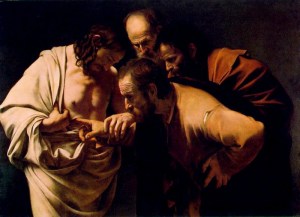
24 Now Thomas, one of the Twelve, called the Twin, was not with them when Jesus came. 25 So the other disciples told him, “We have seen the Lord.” But he said to them, “Unless I see in his hands the mark of the nails, and place my finger into the mark of the nails, and place my hand into his side, I will never believe.”

Thomas Sees Jesus26 Eight days later, his disciples were inside again, and Thomas was with them. Although the doors were locked, Jesus came and stood among them and said, “Peace be with you.” 27 Then he said to Thomas, “Put your finger here, and see my hands; and put out your hand, and place it in my side. Do not disbelieve, but believe.” 28 Thomas answered him, “My Lord and my God!” 29 Jesus said to him, “Have you believed because you have seen me? Blessed are those who have not seen and yet have believed.”

30 Now Jesus did many other signs in the presence of the disciples, which are not written in this book; 31 but these are written so that you may believe that Jesus is the Christ, the Son of God, and that by believing you may have life in his name.

In the name of Jesus. Amen.

Christ is risen!
He is risen indeed! Alleluia!

Death died when Jesus rose. The stone is rolled away. Jesus escaped. The grave’s strength is spent. The guards could not keep Him. Death could not hold Him.

Thomas gets a bad rap. Was he doubting? Yes, of course, but no more doubting than the other disciples.

Our text starts on the evening Jesus rose from the dead. Peter and John had seen the empty tomb, and John believes (Jn. 20:8). Mary Magdalene and some of the other women see Jesus (Mt. 28:9-10). Two other disciples, who are not part of the Twelve, see Jesus on the road to Emmaus. And, at some point, Jesus appears to Peter privately (Lk. 24:34). Jesus is popping up all over the place, but the disciples are scared. Why were they scared?

On the day Jesus died, the Pharisees had gathered before Pilate. They remembered that Jesus had said that He would rise after three days. They figured that the disciples would steal Jesus’ body and fake a resurrection. So Pilate tells the Pharisees to set a guard and seal the tomb (Mt. 27:62-66). So the disciples know that there is an empty tomb. They know the Pharisees were afraid that the disciples might steal Jesus’ body and fabricate a resurrection. The ten disciples are afraid. So they go to the upper room, lock the door, and sit there terrified. They figure, at any moment, the guards were going to come and smash the door and do to them what they had done to Jesus.

Small Catechism - Confession IconBut the door doesn’t come crashing down; it isn’t unlocked; it doesn’t even open. Jesus simply appears there in the room with them to say, “Peace to you.” Jesus shows the disciples His hands and side, and the disciples were filled with joy. And Jesus repeats Himself, “Peace to you. As the Father has sent Me, even so I am sending you.” Then, Jesus breathes on them and says, “Receive the Holy Spirit. If you forgive the sins of any, they are forgiven them; if you withhold forgiveness from any it is withheld.” (More on that a little later.)

Now, Thomas wasn’t with them, and we don’t know where he was. The ten were gathered together with the doors locked because they were afraid. But Thomas isn’t there. Maybe he was out checking to make sure the other disciples were safe. Maybe he wanted to see if they had been arrested. Maybe Thomas was just out running errands. Eventually, Thomas does find the others. They tell him that they have seen Jesus. But Thomas says with some vulgarity, “Unless I see in His hands the mark of the nails and thrust (not just ‘place’ – lit. ‘throw’) my finger into the mark of the nails, and thrust my hand into His side, I will never believe.”

Now, our text jumps to one week later. The Sunday after the Resurrection, Thomas is with the disciples. Even though the ten had seen Jesus, even though Jesus had sent the disciples with His peace to forgive sins, the doors are locked again. Thomas has an excuse to be there but not the others. The ten should have been out speaking about the Resurrection and forgiving sins. But there they are, locked inside. It’s not just doubting Thomas – it’s doubting disciples.

They doubt just like you and I doubt. If you are like me – and I would be willing to guess you are – when you hear the words, “You are forgiven,” your mind goes back to that one sin or those several sins that you have committed. Sins that haunt and guilt and convict and remind you that you deserve hell. Sins that you would do anything to make sure no one ever learns about them. We doubt that Jesus’ forgiveness really covers those sins.

That’s why, dear saints, we need absolution – over and over and over again. That is what Jesus has called us to do. That is what Jesus has called me to do as your pastor.

I wouldn’t dare stand up here and say, “I forgive you of your sins,” unless Jesus had said that is what should be done when sins are confessed.

Boyd Gets Released from PrisonAnother pastor (Rev. Bryan Wolfmueller) uses this analogy: Imagine you are found guilty of a crime and locked in prison. As you sit there in prison, a judge looks over your case and rules that you are innocent. He sends an order to the guard of your prison to set you free. The guard comes with the keys, unlocks your cell, and releases you back into society. Now, who set you free, the judge or the guard? Honestly, the answer is both.
If the judge declares you innocent, but the guard doesn’t go to where you are and unlock your cell – you are stuck in prison. But if the guard, with no order from the judge, lets you go, you will live the rest of your life expecting to be arrested again because you haven’t been justly declared innocent.

Christ is your Judge, and because of what He has done, He declares you innocent. God then orders pastors – the people who have been given the keys (Mt. 16:19) – to go to where you are locked up and open your cell. That is why the absolution is given only “by Christ’s command and authority.”

But this authority isn’t just given to pastors to announce over congregations on Sunday mornings. Jesus gives all believers this authority too. You can announce this forgiveness. If someone comes to you and tells you about their sin and guilt and shame, you can tell them of Jesus death. Tell them that Jesus is the Lamb of God who takes away the sins of the world. Tell them that Jesus’ death takes away their sins, and His resurrection shows that God accepted Jesus’ sacrifice. And tell them, “I forgive you of your sins because of what Jesus has done.”

That is the Gospel message. That is the authority Jesus has given to the Church. That is the message Jesus has sent us into the world to announce. That is the peace that Jesus gives when He says, “Peace to you.” It is the peace that, because He died and rose again, sins are forgiven. They are gone. As far as the east is from the west, so far has Jesus removed our transgressions from us.

No locked door can hold Jesus back. No “secret” sin can match Jesus’ ability to forgive. Jesus is way better at forgiving than you are at sinning. Don’t be afraid anymore. Boldly go. Boldly forgive because:

Christ is risen!
He is risen indeed! Alleluia! Amen.

The peace of God, which surpasses all understanding, will guard your hearts and minds in Christ Jesus. Amen.

Mark 16:1-8 – The Death of Death

Listen here.

Mark 16:1–8

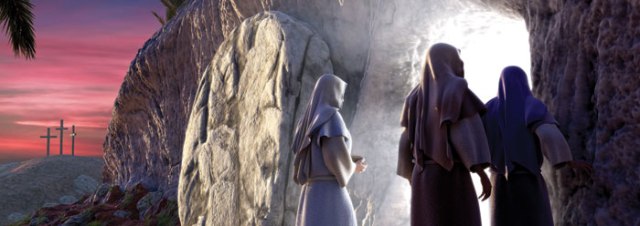
1 When the Sabbath was past, Mary Magdalene, Mary the mother of James, and Salome bought spices, so that they might go and anoint him. 2 And very early on the first day of the week, when the sun had risen, they went to the tomb. 3 And they were saying to one another, “Who will roll away the stone for us from the entrance of the tomb?” 4 And looking up, they saw that the stone had been rolled back—it was very large.

5 And entering the tomb, they saw a young man sitting on the right side, dressed in a white robe, and they were alarmed. 6 And he said to them, “Do not be alarmed. You seek Jesus of Nazareth, who was crucified. He has risen; he is not here. See the place where they laid him. 7 But go, tell his disciples and Peter that he is going before you to Galilee. There you will see him, just as he told you.”

8 And they went out and fled from the tomb, for trembling and astonishment had seized them, and they said nothing to anyone, for they were afraid.

Empty Tomb 1In the name of Jesus. Amen.

Christ is risen!
He is risen indeed! Alleluia!

Jesus Laid in the Tomb 1Death swallowed up the Son of God. The grave took Jesus’ lifeless body into its jaws. Jesus was brought so low that His breath was stopped. He was cut off from the land of the living. The full brunt of the God’s wrath against your sin fell upon the perfect, sinless Son of God.

Was that death’s victory? Had hell won?

Absolutely not. The stone is rolled away. Jesus escaped. The grave’s strength is spent. Death could not hold Him. The guards could not keep Him.

Death died when Jesus rose.

But doesn’t death still rule over the battlefield, the cancer center, the hospital, and even the womb? Aren’t we reminded of death in every skinned knee, mosquito bite, and every time we fall asleep? Isn’t death still the master that will take every one of us and our loved ones whenever it wants? Doesn’t death still make our bodies weak, grow stiff and old, and contract diseases? Yes, it still does.

The ResurrectionBut death has died. The grave cannot hold you. Jesus lives. He has risen out of death and back to us. He came out as a king to meet His people. He is a victorious general returned from war. Jesus burst down the prison walls of death from the inside. Death could not hold Him, and it cannot hold you.

On the last day, the dead will rise. No one will stay in the grave. Death has died.

There will still be a division. The goats will be separated from the sheep, unbelievers from believers. God will not force Himself on you. He will not steal you. If you do not want Him, you can chose to remain in hell. Your body will rise, but you will forever return to the grave, even though the grave is defeated. You will get what is yours. You will be paid the deathly wages of your sin.

But everyone who believes in Jesus, the Risen One, you will rise to eternal life. It doesn’t matter whether you are good or bad, whether you are full of virtue or full of scandal. Through faith, you have eternal life and a place in God’s kingdom. God will happily give you what you did not earn and definitely didn’t deserve. God will freely give what Jesus has won for you. Christ will give you His perfect life.

Now, even when we lower our loved ones into the grave, we do it in mockery of death. Even though they are dead, they live. They are with Jesus who is the Resurrection and the Life. Their bodies only await the resurrection and the life of the world to come.

My kids teach me a lot, but about eight months ago, Annalise gave me a lesson I’ll never forget. On August 4th, she was at the cemetery as we buried Roy Link. I could tell that being there and watching the casket lowered into the ground had got her to thinking. When we arrived home, she said that she was very sad for Sonia. But then she asked the perfect question. “Papa, when is Easter?”

Well, Easter is today. The Resurrection is now. The grave is defeated. Death has died.

Christ is risen!
He is risen indeed! Alleluia!

Christ is risen!
He is risen indeed! Alleluia!

Christ is risen!
He is risen indeed! Alleluia! Amen.[1]

The peace of God, which surpasses all understanding, will guard your hearts and minds in Christ Jesus. Amen.

[1] I am thankful to Rev. David Petersen’s sermon on this text as inspiration for this sermon. http://emmanuelpress.us/books/thy-kingdom-come/

Isaiah 52:13 – 53:12 – You No Longer Own Your Sin, a Good Friday Sermon

Isaiah 52:13–53:12

13 Behold, my servant shall act wisely;
he shall be high and lifted up,
and shall be exalted.

14 As many were astonished at you—
his appearance was so marred, beyond human semblance,
and his form beyond that of the children of mankind—

15 so shall he sprinkle many nations;
kings shall shut their mouths because of him;

for that which has not been told them they see,
and that which they have not heard they understand.

1   Who has believed what he has heard from us?
And to whom has the arm of the Lord been revealed?

2   For he grew up before him like a young plant,
and like a root out of dry ground;

he had no form or majesty that we should look at him,
and no beauty that we should desire him.

3   He was despised and rejected by men;
a man of sorrows, and acquainted with grief;

and as one from whom men hide their faces
he was despised, and we esteemed him not.

4   Surely he has borne our griefs
and carried our sorrows;

yet we esteemed him stricken,
smitten by God, and afflicted.

5   But he was pierced for our transgressions;
he was crushed for our iniquities;

upon him was the chastisement that brought us peace,
and with his wounds we are healed.

6   All we like sheep have gone astray;
we have turned—every one—to his own way;

and the Lord has laid on him
the iniquity of us all.

7   He was oppressed, and he was afflicted,
yet he opened not his mouth;

like a lamb that is led to the slaughter, Lamb of God who takes away the sins of the wolrd
and like a sheep that before its shearers is silent,
so he opened not his mouth.

8   By oppression and judgment he was taken away;
and as for his generation, who considered

that he was cut off out of the land of the living,
stricken for the transgression of my people?

9   And they made his grave with the wicked
and with a rich man in his death,

although he had done no violence,
and there was no deceit in his mouth.

10 Yet it was the will of the Lord to crush him;
he has put him to grief;

when his soul makes an offering for guilt,
he shall see his offspring; he shall prolong his days;

the will of the Lord shall prosper in his hand.

11 Out of the anguish of his soul he shall see and be satisfied;

by his knowledge shall the righteous one, my servant,
make many to be accounted righteous,
and he shall bear their iniquities.

12 Therefore I will divide him a portion with the many,
and he shall divide the spoil with the strong,

because he poured out his soul to death
and was numbered with the transgressors;

yet he bore the sin of many,
and makes intercession for the transgressors.

In the name of Jesus. Amen.

What should sinners expect when the holy, righteous God shows up? We expect judgment, punishment, condemnation, destruction.

That is why Adam and Eve hid themselves when they heard the sound of God walking in the Garden. They knew what they deserved – their eyes had been opened. They knew they were naked. They knew shame. God showed up and they were terrified.

The same goes for Isaiah when he saw the Lord, seated on a throne, high and lifted up. He heard the cries of the seraphim, “Holy, holy, holy is the Lord of hosts. The whole earth is full of His glory.” Isaiah’s only response was, “Woe is me for I am unmade. For I am a man of unclean lips and dwell among a people of unclean lips.”

Adam, Eve, Isaiah, you, and me – our reason and our experience says that each person must bear their own sin. Anything else is “unfair.”

Yet, what actually happens? What do Adam, Eve, Isaiah, you, me, and every other sinner experience? Contrary to all reason and logic, when God shows up, He offers pardon and forgiveness.

God told Adam and Eve that on the day they ate of the tree, they would surely die. But what happens? God slaughters a flock of animals, covers their nakedness, removes their shame, and they live another 900 years.

Isaiah figured He would be unmade because he, a sinner, stood in the presence of God. But what happens? God sends a seraph with a burning coal to touch his lips. His guilt was taken away, and his sins atoned for.

How can God do this? Adam and Eve had the fruit in their stomachs. They were picking the peel from between their teeth. Isaiah had his uncleanness on his lips. All the fingerprint and DNA evidence pointed toward their guilt. So how can God pardon the guilty?

God can forgive because our text says that the sins of Adam, Eve, and Isaiah were somewhere else. Scripture also says that your sins are no longer yours – they are gone. They now belong to God’s Servant, Jesus. God placed on Jesus the iniquity of us all. Jesus bore your griefs. Jesus carried your sorrows. Jesus was pierced for your transgressions and crushed for your iniquities. Your sin, all your sin, even the sins that you will commit years from now, they have all been placed and punished upon Jesus.

Jesus takes and becomes sinThe Gospel tells us that, contrary to everything that is right and “fair,” Jesus is judged guilty for your sin. Jesus bore your sin in His body on the tree that you might die to sin (1 Pet. 2:24). God made Jesus who knew no sin to be sin that you might become the righteousness of God (2 Cor. 5:21). As John the Baptizer said, Jesus is the Lamb of God who takes away the sin of the world (Jn. 1:29). In other words, Jesus has stolen your sins from you. He took possession of them, they are His.

Where are those sins now? They are forever lost in the emptiness of the Easter tomb.

Faith is the constant struggle about who owns sin. Your sin can only be in one of two places. Either your sin is upon you and you are damned, or your sin is on Jesus.

Faith is a struggle because Satan, the world, and you yourself will throw all sorts of accusations against you. The devil, the world, and you will see your sin and say, “Look at that terrible thing you did. You deserve death and condemnation.”

Faith is learning to say what the Scriptures say, what God says about your sin. When you feel the guilt and load of your sin, when you are accused, you can respond, “That sin you see on me is not mine anymore. That sin belongs to Jesus. Jesus has taken away the sins of the world. That includes me. If you want to talk to anybody about that sin, you go talk to Jesus.”

Jesus, God’s suffering Servant, has given you a wonderful exchange. You sin, but Jesus pays the penalty. Jesus deserves lives a life completely obedient to God and deserves peace, but He gets God’s wrath. And you are given, you receive God’s peace.

Some people ask, “How can I know I’m saved?” The answer is, “Jesus is crucified. He has taken the shame of my past. He owns the failures of my present. And He removes the guilt of my future.”

Jesus makes you to be accounted righteous. He has borne your iniquities, and with His stripes you are healed. Amen.

The peace of God, which surpasses all understanding, will guard your hearts and minds in Christ Jesus. Amen.

Mark 14:1 – 15:47 The Path of Life Leads You through the Valley of the Shadow of Death

Listen here.

In the name of Jesus. Amen.

Jesus Crucified 1Three men are tried and condemned as criminals. They are sentenced to be hung until they die. Two of them, the two on the outside, are getting what they deserve. But not the man in the center. He is innocent. But all three share the same execution together. They are brothers in death.

We have followed Jesus’ life through the first half of the church year. We witnessed His birth, just like one of us. We heard as He grew to be a man, a carpenter by trade. Jesus shared His whole life with us. He was our brother in everything, except He did not sin. Jesus’ life was in total harmony with God. Jesus had no life apart from God. He was obedient to God in all things.

So why did He die? Jesus came to go through your whole life with you, and this was completed by His sharing physical death with you. He is with you even when your body dies. As these three men on their crosses were made brothers in death, you are too. Jesus put Himself not only next to the two criminals there on Calvary, but also next to you and next to all rebels against God. Jesus goes through it with you.

Jesus really died. Scripture emphasizes this by telling of His burial. In the Creed we say not only that Jesus was crucified and died, but also that He was buried. His corpse was taken down from the cross by Joseph of Arimathea and Nicodemus, wrapped in a piece of linen, and put in a grave. Jesus was buried. And so whenever you put the body of a loved one down into a grave, you know Jesus has been there too. That makes all the difference. In Jesus you see how God does things.

In John 12:23-25, Jesus says, “The hour has come for the Son of Man to be glorified. Truly, truly, I say to you, unless a grain of wheat falls into the earth and dies, it remains alone; but if it dies, it bears much fruit. Whoever loves his life loses it, and whoever hates his life in this world will keep it for eternal life.”

When Jesus said His hour had come to be glorified, He referred to His death. As a seed only bears fruit by dying first, so it was with Jesus. So it is with you. God brings you to that death, to that participation with Jesus in crucifixion (Ro. 6:3-5). As you stand beneath the cross this morning you can say, “As Jesus dies, I die too. From here on out, I will know no life but that which comes from our dying together.”

Jesus dies the big death for you. He carries the awful load of your sin for you. You are spared from your sin by His death for you. Jesus answers for your sin and breaks it’s domination over you. But all this becomes yours only as you die with Him. At the cross, you part company with both your sin and the miserable life that you would make for yourself apart from Him.

The path of life lies only through dying. Jesus’ death was the climax, the crowning glory. It did not appear so, but He committed Himself to the God who brings life out of death.

Baptism 2So your death, your parting company with sin, will seem a loss to you, but it is not so. For when you die, you are cast on God. The God who brings life out of death – only out of Jesus’ death. He died the big death for the sin that separates you from God. With your sin He suffered, with your sin He was rejected and abandoned by God. Sin cannot condemn you again. For the death Jesus died he died to sin, once for all, but the life he lives he lives to God. So you also must consider yourselves dead to sin and alive to God in Christ Jesus (Ro. 6:10-11). Amen.[1]

The peace of God, which surpasses all understanding, will guard your hearts and minds in Christ Jesus. Amen.

[1] This sermon is based on a sermon by Rev. Donavon Riley https://thefirstpremise.wordpress.com/2014/04/19/homily-for-good-friday-on-mark-1533-47-the-path-of-life-lies-only-through-dying/