Mark 10:32-45 – What Do You Want from Jesus?

Listen here.

Mark 10:32-45

32 And they were on the road, going up to Jerusalem, and Jesus was walking ahead of them. And they were amazed, and those who followed were afraid. And taking the twelve again, he began to tell them what was to happen to him, 33 saying, “See, we are going up to Jerusalem, and the Son of Man will be delivered over to the chief priests and the scribes, and they will condemn him to death and deliver him over to the Gentiles. 34 And they will mock him and spit on him, and flog him and kill him. And after three days he will rise.”

35 And James and John, the sons of Zebedee, came up to him and said to him, “Teacher, we want you to do for us whatever we ask of you.” 36 And he said to them, “What do you want me to do for you?” 37 And they said to him, “Grant us to sit, one at your right hand and one at your left, in your glory.” 38 Jesus said to them, “You do not know what you are asking. Are you able to drink the cup that I drink, or to be baptized with the baptism with which I am baptized?” 39 And they said to him, “We are able.” And Jesus said to them, “The cup that I drink you will drink, and with the baptism with which I am baptized, you will be baptized, 40 but to sit at my right hand or at my left is not mine to grant, but it is for those for whom it has been prepared.”

41 And when the ten heard it, they began to be indignant at James and John. 42 And Jesus called them to him and said to them, “You know that those who are considered rulers of the Gentiles lord it over them, and their great ones exercise authority over them. 43 But it shall not be so among you. But whoever would be great among you must be your servant, 44 and whoever would be first among you must be slave of all. 45 For even the Son of Man came not to be served but to serve, and to give his life as a ransom for many.”

In the name of Jesus. Amen.

Jesus had called the disciples to follow Him, and here they literally are following. Jesus is ahead of them. moving at a fast clip walking to Jerusalem, and the disciples are behind, amazed and afraid. They sense that something dire is down the road in Jerusalem. Things are coming to a head.
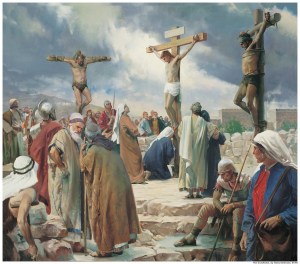
Christ Crucified 1So what does Jesus do? He takes the twelve aside and turns up the heat. “We’re going to Jerusalem, and the Son of Man will be delivered over to the chief priests and scribes, and they will condemn Him to death and deliver Him over to the Gentiles. They will mock Him, spit on Him, flog Him, and kill Him. And after three days He will rise.” Jesus doesn’t sugar-coat what is about to happen.

James and John don’t like all this death talk, so they try to change the subject to something more comfortable – for them at least. “Let’s talk about heavenly seat arrangements, Jesus. When You sit in Your glory, how’s about You let us sit on either side of You – one at Your right and one at Your left.”

This request is so breathtakingly bizarre. In all the Gospels but especially in Mark, the disciples come across as numbskulls who repeatedly don’t get it. But brutally honest moments like these, where the disciples come across as imbeciles, show that the Gospel accounts are honest. If the apostles were making up some new, fake religion, they would certainly make themselves look better in the stories they told.

Jesus bluntly tells James and John that they are out of their minds and don’t have a clue what they are asking. So Jesus asks them, “Are you able to drink the cup that I drink, or to be baptized with the baptism with which I am baptized?”

The cup that Jesus will drink is the cup of God’s wrath against our sin. In the Garden of Gethsemane, Jesus prays that this cup will pass from Him. But He finishes that prayer with, “But not what I will, but what You will” (Mk. 14:36).

Predictably, James and John answer Jesus’ question, “Sure, we are able.”

Jesus Crucified 1Can you imagine the look on Jesus’ face as He pauses and says, “Oooookay. I’m in the death and resurrection business, and that’s all I’m into. You will certainly have that. But the issue of who gets to sit where, well, that’s not in My job description. The seats at My right and left when I am in My glory have already been assigned.”

But then the other disciples, showing that they are just as imbecilic as James and John, get mad at the sons of thunder (Mk. 3:17). So Jesus calls a closed-door team meeting.

“Ok guys, listen up. All this talk of power and glory, it’s Gentile talk. You’re working the way the world works. A CEO will call in his vice-president of production and chew him out. The VP will take it on the chin, apologize, and leave the CEO’s office. But once he’s out of there, he’ll turn around and rip apart the first manager he sees. The manager will turn around and get after the shift supervisor and so on and so forth. But that’s not how it goes in My kingdom. If you want to be great, you must be servant of all. Even I came not to be served but to serve. I’ve come to give My life as a ransom payment for many.”

That’s the key to understanding this whole text. When God shows up on earth, it is to serve and not to be served. You see, we’re no different than the disciples; we are just like James and John.

If you think your presence here at church is fulfilling your weekly duty for God, or if you think coming here is about you offering something to God – well, you’re wrong. When God shows up, He shows up to serve. He came to serve you and give His life as a ransom for you.

This is the last Sunday of Lent. Next week, we will watch the fulfillment of Jesus’ ominous talk about going to Jerusalem to be tried, convicted, crucified, killed, and buried. We will see that the only place where Jesus is labeled as “King of the Jews” is when a sign is hung above Him on the cross (Mk. 15:26). We will learn the identities of those who have the honor of sitting on Jesus’ right and left (the same language that James and John use here) – and they are two robbers (Mk. 15:27). And we will see Jesus serving all humanity, giving His life as a ransom.

But go back to Jesus’ initial question to James and John, “What do you want Me to do for you?” and turn it around. What do you want from Jesus? Like James and John, do you want honor and prestige and power? Or do you want Jesus to serve you by giving His life as a ransom for you?

Before you answer that question, ask yourself: What is the greater honor, sitting chummy with the Son of God at a glorious banquet? Or being served by God in the flesh as He gives His life for yours?

Petersen QuoteI was intentionally overly harsh with James and John and all the disciples in this sermon. Calling them ‘numbskulls’ and ‘imbeciles’ is hardly charitable. For all their faults, the disciples are to be admired. Being able to walk with Jesus for those three and a half years was not an advantage over us. Instead, we have a huge advantage over the disciples. We live after Easter, after the resurrection. We can admire the disciples’ honesty. We should be thankful for how unapologetically they portray themselves as foolish and downright evil. But they can do that precisely because Jesus gave His life as a ransom for them. The apostles were confident of the forgiveness and grace of Christ (Rev. David Petersen).

You can be confident of that same forgiveness and grace. Jesus has come to serve you. He has given His life as a ransom for you. The story of Christianity is not about the best and most holy moving up to God. Instead, it is about God moving down to the worst of sinners, about God moving down to you. Amen.

The peace of God, which surpasses all understanding, will guard your hearts and minds in Christ Jesus. Amen.

John 3:14-21 – Serpents & Crucifixes

Listen here.

John 3:14-21

14 “And as Moses lifted up the serpent in the wilderness, so must the Son of Man be lifted up, 15 that whoever believes in him may have eternal life.

16 “For God so loved the world, that he gave his only Son, that whoever believes in him should not perish but have eternal life. 17 For God did not send his Son into the world to condemn the world, but in order that the world might be saved through him. 18 Whoever believes in him is not condemned, but whoever does not believe is condemned already, because he has not believed in the name of the only Son of God. 19 And this is the judgment: the light has come into the world, and people loved the darkness rather than the light because their works were evil. 20 For everyone who does wicked things hates the light and does not come to the light, lest his works should be exposed. 21 But whoever does what is true comes to the light, so that it may be clearly seen that his works have been carried out in God.”

In the name of Jesus. Amen.

Thursday morning before I left for work, Naomi made a loving gesture. She handed me a little plastic, pink ring with the shape of a heart. As she gave it to me, she said, “Here Papa. Take this so you can remember that I love you when I don’t see you today.” The ring just barely fits on my pinkie, and it probably looked a little ridiculous to the handful of people who saw it on my finger. I’m sure they wondered why 33 year-old man with a beard was wearing it. But it was a good reminder throughout the day. A quick glance at my pinkie reminded me that my little daughter loved me.

To prove He loves us, God has given us a sign, a gesture of love – Jesus on the cross. Whatever situation we find ourselves in, we can look to this sign and know God loves us. God in the flesh crucified, hanging on a tree, and lifted up for you is greatest gesture of love ever given.

As precious as Jesus lifted up on the cross is to us, we tend to forget how strange, mysterious, and downright offensive it is. This text, a familiar text, is a good occasion to remember how odd and wonderful and precious the cross is. John 3:16 has become cliché – we hear it so often – but we rarely hear the context.

The full context, of course, goes back to the beginning of John’s Gospel. The Word who was in the beginning with God and was God, this Word became flesh and dwells, tabernacles, among us. The Word of God in the flesh says in v. 14, “As Moses lifted up the serpent in the wilderness, so must the Son of Man be lifted up.”

Jesus is, of course referring back to our Old Testament text (Nu. 21:4-9). God’s people were complaining for what seems like the eighteenth time about being out in the wilderness with no water and nothing to eat except that loathsome, worthless food. They seem to forget the fact that God repeatedly, miraculously provided water and that God was daily providing them with manna and quail. But the people still whine and moan and complain.

So God sends serpents among the people. Those serpents bite and injecting their fiery venom of death. This venom causes many of the people of Israel die, but they realize what they have done. So they come to Moses and say, “We have sinned, for we have spoken against the Lord and against you. Pray to the Lord, that He take away the serpents from us.” So Moses prays and God tells him to make, of all things, a bronze serpent and set it on a pole. If anyone is bitten, he can look at the serpent raised up on that pole and live.

Now, doesn’t it seem a little rude of God to make the people look at an image of the curse to be healed from their bites? Imagine feeling the poison coursing through your veins, the last thing you would want to look at is an image of the very thing that has caused you this pain.

When something hurts you, you naturally try to avoid it. You have watched your friends and relatives get bitten by these snakes and die in pain as the fiery venom courses through their veins. Now you are bitten. But all God has given you is a bronze image of one of those serpents to look at. Moses says, “Here’s your remedy. If you get bitten, look at this bronze serpent that looks just like the ones that are biting you. Look here and live.”

You would be thinking, “Moses, are you insane? How could that help us? Why would we want to look at an image of the very thing that is killing us and terrifying us?”

But as ridiculous as it sounds, God gave this bronze serpent as a sign of His love and care for His people. Odd? Yes. Strange? Indeed.

But it was God’s sign, God’s remedy. God gave it and attached His promise of life to it. What other cure was there? Nothing. No matter how foolish it seemed, it brought healing and life.

Now, Jesus takes this story and broadens it. Jesus says that God has given one sign of God’s love to all humanity. There is one place to look for healing from the poison of sin coursing through our veins. There is one sign of God’s love. And that is Jesus on the cross.

Just as the people of Israel were bitten with the fiery, poisonous venom of death, you and I and all humanity has the venom of sin coursing through our veins. Only one cure exists – the Son of Man dying on a cross. The only cure for us is to look at Jesus beaten, bloodied, and dying on the cross. Only there do we find forgiveness, life, and healing.

What does God’s love look like? What is the sign of His love? Jesus lifted up on the cross, and nothing else.

John 3:16, maybe the most recognizable verse in the Bible, is one of those verses that can get neglected. We hear it so often that we don’t realize what a beautiful verse it is.

On Friday, Sarah and I went to the jewelry store where we got our wedding rings and had them both cleaned. Our rings are always on our fingers, and they naturally lose their original shine and beauty just because they are always there. But you get them cleaned and they look like new. The same thing can happen with familiar Bible verses.

Today, look at John 3:16 with fresh eyes. Look at fresh and clean. See it from a little different angle to notice the beauty there. Let me tweak the translation a little bit. The little word, ‘so’ can mislead us somewhat. Often, ‘so’ is taken in the sense of “God loved the world soooo much.” But that isn’t what this word means. The Greek word means “in this way.” “For God in this way loved the world, that He gave His only begotten Son.”

God gave His Son to the world, to you, lifted up on the cross. This sign of God’s love is universal. Jesus crucified is given to all the world, to you. No one falls outside of this gift of God’s love. God loved the world so He gave His only begotten Son for the world to see lifted up on the cross as the remedy for sin. Jesus, lifted up, suspended between heaven and earth, held by three nails is God’s eternal sign of love for you.

Jesus crucified is God’s eternal sign of love to show you that God is not out to condemn the world but to save the world through Jesus.

Whatever you are going through, this is God’s one and only sign that His love for you does not change based on how you are doing at any given moment.

When times are good, look to Jesus crucified for you. When you are upset with God, look to Jesus crucified for you. When you feel the pains of sin and death, look to Jesus crucified for you. Look to the Son of God lifted up on the cross as the remedy, the salve, for all your woes, all your pains. Look to Him dying on the cross so that you not die but have everlasting life. This is God’s eternal sign of His love for you. Amen.

The peace of God, which surpasses all understanding, will guard your hearts and minds in Christ Jesus. Amen.

John 2:13-22 – Protect This House

Listen here.

John 2:13-22

13 The Passover of the Jews was at hand, and Jesus went up to Jerusalem. 14 In the temple he found those who were selling oxen and sheep and pigeons, and the money-changers sitting there. 15 And making a whip of cords, he drove them all out of the temple, with the sheep and oxen. And he poured out the coins of the money-changers and overturned their tables. 16 And he told those who sold the pigeons, “Take these things away; do not make my Father’s house a house of trade.” 17 His disciples remembered that it was written, “Zeal for your house will consume me.”

18 So the Jews said to him, “What sign do you show us for doing these things?” 19 Jesus answered them, “Destroy this temple, and in three days I will raise it up.” 20 The Jews then said, “It has taken forty-six years to build this temple, and will you raise it up in three days?” 21 But he was speaking about the temple of his body. 22 When therefore he was raised from the dead, his disciples remembered that he had said this, and they believed the Scripture and the word that Jesus had spoken.

In the name of Jesus. Amen.

“His disciples remembered that it was written, ‘Zeal for your house will consume me.’”

Jesus has a mean side. “Gentle Jesus, meek and mild” – not so much here. This is more like, “Aggressive Jesus, scrappy and contentious.”

Jesus Clears the TempleAfter seeing the merchants selling their oxen, sheep, and pigeons and the money-changers, Jesus assembled His homemade whip. And out He drove them – the sellers, the animals, and the money-changers. Imagine the sounds – animals howling, people yelling, whip cracking, tables flipping, coins clanging to the concrete. A scene like this is more akin to a child throwing a temper tantrum than a religious teacher restoring reverence to a place of worship.

But Jesus didn’t have a choice in the matter. Zeal consumed Him. God’s Temple, God’s house was being destroyed. This was something that had to be done. Jesus had to protect His Father’s house.

But why did it have to be done? Prayers were being made, sacrifices offered. How was what they were destroying the Temple? After all, the merchants and money-changers were offering a service.

God had instituted the sacrifices, and sure it was reasonable for someone from Bethlehem, Nazareth, or Capernaum to bring their own sheep or ox to Jerusalem for a sacrifice. But what about the faithful who lived in Turkey or Rome? Getting to the Temple was difficult enough. Bringing an ox or a sheep or even a pigeon was a burden. It’s much easier to bring money with you, buy the animal at the destination, and sacrifice it. The priests recognized this. And they, as stewards of God’s house, had sanctioned it.

The merchants and money-changers just made everything more convenient. And, quite frankly, there wasn’t anything wrong with them making a profit as they did it. The merchants were simply running a business. No sin in that. Everyone has to make a living. They were simplifying worship. But just because something makes worship more simple, doesn’t make it right.

The problem wasn’t what they were doing – it was where they were doing it. The sale of sacrifices had been going on for a long time, but it had occurred outside the Temple on the slopes of Mount of Olives. Apparently, Caiaphas, who was high priest in Jesus’ day (Lk. 3:2; Jn. 18:24), was the first to allow the merchants to set up shop inside the Temple.

The vulgarity of what they were doing was that, through their indifference and complacency, they turned the house where God freely gave forgiveness into a house of business, a house of transactions. God’s forgiveness should never be connected with making a transaction. The place where God extends mercy to His people gratis should never be a house of business, trade, and enterprise. Through complacency, God’s people were destroying God’s house. Their indifference was the catalyst for the decay and destruction of the Temple that had taken forty-six years to build.

But they didn’t see it that way. They were still offended at Jesus’ action, Jesus’ zeal. So they ask Jesus for a sign. But notice that John doesn’t say that the religious leaders, the Pharisees and Sadducees, demand Jesus give a sign to authenticate His authority. It was all the people. “The Jews said to Him, ‘What sign do You show us for doing these things?’”

Passion of Christ on the CrossJesus replies, “Destroy this temple, and in three days I will raise it up.” But, in saying that, Jesus had moved the metaphor. He was speaking about the temple of His body.

As important as the Temple building was to Jesus, the Temple was pointing to something even more important – Jesus Himself. Jesus is the place where God’s glory dwells. “The Word became flesh and dwelt among us” (Jn. 1:14). Jesus is the place where the perfect Sacrifice for all sin, for your sin, was offered to God. The Jews will get the sign they demand, but only in Jesus’ death and resurrection. Jesus had authority to drive the merchants and money-changers out because He is the resurrected One.

Jesus’ zeal for God’s house consumes Him – in fact, it destroys Him. Jesus’ zeal for God’s house came at a great price.

What about today? Well, the metaphor moves again. The Temple pointed to Jesus’ body, and now the Church – that’s you, believer – the Church is the temple of God. 1 Cor. 3:16-17 says, “Do you not know that you are God’s temple and that God’s Spirit dwells in you? If anyone destroys God’s temple, God will destroy him. For God’s temple is holy, and you are that temple.”

Jesus’ zeal for God’s house consumed Him. Jesus’ zeal for you consumed Him. He was destroyed for you. The Jews did destroy the temple of Jesus’ body, and Jesus raised that temple. Jesus protected that house, and Jesus will protect this house. He will protect you, His church, His temple. Amen.

The peace of God, which surpasses all understanding, will guard your hearts and minds in Christ Jesus. Amen.

Romans 5:1-11 – Peace

Listen here.

Romans 5:1-11

1 Therefore, since we have been justified by faith, we have peace with God through our Lord Jesus Christ. 2 Through him we have also obtained access by faith into this grace in which we stand, and we boast in hope of the glory of God. 3 Not only that, but we boast in our sufferings, knowing that suffering produces endurance, 4 and endurance produces character, and character produces hope, 5 and hope does not put us to shame, because God’s love has been poured into our hearts through the Holy Spirit who has been given to us. 6 For while we were still weak, at the right time Christ died for the ungodly. 7 For one will scarcely die for a righteous person—though perhaps for a good person one would dare even to die— 8 but God shows his love for us in that while we were still sinners, Christ died for us. 9 Since, therefore, we have now been justified by his blood, much more shall we be saved by him from the wrath of God. 10 For if while we were enemies we were reconciled to God by the death of his Son, much more, now that we are reconciled, shall we be saved by his life. 11 More than that, we also boast in God through our Lord Jesus Christ, through whom we have now received reconciliation.

In the name of Jesus. Amen.

This text is simply laying out what Jesus has done for you. While you were weak, while you were ungodly, while you were still a sinner, while you were an enemy of God – Christ died for you. Jesus didn’t die for anyone righteous; He didn’t suffer for anyone who is good.

Jesus died for you who are fighting against God. Jesus died for rebels raging against their Creator. That is me and that is you.

We imagine our problems are one of a thousand earthly problems. Scripture says that we are not even capable of knowing or diagnosing our real problem (Ro. 7:15). We invent other problems then call them all our real problems. That is why we need God’s Word to tell us again and again that our real problem is hatred of God. And not just that, you need God’s Word to constantly tell you that Jesus’ blood and death rescued you from your hatred of God.

Jesus has rescued you from the real problem that you didn’t even know was your problem. And it worked!

How do you know it worked? The evidence that it worked is not seen when you are somehow more moral, or a little better each day. You don’t see that it worked because you are happier or you ‘experience’ Jesus more and more – whatever that means.

You know the cross actually did what Jesus said it did by the fact that the Father raised Him out of the grave three days after we killed Him on that dark Friday afternoon.

In our Gospel text (Mk. 8:27-38), we see Jesus saying He is on His way to Jerusalem, on His way to rejection, on His way to suffering, on His way to death. In all four Gospels, we see a Jesus who is determined to go to the cross. I forget who, but someone has said, the Gospels are accounts of Jesus’ Passion with really long introductions. True, true.

There is no Jesus, the good teacher. There is no Jesus, the miracle worker (even though Jesus actually did those miracles). There is no Jesus, our example. There is only crucified Jesus. If you do not know Jesus as God-in-the-flesh crucified for you, you don’t know the Jesus of the Gospels. And any sermon or teaching about Jesus that isn’t about crucified, dead, and risen Jesus is no Christian sermon.

My problem and your problem isn’t that we feel guilty before God. Our problem is that we are guilty before God – whether we feel it or not. You and I, all of us, we stand justly condemned before God.

The verdict is in. “Guilty.”

The sentence has been pronounced. “Death.” There is no possibility of appeal. We sit on death row waiting for the judgment to fall.

But then, Scripture steps in and declares that judgment fell already. Two-thousand years ago, your death sentence was carried out. Jesus stepped in between you and your enemy. Jesus, the Son of God, stepped between you and God, your enemy. Jesus shoved you out of the way to safety. He bore your sins in His body. Jesus, who knew no sin, became sin for you.

Jesus didn’t die for those who needed a little convincing that God really loved them. Jesus didn’t die for those who want to improve their life, career, marriage, or work habits. Jesus died only for God’s enemies. Sin makes you a God-hater. Jesus died only for those who hated God. Jesus says “The light has come into the world, and people (that’s you and me) loved the darkness rather than the light because their works were evil” (Jn. 3:19).

Only those who are sick need a physician. Only sinners need forgiveness. Only those who are dead need a resurrection. If you don’t need forgiveness or resurrection, if you don’t need peace with God, than Jesus has nothing to offer you that you don’t already have.

But Jesus has come for you whether you like it or not. God has demonstrated His love for you God-haters. Jesus has brought God’s love to you. Jesus has washed you in His life. He feeds you His love. He has made you His own child. Therefore, you now have peace – peace with God. The peace you have with God is all because of Jesus’ action, Jesus’ doing, Jesus’ dying for you.

You have peace with God and access to God because you stand in grace. You stand in Jesus. You stand where God pours His love into your hearts. Here, at this altar, in this bread, in this wine is Jesus. Here, God’s love is poured on you. Be at peace. Amen.

The peace of God, which surpasses all understanding, will guard your hearts and minds in Christ Jesus. Amen.

Genesis 22:1-18 – The Son is Slaughtered

Listen here.

Genesis 22:1-18

1 After these things God tested Abraham and said to him, “Abraham!” And he said, “Here I am.” 2 He said, “Take your son, your only son Isaac, whom you love, and go to the land of Moriah, and offer him there as a burnt offering on one of the mountains of which I shall tell you.” 3 So Abraham rose early in the morning, saddled his donkey, and took two of his young men with him, and his son Isaac. And he cut the wood for the burnt offering and arose and went to the place of which God had told him. 4 On the third day Abraham lifted up his eyes and saw the place from afar. 5 Then Abraham said to his young men, “Stay here with the donkey; I and the boy will go over there and worship and come again to you.” 6 And Abraham took the wood of the burnt offering and laid it on Isaac his son. And he took in his hand the fire and the knife. So they went both of them together. 7 And Isaac said to his father Abraham, “My father!” And he said, “Here I am, my son.” He said, “Behold, the fire and the wood, but where is the lamb for a burnt offering?” 8 Abraham said, “God will provide for himself the lamb for a burnt offering, my son.” So they went both of them together.

9 When they came to the place of which God had told him, Abraham built the altar there and laid the wood in order and bound Isaac his son and laid him on the altar, on top of the wood. abraham sacrificing isaac 210 Then Abraham reached out his hand and took the knife to slaughter his son. 11 But the angel of the Lord called to him from heaven and said, “Abraham, Abraham!” And he said, “Here I am.” 12 He said, “Do not lay your hand on the boy or do anything to him, for now I know that you fear God, seeing you have not withheld your son, your only son, from me.” 13 And Abraham lifted up his eyes and looked, and behold, behind him was a ram, caught in a thicket by his horns. And Abraham went and took the ram and offered it up as a burnt offering instead of his son. 14 So Abraham called the name of that place, “The Lord will provide”; as it is said to this day, “On the mount of the Lord it shall be provided.”

15 And the angel of the Lord called to Abraham a second time from heaven 16 and said, “By myself I have sworn, declares the Lord, because you have done this and have not withheld your son, your only son, 17 I will surely bless you, and I will surely multiply your offspring as the stars of heaven and as the sand that is on the seashore. And your offspring shall possess the gate of his enemies, 18 and in your offspring shall all the nations of the earth be blessed, because you have obeyed my voice.”

In the name of Jesus. Amen.

This text draws you in. The details paint a vivid picture that makes you wonder what it was like for the characters in the story. I wonder what Abraham’s wife, Isaac’s mother, Sarah, thought of this father-son trip. Did she know why they were leaving? Or was it the shock of hearing what happened that killed her? (She dies six verses after this text). What about the servants who accompany Abraham and Isaac? What kind of conversations did they have with their master and his son on the three-day journey? Or were the daily marches and nightly campfires morbidly quiet? And how did Isaac get on top of the wood; did Abraham have to wrestle with him? Probably not, but the text doesn’t say; or how did Abraham go about explaining to Isaac what the plan was?

But what is usually the biggest question, how could Abraham go through all of this? That question is what makes this story so mesmerizing and etches it into our minds.

Listen to how God starts this whole circus – He says, “Take your son, your only son Isaac, whom you love, and go to the land of Moriah, and offer him there as a burnt offering.” God Himself pours on the sentimental words and phrases then says, “Slit his throat and burn him to a charred crisp – reduce him to ashes.”

And Abraham rises early in the morning, saddles his donkey, takes his two servants and his son, and cuts the wood for the offering.

On the third day – those words are so precious wherever they come up in Scripture – on the third day, Abraham saw the place from afar. Abraham tells his servants to stay with the donkey, but then listen carefully to what Abraham says. One subject governs all the verbs, but I’m going to supply the subject before every verb, “I and the boy will go over there. I and the boy will worship. And I and the boy will come again to you.”

Isaac Carries the WoodAbraham takes the wood and lays it on his son, and Isaac carries his own location of death.

Abruptly, Isaac speaks up, “My father!”

“Here I am, my son.”

“Behold, the fire and the wood, but where is the lamb for a burnt offering?” A poignant, touching question.

But we need to interrupt the text. We need to slow down and gaze at Abraham’s answer and ponder it. The Hebrew word here in v. 8 which gets translated ‘provide’ is a really bad translation. The Hebrew word actually means ‘to see’ But basically every English version you can get your hands on will translate it as ‘provide.’ They say that the verb ‘to see’ here has the sense of ‘will see to it’ as in, “God will see to it Himself that there is a lamb.” But to translate it that way makes us miss something big.

Because there is one other part of Abraham’s words here that we miss in English. The most literal, wooden translation of Abraham’s response to Isaac is, “God will see Himself – a lamb” (Dr. John Saleska) God will see Himself – a lamb. Are you beginning to see?

Now, the story slows way down giving every excruciating detail. They come to the place. Abraham built the altar. He laid the wood in order. He bound his son. He laid him on top of the wood. Abraham reaches out his hand. He takes the knife to slaughter his son.

And the angel of Yahweh steps in. You can ask me about this sometime, I’m not going to take the time to fully explain it in this sermon, but the “angel of Yahweh” in the Old Testament is Jesus. For now, the only proof I’ll offer is that the angel of Yahweh speaks as God Himself with God’s same words earlier. Notice He says, “You have not withheld your son, your only son, from Me.”

Abraham lifts up his eyes and “looked” (same word that means ‘see’ but gets translated ‘provide’ earlier) and there is a ram crowned with thorns in a thicket.

Passover LambAbraham offers up the ram as a burnt offering instead of his son. And Abraham names that place, “Yahweh will see.” And it became a saying, “On the mount of Yahweh it will be seen.”

Again, do you see? The Son is slaughtered, but not in this text. Jesus stops this sacrifice because He will be the sacrifice. Isaac could not bear the sins of the world. But Jesus could. In Jesus, God did see Himself – the Lamb, the Lamb of God who takes away the sins of the world.

Jesus, the son of God, the only begotten Son of God, the Son in whom the Father is well pleased came. Jesus, the Son, was offered by the Father as a burnt offering for your sins. Jesus carried His own wood, His own place of death. Jesus was caught in a crown of thorns. Jesus willingly let Himself be slaughtered. And God did not stop Himself.

What does that mean for you? Romans 8:32 says, “He who did not spare his own Son but gave him up for us all, how will he not also with him graciously give us all things?”

Lamb of God who takes away the sins of the wolrdOn Mount Calvary, God saw Himself – the lamb. On the mount of Yahweh, God saw. And now, when He looks at you, all He sees is Jesus. Amen.
The peace of God, which surpasses all understanding, will guard your hearts and minds in Christ Jesus. Amen.

Mark 9:2-9 – To the Top of the Mountain! (Warning: This is not a pleasant sermon)

Listen here.

Mark 9:2-9

2 And after six days Jesus took with him Peter and James and John, and led them up a high mountain by themselves. And he was transfigured before them, 3 and his clothes became radiant, intensely white, as no one on earth could bleach them. 4 And there appeared to them Elijah with Moses, and they were talking with Jesus. 5 And Peter said to Jesus, “Rabbi, it is good that we are here. Let us make three tents, one for you and one for Moses and one for Elijah.” 6 For he did not know what to say, for they were terrified. 7 And a cloud overshadowed them, and a voice came out of the cloud, “This is my beloved Son; listen to him.” 8 And suddenly, looking around, they no longer saw anyone with them but Jesus only.

9 And as they were coming down the mountain, he charged them to tell no one what they had seen, until the Son of Man had risen from the dead.

In the name of Jesus. Amen.

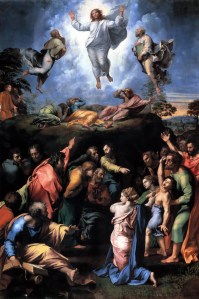
Transfiguration by RaphaelToday, it is important for us to go to the top of the mountain. Today, it is important for us to see this event in Christ’s life, to see Jesus transfigured, metamorphosized. Today, it is important for us to see His clothes turn radiantly white – brighter than the sun glaring off of freshly fallen snow. Today, it is important for us to see Jesus’ face shining more brightly than if He had swallowed the sun. As Peter said, “It is good that we are here.”

The Transfiguration is full of the imagery of the Resurrection. In fact, one liberal theologian, who denies that Mark is divinely inspired, has said that this text is a misplaced Resurrection scene. He says that Mark made a mistake when he wrote the Gospel and put a scene of the resurrected Jesus right smack in the middle of the Gospel. Oops. Well, he is wrong, but this text is a preview of the resurrection glory of Jesus.

It is good for us to see this vision of Jesus today, the last Sunday before Lent because the next six weeks will be focused on the cross. The glory of Jesus will fade, and we will follow Jesus down the mountain and into the valley of the shadow of death. Over the next six weeks, the glory radiating from Jesus on the mountain will disappear from our sight as we watch Him be beaten, whipped, stripped, crucified, dead, and laid in the grave. The glory revealed here will be hidden behind suffering. But the glory of the Transfiguration will once again be visible on Easter after Jesus is raised, and that glory will never fade.

But we cannot put the cart before the horse. There is no resurrection unless death comes first.

The Transfiguration occurs six days after Jesus told the disciples that He must suffer, be rejected, killed, and rise again (Mk. 8:31). Peter didn’t want to hear this. He didn’t want this to happen to Jesus – understandably so. Peter rebuked Jesus for saying that this would happen to Him, and Jesus rebuked Peter for setting his mind on the things of man and not on the things of God.

The glory that is revealed here in the Transfiguration is the glory that Christ receives because He is God’s Suffering Servant. Christ is glorious because He bears your sins. The Transfiguration serves as a preview of what is coming. The glory that shines forth on this mountain before Peter, James, and John is a glimpse of what will come. It is how Jesus will appear after He has risen from the dead. But Jesus can’t stay on the mountain. Jesus can’t dwell in Peter’s tent because He hasn’t yet done His glorious work. Jesus has not yet died for the sins of the world (Php. 2:6-9). Defeat must come before victory. Death must come before resurrection. Suffering must come before glory. This is God’s way, and it is not completely foreign to us.

Take the story of Cinderella for example: You can tell the story in a way that makes it completely forgettable. “Once upon a time, there was a girl who married a prince, and they lived happily ever after.” Boring.

CinderellaOnly when you hear the whole story does the happily ever after mean something. “Once upon a time, there was a girl named Cinderella. After her mother died, her dad married a wicked woman who had two nasty, ugly daughters. Then Cinderella’s dad died too. Her step-mother and step-sisters made Cinderella their slave. But then Cinderella gets a taste of the good life – she is given beautiful coach with magnificent horses. She gets beautiful shoes, mascara, and a stunning evening gown. She dances all night with the prince. But then – bong, bong, bong, bong. Back down she goes. But the prince eventually finds her, marries her, and she lives happily ever after.

Your story follows the same pattern. You are born dead in sin. You are brought to the waters of baptism where God puts His name upon you. You are forgiven and declared innocent before God. You have been raised up with Christ and seated with Him in the heavenly places (Eph. 2:5-6). But you now live in the time of suffering. You live in the time after the clock has struck twelve, and you wait for Jesus to bring you to the palace and live happily ever after.

But suffering currently hides that glory. We need to be ok with that because it is reality. We do ourselves no favors if we deny this fact. Do you want to follow after Christ? Listen to what He says right before the Transfiguration, “If anyone would come after Me, let him deny himself and take up his cross and follow Me” (Mk. 8:34).

In this world, as a sinner saved by Jesus, you have tribulation (Jn. 16:33). Your husband, father, or friend will have a stroke and not be able to talk. You will have back issues that cause you pain and discomfort for months. Crying to GodYour loved ones will die. Your kids will make bad choices and cause you all sorts of heartache. And you can shake your fist at God and be angry with Him. Or you can endure the suffering. And you can even rejoice in your suffering. Rejoice in suffering? Yes. Rejoice in suffering, knowing that suffering produces endurance, and endurance produces character, and character produces hope, and hope does not put us to shame, because God’s love has been poured into your hearts through the Holy Spirit who has been given to you (Ro. 5:3-5).

This Lenten season, you will watch your Savior go to the cross. You will behold Him as He suffers, bleeds, and dies. But you will watch all of that pain and suffering knowing what lies at the end – the resurrection.

The resurrection also awaits you. But for now, you suffer. You suffer until your own transfiguration is complete. “We all, with unveiled face, beholding the glory of the Lord, are being transformed (transfigured, metamorphosized just as Christ was on the mountain) into the same image” (2 Cor. 3:18).

O wondrous type! O vision fair
of glory that the Church may share,
which Christ upon the mountain shows,
where brighter than the sun He glows!

With Moses and Elijah nigh
th’incarnate Lord holds converse high;
and from the cloud the Holy One
bears record to the only Son.

With shining face and bright array
Christ deigns to manifest today
what glory shall be theirs above
who joy in God with perfect love.

O Father, with the’eternal Son
and Holy Spirit ever one,
We pray Thee, bring us by Thy grace
to see Thy glory face to face.[1] Amen.

The peace of God, which surpasses all understanding, will guard your hearts and minds in Christ Jesus. Amen.

[1] “O Wondrous Type! O Vision Fair” LSB #413

Mark 1:29-39 – Bringing the Reign of God – To You (A Frantic Sermon)

Listen here.

Mark 1:29-39

29 And immediately he left the synagogue and entered the house of Simon and Andrew, with James and John. 30 Now Simon’s mother-in-law lay ill with a fever, and immediately they told him about her. 31 And he came and took her by the hand and lifted her up, and the fever left her, and she began to serve them.

32 That evening at sundown they brought to him all who were sick or oppressed by demons. 33 And the whole city was gathered together at the door. 34 And he healed many who were sick with various diseases, and cast out many demons. And he would not permit the demons to speak, because they knew him.

35 And rising very early in the morning, while it was still dark, he departed and went out to a desolate place, and there he prayed. 36 And Simon and those who were with him searched for him, 37 and they found him and said to him, “Everyone is looking for you.” 38 And he said to them, “Let us go on to the next towns, that I may preach there also, for that is why I came out.” 39 And he went throughout all Galilee, preaching in their synagogues and casting out demons.

In the name of Jesus. Amen.

FranticThe Gospel of Mark moves along at a frantic pace. No time to stop and look at the scenery in Mark. No time to take a selfie. In last week’s text, Jesus preached in Capernaum’s synagogue and immediately a demon shows up. Jesus silenced the demon and cast it out of the man. The people were left astonished and wondering who this Jesus is.
But there is no slowing down. With the loud cries of the demon still echoing in the synagogue, Mark is already herding us to the next thing. “Immediately He left the synagogue and entered the house of Simon (Peter) and Andrew, with James and John.” Into that unremarkable house Jesus enters.

You can imagine the reaction of Peter’s family, “If there aren’t enough chairs, we can sit on the floor. If only we had known You were coming, Jesus – everything is such a mess. We’ve had our hands full taking of mother-in-law, You know what a bother she can be, and our men have been no help at all, off listening to some new Preacher – that is You” (Nagel).

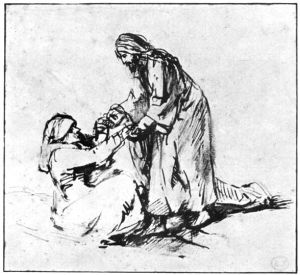
“Immediately” on hearing about mother-in-law, Jesus marches to her. Jesus doesn’t knock on the door to make sure if mother-in-law is decent or presentable enough for Him to enter the room. Jesus doesn’t pause. He simply goes to her. He enters the woman’s room and sits next to her bed – not really a place for a man to be. Jesus heals Peter's Mother-in-law 1Here is the Messiah, the Holy One of God, who is preaching about the reign of God – whose presence is the reign of God. Straight to the bed and to the feverish, flustered women He comes. “There is nothing more important in all the world than for Jesus to be there for the sick woman” (Nagel). Sent with the task of redeeming the whole world, Jesus is there just for her.
Jesus takes her by the hand. Jesus lifts her up, and the fever leaves her. Last week, the demon asked Jesus, “Have You come to destroy us?” But now, the Man whose presence puts the fear of fire into demons removes the fire of fever from Peter’s mother-in-law.

She doesn’t begin to worship Jesus. She doesn’t leave her family to dedicate herself to some spiritual service to God. She does what is right for her to do. She serves. She puts on the coffee and cooks her favorite recipe.

You know how weak you can be when you are sick and even when you get better it still takes days for your strength to return? Yeah, none of that here. Mother-in-law moves from coughing, feverish, and bed-ridden to serving. The restoration that Jesus brings is full and complete. No trace of the fever remains. The fever “left” her. Just so you know, that’s the same word that gets translated often as “forgive.”

From that day on she was never the same. She knew to whom she was precious – to Jesus, the Man whom the boys had brought home. That old woman knew that the reign of God had come to her.

Just as Jesus was for Peter’s mother-in-law so He is for you. He doesn’t look for people who are worthy. He doesn’t seek the pure and holy. He walks straight to those who are unworthy. He approaches those who are in need. Only His worthiness matters. He walks to you, not you to Him. He takes you by the hand, you don’t take His. “He gives power to the faint, and to him who has no might He increases strength” (Is. 40:29).

Jesus lifted Peter’s mother-in-law up. He lifts you up too. “Lifts you up” – that’s the word for “resurrection.” He resurrects you who are dead in sin. He forgives you, removing your sin and restoring you. He does all this so that “at the last day, [He] will raise up [you] and all the dead and will grant everlasting life to [you] and to all who believe in Christ. This is most certainly true.”

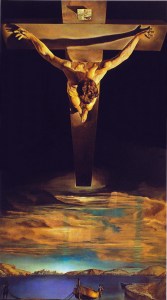
As important as it was for Jesus to do all of this for Peter’s mother-in-law, Jesus wasn’t content just raising her up. He wasn’t satisfied healing all the sick and demonized in Capernaum. He insists on moving on. Christ of St John on the Cross Salvador DaliHe has one goal in mind. He has come to do His Father’s will. He has come to die. Jesus dies for the same reason you will die – because of sin. Jesus raises you up because He was raised up from the earth on the cross with the sins of the world on Himself. Because of His death, your sins have left you. Because He rose again from the dead, you can know that you too will rise from the dead. In your baptism you were united with Jesus’ death so you too can rise again (Ro. 6:4-5).
Jesus brings the reign of God to you so that He can fill you. You can go from this house raised up by Jesus with your sins gone. Jesus is present here, bringing the reign of God to you. There is nothing more important in all the world to Jesus than to be here for you. He sees your helplessness. He knows your unworthiness. But He is not deterred. He comes to you. Takes you by the hand. Raises you up. He serves you. And all your evil, all your sin, all your badness leaves you.

And your life is forever changed. You know to whom you are important. You know to whom you belong. You know that Jesus has brought the reign of God to you. Amen.[1]

The peace of God, which surpasses all understanding, will guard your hearts and minds in Christ Jesus. Amen.


[1] I am thankful to a sermon by Rev. Dr. Norman Nagel as inspiration for this sermon.

Mark 1:21-28 – Unclean? No Problem!

Listen here.

Mark 1:21–28

21 And they went into Capernaum, and immediately on the Sabbath he entered the synagogue and was teaching. 22 And they were astonished at his teaching, for he taught them as one who had authority, and not as the scribes. 23 And immediately there was in their synagogue a man with an unclean spirit. And he cried out, 24 “What have you to do with us, Jesus of Nazareth? Have you come to destroy us? I know who you are—the Holy One of God.” 25 But Jesus rebuked him, saying, “Be silent, and come out of him!” 26 And the unclean spirit, convulsing him and crying out with a loud voice, came out of him. 27 And they were all amazed, so that they questioned among themselves, saying, “What is this? A new teaching with authority! He commands even the unclean spirits, and they obey him.” 28 And at once his fame spread everywhere throughout all the surrounding region of Galilee.

In the name of Jesus. Amen.

This Sabbath probably began like every other Sabbath in Capernaum. Families were scrambling to get ready and out the door so they could to go to synagogue. Fathers hounding their kids to finish breakfast and get their teeth brushed because they already running late. Mothers arguing with daughters about what was and what was not appropriate to wear to synagogue. Sons complaining that the services were too long. Elderly people trying to prepare themselves for another boring sermon. Boring sermons are nothing new.

People entered the synagogue and nestled themselves into the benches that served as pews (pews aren’t new either). The liturgy began. Opening prayers taken from the Psalms were prayed. The hymns were sung. The creed confessed. The Scripture lessons read. With the Scriptures still ringing in their ears, it was time for the sermon. Normally, the preacher would cite rabbi after rabbi. “Rabbi so-and-so learned from rabbi so-and-so who learned from rabbi so-and-so who learned from rabbi so-and-so that this text means….” Scintillating, isn’t it?

But this seemingly normal Sabbath would take a turn. Things would never be the same for the faithful of Capernaum. Today, they would hear a message from God unlike any other. They would hear God speak. They would hear God’s word from the lips of the Prophet that Moses spoke of (Dt. 18:15-19). But this Prophet was more than a prophet. His words were the words of God spoken by the Word of God made flesh.

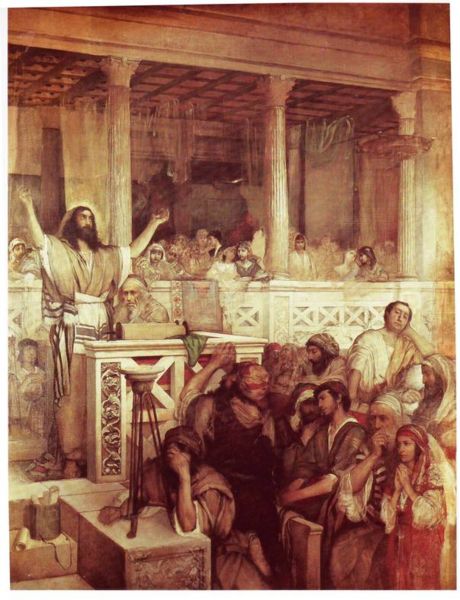
Jesus Teaching at CapernaumThis particular Sabbath, Jesus preaches. But Jesus doesn’t preach like anyone else. Jesus preaches with authority, “You have heard it said of old… but I say to you (Mt. 5:21ff). Oh, and by the way, the time is fulfilled and reign of God is here. Get rid of your sin. Confess it. I’ll take it. I’ll deal with it, and it will be gone forever. Repent and believe the Gospel.”

The people are sitting there in their pews and thinking, “Whoa. This is different.” Some find it refreshing; others find it disturbing. The best way to get people riled up is to change something at church. But as disturbed as the people sitting in the pews were. Satan and the demons were even more upset.

Right in the middle of Jesus’ sermon, all hell breaks loose – literally. A man with an unclean spirit – a demon – was present in the synagogue that day. In the middle of holy worship, a demon cries out, “What have You to do with us, Jesus of Nazareth? Have you come to destroy us? I know who you are – the Holy One of God.”

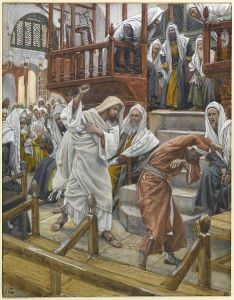
Jesus heals a Demonic at CapernaumBut Jesus keeps right on preaching. He preaches directly to the demon. He doesn’t use swift spiritual ninja moves to shut the demon up. He simply uses words, “Be silent, and come out of Him.” And the evil, unclean spirit obeys. The demon threw the man into convulsions. And the screaming – can you imagine how violent this would have looked? And all of this is happening right in the middle of church! But the evil spirit leaves and the man is unharmed (Lk. 4:35).

The normal reverence of the service was gone. People erupted in astonishment. “What is going on here? We hear this new teaching – these Gospel-filled words – and now we see evil spirits obeying this Guy? This is crazy!” It was the talk of the town. The news spread. Twitter lit up. People throughout the region were hearing about this Jesus who uses words with authority.

Today, we tend to hear stories like this and think of some bygone era when miracles took place. We wonder where the epic battles between God and the forces of hell are taking place today. Maybe we wish something like this would happen here at Christ the King. If we could see this happen, then we would have a story for our friends and neighbors, “Hey, you’ll never guessed what happened at church this week…” Maybe then more people would come and we’d have to add those extra spaces to our parking lot. Maybe we’d even have to add a second service or build a larger sanctuary. But here we are with nothing but our same old liturgy, the same old sermons, the same old words.

But hold on now; just a second. The same Jesus who teaches with authority and commands evil spirits is the same God who is speaking through the liturgy, through the sermons, through the same words.

The demon asked Jesus, “Have you come to destroy us?” The answer is, “Yes.” Jesus came to destroy the power that Satan, the demons, death, sin, and all evil has over His creation. These few verses from Mark are a microcosm of what Jesus, the Holy One of God, does here and now.

You see, there are only two kingdoms – a kingdom of darkness and a kingdom of light. A kingdom of evil and a kingdom of holiness. You are either under the lordship of Satan or under the lordship of God. There’s no such thing as dual citizenship.

Assailed by DemonsThe forces of hell assail our worship today. Demons are here. You have brought them with you into this holy place. Your demons of drunkenness, your demons of gossip, your demons of adultery, your demons of hatred, your demons of laziness, your demons of despising the Word of God. Don’t just give them little pet names. Call them what they are! They are evil, wicked, damnable sins. They too need to be silenced and ripped out of you. And that is precisely why Christ is here – to remove your demons with His words.

And that is precisely what Jesus has done. He has conquered sin, death, the devil, and all of hell’s strength through His death and resurrection. And Jesus still wages war on evil through His Words. He’s been doing it all through our service. Through the Absolution, Jesus speaks His words to you that you are forgiven, freed, and made holy. Through this simple sermon, Jesus speaks to you that you are delivered by His prefect life, His atoning death, and His glorious resurrection. And, soon, the climax of it all, when you will come to this altar, when you will be fed the body of your Savior. Where your thirst for righteousness will be quenched by the blood of your Redeemer.

Are you unclean? Absolutely. But that’s no problem because here’s Jesus – for you. Amen.

The peace of God, which surpasses all understanding, will guard your hearts and minds in Christ Jesus. Amen.

Mark 1:14-20 – Repent & Believe

Listen here.

Mark 1:14-20

14 Now after John was arrested, Jesus came into Galilee, proclaiming the gospel of God, 15 and saying, “The time is fulfilled, and the reign of God is at hand; repent and believe in the gospel.”

Jesus calls the disciples by the sea16 Passing alongside the Sea of Galilee, He saw Simon and Andrew the brother of Simon casting a net into the sea, for they were fishermen. 17 And Jesus said to them, “Follow Me, and I will make you become fishers of men.” 18 And immediately they left their nets and followed Him. 19 And going on a little farther, He saw James the son of Zebedee and John His brother, who were in their boat mending the nets. 20 And immediately He called them, and they left their father Zebedee in the boat with the hired servants and followed Him.

In the name of Jesus. Amen.

You have heard two of the shortest sermons recorded in Scripture this morning. From Jonah’s cry, “Yet forty days, and Nineveh shall be overthrown!” (3:4) to Jesus’ proclamation, “The time is fulfilled, and the reign of God is at hand; repent and believe in the gospel.”

Jonah’s audience, the evil pagans of Nineveh, had an urgent timeline. Forty days is not a long time before annihilation. But Jesus’ call is even more urgent, “The time is fulfilled – the time is even now – and the reign of God is at hand. Repent and believe the gospel.”

Jonah’s sermon is very incomplete. He gives no Gospel, delivers no forgiveness. He doesn’t proclaim God’s mercy, only God’s judgment. If the time ever comes when you hear me preaching sermon after sermon proclaiming only God’s coming judgment on sin, run me out of here! Remove me from being your pastor because your only getting half the story – less than half. That is not how a shepherd should treat his flock.

However, even though Jonah proclaims nothing but Law, judgment, and destruction, God speaks His Word through Jonah’s mouth to miraculously bring about repentance and faith in the Ninevites. That is how powerful God’s Word is. God works through His Word to do His work of bringing people to repentance and faith.

The king of Nineveh took a shot in the dark when it came to repentance. He said (Jon. 3:9), “Who knows? God may turn and relent and turn from His fierce anger, so that we may not perish.” For all they knew, God would still destroy their city even if they repented. The people of Nineveh could have simply taken on the slogan, “Let us eat, drink, and be merry for in 39 days we die.” They didn’t know God’s nature or character because Jonah didn’t tell them. Jonah didn’t mention that God is slow to anger and abounding in steadfast love and mercy. But the Ninevites rolled the dice, and they did learn that God is merciful.

Jesus’ sermon is complete. Today, through my voice, Jesus says to you, “The time is fulfilled, and the reign of God is at hand. Repent and believe in the Gospel.”

Small Catechism - Confession IconToday, God brings His kingdom, His rule, His reign in this place, in this city, this state, this world. Repent. Turn from your sin. Confess your sin. Do you know what that word confess means? It literally means ‘to say the same thing as.’ Every week, you come here and together we all say the same thing about ourselves and our sin as God says about us and our sin. We are poor sinners. We are, by nature, down to our core, sinful and unclean, unfit to be in God’s presence. Throughout the week, we have sinned against God in thought, word, and deed. You are damnable. I am damnable.

“Repent,” this is the command of your Lord and Savior, Jesus Christ. But this very command is not something we are able to do. We cannot repent. But this word, “Repent,” from Jesus creates exactly what it calls for. Don’t look at your repentance or confession as the part you have to do to be saved. Repentance is not your work (Act. 5:31; 11:18; 2 Tim. 2:25). That’s a good thing. How could you ever know if you have really repented enough? Your sin is so bad that you are dead. Last I checked, dead people don’t do anything.

Think back to creation. When God said, “Let there be light,” light obeyed the word of God. God spoke into the void, and that which did not exist obeyed. When God said, “Let the earth sprout vegetation,” it just happened. Plants, grass, and trees simply grew and produced fruit and seed. The very nature of God’s Word is that it creates, and it always creates what it calls for.

Jesus’ call to repent is the same. Spoken by the lips of Jesus, the command, “Repent,” creates the very repentance demanded. But it can and does, sadly, happen that some resist and defy God’s Word. “In between repentance and defiance is the mystery of the Holy Spirit’s work” (Rev. Timothy Winterstein).

The same goes for Jesus’ command, “Believe the gospel.” By our own reason and strength, we cannot believe in Jesus Christ as Lord or come to Him. But the power of Jesus’ word creates belief and faith as the Spirit works. A simple word from Jesus moves the dead to life. The living Gospel brings life to the dead.

The people of Nineveh didn’t know what would happen if they repented; Jonah didn’t even tell them to repent. But you know. Jesus gives the Gospel because He is the Gospel. He is the one who miraculously took away your sins through His death on the cross.

You are here because of Jesus. Jesus’ call to Andrew and Simon and James and John has left the shores of the sea of Galilee and echoes through the millennia to you here today. Jesus calls you just as He called them, “Follow Me.” Though I do have to say that translation is too clean. Literally, Jesus says, “Com’ere [sic], behind Me.” And, now, here you are – behind Jesus.

Small Catechism - Jesus on Trial IconLiving in repentance and faith and being behind Jesus means you are different. The time is short, and the present form of this world is passing away (1 Cor. 7:29, 31). Jesus has called you out of this world to be behind Him wherever He goes. Where He goes proclaiming the Gospel, you also go. You go freed from having to live as though the things of this world matter. You can walk through the things of this world knowing that nothing matters except that you are repentant, believing, and behind Jesus.

You know that Jesus has placed you behind Him living with your spouse, your children, your jobs, and your stuff as salt and light. You are in this world now as God’s own child, repentant and forgiven. Living in the present reign of God, and being His voice calling others into His reign. Amen.

The peace of God, which surpasses all understanding, will guard your hearts and minds in Christ Jesus. Amen.