John 1:43-51 – Greater Things

Listen here.

John 1:43-51

43 The next day Jesus decided to go to Galilee. He found Philip and said to him, “Follow me.” 44 Now Philip was from Bethsaida, the city of Andrew and Peter. 45 Philip found Nathanael and said to him, “We have found him of whom Moses in the Law and also the prophets wrote, Jesus of Nazareth, the son of Joseph.” 46 Nathanael said to him, “Can anything good come out of Nazareth?” Philip said to him, “Come and see.” 47 Jesus saw Nathanael coming toward him and said of him, “Behold, an Israelite indeed, in whom there is no deceit!” 48 Nathanael said to him, “How do you know me?” Jesus answered him, “Before Philip called you, when you were under the fig tree, I saw you.” 49 Nathanael answered him, “Rabbi, you are the Son of God! You are the King of Israel!” 50 Jesus answered him, “Because I said to you, ‘I saw you under the fig tree,’ do you believe? You will see greater things than these.” 51 And he said to him, “Truly, truly, I say to you, you will see heaven opened, and the angels of God ascending and descending on the Son of Man.”

In the name of Jesus. Amen.

Again, these words of Jesus, “Because I said to you, ‘I saw you under the fig tree,’ do you believe? You will see greater things than these. Truly, truly, I say to you, you will see heaven opened, and the angels of God ascending and descending on the Son of Man.”

I want to tell you a nasty story. It is about a whole family that was sneaking around and backstabbing each other. Isaac and Rebekah had twin sons – Esau and Jacob. Isaac loved Esau, but Rebekah loved Jacob (Gen. 25:28). Esau and Jacob had been fighting since they were in Rebekah’s womb. Two brothers fighting is hardly a new phenomenon, but this was bigger than a typical sibling rivalry. Jacob and his mother Rebekah had plotted to lie to Isaac in order to steal Esau’s blessing. They planned every last detail. Rebekah would cook Isaac’s favorite meal, like Esau would have prepared. Isaac had become blind in his old age, so Rebekah told Jacob to wear animal skins so that he would feel hairy like his brother Esau. Rebekah even had Jacob put on some of Esau’s cloths so that Jacob would smell like Esau.

When Jacob came into Isaac’s room to steal the blessing, Isaac was unsure at first. He recognized the voice as Jacob’s. But twice Jacob lied, insisting that he was Esau. When Isaac felt the hairy animal skins, which felt like Esau, and when he smelled Esau’s cloths, he took the bait and blessed Jacob.

When Esau found out, he was so enraged that he decided he would kill his brother. But Rebekah heard about Esau’s plot. She told Jacob to flee to her relatives who lived far north.

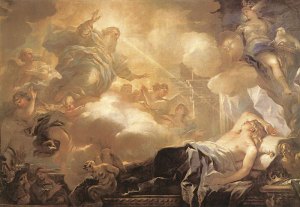
With his life in danger, Jacob flees alone with only the cloths on his back. When the sun set, Jacob stopped. He lied down to sleep with a rock for his pillow. His own actions had brought him to this lonely place. His head is filled with regrets, and his future is one of fear. Finally, he falls asleep and has a dream – a strange dream.
In this dream, JaJacob's Laddercob sees a ladder touching the earth and reaching up to heaven. On that ladder, angels ascend and descend – up and down, down and up. From earth to heaven, from heaven to earth. Jacob sees the bridge between Creator and creature. He hears God speak to him.

God had watched as Jacob maliciously plotted with his mother, stole from his brother, lied to his father, and ran away. So what would you expect God would say to little, wretched Jacob? Something like, “You little twerp, you’ve really done it now. You’re alone, alienated from your family. You have a rock for a pillow. But you sure do deserve it.” But God doesn’t say anything like that.

Listen to what God actually says, “I am the Lord, the God of Abraham your grandfather and the God of Isaac your father. I am your God too. I am with you. I will keep you wherever you go. I will give you so many offspring that they will be like the dust of the earth. And in you and your offspring shall all the families of the earth be blessed. I will not leave you until I have done all that I have promised you.”

After this, Jacob woke up. He set up that stone that he used as a pillow as a pillar, and named that place Bethel – “house of God.” That very spot became a place of worship for the people of Israel when they were taking possession of the Promised Land. The Israelites knew that when you worshiped at Bethel, at the “house of God,” God was present there.

Jacob’s dream is what Jesus is referring to when He tells Nathaniel and the other disciples (the ‘you’ here is plural) ”Truly, truly, I say to you, you will see heaven opened, and the angels of God ascending and descending on the Son of Man.”

Nathaniel was impressed when Jesus knew about him before they even met – so impressed that he confesses that Jesus is the Son of God and King of Israel. But that’s just the beginning of what Nathaniel and the other disciples will see. They will see that Jesus is what Jacob’s ladder was pointing to. They will see the reality of what Jacob saw in a dream. They will see what it actually looks like when God makes His house on earth. They will see that Jesus, the Son of God and Son of Man, is the link between heaven and earth, between God and man. They will see that Jesus has fused heaven and earth together in His very body (Rev. Chad Bird).

Nathaniel and the disciples saw many miracles: Jesus turning water into wine, feeding the hungry, cleansing lepers, making the lame to walk, giving sight to the blind, and raising the dead. But they saw and heard even greater things than these. They heard God Himself forgiving sins. They ate Jesus’ very body and blood. They saw God delivering Himself into the hands of evil, wicked men. They saw God die. They saw God’s corpse placed into the ground. They saw Jesus raised from the dead. They saw the physical body of Christ ascend into heaven.

Jesus Cross Heaven & EarthJesus has come and heaven is opened to you. Heaven is just a short ladder away. A ladder with one rung – the ladder of the cross. Through the cross, Jesus has united heaven and earth. Even if you may not see it with your eyes, you see it through faith. When you were baptized, when you eat and drink Communion, when you receive the absolution, or listen to a sermon, heaven is open. You hear the voice of your heavenly Father.

Just as God knew what Jacob had done – all his deceit, all his trickery, all this thieving – God knows what you have done too. He knows your treachery. He knows your hatred toward your neighbor and brothers and sisters. He knows all your malicious thoughts and intents. And yet, He still died for you. He still forgives you. He promises to be with you wherever you go and bless you. He promises to be your God, and He will never leave you or forsake you. Amen.

The peace of God, which surpasses all understanding, will guard your hearts and minds in Christ Jesus. Amen.

Mark 1:4-11 – God, Water, Death, & Life

Listen here.

Mark 1:4-11

4 John appeared, baptizing in the wilderness and proclaiming a baptism of repentance for the forgiveness of sins. 5 And all the country of Judea and all Jerusalem were going out to him and were being baptized by him in the river Jordan, confessing their sins. 6 Now John was clothed with camel’s hair and wore a leather belt around his waist and ate locusts and wild honey.

7 And he preached, saying, “After me comes he who is mightier than I, the strap of whose sandals I am not worthy to stoop down and untie. 8 I have baptized you with water, but he will baptize you with the Holy Spirit.”

Baptism of Christ - Theophany9 In those days Jesus came from Nazareth of Galilee and was baptized by John in the Jordan. 10 And when he came up out of the water, immediately he saw the heavens being torn open and the Spirit descending on him like a dove. 11 And a voice came from heaven, “You are my beloved Son; with you I am well pleased.”
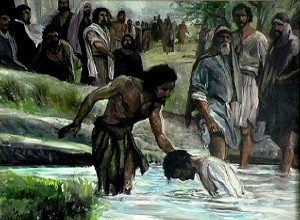
In the name of Jesus. Amen.

I’m not a person who enjoys taking a bath. Maybe once every other year, I’ll take a bath to relax, but not to get clean. For one thing, I’m too tall to fit nicely in a bathtub. But mostly, I don’t feel clean after a bath. Showers, now, showers are great – the water washes the dirt right down the drain. With a bath, you just sit in your own filth.

Imagine though, taking a bath in someone else’s used bathwater. It’s not really a nice thought, is it? We are blessed with plenty of clean water in our country so we don’t have to even consider doing that in an attempt to make ourselves clean.

In our Gospel text, John the Baptizer is doing his thing – baptizing and preaching. John came on the scene preaching a baptism which led to and resulted in repentance. Sometimes this gets turned around by people with a theological agenda. John was not baptizing people because they were repentant. Instead, the baptism they received brought the people to repentance (the grammar here makes it very clear, so does Mt. 3:11). Jesus' BaptismPeople heard John’s preaching, got baptized, and became repentant people. A lot of people did. “All the country of Judea and all Jerusalem were going out to him and were being baptized by him in the river Jordan, confessing their sins.” That’s a lot of people.
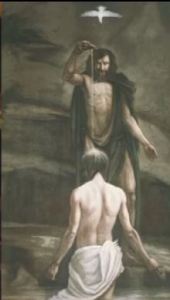
Men, women, children, and even infants (unless there were no infants in all of Judea and Jerusalem) were all going out to be baptized by John and going home repentant people. They came and their sins were washed away in the waters of the Jordan.

Now, imagine having the eyes of God and seeing all the sins of all the people of Judea and Jerusalem mucking up the Jordan River. It would be a cesspool. The Parks & Rec. Department should shut down the beach and send everyone home. They would call in teams wearing hazmat suits to get the clean-up effort started. The headlines would read, “Jordan River Becomes Toxic with Sin.”

Now, here comes Jesus to the Jordan River, and He is here to be baptized. John tried to prevent Jesus from being baptized. Mark doesn’t record it this, but Matthew does. John said (Mt. 3:14), “I have need to be baptized by You, and do You come to me? This isn’t right, Jesus. What do You think You’re doing?”

John is thinking like we do. We think that God must stay separate from sinners. Sinners should have to move to God – not the other way around. But Jesus is not going to hear of it. Jesus is here to be with sinners, to stand next to us, to identify with us. Jesus will be baptized. He will go down to those sin infested waters and be washed.

But unlike the sinners coming to John, Jesus has nothing to be repentant of. Jesus is not washed to remove His sins and make Him repentant – just the opposite. Like a filter, Jesus sucks all the sin, all of the filth, all of the muck out of the water into Himself. Jesus takes on all that has gone wrong with us, all our sins. God made Jesus, who knew no sin, to be sin for your sake.

We often think of Jesus bearing our sin on the cross, and He did. But His baptism is where He began to be the sin-bearing Messiah. John says as much later. When he tells people about the time he baptized Jesus, he says, “Behold the Lamb of God who takes away the sin of the world” (Jn. 1:29).

In His baptism, Jesus fulfills Isaiah’s prophecy in Is. 53:11 that God’s Servant, God’s righteous One, shall bear their iniquities. In His baptism, Jesus takes your sin and the sin of the whole world so He could bear that sin to the cross and to the grave.

And now you who are baptized into Christ Jesus are baptized into His death. That’s right. In your baptism, you have already died the only death that will have any lasting significance for you. God uses the waters of your baptism to put you to death with Jesus – but no so He can leave you there. Because remember what happened to dead Jesus. He rose again. If you die with Jesus, you certainly will rise with Jesus.

Jesus' Baptism Spirit DescendsSo there is Jesus, in those sin-filled waters, receiving a sinner’s baptism. He comes out of the waters and God shows up, and God shows up violently. Immediately the heavens were torn open. But it doesn’t stay violent. Normally, when God shows up like this, people are falling to the ground in fear. But instead of fear and trembling in the presence of God, a dove, a sign of peace, descends. The Holy Spirit comes in peace and descends, literally, “into” Jesus. And the voice of God says, “You are my beloved Son; with you I am well pleased.”
God’s pleasure and delight is in His Son, Jesus. And that is where you are. “As many of you who have been baptized into Christ have put on Christ” (Gal. 3:27).

God is not far off. He is not aloof. He is not separate. In fact, God has come straight to you. He walked right up to you and took your sin. Jesus was baptized to become your sin-bearer. Where your sins are is where Jesus is. And where Jesus’ righteousness is, is where you are (Nagel).

Jesus has taken every last thing that is wrong with you. He has taken it away and, in return, He has given you His righteousness. Amen.

The peace of God, which surpasses all understanding, will guard your hearts and minds in Christ Jesus. Amen.

1 Kings 3:1-15 – The Folly of Wisdom

Listen here.

1 Kings 3:1-15

1 Solomon made a marriage alliance with Pharaoh king of Egypt. He took Pharaoh’s daughter and brought her into the city of David until he had finished building his own house and the house of the Lord and the wall around Jerusalem. 2 The people were sacrificing at the high places, however, because no house had yet been built for the name of the Lord.

3 Solomon loved the Lord, walking in the statutes of David his father, only he sacrificed and made offerings at the high places. 4 And the king went to Gibeon to sacrifice there, for that was the great high place. Solomon used to offer a thousand burnt offerings on that altar. 5 At Gibeon the Lord appeared to Solomon in a dream by night, and God said, “Ask what I shall give you.” 6 And Solomon said, “You have shown great and steadfast love to your servant David my father, when he walked before you in faithfulness, in righteousness, and in uprightness of heart toward you. And you have kept for him this great and steadfast love and have given him a son to sit on his throne this day. 7 And now, O Lord my God, you have made your servant king in place of David my father, although I am but a little child. I do not know how to go out or come in. 8 And your servant is in the midst of your people whom you have chosen, a great people, too many to be numbered or counted for multitude. 9 Give your servant therefore an understanding mind to govern your people, that I may discern between good and evil, for who is able to govern this your great people?”

10 It pleased the Lord that Solomon had asked this. 11 And God said to him, “Because you have asked this, and have not asked for yourself long life or riches or the life of your enemies, but have asked for yourself understanding to discern what is right, 12 behold, I now do according to your word. Behold, I give you a wise and discerning mind, so that none like you has been before you and none like you shall arise after you. 13 I give you also what you have not asked, both riches and honor, so that no other king shall compare with you, all your days. 14 And if you will walk in my ways, keeping my statutes and my commandments, as your father David walked, then I will lengthen your days.”

15 And Solomon awoke, and behold, it was a dream. Then he came to Jerusalem and stood before the ark of the covenant of the Lord, and offered up burnt offerings and peace offerings, and made a feast for all his servants.

In the name of Jesus. Amen.

I remember watching the movie Aladdin as a kid. You know the story of the street rat stumbling upon a magic lamp and being granted three wishes by Robin Williams – I mean a genie. I remember daydreaming about what I would do if I was ever granted three wishes. Visions of piles of money, a huge mansion, and a peaceful life distracted my grade-school mind from long division; participles, infinitives, and gerunds; and plant science. In the movie, Aladdin decides that two wishes are enough for himself, and he promises to use his third wish to free the genie. You can certainly get a lot with two wishes. Most people would even be happy with one wish. One wish, rightly used, could solve most, if not all, your problems.

Solomon has just taken over as king. He blows out the candles on his coronation cake, and God tells him to ask for anything. “At Gibeon Yahweh appeared to Solomon in a dream by night, and God said, ‘Ask what I shall give you.’”

Solomon Asks God for WisdomNow, Solomon could have used a lot of things. Solomon was not David’s oldest son. Several of his brothers were in line before him to sit on the throne of David. But David chose Solomon to be king after him. The previous chapter, 1 Kings 2, is filled with Solomon wading through the mess of killing people who opposed him and David. It’s not easy becoming king. Solomon could have really used wealth and power to his advantage, as any new, young king could. But Solomon puts power and wealth to the side.

To our worldly minds, it looks like a mistake. It looks like Solomon wastes the biggest opportunity of his life. The all-powerful God of the universe says that He will give Solomon anything, but Solomon throws all worldly things away. He doesn’t ask for riches or power or fame. Solomon lets all those things go.

Instead, Solomon remembers how God had dealt with his father, David. Remember who Solomon’s mother was and how she became the king’s wife? David had lusted after Solomon’s mother, Bathsheba, while she was another man’s wife. David got Bathsheba pregnant, and to cover up his sin, he murdered her husband. But God was merciful and gracious toward David forgiving him of these terrible sins. And God showered David with great and steadfast love and mercy. And Solomon remembers all of that first and foremost.

Now when God tells Solomon to ask Him for anything, Solomon doesn’t treat God as just a magic genie who will grant one wish and go back into his lamp to sleep for a thousand years. Instead, he knows that his God is merciful and gracious. That’s a good kind of God to have around. So Solomon asks for an understanding mind.

Solomon recognizes that he is king only because of God’s great and steadfast love. He recognizes his inadequacies to be king and humbles himself. He asks God to give him discernment to govern God’s great people. By itself, this request shows wisdom, and it pleased God.

God grants Solomon’s request, and God says He will add even more. As icing on the cake, God says that He will, willy-nilly, throw in the riches and honor that Solomon didn’t ask for.

Now, I’d be a terrible preacher if I ended the sermon here and said, “Now, go be like Solomon.” You know what happens to Solomon. He is blessed with wisdom, and his wisdom makes him world-famous (1 Kgs. 10:24), but he recognizes the emptiness of wisdom and fame (Ecc. 1:12-18). Solomon is blessed with riches, but he wrote later that he was never satisfied with the wealth that God gave him (Ecc. 4:8, 6:1-2). Even a long life was not a blessing to Solomon. He said that, since he found no satisfaction in the good things God gave him, a stillborn child is better off than he was (Ecc. 6:3).

Wisdom is a gift from God, but wisdom itself is not the doorway to peace with God. Wealth is a gift from God, but all the riches in the world will not buy your way into eternal life. Solomon’s wisdom, wealth, fame, honor, and power distracted him. Through his life, Solomon forgot that God was the source of those blessings. As his grew older, Solomon saw the emptiness and vanity of all these good gifts from God.

So where should the sermon go from here?

Scripture speaks of another wisdom in 1 Cor. 2:7, a secret and hidden wisdom from God that looks foolish to the world. “In the wisdom of God, the world did not know God through wisdom, [therefore] it pleased God through the folly of what we preach to save those who believe” (1 Cor. 1:21). This wisdom is Jesus Christ and Him crucified. It is the wisdom that looks past the foolishness of God saving humanity through the death of a Man on a cross.

Passion of Christ on the CrossReal wisdom finds God where He has said He is – even when it sounds foolish. Wisdom sees the King of kings born not in a capitol city but in the little town of Bethlehem. Wisdom finds the Good Shepherd not hunting wolves and bears but hidden in the manger. Wisdom sees a helpless infant as the Creator of the universe. Wisdom sees the death of a carpenter’s Son on a cross as the way God punishes of the sin of the world. Wisdom sees the emptiness of a tomb and believes that guilt is gone.

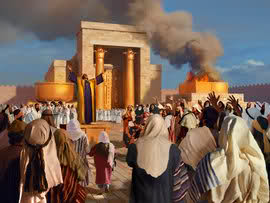
Anyone can see God’s power by looking around at creation. But only through faith can anyone see God delivering His grace through something as simple as the Word and Sacraments. Only by faith, can we find God working through bread and wine to forgive sins. Amen.

May the peace of God which surpasses all understanding guard your hearts and minds in Christ Jesus. Amen.

Luke 1:26-38 – Call Him Jesus

Listen here.

Luke 1:26-38

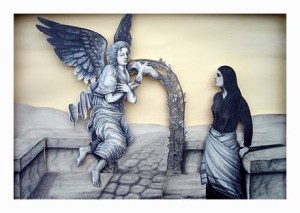
26 In the sixth month the angel Gabriel was sent from God to a city of Galilee named Nazareth, 27 to a virgin betrothed to a man whose name was Joseph, of the house of David. And the virgin’s name was Mary. 28 And he came to her and said, “Greetings, O favored one, the Lord is with you!” 29 But she was greatly troubled at the saying, and tried to discern what sort of greeting this might be. 30 And the angel said to her,Gabriel Visits Mary

“Do not be afraid, Mary, for you have found favor with God.

31 And behold, you will conceive in your womb and bear a son,
and you shall call his name Jesus.

32 He will be great and will be called the Son of the Most High.
And the Lord God will give to him the throne of his father David,

33 and he will reign over the house of Jacob forever,
and of his kingdom there will be no end.”

34 And Mary said to the angel, “How will this be, since I am a virgin?”

35 And the angel answered her,

“The Holy Spirit will come upon you,
and the power of the Most High will overshadow you;

therefore the child to be born will be called holy—
the Son of God.

36 And behold, your relative Elizabeth in her old age has also conceived a son, and this is the sixth month with her who was called barren. 37 For nothing will be impossible with God.”

38 And Mary said, “Behold, I am the servant of the Lord; let it be to me according to your word.” And the angel departed from her.

In the name of Jesus. Amen.

“Behold, you will conceive in your womb and bear a Son, and you shall call His name Jesus.”

These twelve verses are packed with salvation, they are filled with deliverance, they are stuffed with wonder and power and mystery and Gospel.

In these verses, we hear the basis for what we confess in the Nicene Creed: Jesus Christ, the Son of God “for us and for our salvation, came down from heaven, and was incarnate by the Holy Spirit of the Virgin Mary.”

In these verses, we hear the details of that mysterious beginning of John’s Gospel: “In the beginning was the Word, and the Word was with God and the Word was God…. And the Word became flesh and tabernacled among us” (Jn. 1:1, 14).

Small Catechism - Creed IconThis text tells us about the first new thing since the beginning of creation – a virgin becomes pregnant with a Son. This had never happened before, and it will never happen again. In a completely new and unique way God did what He had been doing since the beginning. He comes to dwell – to tabernacle – with His people.

When God led His people out of slavery in Egypt, God was present with them in a pillar of cloud by day and a pillar of fire by night. As Israel wandered in the wilderness, God instructed them to build the Tabernacle. After it was completed, Exodus 40:34-38 says that the cloud covered – it ‘overshadowed’ – the Tabernacle and the glory of Yahweh filled it.

For several hundred years, the Tabernacle continued to be the place where God dwelt among His people. Then, in our Old Testament text (2 Samuel 7:1-16), David realizes something – he is living in a nice, warm, comfortable house, but God is dwelling in a tent. Tents are for camping. Someone has said, “Camping is fun, if you like to pretend to be homeless.” So David decided to build God a house. But God told David that He had something much better in store. Through Nathan, God told David, “No, David. You’re not going to build a house for Me. I’m going to build a house for you. Your house and your kingdom shall be established forever.”

Solomon Dedicates the TempleAfter David died, Solomon built the Temple. 1 Kings 8 tells how the priests took the ark of the covenant and placed it in the Temple. Again, the cloud descended on the Temple – think ‘overshadowed’ again – and the glory of Yahweh filled the Temple.
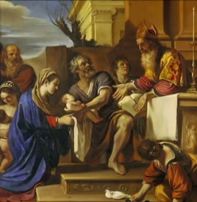
As more centuries passed, the people of Israel began to sacrifice to pagan gods. Because of this, God sent the people into exile and allowed Babylon to destroy His Temple. Then when King Cyrus let the people of Israel return to their land, he told them to rebuild the Temple. But when this second Temple was dedicated, the cloud did not overshadow it. God’s glory did not return. This was very troubling for the people of Israel. God’s glory had departed, and it hadn’t come back.

However, through the prophets, God repeatedly promised that His glory would return to His Temple (Hag. 2:19, Zech. 8-9). Centuries passed, but God’s glory still did not return. Fast-forward several hundred years, King Herod began a large building project improving the second Temple and the grounds around it. But still, the glory did not return.

Then, suddenly, right here in our text, Gabriel tells Mary, “The Holy Spirit will come upon you, and the power of the Most High will overshadow you.” God’s messenger, Gabriel, tells Mary, “The glory and the cloud is going to descend upon you, Mary. God is coming again to dwell with His people.” Jesus presented in the Temple SimeonFor the nine months of her pregnancy, Mary was literally the temple, the place where God’s glory dwelt. And finally, when Jesus was 40 days old, God returned to His Temple.
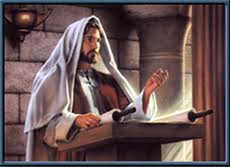

There are three miracles are in this text: First, God and man are joined together in the Child conceived in Mary’s womb. The second is that Mary, a virgin, would conceive a Child. But third, and most miraculously, that Mary believed God’s word that this would actually happen.

Now, Mary is not the first believer. Adam and Eve, Noah, Abraham, Isaac, Jacob, Joseph, Moses, Joshua, David, Isaiah, Jeremiah, and all the godly Old Testament believers had faith in God’s promised Messiah, the Christ. But Mary is the first to learn the identity of God’s Messiah. The Child conceived in her womb is the Savior of the world. Mary is first in the line of faith in the person of Jesus.

The church of Rome goes too far in exalting Mary, and they are wrong to do so. However, we Christians outside of the Roman church have made the opposite error. We lower Mary too much. Mary truly is the mother of God. God was with Mary in a way that He will never be with another human. If you believe the creeds, then this is what you believe.

God entered the womb of only one woman, Mary. But through that union, God enters you. Gabriel’s greeting to Mary (literally translated), “Rejoice, favored woman, the Lord is with you,” is also true for you. God was with Mary, so He can be your Emmanuel – God with you.

The glory of God that overshadowed the Tabernacle and the Temple and the glory of God that overshadowed Mary, also overshadows you. Yes, it is a miracle that a virgin conceives, but that is child’s play for the Lord and Giver of life. It is a miracle that God joined Himself to human flesh, but nothing is impossible with God.

The real miracle here is faith. That Mary believed these words of God is a miracle. However, God is doing that same miracle here and now. God speaks to you, now, through His Word. You have already confessed that you believe these words of God in the Creed. You have confessed that you believe that Jesus, this Son of Mary, died and rose again for your sins. Just like Mary, but with different words, you have said, “Behold, I am the slave of God. Let it be to me as you have said.” Amen.

The peace of God, which surpasses all understanding, will guard your hearts and minds in Christ Jesus. Amen.

Isaiah 61:1-4, 8-11

Listen here.

Isaiah 61:1-4, 8-11

1   The Spirit of the Lord God is upon me,
because the Lord has anointed me

to bring good news to the poor; Jesus Reading Isaiah
he has sent me to bind up the brokenhearted,

to proclaim liberty to the captives,
and the opening of the prison to those who are bound;

2   to proclaim the year of the Lord’s favor,
and the day of vengeance of our God;
to comfort all who mourn;

3   to grant to those who mourn in Zion—
to give them a beautiful headdress instead of ashes,

the oil of gladness instead of mourning,
the garment of praise instead of a faint spirit;

that they may be called oaks of righteousness,
the planting of the Lord, that he may be glorified.

4   They shall build up the ancient ruins;
they shall raise up the former devastations;

they shall repair the ruined cities,
the devastations of many generations.

8   For I the Lord love justice;
I hate robbery and wrong;

I will faithfully give them their recompense,
and I will make an everlasting covenant with them.

9   Their offspring shall be known among the nations,
and their descendants in the midst of the peoples;

all who see them shall acknowledge them,
that they are an offspring the Lord has blessed.

10 I will greatly rejoice in the Lord;
my soul shall exult in my God,

for he has clothed me with the garments of salvation;
he has covered me with the robe of righteousness,

as a bridegroom decks himself like a priest with a beautiful headdress,
and as a bride adorns herself with her jewels.

11 For as the earth brings forth its sprouts,
and as a garden causes what is sown in it to sprout up,

so the Lord God will cause righteousness and praise
to sprout up before all the nations.

In the name of Jesus. Amen.

Rocky & DragoWe love Cinderella stories. We want the down-and-out rise from the dust. We want characters move from rags to riches, orphans to become kings. We want Rocky to beat Drago. We love these stories because we want to be like them. We want to move up, climb the ladder, reach the top. We want to better ourselves, rise up, and thrive. But we’ve tried it and found that too often, it doesn’t work.
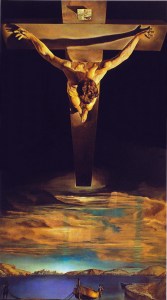
We tried to better ourselves in the Garden of Eden. God told us that we were good. We were whole and needed nothing more to be complete. Then, Satan presented Adam and Eve with the possibility of becoming more than they were. “When you eat of the tree, your eyes will be opened, and you will be like God, knowing good and evil. You can improve yourself. You will be better than you are now.”

Adam and Eve attempted to climb the ladder. They took from the tree and ate. Their eyes were opened. They became something more. Now, they knew evil – but it was not better.

The root of sin is seeking to improve ourselves. We want to take control of our own lives. We want to be the master of our own destiny. We keep looking up, striving to be more. We want to be our own god. But the more we try, the more we fail, the more we sin, and the worse we become.

Christ of St John on the Cross Salvador DaliGod is not like us. God does not look up – there is nothing above Him. God doesn’t even look side-to-side – there is no one like Him. God only looks down. God looks down to those who are beneath Him. Luther even says, “The farther one is beneath God, the better doss God see him.” God is far-sighted.
God has always acted this way. God brings good news to the poor. Even before God cursed poor Adam and Eve, He promised that He would crush Satan’s head.

God binds up the brokenhearted. After Cain killed Abel, God gave Adam and Eve another son, Seth.

God proclaims liberty to the captives. He delivered His people from slavery under Pharaoh.

God opens the prison to those who are bound. Whether it was the apostles Peter, John, or Paul. God opens any and all iron bars to release His people.

God gives a beautiful headdress instead of ashes. Abraham’s son Isaac was not reduced to ashes, instead God provided.

God gives the oil of gladness instead of mourning. Jesus forgave the sins of the woman who washed His feet with her tears.

God does all of this because it brings Him glory.

God sees our pathetic attempts to rise up and improve, and He has pity on us. So He came down. He came down in the most dramatic, humble way.

Your God came down and placed Himself in the womb of a poor peasant girl. Your God came down to be born at night in a cold barn. Your God let Himself be carried by His parents to another country to escape being slaughtered as an infant. Your God grew up in a little podunk town learning the trade of a carpenter. Your God was despised and rejected by His peers and relatives. Your God touched lepers. Your God ate with the tax collectors and prostitutes. Your God suffered. Your God bled. Your God died. He did all of this for you.

God’s glory isn’t to become something more than He already is. God can’t become anything more. God is glorified through what He does for you. He was anointed to bring good news to you who are poor. His glory is to bind up you, the brokenhearted, to proclaim liberty to you who are captive in sin, and releasing you even from the prison of death. Christ’s glory is to proclaim to you the year of Yahweh’s favor and to comfort you who mourn. He is glorified by giving you a beautiful headdress instead of ashes and oil of gladness and garments of praise.

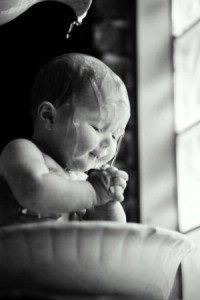
Baptism 2In your baptism, He clothed you in the garments of salvation. Through His Word, He covers you with the robe of righteousness.
Christ was anointed to do all of this for you. You, and the faithful believers who have come before you and who will come after you, you all are His garden, His planting. You produce the fruit of righteousness and praise. God has made His covenant with you, and He is always faithful to His promises. Amen.

The peace of God, which surpasses all understanding, will guard your hearts and minds in Christ Jesus. Amen.

2 Peter 3:8-14 – Relative Slowness

Listen here.

2 Peter 3:8-148 But do not overlook this one fact, beloved, that with the Lord one day is as a thousand years, and a thousand years as one day. 9 The Lord is not slow to fulfill his promise as some count slowness, but is patient toward you, not wishing that any should perish, but that all should reach repentance.

10 But the day of the Lord will come like a thief, and then the heavens will pass away with a roar, and the heavenly bodies will be burned up and dissolved, and the earth and the works that are done on it will be exposed. 11 Since all these things are thus to be dissolved, what sort of people ought you to be in lives of holiness and godliness, 12 waiting for and hastening the coming of the day of God, because of which the heavens will be set on fire and dissolved, and the heavenly bodies will melt as they burn! 13 But according to his promise we are waiting for new heavens and a new earth in which righteousness dwells.

14 Therefore, beloved, since you are waiting for these, be diligent to be found by him without spot or blemish, and at peace.

In the name of Jesus. Amen.

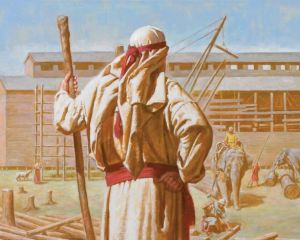
Noah Building the ArkThe earth was corrupt in God’s sight. Every intention of the thoughts of man’s heart was only evil continually (Gen. 6:5). So God told Noah, “Build an ark (lit. ‘a box), and make it big. I’m sending a flood. Everything that is on the earth shall die.” Now, if you were Noah, you’d be jumping in your car and speeding to Menards to get tools and building supplies. God didn’t tell Noah exactly when He would send the flood, and the ark would take a long time to make. It was a pretty big boat – bigger than a football field. But God gave Noah a promise. “I establish My covenant with you, I’ll keep you, your family, and the animals you take with you alive.”

Noah had a big job in front of him with an important deadline, a true deadline. Because of God’s wrath against sin, death was coming to everything. But 1 Peter 3:20 says that God patiently waited for Noah to build the ark. God was disgusted with His creation, but God was patient for Noah’s sake.

God is slow to anger and abounding in steadfast love and faithfulness.

Beloved by God, the day of the Lord is coming. God will again judge the wickedness of mankind. The heavens will pass away with a roar, and the heavenly bodies will be burned up, dissolve, and melt. That day will come unannounced, like a thief, like an army marching against a city. Watch.

A watchman’s work is boring. He waits and watches for something that may never come – he doesn’t know. But if a watchman becomes careless, grows impatient, and falls asleep on his watch, the results can be catastrophic – and not just for him. If the watchmen are asleep when the enemy or thief comes… well, nothing good can come from that.

Christ said He would return. He promised. But for 2,000 years now, believers have been watching and waiting. Even the Christians in Peter’s day were getting tired of waiting and watching. They had expected that Jesus would return before they died. But now false teachers were mocking them for believing that Christ would ever return. Peter even quotes them back in 2 Peter 3:4, “Where is the promise of Jesus’ coming? The fathers have died. And everything is the same as it has been since the beginning of creation.”

You can imagine the scoffers of Noah’s day. “What’s that big box for, Noah? There’s no water around here. Nothing bad is going to happen.” I would venture to guess there were days and weeks and months and years when the scoffers’ words got to Noah and made him wonder, “Why am I doing all this?” But then, the waters did come. The unbelievers were caught unaware. God came like a thief and took their lives away.

Most of the time, we don’t need scoffers to distract us into thinking Jesus won’t return. Today feels like yesterday, and yesterday felt like the day before. Most of the time, you don’t think about Jesus’ coming. Your life is manageable, so you get comfortable. You get sleepy. You don’t watch. You start to think that God is getting too old, too slow, too decrepit. You think that God doesn’t care.

But the Lord is not slow to fulfill His promise – at least, not as some count slowness. I love that line. What is any amount of time to God who is eternal? With the Lord one day is as a thousand years, and a thousand years as one day. Beloved, do not overlook this fact.

With the Lord, one day is as a thousand years. Our kids teach us that one hour can feel like 1,000 years. Monday night, before going to bed, Annalise trotted into the bathroom, emphatically picked up a cup, filled it, and stated, “I haven’t had a drink in 1,000 years.” She just had a full glass of water at supper.

Time, all of time, stands before God as a single thing. God sees every moment of created history right before Him. To God, Adam is just as close as you are. To God, a thousand years are as one day.

Jesus Second ComingWatch because God is not slow to fulfill His promises. Watch knowing that the time is soon. Maybe it isn’t what you call soon, but Jesus is coming soon. The creation will be dissolved, so live in holiness and godliness. Be diligent to be found by Him without spot or blemish and at peace.

Doomsday is coming, so be at peace. That sounds odd. Everything observable is going to be destroyed by fire, how can you be at peace? Because Jesus, your Savior, is coming. He is coming soon, and He is coming now in bread and wine. This meal of His supper purifies you. Jesus’ body and blood removes all spots, wrinkles, and blemishes. This meal gives you strength and feeds you for a life of godly and holy watching and waiting. Amen.

The peace of God, which surpasses all understanding, will guard your hearts and minds in Christ Jesus. Amen.

Mark 13:24-37 – In Those Days; In That Day

Mark 13:24–37 24 “But in those days, after that tribulation, the sun will be darkened, and the moon will not give its light, 25 and the stars will be falling from heaven, and the powers in the heavens will be shaken. 26 And then they will see the Son of Man coming in clouds with great power and glory. 27 And then he will send out the angels and gather his elect from the four winds, from the ends of the earth to the ends of heaven.

28 “From the fig tree learn its lesson: as soon as its branch becomes tender and puts out its leaves, you know that summer is near. 29 So also, when you see these things taking place, you know that he is near, at the very gates. 30 Truly, I say to you, this generation will not pass away until all these things take place. 31 Heaven and earth will pass away, but my words will not pass away.

32 “But concerning that day or that hour, no one knows, not even the angels in heaven, nor the Son, but only the Father. 33 Be on guard, keep awake. For you do not know when the time will come. 34 It is like a man going on a journey, when he leaves home and puts his servants in charge, each with his work, and commands the doorkeeper to stay awake. 35 Therefore stay awake—for you do not know when the master of the house will come, in the evening, or at midnight, or when the rooster crows, or in the morning— 36 lest he come suddenly and find you asleep. 37 And what I say to you I say to all: Stay awake.”

In the name of the Father, Son, and Holy Spirit, Amen.

“Stay awake… lest he come suddenly and find you asleep.  And what I say to you I say to all: Stay awake.”

You have maybe seen commercials for the National Geographic show Doomsday Preppers.  Individuals across the country are stockpiling seeds, food, ammunition, and potable water; they are building shelters, learning self-defense, and preparing their bodies to face what could be the “end of the world as we know it.”

Different individuals are preparing for various contingencies: earthquake, nuclear warhead, chemical attack, asteroid, electromagnetic pulse.  The commercial for Doomsday Preppers ends with an individual asking, “Am I nuts, or are you?”

My answer to that question would be, “Yes.”

“Stay awake.”  The whole chapter of Mk. 13 is Jesus’ answer to two questions.  The first question is when will the Temple will be destroyed and the second is when will the end of the age be.  In the mind of a Jew in Jesus day, the destruction of the Temple and the end of the world were the same event.  One-thousand-nine-hundred-forty-two years later, hopefully, we know better.  Jesus did not come back, the world did not end, when the Temple was destroyed in 70 A.D.  The majority of Jesus’ answer in Mk. 13 deals with when the Temple was destroyed—that is how Jesus can say, “This generation will not pass away until all these things take place” in v. 30.

And Jesus gives us a clue throughout Mk. 13 when He is speaking about the destruction of the Temple in 70 A.D. and when He is speaking about the end of the world.  It’s all about the difference between when Jesus says, “In those days,” all the way up until v. 32 when He says, “But concerning that day.”

Yes, even v. 24-27 are speaking about Jesus’ days before that “generation passed away.”

When Jesus says, “The sun will be darkened, and the moon will not give its light,”  He is speaking about His death.  At the hour of Jesus’ death, there was darkness covering the whole land (Mk. 15:33).  As He died, the curtain in the temple which had sun, moon, and stars upon it was torn in two; “the powers in the heavens [were] shaken.”

V. 26 ”And then they will see the Son of Man coming in clouds with great power and glory,”  is a quote from our OT text (Dan. 7:13,look at it).  You will notice that the Son of Man’s “coming” is not a descent to earth, but an ascent to the Ancient of Days.  Fits in pretty well with what Jesus said before He ascended into heaven.  Mt. 28:18–20 ”All authority in heaven and on earth has been given to Me.19 Go therefore and make disciples of all nations, baptizing them in the name of the Father and of the Son and of the Holy Spirit, 20 teaching them to observe all that I have commanded you. And behold, I am with you always, to the end of the age.”

Since then, Jesus has sent (“apostled”) His angels—lit.  His ‘messengers’—to all the corners of the earth to proclaim the Gospel and to gather His elect.  On the day of Pentecost, there were “men from every nation under heaven” (Act. 2:5), and the message continues to go out today.

Until about 150 years ago, this is how the Church interpreted this passage.  Today, there are so many people trying to pin the tail on the antichrist and predict the precise date when Christ will return that they’ve completely forgotten what Jesus said about His return in v. 32, “But concerning that day or that hour, no one knows, not even the angels in heaven, nor the Son, but only the Father.”

“Stay awake.”  I don’t think Jesus will be very pleased with the Harold Camping’s (the May 21st/October 21st guy) of this world when He returns and finds them trying to figure out the precise day when He will return.  I don’t think they will be too impressed either when Jesus foils their life’s work.

Jesus does speak about the End of the Age; He speaks about His return.  Jesus speaks about judgment and doom.

The End of the World, Judgment Day, is coming, and in a very real sense, it has already come. Jn. 12:31–32 31 “Now is the judgment of this world; now will the ruler of this world be cast out. 32 And I, when I am lifted up from the earth, will draw all people to Myself.”

This world has been judged and condemned; it is just waiting its sentencing.

The cross stands through all of history as the time and place where the world was judged.  As Christians, we look at the cross and see deliverance; we see hope; we see where Christ forgave our sins.  But the cross is a place of judgment and execution.  The cross is an instrument of doom.  Had Jesus come in our time, we would probably be wearing necklaces with an electric chair hanging from them instead of a cross.

For the life of a believer, Judgment Day is every day.  You experienced it once in your baptism when Christ condemned, killed, and buried your sinful nature in His tomb (Ro. 6).  In that same baptism, you were also connected with Christ’s resurrection.  Your life, believer, is a life of daily judgment—drowning to death and sin, but rising to life in the new creation.  Daily you are moved from conviction of sin to faith, from condemnation to forgiveness, from death to life.

For the believer, every day is Judgment Day until that final day, when Christ returns and will be revealed.  Then the party begins. “Stay awake.”

Yes, the party begins when Christ returns.  Too often, Christians, we look at the Return of Christ as Doomsday.  But, when Christ returns, the party begins, and you don’t want to miss it.  “Stay awake.”

Christ isn’t coming like your Great Aunt Maggie who is going to make sure you are wearing the itchy wool sweater she made you and is two sizes too small.

Christ is coming like your favorite Uncle Chuck.  The Uncle Who is going to take you outside to play football, or go sledding or fishing.  He is going to play cards with you, make you the best hot ham and cheese, and tell you stories that make you laugh so hard your guts hurt.

“Stay awake.”  The party is coming, and you don’t want to miss it.  Neither do your friends and family, so tell them about Christ your favorite crazy Uncle Who is so fun they won’t believe it until they meet Him.

“Stay awake.”  Believer wait with patience.  Wait with hope.  Wait with faith.  Amen.

And may the peace of God, which surpasses all understanding, guard your hearts and minds in Christ Jesus until that Great, Awesome Day.  Amen.

Mark 12:38-44 – The Pompous & the Penurious

Mark 12:38–44 38 And in his teaching he said, “Beware of the scribes, who like to walk around in long robes and like greetings in the marketplaces 39 and have the best seats in the synagogues and the places of honor at feasts, 40 who devour widows’ houses and for a pretense make long prayers. They will receive the greater condemnation.”

41 And he sat down opposite the treasury and watched the people putting money into the offering box. Many rich people put in large sums. 42 And a poor widow came and put in two small copper coins, which make a penny. 43 And he called his disciples to him and said to them, “Truly, I say to you, this poor widow has put in more than all those who are contributing to the offering box. 44 For they all contributed out of their abundance, but she out of her poverty has put in everything she had, all she had to live on.”

Grace, mercy, and peace to you from God the Father through our Lord and Savior, Jesus Christ.  Amen.

Nobody wants to lose.  Nobody enters a competition planning on losing.  Maybe, you recognize your opponent is faster, smarter, more skilled, and better equipped.  Maybe you recognize that your opponent will probably win, but you always compete with the hope to overcome and be victorious.

We like the movies that portray the underdog, the down-and-outers, coming back against all odds and winning the State Championship or getting the girl/guy or landing the ultimate job.  We cheer for the Titans, we hope for Cinderella, and we are a just a little bit jealous of Forest Gump.

In our Gospel text today, Jesus contrasts winning and losing.  And everything leading up to our text certainly makes it look like Jesus is winning.

Jesus is in Jerusalem awaiting His death.  Huge crowds welcomed Him waving palm branches and shouting “Hosanna.”  He is challenging the authorities with His every word and action.  He clears the money-changers out of the temple.  He has made the scribes and Pharisees look foolish by asking them if John the Baptizer was from heaven or from man (Mk. 11:30); a question they do not answer.  He speaks in a parable which shows that the religious leaders have rejected the God of their fathers (Mk. 12:1-11).

Finally, we are told that the scribes and Pharisees want to arrest Jesus, but they are afraid of the people (Mk. 12:12).  Jesus appears to be winning and the scribes and Pharisees appear to be losing.

So the scribes and Pharisees start asking Jesus questions that appear to have no safe answer.  They try to make Jesus walk a tightrope without a balancing pole.  They ask questions designed to get Him in trouble either with the religious leaders or with the Roman government.  They ask questions about paying taxes (12:13-17), about the resurrection (12:18-27), and about which is the greatest commandment (12:28-34).  But Jesus skillfully gives them nothing to bring against Him.  After these encounters, no one even dared to ask Him any more questions (Mk. 12:34).

But Jesus isn’t done; He goes on the offensive and asks the scribes and Pharisees a difficult question, “Whose son is the Christ?  How can the Messiah be David’s son and David’s Lord?”  The scribes and Pharisees answer not one word.  But we are told, “a great throng heard Him gladly” (Mk. 12:37).

Jesus certainly appears to be winning and the scribes and Pharisees appear to be losing.  And Jesus even keeps hitting them while they were down.

But Jesus’ words in the beginning of our text (Mk. 12:38-40) speak against winning.

Beware.  Beware of winning.  Beware the desire to have the ‘latest and greatest’ in clothes and gadgets.  Beware of what those things do to your head.  Beware the things that make you in.  Beware the things that make you someone.

Beware of winning.  Beware the winning ways that you publish through your Christmas letters, through your conversations, and on your Facebook wall.  You are so smart and so witty.  You and your family have it all together.  You are so popular that you have dozens of friends talking about you and liking and commenting on your status.  Beware of winning popularity.

Beware of winning.  Beware of having the best places in your job (with tasks beneath you).  Beware in your circle of friends (where you keep certain people close and shun everyone else) even here at church.  Beware of the notoriety and fame that you crave so badly.

Is the cost of constantly winning worth it?  Does it bother you when someone else is winning more than you are?  Aren’t you still miserable even when you win?

Misery loves company.  One author wrote,“Misery loves company, particularly when she is herself the hostess, and can give generously of her stores to others” (John K. Bangs).

Jesus warns against your winning ways.  Jesus says, “You winners will receive the greater condemnation.”

After all of the controversy with the scribes and Pharisees, Jesus—maybe tired of arguing—sits down opposite the treasury to watch the spectacle of people putting their offerings into the boxes.  In the Temple, there were thirteen different horns which received offerings; those horns were literally shaped like trumpets.

Jesus watches people put in their large sums of money and “sound the trumpet” (Mt. 6:2) tooting their own horn.  You can almost hear the clamor of the wheel-barrow full of valuable coins clinking and clanking as they fall through the trumpet and land in the box.  You can almost hear the wonder in people’s voices and the encouragement they give to each other.  “Good job, Larry.  Boy, you sure gave a lot!”  “Wow Hank. That’ll be hard to top.”  “My goodness Phil.  You are generous.”

But there is a sight and a sound that almost goes unnoticed and would have gone unnoticed if Jesus had not been there.  A poor pauper widow accidently makes a tiny sound of two small copper coins tinkling into the box.  Together, her two coins totaled 1/64th of a days’ wage.

Her offering was so small that it was unlawful to give a less amount.  She could not have given more and was not allowed to give less.  This offering was everything to her; she has nothing left.  And as that miniscule offering drops into the box, she loses.  The scribes have devoured another house.  They have won this match; game over.  Score: pompous scribes and Pharisees-1, penurious widow-0.

Yet, the looser widow gets singled out by Jesus.  He doesn’t publicly recognize her; it would mar the beauty of her gift.  Jesus does not encourage her; she already has God’s promised faithfulness.

The pompous scribes “devour widow’s houses.”  This penurious widow gives away not only her house but everything she had to live on.  She loses.  She loses not bitterly but of her own free will knowing God’s promise.

This impoverished widow has the world because she has nothing.  She is the last; she is made first.  She is servant of all—servant even of the greedy scribes and Pharisees; she is made the greatest.  She is a loser; God gives her the victory.

While Jesus appears to be winning in this text, He is the Ultimate Loser.  He, even though He had lived a perfect life, died an unjust death.  Jesus had the most to give and the greatest reason to “trumpet” His offering, but He laid it down.  He was oppressed and afflicted, but He didn’t open His mouth.  He was led like a lamb to the slaughter, but He didn’t speak a word (Is. 53:7).

In His death, Jesus didn’t notice the pious, the moral, the great, or the winners.  In His death, Jesus noticed the nobodies, the losers; He noticed you.  He noticed you who had nothing to offer, and He rejoiced in that.

Jesus saw that there was no way for you to win.  So Jesus took the loss for you.  He gave you His victory.  He gave you Himself.  Amen.

May the peace of God which surpasses all understanding guard your hearts and minds in Christ Jesus.  Amen.

Revelation 7:9-17 – All Saints

Revelation 7:9–17 9 After this I looked, and behold, a great multitude that no one could number, from every nation, from all tribes and peoples and languages, standing before the throne and before the Lamb, clothed in white robes, with palm branches in their hands, 10 and crying out with a loud voice, “Salvation belongs to our God who sits on the throne, and to the Lamb!” 11 And all the angels were standing around the throne and around the elders and the four living creatures, and they fell on their faces before the throne and worshiped God, 12 saying, “Amen! Blessing and glory and wisdom and thanksgiving and honor and power and might be to our God forever and ever! Amen.”

13 Then one of the elders addressed me, saying, “Who are these, clothed in white robes, and from where have they come?” 14 I said to him, “Sir, you know.” And he said to me, “These are the ones coming out of the great tribulation. They have washed their robes and made them white in the blood of the Lamb.

15 “Therefore they are before the throne of God,
and serve him day and night in his temple;
and he who sits on the throne will shelter them with his presence.

16 They shall hunger no more, neither thirst anymore;
the sun shall not strike them,
nor any scorching heat.

17 For the Lamb in the midst of the throne will be their shepherd,
and he will guide them to springs of living water,

and God will wipe away every tear from their eyes.”

Grace, mercy, and peace to you from God the Father, Son, and Holy Spirit.  Amen.

Today, is All Saints Sunday.  It is a time to remember those who have gone before us in the faith.  It is a good day to remember loved ones who have been transferred out of this broken world into the presence of Christ.  It is a good time to remember the martyrs of the faith, not because they were so courageous or strong or faithful, but because of their Savior, Jesus Christ, His courage, His strength, and His faithfulness to and for them.

If we looked at all of Revelation 7, we would see two pictures of the church, both of which are comforting.

In Rev. 7:1-8 John hears about the 144,000 who are also called the “Church militant.”  Every member of the Church, every believer of all time, is called by God into His organized army of servants who live in this broken world.  Every believer of all time is sealed individually—one-by-one.  The whole group is organized for battle in the Lord’s army.

After John hears this, he turns and sees the group.  John sees the “Church militant” revealed to be the “Church triumphant” in our text.  The picture is of every believer of all time cleansed by the blood of the Lamb removed from tribulation.  People from every tribe and language, clothed in blood-washed, white robes, waving palm branches, crying out together, standing before the throne and the Lamb.  They are no longer troubled by the brokenness and tribulation of this world: no hunger, no thirst, no striking sun, no scorching heat.  They are led by springs of living water.

Every tear, even the smallest tear in this uncountable multitude, is wiped away.

At this point, we simply need to be content with the words of Scripture.  The New Heavens and the New Earth; the Holy City, the New Jerusalem coming down from God out of heaven prepared as a bride adorned for her husband; the Twelve Gates and Twelve Foundations; the Pearls, the Precious Stones, the Pure Gold like transparent glass, the River and the Tree of Life (Rev. 21:1-22:6).  All of it is utter triumph.

All of it reveals the victory of Christ—Who swallowed up of death—and gives the victory to you.

Believer, whatever you think about eternal life, make sure that you recognize that it is yours now, not just later.

Christ says (Jn. 5:24), “Whoever believes in Me has passed from death to life.”  And Eph. 2:5–6 says,5 even when [you] were dead in our trespasses, [God] made [you] alive together with Christ… 6 and raised [you] up with Him and seated [you] with Him in the heavenly places in Christ Jesus.

Let the comfort of that sink in.

Our text today is a picture of your friends and family who have died and are now with Christ, and it is a picture of you before Christ.  You are joined together with that uncountable multitude from every tribe and nation, even here today, as you join in the great Feast that Christ has given His Church—His Supper.

You are in the presence of God.  You join “with angels and archangels, and with all the company of heaven” lauding and magnifying the glorious Name of Christ.

In the Name that God placed upon you in your baptism—Father, Son, and Holy Spirit, you are sealed, protected, forgiven.

Eternal life is yours now.  God doesn’t make you wait.  You are in Jesus Who is the Resurrection and the Life (Jn. 11:25-26).  You are connected with Christ, the One Who gives Living Water (Jn. 4:10; 7:37-38).  You are in the flock of Jesus—the Lamb Who is the Good Shepherd (Jn. 10:11).

Unless you don’t believe what Jesus says…

These glories, these mysterious glories, are all true for you here.  They are true for you now.  They are true for you forever.  Amen.

May the peace of God which surpasses all understanding guard your hearts and minds in Christ Jesus.  Amen.

Mark 10:17-31 – All Things Possible

Mark 10:17–31 17 And as he was setting out on his journey, a man ran up and knelt before him and asked him, “Good Teacher, what must I do to inherit eternal life?” 18 And Jesus said to him, “Why do you call me good? No one is good except God alone. 19 You know the commandments: ‘Do not murder, Do not commit adultery, Do not steal, Do not bear false witness, Do not defraud, Honor your father and mother.’ ” 20 And he said to him, “Teacher, all these I have kept from my youth.” 21 And Jesus, looking at him, loved him, and said to him, “You lack one thing: go, sell all that you have and give to the poor, and you will have treasure in heaven; and come, follow me.” 22 Disheartened by the saying, he went away sorrowful, for he had great possessions.

23 And Jesus looked around and said to his disciples, “How difficult it will be for those who have wealth to enter the kingdom of God!” 24 And the disciples were amazed at his words. But Jesus said to them again, “Children, how difficult it is to enter the kingdom of God! 25 It is easier for a camel to go through the eye of a needle than for a rich person to enter the kingdom of God.” 26 And they were exceedingly astonished, and said to him, “Then who can be saved?” 27 Jesus looked at them and said, “With man it is impossible, but not with God. For all things are possible with God.” 28 Peter began to say to him, “See, we have left everything and followed you.” 29 Jesus said, “Truly, I say to you, there is no one who has left house or brothers or sisters or mother or father or children or lands, for my sake and for the gospel, 30 who will not receive a hundredfold now in this time, houses and brothers and sisters and mothers and children and lands, with persecutions, and in the age to come eternal life. 31 But many who are first will be last, and the last first.”

Grace, mercy, and peace to you from God the Father and His Son, our Lord, Jesus Christ.  Amen.

Yes, this is the same text we looked at last week.  Yes, we are looking at it again.  No, it isn’t the same sermon.  Some will be review of what we covered, but, overall, today will have a different focus from last week.

Last week, we looked at this rich young man who realized that he was incomplete; he was lacking something for his salvation.  He looked to Jesus, yet he walks away from Jesus grieved with his face clouded over.  Jesus’ command, “Go and sell all that you have.  Give it to the poor.  Then come, follow Me as I go to Jerusalem where I will die on the cross,” was just too much.

Jesus had asked the rich, young ruler to do something that was more difficult than shoving a camel through the eye of a needle; Jesus’ command was something that was more difficult than impossible.

Imagine with me, please, the life of this rich young ruler—let’s call him “Joshua.”

Joshua is born into a family with royal lineage.  His parents raise him to be a devout Jewish boy.  Joshua’s parents teach him about Yahweh Who had delivered His people in the past.  He learns about Noah, Abraham, Isaac, Jacob, Moses, Samuel, David, Isaiah, Elijah and all the great prophets of old.

Joshua learns the great Shema Blessing, the confession of Israel, “Hear, O Israel: The Lord our God, the Lord is one.  You shall love the Lord your God with all your heart and with all your soul and with all your might.”  Joshua’s parents diligently taught Joshua when they sat in their house, and when they walked by the way, and when they lied down, and when they rose (Dt. 6:4–7).

As Joshua grew up, not only did he became strong and tall, but also loving and wise.  People liked him, and God was obviously blessing him.

Joshua’s parents continued to teach him.  Each year they would bring him to Jerusalem for the Passover Feast.  Joshua continued to hear and learn his people’s history.

Parents wanted their kids to be like Joshua, and other kids liked him too.  Even though some were jealous of how greatly he was blessed, no one had any reason to complain about Joshua being greedy or stingy because he was always generous.

Joshua never caused anyone to suffer or be in any distress; he was blameless in his words and deeds.  Joshua gave freely to anyone that had need; he helped when someone else was in trouble.  Joshua always spoke well of people—even when others were gossiping; he never complained about what others had, but was excited for them when they were blessed.  And Joshua continued to honor, serve, obey, love, and respect his parents.

But when Joshua grew up, he suddenly left.  He left his parent’s royal house with all its comforts.  He simply walked away.  People began to wonder why he left.  Some thought he was crazy and wondered if he leaving his royalty behind.

But Joshua left because something was not right.  Something was missing for eternal life.  That something kept nagging his mind, so he left.

Now imagine, please, as the rich, young ruler’s face clouds over and visible grief overtakes him, he walks away.  He turns the corner, and the disciples ask, “Who can be saved?”

And Joshua (Yeshua), Jesus the real Rich, Young Ruler—Who had perfectly obeyed the Commandments and Who had great riches and power and glory and Who gave it all up, giving everything He had to the poor.  Jesus says, “With man, entering the reign of God is impossible, but not with God.  For all things are possible with God.”

You see the real Rich, Young Ruler here is Jesus.  Jesus wasn’t asking the man who ran up and knelt before Him (let’s call him Henry) to do anything Jesus hadn’t done Himself.  Jesus looked at Henry and loved him because, I think, Jesus saw something of Himself in Henry.

We tend to look at this text and see Jesus heaping the law upon poor Henry, but Jesus was tenderly calling on him to receive the Gospel.  Jesus was calling Henry to give up anything that he thought made him right with God.  Jesus was calling Henry to give up on winning and excelling and, even, living.  Henry wanted to earn an inheritance, but Christ wants to give a free gift.

Christ is waiting, just waiting, to give him this gift, but Henry walks away.

“How hard it is,” Jesus says, “for those who have stuff to enter the reign of God.”  This is not just the final nail in the coffin for those who are rich.  The word wealth in v. 23 (again from last week) simply means things, possessions, stuff—even, possibly, debt.  The words from Jesus, “How hard it is to enter the reign on God,” condemn us all.

“How hard it is, for those who have stuff to enter the reign of God.”  Or in another place (Mt. 7:13-14), “Enter by the narrow gate.  For the gate is wide and the way is easy that leads to destruction, and those who enter by it are many.  For the gate is narrow and the way is hard that leads to life, and those who find it are few.”

But Jesus also said (Jn. 12:32), “I, when I am lifted up from the earth, will draw all people to Myself.”  That includes Henry; that includes you.

I wonder, what if Henry had stayed?  What would happened if, after Jesus had commanded him, “Go, sell, give, follow,” Henry had simply said, “I can’t do that”?  I think Jesus would have said the same thing but in a different way.

“It is difficult to enter the reign of God.  So difficult, in fact, that with man it is impossible, but not with God.  For all things are possible with God.  That is why, dear Henry, I am going to Jerusalem.  You see, Henry, I am going to Jerusalem to be delivered over to the chief priests and scribes to be condemned.  Yes, Henry, condemned to death.  I will be delivered over to the Gentiles who will mock Me and spit on Me and flog Me and kill Me.  Yes, it is a far cry from the royal riches that I left, but after three days I will rise.”

Salvation is impossible with man.  Salvation is impossible for you, but God specializes in the impossible.

Then Peter speaks up, but let’s not be too hard on Peter here—Jesus isn’t.  Peter rightly recognizes that he and the disciples have left things behind and are following Jesus.  And Jesus’ response isn’t harsh.  He doesn’t rebuke Peter.  He says, “Amen (Truly), I say to you there is no one who has left house or brothers or sisters or mother or father or children or lands, for my sake and for the gospel, who will not receive a hundredfold now in this time, houses and brothers and sisters and mothers and children and lands.”

Look around at your family here and imagine the family—the houses and brothers and sisters and mothers and children and lands—that you have inherited because you too are a part of the body of Christ.  Imagine the believers of all of history, they are your family, even now they are your family.  Imagine, Who your Father is—the Creator of the universe.  Imagine the age to come—eternal life with that family and Father.

Sounds good right?  Hold on, “with persecutions,” Jesus adds.  Jesus doesn’t save you out of all your problems.  He doesn’t remove you from this broken world.  He does save and pulls you safely through it.

“But many who are first will be last, and the last first.”

That’s how Jesus works.

Jesus isn’t interested in your piety or honesty or good works at all.  Jesus doesn’t save you strutting around, dressed up in your Sunday best.  “The first will be last.”

Jesus saves you stumbling around naked and un-showered.  He saves you sweaty and smelly and dead and rotting.  “The last will be first.”

Jesus saves you the last, the least, the lost, the little, and the dead.  Amen.

May the peace of God which surpasses all understanding guard your hearts and minds in Christ Jesus.  Amen.