John 21:1-14 – Familiarity

Listen here.

John 21:1-14

1 After this Jesus revealed himself again to the disciples by the Sea of Tiberias, and he revealed himself in this way. 2 Simon Peter, Thomas (called the Twin), Nathanael of Cana in Galilee, the sons of Zebedee, and two others of his disciples were together. 3 Simon Peter said to them, “I am going fishing.” They said to him, “We will go with you.” They went out and got into the boat, but that night they caught nothing.

4 Just as day was breaking, Jesus stood on the shore; yet the disciples did not know that it was Jesus. 5 Jesus said to them, “Children, do you have any fish?” They answered him, “No.” John 21 Catch Fish6 He said to them, “Cast the net on the right side of the boat, and you will find some.” So they cast it, and now they were not able to haul it in, because of the quantity of fish. 7 That disciple whom Jesus loved therefore said to Peter, “It is the Lord!” When Simon Peter heard that it was the Lord, he put on his outer garment, for he was stripped for work, and threw himself into the sea. 8 The other disciples came in the boat, dragging the net full of fish, for they were not far from the land, but about a hundred yards off.
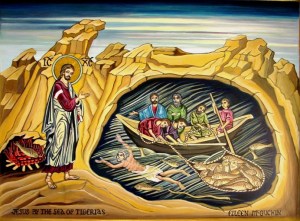
9 When they got out on land, they saw a charcoal fire in place, with fish laid out on it, and bread. 10 Jesus said to them, “Bring some of the fish that you have just caught.” 11 So Simon Peter went aboard and hauled the net ashore, full of large fish, 153 of them. And although there were so many, the net was not torn. 12 Jesus said to them, “Come and have breakfast.” Now none of the disciples dared ask him, “Who are you?” They knew it was the Lord. 13 Jesus came and took the bread and gave it to them, and so with the fish. 14 This was now the third time that Jesus was revealed to the disciples after he was raised from the dead.

In the name of the Father and of the Son and of the Holy Spirit. Amen.

Christ is risen!
He is risen indeed! Alleluia!

Welcome to the third week of Easter. Can’t you just feel the excitement? Yeah, maybe not. We are peak and valley people. We trudged through the valley of Lent hearing over and over to repent. We were humbled by the Scriptures recounting what our Lord did for us during Holy Week. Then Easter Sunday, we were ready to burst out singing, “Christ the Lord is risen today!” The music, the flowers, the dresses, the ties. The time with family, the delicious ham dinner, hiding eggs full of candy and watching the kids hunt for them. Easter is exciting. We burst out with joy telling each other that our Lord has conquered death and the grave. He is risen, alleluia!

But then Easter Sunday passes. The Resurrection slips into the background. We go back to familiar things. The glow wears off, and the excitement dies down. Now, we can feel guilty about this – maybe we should. But we are no different than the disciples and the women; we’re no different than the very people who were living through the events of Easter.

Look back to John 20 where John tells us about what happened that Easter morning. Mary Magdalene sees the stone rolled away from the tomb. She runs back to tell Peter and John, who both take off running. John and Peter see the tomb empty and the linen cloths. They are excited, their adrenaline is pumping, things are happening. But then Peter and John lamely go back to their homes (v. 10), and the excitement dies down.

After this, Jesus appears to Mary Magdalene and talks with her, and she finally recognizes that it is Jesus. She clings to Jesus, and Jesus sends her to tell the disciples that she has actually seen Jesus which she does, but John doesn’t give us any indication about what the disciples do with this. So, we are somewhat let down again.

John starts up again in v. 19 saying that Easter evening, Jesus appears in the room where the disciples were. He says, “Peace be with you.” He shows them His hands and feet. He breathes on them and gives them the Holy Spirit and sends them out to forgive sins. But then Thomas, arrives having just missed Jesus. The disciples tell him, “We have seen the Lord! Man, Thomas, you should have been here.” But Thomas throws a wet blanket on it all. Thomas says that he absolutely will not believe until he can place his finger in Jesus’ hands and feet and place his hand in Jesus’ side. Talk about a killjoy.

The next Sunday (v. 26), Thomas gets exactly what he demanded. He sees Jesus. He sees the scars in hands, feet, and side. Jesus calls Thomas to believe, and he does. Then Jesus gives a blessing, “Have you believed because you have seen Me? Blessed are those who have not seen and yet have believed.”

Then in the last two verses of ch. 20, John writes what sounds like a nice conclusion to his Gospel. He writes, “Now Jesus did many other signs in the presence of the disciples, which are not written in this book; but these are written so that you may believe that Jesus is the Christ, the Son of God, and that by believing you may have life in His name” (Jn. 20:30-31). What a perfect way that would have been for John to end his Gospel. But he doesn’t. He writes these words of our text to tell us about the third time Jesus reveals Himself to the disciples. And Jesus reveals Himself in the most familiar way.

The disciples have left Jerusalem and are back in familiar territory – the Sea of Tiberias which is also known as the Sea of Galilee (Jn. 6:1). And they seem, quite frankly, lost as to what to do. Jesus is risen from the dead. The Teacher they had been following for three years has done everything He said He would do. He has been crucified, dead, buried, and risen just as He said He would be. But Jesus isn’t with them all the time. So Peter decides, “Well, I don’t know what to do, so I’m just going to do what I used to do. I’m going fishing.” And the other disciples say, “Let’s go with you. Why not?”

So these fishers of fish, who had been called to be fishers of men by Jesus who has conquered death, return to the familiar. They go back to being fishers of fish. But they aren’t very successful, in fact they stink. The whole night, they catch nothing.

Day is breaking. The best time to catch fish is past. And here comes Jesus standing on the shore. The disciples had no idea who it was. So, in their minds, there’s a heckler on the shore, “Children, do you have any fish?” “No.” “Cast the net on the right side of the boat, and you will find some.” Why they actually did it, I don’t know. But their nets are filled with so many fish, they can’t haul it into the boat.

Pause here. I hope this sounds familiar to you because this is almost identical to what happened in Luke 5. There, Luke records Jesus calling the disciples. Now, many Christians think that Jesus simply calls the disciples, “Follow Me,” and they do and have this three-year adventure. But Jesus actually calls the disciples at least two, and I would argue that Scripture is very clear that Jesus calls them three, times. You can ask me about it later.

Luke 5 is Jesus’ final call for them to be fishers of men. And it is almost identical to our Gospel text. The disciples have been fishing all night and have caught nothing – just like in our text. You start to wonder how the disciples made a living because they never seem to catch anything. In both of these texts, Jesus tells them to let down the nets. In both texts, they catch a lot of fish – in fact too many. In Lk. 5, they fill two boats so full of fish that they start sinking. In Jn. 21, they cannot pull the nets up onto the boat, so they have to drag it behind them.

With all the familiarity, there are differences between these two texts. In Lk. 5, Peter sees this miraculous catch of fish, and you might think that he would offer Jesus a contract to be their fishing guide. But he doesn’t. He says, “Depart from me, for I am a sinful man, O Lord.” Here, Peter frantically does everything he can to get to Jesus as quickly as possible. In Lk. 5, Jesus comforts Peter with forgiveness, “Do not be afraid; from now on you will be catching men.” Here in Jn. 21, just after this text, Jesus forgives Peter again, but in a different way. Peter had denied Jesus three times, so Jesus asks Peter three times, “Peter, do you love Me?” And Peter answers Jesus three times, “Lord, You know that I love You.” And Jesus restores Peter, “Feed My lambs, tend My sheep, feed My sheep.”
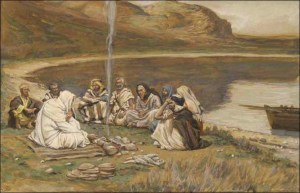
John 21 BreakfastBut there is more familiarity to be found here. This text should bring our minds back to the shores of this very sea, about one year earlier when Jesus used five loaves of bread and two fish to feed 5,000 men plus women and children. Remember how afterward, the disciples carried off twelve baskets of leftovers for themselves (Jn. 6:1-14). Here in our text, Jesus is sitting on the shore by a fire, and again He provides fish and bread. But Jesus has also provided 153 extra large fish. What is the significance, why does John tell us there were 153 fish? Because that’s how many there were. Jesus takes the bread and gives it to them. Jesus takes the fish and gives it to them. Just as He did before.

John writes, “Now, none of the disciples dared ask Him, ‘Who are you?’ They knew it was the Lord.” They knew because Jesus was doing what was familiar.

You know the phrase, “Familiarity breeds contempt.” It sure can. But when it comes to Jesus and your faith, I hope that the familiar brings you a calming peace because your needs don’t change. Of course, you grow in your faith and in your maturity, but you will always need the same forgiveness. Every Sunday, you come here and you confess your sins with the same words and hear God’s absolution with the same words. Jesus told His disciples, “Take, eat. Take, drink. This is My Body and Blood shed for the forgiveness of sins. Do this in remembrance of Me.” To remember Him, we keep eating His Supper because we know He is there.

Jesus the Good Shepherd 1Jesus said to preach the Gospel to the ends of the earth. So, every sermon you will hear me preach will essentially be the same: you are a sinner, Jesus died on the cross for your sin, He is risen again, and you are forgiven. There is no new material. Sure we might get tired of hearing it, but I hope instead, you recognize the voice of Jesus in the familiar.

Keep hearing those familiar words because in those words you don’t have to wonder, you don’t have to ask, “Who are you?” because you will know there is Jesus. He keeps doing for you what He has done for you, bringing you to eternal life with Him.

Christ is risen!
He is risen indeed! Alleluia! Amen.

The peace of God, which surpasses all understanding, will guard your hearts and minds in Christ Jesus. Amen.

Luke 24:1-12 – The Tomb Is Empty

Listen here.

Luke 24:1–11

Empty Tomb 11 But on the first day of the week, at early dawn, they went to the tomb, taking the spices they had prepared. 2 And they found the stone rolled away from the tomb, 3 but when they went in they did not find the body of the Lord Jesus. 4 While they were perplexed about this, behold, two men stood by them in dazzling apparel. 5 And as they were frightened and bowed their faces to the ground, the men said to them, “Why do you seek the living among the dead? 6 He is not here, but has risen. Remember how he told you, while he was still in Galilee, 7 that the Son of Man must be delivered into the hands of sinful men and be crucified and on the third day rise.” 8 And they remembered his words.

9 And returning from the tomb they told all these things to the eleven and to all the rest. 10 Now it was Mary Magdalene and Joanna and Mary the mother of James and the other women with them who told these things to the apostles, 11 but these words seemed to them an idle tale, and they did not believe them.


In the name of the Father and of the Son and of the Holy Spirit.
Amen.

Christ is risen!
He is risen indeed! Alleluia!

You may not like to hear it, but you are dying. “On a long enough timeline, the survival rate for everyone drops to zero” (Chuck Palahniuk). No matter how full your life is now, eventually (unless Christ comes back first) you will die. And until that time, you will watch as those around you – people you care about and love – will die too. They will die and you will die because of sin.

Scripture says that because you are sons and daughters of Adam and Eve, you are born under the curse of sin. Because of that curse, you will die.  “In Adam all die” (1 Cor. 15:22). But it is even worse than that. Because of your sin, you are already dead. You are born a creature destined for eternal death under wrath of God.

So what is to be done? What can you, who are dead and dying, do about it? Or, has someone else done something about it?

Indeed, Someone has.

The women arrive at the tomb early in the morning to finish what had been started. Joseph of Arimathea and Nicodemus had begun the work of embalming Jesus’ body back on Friday. They were back to finish their work for the dead. They didn’t know the One who had died had finished off death.

They find the tomb open. They see two men in dazzling apparel, and they were so astonished, they bow their faces to the ground.

They are asked, “What are you doing with those spices? Those are for the dead. No dead people here. Why are you looking for the Living One where only dead ones should be? He is not here. He is risen! Don’t you remember what He told you? It was necessary for the Son of Man to be handed over to sinful men, suffer, die, and on the third day rise again. Remember?”

And it all came back to them. They remembered His words.

Even though you do not chose to die, Jesus did. Because He is the eternal Son of God, He could not die. So He chose to be born in your likeness, your flesh. He was baptized into your sin so He could carry it. He takes your sin – all of it – so there is no more sin in you. He takes that sin and marches to His death knowing that on the third day – today, Resurrection Day – He will rise. But now, this Jesus, the Living One who died and rose again, chooses to stay among you who are dead in sin so He can raise you to eternal life.

So, you here, remember what He has said to you. “I baptize you in the Name of the Father and of the Son and of the Holy Spirit. Because you are baptized into Me, you are in Me. Here. Take, eat, and drink My living Body and My living Blood. You cannot die anymore. I am the Resurrection and the Life. He who believes in Me, even if He dies will life. And everyone who lives and believes in Me will never die” (Gal. 3:27; Mt. 26:26-28; Jn. 11:25-26).

The ResurrectionJesus’ resurrection gives you all the answers to death in your life.

When you staring your own death in the face, when your body decays, remember, “He is risen!” When you are laying your friend or family into the ground, remember, “He is risen!” When you are undergoing painful treatment for disease, remember, “He is risen!” When you are fired, when you can’t afford the mortgage, when the bills pile up, remember, “He is risen!” When you look around and see how messed up this world is, remember, “He is risen!” When you fall, when you stand, when life gets you down, and when life is good, remember, “He is risen!”

Christ is risen!
He is risen indeed! Alleluia!

Christ is risen!
He is risen indeed! Alleluia!

Christ is risen!
He is risen indeed! Alleluia!

Amen.[1]

The peace of God, which surpasses all understanding, will guard your hearts and minds in Christ Jesus. Amen.

[1] I am thankful for a sermon by my friend, Pr. Timothy Winterstein, as inspiration for portions this sermon.

Luke 22:1 – 23:56 – Finding Yourself in Christ’s Passion

Listen here.

Sermon Text: Luke 22:1 – 23:56

Grace, mercy, and peace to you from God our Father and from our Lord and Savior Jesus Christ. Amen.

Jesus takes and becomes sinThat Gospel reading is a lot to take in. With all the betrayal, conniving, injustice, denial, mockery, beating, and torture, we may wish to turn away from this reading. But we can’t. We must see. We must look. We must ponder because in this reading we see who we truly are.

We are the priests who refuse to listen to Jesus’ preaching and repent. We would rather murder an innocent Man rather than listen to one more word from His mouth.

We are Judas. We are more interested in money than our relationship with God. And we hide it all behind a show of love and devotion.

We are the disciples who, after receiving our Lord’s body and blood, dispute with each other about who of us is the greatest. Like them, we get bored and tired of spending time with our Lord, and so we fall asleep while Jesus is in agony. We unjustly rise up against those who threaten violence, and we leave a bloody mess in our wake.

We are Peter and fear what others might do to us if they know we are Jesus’ disciple. So we deny our Lord.

We are the false witnesses against Jesus and we misrepresent Him.

We are Pilate failing to work for justice because we are afraid of the consequences if we do what is right.

We are Herod and the guards who treat Jesus with mocking contempt.

We are the crowds crying for the release of Barabbas and shouting, “Crucify, crucify Him!”

Repent.

Even though, like Peter, your initial reaction is to boast about our devotion to Jesus, deep inside you are like the disciples (Lk. 22:23) wondering if you are so innocent. Is it your sin that drove the nails into Christ’s hands and feet?

Sure, but only in a small way. Sin did not bring Jesus to this world. Sin did not cause His death. Instead, love did. The never-ending love and mercy of God did. God would simply not allow Satan to win. The devil could not be allowed to hold his claim over you. Instead, the Lord of creation – out of sheer love, grace, and mercy – would restore and redeem His creation and set Jesus in dominion over it.

Because of that very love, through the faith Jesus has given you through the working of the Holy Spirit, you are those who cried out, “Hosanna! Save us now, Lord!”

You are the disciples who simply follow Jesus’ direction. And even though His words seem odd, you find everything just the way Jesus said it would be.

Jesus Crucified 1You are Barabbas. Even though you are guilty, you go free.
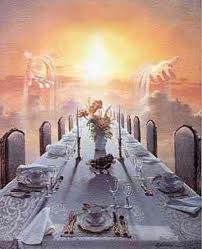
You are Simon of Cyrene. You carry the cross for Christ and bear the burden of His confession in this world.

You are the penitent thief who pleads for mercy and finds its source is there upon the cross.

And you are the centurion who confesses that the Man who died there on that cross is truly the Son of God. You see that blood has been shed. You know that blood opens heaven’s gates to you.

You know all of this because the stone will not hold Jesus. He is not dead, but lives.

Hosanna! Hosanna to the Son of David! Hosanna in the highest. Amen.[1]

The peace of God, which surpasses all understanding, will guard your hearts and minds in Christ Jesus. Amen.

[1] I am thankful for a sermon by Rev. David H. Petersen as inspiration for this sermon.

Luke 15:1-3, 11-32 – The Waiting Father (A Caponic Sermon of Death, Resurrection, and Parties)

Listen here.

Luke 15:1-3, 11-32

1 Now the tax collectors and sinners were all drawing near to hear him. 2 And the Pharisees and the scribes grumbled, saying, “This man receives sinners and eats with them.” 3 So he told them this parable:

11 And he said, “There was a man who had two sons. 12 And the younger of them said to his father, ‘Father, give me the share of property that is coming to me.’ And he divided his property between them. 13 Not many days later, the younger son gathered all he had and took a journey into a far country, and there he squandered his property in reckless living. 14 And when he had spent everything, a severe famine arose in that country, and he began to be in need. 15 So he went and hired himself out to one of the citizens of that country, who sent him into his fields to feed pigs. 16 And he was longing to be fed with the pods that the pigs ate, and no one gave him anything.

17 “But when he came to himself, he said, ‘How many of my father’s hired servants have more than enough bread, but I perish here with hunger! 18 I will arise and go to my father, and I will say to him, “Father, I have sinned against heaven and before you. 19 I am no longer worthy to be called your son. Treat me as one of your hired servants.”’ 20 And he arose and came to his father. But while he was still a long way off, his father saw him and felt compassion, and ran and embraced him and kissed him. 21 And the son said to him, ‘Father, I have sinned against heaven and before you. I am no longer worthy to be called your son.’ Eschatological Lord's Supper22 But the father said to his servants, ‘Bring quickly the best robe, and put it on him, and put a ring on his hand, and shoes on his feet. 23 And bring the fattened calf and kill it, and let us eat and celebrate. 24 For this my son was dead, and is alive again; he was lost, and is found.’ And they began to celebrate.

25 “Now his older son was in the field, and as he came and drew near to the house, he heard music and dancing. 26 And he called one of the servants and asked what these things meant. 27 And he said to him, ‘Your brother has come, and your father has killed the fattened calf, because he has received him back safe and sound.’ 28 But he was angry and refused to go in. His father came out and entreated him, 29 but he answered his father, ‘Look, these many years I have served you, and I never disobeyed your command, yet you never gave me a young goat, that I might celebrate with my friends. 30 But when this son of yours came, who has devoured your property with prostitutes, you killed the fattened calf for him!’ 31 And he said to him, ‘Son, you are always with me, and all that is mine is yours. 32 It was fitting to celebrate and be glad, for this your brother was dead, and is alive; he was lost, and is found.’”

Grace, mercy, and peace to you from God our Father and from our Lord and Savior Jesus Christ. Amen.

You know this parable. In fact, if you randomly approached someone on the street and asked them, I would venture to guess almost everyone you met would be able to give you at least a summary of the story. But they will inevitably flunk a theological quiz about what the parable means. That is because so mush of the teaching on this parable is so far off. To be fair, part of the fault lies in the fact that the story is, unfortunately, named The Prodigal Son.

This parable is not primarily about a son who is received back into the loving arms of his father. This parable is Jesus’ attempt to completely blow up the natural theology of us sinners.

Don’t miss the first three verses of Luke 15 because they are vital to understanding what Jesus is teaching in this parable. Tax collectors and sinners were all drawing near to Jesus. Imagine this. Jesus is always found with the drunkards at the biker bars and with the people who are under investigation for Ponzi schemes. The Pharisees didn’t like this at all. The mindset of the Pharisees was this: If God is mad at my sins, then He is pleased with my good works. Now, be careful here because your natural tendency is to look at the Pharisees and think, “Wow, that’s terrible of them. I don’t think like they do” Then you quietly pat yourself on the back for not being like them. But as soon as you do that, you have adopted the Pharisees theology which, again, is your natural theology.

Jesus tells three parables to destroy your natural theology – the lost sheep, the lost coin, and the prodigal son. Each of these parables has three main parts: something is lost (think ‘dead’), it is restored (think ‘resurrected’), and there is a party. Jesus concludes the parable of the lost sheep by saying this, “There will be more joy in heaven over one sinner who repents than over ninety-nine righteous persons who need no repentance.” He concludes the parable of the lost coin, “There is joy before the angels of God over one sinner who repents.” And the main point is that third part – the party. The party that ensues only after death and resurrection. We see this most clearly in the third parable which would be better titled, “The Waiting Father.”

In this parable, the younger son tells his father, “My life would be better if you were dead. In fact, why don’t you just pretend you are dead and give me what I’ll get when you finally are in the ground.” The father does exactly as the son asks and drops dead.

The son takes off. He lives high on the hog, and it’s fun while it lasts. But the inevitable comes sooner rather than later. Prodigal with the pigsThe money is gone, the economy turns south, and he is left with nothing. So he hires himself out. But the best job he can get is feeding pigs, and the pay – well it’s not so good. He can’t even afford food with his income, so he wishes he could eat the slop he is tossing to the little piggies. He realizes he’s going to starve. His current employer is a stiff. This pathetic son looks at his life and finds nothing.

But his dad, his dad is the best boss around, and his employees have more than enough to eat. He formulates this little speech, “Father, I have sinned against heaven and before you. I am no longer worthy to be called your son. Treat me as one of your hired servants.” Now, this may sound like repentance. But it’s not. Look closer. Teetering on the brink of death, this son formulates a plan to hold on to the possibility of carving out a life for himself.

His plan is to say to his dad, “Look, we both know each other, and we don’t have the best history. I know all of that. Can you just give me a job? I’ll work for you, and you don’t have to bother about me. Just deposit my wages in my account. I’ll stay out of your way, and you can stay out of mine.”

But when he finally meets his father, he doesn’t even get the chance to make his proposition. This son dies to his plan to hold onto his life because his dead-to-him father falls on him and kisses him. He interrupts the son mid offer. The father calls the servants to dress him, restore him, and kill the fattened calf so the whole town can celebrate. The dead son has been raised.

But not everyone is ready to die to their rights and party. The older son off living dutifully for his father – in fact double duty since his brother left – working away in the fields. He is so busy with his life that doesn’t even notice, at first, his brother’s return. This older son is just as lost as his brother had been (if not even more lost). He was simply lost in plain sight.

This older son learns about this party, and he starts opening fire on his father blaming the father for all his misery. “I have served you all these years,” bang. “I have never disobeyed your command,” Bang. “You haven’t given me a little to celebrate with my friends,” bang. Now, the son goes for the kill shot, “You don’t even see how much better I am than my brother. This sham of a son of yours comes home after devouring your property with prostitutes, and you kill the fattened calf for him,” BANG!

This is a picture of you and of me in our natural, fallen theology. You see, we are not the younger son in this parable. We are the older brother. We think God should reward us for our life of service to Him. We think that our obedience, devotion, and work have earned us something from God. We do this even with our confession and repentance.

The message of the Gospel is not that you confess your sins to get God’s forgiveness. Confession isn’t a transaction between the Lord and Giver of life and those who are clinging to life by a thread. That’s Pharisee reasoning, that is your natural, fallen, sinful theology thinking you can live and work your way back to God.

The ResurrectionThe Gospel only works on those who are already dead. Confession is simply a corpse realizing, “Yup, I’m dead as dead. Only resurrection will help me.” The father accepted and received the son before he said a blasted thing. The father restored the son before he could even try to cling to life. And the father is even accepting of the older son longing for him to simply get over himself, his works, his obedience, and his life.

The father says, “Look at yourself, standing out in the yard living like a beggar when you own this place. Remember, I died and the inheritance has already been doled out. All that is mine is yours. And the only reason you aren’t having a good time is because you won’t drop dead to your dumb rules about how you think things should be run. Just die to your rights and works and obedience. Drop dead like us. We’re all dead in here, and we’re having a splendid time. Get in here and pour yourself a drink.”

This is the Gospel. Everything that belongs to God is yours because of Christ. God is simply waiting to throw a party. All you can do is drop dead. Drop dead to your works. Drop dead to your rights. Drop dead to any claim of reward or privilege you would make on God. Drop dead because you already are and enter the party.

And here’s the kicker. Here’s how we know the party has already started. Which character in this parable is Jesus? He’s not either of the sons. Is Jesus the Father? Maybe, in a sense. The clearest character in this parable relating to Jesus is the over-looked fattened calf. All a fattened calf does is stand around waiting to drop dead at a moment’s notice so people can have a party. And Scripture tells us that Jesus is the Lamb slain from before the foundation of the world (1 Pet. 1:19-21).

The party only comes through death and resurrection. Christ is risen. Risen centuries before any of you were born. The resurrection is today (1 Cor. 15:20-23). The party is now.

Cross and CommunionAnd, now, here, at this altar, you have a seat at the party – the eternal feast of the marriage supper of the Lamb. This Supper is for those who are dead in their sin. If you think you deserve a seat at this party because of anything you have done, then it isn’t for you. Don’t come. This party is only for those dead in sin.
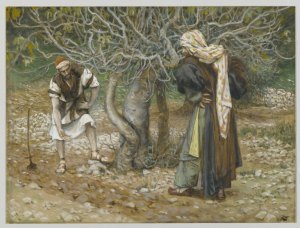
Here Jesus is inviting you to drop dead to your morality, your works, your efforts and enter into the party. Here is His crucified and risen body and blood to enter into your deadness so that you too will rise again. Amen.

The peace of God, which surpasses all understanding, will guard your hearts and minds in Christ Jesus. Amen.

Luke 13:1-9 – God Isn’t Nice, But He Is Good

Listen here.

Luke 13:1-9

1 There were some present at that very time who told him about the Galileans whose blood Pilate had mingled with their sacrifices. 2 And he answered them, “Do you think that these Galileans were worse sinners than all the other Galileans, because they suffered in this way? 3 No, I tell you; but unless you repent, you will all likewise perish. 4 Or those eighteen on whom the tower in Siloam fell and killed them: do you think that they were worse offenders than all the others who lived in Jerusalem? 5 No, I tell you; but unless you repent, you will all likewise perish.”

Parable of the Barren Fig Tree 16 And he told this parable: “A man had a fig tree planted in his vineyard, and he came seeking fruit on it and found none. 7 And he said to the vinedresser, ‘Look, for three years now I have come seeking fruit on this fig tree, and I find none. Cut it down. Why should it use up the ground?’ 8 And he answered him, ‘Sir, let it alone this year also, until I dig around it and put on manure. 9 Then if it should bear fruit next year, well and good; but if not, you can cut it down.’”

Grace, mercy, and peace to you from God our Father and from our Lord and Savior Jesus Christ. Amen.

So. Did you have a good week? Everything go well for you or, at least, mostly well? Did your house keep you warm and sheltered? Did your kids stay mostly healthy? Did you get enough to eat? Did you keep your job? Good!

How are you going to spend your afternoon? A little nap? Maybe relax a little and read a few more chapters in your book? Do a little cleaning up around the house and pay some bills? Go and buy your groceries for the week? Get that last bit of homework done before your Monday morning class? Sure.

What do you have planned for this coming week? Same old, same old? Keep the house fairly clean? Grind out another week of work? Get the kids to their activities? Visit some friends or family? Sounds nice.

Life goes on, and it is fairly comfortable. Some rough patches pop up here and there, but nothing out of the ordinary. We sit down to eat and drink and rise up to play (1 Cor. 10:7). We come each week to church, go through the liturgy, hear the Word, listen to the sermon, and think God that is mostly pleased with us. “What has been is what will be, and what has been done is what will be done” (Ecc. 1:9). We just continue on with our normal, mundane routine.

But beware. “Let anyone who thinks that he stands take heed lest he fall” (1 Cor. 10:12). You do not know what this week will bring. You could get diagnosed with pancreatic cancer. You do not know what tomorrow will bring. Maybe, you will be hit by a drunk driver. You do not know what will happen even while I am speaking this sentence. A gunman could come in here and shoot us all dead. This fallen world is a lethally dangerous place for sinners, that means you and me. Because of our sin, our life is dangerous, our existence perilous. Your lives should be filled with constant repentance.

Some people come up to Jesus and speak about a national outrage. “Hey, Jesus. While some Galileans were offering their Passover sacrifices, Pilate sent soldiers into the Temple where they were not allowed, and they slaughtered those poor souls.” To get a sense of how outrageous this: Imagine approaching this altar to receive Holy Communion, and the National Guard comes in here by order of the governor, and guns a bunch of us down. Despicable! Ghastly! Horrid!

“Hey, Jesus. Have You heard about how evil Pilate is? We need to take action. We need to protest! We need to occupy Pilate’s residence! We need to start a group – Galilean Lives Matter!”

But Jesus doesn’t condemn Pilate. He doesn’t say, “Yes, it is tragic. Pray for survivors. This violence has to end.” He says nothing of the sort. Neither does Jesus say something trite, “Where God closes a door, He opens a window.” Or, “Some things we don’t understand now, but we will later.” No!

Instead, Jesus says, “Do you think that those who were killed were worse sinners than everyone else because they died like this?”

No, they were not worse sinners. But when you see evil, when you see injustice, when you see ruthlessness, don’t seek revenge. Don’t take things into your own hands. Don’t even ask, “Why did this happen?” Instead, Jesus uses this wicked deed by a ruthless governor to remind us all to repent. “Unless you repent, you will all likewise perish.”

And Jesus takes it a step further. “Hey, remember those eighteen people who were crushed when the tower fell in Siloam? Do you think they were more sinful than the people who weren’t crushed and buried by the rubble? Did karma catch up with them? Nope, no sir. But unless you repent, you will all likewise perish.”

Crying to GodJesus uses both of these things – the wickedness of a political authority and a tragic “act of God” – to remind us to live as repentant people. All tragedies and all acts of violence should remind us that we are sinners who deserve nothing good. God doesn’t owe us peace or long, healthy lives. God’s anger against our sin is real. And just because we are God’s forgiven, adopted children does not mean that we will have a wonderful life. We deserve to be slaughtered. We deserve to have towers pushed over on us. God’s anger is real, and death is what our sin has earned us. We, all of us, need to repent.
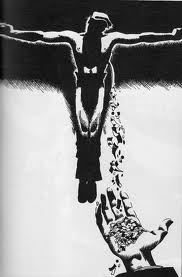
We have angered God by the evil we have done. We deserve His wrath for the good we have left undone. We need to repent of our good works because they don’t cut it. Even our righteous deeds are as filthy rags (lit. used toilet paper). Do you think that your attendance at church, giving your offering, and living a generally good life means that God owes you? Does any of that mean you are less likely to be crushed by a tower or martyred by a wicked ruler?

Repent. Your life isn’t quiet and comfortable because you have pleased God with the fruit of your good works. God isn’t nice to you based on how you are living at any given moment. In fact, God isn’t nice at all. He does not tolerate your sin. He condemns it and punishes it. “Unless you repent, you will all likewise perish.”

God isn’t nice, but He is good. Jesus uses this little parable about the barren fig tree to show you the goodness and patience of God. Imagine this barren fig tree. According to God’s command (Lev. 19:23-25), when a tree was planted, you gave the tree three years to grow. Then, the first three years of fruit from that tree were forbidden. The seventh year after the tree is planted (which should also be the fourth year that it produces fruit), all the fruit is to be given as an offering to God. So, the vineyard owner in this parable has been waiting for three years for that first crop to bring as an offering to God. This is a nine-year-old tree hasn’t produced anything – worthless thing that it is.

The vineyard owner calls his vinedresser to sharpen the axe and chop down that parasitic tree. But the vinedresser intercedes. “Sir, let it alone this year also.” Let it alone. Jesus literally says, “Forgive the tree this year also. Give Me have some time with it. Let Me dig around it. Let Me fertilize it. Let’s see what I can do with this worthless tree.”

In this little parable, Jesus is giving us a beautiful picture of what we read in Romans 8:34, “Who is to condemn? Christ Jesus is the one who died – more than that, who was raised – who is at the right hand of God who indeed is interceding for us.”

You see, the God who is angry with your sin, the God who pushes over towers, the God who puts rulers in authority who sentence Christians to death, Blessings from the CrossHe is the very God who digs, prunes, and fertilizes. And He is not done with you. He refuses to stand by and watch as you grow fruitless and wild. He will not chop you down without first caring for you with His love. Jesus pours out His blood for you and showers his constant forgiveness upon you.
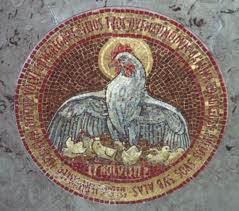
Always remember that. You live only by His mercy. Learn to number your days because God is not nice, but He is good. His mercy endures forever and ever. Amen.

The peace of God, which surpasses all understanding, will guard your hearts and minds in Christ Jesus. Amen.

Luke 13:31-35 – Under His Wings

Listen here.

Luke 13:31-35

31 At that very hour some Pharisees came and said to him, “Get away from here, for Herod wants to kill you.” 32 And he said to them, “Go and tell that fox, ‘Behold, I cast out demons and perform cures today and tomorrow, and the third day I finish my course. 33 Nevertheless, I must go on my way today and tomorrow and the day following, for it cannot be that a prophet should perish away from Jerusalem.’ Under the Wings of a Hen34 O Jerusalem, Jerusalem, the city that kills the prophets and stones those who are sent to it! How often would I have gathered your children together as a hen gathers her brood under her wings, and you were not willing! 35 Behold, your house is forsaken. And I tell you, you will not see me until you say, ‘Blessed is he who comes in the name of the Lord!’”

Grace, mercy, and peace to you from God our Father and from our Lord and Savior Jesus Christ. Amen.

Personal threats are one thing, but what do you do with secondhand threats? The Pharisees come to Jesus saying, “King Herod has it out for you and is going to kill you.” There is no question that Herod was a ruthless individual. He had the gall to lop off John the Baptizer’s head. But Herod doesn’t appear to be seeking Jesus’ life (see Lk. 23:7-11). When he finally meets Jesus on Good Friday, Herod mocks Jesus and treats Him with contempt, but Herod doesn’t sentence Jesus to death.

The Pharisees here aren’t suddenly being friendly toward Jesus and protecting Him. They had been seeking Jesus’ life (Mt. 12:14). Instead, it appears they want Jesus to get out of town, and so they lie about Herod’s threat. But Jesus doesn’t take this second-hand threat seriously. Even if Herod was threatening Jesus’ life, “Jesus gonna do what Jesus gonna do.” He will continue His ministry of releasing the captives from disease, demonic powers, sin, and death as He said He would when He preached in Nazareth (Lk. 4:18-21). Jesus says, “Go and tell that fox Herod, ‘Behold, I cast out demons and perform cures today and tomorrow, and the third day I finish My course.’”

Now, we need to pause here for a moment. The phrase that gets translated here, “I finish my course,” is a really bad translation. In Greek, that phrase is only one word, and it is a passive verb. But the English translates it as active, “I finish.” But a more literal translation would be, “On the third day, I am finished,” or “I am completed.” Jesus knows that He is going to die, but it won’t be at the hand of Herod, the fox. Instead the Lion of the tribe of Judah will be killed in Jerusalem. Jesus is saying, “I will continue on my journey to Jerusalem because Jerusalem is the place for a prophet to die.”

Jesus’ life is not in danger anywhere but in Jerusalem, but that doesn’t scare Jesus. Instead Jerusalem is precisely where He is going to go, resolutely and unwaveringly. Jesus knows knows that going Jerusalem will cost Him His life, but amazingly He is not angry about it. In fact, Jesus laments this. “O Jerusalem, Jerusalem, the city that kills the prophets and stones those who are sent to it! How often I would have gathered your children together as a hen gathers her brood under her wings, and you were not willing.”

Because Jerusalem refuses to listen to God’s Word, she is her own worst enemy. Jerusalem continues to reject God’s prophets. Now Jesus – the Prophet (Dt. 18:15) and more than a prophet, the Savior – is about to be rejected and killed by Jerusalem, but still Jesus longs to shelter and protect those very people.

There are stories about barns being burned down in a fire. When the fire is finally out, a hen will be found burned to death, but her brood of chicks are safely alive under her charred wings.

This is the picture Jesus wants us to see. All our suffering is caused by sin – either ours or someone else’s. As the fiery consequences of sin engulf everything around us, there is Jesus frantically seeking to rescue you from God’s wrath against sin and give you shelter under His wings. You can hear Jesus’ frustration, “O Jerusalem, Jerusalem! How often I would have gathered your children together as a hen gathers her brood under her wings, and you were not willing.”

You can see that mother hen trying to get her chicks to stand still and be sheltered, but those chicks keep running frantically around the barnyard. chicken-littleWe are just like those chicks. Rather than seeing Jesus’ wings as our place of refuge, we see them as smothering and confining. We don’t want to be stifled and cramped under His wings. Because of our sinful nature, our wills are hell-bent on remaining free and unfettered to run around rather than being protected in repentance under the wings of Jesus. We see the fire, and we are scared. But rather than trusting Jesus to protect us, we keep running around kicking up sparks, spreading the fire, and making things worse.

This is what most often happens with us sinners. A gracious and merciful God seeks us sinners, but we think that He is coming to destroy us. So we refuse to repent. Adam and Eve tried to create their own refuge from their sin. They tried to cover their sinfulness with fig leaves. David tried save himself by covering up his adulterous affair with Bathsheba. But all he did was fall into more and more sin. Peter was even told beforehand by Jesus that he would deny Jesus. But rather then repenting before he sinned, instead of seeking shelter under Jesus’ mercy, Peter defiantly boasted that he would go to death with Jesus rather than deny Him.

Jerusalem was unwilling to be gathered under the wings of Jesus, and so are we.

Passion of Christ on the CrossThankfully, Jesus’ will is stronger than yours. Jesus knows what it will cost for Him to spread His wings over you. And Jesus still resolves to go to Jerusalem. Jesus will continue to run His course. He will cast out demons and perform cures today and tomorrow, and on the third day will be finished. This is exactly what Jesus says on the cross. He cries out, “It is finished,” (Jn. 19:30 same word as in v. 32), and He gives up His spirit.

Jesus sees the fire of God’s wrath coming upon you, sinner. But He chases you down, and He smothers you under the safety of His outstretched arms on the cross. The fire of God’s wrath completely consumes Him, but you, sinner, are kept safe and secure under His wings. Amen.

The peace of God, which surpasses all understanding, will guard your hearts and minds in Christ Jesus. Amen.

Luke 4:1-13 – The Devil’s Favorite Game

Listen here.

Luke 4:1-13

1 And Jesus, full of the Holy Spirit, returned from the Jordan and was led by the Spirit in the wilderness 2 for forty days, being tempted by the devil. And he ate nothing during those days. And when they were ended, he was hungry. Temptation of Jesus Modern3 The devil said to him, “If you are the Son of God, command this stone to become bread.” 4 And Jesus answered him, “It is written, ‘Man shall not live by bread alone.’”
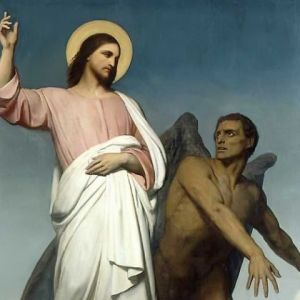
5 And the devil took him up and showed him all the kingdoms of the world in a moment of time, 6 and said to him, “To you I will give all this authority and their glory, for it has been delivered to me, and I give it to whom I will. 7 If you, then, will worship me, it will all be yours.” 8 And Jesus answered him, “It is written,

“‘You shall worship the Lord your God,
and him only shall you serve.’”

9 And he took him to Jerusalem and set him on the pinnacle of the temple and said to him, “If you are the Son of God, throw yourself down from here, 10 for it is written,

“‘He will command his angels concerning you,
to guard you,’

11 and

“‘On their hands they will bear you up,
lest you strike your foot against a stone.’”

12 And Jesus answered him, “It is said, ‘You shall not put the Lord your God to the test.’” 13 And when the devil had ended every temptation, he departed from him until an opportune time.

Grace, mercy, and peace to you from God our Father and from our Lord and Savior Jesus Christ. Amen.

Dear saints, beware. Your adversary the devil prowls around like a roaring lion, seeking someone to devour (1 Pet. 5:8). His ultimate goal is to get you to utterly reject God’s Word. But the devil is content with being patient so long as he can simply get you to doubt, at least a little, what God promises. So, the devil is always playing his favorite game where he questions all of God’s promises to you. And he is really good at it. The worst part of this is that our own sinful flesh likes to play doubles with the devil.

This was the devil’s game in the beginning, in the Garden of Eden. The first words we hear from Satan are, “Did God actually say? Did God actually say, ‘You shall not eat of any tree in the garden’?” With those words, the devil plants a little seed of doubt in Eve’s mind. That seed germinates so fast you can see the growth.

Eve adds to God’s Word, “We may eat the fruit of the trees in the garden, but God said, ‘You shall not eat of the fruit of the tree that is in the midst of the garden, neither shall you touch it, lest you die.’” God never said it was wrong to touch the tree. But Satan, pleased with this slight twist on God’s word, waters his little doubt plant and presents the possibility of Adam and Eve being like God. And you know the rest of the story. Eve put herself in the place of God when she saw the tree was good for food. She went after the desire of her eyes. She decided that going against God’s Word would make her wise. Adam and Eve believe the lie of Satan. Satan wins his game, and all humanity falls.

Satan tries this same ploy on Jesus. If you are simply reading through the Gospel of Luke, it is shocking how bold Satan is as he plays his cards. At the Baptism of Jesus in Lk. 3:21-22, the text closes with God the Father saying, “You are my beloved Son; with You I am well pleased.” The next quoted words in the Gospel are Satan’s words in our text, “If you are the Son of God, command this stone to become bread.”

The devil comes to Jesus when He is weak from fasting. But, notice, that the temptation is not merely for Jesus to fill His belly, rather the temptation is to prove what the Father has already declared. In other words, the devil is saying, “If You are the Son of God, You provided Your people with mana in the wilderness. And You are, right now, giving food to the whole world. You should be able to have what is Yours. If You really are God, why should You go hungry? Why shouldn’t You have what You are providing for everyone else? Prove you are God by turning this stone into bread.”

But it would have been a sin for Jesus to turn that stone to bread. The Holy Spirit had taken Jesus into the wilderness to fast. Jesus is God’s Son, but being a son is not about getting the inheritance, the power, and the rights. Being a son is all about obedience. Jesus knows that the Father is good and will provide precisely what He needs at exactly the right time. “Man shall not live by bread alone.”

So the devil shows Jesus all the kingdoms of the world in a moment of time. Satan promises, “All the authority and glory I will give to you, just worship me, and it will all be Yours.” But Jesus knows what is at the heart of this temptation. The devil wants Jesus to get what Jesus will get after His death on the cross. The devil just wants Jesus to skip the cross part. Jesus knows that, if He does as the devil asks, He will have the world under His authority. Sure, the world would go on for ages and ages, and people might even live long lives. But they would still spend eternity in hell. Jesus doesn’t get that power and authority and glory for His own sake but for your sake. “You shall worship the Lord Your God, and Him only shall you serve.”

Temptation of JesusFinally, the devil takes Jesus to the top of the Temple, and the he goes back to questioning Jesus’ son-ship. “If You are the Son of God, throw Yourself down from here because God will not let you get hurt.” The devil even quotes from our Psalm this morning. Satan is being really tricksy here. He is saying, “God has said that He will protect You. Prove that you trust God’s promises to You.”

God would, of course, protect Jesus, but God had never told Jesus to jump from the pinnacle of the Temple either. And even though God does protect Jesus in every way, Jesus still goes through temptations, suffering, beating, and death. “You shall not put the Lord your God to the test.”

In all of these temptations, the devil tempts Jesus to get what is rightfully His – food, glory, protection – but not in the way or the timing that the Father has in store for Jesus.

The devil still plays this game. Satan wants you to look at your circumstances, your status, your surroundings so that you doubt God’s promises. But what is more trustworthy – your circumstances or God’s Word?

The devil even uses the voices of even some Christians. They join in the devil’s game of causing you to doubt what God says.

God says, “Baptism now saves you” (1 Pet. 3:21). God says, “In baptism you are united with Jesus’ death and resurrection” (Ro. 6:3-5). But many mislead Christians say, “Your baptism is only symbolic. It doesn’t actually do anything. It is just an act of obedience.”

Jesus says, “Take eat. Take drink. This is My Body. This is My Blood for the forgiveness of your sins” (Mt. 26:26-28). But, again, the voice of doubt is preached from pulpits. “Jesus isn’t really in Communion. This is physical, material stuff. It doesn’t really do anything but remind you of what Jesus has done.”

Jesus says, “I will give you the keys of the kingdom of heaven, and whatever you bind on earth shall be bound in heaven, and whatever you loose on earth shall be loosed in heaven” (Mt. 16:19). Then more explicitly, “If you forgive the sins of any, they are forgiven them” (Jn. 20:23). And God says, “Confess your sins one to another that you may be healed” (Jam. 5:6) But the devil has caused you to doubt the Absolution. Absolution is not the pastor’s forgiveness it is always God’s forgiveness – the pastor is simply God’s mouthpiece.

You see, any teaching that even slightly deviates from the Word of God is poison. Poison might not kill you immediately, but it still kills. When God says something, it is clear and certain – even though our sinful minds might not be able to comprehend it. The devil’s game is to cause a sliver of doubt wherever God has spoken. Then, all he has to do is continue to feed that doubt, and the wedge of unbelief is driven deeper and deeper between us and God.

Now, we do see a way out of temptation here. Jesus is our example as He always returns to God’s Word wherever the devil attacks. The answer to doubt is always God’s Word which never changes. It is solid, lasting, eternal.

Blessings from the CrossBut even more importantly, brothers and sisters in Christ, the Word of God says that Jesus resisted every temptation of the devil. And that sure, certain Word of God says that you, dear saint, are in Christ. As Jesus resisted all the devil’s temptations, you do too. God sees you only in Christ. Jesus’ resisting temptation is your resisting temptation. His life is your life. His death is your death. His resurrection is your resurrection. His righteousness is your righteousness. Amen.

The peace of God, which surpasses all understanding, will guard your hearts and minds in Christ Jesus. Amen.

Luke 9:28-36 – Fear & Love

Listen here.

Luke 9:28-36

28 Now about eight days after these sayings he took with him Peter and John and James and went up on the mountain to pray. 29 And as he was praying, the appearance of his face was altered, and his clothing became dazzling white. 30 And behold, two men were talking with him, Moses and Elijah, 31 who appeared in glory and spoke of his exodus, which he was about to accomplish at Jerusalem. 32 Now Peter and those who were with him were heavy with sleep, but when they became fully awake they saw his glory and the two men who stood with him. 33 And as the men were parting from him, Peter said to Jesus, “Master, it is good that we are here. Let us make three tents, one for you and one for Moses and one for Elijah”—not knowing what he said. 34 As he was saying these things, a cloud came and overshadowed them, and they were afraid as they entered the cloud. 35 And a voice came out of the cloud, saying, “This is my Son, my Chosen One; hear him!” 36 And when the voice had spoken, Jesus was found alone. And they kept silent and told no one in those days anything of what they had seen.

Grace, mercy, and peace to you from God our Father and from our Lord and Savior Jesus Christ. Amen.

Climbing a mountain is hard work. With families to feed, fish to catch, nets to mend, and boats to maintain, Peter, James, and John probably didn’t have the leisure to be regular mountain climbers. Their lives as fishermen probably didn’t afford them time for working up the endurance it takes to climb a mountain. They were already physically tired.

On top of that, eight days earlier, Jesus had been talking about some heavy stuff. He said that He must suffer many things and be rejected by the elders and chief priests and scribes, and be killed, and on the third day be raised (Lk. 9:22). That had to be heavy on the disciples’ minds. So they were mentally fatigued too. Jesus takes these dogged disciples up to the mountain so He can pray. But what is there to do while someone else is praying? Exhaustion sets in, and the three disciples fall into a heavy sleep.

Transfiguration 1What they saw must have woken them up quickly. Before them, the Son of God shines in open, unmistakable glory. Moses and Elijah are there speaking with Jesus about the departure (lit. ‘exodus’) of His cross and resurrection. This is a tremendous moment that Peter, James, and John want to hold on to. They love this shiny Jesus more than the Jesus who speaks so openly about dying. And Peter has a bright idea (pun intended) of his own. “Master, it is good that we are here. Let us make three tents, one for You and one for Moses and one for Elijah.”

But those very words of love are misplaced. Peter did not know what he was saying. Peter’s love for this glorified Jesus would cut out the cross. In saying this, Peter shows that he wants a beautiful, awesome, dazzling Jesus – not a crucified, dead, and buried Jesus. Peter is saying this because he does not have the sober awareness of his own sin. So God reveals His terrifying glory as the cloud overshadows them. And the disciples are terrified.

We need this same sobering experience. We need to listen to God’s Word of both Law and Gospel. As Christians, too often we fall into the trap of assuming God’s grace. The holy, holy, holy God – whose presence is doom for sinners – He doesn’t stop being God because He is merciful toward you. This is one of Satan’s favorite tricks to steal away our faith. We get lulled into sleep that God isn’t serious about punishing our sin. We start to think that our sin doesn’t really matter all that much and that God, because He is merciful, just gives a wink and a nod at our sinful actions. Repent.

Yes, Jesus is a friend for sinners, but that doesn’t mean He is a friend of your sin. We need to listen to Him. We need to listen to His Law. Through the Law, God constantly tells you that He hates your sin and that you deserve His eternal wrath. We need to listen to Him. We need to listen to His Gospel. Through the Gospel, God constantly tells you that His love and mercy is always for you. In the midst of the terrors of His threats, God draws you in with His voice of mercy.

We cannot understand Jesus’ mercy and love unless we also fear Him. In the explanation to the First Commandment, Luther strikes us with exactly what the Bible teaches, “Thou shalt have no other gods before Me. What does this mean? We should fear, love, and trust in God above all things.” This isn’t meant to be chronological. Fear does not come first and then love. Rather fear and love go together. Both are faith, trust. Fear of God believes God when He says He is angry because of our sin. Love of God believes God when He says that He fully and freely forgives our sin and absolves it. Through faith, “our fear is softened by our love of God, and our love for God is sobered by our fear of Him” (Rev. David Petersen).

The fear of the Lord is the beginning of wisdom (Prov. 9:10). “Since we are fallen beings obsessed with ourselves, that which we do not fear we hold in contempt” (Rev. Petersen). You have probably seen parents who constantly threaten punishment but never follow through. Their child is misbehaving and they know it, so they threaten to take away their tablet or send them to bed. But the child doesn’t stop, and the punishment never comes. That child quickly learns his actions do not have consequences. And the child learns to disrespect his parents. There is no fear of punishment so there is no respect or love for the parent.

We sometimes fall into the trap of thinking that God’s threats against our sin are not serious. We need to look from this mountain of transfiguration toward the next mountain Jesus will ascend to keep our fear and love of our Savior balanced.

Jesus ascended this mountain with Peter, James, and John to pray, and those disciples fell asleep. The disciples are awakened by Jesus’ face shining like the sun. On the next mountain, Jesus will again take Peter, James, and John to pray. They will again fall asleep, but they will be roused by the sounds of swords and shackles as Jesus is arrested.

On this mountain, Jesus’ face bursts forth gloriously white. On the next mountain, Jesus’ face will be covered in His glorious blood.

On this mountain, Jesus is surrounded by Moses and Elijah who speak of that other mountain. On the other mountain, Jesus will be surrounded by two criminals as all three are suspended between heaven and earth hanging on crosses.

On this mountain, Jesus is proclaimed the only Son of the eternal God by the voice of the Father. On the other mountain, Jesus is mockingly labeled as “Jesus of Nazareth – King of the Jews” by an etched placard hanging over His head.

On this mountain of Transfiguration, Jesus’ glory fades as His holiness is veiled once again. On the other mountain, the glory dies when Jesus breathes His last and the tomb is sealed.

Cross and CommunionTo strengthen us on our journey to the mount of His crucifixion, this morning, we are invited to Jesus’ table. You are invited by your Savior to behold another glorious thing. Your Savior comes to you, body and blood, in bread and wine. He comes to you to forgive you of your sins and to be your Savior. He comes to absolve you of your sins and to fix your eyes upon Him.

The Mount of Transfiguration and Mount Golgotha are both mountains of Jesus’ glory. We see the Transfiguration here today so that we are strengthened to travel through the valley of Lent. On the other mountain, we will see Christ’s glory where He is the beaten, bloodied Savior of the world – your Savior. Amen.

The peace of God, which surpasses all understanding, will guard your hearts and minds in Christ Jesus. Amen.

Luke 4:16-30

Listen here.

Luke 4:16-30

16 And he came to Nazareth, where he had been brought up. And as was his custom, he went to the synagogue on the Sabbath day, and he stood up to read. 17 And the scroll of the prophet Isaiah was given to him. He unrolled the scroll and found the place where it was written,

18 “The Spirit of the Lord is upon me,
because he has anointed me
to proclaim good news to the poor.

       He has sent me to proclaim liberty to the captives
and recovering of sight to the blind,
to set at liberty those who are oppressed,

19 to proclaim the year of the Lord’s favor.”

20 And he rolled up the scroll and gave it back to the attendant and sat down. And the eyes of all in the synagogue were fixed on him. 21 And he began to say to them, “Today this Scripture has been fulfilled in your hearing.” 22 And all spoke well of him and marveled at the gracious words that were coming from his mouth. And they said, “Is not this Joseph’s son?” 23 And he said to them, “Doubtless you will quote to me this proverb, ‘Physician, heal yourself. What we have heard you did at Capernaum, do here in your hometown as well.’” 24 And he said, “Truly, I say to you, no prophet is acceptable in his hometown. 25 But in truth, I tell you, there were many widows in Israel in the days of Elijah, when the heavens were shut up three years and six months, and a great famine came over all the land, 26 and Elijah was sent to none of them but only to Zarephath, in the land of Sidon, to a woman who was a widow. 27 And there were many lepers in Israel in the time of the prophet Elisha, and none of them was cleansed, but only Naaman the Syrian.” 28 When they heard these things, all in the synagogue were filled with wrath. 29 And they rose up and drove him out of the town and brought him to the brow of the hill on which their town was built, so that they could throw him down the cliff. 30 But passing through their midst, he went away.

Grace, mercy, and peace to you from God our Father and from our Lord and Savior Jesus Christ. Amen.

Dear saints, the Gospel is offensive. Yes, you heard me right – the Gospel is offensive. The Gospel is the Good News; it is the power of God for salvation to everyone who believes. But it is offensive in two different ways. Follow with me on this:

Lamb of God who takes away the sins of the wolrdThe Gospel says that Jesus is the Lamb of God who takes away the sins of the world. In other words, there is not one person for whom Christ did not die. His crucifixion appeases the wrath of God for all sin of all time. But imagine walking up to a total, complete stranger at the grocery store and telling them, “You are forgiven.” Now, some of them might be Christians and say, “Praise God!” Be I bet that most people and even some Christians would say something like, “Forgiven for what? I haven’t done anything wrong.” For someone who does not have a sense of their sin and guilt, the Gospel is offensive. This is the first way that the Gospel is offensive; it is out of an ignorance of sin and guilt.
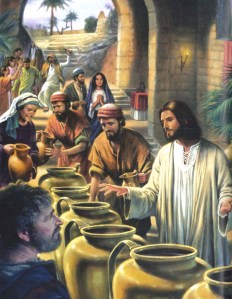
The second way that the Gospel is offensive is the exact opposite – for people who have an ignorance of their own righteousness. This is the one that I think is most applicable to you, here. I say that because it is most applicable to me too. It is easy to start comparing ourselves to others – especially as Christians. Sure, we know that we have sinned, but we’ve gotten much better. We have improved. We aren’t as sinful as we were ten years ago, five years ago, last month. Yes, we still sin, but we’re not as bad as the drunks, the abortionists, the terrorists, the adulterers, and the homosexuals. They are the ones who are really sinful. They need to hear a Law-filled sermon and repent of their wicked ways.

But then, we see Jesus giving the Gospel to exactly those people. In fact, those are the very people Jesus is hanging out with in the Gospels. You see, Jesus didn’t come to help those who are basically good and just needed a little help. He came for poor, miserable sinners. He came to those who are captive to their evil lusts, desires, and actions. He came to give sight to those who are blind to any goodness within themselves. He came to release the oppressed slaves of sin.

This is what our Gospel Lesson, which is Jesus’ first sermon, is about. Jesus has come to Nazareth, His hometown. Anointed by the Holy Spirit in His baptism, tempted by the devil in the wilderness, and having manifested His glory at a wedding in Cana, now, here He is. In His synagogue, the place where He had heard the Word of God proclaimed. Now, it is His turn.

He is handed the scroll of Isaiah. He finds the place and reads, “The Spirit of the Lord is upon me, because he has anointed me to proclaim good news to the poor. He has sent me to proclaim liberty to the captives and recovering of sight to the blind, to set at liberty those who are oppressed, to proclaim the year of the Lord’s favor.”

The people hear those gracious words and wait with bated breath for Jesus to begin preaching. They can’t take their eyes off of Him. Jesus opens His mouth again and says, “Today this Scripture has been fulfilled in your hearing.”

Now, the people’s response in v. 22 is difficult to decide how to translate. The phrase that gets translated ‘spoke well of Him’ is not necessarily meant to be taken in a positive way. It is actually a very neutral phrase. The phrase is simply ’witnessed Him’ (the Greek is the word ‘martyr’ which means ‘witness’). Some places it does mean ’to speak well of,’ (Jn. 1:34; Ro. 10:2), but other places it means ’to witness against’ (Mt. 23:31; Jn. 7:7; Js. 5:3). So there is a possibility that the people were witnessing against Jesus’ gracious words.

But, there is another option. It could also be that they were speaking well of the gracious words Jesus was preaching. But they were really upset about the not-so-gracious words Jesus didn’t speak. You see, Jesus left something out of His reading in Isaiah. The portion of Isaiah that Jesus read is, mostly, from Is. 61:1-2 (He does throw a line from Is. 58:6). But Jesus doesn’t read the line from Is. 61:2 that says He has come to proclaim “the day of vengeance of our God.”

So the text leaves us with two options: Either A – The people were upset right away that Jesus is saying that the text from Isaiah is fulfilled as He read the text. Or B (the option I’m going with)– The people loved hearing about the poor hearing good news, the liberty for the captives, the recovery of sight to the blind, etc. But when they realized that their Homeboy wasn’t proclaiming anything about God’s vengeance on their enemies, they got upset.

But either way, you can hear the people whispering and murmuring to each other: “Hey, wait. Isn’t this Joseph’s son?” “Yeah, He’s the one who made my coffee table.” “He made my made my custom cabinets.” “How could the son of a carpenter be saying this?” “Sure, these words are gracious, but who does He think He is, changing Scripture to skip the line about the destruction of the wicked?”

Brothers and sisters, here lies our danger. We cannot be too eager for the destruction of the wicked. Because of our sin, we deserve the same destruction. Without the Gospel, we too are destroyed. We can get too presumptuous and think that we have moved on past our need of the Gospel. When we start to neglect hearing the Gospel, we are in great danger because we do not know when the Gospel will no longer be proclaimed to us.

The Gospel is the Good News of the forgiveness of sin and is the power of God unto salvation to everyone who believes. You could take Hitler, Osama bin Laden, and a serial rapist and roll them all into one person and Jesus still died for that person’s sin. Because of the cross, all their sins are forgiven. And for any scumbag who believes that Jesus’ death forgives them of their sins, that faith is counted by God as their righteousness. That is the Gospel. We don’t like to hear that. But Jesus says, “There will be more joy in heaven over one sinner who repents that over ninety-nine righteous persons who need no repentance” (Lk. 15:7).

The people of Nazareth didn’t like the fact that Jesus doesn’t speak about God’s vengeance on sinners. So, Jesus’ sermon takes a turn. He stops preaching the Gospel completely because the people are already rejecting those words of grace. And Jesus goes all Law. He says to them, “Doubtless you will quote to me this proverb, ‘Physician, heal yourself.’” And, that is basically what the people say while Jesus hangs on the cross in Lk. 23:39, “He saved others; He cannot save Himself. If He is the King of Israel, let Him come down now from the cross, and we will believe in Him.”

In other words, Jesus is saying, “You are going to demand that I do some miracle before you believe that what I’m telling you is true. You aren’t going to get one. You have to believe My word. Remember the days of Elijah? Many widows were in Israel. But because Israel had rejected God’s word, Elijah wasn’t sent to any of them but only to heathen widow from Sidon, Israel’s enemy. Also, there were many lepers in Israel during Elisha’s day, but they too rejected God’s word. So Elisha didn’t heal any of them. He only healed an officer of the enemy army – Naaman the Syrian.”

This, of course, sets the people off. They are filled with wrath. And they are ready to kill the Preacher of Good News by throwing Him off a cliff. But that death was not the way that God would take away their sin.  So Jesus simply passes through that murderous crowd and walks away.

And even in this, we see the grace of Jesus. There was a more torturous death that Jesus didn’t walk away from. Passion of Christ on the CrossAs the nails pierced His hands and feet, Jesus prayed for those who were killing Him, “Father forgive them for they know not what they do” (Lk. 23:34). Jesus was there on that cross dying for the sins of those who were crucifying Him. He was dying for the sins of these people in Nazareth who rejected Him and tried to kill Him. And He was dying for your sins as well.

Brothers and sisters, the Gospel that Jesus preaches is offensive, but it is true. He has died for your sins. Jesus’ ministry is all grace. He has been anointed with God’s Spirit to minister to the poor, the captive, the blind, the oppressed. He has come to bring God’s favor not to the righteous, but to sinners – to you. Amen.

The peace of God, which surpasses all understanding, will guard your hearts and minds in Christ Jesus. Amen.

John 2:1-11 – They Have No Wine

Listen here.

John 2:1–11

1 On the third day there was a wedding at Cana in Galilee, and the mother of Jesus was there. 2 Jesus also was invited to the wedding with his disciples. 3 When the wine ran out, the mother of Jesus said to him, “They have no wine.” 4 And Jesus said to her, “Woman, what does this have to do with me? My hour has not yet come.” 5 His mother said to the servants, “Do whatever he tells you.”

Water into Wine Jesus Christ6 Now there were six stone water jars there for the Jewish rites of purification, each holding twenty or thirty gallons. 7 Jesus said to the servants, “Fill the jars with water.” And they filled them up to the brim. 8 And he said to them, “Now draw some out and take it to the master of the feast.” So they took it. 9 When the master of the feast tasted the water now become wine, and did not know where it came from (though the servants who had drawn the water knew), the master of the feast called the bridegroom 10 and said to him, “Everyone serves the good wine first, and when people have drunk freely, then the poor wine. But you have kept the good wine until now.” 11 This, the first of his signs, Jesus did at Cana in Galilee, and manifested his glory. And his disciples believed in him.

Grace, mercy, and peace to you from God our Father and from our Lord and Savior Jesus Christ. Amen.

Our Gospel text begins with four words that should send a thrill up your spine, “On the third day.” John could have written, ‘a couple days later,’ or ‘Tuesday,’ or any other indication of time. But John, inspired by the Holy Spirit, wrote, “On the third day.” John wants us to see the connection between Jesus’ first sign and the resurrection because they are linked.

For the first time, Jesus manifests His glory to His disciples ‘on the third day’ at a wedding because Jesus came to end divorce. The divorce between men and women, between body and soul, between God and man. Jesus makes you, the Church of redeemed sinners, to be His holy bride without wrinkle or blemish. This miracle at a wedding feast shows that Jesus comes to reunite you with God as you were meant to be, in harmony and peace with yourself, your neighbor, and with God.

This is Jesus’ first sign. While this is the first miracle of Jesus chronologically, it is also the first sign because it is the primary sign. Jesus turning water into wine defines all the other signs of His ministry because it is an act of pure grace.

To see this, let’s get this miracle set up in its context: Jesus has been baptized. He has been in the wilderness for forty days being tempted by the devil, but not falling into any sin. Then, Jesus returns to inhabited society. Jesus has called five of His disciples. Three days later, Jesus, His disciples, and His mother are all invited to a wedding. At that wedding feast, the wine runs out.

Ask yourself, is this really a big deal? Sure, it was probably embarrassing for the new husband and wife. It was probably very upsetting for their bottle-chugging uncle, Chuck. But does it go any farther than that? The world is full of people who are sick, lame, blind, and deaf. Lepers are everywhere. So many people are cruelly possessed by demons. There are wicked rulers and wars. All these things are more important in the grand scheme of things. But here comes Mary, the mother of our Lord, and she says, “They have no wine.”

Child WhiningReally, Mary? You are bringing the Son of God into this situation, and you’re doing it like this? Mary, you sound like a whiny child. Parents, you know what I’m talking about. Your kid lethargically walks up to you and says in their whiney little voice, “There’s nothing to eat.” You know that they are in a very ungrateful, impolite way they are asking you for food. It is very easy to get upset when our children approach us like this. I get upset. But notice the faith of your children in this. They feel a need, and where do they go? They go to you. They know that you provide food and so they present their need to you trusting that you will translate their statement into a request. And lovingly or, maybe, not so lovingly, you give them what they haven’t asked for simply because you are gracious.

Mary comes to Jesus, not asking for anything, but simply making a statement, “They have no wine.” And Jesus responds with a phrase that is really difficult to translate. Literally, He says, “Woman, what to you and to Me?” Our translation mostly gets it – but it leaves Mary out of Jesus’ statement. Maybe, to get the sense a little better we should understand Jesus as asking, “Woman, why should we be bothered about this?”

There are all sorts of reasons for Jesus to do nothing. First, He hasn’t been asked to do anything; He’s only been rudely told that the wine, which isn’t necessary, has run out. But, secondly and even more shocking, is what we hear from the master of the feast. In v. 10 after the master tastes the water that Jesus made into wine, he tells the groom, “Hey, there has been a mistake here. This is the top-shelf wine. This stuff tastes way better than the swill you have been serving up until now. You are supposed to serve this good stuff first. Then, when the people have become intoxicated,” (not ‘drunk freely’ [every other place where this word is used in Scripture Lk. 12:45; Eph 5:18; 1 Th. 5:7; Rev. 17:2 and in ancient Greek literature it means ‘drunk, intoxicated’]), “then serve the cheap stuff because their numbed brains and taste buds won’t be able to tell the difference.”

This is the scene that the text paints for us. Jesus is at a wedding reception where at least some of the people are sloshed. It’s scandalous! This is the type of behavior of Jesus that led the Pharisees to their grumbling accusation in Lk. 15:2, “This Man receives sinners and eats with them.” And what does Jesus do for these sinful people? He gives them 120-180 more gallons of good wine.

Now don’t walk out on me because I know what you are thinking. “Pastor, are you saying that Jesus gives wine to drunks.” Yup, but it’s not me saying it so much as the Bible.

“Pastor, are you saying that Jesus gives not only more wine but better-tasting wine to people who can’t appreciate it because they are three sheets to the wind?” Yup; it’s what the text says.

“Pastor, this cannot be. Jesus shouldn’t give anything good to such undeserving, ungrateful, sinful people who are only abusing what God gives. Sinners like this need a fire and brimstone sermon.”

You are right. But that is precisely where the Law points its finger at you. Do you really think you are less sinful than the people at this wedding feast? Do you think that you don’t abuse God’s good gifts of grace and mercy? Do you really think that you appreciate and give proper thanks for all that God does for you? Repent.

God doesn’t save you on the condition that you, then, turn into someone worth saving. God always gives more than you ask. God always gives better than you deserve. He never holds back on giving what is right and good to you. Even though you take God’s free gifts of forgiveness, mercy, and grace and abuse them and do not appreciate them, He still gives His forgiveness, mercy, and grace freely and recklessly.

images (1)This most clearly seen on the cross. To the lost, rebellious, drunk-with-sin, unthankful human race, Jesus gives what is most precious and what should make all our hearts burst with gladness. Jesus gives His very blood and His perfect obedience to the Father.

Jesus knows we will be too numb to appreciate it like we should. Jesus knows that we will abuse this great and unfathomable gift. But He gives it nonetheless. Because of Jesus, God showers His gifts of love – not because you are worthy or will respond rightly, but because He is generous and loving to you. And because His works toward you are always, always pure and unmerited grace. Amen.

The peace of God, which surpasses all understanding, will guard your hearts and minds in Christ Jesus. Amen.