Luke 2:40-52 – Among the Things of His Father

Listen here.

Luke 2:40-52

40 And the child grew and became strong, filled with wisdom. And the favor of God was upon him.

41 Now his parents went to Jerusalem every year at the Feast of the Passover. 42 And when he was twelve years old, they went up according to custom. 43 And when the feast was ended, as they were returning, the boy Jesus stayed behind in Jerusalem. His parents did not know it, 44 but supposing him to be in the group they went a day’s journey, but then they began to search for him among their relatives and acquaintances, 45 and when they did not find him, they returned to Jerusalem, searching for him. Jesus in the Temple Twelve46 After three days they found him in the temple, sitting among the teachers, listening to them and asking them questions. 47 And all who heard him were amazed at his understanding and his answers. 48 And when his parents saw him, they were astonished. And his mother said to him, “Son, why have you treated us so? Behold, your father and I have been searching for you in great distress.” 49 And he said to them, “Why were you looking for me? Did you not know that I must be in my Father’s house?” 50 And they did not understand the saying that he spoke to them. 51 And he went down with them and came to Nazareth and was submissive to them. And his mother treasured up all these things in her heart. 52 And Jesus increased in wisdom and in stature and in favor with God and man.

Grace, mercy, and peace to you from God our Father and from our Lord and Savior Jesus Christ. Amen.

I would guess that a perfectly obedient child is easy to neglect. I don’t know personally, but I guess. They assume He is with them.

This text leaves all sorts of questions about everything Jesus did during those three days unanswered. What did He eat? Where did He sleep? How was He kept safe? What about His parents? Mary and Joseph had no way to get hold of Him. They can’t text Him to see where He is. They cannot put out an Amber Alert for others to look for Him. They have to go back, but even going back has risks. If they start back and He leaves the city, what happens if they miss Him on the road? What if He decides to hole up somewhere along the way?

Joseph and Mary have failed as parents. They are feeling the burning shame of leaving a twelve-year-old alone for three days in the big city. When they finally do find Him, there in the Temple, Mary takes all of those feelings of shame, pain, and grief and speaks harshly to Jesus. It is His fault. Why is Jesus treating them so? He should have stayed with His parents, right?

Repent.

Our anxiety and guilt transform us into something nasty. We choose to feel the way we feel. Our reactions are under our control and no one else’s. Even if we are provoked, that is no excuse. AngerNo one makes us angry. Rather, we give in to our anger and let it have the best of us. In our fight or flight instinct, we usually choose to fight, and we blame others for our overreactions.

Yes, there are times when we are victims, but we add to the hurt. We hurt ourselves with bad responses to bad behavior. There is no excuse, nowhere to point the finger of blame, for our anger, gossip, or worry but to our own sinful selves.

Mary did a bad thing – she neglected her Son. But she made it worse by blaming Him. “Son, why have you treated us so? Behold, your father and I have been searching for you in great distress.”

Jesus rebukes her, but He is gentle. “Why were you looking for Me?” In other words, “Why did I get lost? Whose responsibility was it to watch over Me? What went wrong?” But then He continues to correct Mary’s heated accusation. “Did you not know that I must be in My Father’s house?” Joseph was not His father. Jesus had been safely tucked away there in the Temple.

Now, every English Bible fails at Jesus’ words which get translated, “Did you not know that I must be in My Father’s house?” Luke doesn’t use either the word must or the word house. The most literal way to translate Jesus’ words is, “Did you not know that it is necessary for Me to be among My Father’s things?”

Whenever you hear this text, remember this. Jesus doesn’t say, “I must be.” He says, “It is necessary.” Those important words, “It is necessary,” indicate that Jesus is fulfilling prophecy. Jesus will use the same words later to say that it is necessary for Him to be betrayed, beaten, and be crucified. It is necessary for Him to suffer and die. It is necessary for Mary, for you, for me.

The other problem is when our translations speak of the Father’s house. There is nothing in Jesus’ words here that carries the idea of Him being in the Father’s house. It is not necessary for Jesus to be in the location of a particular building that was His Father’s. Instead, Jesus says that it is necessary to be among His Father’s things. The things like the lampstand, the altar of incense, the altar of burnt offerings, and all of that stuff of sacrifice. Jesus is in the midst of the stuff that makes God’s people clean through blood. Jesus is among the stuff that reconciles the people to God. The whole purpose of the Temple was to give God’s people safe access to Him. God didn’t need the Temple, we do.

Jesus is among the things of His Father because Jesus is the Thing of His Father. He is the Thing that makes mankind clean and reconciles all sinners back to God. On the cross, Jesus is there at the altar making the one-time blood payment for your sin. He is there as both the Priest and the Victim.

Luke gives an important clue to foreshadow all of this: Joseph and Mary find Jesus on the third day. This does foreshadow the Resurrection, but it also tells you where to find Jesus. You live in the third day. You live in the time of the Resurrection.

So where is Jesus today? He is still there among His Father’s things. We sinners tore down the Temple – which is Jesus’ own body. And Jesus rebuilt that Temple again on the third day. You see Jesus is where God has promised to dwell and abide with you. Jesus is where you have access to the Father.

Cross and CommunionSo, here He is. Present in His Body and Blood. Here He is in His holy Word. Here He is among you, His purchased, chosen, elect people. He is in the preaching of His Gospel and in the Absolution. Here is where Jesus is and remains for you.

Jesus welcomes Joseph and Mary back into His fold, and He welcomes you.

Your sins do not and can not stop His love. Jesus is faithful to the end. His mercy endures forever. Treasure these things up in your heart. And be fed, be forgiven, be here. Amen.[1]

The peace of God, which surpasses all understanding, will guard your hearts and minds in Christ Jesus. Amen.

[1] I am thankful to a sermon by Rev. David H. Petersen as inspiration for this sermon.

Micah 5:2-5a – An Ancient Ruler from the House of Bread

Sermon for Advent 4 and our Sunday School Christmas program.

Listen here.

Micah 5:2-5a

2 But you, O Bethlehem Ephrathah,
who are too little to be among the clans of Judah,

from you shall come forth for me one Bethlehem with Star
who is to be ruler in Israel,

whose coming forth is from of old,
from ancient days.

3   Therefore he shall give them up until the time
when she who is in labor has given birth;

then the rest of his brothers shall return
to the people of Israel.

4   And he shall stand and shepherd his flock in the strength of the Lord,
in the majesty of the name of the Lord his God.

And they shall dwell secure, for now he shall be great
to the ends of the earth.

5   And he shall be their peace.

Grace, mercy, and peace to you from God our Father and from our Lord and Savior Jesus Christ. Amen.

Where you are from can say a lot about you. If someone tells you they are from Wisconsin, you can picture them wearing their cheese head and green jersey on Sunday. If someone tells you they are from Alabama, you can see their old pickup with a Confederate flag and gun rack on the back window. In high school, I went on a trip to Washington D.C. with other high schoolers from across the country. When they heard I was from North Dakota, they inevitably responded, “Oh! Fargo, eh?” (the movie Fargo had recently been released).

Where you are from can say a lot about you. And this text from Micah tells us about a ruler who would come from the little town of Bethlehem.

She’s a little town with a long, sad story of pain and sorrow. In Bethlehem, Jacob buried Rachel – the wife he loved (Gen. 35:16, 19; 48:7). Bethlehem was the home of a concubine who was brutally raped and killed which led to a civil war (Jdg. 19-20). Bethlehem was the place of a severe famine that drove Naomi, her husband, and her two sons into the pagan land of Moab. Widowed and sonless, Naomi and her daughter-in-law, Ruth, returned to Bethlehem to spend the rest of their lonely days. And, saddest of all, Bethlehem is where the infant boys were slaughtered after Herod learned from the magi that the King of the Jews had been born there.

Even though Bethlehem had her sad stories, she produced an important ruler too. After returning with her mother-in-law to Bethlehem, Ruth got remarried to a man named Boaz. Boaz and Ruth had a son named Obed. Obed had a son named Jesse. Jesse had eight sons – the youngest was named David. God sent Samuel to Bethlehem – of all places – to anoint a new king because King Saul had abandoned God. Fearing that Saul would kill him for this, Samuel went, as God directed him, to the house of Jesse. Seven of Jesse’s sons were paraded before Samuel, but God told him that none of those were to be the new king.

So Samuel asks Jesse if he has any more sons. There was the youngest, but he was too unimportant to be there when Samuel came, so he was out tending the sheep. What interest could there be in him? Samuel says, “Send for him, for we will not sit down until he comes here.” When David arrives, God tells Samuel to anoint him as king. From his humble beginnings, in that sad, little town of Bethlehem, shepherd David was anointed to be king. But David quickly forgot his lowly roots. David became a king with blood on his hands, a murderer.

So here in Micah, God says, “It’s back to the little town of Bethlehem again.” Again, from humble, insignificant Bethlehem, God will raise up one who will rule Israel. But he isn’t really from Bethlehem either. His “coming forth is from of old, from ancient days.”

Cross and CommunionWhere you are from can say a lot about you, and when you combine these two statements from Micah, you learn a lot about this Ruler. He is from the tiny town whose name means “House of Bread,” but his coming is also from ancient days. If His coming is from ancient days, then He is the Ancient of Days. This ruler is, of course, Jesus. Because Jesus is from ancient days and from Bethlehem, “House of Bread,” He is the Living Bread which came down from heaven (Jn. 6:35, 41).

Jesus, the ancient Ruler from the House of Bread, He comes to rule shepherd you, His people, in the strength and majesty of God.

Where you are from says a lot about you. Brothers and sisters in Christ, you are citizens of the kingdom of this Ruler who comes from ancient days. You are part of the kingdom of God because your Ruler is the Lamb slain from the foundation of the world (1 Pet. 1:18-20). You dwell secure because Jesus has fully paid for all your sins on the cross. And though you live in this world full of tribulation, Jesus Himself is your peace because He has reconciled you back to God. Amen.

The peace of God, which surpasses all understanding, will guard your hearts and minds in Christ Jesus. Amen.

Zephaniah 3:14-20 – Rejoice for God Rejoices over You

Listen here.

Gaudate Sunday and the baptism of Leah Yvonne Lorentz.

Zephaniah 3:14-20

14  Sing aloud, O daughter of Zion;
shout, O Israel!

Rejoice and exult with all your heart, Advent Wreath Guadete
O daughter of Jerusalem!

15   The Lord has taken away the judgments against you;
he has cleared away your enemies.

The King of Israel, the Lord, is in your midst;
you shall never again fear evil.

16 On that day it shall be said to Jerusalem:

“Fear not, O Zion;
let not your hands grow weak.

17   The Lord your God is in your midst,
a mighty one who will save;

he will rejoice over you with gladness;
he will quiet you by his love;

he will exult over you with loud singing.

18   I will gather those of you who mourn for the festival,
so that you will no longer suffer reproach.

19   Behold, at that time I will deal
with all your oppressors.

And I will save the lame
and gather the outcast,

and I will change their shame into praise
and renown in all the earth.

20   At that time I will bring you in,
at the time when I gather you together;

for I will make you renowned and praised
among all the peoples of the earth,

when I restore your fortunes
before your eyes,” says the Lord.

Grace, mercy, and peace to you from God our Father and from our Lord and Savior Jesus Christ. Amen.

Dear Leah,

Today, you are baptized. Today, you are joined with Christ’s death and resurrection (Ro. 6:3-5). Today is a day, as our text says, to rejoice and exalt with all your heart because, in your baptism, God has taken away all the judgments against you and cleared away all your enemies. Today, dear Leah, God has come to be with you – you are joined to Him. Because of your baptism today, you have no reason to ever fear evil.

And yet, you live in a world filled with hate, death, and evil. Tony and Angela (and all parents here), I am sure that you worry about what kind of world your child will live in. And I have to admit that I do too. The seemingly random terrorist attacks, of which we have heard whispers around the world, are here. The carefree life that most of us grew up with may very well be a thing of the past.

Leah, you are baptized, and now you have a target on your back. Satan will do everything in his power to cause you to leave the faith into which you have been baptized. Satan will attack you in ways that we, your brothers and sisters in Christ, cannot yet see. Satan will torment you in ways that your parents cannot even fathom. Leah, the devil, the world, and even you yourself will oppress you and give you plenty of reasons to mourn.

And yet, dear Leah, these words from God are for you just as they are for all of your brothers and sisters in Christ here today:

Blessings from the CrossSing aloud. Rejoice. Exalt with all your heart. The Lord has taken away the judgments against you. He has cleared away your enemies. God is in your midst. You shall never again fear evil. You see, Leah (and all of you here), your existence as a believer is the “already and not yet” of deliverance. Notice how all of these promises are yours now, and still God says that He is a mighty One who will save. He will gather those who are morning. He will deal with all your oppressors. God will change your shame into praise. He will restore your fortunes.

Leah, you will find out, like we, your brothers and sisters in Christ, have found out – life as a baptized child of God isn’t all peaches and cream. You will waver in your faith because you will have reason to mourn. You will have oppressors. You will have shame. Ill fortune will come upon you. And yet, dear Leah, rejoice in the Lord always, I will say it again, rejoice! (Php. 4:7).

As we heard in our Gospel text (Lk. 11:18-28), even John the Baptizer, the forerunner and herald of Jesus, the one who pointed to Jesus saying, “Behold the Lamb of God who takes away the sin of the world” (Jn. 1:29), the one of whom Jesus said, “I tell you, among those born of women none is greater than John,” – even his faith wavered. John sat in prison for proclaiming the Word of God. In that dark, dank place, John sent some of his disciples to Jesus asking, “Are You the One who is to come, or should we look for another?” And Jesus healed many and said, “Go and tell John what you have seen and heard. The blind receive their sight, the lame walk, lepers are cleansed, and the deaf hear, the dead are raised up, and the poor have good news preached to them.”

Jesus doesn’t lead a throng of individuals who needed healing to John’s cell window and heal them so John can see. Instead, Jesus simply sends individuals with a message to preach. Leah, you may, at times, see God do mighty things. But the most important things that God does for you will be what you hear in the message of the Gospel, the proclamation of forgiveness which you cannot see. God and His work will most often be hidden. Even Zephaniah’s name says this – Zephaniah means ‘Yahweh is hidden.’ Even though God’s work is hidden from your eyes, rejoice because it is not about what you see but what you hear. So hear God’s promises to you in His Word. Even when you cannot see the forgiveness, life, and deliverance promised, those promises remain true, certain, and unchangeable.

Baptism 2Leah, today rejoice for your God rejoices over you. God rejoices and sings over you and exalts over you with loud singing because He has made you His own. You live under Him in His kingdom. And you will serve Him in everlasting righteousness, innocence, and blessedness. So, dear Leah, and all you saints, “Rejoice, rejoice Christ is born of the virgin Mary. Rejoice.” Amen.

The peace of God, which surpasses all understanding, will guard your hearts and minds in Christ Jesus. Amen.

Malachi 3:1-7b – A Herald Heralding the Herald of the King

Listen here.

Malachi 3:1-7b

John the Baptizer1 “Behold, I send my messenger, and he will prepare the way before me. And the Lord whom you seek will suddenly come to his temple; and the messenger of the covenant in whom you delight, behold, he is coming, says the Lord of hosts. 2 But who can endure the day of his coming, and who can stand when he appears? For he is like a refiner’s fire and like fullers’ soap. 3 He will sit as a refiner and purifier of silver, and he will purify the sons of Levi and refine them like gold and silver, and they will bring offerings in righteousness to the Lord. 4 Then the offering of Judah and Jerusalem will be pleasing to the Lord as in the days of old and as in former years.

5 “Then I will draw near to you for judgment. I will be a swift witness against the sorcerers, against the adulterers, against those who swear falsely, against those who oppress the hired worker in his wages, the widow and the fatherless, against those who thrust aside the sojourner, and do not fear me, says the Lord of hosts.

6 “For I the Lord do not change; therefore you, O children of Jacob, are not consumed. 7 From the days of your fathers you have turned aside from my statutes and have not kept them. Return to me, and I will return to you, says the Lord of hosts.

Grace, mercy, and peace to you from God our Father and from our Lord and Savior Jesus Christ. Amen.

Imagine you are driving south on Columbia Rd. to go Christmas shopping. You’ve passed through the UND campus and crossed the bridge over the train yard and Demers. You are next to Altru and you hit the light next to Perkins red. You are the first car to the light. You wait as the cross traffic makes its way through the intersection. Finally, the light turns green. You start accelerating and, suddenly, you are T-boned by someone who didn’t stop. Your car is totaled. You have a broken arm and leg. The only good thing is that you are close to the hospital. After surgery, physical therapy, and a week-long hospital stay you are finally ready to go home; however, it will be five weeks before you can return to work.

You end up having to take the other driver to court. The judge asks you what compensation you are looking for. You tell your sad story of how the bills were piling up because you couldn’t work. You tell him about how you had late fees for your utility bills and mortgage because you had no income. You conclude by telling the judge, “I want justice. I want all my hospital bills paid for. I want compensation for all the time I missed work. I want the late fees for my bills covered. And I want a car that will replace the car that was destroyed. I want justice.”

The judge asks the other driver, “Did you hear all of that?” The other driver stares at the ground and nods. “Well,” says the judge, “are you willing to fix what you have broken?”

The other driver says, “I know I’m at fault. But I can’t afford all of that. I have a family of my own, and we struggle to make ends meet. I know I have made a mess of the plaintiff’s life, but I can’t afford to fix what I’ve broken. Please, judge, have mercy on me.”

The judge appears to have a soft spot for the defendant. He looks at you inquiringly, and you respond, “Your honor, I’m the victim here. I simply what what is right. It’s not as though I’m asking for millions in pain and suffering. I simply want justice. I demand justice.” So, the judge rules in favor of you. You get every penny that you are asking for, and life returns to normal.

One month later, you are driving along in your car. You hit a patch of ice and slide into oncoming traffic hitting an approaching vehicle head-on. You are fine, and neither car has too much damage. But, in the other vehicle, a child was eating her snack. The impact made the child choke she dies.

You find yourself, once again, in court before the same judge. The judge asks the other driver, “What compensation are you looking for?”

The mother’s eyes are filled with tears. She’s barely able to speak through her sobs. “Your honor, that was the worst day of my life. Because of that day, I will never get to see my daughter again. I simply want justice.”

You burst out, “I can’t give justice! I can’t replace what has been lost! I can’t give her child back to her. Please, your honor, have mercy.”

JudgeThe judge looks at you and says, “I remember you. You were here before and demanded justice. I am ordering you to pay for every expense. You will pay all expenses to have the car fixed. You will pay for the funeral. Beyond that, you will pay $50 million in pain and suffering and be imprisoned for vehicular homicide.” And you are taken directly to jail.

The moral of the story: “Be careful what you ask for, you just might get it.” Malachi has just told the people that they have wearied God by complaining about everything – every injustice, every misfortune, every bump in the road – they have been complaining about everything except their own sins and offences (Mal. 2:17). The people kept asking for God’s judgment and justice to fall upon evil. The people want God’s fiery wrath to scorch the sinners. “Be careful what you ask for, you just might get it.”

The people crying out for justice in this text might not like it so much when it comes because they are not as good as they thought. Those calling out for God to punish evil are going to find out they are more evil than they thought. And you too, have a care. Do not be too eager for God’s judgment and justice to fall upon the guilty. You will not like it when justice comes because it comes for all – it comes for you.

“Who can endure the day of His coming, and who can stand when He appears?” (v. 2) “Christ is not merely the Purifier but also the purifying Agent. He is not only the Blacksmith but also the Fire; not only the Cleaner but also the Soap” (Luther). Jesus comes to burn away all the evil and injustice of the world. You too are evil and unjust, and you will not endure the coming of Christ. You will not stand when he appears.

Repent. Instead of asking for judgment and wrath, beg, plead, “Lord, have mercy upon me the sinner” (Lk. 18:13).

Here, Malachi, whose name means ‘my messenger/herald,’ announces that God is going to send another messenger who will prepare the way of the King. A herald heralds the herald of the King because the people had better be ready for His coming. This herald that Malachi spoke of came. John the Baptizer appeared in the wilderness preaching, “Prepare the way of the Lord. Make His paths straight. Every valley shall be filled and every mountain and hill made low. The axe is already laid at the foot of the trees, and every tree that does not bear good fruit will be hacked down and thrown into the fire” (Lk. 3:4-5, 9).

John’s bony finger points at us and says, “You brood of vipers! Who warned you to flee from the wrath to come?” (Lk. 3:7). Don’t even try to pretend that the finger of the Law doesn’t point in your direction. When you see the evil in this world, instead of crying out for God’s justice, cry out for God’s mercy.

In repentance, we see John’s finger pointing away from us and pointing to Jesus. John’s preaching changes from, “You brood of vipers,” to, “Behold, the Lamb of God who takes away the sin of the world.” We hear from even from this text that though we deserve to be devoured in the refiner’s fire, “I the Lord do not change; therefore, you are not consumed.”

Advent is all about the coming of Jesus. He has come in the flesh by way of the Virgin. He is coming again in judgment on the Last day. And Jesus came preaching just as John did, “Repent.” But, unlike John, Jesus brought the very grace and mercy that you need.

Cross and CommunionJustice for your sins has already been doled out, but not on you. Your sins have been paid for, but not by you. Jesus comes here and now in this Sacrament. Jesus’ body is broken – for you. Jesus’ blood is shed – for you for the forgiveness of sins. Return to Him, once again, in repentance and faith. Amen.

The peace of God, which surpasses all understanding, will guard your hearts and minds in Christ Jesus. Amen.

Jeremiah 33:14-16 – The King’s Secure City

Listen here.

Jeremiah 33:14-16

14 “Behold, the days are coming, declares the Lord, when I will fulfill the promise I made to the house of Israel and the house of Judah. 15 In those days and at that time I will cause a righteous Branch to spring up for David, and he shall execute justice and righteousness in the land. 16 In those days Judah will be saved, and Jerusalem will dwell securely. And this is the name by which it will be called: ‘The Lord is our righteousness.’”

Grace, mercy, and peace to you from God our Father and from our Lord and Savior Jesus Christ. Amen.

In the name of Jesus. Amen.

God promises that a new King will rule rightly and justly over a secure city which will be called ‘The Lord is our righteousness.’ This promise came even as the city of God’s people sat besieged and surrounded by enemies. From our Gospel text, Jesus says, “Watch yourselves lest your hearts be weighed down with dissipation and drunkenness and the cares of this life” (Lk. 21:34). In the days of Jeremiah, the cares of life weren’t just a heavy burden – they were a bone-crushing hammer. The bottle would have been a tempting escape from reality as the capitol city, Jerusalem, sat in shambles and the country was teetering on the edge of complete destruction.

Captives Leave JerusalemIn Jeremiah’s days, the Babylonians had already sacked the capitol city once. They had stormed the Temple and stolen the important vessels of worship. But the Babylonians didn’t stop there. They took all the government officials, military officers, craftsmen, and King Jehoiachin captive into Babylon. In his place, King Nebuchadnezzar had set up Zedekiah, a relative of Jehoichin, as ruler (2 Kgs. 24:17).
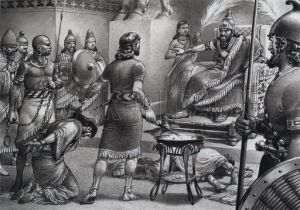
In those days, many false prophets were guaranteeing that Babylon’s power would be broken within two years (Jer. 28:2-4) and that the Temple vessels would be returned. But Jeremiah said otherwise. Speaking on God’s behalf, Jeremiah told the priests and rulers to serve Nebuchadnezzar if they wanted to live (Jer. 27:16-22). Jeremiah told them that the few items left in the Temple would be taken away because Babylon was going to come again. But Zedekiah and his advisors didn’t listen to Jeremiah. Instead, they all listened to the false prophets who were speaking deceitful words and fake prophecies of peace. Zedekiah made an alliance with the surrounding countries who were plotting against the Babylonian empire and joined in a multi-nation rebellion against Babylon. Not a good idea.

Babylon came back. Nebuchadnezzar surrounded Jerusalem a second time. The food started running short, and Jeremiah told Zedekiah that Babylon would take him captive. But Zedekiah still didn’t listen and put Jeremiah in prison for speaking the word of God.

Can you imagine the darkness of those days for those inhabitants of Jerusalem? Can you imagine watching and waiting for the Babylonians to invade your capitol city a second time? Can you imagine going to the already decimated Temple knowing that Jeremiah had prophesied that the few things that were left in that Temple would be taken? Again, it would have been easy for your heart to become weighed down with dissipation, drunkenness, and the cares of life.

Finally, the food did run out. The Babylonians broke through the walls. Zedekiah fled the city, but he didn’t get very far. He was caught by Nebuchadnezzar near Jericho. As punishment for his rebellion, Nebuchadnezzar slaughtered Zedekiah’s sons before his eyes. And that was the last thing Zedekiah saw. After the execution of his sons, Zedekiah’s eyes were plucked out (2 Kgs. 25:5-7), and he was taken to Babylon where he spent the rest of his dark days in a dungeon (Jer. 52:11).

But before Jerusalem fell, in the midst of this second siege of Jerusalem, the words of this text come from Jeremiah who was doubly captive – imprisoned by his own king, Zedekiah, and besieged by a foreign king, Nebuchadnezzar. Yet Jeremiah promises that a new King would come. This Righteous Branch would rule over an enduring capitol city where justice and righteousness would reign. These words came even as there was no justice for Jerusalem. Jeremiah was held captive for speaking God’s Word. There was no righteousness in the city where King Zedekiah ruled (even though Zedekiah means ‘Yahweh is my righteousness’); he did evil in the sight of God and rebelled against God and God’s messenger. But through Jeremiah God gave this beautiful promise.

Days were coming when God would cause a Righteous Branch to spring up for David. In those days, a King would come who would execute justice and righteousness in the land. In the midst of the destruction of the capitol and the uncertainty, Jeremiah spoke of days when Judah would be saved and Jerusalem would dwell securely. Jeremiah and his neighbors were soon to be captives in a pagan land and homeless. But Jeremiah speaks of the day when he and his countrymen would be citizens of the city of God which would be called, “Yahweh is our righteousness.”

Jeremiah was, of course, speaking of the coming, the Advent, of Jesus the true Righteous Branch. Five-hundred-eighty-four years after these words from Jeremiah, Jesus, the Son of David, was born to rule God’s people. He came in justice and righteousness, but we sinners treated Him unjustly and wickedly. King Jesus was crowned – but with thorns. King Jesus was proclaimed as king – but only with mocking and ridicule. King Jesus was enthroned – but only as He hung naked on a cross. Jesus came as your King – not the kind of king you would expect, but as the King you needed.

Jesus came as the eternal King for the people of Jeremiah’s day and for you. Through Jesus, the Righteous Branch, God has provided a place, even in the midst of this fallen world. He calls you right here, right now, to your home in His presence. Your city is safe and secure not because of your efforts or the efforts of some government or military. It is secure because of Christ’s work and God’s enduring promise.

In these days of Advent, you can celebrate as you wait because even now you have an enduring city you can call home. Even though foes surround you on every side, you dwell securely. In this eternal city, God is with you and loves you with an everlasting love. You are part of the Church, the Body of Christ. In this secure city, your King rules to forgive, renew, and empower you as you await the second advent of your King. Amen.

The peace of God, which surpasses all understanding, will guard your hearts and minds in Christ Jesus. Amen.

Luke 18:1-8 – The Anti-Hero

Luke 18:1-8—And [Jesus] told them a parable to the effect that they ought always to pray and not lose heart. 2 He said, “In a certain city there was a judge who neither feared God nor respected man. 3 And there was a widow in that city who kept coming to him and saying, ‘Give me justice against my adversary.’ 4 For a while he refused, but afterward he said to himself, ‘Though I neither fear God nor respect man, 5 yet because this widow keeps bothering me, I will give her justice, so that she will not beat me down by her continual coming.’ ” 6 And the Lord said, “Hear what the unrighteous judge says. 7 And will not God give justice to his elect, who cry to him day and night? Will he delay long over them? 8 I tell you, he will give justice to them speedily. Nevertheless, when the Son of Man comes, will he find faith on earth?”

Luther Preaching ChristIn the name of the Father, Son, and Holy Spirit.  Amen.

This short little parable, just four verses, is a captivating use of story.  Jesus uses this scoundrel of a judge to illustrate something about God.  This parable is both irreverent and funny; who here would compare God to a judge who neither fears God or respects man?  Jesus depicts a judge who is perfectly and completely unqualified to be a judge.  Even though this judge is a completely despicable human being, Jesus has him stand in for God.

In a hilarious way, the first words out of this character’s mouth agree with public opinion on him, “I neither fear God nor respect man.”  Imagine if the first words out of Cinderella’s wicked stepmother and ugly stepsisters were, “I’m Cinderella’s wicked stepmother,” and, “We’re Cinderella’s ugly stepsisters.”  It’s great stuff.

The legal system in Jesus’ day worked quite different than ours.  Cases were heard in no particular order; people who had legal disputes would stand around the judge and holler.  The judge would pick your case to be heard based on how he felt that day.  So if you wanted your cast to be heard quickly, the best course of action was to bribe the judge.

JudgeThis particular judge would probably need a large bribe because you could not appeal his sense of decency.  Because he has no fear of God, he is unconcerned that he will one day be judged by God.  Also, because he has no respect for anyone, you cannot threaten to ruin his reputation.  He just doesn’t care.

Now, enter the poor widow.

Typically in Jesus’ day, women were not allowed to speak in legal disputes – that was the job of the woman’s father, husband, or sons.  Because this widow goes herself to this scoundrel of the judge we know she is completely alone, completely helpless.

The widow kept coming demanding justice.  Finally, he caves in; the judge not only hears the widow’s case, but he also rules in her favor with no bribes.  He does all of this, frankly, because he’s annoyed.  Look at what the judge says in the last part of v. 5.  “I will give her justice, so that she will not beat me down by her continual coming.”

That phrase, ‘beat me down,’ literally means, ‘to blacken my eye.’  I’m pretty sure judge isn’t worried about this widow physically attacking him.  And he’s not worried about this widow ruining his reputation in the community – he has no fear of God or respect for man.  He is like the parent who has been beaten down by question after question about everything in the universe and how it all works.  (Come to my house; I know how this judge feels).  He is sick and tired of hearing this woman day after day, night after night, hour after hour, minute after minute crying out to him demanding justice.  The judge does give justice because he is worried about his physical health.

Jesus uses the unrighteous judge to make an incredible point.  Even this worthless scoundrel of the judge will give justice to someone who has absolutely nothing to offer him.  How much more then will God, who loves justice, who defines justice – how much more will give justice to His elect when they cry to Him?  God will absolutely give justice to His chosen ones speedily.

Now, Jesus told this parable to the effect that “they ought always to pray and not lose heart.”  So who here is losing heart?  I know that there are some of you here who are losing heart.  Lately, you’ve been stretched, you are tired, and autumn, the season of death, can be depressing.  The snow is about to fly, the temperature is plummeting, and it’s getting darker and darker every day.

To be a disciple of Jesus can be wearisome and discouraging.  You live  in a hostile world filled with heartache and heartbreak and suffering.  Being a Christian calls for endurance.  Are you losing heart?

Losing heart is a poetic way to say that you despair.  You are helpless, hopeless, lost, and alone.

Believer, you are more like the widow than you realize.  You have nothing to offer God.  You have nothing to use for a bribe.  Your works all fall far too short.  You have no one to advocate for you.  No one can help you.

And above all of that, why would you, a sinner, approach Almighty God asking for justice?  You know your sins.  You know that you are guilty – very guilty.  Satan, your accuser, your adversary,  has a very damning case against you.  You have been unfaithful to God.  You have despised His name, and worshiped everything under the sun.

But there is good news.  Romans 7 says that you are truly a widow.  Your husband, the law, has died.  You are no longer married to the law.  The law has died to you and you can belong to another, to Christ (Ro. 7:4).  The best part is that your new Husband, Jesus Christ, is the Judge to whom you appeal for justice.  You, church, are the bride of Christ.

Imagine that, believer, you are the bride of Christ.  Keep on praying to the Judge to give His judgment upon you.  Your judge is the very One who has taken away your sin.  Do not lose heart.  Do not listen to the devil’s accusations; do not let him or anyone else accuse you.  You are forgiven of all your sins.

How does Christ deal with you, how will He judge?  He will vindicate you.  He judges you to be, “Not guilty,” because you have the righteousness of Christ.

Believe this.

Jesus told this parable to the effect that you not lose heart and always pray.  He told this parable to strengthen your faith that God will certainly hear and answer your prayers.

So who is losing heart?  Notice what Christ says at the end of v. 8, “When the Son of Man comes, will He find faith on earth?”  It looks like Christ is the one losing heart.  But see how strong of an exhortation this is to pray and believe.  According to Jesus in this text, faith and prayer go hand-in-hand.  You do not pray if you do not believe that prayer will do something.  And you do not believe if you do not pray to your God who invites you to pray.

Christ begs you to believe Him when He says that His forgiveness, His work, and His sacrifice is for you.

If He is willing to give you Himself, what good thing would He withhold from you?  Amen.

May the peace of God which surpasses all understanding guard your hearts and minds in Christ Jesus now and until He comes again.  Amen.

Luke 16:1-15 – The Lauding of the Shrewd

Luke 16:1–15—He also said to the disciples, “There was a rich man who had a manager, and charges were brought to him that this man was wasting his possessions. 2 And he called him and said to him, ‘What is this that I hear about you? Turn in the account of your management, for you can no longer be manager.’ 3 And the manager said to himself, ‘What shall I do, since my master is taking the management away from me? I am not strong enough to dig, and I am ashamed to beg. 4 I have decided what to do, so that when I am removed from management, people may receive me into their houses.’ The Unjust Steward5 So, summoning his master’s debtors one by one, he said to the first, ‘How much do you owe my master?’ 6 He said, ‘A hundred measures of oil.’ He said to him, ‘Take your bill, and sit down quickly and write fifty.’ 7 Then he said to another, ‘And how much do you owe?’ He said, ‘A hundred measures of wheat.’ He said to him, ‘Take your bill, and write eighty.’ 8 The master commended the dishonest manager for his shrewdness. For the sons of this world are more shrewd in dealing with their own generation than the sons of light. 9 And I tell you, make friends for yourselves by means of unrighteous wealth, so that when it fails they may receive you into the eternal dwellings.

10 “One who is faithful in a very little is also faithful in much, and one who is dishonest in a very little is also dishonest in much. 11 If then you have not been faithful in the unrighteous wealth, who will entrust to you the true riches? 12 And if you have not been faithful in that which is another’s, who will give you that which is your own? 13 No servant can serve two masters, for either he will hate the one and love the other, or he will be devoted to the one and despise the other. You cannot serve God and money.”

14 The Pharisees, who were lovers of money, heard all these things, and they ridiculed him. 15 And he said to them, “You are those who justify yourselves before men, but God knows your hearts. For what is exalted among men is an abomination in the sight of God.”

In the name of the Father, Son, and Holy Spirit.  Amen.

This is not an easy parable.  It comes on the heels of the three famous parables: The Lost Sheep, The Lost Coin, and The Prodigal Son – remember better titles for those parables would focus on the main characters: The Reckless Shepherd, The Persnickety Woman, and The Wasteful Father.

Remember back in Lk. 15:1-2, the Pharisees and scribes were grumbling because Jesus was receiving tax collectors and sinners and eating with them.  Jesus was surrounding Himself with all the lowlifes of society, the riffraff, the scoundrels, and the bums.  To those tax collectors and sinners, His followers [disciples], Jesus tells this parable.  But the Pharisees and scribes certainly heard it too.

Can’t you just see Jesus trying to hide the smile on His face as He told this parable.  Can you imagine the shock and horror of the Pharisees and scribes as they hear Jesus tell this parable about the manager’s and his unrighteous, sinful actions and then praising him?

In this parable, Jesus presents a rich man who is so full of mercy and grace that he is happy to be cheated repeatedly rather than ceasing to be merciful and gracious.

The rich man catches his manager red-handed cooking the books and stealing.  The rich man is an honest man, and so he can’t have an unrighteous, dishonest man managing his books.  The rich man not willing to tarnish his reputation of being righteous and just at the expense of his unrighteous manager.  In other words, the rich man does not overlook the sin.  He tells the unrighteous manager, “Pack up your things.  Turn in the books.  You’re fired.”

The manager realizes that his very life is in danger because this is the only job he can do.  He is an accountant – a dishonest accountant – but an accountant nonetheless.  When word gets out that he has been fired because he is a crook and a cheat, no one will ever hire him to be an accountant again.  He can’t do anything else.  He is not strong enough to dig, and he is too ashamed to beg.  The fact that he is fired is an utter and complete disaster.

The manager realizes that he is in huge trouble, faced with a major crisis.  He whole life is burning down.  He needs help.

But he doesn’t waste any time.  He thinks on his feet, and he acts.  He acts quickly.

The unrighteous manager knows that his master is being merciful.  He could, and maybe should, have been thrown into prison immediately, but he was not.  Instead, the rich man has mercifully given the manager a sliver of time.  So the unrighteous manager decides to bet his entire future on the mercy of his former boss.  The unrighteous manager goes ‘all-in’ on the master’s grace.

As he goes back to his office to collect his ledger, the unrighteous manager summons all of his master’s debtors.  He is going to  purchase, friends for himself, not spending his own money, but charging the expense on the rich man’s credit card.

The unrighteous manager lowers all the tenant’s bills.

As far as the tenants know, the rich man has instructed the manager to lower the bills.  As far as the tenants know, the rich man is the source of this mercy and grace.  But, in the end, the tenants don’t really care why this is happening.  All they focus on is the fact that they have been freed from their debts, and they are thankful.

The unrighteous manager hopes that some of the villagers’ praise and thanks will spill over to him too.  Maybe one or more of the villagers will help him when they see him destitute and out of a job.  Maybe they will help him so that he will not have to dig or beg.

So, now, picture this final scene:  The unrighteous manager dismisses the very last debtor who skips out of his office because his debt has been significantly reduced.  The unrighteous manager takes a deep breath and smirks.  Even he can barely believe he is trying this.  He picks up the pile of papers reflecting the discounted debts.  The ink is still wet.  He closes the door to his office for the last time and walks to the rich man’s office.  As he opens the door, he rich man is looking out his window watching the whole village dancing and shouting for joy.  He turns toward the manager who is waving the bills in the air to get the ink as dry as possible.  With a crooked smile, he hands the bills over and they have obviously been reduced.

What does the rich man think?  What does he do?

He commends and compliments the unrighteous manager!  He sees the joke.  Yes, the joke is very expensive and at the rich man’s expense, but it’s still funny.

The rich man can’t turn stop the singing and dancing by saying, “No, no, no.  This man was fired.  He had no right to change your bills.  The bills are all going back to what they were.”  If he stopped the party and celebration like that, the villagers would turn against him forever.  The rich man’s reputation of generosity and mercy would be forever lost, and he won’t have that.

This is a beautiful story where everyone wins.  The villagers have less debt; the rich man has tenants who love him; and the unrighteous manager will probably not have to dig or beg to keep himself alive.

Do not be offended that the unrighteous manager gets away with his cheating and stealing – the rich man isn’t.  If the rich man is willing to die to those debts that are owed to him, why aren’t you?

Why do you find it so difficult to get over the fact that the rich man, the God character in this story, is willing to die to what is owed to Him?  Maybe you are thinking, “It simply is wrong, unfair, unjust that the rich man didn’t nail that sinner.”  You are right – how beautifully wrong, unfair, and unjust.  How gracious, loving, and merciful.

You see, this parable is so difficult because it so clearly reveals God’s mercy and grace.  When you look at it, you think it is about sin and deceit, but you are wrong.  It is important to note, that Jesus doesn’t use this parable to praise the unrighteous manager for his stealing or cheating.  No, Jesus praises his shrewdness.

Just as the rich man was willing to be cheated by the unrighteous manager, God is willing to be the butt end the poorly told joke of our lives.

Like the unrighteous manager, your life is an absolute disaster and crisis.  Like the unrighteous manager, you need help.  Like the unrighteous manager, your life is too messy and complex to deal with on your own.

You live in a world where evil is answered with evil; you see it every day.  Today, Jesus is challenging you to see the moral complexity of our world as an opportunity.  That’s right, the mess of this world and your life is an opportunity to find different ways to show this world of thieves and cheats the justice, love, peace, and mercy of your God.

You have a God who loves you in spite of yourself.  A God, who through the death and resurrection of His Son, Jesus, is the only one who can bring you out of your messes – the messes you and your selfishness create.  Amen.

May the peace of God which surpasses all understanding guard your hearts and minds in Christ Jesus.  Amen.

Luke 15:1-10 – Found

Luke 15:1-10—Now the tax collectors and sinners were all drawing near to hear him. 2 And the Pharisees and the scribes grumbled, saying, “This man receives sinners and eats with them.”

3 So he told them this parable: 4 “What man of you, having a hundred sheep, if he has lost one of them, does not leave the ninety-nine in the open country, and go after the one that is lost, until he finds it? 5 And when he has found it, he lays it on his shoulders, rejoicing. 6 And when he comes home, he calls together his friends and his neighbors, saying to them, ‘Rejoice with me, for I have found my sheep that was lost.’ 7 Just so, I tell you, there will be more joy in heaven over one sinner who repents than over ninety-nine righteous persons who need no repentance.

8 “Or what woman, having ten silver coins, if she loses one coin, does not light a lamp and sweep the house and seek diligently until she finds it? 9 And when she has found it, she calls together her friends and neighbors, saying, ‘Rejoice with me, for I have found the coin that I had lost.’ 10 Just so, I tell you, there is joy before the angels of God over one sinner who repents.”

In the name of the Father, Son, and Holy Spirit.  Amen.

Can’t you just hear the Pharisees and scribes grumbling and murmuring with clenched teeth and lowered voices, “This man receives sinners and eats with them”?

Jesus was associating Himself with the types of people that were questionable, shadowy, uncouth, lazy, selfish, profane, perverse, and scandalous.

If He had lived today, Jesus would be eating with the IRS agents who illegally targeted conservative political groups.  Jesus would be going to Olive Garden with the NSA agents who spied on people who are on the wrong side of elections.  Jesus would be barbecuing with the alcoholics.  He would have a picnic with the people who use their food stamps to buy liquor at strip clubs.

All sorts of lowlifes would be crowding around Jesus.  The air around Jesus would be clouded in cigarette smoke and filled with profanities.

Think of all the people whose lives are big neon signs that read, “Failure,” and Jesus is surrounded by them.  Flocks of individuals whose lives were mere shells of what they could have been or were supposed to be.  Hosts of people who fill their lives with every imaginable variation of immoral living were Jesus’ cup of tea.

Jesus was surrounded by the junkies, druggies, hippies, and beatniks – all the people who knew they had gone astray from God.

These very people hemmed around Jesus to hear His words, and Jesus would receive them and even eat with them.  Jesus, the man who performed miracles and claimed to speak for God, was making God’s name very unholy because of the people He associated with.

“This man receives sinners and eats with them.”

Jesus’ responds to these grumbling voices with three parables; we give them the titles, “The Lost Sheep,” “The Lost Coin,” and “The Prodigal Son.”  But those titles do not recognize the main character of the parables and obscure the point of each parable.  How many of you are going to go home this afternoon to watch refereeing while some guys in pads play football?  Just like referees, the sheep, coin, and son are important parts of the story, but they are not the main attraction.  I would suggest better titles for these three parables: “The Reckless Shepherd,” “The Persnickety Woman,” and “The Wasteful Father.”

In each of these parables, Jesus does not highlight how those things get lost.  Even in the third parable we learn so little about younger son and how he gets lost.  We are given very little information about how either the sheep or the coin got lost.  But were given very clear details of the determination and the pains and the sufferings and the work of the Reckless Shepherd and the Persnickety Woman to find what is lost.

This Reckless Shepherd leaves his 99 sheep.  He leaves his flock out in the wilderness, where bears, lions, and wolves are easily able to kill and eat the abandoned flock.  And this shepherd leaves the flock to go find one sheep which, for all he knows, is already maimed or dead.  For all he knows, this shepherd is wasting not just his time and efforts but potentially his entire flock for the sake of the lost.

This Persnickety Woman has lost one coin.  She goes through the dirty, dusty work of finding what others might have just chalked up as a loss. She goes through the pains of using a dim lantern to light her floor as she sweeps and rummages through every square inch of her disaster of a house to find the lost.

The actions of both the Reckless Shepherd and the Persnickety Woman flirt with being comically foolish.  But both the shepherd and the woman search, sweat, and swoon not just to find the lost, but to preserve their own integrity.

These two are pictures of Christ.

You, of course, are the lost.  You are lost because of your own doing.

You have severed yourself from the rest of the flock and the protection of the shepherd.  Your every action leads you astray.  You turn your own way.

You sin causes you to fall down into the cracks of the floor.  You roll farther and farther away picking up speed and end up in a heap of ashes and crumbs and grime and filth.

You are that sheep; you are that coin.  In this world, a lost sheep is a dead sheep.  But in the kingdom of God, lost and dead sheep are worth finding and raising.

In this world, a lost coin is a dead coin.  But in the kingdom of God, lost coins retain all their value once they are found.

You and I can put names and faces to those lost sinners that we think God is wasting His time and effort trying to find.  Sure, you like it for yourself, you find comfort in the fact that God searches you out and finds you.  You are happy to hear that God still has use for you.  But what about when that message is given to the other lost?  We, just like the Pharisees and scribes grumble, “This man receives sinners and eats with them.”

I wonder what the Pharisees and scribes would say if they saw us in this sanctuary gathered around Jesus, hearing His word, sitting round His table?  Would they be grumbling about us?  Maybe not.

Let me say it as plainly as possible: Are you the tool Jesus wants to use to bring in the tax collectors and sinners of our community, or are you holding back because you know that you would grumble if those lowlifes showed up here?

You see, the Pharisees and scribes were singing the right lyrics, but to the wrong tune.  The line, “This man receives sinners and eats with them” is best sung to the tune of the Gospel.

You see, sinner, you do not receive Jesus – Jesus receives you.

Christ wandered in the mountains and hills of death and despair to find you.  He heaved you up on His shoulders and brought you back.  Jesus took out His broom and swept and searched all the cracks of His tomb, and He found you there.  He picked you up and put you back in His pocket, calling all of heaven to celebrate with Him because of His tremendous finding.

And maybe, just maybe, God leaves you here until you are ready to join the angel’s song, “This man receives sinners and eats with them.”  Amen.

May the peace and joy and celebration of God which surpasses all understanding guard your heart and mind and fill your soul with gladness now and into all eternity.  Amen.

Luke 14:25-35 – Throw It All Away

Luke 14:25-35—Now great crowds accompanied him, and he turned and said to them, 26 “If anyone comes to me and does not hate his own father and mother and wife and children and brothers and sisters, yes, and even his own life, he cannot be my disciple. 27 Whoever does not bear his own cross and come after me cannot be my disciple.

28 “For which of you, desiring to build a tower, does not first sit down and count the cost, whether he has enough to complete it? 29 Otherwise, when he has laid a foundation and is not able to finish, all who see it begin to mock him, 30 saying, ‘This man began to build and was not able to finish.’ 31 Or what king, going out to encounter another king in war, will not sit down first and deliberate whether he is able with ten thousand to meet him who comes against him with twenty thousand? 32 And if not, while the other is yet a great way off, he sends a delegation and asks for terms of peace. 33 So therefore, any one of you who does not renounce all that he has cannot be my disciple.

34 “Salt is good, but if salt has lost its taste, how shall its saltiness be restored? 35 It is of no use either for the soil or for the manure pile. It is thrown away. He who has ears to hear, let him hear.”

In the name of the Father, Son, and Holy Spirit.  Amen.

How often do you ask yourself the question, “Do I measure up?”  How often do you wonder if you have made the grade?  Do you wring your hands if you haven’t pleased everybody, or if you failed that one important person?  Do you find yourself coming up short again and again no matter what new techniques you try?

Even when you do everything right, do the results reach your intended goals?  Even after you’ve followed all the rules, filled out the right forms, made every call, and pleaded your case brilliantly, do things end up the way they should?

Maybe you went to college and got a good degree, but you cannot find a job.  Maybe you built a business with a good model and great potential, but someone made it all fall apart.  Or maybe you own a business, but a customer fails to pay a bill, or an employee makes an expensive mistake, or regulations weigh you down, and you aren’t is profitable as you need to be.

Maybe you studied hard for that test, but still didn’t get a good grade.  Maybe you have thrown your whole heart into that relationship, but you are unappreciated and abandoned.

You pulled every string, used all of your connections, left no stone unturned, and you still don’t measure up.

You maybe wonder, “If I still can’t achieve my goals no matter how much I sacrifice, then why make any sacrifices it all?”

Now, in today’s text, Jesus makes following Him, makes being His disciple, sound more difficult than anything else you have tried.  Isn’t following Christ supposed to be easy?  Isn’t being a Christian all about life, joy, hope, faith, and love?

Not if you listen to what Jesus says, “If anyone comes to Me and does not hate his own father and mother and wife and children and brothers and sisters, yes, and even his own life, he cannot be My disciple.  Whoever does not bear his own cross and come after Me cannot be My disciple.”  Ouch.

Jesus, the man who said, “Love your enemies.”  Is now saying, “Hate your father, mother, wife, children, brothers, sisters, and even your own life, or you cannot be My disciple.  Bear your own cross, or you cannot be My disciple.”

With the track record of all your previous failures, it sounds as though following Jesus is going to be added to the list of projects begun but abandoned.  It looks like Jesus is setting you up to fail.

You still try.  You work at this.  You live your life thinking that your relationship with God is dependent upon you.  You suspect that God loves you when you are a good little Christian boy or girl and go to church, put money in the offering plate, and talk about God every now and then.  You think that God smiles upon you when you help others who are in need.  Then, when something bad happens, you wonder why God is allowing it to happen.

You have been keeping track of all the things that you bring to your relationship with God; you rely on all of your efforts and works.  But, in the end, you realize your efforts and works simply do not measure up.

Though you rarely think about it, you know eventually you will die, and nothing that you could claim as yours will be of any benefit to you.  Even though you still try to do it, you know that you cannot build yourself a tower to get to heaven.  The foundation will not be strong enough; the materials will not get you high enough.

Even though you still fight against Him, you know that you cannot win a war against God.  He is marching against you with 20,000 special-force soldiers, and your 10,000 little plastic toy soldiers are going to melt away.  God is mustering His troops and surrounding you because of your sins and failures.  Christ is coming again on the warpath to tear down, pluck up, and destroy all sinners and failures.  He is coming to battle against you, and you will lose.

This text today is a call from Jesus to let it all go.  Surrender.  Throw it all away.

Jesus tells you to renounce everything you would offer to become His disciple, His follower.  You may have to distance yourself from your family.  The word translated hate in v. 26 is an accurate translation, but it carries wrong connotations for us today (our use of hate is so connected to emotion), better to understand this word in light of the context of v. 33 where Jesus says to ‘renounce’ everything that you have.  Distance yourself from your parents, spouse, and children.  Especially, put space between yourself and your whole life filled with works because your life full of works do not and will not ever measure up.

While Christ is still a long way off, sue for peace.  Send the delegation that God has given you.  Send the diplomat of your baptism to remind Christ that He has put His name upon you.  Commission the negotiator of the Lord’s Supper to show that Christ Himself is given to and for you.  Jesus Christ will set you behind Him so that you are following Him as He continues to bring His kingdom as He leads the charge against sin.

Even while others mock you for your pathetic tower, remember that Christ built a tower to the heavens built on a block of wood in the shape of a cross.

Abandon your efforts and works.  Carry your cross.  Even though it may be unpleasant, you will actually find that it is no work whatsoever to pick up and carry your cross because it has already been carried to its end in your Savior’s death and resurrection.  Amen.

May the peace of God which surpasses all understanding guard your hearts and minds in Christ Jesus.  Amen.

Luke 14:1-14 – Table Manners

Luke 14:1-14—One Sabbath, when he went to dine at the house of a ruler of the Pharisees, they were watching him carefully. 2 And behold, there was a man before him who had dropsy. 3 And Jesus responded to the lawyers and Pharisees, saying, “Is it lawful to heal on the Sabbath, or not?” 4 But they remained silent. Then he took him and healed him and sent him away. 5 And he said to them, “Which of you, having a son or an ox that has fallen into a well on a Sabbath day, will not immediately pull him out?” 6 And they could not reply to these things.

7 Now he told a parable to those who were invited, when he noticed how they chose the places of honor, saying to them, 8 “When you are invited by someone to a wedding feast, do not sit down in a place of honor, lest someone more distinguished than you be invited by him, 9 and he who invited you both will come and say to you, ‘Give your place to this person,’ and then you will begin with shame to take the lowest place. 10 But when you are invited, go and sit in the lowest place, so that when your host comes he may say to you, ‘Friend, move up higher.’ Then you will be honored in the presence of all who sit at table with you. 11 For everyone who exalts himself will be humbled, and he who humbles himself will be exalted.”

12 He said also to the man who had invited him, “When you give a dinner or a banquet, do not invite your friends or your brothers or your relatives or rich neighbors, lest they also invite you in return and you be repaid. 13 But when you give a feast, invite the poor, the crippled, the lame, the blind, 14 and you will be blessed, because they cannot repay you. For you will be repaid at the resurrection of the just.”

In the name of the Father, Son, and Holy Spirit.  Amen.Jesus Reclining at Table

God does not love you for who you are.  Yes, you heard me right.  God does not love you for who you are.  The sooner you get that through your skull made thick by your own self-righteousness, the better.

Three times in this text, Jesus tries to get that single point across to you and the Pharisees.

Some dinner party this must have been.  Jesus intentionally and repeatedly offends everyone at the table – even, and especially, the man who had invited Him.  Jesus takes the hammer of the Law and strikes again and again, in an effort to crush and pulverize self-righteousness.

Notice how the Pharisees were “watching Jesus carefully” (v. 1).   The Pharisees were like tigers prowling in the tall grass waiting for an opportunity to pounce on Jesus.  They wanted an opportunity to accuse sinless Jesus.  But Jesus is wise to their game.  He simply won’t be hunted.  Rather, He becomes the hunter of false piety and self-righteousness.

Enter this man with dropsy (now, it’s called edema), an accumulation of fluid in one or more parts of the body which causes painful swelling.  One glance at this man and you know something is wrong with him.  Jesus asks, “Is it lawful to heal on the Sabbath, or not?”  He lets the uncomfortable silence hang in the air for a while, but not one of the Pharisees know what to say.  The Pharisees won’t even give Jesus an honest answer.  No one is willing to say, “Sure, Jesus.  It’s alright to heal on the Sabbath.”  But neither does anyone say, “Absolutely not; no healing on the Sabbath.”  But Jesus doesn’t wait for them to answer.  He heals the man and sends him on his merry little way.

Jesus calls them hypocrites.  It is as if Jesus were saying, “I am the Maker and Redeemer of this swollen man.  Here we are on the Sabbath, a day when you are to rejoice in and receive everything God gives you, a day when you remember that God will give you an eternal rest from sin and death, and you won’t let that same Sabbath rest come to this man.  Seriously, look at him!  But if your son or even your animal fell into a pit, you would help him.  You all make me sick.”

The Pharisees are silent.  The Law has hit them square in the face, but they do not and will not repent.  None say, “Yes, you are right Jesus.  I, at least, am not consistent in how I apply the law.  I was just judging You when you healed that guy.  But I excuse myself for doing the exact same thing when it is beneficial to me.”  But none of them have the guts to stand on their self-righteousness either.  “Hey, Jesus.  Who are you to judge us?”

But they cannot challenge Jesus’ authority to judge them because Jesus has plainly revealed that He is God.  They prefer to stand on their works, their self-righteousness, and their efforts.  They chose to deny the plain reality that God is standing before them, eating with them rather than repenting of their own works and deeds.

So Jesus decides, “They think I’ll accept them for who they are.  Ok. I’ll hit ‘em with the Law again.”  He notices how the people around Him like to sit in the places of honor.

He tells this little parable (probably here the word parable would be better understood as proverb) which, basically, repeats Prov. 25:6-7.  Remember now, this is a Sabbath.  This day was given to the people to remember that God is preparing an eternal feast for His people.  Let’s put this parable in today’s setting:

When you go to a wedding reception and you are waiting for the wedding party to come in, don’t go sit at the head table.  You will not be there for long.  The wedding party will come in and you will be told to go and sit somewhere else – somewhere in the back near the bathroom and garbage cans.  But there is always the possibility that if you sit in the back willingly, when the bride and groom come in, they will raise you to sit at a good table.

These guests all thought they were important, just like you think you are more important.  You just reveal it in different ways.  You make yourself the center of conversation.  You gossip and speak about others excusing it as concern.

The host isn’t free from the Law either.  Jesus says, “You are inviting people who agree that God loves you for who you are.  Rather than receiving your commendation from God, you receive it from men.  Then when they invite you, you will pat them on the back too.  Try this instead: invite the people who aren’t impressed with your good works and piety.  Invite the last, lost, least, and little. Stop surrounding yourself with ‘good people.’  Instead, eat with the scoundrels and sinners like I do.”

In each section of this Gospel lesson, Jesus is striking at the heart of the Pharisees’ piety.  But you need to hear all this too.  You think God accepts you for who you are.  He doesn’t.  The next section of Luke v. 15-24 which occur at this same Sabbath party reveal that you and every human being in all history think God is just waiting for a person like you to come along – He isn’t.

In v. 15-24, Jesus tells a parable about God.  Jesus depicts God as a rich man who prepared a great banquet.  He invited many, but when the party was supposed to begin, no one showed up.  So God sent out a servant to tell the invitees, “Come, for everything is now ready.”  But everyone makes an excuse.  “I have to go see a field I just bought.”  And, “I have to look at the oxen I have just bought.”  And, “I have just gotten married, so I can’t come.”

So God tells His servant, “Go out to the streets and bring in the poor, the cripple, the blind, and the lame.”  The servant replies, “I’ve already done that, and there is still room in the party.”  God tells him, “Go to the highways and hedges and compel people to come in so that this party is full.  For not one of those men who were invited shall taste my banquet.”

My beloved fellow sinners. That parable is your call to quit trying to stand before God on your own.  God’s banquet isn’t filled with important people.  God’s banquet is filled with losers.  Losers who are found by the servant, by Jesus, and compelled to go to the party.

Jesus, the Son of God, came and chose the last seat.  He chose to sit upon a cross with outstretched arms with pierced hands and feet.  Jesus then noticed a seat further from the head of the table.  He went and sat down in death’s cold grip.  God saw Him there, and exalted Him.  Jesus has been exalted above every name that is named in heaven or on earth or under the earth.

This Jesus is the one who rescued you from your pit so you could experience the rest of God’s eternal Sabbath.  Jesus is the one who sees you in your sins and says, “Hey come sit up here closer to Me.  Come taste My banquet.  I am inviting all the poor, cripple, lame, blind, and dead.  You’ll fit right in.  The food might not look like much, but it’ll feed you for your journey.  This food fills your soul with the forgives sins.  It quenches your hunger and thirst for righteousness.  It can do that because this food is My own body and blood – given for you and shed for the forgiveness of your sins.  Come to My feast, for all is now ready.”  Amen.

May the peace of God which surpasses all understanding guard your hearts and minds in Christ Jesus, now and forever.  Amen.