
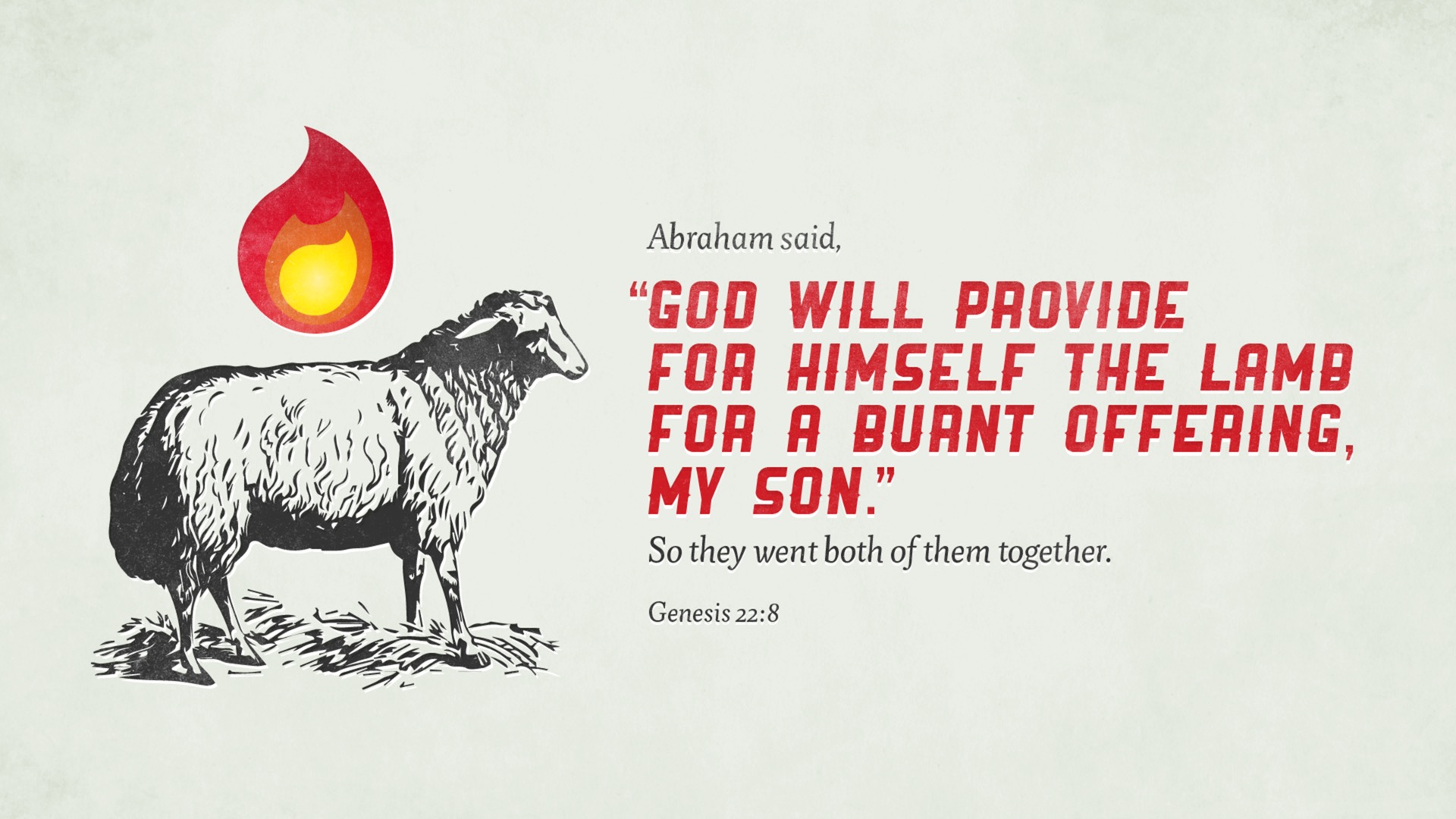
1 After these things God tested Abraham and said to him, “Abraham!” And he said, “Here I am.” 2 He said, “Take your son, your only son Isaac, whom you love, and go to the land of Moriah, and offer him there as a burnt offering on one of the mountains of which I shall tell you.” 3 So Abraham rose early in the morning, saddled his donkey, and took two of his young men with him, and his son Isaac. And he cut the wood for the burnt offering and arose and went to the place of which God had told him. 4 On the third day Abraham lifted up his eyes and saw the place from afar. 5 Then Abraham said to his young men, “Stay here with the donkey; I and the boy will go over there and worship and come again to you.” 6And Abraham took the wood of the burnt offering and laid it on Isaac his son. And he took in his hand the fire and the knife. So they went both of them together. 7 And Isaac said to his father Abraham, “My father!” And he said, “Here I am, my son.” He said, “Behold, the fire and the wood, but where is the lamb for a burnt offering?” 8 Abraham said, “God will provide for himself the lamb for a burnt offering, my son.” So they went both of them together.
9 When they came to the place of which God had told him, Abraham built the altar there and laid the wood in order and bound Isaac his son and laid him on the altar, on top of the wood. 10 Then Abraham reached out his hand and took the knife to slaughter his son. 11 But the angel of the Lord called to him from heaven and said, “Abraham, Abraham!” And he said, “Here I am.” 12 He said, “Do not lay your hand on the boy or do anything to him, for now I know that you fear God, seeing you have not withheld your son, your only son, from me.” 13 And Abraham lifted up his eyes and looked, and behold, behind him was a ram, caught in a thicket by his horns. And Abraham went and took the ram and offered it up as a burnt offering instead of his son. 14 So Abraham called the name of that place, “The Lord will provide”; as it is said to this day, “On the mount of the Lord it shall be provided.”
In the name of Jesus. Amen.
In most of our interactions with people, we typically give more weight to their commands than we do to their promises. In other words, we take commands seriously but promises, not so much. We’ve grown accustomed to people who over-promise but under-perform.
When your boss tells you he wants a certain task completed by the end of the day, that carries a lot of weight. But when your boss promises that he’ll consider your request for a new chair as soon as possible, you anticipate that there will be delays and excuses and figure you’ll probably have to ask several more times. Sadly, even children learn this. Parents will command their children to do certain things, but then when a child asks their parents to consider getting a puppy, a parent responds, “Sure, I’ll think about it,” but that may or may not happen.
The worst part of this is how it clouds how we consider God’s Word. God’s Word is consistent. His promises carry same weight as His commands. What God promises always happens. You can count on it. He is the Lord; He has spoken, and He will do it (Ezk. 24:14).
That helps us understand a little better what’s going on in this text. The biggest hurdle we have to understanding this text is the question, why is God commanding Abraham to do this? Why command the human sacrifice of Isaac? Last week we talked about the tests that God gives, and this is clearly a test. God is testing Abraham here, and this is probably the most difficult test recorded in Scripture. (Who knows? Maybe Job would argue with that statement.)
The reason God tests always to strengthen faith. He doesn’t test you to see if you have enough willpower or inner strength. Instead, God tests faith to make it stronger. God’s tests increase steadfastness (Jam. 1:2-4), endurance, character, and hope (Ro. 5:3-5). One pastor put it nicely when he said that God gives tests to strengthen our “givable-to-ness.” His tests open us up so we can receive from God’s hands the abundance He wants to give us.
God had been making promises to Abraham for years prior to this. God called Abraham to leave his land and people (Gen. 12:1-3) so God could make a great nation out of him (Gen. 15:1-6). When Abraham was 99 years old, God promised to give Abraham a son through his wife Sarah – even though she was 90 and past the age of having children (Gen. 17:15-16). God kept giving promises. Just before this reading, God promised that Isaac would have children, and through Isaac’s children all the families of the earth would be blessed (Gen. 21:12, 18:18).
But now, God commands Abraham to offer Isaac as a burnt offering. God’s promise that Isaac would have children is in direct contradiction to God’s command that Isaac be sacrificed. So, what is Abraham to do? Should he believe God’s command or God’s promise? The answer is to believe both, and Abraham does. Hebrews 11:19 says, that Abraham believed that God would raise Isaac from the dead. Abraham believed God’s promises and commands – even when God’s promise and command appeared contradictory.
Now, to the text. God doesn’t just say, “Go sacrifice Isaac.” No. God lays it on thick. “Take your son, your only son Isaac, whom you love.” That, dear saints, is the first time the word ‘love’ is used in the Bible. “Take your son, your only son Isaac, whom you love, and go to the land of Moriah, and offer him there as a burnt offering on one of the mountains which I will show you.”
Abraham knew that all the animal sacrifices in the Old Testament pointed to the fact that God would accept the death of another in the place of the sinner. Abraham and all the believers in the Old Testament believed that those sacrifices were pointing forward to the Savior God had promised (Gen. 3:15) who would die in their place (Heb. 9:12).
This sacrifice (or ‘near sacrifice’) of Isaac might be the clearest portrayal of what God would do through Christ. The whole thing is parallel to what Jesus would do. Abraham is to offer his son, just like God the Father, is to offer up His beloved son, Jesus (Jn. 3:16). It takes three days for the thing to take place (Gen. 22:4; Lk. 24:46). Isaac, like Jesus, carries the wood to the place where he is to be the sacrifice (Gen. 22:6; Jn. 19:17). The ram that gets offered in place of Isaac is crowned with thorns (Gen. 22:13; Mt. 27:19).
When Abraham sees that ram caught in the thicket by its horns, which doesn’t happen to rams, Abraham recognizes that ram is to be sacrificed instead of Isaac. God has put that ram there, and God will accept the death of that ram in the place of Isaac. But the ram is not the actual substitute. That ram points to Jesus as the sacrifice in place of Isaac and Abraham and the whole world and for you.
Through this whole thing, God is giving Abraham an insight into what God will go through when He offers up Jesus as the sacrifice for the sin of the world.
Dear saints, as we move into Holy Week, we’re going to hear a lot of sad things. Next week, Palm Sunday, we’ll hear the Passion of Christ from Matthew. We’ll hear about the betrayal, beating, whipping, crucifying, and dying of the eternal, beloved Son of God. There will be no substitute for Jesus. He will die, and this is serious and sad like this offering of Isaac was for Abraham. But notice how Jesus talks about all of this. When Jesus spoke of Abraham in our Gospel reading today, our Lord says, “Abraham saw my day and was glad” (Jn. 8:56). Abraham rejoiced.
Abraham saw what God would do in giving His only begotten Son on the cross, and he rejoiced. Dear saints, in the days that are coming up, you’ll hear all that Christ did. Yes, it’s sad and somber, but the greatest expression of faith is that you would be glad and happy about this. Receive it all with a thankful and joyful heart. God loves you, so He loves to do this for you.
Tenali, today you are Baptized. Jesus is the one who has taken your place. This is reason to rejoice all the days of your life. Live a life filled with rejoicing in the fact that Jesus is your substitute. Tenali, and all you saints, remember that Jesus endured all His suffering with joy. It was for the joy that was set before Him that Jesus endured the cross, despising the shame (Heb. 12:2).
Joy isn’t only for Easter. Joy is found in all Christ has done for you. You have a substitute. You have a Savior. Good Friday, a glad day, indeed. Amen.
The peace of God, which surpasses all understanding, will guard your hearts and minds in Christ Jesus. Amen.
 Pastorsamwise
You must be logged in to post a comment.