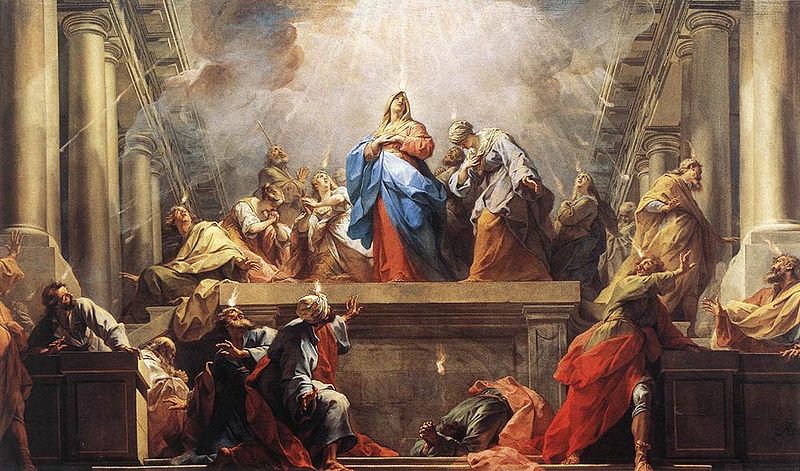
Acts 2:1-11
1 When the day of Pentecost arrived, they were all together in one place. 2 And suddenly there came from heaven a sound like a mighty rushing wind, and it filled the entire house where they were sitting. 3 And divided tongues as of fire appeared to them and rested on each one of them. 4 And they were all filled with the Holy Spirit and began to speak in other tongues as the Spirit gave them utterance.
5 Now there were dwelling in Jerusalem Jews, devout men from every nation under heaven. 6 And at this sound the multitude came together, and they were bewildered, because each one was hearing them speak in his own language. 7 And they were amazed and astonished, saying, “Are not all these who are speaking Galileans? 8 And how is it that we hear, each of us in his own native language? 9 Parthians and Medes and Elamites and residents of Mesopotamia, Judea and Cappadocia, Pontus and Asia, 10 Phrygia and Pamphylia, Egypt and the parts of Libya belonging to Cyrene, and visitors from Rome, 11 both Jews and proselytes, Cretans and Arabians—we hear them telling in our own tongues the mighty works of God.” 12 And all were amazed and perplexed, saying to one another, “What does this mean?” 13 But others mocking said, “They are filled with new wine.”
14 But Peter, standing with the eleven, lifted up his voice and addressed them: “Men of Judea and all who dwell in Jerusalem, let this be known to you, and give ear to my words. 15 For these people are not drunk, as you suppose, since it is only the third hour of the day. 16 But this is what was uttered through the prophet Joel:
17 “‘And in the last days it shall be, God declares,
that I will pour out my Spirit on all flesh,
and your sons and your daughters shall prophesy,
and your young men shall see visions,
and your old men shall dream dreams;
18 even on my male servants and female servants
in those days I will pour out my Spirit, and they shall prophesy.
19 And I will show wonders in the heavens above
and signs on the earth below,
blood, and fire, and vapor of smoke;
20 the sun shall be turned to darkness
and the moon to blood,
before the day of the Lord comes, the great and magnificent day.
21 And it shall come to pass that everyone who calls upon
the name of the Lord shall be saved.’”
In the name of Jesus. Amen.
To understand the significance of this text and what happened here in Acts 2, it is helpful for us to realize two things. First, Pentecost was already an important feast that had been instituted by God. And Second, the Holy Spirit was already at work in the world before this text. But let’s dive into each of those a little more. What was this feast, and what was the feast celebrating?
Pentecost was one of three Old Testament feasts that required a trip to Jerusalem. The other two were Passover and the Feast of Booths. Now, you won’t find the word “Pentecost” in the Old Testament. There, it’s usually called the “Feast of Weeks.” To understand why it eventually gets called “Pentecost,” we have to do a little math. (Yes, math in a sermon.) In Lev. 23:15-16, God tells the people to count seven weeks plus one more day after the Passover. So, you count seven weeks – 7×7=49 – plus one more day equals 50. And “Pentecost” means the 50th day. In the Jewish mind, the 50th day was a week of weeks plus one more day. So, the “Feast of Weeks”/Pentecost is a celebration of the 8th day.
And this is significant because when Genesis tells us about creation (Gen. 1:1-2:3), it counts out the first seven days, but that’s it. So, in the Jewish mind, the 8th day is the day outside of creation and the day of the new creation when we stop counting. The festival of Pentecost was a time of joy and rest because it was the end of the barley harvest (similar to our Thanksgiving holiday), and the focus of Pentecost was looking forward to the eternal rest God promised to His people.
Pentecost was also considered as the anniversary of the giving of the Law on Mt. Sinai. The idea was that Passover and the exodus from Egypt was the birth of the people of Israel, and then fifty days later, God gives the Law on Sinai which was understood as God’s marriage to His people, Israel. To see this, it is helpful to expand our understanding of what Ten Commandments are. (And if anyone is interested, we can have a brief Bible study after the service to cover this more thoroughly.)
In Exodus 20:1-17, God speaks to the whole congregation of Israel and gives the Ten Commandments. When you look through those verses, God says a lot of things, and if you take all the “you shalls” and “shall nots” there are more than ten. In fact, you get at least 13. But in Ex. 34:28 and Dt. 10:4, the Bible tells us that there are ten things there. But there is no place in Scripture where we are told how to number the things God gives there. God simply lets us figure it out, which is why there are different numberings of the Commandments.
The other important thing to know is that the Bible itself doesn’t call what God gives us in Ex. 20 “Commandments.” Scripture simply calls them the “Ten Words.” So, to get to the point quickly (again if you want more of an explanation, stick around after the service), the Jewish people count the first of the Ten Words as, “I am the Lord your God, who brought you out of the land of Egypt, out of the house of slavery.” The way they count the Ten Words, the first Word is a promise from God. God defines who He is – He is their God who delivers them. Then, in the other nine words, God gives the instructions about what His people are to be in this world because He is our God.
So, the Ten Words are understood as the wedding vows. God is the faithful husband, and His people are to be His faithful bride. And, again, Pentecost was a celebration of that. That is why the people have gathered in Jerusalem. They are celebrating because the harvest has ended, and they are looking to the eternal rest with God, their faithful husband.
The second thing that helps us understand what is happening here in Acts 2 is a right understanding that the Holy Spirit was already at work in the world before this first Day of Pentecost. Just a few examples:
In Gen. 1:2, we see that the Holy Spirit was involved in creation.
In Gen. 41:38, Pharaoh recognizes that the Holy Spirit had blessed Joseph with wisdom to interpret his dream and make plans to provide food during the upcoming famine.
In Ex. 31[:3] & 35[:21], God says that a guy named Bezalel is filled with the Holy Spirit to have artistic skill so he could make all the different pieces of the Tabernacle.
In Num 11:26-29, the Holy Spirit rests on two men named Eldad and Medad, and they begin to prophesy. (And I’ll give $100 to anyone who has twin boys, and names them Eldad and Medad. Those names mean, “God has loved,” and, “Love.”)
In Num. 24:2ff, the wicked prophet Balaam has the Holy Spirit come upon him so that he blesses Israel instead of cursing them like he intended. In Num. 27:18, Joshua, Moses’ successor, is said to have the Holy Spirit dwelling in him.
In Ps. 51:11, David’s great Psalm of confession, David prays that God would not take the Holy Spirit from him.
Is. 63:10, talks about how God’s people sinned and grieved the Holy Spirit.
In Lk. 1:35, Gabriel tells Mary that she will conceive Jesus when the Holy Spirit comes upon her. We could go on, but I hope you get the picture. The Holy Spirit was active in many ways before He came upon the disciples here in Act. 2.
To sum up: Pentecost was already a festival celebrating the eternal rest of the new creation and God being a husband to His people. And the Holy Spirit was already at work in many significant ways before this text in Acts 2. So, what is the big deal about Pentecost?
Now, Jesus has come. Christ has been born as a Man. He has suffered, shed His blood, and died. Jesus has risen again and ascended to the right hand of God the Father. Now, the Holy Spirit comes in full measure and is poured out upon His Church as the promised Comforter.
On the day of Pentecost, the Holy Spirit comes in ways that were seen and heard. The Spirit was visible in the fire that rested on the heads of those who were gathered. They had that fire rest upon them, but they were not burned or consumed like the burning bush where God appeared to Moses. And the Holy Spirit is audible first in the mighty rushing wind and then in the languages that the disciples spoke telling the mighty works of God (Act. 2:4, 11).
These miracles are significant. Remember, it was mandatory that all the Jewish males try to get to the Temple for Pentecost, so all sorts of pilgrims were gathered from all over the world to celebrate the harvest and rest God had given. And while those pilgrims are in the Temple, they hear the sound of the mighty rushing wind. V. 6 of our text says that the multitude gathered together because they heard the sound of that wind. This crowd knew it wasn’t just a normal storm, something extraordinary was hapening.
So, they come out of the Temple and hear not simply the wind, but they hear about the mighty works of God in Jesus in their native languages. And this is so spectacular because these people had just been in the Temple hearing God’s Word, but not in their native language. Hebrew was the language of the Temple, and it is likely that some of them didn’t even understand the Hebrew used in the Temple. Even though they were ethnically Jewish, they had been living for generations in other countries and didn’t know Hebrew at all or very well.
But that multitude who came together at the sound of the rushing wind did know more than one language. For them to get to Jerusalem, check into a hotel, and buy food, they had to know at least Greek, Aramaic, or Latin. These people couldn’t have been at the feast of Pentecost without at least a working knowledge of one of those languages. So, the Holy Spirit could have enabled the apostles to speak in only those four languages, and everyone there would have been able to understand. But the Holy Spirit is more gracious than that. Each person there heard in their native language the mighty works of God in Jesus.
So, here at Pentecost, the Holy Spirit reaches out to that entire multitude of pilgrims in a very personal way. The Temple was strict, everything had to be in Hebrew. But now people from every tongue are able to hear the mighty works of God in their mother’s tongue. The Holy Spirit sanctifies all those languages to carry the Gospel of Jesus Christ. This is so beautiful.
We heard in our Old Testament reading (Gen. 11:1-9) how God dispersed the inhabitants of the earth by confusing their language at the tower of Babel. Here at Pentecost, God reverses the curse of Babel, but not in the way we would expect. He doesn’t reunite the languages of the world into one language. Instead, God unites all people through the one message of the Gospel and blesses what once divided us. What used to divide humanity becomes a blessing and a variety of grace. And this multiplied grace continues into eternity. In Rev. 7:9-10, John sees a great multitude that no one could number from every nation, from all tribes and all peoples and all languages standing before the throne of God and before the Lamb. In heaven, the saints are equally perfected, but they aren’t erased of their personalities and histories.
If you want diversity, look to the Church united in faith in Jesus.
But as amazing as all these Pentecost miracles are – the wind, the tongues of fire, the speaking in a multitude of languages – these miracles have their limits. Some in that crowd figure the apostles are drunk, which is absurd. Drunk people have difficulty speaking their own language let alone fluently, coherently, and eloquently in other languages that they don’t even know. But even those who don’t accuse the apostles of being drunk only get to the point of asking the Lutheran question, “What does this mean?”
So, Peter stands up for the apostles and says that Joel 2 is being fulfilled in their presence. In these last days (Act. 2:17), the Holy Spirit is being poured out so that the wonders of heaven and mighty works of God in Christ Jesus are being shown to the multitude so that “everyone who calls upon the name of the Lord may be saved.”
That is the most significant miracle. The greatest miracle of all the spectacles of Pentecost is the salvation that is available to everyone despite their sin.
Peter will go on to preach a short sermon. Listen quickly to the main thrust of that sermon in the three verses that follow our text here. Peter preaches, “Men of Israel, hear these words: Jesus of Nazareth, a man attested to you by God with mighty works and wonders and signs that God did through Him in your midst, as you yourselves know – this Jesus, delivered up according to the definite plan and foreknowledge of God, you crucified and killed by the hands of lawless men. God raised Him up, loosing the pangs of death, because it was not possible for Him to be held by it” (Act. 2:22-24).
After Peter’s sermon is done, the multitude is convicted of their sin and asks, “What shall we do?” And Peter says, “Repent and be baptized every one of you in the name of Jesus Christ for the forgiveness of your sins, and you will receive the gift of the Holy Spirit for the promise is for you and your children and for everyone who is far off, everyone whom the Lord calls for Himself.” And 3,000 believe, are Baptized, and saved.
That is the real miracle of Pentecost. The Holy Spirit calls, gathers, enlightens, and sanctifies those who were responsible for the crucifixion of Jesus. The Holy Spirit used Peter to preach to them the Word of God – Law and Gospel. And the Holy Spirit causes them to repent, believe, and be saved.
And that miracle continues to this day. Whenever you hear the Word of God and are pointed to Jesus, there is Holy-Spirited, Pentecost work going on. Just last week, you heard how Jesus says we can tell when the Holy Spirit is working. In John 15:26 Jesus says, “When the Helper comes, whom I will send to you from the Father, the Spirit of truth, who proceeds from the Father, He will bear witness about Me.” Wherever and whenever Jesus is being proclaimed as the Savior of sinners, the Holy Spirit is at work.
Dear saints, the real miracle of Pentecost is still going on; in fact, it’s happening right now. You think your pastor is preaching to you, but I’m just the speaker producing the sound. When you hear the Gospel that declares that all your sins are forgiven and that you have peace with God because of the suffering and death of Jesus on the cross, it isn’t a mere human telling you this. That is the work of the Holy Spirit.
So, when you come to church with your sins, failures, and doubts, when you come stained and soiled by the godless world in which we live, the Holy Spirit enters into this place and opens the Scriptures to you. He brings to remembrance all that Jesus has said (Jn. 14:26). And by pointing you to Jesus, the Holy Spirit does His work of making you holy. That’s why He’s called the Holy Spirit. Yes, He is holy, but He is called the Holy Spirit because He makes you holy. He clothes you in the robe of Christ’s righteousness and sends you home at peace with God.
Dear saints, Pentecost happened. The Holy Spirit came that day nearly 2,000 years ago in Jerusalem, but Pentecost continues, and for that, God be praised. Amen.
The peace of God, which surpasses all understanding, will guard your hearts and minds in Christ Jesus. Amen.
 Pastorsamwise
You must be logged in to post a comment.