The Clash – Sermon on Matthew 11:12-19 for Reformation Sunday

Matthew 11:12-19

12 From the days of John the Baptist until now the kingdom of heaven has suffered violence, and the violent take it by force. 13 For all the Prophets and the Law prophesied until John, 14 and if you are willing to accept it, he is Elijah who is to come. 15 He who has ears to hear, let him hear.

16 “But to what shall I compare this generation? It is like children sitting in the marketplaces and calling to their playmates,

17 “‘We played the flute for you, and you did not dance; 
we sang a dirge, and you did not mourn.’

18 For John came neither eating nor drinking, and they say, ‘He has a demon.’ 19 The Son of Man came eating and drinking, and they say, ‘Look at him! A glutton and a drunkard, a friend of tax collectors and sinners!’ Yet wisdom is justified by her deeds.”

In the name of Jesus. Amen.

Do you believe that God uses the plans and actions of violent men to accomplish His will? I hope you can answer, “Yes.”

We don’t normally think of it this way, but the cross is the greatest example of God’s will being accomplished through the actions of evil men. The very event that won your salvation was the height of mankind’s rebellion against God. The world planned, plotted, and schemed to put the Son of God to death (Mt. 12:14Mk. 3:6Jn. 11:47-53). Christ’s death on the cross was the most unjust act ever committed by mankind. Jesus, the only person to ever live a righteous and sinless life, was condemned and crucified. And it was through Christ’s death that death itself was undone. There, on the cross, God won your salvation.

So, if God can accomplish your salvation through the actions of violent men – which He has, He absolutely has – then you don’t ever have to fear any evil in this world. The plans and actions of evil men never stop God and His will. When we see all the violence, upheaval, and opposition in this world, it can be easy to fall into despair and think that God isn’t in control. But He is – no question He is. Christ is still ruling and reigning over all things. And God’s will is still done.

Still today, God destroys and brings to nothing every evil council and purpose of the devil, the world, and our own flesh. His Name is still hallowed. His kingdom still comes. God continues to strengthen and keep us steadfast in His Word and in faith. This is His good and gracious will that we pray would be done in the Lord’s Prayer.

So, believer, every night when you go to bed, you can close your eyes in the peace and comfort of knowing that your sins are forgiven because of what Christ has done. Even as the world constantly clashes against the kingdom of heaven, you have God’s comfort and peace that surpasses all understanding (Php. 4:7).

Ever since the Fall into sin, there has been a clash between fallen humanity and God. This clash is rightly described when theologians make a distinction between believers on earth and believers in heaven. Christian, as long as you are in this world, you are part of the “Church militant,” and when you are removed from this world – either when you die or when Christ returns – you are transferred to the “Church triumphant.”

In this text, Jesus teaches us how to live as members of the “Church militant.” And this is important and helpful instruction because the clash between this fallen world and you citizens of the kingdom of heaven, that clash can make us want to fight back against the world. But you don’t need to fight because Jesus has already won the war.

So, in this text – which is not an easy text – Christ helps you understand how to live when you face violence and opposition in this world. There are two portions of this text that I’ve always found confusing and somewhat difficult. The first deals with the violence the Church faces in this world. The second deals with the world’s opposition and ridicule of the Church. We’ll think our way through each of them; then, we’ll see how Jesus tells us to respond.

The first difficult part is right away in v. 12 where Jesus addresses the violence that faces the Church. Our Lord says, “From the days of John the Baptist until now the kingdom of heaven has suffered violence,” no problems so far. It’s what comes next, “and the violent take it by force.” What is Jesus talking about? Do the violent seize control of the kingdom? No. There’s something else going on. But we have to wade through all of this to get the full picture.

Both John the Baptist and Jesus came preaching the exact same message “Repent, for the kingdom of heaven is at hand” (Mt. 3:24:17). And the world didn’t like that message. It turns out – surprise, surprise – that people who don’t think they’re sinners, they don’t want to be told to repent. So, they violently attacked the messengers. John’s preaching got him arrested, and soon after this text, John will be beheaded (Mt. 14:1-12). At this point in Matthew’s gospel, Jesus is still a couple of years from being crucified, but it’s coming.

That violence against the kingdom of heaven that John and Jesus faced continues to this day. It’s happening all over the world – even here in our country. The shootings at Annunciation School in Minneapolis, the Christian school in Nashville, Charlie Kirk’s martyrdom, and many other events are part of this clash. Today, in North Korea, China, Egypt, and all around the world, Christians are being violently persecuted. Just this week, I saw horrifying statistics from Nigeria. Since the year 2000, 62,000 Christians have been martyred there, and already in 2025, 7,000 have been martyred. Yes, the kingdom of heaven still suffers violence. Lord, have mercy.

So, what does Jesus mean with that last phrase, “the violent take it by force”? Again, it isn’t that the violent gain possession or ownership or control of the kingdom of heaven by force. Instead, they try to take it away by force. In other words, this world actively tries to prevent the coming of God’s kingdom. But they will never succeed.

The second part of the text that can be confusing starts in v. 16 where Jesus is trying to figure out how to describe ‘this generation.’ “To what shall I compare this generation? It is like children sitting in the marketplaces and calling to their playmates, ‘We played the flute for you, and you did not dance. We sang a dirge, and you did not mourn.’”

In a way, this is a little parable. The generation Jesus is speaking about isn’t just the generation of His time. The children in the marketplace are the same violent people Jesus talked about in v. 12 – it’s the generation of sinners. Sinners aren’t happy with anything. Basically, they say, “We were happy, but you weren’t happy with us. We were sad, and you didn’t get sad with us.” And Jesus goes on to explain that little poem to illustrate how the world reacts to the kingdom of heaven. The explanation is seen in how this generation reacted to John the Baptizer and to Jesus Himself.

In short, neither John nor Jesus followed the world. John wouldn’t dance when the world wanted him to. He came eating locusts and honey, and he wasn’t feasting with them because he was too busy calling them to repentance. They thought John’s preaching was too pessimistic. They figured things weren’t as bad as John said they were. So, they tried to dismiss John saying, “You won’t dance to our flute? You must have a demon.”

But then Jesus came, and He did eat and drink. He went to many feasts throughout His ministry. He went to dinners at Pharisees’ houses (Lk. 7:36ff14:1ff). Jesus feasted with tax collectors and sinners (Mk. 2:15-17Mt. 9:10-13Lk. 15:1), and the world didn’t like that either. Christ wouldn’t mourn during their dirges and funeral songs. So, just like they did with John, they tried to dismiss Jesus saying, “You’re a glutton, a drunkard,” (both of which are ridiculous accusations), “a friend of tax collectors and sinners.”

In other words, dear saints, you can live a life of fasting that avoids all of the pleasures this world seeks because you know this world is not all there is. And people will respond by calling you evil and demonic. You can also live a life where you participate and eat and drink, and people will say that you are a glutton and a drunkard.

So, Jesus is saying you can’t win with the world. Yes, there is a time for fasting and saying that the things of this world don’t matter. And there is also a time for feasting and enjoying the fullness of the gifts God has given. But it doesn’t matter to the world if you fast or feast, the world is going to hate you – not because of your eating and drinking or your abstaining. The world is going to hate you, dear saints, simply because you are a citizen of the kingdom of heaven.

So, what should our response be? How do we live in a generation that violently attacks and opposes the Gospel?

Well, first, recognize that the kingdom of heaven advances through the simple, unimpressive Word of God that can be attacked and resisted. The kingdom of God advances through the preaching of the Gospel because faith comes by hearing (Ro. 10:17). In other words, listen. Jesus puts it this way, “He who has ears to hear, let him hear” (Mt. 11:15).

One of the most important lessons from the Reformation is that we don’t need to talk as much as we need to listen. Christians are first and foremost hearers. You hear the Law which stops your mouth and makes you silently accountable to God (Ro. 3:19). Stop making excuses for your sin and be silent before God. Then, hear the Gospel, which forgives all your sin.

The other response to the violence and opposition from this generation is to patiently wait. Jesus says, “Wisdom is justified by her deeds” (Mt. 11:19). That means that the day is coming when your faith and your identity as a member of the kingdom will be proven true. No one will be able to deny the wisdom you had in confessing your sin and believing in Jesus. That right fear of the Lord is the beginning of wisdom (Pr. 9:10).

Christian, you do not need to try to make God’s kingdom come. God is, and He will, bring about the coming of His kingdom. In the meantime, He arms you with the sword of His Word (Eph. 6:17). The sword of God’s Word doesn’t function like any other sword because it is the sword that makes the wounded whole. Use that sword to heal this broken generation. And pray. Pray, “Lord, keep us steadfast in Your Word.”

When this world is filled with wickedness, when violence surrounds you, when the evil people oppose you, and when all of this is clashing down around you, remember what Jesus says to you. “Fear not, little flock, for it is your Father’s good pleasure to give you the kingdom” (Lk. 12:32). Alleluia! Amen.

The peace of God, which surpasses all understanding, will guard your hearts and minds in Christ Jesus (Php. 4:7). Amen.
Change of Plans – Sermon on Mark 16:1-8 for the Resurrection of Our Lord

Mark 16:1–8

1 When the Sabbath was past, Mary Magdalene, Mary the mother of James, and Salome bought spices, so that they might go and anoint him. 2 And very early on the first day of the week, when the sun had risen, they went to the tomb. 3 And they were saying to one another, “Who will roll away the stone for us from the entrance of the tomb?” 4 And looking up, they saw that the stone had been rolled back—it was very large. 5 And entering the tomb, they saw a young man sitting on the right side, dressed in a white robe, and they were alarmed. 6 And he said to them, “Do not be alarmed. You seek Jesus of Nazareth, who was crucified. He has risen; he is not here. See the place where they laid him. 7 But go, tell his disciples and Peter that he is going before you to Galilee. There you will see him, just as he told you.” 8 And they went out and fled from the tomb, for trembling and astonishment had seized them, and they said nothing to anyone, for they were afraid.

Alleluia! Christ is risen!
He is risen indeed! Alleluia!

In the name of Jesus. Amen.

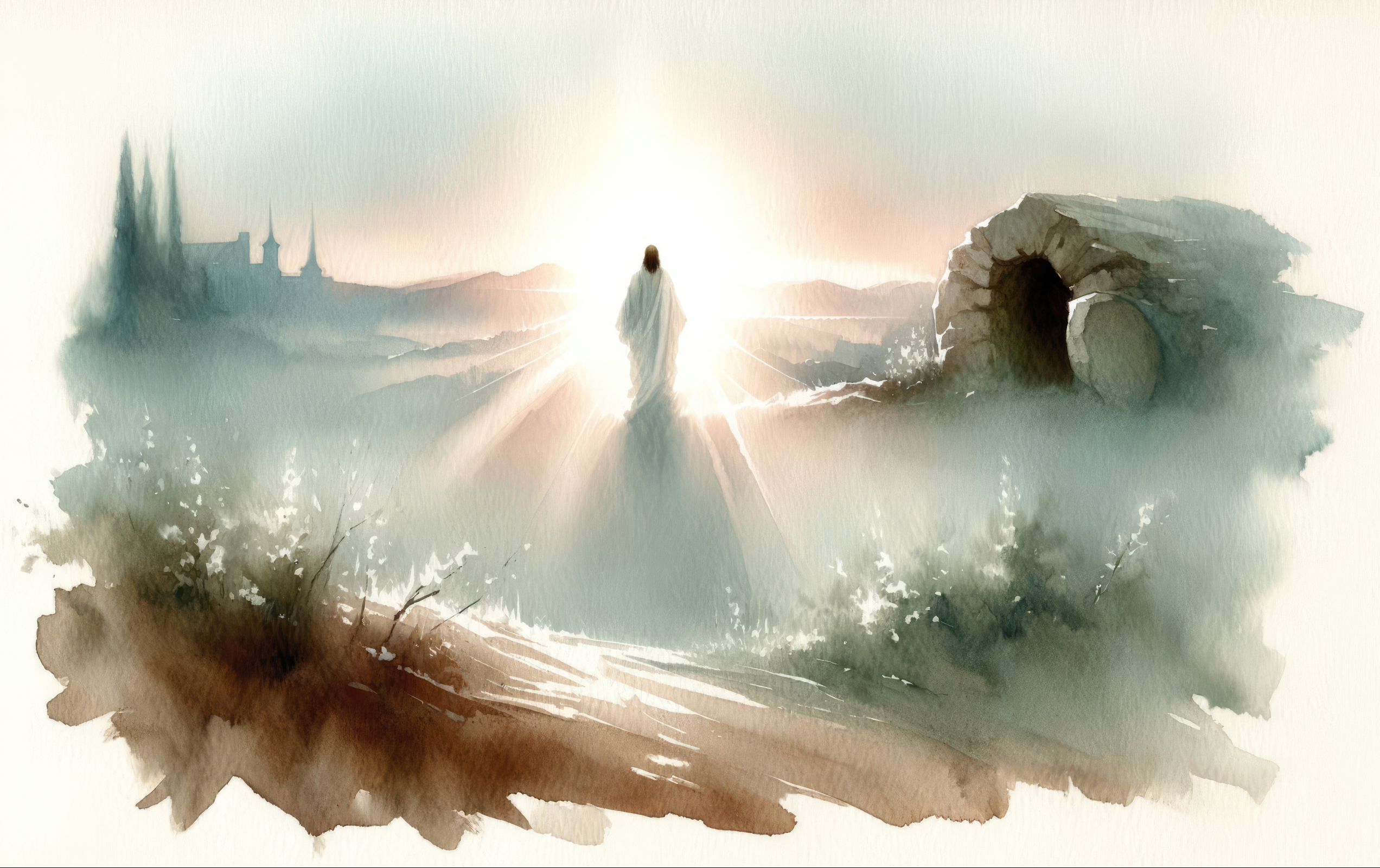
That day began like any other day in that garden. While the city slept, daylight began to peek over the horizon. Birds began to rustle in the bushes and branches. They didn’t have any songs yet, just little chirps here and there. A light breeze rustled through the trees, but otherwise everything was silent and still.

For the women, any other day like this would have seemed utterly and completely normal. But everything that had transpired on Friday made this morning bitterly different. They had woken up early, well before the sun had risen. They walked out of the city walls in complete silence, each of them carrying a bundle of spices. They were returning to the place they had seen Him laid, and every step was agonizing but not because the path was difficult to walk. That wasn’t the problem. This trek was painful because His tomb was in the shadow of where they had stood for three hours watching Him die (Jn. 19:41). And those memories were still bitterly fresh and raw. But they had to go. They had a job to finish.

Their intention was to give Him a proper burial. It was something they had done for countless others back home in Galilee. But as they approached the garden, their plans were interrupted. They started to worry because they remembered the large, heavy stone that stood between them and their task. They had completely forgotten to calculate it into their plans. “Oh no! What are we going to do about that stone?” “We could go back and get some of the disciples to move it for us.” “No, that won’t work. The guards aren’t going to let them anywhere near His body.” “Ok then. What do you suggest we do?” “I guess we keep going. We’re almost there anyway. Maybe the guards will move it for us. If they won’t, we’ll just figure something else out.”

But then, as they came into the clearing, Mary saw something. The stone had been rolled back. It was laying there, face down. Somehow, the grave looked different. On Friday, the mouth of that tomb looked like the fierce jaws of a predator ready to snap shut. Now, it looked as weak and harmless as a limp, drooling mouth of someone who had unintentionally fallen asleep in a chair.

Those women had planned to anoint the body of a dead Man, but their plans were irrelevant. There was no dead man there. Those women were worried about the heavy stone, but their anxiety was a moot point. It had already been tossed aside by the angel who now sat on it in mocking it (Mt. 28:2).

All the plans of the women, all their worry and anxiety, all their calculations of how this day would go – all of that was thrown out the window because this was no normal day. It was the first day, and not just the first day of the week. It was the first day of something much, much, much greater. It was the first day of the new creation. It was the first day of the Resurrection of the dead. Jesus is the firstfruits, and the full harvest will come soon (1 Co. 15:20, 23).

It wasn’t just the women who had their plans changed and their worries wiped away that day. The guards had planned to watch over Jesus’ dead body to prevent the disciples from stealing it, but hose plans didn’t matter. One, they didn’t matter because Jesus wasn’t, still isn’t, and never for the rest of eternity done with His body. And two, they didn’t matter because the disciples were afraid and locked in the house (Jn. 20:19, 26). I imagine those guards were worried about getting this assignment. “They want us to guard a dead body? This must be some sort of demotion.”

The religious leaders had plans to destroy Jesus (Mt. 27:20), but all they could do was kill Him. And when the Son of God dies, He doesn’t stay dead. Those religious leaders planned to annihilate the Son of David, their King, and have no king but Caesar (Jn. 19:14-21). But now, Jesus is risen and ascended into heaven, seated at God’s right hand on the throne of creation with all authority in heaven and on earth (Mt. 28:18, Col. 2:10). The devil planned to strike Jesus, but he only got Christ’s heal. And now, the devil’s head is crushed (Gen. 3:15).

Christ’s Resurrection requires – even demands – a change of plans. It doesn’t matter if the plans are to do good things like the women, and it doesn’t matter if the plans are for evil like the religious leaders, the rulers, the soldiers, and the devil. None of those plans end up mattering because Christ is risen.

Now, this doesn’t mean you shouldn’t ever make any plans. Don’t let that be your conclusion. Instead, what it means is this: only what God plans matters. God’s plan is what is going to happen. God’s plan is what you can count on. So Christian, whatever plans you make, make them with your mind set on Christ your crucified, risen, ruling, reigning King. Every plan you make, make it by first setting your mind on Christ who is seated at the right hand of God because when Christ who is your life appears, you also will appear with Him in glory (Col. 3:1-4).

This also means that, whatever worries and anxieties you have, now they matter a whole lot less. Christian, because of Christ’s Resurrection, you can now look at everything – all the sin, evil, sickness, injustice, opposition, wickedness, and death in this world – you look at all of that through a different lens, the lens of Christ’s Resurrection.

That lens makes everything clear. That puts everything into its proper perspective. That is how things actually are in reality. The Resurrection has forever changed creation. Your sins are died for and forgiven. And Jesus is out of the tomb proving that God accepted His sacrifice. Death and the grave are defeated. Satan is crushed. And because Christ is risen, so will you.

Today and every day, celebrate that this morning, and every other morning of your life, is no normal morning. Every morning is another morning in the Resurrection. Your Redeemer lives. At the end, He will stand triumphant upon the earth. You will see Him with your own eyes (Job 19:25-26). You can plan on it. Amen.

Alleluia! Christ is risen!
He is risen indeed! Alleluia!

The peace of God, which surpasses all understanding, will guard your hearts and minds in Christ Jesus. Amen.

Silently Accused – Sermon on Matthew 26:1-27:66 for Palm Sunday

Matthew 26:1-27:66

In the name of Jesus. Amen.

It doesn’t matter how familiar you are with a passage of Scripture, there’s always something more to see, to glean, to meditate on. That’s true for short, familiar passages, but it is certainly true for a long passage like this. While preparing this week, what struck me in a fresh way is what Matthew tells us in Mt. 27:20. The chief priests and elders persuaded the crowd to ask for Barabbas and destroy Jesus.

Of the four Gospels, Matthew is the sharpest on this. They don’t persuade the crowd to just kill, execute, or even crucify Jesus. They want Him destroyed. That’s their desire.

There is utter malice behind this. Jesus looks so weak. He had already been betrayed by Judas. The other eleven disciples fled when He was arrested. Peter denied even knowing Him. Jesus had been mocked, spit upon, beaten, bound, and whipped. And they still call for Jesus to be destroyed. The cruelty of wanting Jesus destroyed is absolutely astounding.

But through all of it, Jesus barely speaks. Jesus talks a lot at the beginning of this reading while He is with the disciples, but once He is arrested, He only speaks three more times before His death here in Matthew’s gospel. All these false accusations are thrown at Him, but He doesn’t respond to any of them. Jesus just stays passive and silent as He is accused. Again, He looks weak.

During His trial before Caiaphas, all sorts of false charges are brought against Jesus, but He simply stands there and receives them. He doesn’t say a word. He only talks when Caiaphas demands, “Tell us if you are the Christ, the Son of God” (Mt. 26:63). But then, Jesus says, “You have said so. But I tell you, from now on you will see the Son of Man seated at the right hand of Power coming on the clouds of heaven.”

It sure doesn’t look like Jesus is seated at the right hand of Power through the rest of His Passion. His silence looks like weakness, but that’s not how we should see it. It is powerful.

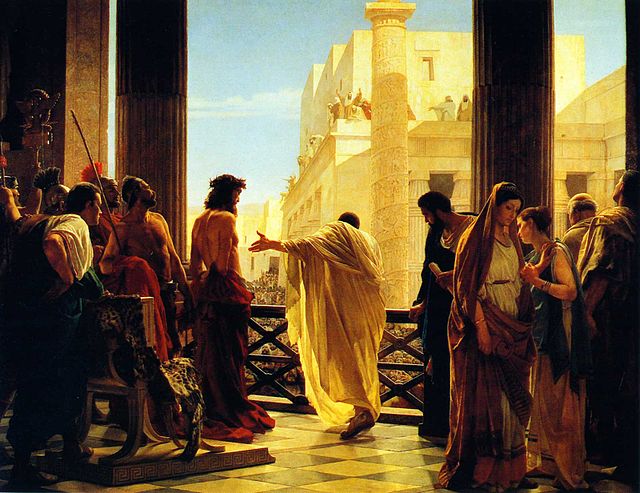
Jesus doesn’t speak again until Pilate asks Him, “Are you the King of the Jews?” There, Jesus says,“You have said so.” But again, as the chief priests and elders accuse Jesus before Pilate, Jesus is silent (Mt. 27:12). Even though Pilate asks Jesus to respond to all these accusations, Jesus still gives no answer, not even to a single charge. In His silence, Jesus looks weak and passive.

All of this reminds me of the scapegoat. Do you remember what God had commanded His people to do on the Day of Atonement (Lev. 16)? Each year, there were two goats. One was sacrificed and the blood of that goat allowed the high priest to enter the Holy of Holies. But the other goat, the scapegoat – it had a different purpose. The high priest laid both of his hands on the head of that goat and confessed all the iniquities, all the transgressions, and all the sins of the people. And God said that what happened there was that the high priest was placing all that sin on the goat’s head (Lev. 16:21).

And what do you suppose that goat did during that? It couldn’t object. The goat didn’t say, “Hey, what do you think you’re doing?” The goat remained passive and silent and simply received it. Once all those sins were placed on that goat’s head, it was led into the wilderness carrying all those sins away from the sinners (Lev. 16:22). The scapegoat and all those sins were destroyed, never to be seen again. Yes, the scapegoat was passive, but by it God powerfully removed those sins.

Pilate hears all these accusations and sees how Jesus is silent. He knows these religious leaders want Jesus destroyed for no good reason, but Pilate has an idea. Pilate has the notorious Barabbas in custody who had committed murder and started a riot and insurrection (Mk. 15:7; Lk. 23:18-19). Pilate puts Barabbas and Jesus forward as his nominees to potentially be released. It seems as though Pilate figured Barabbas was such a rotten individual and danger to society that the crowds would rather have Barabbas crucified for their own safety and protection. But the crowd calls out for Barabbas to be released and for Jesus to be crucified.

And that’s what Jesus wants too. So, Jesus stays silent, passive, and powerful.

It was God’s will that Jesus should be on the cross instead of Barabbas. By taking Barabbas’ place on that cross, Jesus also takes your place under God’s wrath against your sins.

God takes all this evil, malice, and injustice and uses it for your eternal good (Ro. 8:28). Jesus’ Passion isn’t a tragedy. It is God’s victory. In fact, this is the victory. Jesus’ silence in all of this isn’t weakness. It’s God’s power because this is God’s plan playing out. This is how God powerfully removes your sins from you as far as the east is from the west (Ps. 103:12). Jesus is crucified and heaven rejoices to see God’s great, powerful love for His creation. This is how God loves the world. This is how God loves you.

Jesus silently takes all those accusations, He is loaded up with all your sins, and He is led into the wilderness of death as He is crucified and destroyed. But death will no power over Him.

Dear saints, welcome to Holy Week. Easter is coming. Amen.

The peace of God, which surpasses all understanding, will guard your hearts and minds in Christ Jesus. Amen.

Christ’s Obedience – Sermon on Romans 5:19 for Midweek Lent 1

The Scripture readings for tonight’s service are Psalm 16; Isaiah 50:5-10; and John 6:35-40.

In the name of Jesus. Amen.

Tonight, as we begin this series contemplating Christ’s suffering, we need to have a couple of things straight in our minds.

First, to contemplate Jesus’ suffering isn’t just about knowing facts, events, and details about Jesus’ Passion. For example, there are books and articles you can read about the horrors of what crucifixion does to a person. Doctors can tell you about what happens to the body and the pain that those who are crucified experience. There can be a benefit to those sorts of things because it can add shed light on certain Biblical texts like Psalm 22 which talks about being “poured out like water, all my bones are out of joint, … my tongue sticks to my jaws, … I can count all my bones,” etc. So, to be clear, the point of this series is not just to see how great Jesus’ suffering was or how much He suffered as He gave His life on the cross. Instead, the point of this series is to see that Christ’s suffering is for you and for your salvation.

The second thing we need to have straight is this: Tonight’s sermon is titled “Christ’s Obedience.” Obeying God does not cause Jesus to suffer. Not in the least! 1 Jn. 5:3 makes it clear that God’s Commandments, along with keeping and obeying them, are not burdensome. Yes, because we are sinners, we think God’s Commands restrict us. We don’t always want to do what the Commandments require of us and think they cause us suffering, but that’s not the fault of the Commandments.

The Commandments are simply how creation works. People who have never heard the Commandments know that murder, stealing, and lying is wrong (Ro. 2:14). All of the Ten Commandments are written into the fabric of creation just like the laws of physics. Think back to right after Christmas when we had a couple inches of ice on everything. You knew that you needed to be careful moving around because there wasn’t the normal amount of friction between your foot or tire and where you were stepping or driving. And if you didn’t compensate for how slippery everything was, the laws of physics meant that things could go wrong very quickly. The same is true for the Commandments. Whether a person recognizes them as God’s Commands or not, life goes so much better if the Commands are kept and observed because they keep us in line with how creation works.

Jesus perfectly kept God’s Commands and was completely obedient to them, and it was His delight to do so (Ps. 1:2, 119:113). Don’t get the sense that Jesus was groaning and complaining because He had to obey. Now, His obedience did bring Him to suffering because He was the Savior of us disobedient sinners. But Scripture is clear that Jesus wanted to be on the cross to save and rescue you.

Luther draws on this in his great hymn “Dear Christians, One and All, Rejoice,” in two of the verses. “God said to His beloved Son: ‘It’s time to have compassion. Then go, bright jewel of My crown, and bring to all salvation. From sin and sorrow set them free; slay bitter death for them that they may live with You forever.’ The Son obeyed His Father’s will, was born of virgin mother; and God’s good pleasure to fulfill, He came to be my Brother. His royal pow’r disguised He bore; a servant’s form, like mine, He wore to lead the devil captive.”

In other words, it was Jesus’ obedience to God’s will and His desire to He deliver you from sin, sorrow, and death that led Him to suffering. But obeying God’s will wasn’t what caused Jesus to suffer. I know that is a little nuanced, but I hope you get the picture.

So, tonight what I want to highlight is that Jesus’ obedience to God’s will is what makes His suffering even more profound and precious because, again, He willingly does it for you. Php. 2:5-8 gives us some insight into this: Even though Jesus is the eternal Son of God, He, “did not count equality with God a thing to be grasped, but emptied himself, by taking the form of a servant, being born in the likeness of men. And being found in human form, he humbled himself by becoming obedient to the point of death, even death on a cross.”

Our Gospel reading (Jn. 6:35-40) sheds light on this. Jesus came and was born to do God’s will. Christ obeyed His Father’s will which was to be your Savior. Your heavenly Father’s will was that Jesus would win you for His own and raise you up on the last day. God’s will is that everyone who beholds Jesus and believes in Him would have eternal life. Doing all of this was Jesus being obedient to His Father’s will, and it was His delight. It was for the joy that was set before Jesus that He endured the cross despising its shame (Heb. 12:2).

So, when you think of Jesus’ obedience, remember that includes everything He suffered. And recognize that it was all for you. So, what did Jesus suffer, and how is it a benefit to you?

Jesus was born in a stable (Lk. 2:7) so you could be reborn as a child of the King of creation (Jn. 1:12-13).

Jesus was raised in the home of a poor carpenter (Lk. 2:40, 52) so you could have eternal riches (Eph. 1:18).

Jesus got tired (Jn. 4:6) so your soul could be refreshed and restored (Ps. 23:3, 5).

Jesus had no place to lay His head (Mt. 8:20) so you could live in a mansion that He has prepared for you (Jn. 14:2-3).

Jesus was arrested (Jn 18:12) so that you would not be eternally captive to the devil (2 Th. 2:26).

Jesus was bound (Jn. 18:12) to release you from the chains of sin (Mt. 18:18).

Jesus was forsaken by all His closest friends (Mt. 26:56) so you could be reconciled with God (2 Co. 5:18).

Jesus was falsely accused (Mt. 28:59-60) so that the Law could not accuse you before God (Ro. 8:1, 33).

Jesus was sentenced to death (Mt. 27:15-26) to release you from eternal death (Jn. 5:24).

Jesus carried His cross (Jn. 19:17) so you would not have to bear the burden of your sins for all eternity (Heb. 12:1).

Jesus was nailed to the cross (Jn. 19:18) so your sins could be cancelled (Col. 2:14).

Jesus was stripped (Jn. 19:23) so He could clothe you in His righteousness (Gal. 3:27).

And Jesus was forsaken by God (Mk. 15:34) so you would not be rejected by God (Ro. 5:10).

Dear saints, Romans 5:19 says, “As by [Adam’s] disobedience the many were made sinners, so by [Jesus’] obedience the many will be made righteous.” That is what Christ has done for you. His obedience, even through suffering, has made you righteous now and forever. Amen.

The peace of God, which surpasses all understanding, will guard your hearts and minds in Christ Jesus. Amen.