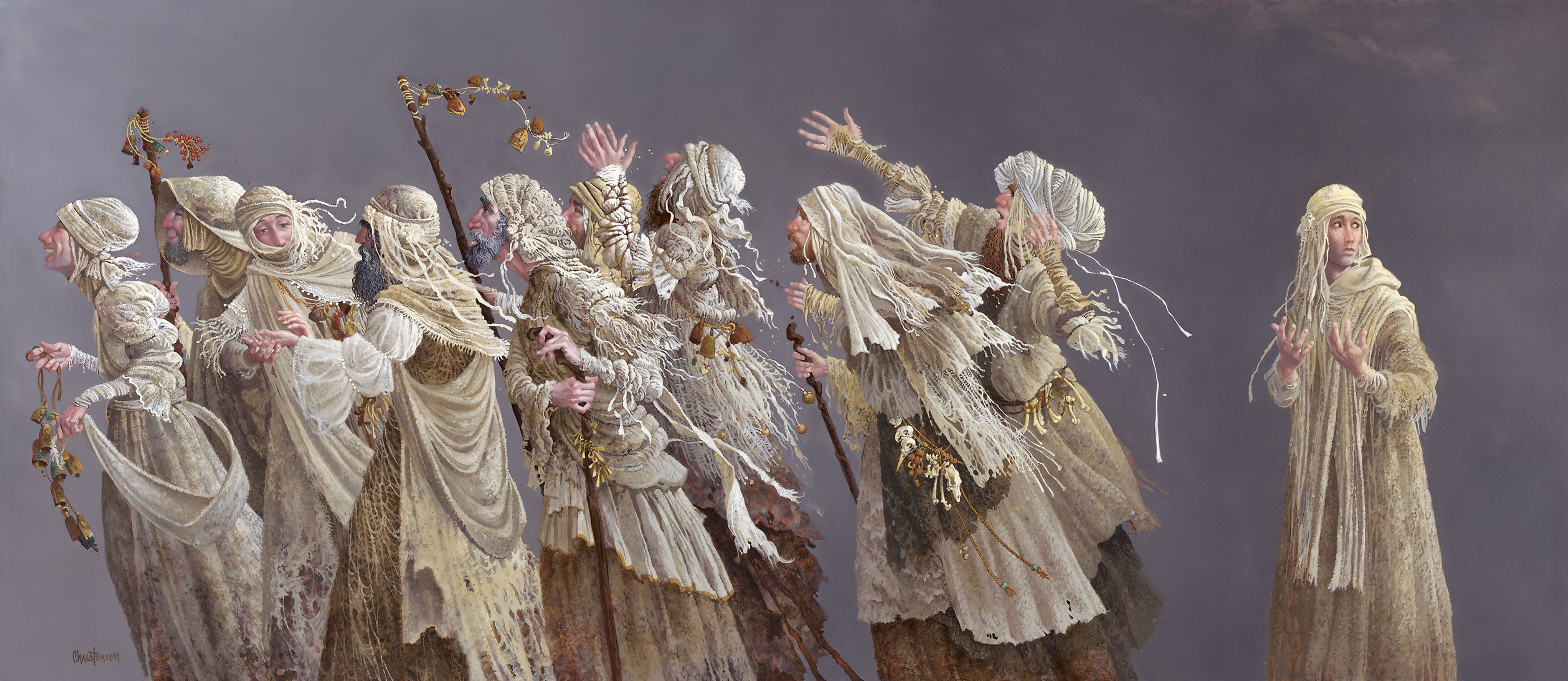
11 On the way to Jerusalem he was passing along between Samaria and Galilee. 12 And as he entered a village, he was met by ten lepers, who stood at a distance 13 and lifted up their voices, saying, “Jesus, Master, have mercy on us.” 14When he saw them he said to them, “Go and show yourselves to the priests.” And as they went they were cleansed. 15Then one of them, when he saw that he was healed, turned back, praising God with a loud voice; 16 and he fell on his face at Jesus’ feet, giving him thanks. Now he was a Samaritan. 17 Then Jesus answered, “Were not ten cleansed? Where are the nine? 18 Was no one found to return and give praise to God except this foreigner?” 19 And he said to him, “Rise and go your way; your faith has made you well.”
In the name of Jesus. Amen.
Trouble will often create fellowship. After the terrorist attacks on 9/11 our country had a strong sense of unity – at least for a bit. Those of you who lived here during the ’97 flood still have that fellowship. Maybe you’ve noticed having better fellowship with your family when a loved one has gone through lengthy medical treatments or died. Everyone bands together to get stuff done.
One of the reasons Alcoholics Anonymous or other support groups are so helpful is that struggling people can meet others have gone through similar situations. People gain strength and encouragement from others who have had similar experiences and struggles. All those are good examples of trouble creating fellowship. That kind of fellowship produces unity and focus, a renewed sense of purpose and drive, and hope in the midst of sorrow. Fellowship created by and through trouble can have a powerful positive effect.
But trouble can also create bad fellowship – really bad fellowship. I’ve heard of support groups that morph into a kind of contest where some will try to show how much more pain they have endured than the rest of the individuals in that group. Or, when a group like that only focuses on their pain and struggle, some might start to think they’ll lose their connections if they begin to heal from the pain. So, everyone gets fixated on either being or, even worse, remaining a victim in an effort to not lose that camaraderie.
It seems like that fixation on victimhood is one of the tactics the devil is using to divide our culture today. There is so much conversation about privileged and the underprivileged. The super-rich and those who aren’t. The oppressors and the oppressed. Even if you aren’t initiating those conversations, the natural, knee-jerk reaction to that kind of talk is to view people who are introducing that kind of vocabulary as the enemy, so you put up walls and barriers. Dear saints, you must fight against that urge.
As a Christian, you know that all of humanity is much more united than we are divided. Whenever you have the urge to shove others away – and it doesn’t matter who the ‘others’ are – remember two things: First, you are united with every person you meet by the trouble of sin. We are all under the curse of sin and the sentence of death because of that sin. Second, you are united with every person you meet by the mercy of God that is only found in Christ. You know from the Word of God that every person you meet is someone from whom Christ died (Jn. 1:29; 1 Tim. 2:6). Those two points of unity are desperately needed in our society and culture today.
In this text, the ten lepers were united by the trouble of their disease. Leprosy was a chronic skin disease caused sores, numbness, and the eventual loss of limbs. Because it was so contagious, leprosy also caused isolation from family and friends. Lepers had to live apart from others. But these ten found fellowship with each other because of their common trouble. The leprosy created a tight-knit community of ten that is more remarkable than we might realize. Apparently, most of these lepers were Jewish, but at least one was a Samaritan.
This is remarkable because this community of ten wouldn’t have formed unless they shared this disease. It wasn’t even conceivable. The disdain and divide between Jews and Samaritans was even bigger than between Vikings and Packers or Red Sox and Yankees fans. Or any other divide you want to insert here. But here they are in this little community of the suffering. And they are so united they do something very interesting.
When lepers encountered people who weren’t lepers, they would cry out, “Unclean, unclean” (Lev. 13:45). But that isn’t what these ten holler when they see Jesus. Instead, with a united voice (by the way, the Gk. for ‘voice’ there is singular not plural), these ten lepers cry out, “Jesus, Master, have mercy on us!” Jesus tells them to present themselves to the priests, and the only reason a leper would do that is if they had recovered from their leprosy. It’s only as they walk away from Jesus that they are healed from their leprosy. But only one, only the Samaritan, does an about-face and returns to give thanks to Jesus.
Once the leprosy that united them was miraculously healed by Christ, the unity they had was gone, so the group splits up. The Samaritan is now united through faith to Jesus. So, of course, this cleansed Samaritan returns to the One who cleaned him. The saved returns to his Savior. What happened to the nine? Were they just too excited to get back to their families that they forgot to thank the Son of God? Who knows?
We can ask this Samaritan in the Resurrection because, dear saints, you will meet him there. You will meet him because you have also been cleansed from the leprosy of your sin, just as he was. One day, you will join him in giving thanks and worshiping at the feet of your God and Savior, Jesus Christ. Maybe that Samaritan will tell us how he went and witnessed to the other nine and will introduce us to them.
From this Samaritan, we should learn that one of the characteristics of faith is thanksgiving and being a person of thankfulness. It’s interesting when Paul listed the fruit of the Spirit in our Epistle reading (Gal. 5:16-24) that he didn’tinclude thankfulness. But based on this account of the thankful Samaritan, we do see that thankfulness is one of the ways that faith is manifest.
As the Samaritan lies with his face on the ground giving thanks at Jesus’ feet, our Lord says to him, “Rise and go your way; your faith has (lit.) saved you” (not just ‘made you well’). In other words, the Samaritan’s thankfulness is the visible manifestation of faith because giving thanks is how he recognizes and acknowledges the Source of his cleansing.
Dear saints, be people of thanks, not just people of gratitude. There’s a lot of talk about gratitude today, and gratitude is good, but thankfulness is better. The distinction between the two is this (you’ve heard me say this before): Gratitude recognizes the goodness of the thing that has been given. But thankfulness goes a step further. Thankfulness recognizes the goodness of the giver. If a daughter asks her mom for a snack and is given a bowl of ice cream, the girl can be grateful, but if mom gives her a few sticks of celery, the kid won’t be grateful because celery is gross. But that same child can be thankful with either a bowl of ice cream or disgusting celery because it comes from her mom who loves her and knows what her daughter needs.
This distinction between gratitude and thankfulness helps us understand 1 Th. 5:18 which says, “Give thanks in all circumstances.” Not all circumstances are good, so how can you give thanks? Well, because thankfulness is not gratitude. Through faith you can give thanks whether God sends you joy or sorrow, pleasure or pain, goodness or even evil. Remember Job. After all his property and children were taken from him, Job said, “Naked I came from my mother’s womb, and naked shall I return. The Lord gave, and the Lord has taken away; blessed be the name of the Lord” (Job 1:21). Even after Job’s health was taken from him and his wife told him to curse God and die, Job said, “You speak as one of the foolish women would speak. Shall we receive good from God, and shall we not receive evil?” (Job 2:10). In both instances, Scripture says, “In all this Job did not sin with his lips” (Job 1:22, 2:10).
In moments of loss and pain, you might not be able to be grateful, but you can be thankful. If nothing else, you can give thanks to God for what He has given, even if He takes it away. Through faith, you can give thanks – even when God takes His gifts from you because you know the goodness of the God who gave and removed those gifts. Through faith, you know that His goodness doesn’t fade or change. Only through faith can you give thanks in all circumstances (1 Th. 5:18).
Dear saints, in this world you have lots of trouble (Jn. 16:33), but even in and through that trouble, God unites you into the community of His Church. Christ has delivered you from your sin by the forgiveness He won and purchased with His blood on the cross. Because of that, you aren’t just united with others by trouble. You are united by something much, much stronger. You are united by His Blood, which cleanses you from all your sin.
Live now as God’s forgiven people, united in giving Him thanks. Your gracious, cleansing God and Savior, Jesus Christ, now invites you to His table to receive that cleansing through His Body and Blood. Come. Receive. And leave here with His thanks and praise on your lips. Let that thankfulness be on your tongue as you go about your business this week and every week because that thankfulness will point others to your Savior, who has cleansed you. Amen.
The peace of God, which surpasses all understanding, will guard your hearts and minds in Christ Jesus (Php. 4:7). Amen.
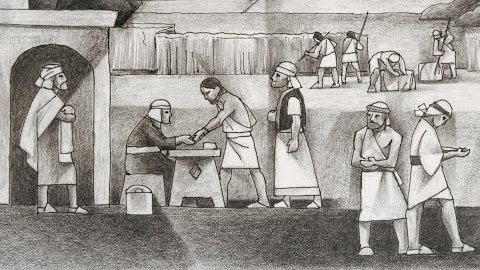
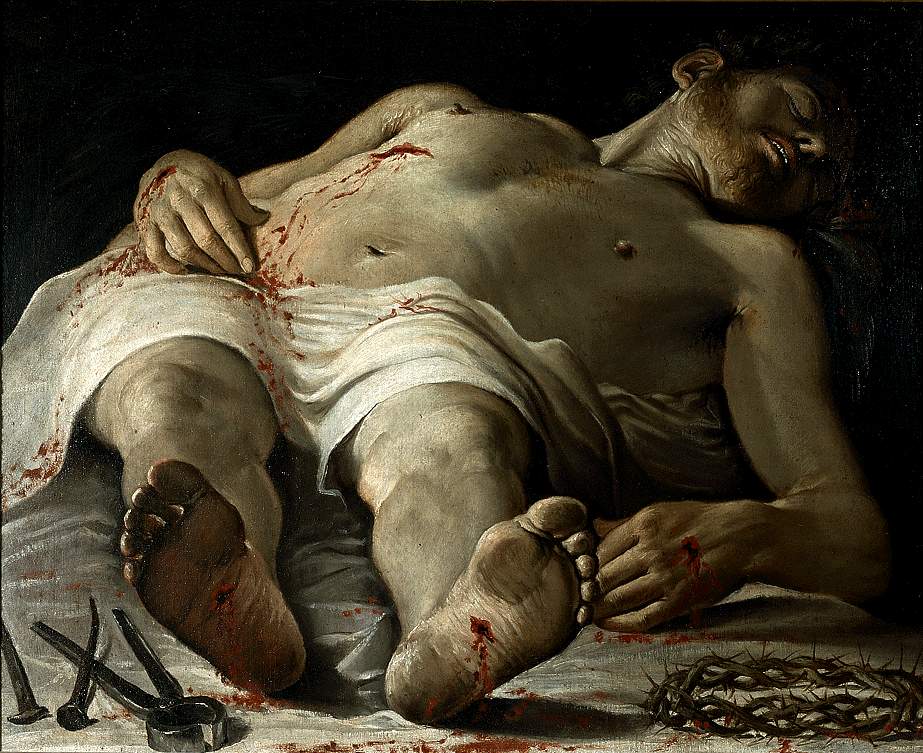 Dear saints, welcome to the kingdom of heaven. In the kingdom of heaven, you are never rewarded based on your works or efforts because, if you received what you deserved, you would be sent straight to hell. In the kingdom of heaven, there are no formulas or set, hourly wages. You are given to based solely on the merits of Christ’s work for you. He is the only one who can say that He bore the burden of the day and the scorching heat. His atonement, His mercy, His grace is what you get, nothing less. Because of God’s unmerited, unearned, undeserved, unconditional love freely given to you for the sake of Christ, you are an heir of the kingdom of heaven. God be praised!
 Each of them was called, and each of them was called at the precise time the owner called them. He went and retrieved them.
 God had a reason for bringing you in when He did. Trust His timing. He brought you into His vineyard exactly when He wanted you.
 And it isn’t just their work. Your work, done as a Christian, is holy work. Fathers and mothers, the work you do day in and day out will reap results in the lives in your children, grandchildren, and great-great-great-great grandchildren if Christ tarries. But it will also reap results in the lives of others whom you will never meet because you have shined the light of Christ to those you have met, and they will shine that light elsewhere. You Sunday school teachers, you who are praying for and encouraging our youth, you trustees who are caring for our facility, and everyone who is here encouraging another person is offering holy work that will be used by God until Christ returns. Everyone has a story of being impacted by someone else long after that person has entered into glory. So, take heart, and keep working. The labor that God has called you to is fruitful, holy work. It is holy work that God will multiply and expand. For that, God be praised. Amen.
 6 But at midnight there was a cry, ‘Here is the bridegroom! Come out to meet him.’ 7Then all those virgins rose and trimmed their lamps. 8 And the foolish said to the wise, ‘Give us some of your oil, for our lamps are going out.’ 9 But the wise answered, saying, ‘Since there will not be enough for us and for you, go rather to the dealers and buy for yourselves.’ 10 And while they were going to buy, the bridegroom came, and those who were ready went in with him to the marriage feast, and the door was shut. 11 Afterward the other virgins came also, saying, ‘Lord, lord, open to us.’ 12 But he answered, ‘Truly, I say to you, I do not know you.’ 13 Watch therefore, for you know neither the day nor the hour.”
 But thanksgiving, yes it recognizes the goodness of the thing, but it looks past that and sees the goodness of the giver of the thing. This is why Christians can give thanks in all circumstances (1 Th. 5:18). Even in the tough stuff, even in difficult times, in sorrow, and in afflictions that come to us in this broken world, you can know that everything comes to you from the very same hands that were nailed to the cross for you.
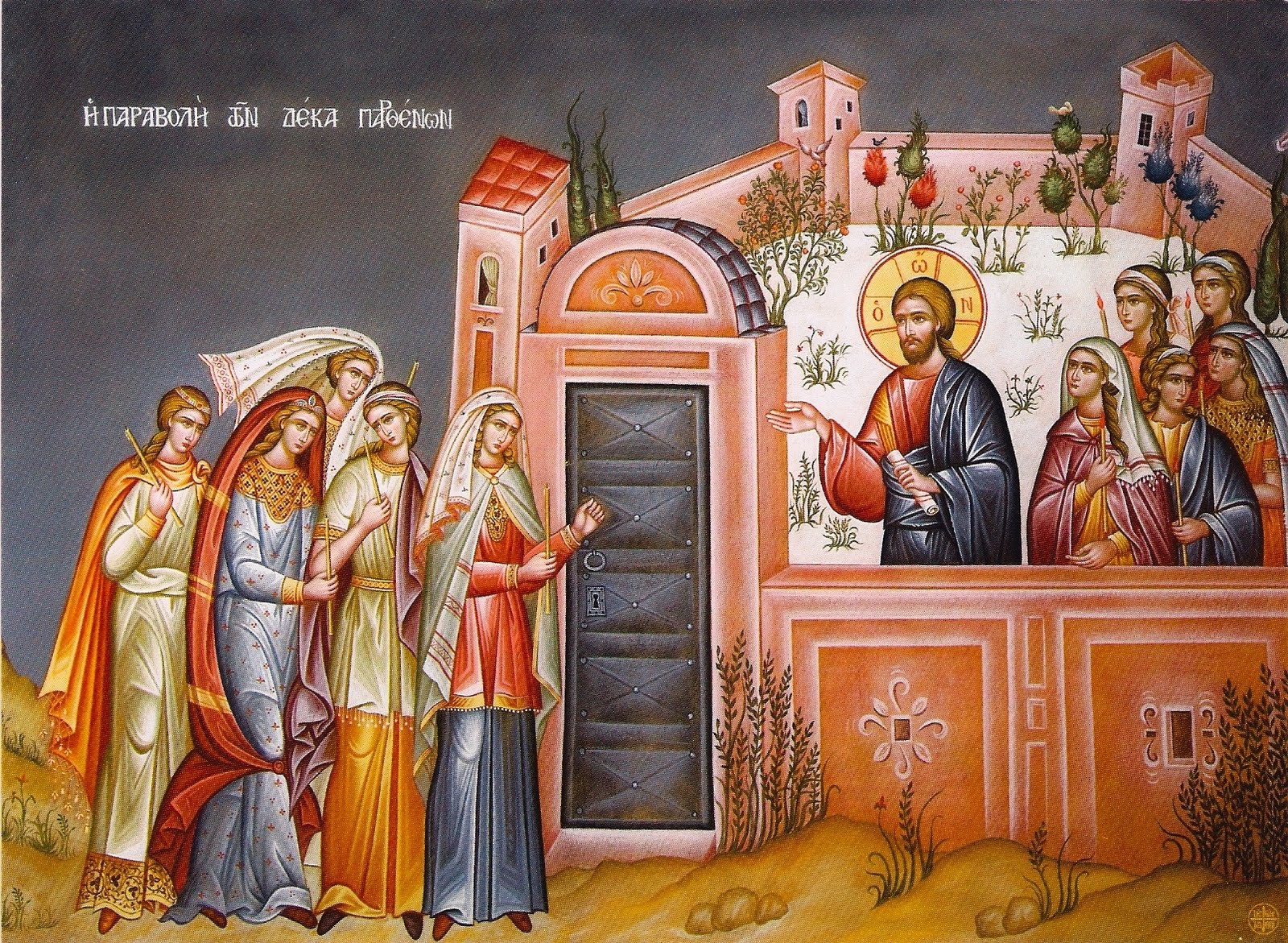 Now, to the parable. Honestly, it is very difficult, and the difficulty mainly lies in the fact that we don’t know enough about Jewish wedding customs in Jesus’ day to know why it was so important that these virgins have lit lamps when the groom arrived.
 Pastorsamwise
You must be logged in to post a comment.