In the name of Jesus. Amen.
Joseph and Mary knew that was a night they would not forget – not ever. The birth of a child is always memorable and remarkable, but this birth was even more so. Both of them knew that this Child was God coming in the flesh to save His people. They both knew that because both had been independently told by angels (Lk. 1:30-35; Mt. 1:19-23). But even beyond that, the birth of Mary’s firstborn Son was memorable because of the circumstances.
Like all governments, Rome wanted to count its citizens and, of course, to collect taxes. So, Joseph and Mary took the trip from Nazareth and headed south roughly 80 miles to Bethlehem. They are probably lodging with one of Joseph’s relatives, but not in the guest room. Instead, they had to make do with a spot where the family’s animals were kept. Far from their home and in unsanitary conditions, Mary goes into labor and gives birth to her firstborn Son. Again, for Joseph and Mary, that night was anything but routine.
But, for everyone else, it was – at least at first. None of the residents in and around Bethlehem were expecting anything special to happen. For them, that night was like any other night. Anyone walking around Bethlehem could have seen Joseph, Mary, and Baby Jesus lying in a feeding trough. That might have thought it was odd, but they wouldn’t have known that it was the greatest miracle ever in the history of the world.
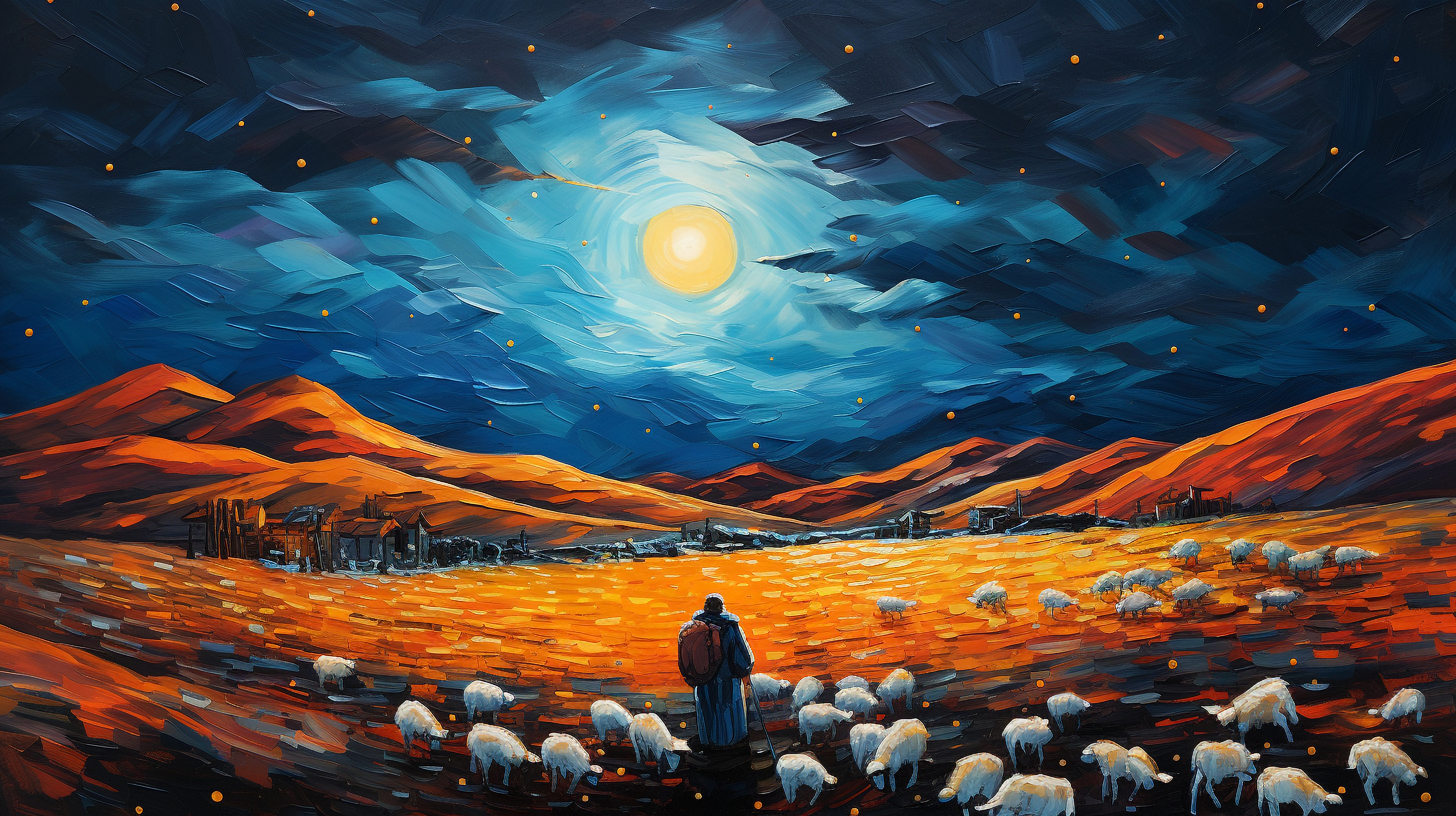
Same for the shepherds. They began that night like any other night. Watching flocks in the dark of night was nothing new for these guys. They were on a rotating shift, and these guys had the night watch. So, they headed off to work figuring that it would be a normal night of finding pasture and water, protecting the flocks, and sitting around with little to do while the sheep did sheep things.
Imagine those shepherds that night. They were likely thinking about the same sort of things that you think about while you’re just waiting around and not expecting anything extraordinary to happen. Imagine one of them leaning against a rock and contemplating the politics of his day and how bad a ruler Herod was. Two of them are little further down the hill so they can twirl their staffs. As they chat with each other, one is concerned about finding a wife while the other is disturbed because he and his wife hadn’t had any children yet. One off to the side is excited about his new house. One rummages through his lunchbox, and disappointed by the contents, he starts thinking about learning how to make jerky. The lead shepherd is thinking about the aches and pains in his back and knees and about the number of days until his retirement. Of course, we don’t actually know what any of them were thinking. But as that line we just sang earlier, “the hopes and fears of all the years,” were likely on the minds and hearts of the shepherds on that normal, routine night.
For these shepherds, it began as a night filled with the same tasks, the normal thoughts, and the typical monotony of shepherding. Sure, it was dreary, but they’d been doing it for years. And they would continue the same pattern for years to come. A pattern where nothing new or exciting happened to break their routine.
Routine is reasonable. Having one makes sense. It helps you know what to expect hour after hour, week after week, month after month, year after year. Routines can help you handle things that don’t exactly fit together the way you think they should. They help you recover and adapt when interruptions come up and you hit life’s speed bumps. Those bumps might be things you like; they might be things that you dislike. But your routines help you get back on track when you are interrupted and thrown off your ‘regularly scheduled programming.’ They can help maintain the discipline to focus on what is important and the ability let go of what isn’t. Routines can be good, but routines can also make life monotonous, rigid, boring, and predictable.
Mary and Joseph might have been alone in all the earth in knowing that that night was special. That that night would matter more than any other night – ever. But the residents of Bethlehem and shepherds outside of Bethlehem all kept to their normal routine. No one that night was expecting a miracle from heaven – at least, until that first angel showed up.
Suddenly, it all changed. That first angel appeared to the shepherds saying, “Behold, I bring you good news of great joy that will be for all people. For unto you is born this day in the city of David a Savior, who is Christ the Lord.” The angel goes on to tell the shepherds how to find and identify the Baby. Suddenly, the multitude of the heavenly host appears.
Now, there’s no way to prove it, but I wonder if every angel was dispatched to that field and given orders to sing to those shepherds. I wouldn’t be surprised if every single angel got a night off from their normal routines and patrols. We’ll have to ask them some day. Anyway, the multitude of the heavenly host appears to the shepherds, and they are all singing, “Glory to God in the highest, and on earth peace among those with whom He is pleased!”
This angel choir is pretty unique. Sure, angels regularly show up in Scripture, but there are only a few places where a whole choir of angels sing. In Job 38:4-7, God seems to refer to how the angels sang as He created and established the foundations of the earth. There are a few passages in Revelation that talk about choirs of angels singing (Rev. 5:11-13; 7:11-12; 19:1-9). But the closest comparison to this angelic choir singing to these shepherds is when God called Isaiah to be a prophet. There, angels are flying around the throne where God is seated singing, “Holy, holy, holy is the Lord of hosts; the whole earth is full of His glory” (Is. 6:3).
But here, the angels sing to the shepherds on the hill outside of Bethlehem. The shepherds probably thought it was a mistake. “If the Christ Child is over there in Bethlehem, what are you angels doing out here? Why sing to us?” Really, it’s like the angels are singing “Happy Birthday” to someone who isn’t even in the room. I can just imagine – when the shepherds tell Joseph and Mary what had happened, what they heard, and why they’ve come – I can imagine Mary explaining, “They’re probably protecting Baby Jesus’ hearing from too much noise because this little boy’s been here ‘pa-rum-pum-pum-pumming’ on his drum all night.”
So, consider this: God directs that angelic choir to a bunch of shepherds who weren’t expecting anything but a routine night of watching sheep. But they are the first to hear heaven’s announcement that the entire cosmos had changed. Just think of the shepherds in the days, months, and years that came after this night. After a night like this, I can’t imagine they thought any other night of their lives would be routine. Their entire world – filled with schedules, tasks, and to-do lists – had been changed forever. But it wasn’t just their world that had changed. Yours did too – even though you weren’t there.
Dear saints, routines are fine for a world that doesn’t have God becoming Man inside of it. But you live in a world that God has entered. Because of that, there is nothing routine about your routine. Still, routines can be helpful, but now only when they center your life around the most not routine thing that has ever and will ever happen. Your God has entered creation to be near to you, to forgive you, to pour out His blood His mercy upon you, to die on the cross for you, to rise again for you, to grant you His peace, and to save you.
Christ is born. He is born to join Himself to you and to every second, every minute, every hour, every year of your life. The Incarnation, the fact God has come in your flesh, infuses your entire life with significance and eternal meaning because the Eternal God is born to save you. Even though the Incarnation doesn’t demolish your need for rhythm and routine, it does rescue your routine from them being meaningless.
Jesus has joined Himself to you and promises, “I am with you always, to the end of the age. And I will never leave you or forsake you” (Mt. 28:20; Heb. 13:5). Christ has entered creation, so even the most mundane things in your life are not routine. Your showers, your commutes, your work, your vacuuming and dishwashing and folding laundry – all of it is done with Christ at your side. Your interactions with family and friends and neighbors and strangers that can, sometimes, be messy – all of those are now moments where Jesus, Immanuel, can shine through you. So, be slow to speak, quick to forgive, and patient with those who are hurting.
The Eternal Word has become flesh. Change your routines to make room for Him. He is eternally with you. Every moment He guides you, and He fills every moment with greater purpose and holiness.
Unto you is born this day a Savior, who is Christ the Lord. Glory to God in the highest, and on earth peace among you because God is pleased with you. Because of Him and because He has joined His life to yours, your life is not routine. Not now, not ever. Amen.
The peace of God, which surpasses all understanding, will guard your hearts and minds in Christ Jesus (Php. 4:7). Amen.

 Pastorsamwise
You must be logged in to post a comment.