Fishers of Men & Fish – Sermon on Luke 5:1-11 for the Fifth Sunday after Trinity

Luke 5:1–11

1 On one occasion, while the crowd was pressing in on him to hear the word of God, he was standing by the lake of Gennesaret, 2 and he saw two boats by the lake, but the fishermen had gone out of them and were washing their nets. 3Getting into one of the boats, which was Simon’s, he asked him to put out a little from the land. And he sat down and taught the people from the boat. 4 And when he had finished speaking, he said to Simon, “Put out into the deep and let down your nets for a catch.” 5 And Simon answered, “Master, we toiled all night and took nothing! But at your word I will let down the nets.” 6 And when they had done this, they enclosed a large number of fish, and their nets were breaking. 7 They signaled to their partners in the other boat to come and help them. And they came and filled both the boats, so that they began to sink. 8 But when Simon Peter saw it, he fell down at Jesus’ knees, saying, “Depart from me, for I am a sinful man, O Lord.” 9 For he and all who were with him were astonished at the catch of fish that they had taken, 10 and so also were James and John, sons of Zebedee, who were partners with Simon. And Jesus said to Simon, “Do not be afraid; from now on you will be catching men.” 11 And when they had brought their boats to land, they left everything and followed him.

In the name of Jesus. Amen.

Today, we hear Jesus calling Peter along with James and John, “From now on you will be catching men.” After they are called, they bring their boats to the shore, leave everything, and follow Jesus. They didn’t make sure their boats were properly registered for the marina. They didn’t clean, fold, and neatly store their nets. They didn’t sell this massive catch of fish to a person someone with a booth in the marketplace. They didn’t take care of any of the details that would have been required to leave their fishing business or to sell this massive quantity of fish. Instead, they leave everything and follow Jesus to learn to become fishers of men (Mk. 1:17).

This isn’t the first time Jesus calls these men to follow Him. Most Bibles have a heading over this reading in bold letters that says something like, “Jesus Calls the First Disciples,” but that’s a bit misleading because, when we look at the other Gospels, we can easily see that this is the not the first time Jesus has called Peter, James, and John to follow Him. John 1 is where Jesus first calls these guys. There, Andrew, who is Peter’s brother, is a disciple of John the Baptizer. Andrew hears John call Jesus the Lamb of God. Andrew goes and finds Peter and they both begin to follow Jesus. The other guy Jesus calls away from being a disciple of John the Baptizer is John who gets his brother James. These guys follow Jesus and end up at the wedding in Cana where they see Jesus turn water into wine and believe in Him (Jn. 2:11).

So, by the time we get to this text in Luke 5, Peter, Andrew, James, and John have already been called by Jesus to be His disciples. But when this text begins, they are still providing for their families through their fishing business. And by the end of this text, they are called to full-time disciples or (if you remember what the word ‘disciple’ means from last week’s sermon) they care called to full-time ‘learning.’ After this text in Luke 5, they aren’t fishers of fish anymore. Instead, they are learning from Jesus to be fishers of men.

When you read the rest of the Gospels, it is clear that they don’t start catching men immediately. They do leave everything to follow Jesus, but when they leave their boats and nets here, it is the beginning of their training. The follow Jesus for about three and a half years and watch all that Jesus does. They listen to His teaching, they see Him do all kinds or miracles, and they are witnesses of His resurrection. They only start catching men after Christ makes them apostles and sends them out to preach the Gospel in Jerusalem, Judea, Samaria, and to the ends of the earth (Act. 1:8). The listen to Jesus’ call and proclaim the Gospel. Thanks be to God.

The thing to notice today is that there is another individual in this text whom we easily overlook. That character is the father of James and John named Zebedee, whose name means, “my gift.” Zebedee is simply mentioned as James and John’s father, but in Mark we are told that James and John leave Zebedee in the boat to follow Jesus (Mk. 1:20). Jesus didn’t call Zebedee to be a fisher of men. Instead, Zebedee, the father of two of the three closest disciples of Jesus, gets left in the boat.

Now, there’s no question that Zebedee believed that Jesus was the Messiah and Savior. Zebedee made great sacrifices as a believer in Jesus. He didn’t try to stop his sons from following Jesus to learn to catch men even though he probably planned to have James and John take over the family business, but he lets them leave everything to follow Jesus. We know that Zebedee’s wife, Salome (Mt. 27:56; Mk. 15:40; 16;1), was one of the women who supported Jesus during His ministry. She was also present at the cross and the empty tomb on Easter morning.

So, when we consider this text, we see that Jesus calls people some people away from their careers and livelihood to become fishers of men. But don’t miss the fact that Jesus calls others to stay and remain in their careers and be fishers of fish. This is still the case today. Jesus calls some to be nurses of patients, farmers of crops, secretaries of offices, law enforcement officers of cities, landscapers of homes, teachers of students, mothers of children, and we could go on and on. Jesus also calls some to leave their careers and train to become full-time preachers and teachers of His Word. In other words, Christ calls some men to be pastors.

Scripture is clear that we need men to be pastors. God wants pastors to shepherd His flocks in His congregations. That is important. But as your shepherd and pastor, I want to make something absolutely, crystal clear: this does not mean that pastors have a ‘spiritual calling,’ and you have a ‘secular calling.’ Nope! Every Christian has a spiritual calling to be a Christian and to faithfully carry out your vocation, whatever that vocation may be.

In the kingdom of God, we need many, many more parishioners than pastors. We need more Zebedees than Peters, Jameses, and Johns [sic.]. In fact, we need at least ten Zebedees for every one pastor. In all likelihood, God used Zebedee so that James and John could follow Jesus and learn how to become fishers of men. It’s even likely that God used Zebedee to sell that miraculous catch of fish to finance James and John’s training under Jesus.

In short, most believers are called by God to be fishers of fish, and this is by God’s good design. Dear saints, not every believer is called to be a fisher of men. That might be contradictory to what you’ve heard, but it’s true. That doesn’t mean that Zebedee didn’t share his faith with people that he came into contact with. I can’t prove it from Scripture, but I’m sure Zebedee pointed people to Jesus as the Messiah and Savior whenever he got the chance. Yet, his chief vocation was fishing. And God works through these callings, not just to put food in bellies but also to put His Word into people’s ears.

God works through your calling to give people what they need. God works through teachers to prepare their students for the different callings those students will have. God works through those students who become doctors, engineers, architects, accountants, and mechanics to provide His blessings. When we pray for our daily bread, God answers that prayer through hundreds of people – farmers, factory workers, bakers, drivers, insurance brokers, etc. God doesn’t answer our prayers for daily bread through fishers of men. If everyone was called to be a fisher of men, we’d all starve – including pastors. God uses you, your work, your salary, and your generosity to fund the proclamation of His Word.

So, God be praised for the many Zebedees who started this congregation and sacrificed their time, talents, and treasures to give us this building, and God be praised for those of you who have worked to maintain it, keep it clean, and fund the ministry here so we can come here each week and receive God’s gifts of His Word and Sacrament. Hundreds of Zebedees have made it possible for us to be here today. We owe them our gratitude and thanks. They have sacrificed to expand and maintain our facilities. And God calls all of us to this same work so we can pass on a place where our children and others can come to hear the Gospel. May the casting of nets from this place continue now and in the future years until Christ returns.

So yes, we praise God for the fishers of men who have stood in this pulpit and faithfully proclaimed God’s Word, and we pray that God would call more men to answer that calling. But none of that happens without the Zebedees, who are equally important. Let all of us pray that God would grant a miraculous catch of people that fills the boat of this sanctuary.

Dear saints, you have been brought into God’s Church, and now Jesus invites you to His table to receive His Body and Blood for the forgiveness of all your sins. Through this Sacrament, you are strengthened to be whatever God has called you to be. Faithfully carry out the calling and vocation He has given you. Because through that vocation, God will continue to expand and further of His kingdom. May God bless you and the work He gives you to do. Amen.

The peace of God, which surpasses all understanding, will guard your hearts and minds in Christ Jesus. Amen.
Diagnosed – Sermon on Matthew 9:1-8 for the Nineteenth Sunday after Trinity

Matthew 9:1-8

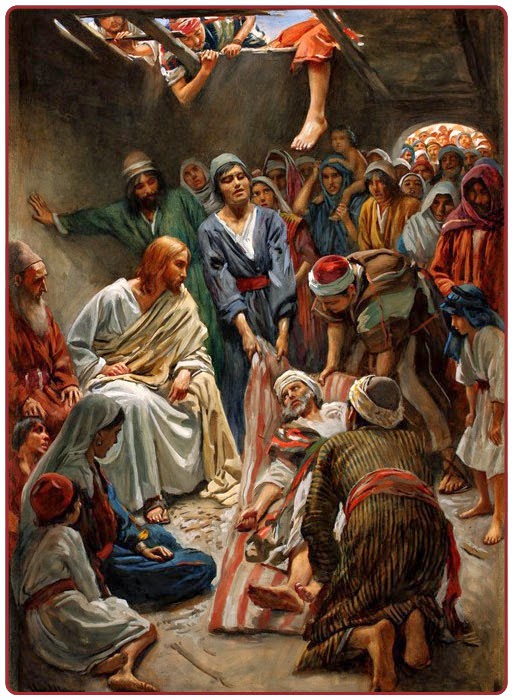
1 And getting into a boat he crossed over and came to his own city. 2 And behold, some people brought to him a paralytic, lying on a bed. And when Jesus saw their faith, he said to the paralytic, “Take heart, my son; your sins are forgiven.” 3 And behold, some of the scribes said to themselves, “This man is blaspheming.” 4But Jesus, knowing their thoughts, said, “Why do you think evil in your hearts? 5 For which is easier, to say, ‘Your sins are forgiven,’ or to say, ‘Rise and walk’? 6 But that you may know that the Son of Man has authority on earth to forgive sins” – he then said to the paralytic – “Rise, pick up your bed and go home.” 7 And he rose and went home. 8 When the crowds saw it, they were afraid, and they glorified God, who had given such authority to men.

In the name of Jesus. Amen.

When you go to the doctor, you have certain expectations of what is going to happen. You know that you will fill out forms and provide information about your health history and habits. You expect to have your weight, heart, lungs, blood pressure, and reflexes checked. Depending on the reason for your visit, you also anticipate other tests – bloodwork or other lab work; an x-ray, ultrasound, or MRI; maybe a stress test or sleep study. Depending on the results of all of that, you expect more tests might get ordered. Only after all those results are studied and considered will the doctor call you in to present a diagnosis and offer a treatment plan.

Well, in our Gospel text today, this paralytic is brought to Jesus, and by all appearances, Jesus skips right over the testing and diagnosis process and goes straight to the treatment saying, “Take heart, My son; your sins are forgiven.”

For a moment, use your sanctified imagination to consider this from the perspective of the paralytic’s friends. Matthew has condensed the story in his Gospel. Here in v. 2, he tells us that ‘some people’ brought this paralytic to Jesus. But Mark and Luke give a fuller picture of this event, filling in some of the details (Mk. 2:1-12; Lk. 5:17-26). They let us know that it was four men (Mk. 2:3) who carried this paralytic to Jesus, and they had a difficult time getting their friend there. People from the whole region had heard that Jesus was in town, and so many people had gathered to hear Him preach (Lk. 5:17) that there was no room to even get in the door (Mk. 2:2). So, these four friends lug their paralyzed buddy on top of the house, punch a hole in the roof, and lower him down to get him in front of Jesus (Mk. 2:4).

Now, this is just an aside. As a preacher, I have, what I hope is, a godly and pious curiosity about this. At what point does Jesus stop preaching? Is it when He hears the scuffle of eight feet on the roof above Him? I think that would distract me enough that I’d stop preaching, but, please, don’t test that hypothesis. Is it when the pounding starts or until bits of dirt and debris start falling from the ceiling? Maybe, Jesus preached straight through all of that until the paralytic was being lowered through the new skylight above Him. I guess I’ll just have to go rent the video at heaven’s Blockbuster. Maybe all of heaven’s Blockbusters have closed and everything is available through streaming services. Anyway…

These four friends go through all that work and effort knowing that they would have more work later to fix the hole they made. They had brought their paralyzed friend to Jesus to be healed (Lk. 5:17-18). But, to their perspective, Jesus skips right over the diagnosis and says, “Take heart, My son; your sins are forgiven.”The worst thing is that it looks like the wrong treatment! Imagine you had a friend with a badly sprained ankle, so you bring him to a new doctor in town. The doctor watches your friend limp in, but before your friend even says why he is there, and before asking any questions or doing any tests, the doctor says to your friend, “Here is a prescription for Lipitor for your high cholesterol.” You’d probably report the doctor to have his license revoked. Well, that is essentially what Jesus does.

We might think that the healing of this paralytic is a lesson that the most important thing we need is the forgiveness of sins. Above money, security, food, house, or health we need forgiveness. Once Jesus forgives this paralytic of his sins, he has everything he needs. If the text had stopped there and Jesus hadn’t miraculously given this man the ability to walk, it wouldn’t be too bad. He could have lived the rest of his life paralyzed because he had everything he needed for eternal life. In fact, the physical healing seems to take the back seat in this text. Jesus only heals him after the grumbling of the scribes. You could even conclude that Jesus never intended to heal the guy and only does so as an afterthought.

Now, to be sure, the most important thing that everyone needs is the forgiveness of sins. But if the main thing you take away from this text is that physical healing isn’t important, you’re wrong. This isn’t Jesus’ first miracle. There were many others that He healed before and after this. Just before this, Jesus healed a leper (Mt. 8:1-4), but Jesus didn’t forgive him before He healed him. Right after that, a centurion asks Jesus to heal his paralyzed servant (Mt. 8:5-13), but no absolution. Then, Matthew records that Jesus heals Peter’s mother-in-law who had a fever, Christ heals a whole slew of other people and casts out demons (Mt. 8:14-17), but no mention of Jesus proclaiming forgiveness there either. All over the Gospels, Jesus will heal people, but there is no mention of absolution. In fact, most of the time when Jesus mentions forgiveness and salvation, it’s only after He heals. We don’t take those instances to mean that Jesus cares more about physical healing more than forgiveness.

Now, where am I going with all of this? Jesus is a Pastor – in fact Jesus is the Pastor. The word ‘pastor’ simply means ‘shepherd.’ Jesus is the Good Shepherd (Jn. 10:11), the Good Pastor. Christ knows when His sheep need to be fed by green pastures or led beside still waters, and He knows when His sheep need to have their soul restored with forgiveness and mercy (Ps. 23:1-3). Jesus doesn’t need to run a bunch of diagnostic tests to figure out what His sheep need. He always knows and gives the right treatment, and He always perfectly gives what His sheep need. Jesus, the Good Pastor, so intimately knows you and all your actions, thoughts, and ways that you are always diagnosed and receive the care you need.

The reason Jesus forgives this paralytic before healing his paralysis is that is what the man needed. The man’s friends – maybe even the man himself – figured what he needed most was to be able to use his limbs again. But Jesus, the Good Shepherd and Pastor, knows best. So, Christ forgives the man. “Take heart, My son; your sins are forgiven.” And those words deliver to the paralytic exactly what he needed.

I’m going to change gears here for just a minute. It’s October, and I’m aware that October, among other things, is Pastor Appreciation month. First of all, I want to thank you all for how good you’ve been to me, your pastor, for the past twelve years and ten plus months. I can’t imagine being called by God to shepherd a better flock. Last week, I preached about stewardship and tithing and mentioned how I don’t particularly like to preach about that. Well, preaching about the duties of a pastor is low on my preference list as well. But Scripture teaches about the duties of pastors, so preaching the full council of God requires me to preach about what I’m supposed to do as a pastor. So, here we go.

Every pastor is an under-shepherd of Jesus, the Good Shepherd. And I confess to you that I am a very flawed shepherd. Jesus shepherded this paralytic man exactly as he needed. But I know that there are times where I have not shepherded rightly. I don’t always know what is needed in any given situation.

God has given pastors one tool to use and apply to the flocks entrusted to their care – His Word of Law and Gospel. There have been times where I have given Law when you needed comfort and forgiveness, which results in you being further discouraged and dismayed. And there are times when I gave the Gospel of comfort and forgiveness when the Law should have been proclaimed, and that can lead to a boldness to continue in sin. This is a long way around for me to say, “I’m not as good of a pastor as Jesus is.”

First of all, please forgive me for my shortcomings as your pastor. And second, please pray for me that God would give me the wisdom and words that are needed in each interaction I have as your pastor. But I take great comfort in God’s promise that whenever His Word goes forth it always accomplishes the purpose for which God sends it (Is. 55:10-11). I am also comforted by the fact that God can always shut my mouth if I am doing more harm than good. But again, please pray for me.

I want to close by pointing you back to Jesus, my Boss, and your perfect Shepherd. Notice how Christ is always perfectly in tune with His sheep. Jesus sees the faith of the people who brought the paralytic to Him, so He immediately applies the Gospel of forgiveness. He knows the grumbling of the scribes after He absolves the paralytic and applies the Law to them. And notice how Jesus’ perfect diagnosing and shepherding results in the crowds glorifying God.

Those crowds glorify God because God had given authority to forgive sins to men (Mt. 9:8). That line struck me this week. Notice, it’s plural – to men, not to ‘a man,’ not just to Jesus, but to men. Dear saints, as those who have been redeemed, restored, and forgiven by Jesus’ death and resurrection, Jesus has given you the authority to forgive the sins of others. Jesus says in John 20:23, “If you forgive the sins of any, they are forgiven.”

My fellow Christians, Jesus invites you to join with Him in proclaiming to a broken creation the forgiveness and eternal life He has won by His death and resurrection. May we carry that treatment and soul-saving medicine to a hurting world. Amen.

The peace of God, which surpasses all understanding, will guard your hearts and minds in Christ Jesus. Amen.