
Pursue What Never Fades – Sermon on 1 Corinthians 9:24-10:5 for Septuagesima Sunday

1 Corinthians 9:24-10:5

In the name of Jesus. Amen.

Before we get into the text something needs to be abundantly clear in our minds. Salvation is a gift. It is freely given by God because He is merciful and gracious, abounding in steadfast love and faithfulness (Ex. 34:6). You are saved by grace through faith and not because of your own doing; salvation is a free gift given by God and isn’t a result of your works (Eph. 2:8-9). You don’t earn your way into heaven. You don’t deserve God’s forgiveness and mercy, but He loves to freely give you His forgiveness, mercy, and grace because of what Christ has done by His death and resurrection. That needs to be firm in your mind because that isn’t what Paul is dealing with in these verses.

What Paul is dealing with is the fact that salvation can be neglected and cast aside. Salvation can be lost. That’s why those first few verses from 1 Co. 10 talk about how God’s people were overthrown in the wilderness. They prayed, and God delivered them from bondage and slavery in Egypt. God sent His judgment on their oppressors, and His people left with the treasures of Egypt (Ex. 12:35-36). On top of that, God gave them every spiritual blessing. They were Baptized in the cloud and the sea. God fed them with spiritual food and gave them spiritual drink. But even though they had received all those gifts, they didn’t enter the Promised Land. Instead, they were overthrown in the wilderness (1 Co. 10:5). Or, to use the word Paul uses at the end of ch. 9, they were disqualified.

So, what Paul is dealing with here isn’t about becoming saved. That’s a free gift. What he’s talking about is being a Christian, living a Christian life, denying self, and bearing the cross (Mt. 16:24). He’s talking about walking in the good works that God prepared for you (Eph. 2:10) and about bearing the fruit of good works that proves that faith is living (Jam. 2:17-18).

When you aren’t striving to walk in the good works God has prepared for you, Paul says you look absurd. You look like an athlete on a track who isn’t even trying. The gun goes off, and you’re still standing at the starting line as though nothing is happening, or you’re ridiculously dancing across all the lanes while the other competitors are finishing the race. When you are complacent in your faith, you’re like an unfocused boxer. The bell rings, and you’re swinging punches in the air willy-nilly while the other guy in the ring is waiting to knock you out cold.

Yes, God has saved us and freely granted us salvation. The point here is that salvation places us into a life that is filled with good works, a life where we fight against the sins of being lazy and complacent, a life where we are devoted to loving God and our neighbor, and a life where we are determined and disciplined to do better at keeping His commandments. This kind of life is what gives us a deeper and firmer faith in and devotion to Christ.

This pursuit to faith, this growth in and devotion to good works isn’t just a minor teaching of Scripture. It’s all over the New Testament. In Lk. 13:24, Jesus says, “Strive to enter through the narrow door.” In Jn. 6:27, He says, “Do not work for the food that perishes, but [work] for the food that endures to eternal life.” 1 Co. 15:58 says, “Be steadfast, immovable, always abounding in the work of the Lord.” Gal. 6:9, “Let us not grow weary of doing good.” Php. 2:12“Work out your own salvation with fear and trembling.” Tit. 2:14 says that Jesus purified us to be His people who are “zealous for good works.” Heb. 4:9-11 says, “There remains a Sabbath rest for the people of God; …strive to enter that rest.” 1 Pt. 1:22, “Love one another earnestly from a pure heart.” This teaching everywhere.

But one of the problems that we have with these many calls to good works is that we look backward. We think about how it went when we had opportunities to do good works. We look back at our failures to be diligent and how un-zealous and lazy we were. We realize that we aren’t what God calls us to be. So, the Bible is pushing us forward to good works, but we look back and see our failures. That kills our drive and motivation. Instead of being inspired by these calls to good works, we are discouraged. We think, “With all the times I’ve failed, why would I even try?” The very thing that is meant to encourage us ends up discouraging us. And that isn’t a problem with the Scriptures. The problem is our sin and looking backward.

What Paul is doing with this text is trying to get us to quit looking at our past failures and laziness. Instead, we are to look forward to the prize. In Php. 3:13–14, Paul puts it this way, “[O]ne thing I do: forgetting what lies behind and straining forward to what lies ahead, I press on toward the goal for the prize of the upward call of God in Christ Jesus.”

This is why Paul uses this sporting analogy here and says that he disciplines his body and keeps it under control. The Greek there literally says, “I pummel my body and make it a slave… lest I should be disqualified.”

To compete in the games that Paul mentions here, athletes in Paul’s day would devote themselves to ten months of training. They would go on strict diets and give up anything that hindered their training. Those competitors had to have the will and self-control to let go of everything that would distract them from winning. And when it was time to compete, they had one goal – winning the prize.

The prize the athletes won at the games near Corinth wasn’t a gold medal. No, they got a wreath made of dried, withered celery. Dear saints, if an athlete is willing to do all that for celery – something that you buy at the store simply so you can throw it away after it sits in your fridge for a week – how much more should you work and strive and discipline yourself and use self-control? You should do all that because your prize, your aim, your goal is the resurrection? Your goal is eternal life. It’s peace and rest with God Himself (Heb. 4:9-11).

The parable in our Gospel lesson today (Mt. 20:1-16) dealt with this too. The problem with the workers who were hired at the beginning of the day was that they kept looking backward at their work and toil and were focused on the wage. That perspective wrongly led them to think they were owed more than the guys who were hired later. The problem with those workers was that were looking in the wrong direction. They figured the goal was the paycheck when, in reality, it was a place in the vineyard. That’s why they are told to exit the vineyard.

Dear saints, pursue what never perishes. Chase what never fades because that is actually worth having and attaining. 2 Tim. 4:8 points you to the crown of righteousness which the Lord, your Savior and righteous Judge, will award to you because you have loved His appearing. That is what is before you, and that is worth striving for.

Look to that. When you wake up every morning, you are to see a track, a race, a finish line, and a prize. That prize is the imperishable crown of righteousness and life with your Savior. Get up and run that you may obtain it. Dear saints, pursue that because it will never fade. Amen.

The peace of God, which surpasses all understanding, will guard your hearts and minds in Christ Jesus (Php. 4:7). Amen.

Ready, Set, Go! – Sermon on 1 Corinthians 9:24-10:5 for Septuagesima.

Listen here.

1 Corinthians 9:24-10:5

24 Do you not know that in a race all the runners run, but only one receives the prize? So run that you may obtain it. 25 Every athlete exercises self-control in all things. They do it to receive a perishable wreath, but we an imperishable. 26 So I do not run aimlessly; I do not box as one beating the air. 27 But I discipline my body and keep it under control, lest after preaching to others I myself should be disqualified.

For I do not want you to be unaware, brothers, that our fathers were all under the cloud, and all passed through the sea, and all were baptized into Moses in the cloud and in the sea, and all ate the same spiritual food, and all drank the same spiritual drink. For they drank from the spiritual Rock that followed them, and the Rock was Christ. Nevertheless, with most of them God was not pleased, for they were overthrown in the wilderness.

In the name of the Father and of the Son and of the Holy Spirit. Amen.

Paul compares the Christian life to a sporting event. They didn’t have the best sport – baseball – in Paul’s day, but they had sporting competitions. The city of Corinth, in particular, hosted a series of games every other year called the Isthmian Games which were the second most famous athletic competition in the world after the Olympics. The events included racing, wrestling, jumping, boxing, javelin, discus, and even poetry. Thousands of athletes would show up to compete in the events, and throngs of people would come to watch. The winners of each competition would end up being famous throughout the Roman Empire and get statues and monuments. isthmean-games-celery-crown.jpg
But the immediate reward, the prize they got right after the competition, wasn’t a gold medal placed around their neck. No, they got a wreath made of dried, withered celery. Yes, celery – that vegetable that is tasteless when you eat it alone but ruins every dish you add it to.

I can just imagine the first guy to win. He ascends the podium while the crowds cheer and receives his celery wreath. He holds it and thinks, “Celery? I get celery? I thought I was competing for a salary.”

To compete in the games, athletes would be required to devote ten months to training. They had to focus their complete attention on their training, give up any bad habits, and even had to give up things that weren’t bad in general but were a hinderance to their training. The competitors had to have the will and self-control to let go of anything that would distract them from winning first place. And when it was time to compete, they had one goal – finishing first.

Paul takes the imagery of those athletes who wholly dedicated themselves to training, running, and winning a perishable wreath of withered celery and says, “You, Christian, should have even more dedication to receive the imperishable prize of forgiveness and eternal life.”

Now, this analogy Paul is using is good and beneficial, but all analogies have their limitations. So, we have to pause for a moment here to make sure everything stays clear.

One limitation comes when Paul says, “all the runners run, but only one receives the prize.” In the Christian race, all believers win the prize. It should go without saying, but I’m going to say it anyway. It isn’t as though only one person will be saved. If that were the case, Jesus wins period and no one else. His perfect life and perfect obedience in thought, word, and deed have never and will never be matched. Not even close.

Another limitation to the analogy is that you aren’t saved because of your work, your training, your dedication, your self-control. This has to be clear – if you don’t get this, you will completely miss the point of this entire text, this sermon, and the whole Bible. Salvation isn’t earned or deserved. You don’t earn eternal life by being better than most people. Getting a “C” in “Morality” doesn’t cut it. You’ve probably heard the joke about two guys (we’ll just say Sven and Ole) who are camping in the forest. Outrun the BearThey see a bear eyeing them and licking its chops. Sven looks over at Ole who is bent over tying his shoelaces. Sven says, “Ole, do you really think you can outrun a bear?” Ole pulls the laces tight, stands up, sniffles and says, “I don’t have to outrun the bear. I only have to outrun you.” Salvation is not like that. You aren’t saved because you are better than most people. You are saved by grace alone through faith alone by Christ alone.
But here is the point Paul ismaking in these verses. You can fall away. Salvation can be lost. And if you don’t take salvation seriously, you are like an athlete who shows up for a race but has no plans of actually competing to win. Paul points to Israel’s ancestors (whom we heard about a little bit in the Old Testament text [Ex. 17:1-7]). Of the six-hundred-thousand men plus women and children who were brought out of Egypt by God’s mighty hand, only two of them – only Joshua and Caleb – got to enter the Promised Land. All of them had been given physical deliverance, physical food, physical drink. But they had also been given spiritual deliverance. They had been given a type of Baptism. They were given spiritual food and spiritual drink directly from Christ who gives water that wells up to eternal life (Jn. 4:13-14; 7:37-38). But with most of them, God was not pleased, and they were overthrown in the wilderness.

Because faith and salvation can be lost and because so many were overthrown in the wilderness, you need to run after the prize of eternal life. Discipline yourself. And that doesn’t mean that you give yourself a spanking or something like that if you sin. No, discipline yourself in a way that keeps you from running headfirst into sin.

If you know that you are prone to falling into sin when you go to that certain place, when you hang out with that crowd, when you drink too much, or when you surf the internet late at night, have the discipline to refrain, to stay away, from those things. In other words, don’t get lazy about your sin. Practice self-control. Do all of this so that you aren’t running aimlessly, so that you don’t box as one beating the air, or so that you don’t get disqualified. This text is exhorting, urging, prompting, and prodding us to good works and to live as Christians.

But with all that said, I need to confess something. The more I am told to do a certain thing, the less I want to do it. It is too easy to look back on how I’ve failed in the past. My failures and sins easily haunt me, and it is tempting to give up. Maybe you have the same problem. That is what Paul is addressing in this text. He wants to focus us on the imperishable prize so that we keep working, keep striving, and keep pressing toward it.

The Bible is constantly pushing us forward toward the prize, but we are too often looking back at our past sins and failures. And those sins and failures get us down and discouraged so that we are tempted to give up even trying. We can’t do that.

So, what’s the answer? What will motivate us to do good works and live as Christians? Don’t look back at your failures and sins. Forget them. Know that God has forgiven your sins through Jesus’ cross, death, burial, and resurrection. In Isaiah 43:25, God says, “I am He who blots out your transgressions for My own sake, and I will not remember your sins.” Or Jeremiah 31:34 where God says, “I will forgive their iniquity, and I will remember their sin no more.”

Because God has forgotten your failures, you don’t need to dwell on them either. Paul uses similar language in Philippians 3:13–14. That passage is in your Scripture insert. Listen to this: “Brothers, I do not consider that I have made it my own. But one thing I do: forgetting what lies behind and straining forward to what lies ahead, I press on toward the goal for the prize of the upward call of God in Christ Jesus.”

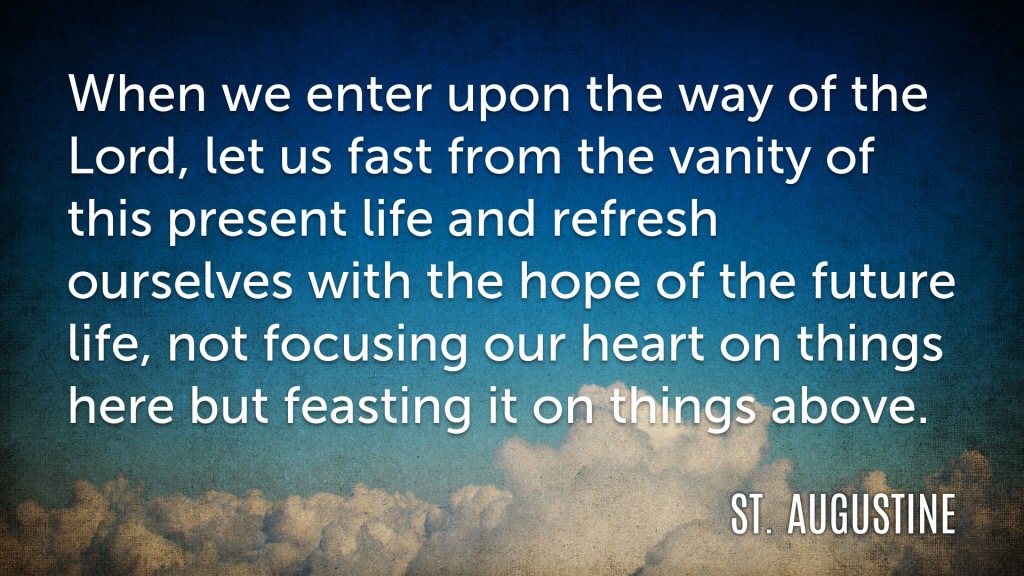
Your past failures and sins are just that. They are in the past, and they are forgiven and died for by Christ. You have received the entire forgiveness of all your sins, and you are about to receive the very Body and Blood of Christ, given and shed for the forgiveness of your sins. Believer, every promise of Scripture lies before you. The eternal party, the never-ending feast of God lies before you. It is a feast of rich food, a feast of well-aged wine, of rich food full of marrow, of aged wine well refined. There, God will swallow up death forever; and the Lord God will wipe away tears from all faces (Is. 25:6-8).Augustine on 1 Corinthians 9_25.JPG

Listen to what Christ Himself says is your goal, your prize from Revelation 2-3: To the one who conquers, God will grant to eat of the tree of life, which is in the paradise of God. The one who conquerors will not be hurt by the second death. The one who conquerors will be clothed in white garments, and Jesus will never blot his name out of the book of life but will confess his name before God the Father. The one who conquerors will be made a pillar in the temple of God. And the one who conquerors will sit with Jesus on His throne (Rev. 2:7, 11, 3:5, 12, 21).

Christian, this is your goal, your prize, your imperishable wreath. And it is worth running for. Ready? Set. Go! Amen.

The peace of God, which surpasses all understanding, will guard your hearts and minds in Christ Jesus. Amen.

The Race – Sermon on Hebrews 11:39-12:2 for Observation of All Saints’ Day

Listen here.

Hebrews 11:39-12:2

39 And all these, though commended through their faith, did not receive what was promised, 40 since God had provided something better for us, that apart from us they should not be made perfect.

Therefore, since we are surrounded by so great a cloud of witnesses, let us also lay aside every weight, and sin which clings so closely, and let us run with endurance the race that is set before us, looking to Jesus, the founder and perfecter of our faith, who for the joy that was set before him endured the cross, despising the shame, and is seated at the right hand of the throne of God.

In the name of the Father and of the Son and of the Holy Spirit. Amen.

Let these words of Scripture paint a picture in your mind. The picture is of a huge stadium, and it has to be massive. We’re not talking thousands or tens of thousands of seats. Imagine millions, billions, even trillions of seats. And every single seat is filled – a capacity crowd. You, believer, are there in that stadium, but you are not in the stands. You are running a race on the track.

All the people in the stadium are Christians. They are the believers who have come before us. Hopefully, the rest of Hebrews 11, which you didn’t hear, is familiar to you. It is sometimes called “the hall of faith” and is a list Old Testament believers who finished the same race. The chapter gives sixteen names including Abel, Noah, Abraham, Sarah, Moses, Rahab, David, etc., but it also includes multitudes more who aren’t named. All of them had faith in Jesus (v. 13, 39) even though they faced persecution, difficulty, trials, and temptations. They were all sinners who clung to faith in Jesus. But these saints have finished their race, are now in heaven, and are part of that great cloud of witnesses that surround us.

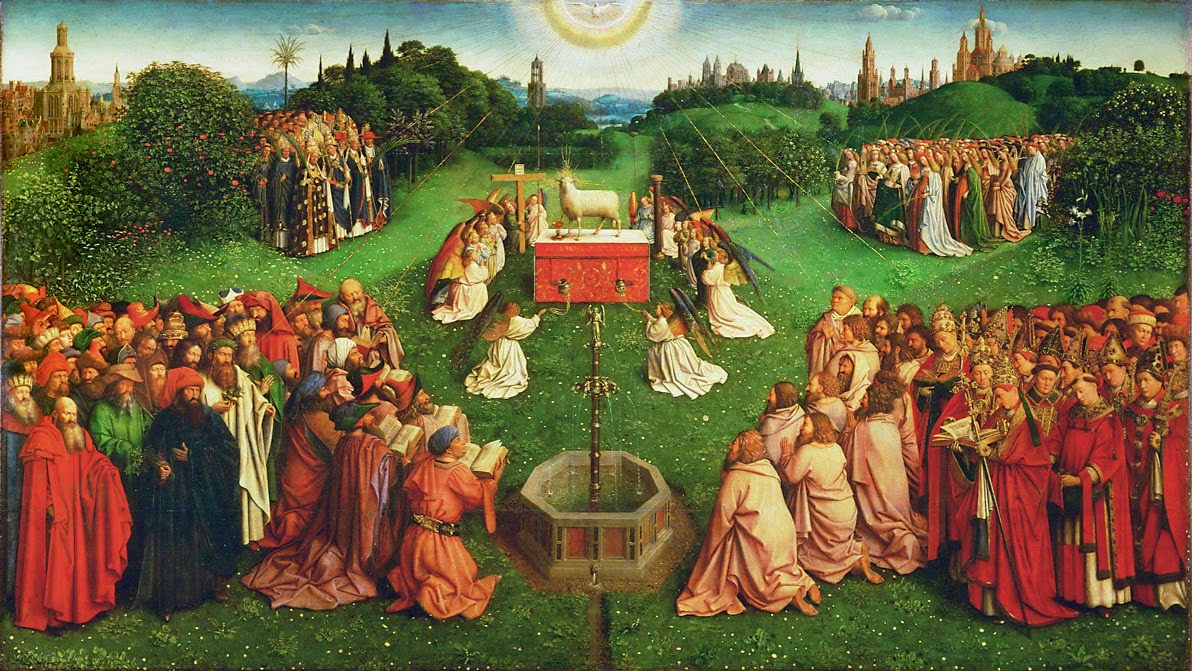
Wedding Feast of the LambSo, the picture is this: These Christians have crossed the finish line. But instead of going to the locker room and getting into an ice bath, they go into the stands to cheer us on as we run our race. And again, this is multitudes of people – more than you could count – people from every nation, tribe, people, and language (Rev. 7:9). Imagine the cheers, chants, clapping, and whooping encouraging you as you run.

Here you are on the track. Running your race of faith. The race has been long. It has been hard and difficult. Parts of the course of your race have been filled with sorrow, with disappointment, with discouragement. Parts of your course have brought you through the valley of the shadow of death. And you have gotten tired. Your lungs are burning. You can hardly feel your legs, and with each stride your feet hit the ground harder and harder. You are weary and might be tempted to stop pushing, to take it easy and walk, or even stop the race altogether.

But everyone in the stands is cheering you on, “Don’t stop! Run! Keep going! Dig deep! Keep pressing on! Go!”

I remember when I was in cross-country (I was never a great runner, but I still did cross-country to get ready for swimming, and I was good at swimming). But when I was in cross-country, everyone running the race would start in a huge pack. Scores of runners would all get on the starting line, and all the parents and classmates would be there to cheer everybody on at the start. As the runners would make their way through the course, fans would find different spots to cheer people on, and when their runner went by, they would move to another spot to cheer. Anyway, people would all try to be at the finish line to encourage runners to finish strong. But as the leaders and the main pack of runners finished, the crowd at the finish line would thin out. Usually, by the time I would finish, there would hardly be anyone left to watch. I think even once, the official timer wasn’t paying attention when I crossed the finish line which was discouraging to say the least.

But that is not the picture Scripture gives us about the race we are running. This great cloud of witnesses is there encouraging us at every last bit of the race.

These Christians who have gone before us and are cheering us on are called ‘witnesses.’ They aren’t called an ‘audience’; they are ‘witnesses.’ That means, as we run our race, they are cheering us on with their witness, their testimony, encouraging us to press on.

Exhausted Runner.jpgSo, maybe you are tired and struggling with quarrels in your family, and you want to quit running. But there is Abel cheering you on, “Keep going. I know it’s hard. My brother hated me for my faith in Jesus and killed me. But Christ was faithful to me and brought me to the end of my race. Keep going.”
Maybe, you are tired of all the evil in the world and it’s pressing down on you. But there is Noah, “Don’t stop. The evil in the world is nothing new. I was one of only eight people in the whole world who believed in Jesus. But Jesus protected us. He delivered us from the evil. He brought us to the finish line. He’ll get you there too.”

Maybe, you discouraged because you want to have kids but can’t. There is Sarah, “I know your pain and heartache. Keep running. God is faithful. Jesus will see you through.”

You are afraid of your enemies, there are the people who crossed the Red Sea on dry land and the people who walked around Jericho and shouted telling you to look to Jesus.

You are filled with regret and guilt or how you gave your body away to people who were not your spouse, and there is Rahab telling you to look to Jesus.

You committed one little sin which tossed you headlong into more sin, shame, guilt, and regret. There is David telling you that Jesus is faithful to you.

This is one reason – not the main reason, but one reason – that it is important to know your Bible. No matter what you are struggling with, no matter what problems and guilt and shame you have, you can see how Jesus was faithful to your brothers and sisters in Christ who went through the same things you are going through.

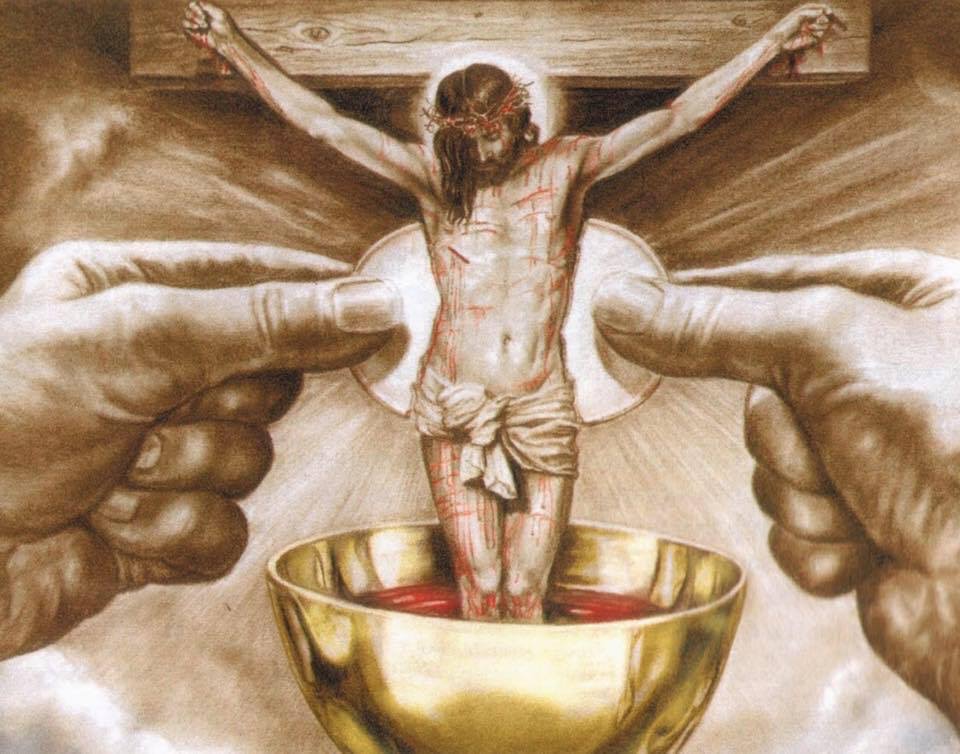
All those saints are bearing witness. They are telling you, “Those sins and burdens you have, let them go. Get rid of them. You don’t need them. Lay them aside. Let them go, and don’t look back. Cross and CommunionLook to Jesus. Fix your eyes on Him. Look to Christ, the author, the founder, and the perfecter of your faith. For the joy what was set before Him, He endured the cross, despising the shame, and is seated at the right hand of the throne of God.”

Yes, dear saints, the race is long and hard. But here is Jesus. He is here to lift your drooping head. He is here to draw your wandering eyes back to Himself. He is here to nourish and sustain you for the race. He is here to give you His Body and Blood in His holy Sacrament. Amen.

The peace of God, which surpasses all understanding, will guard your hearts and minds in Christ Jesus. Amen.