A Peaceful, Quiet Life of Prayer – Sermon on 1 Timothy 2:1-6 for the Sixth Sunday of Easter

1 Timothy 2:1–6

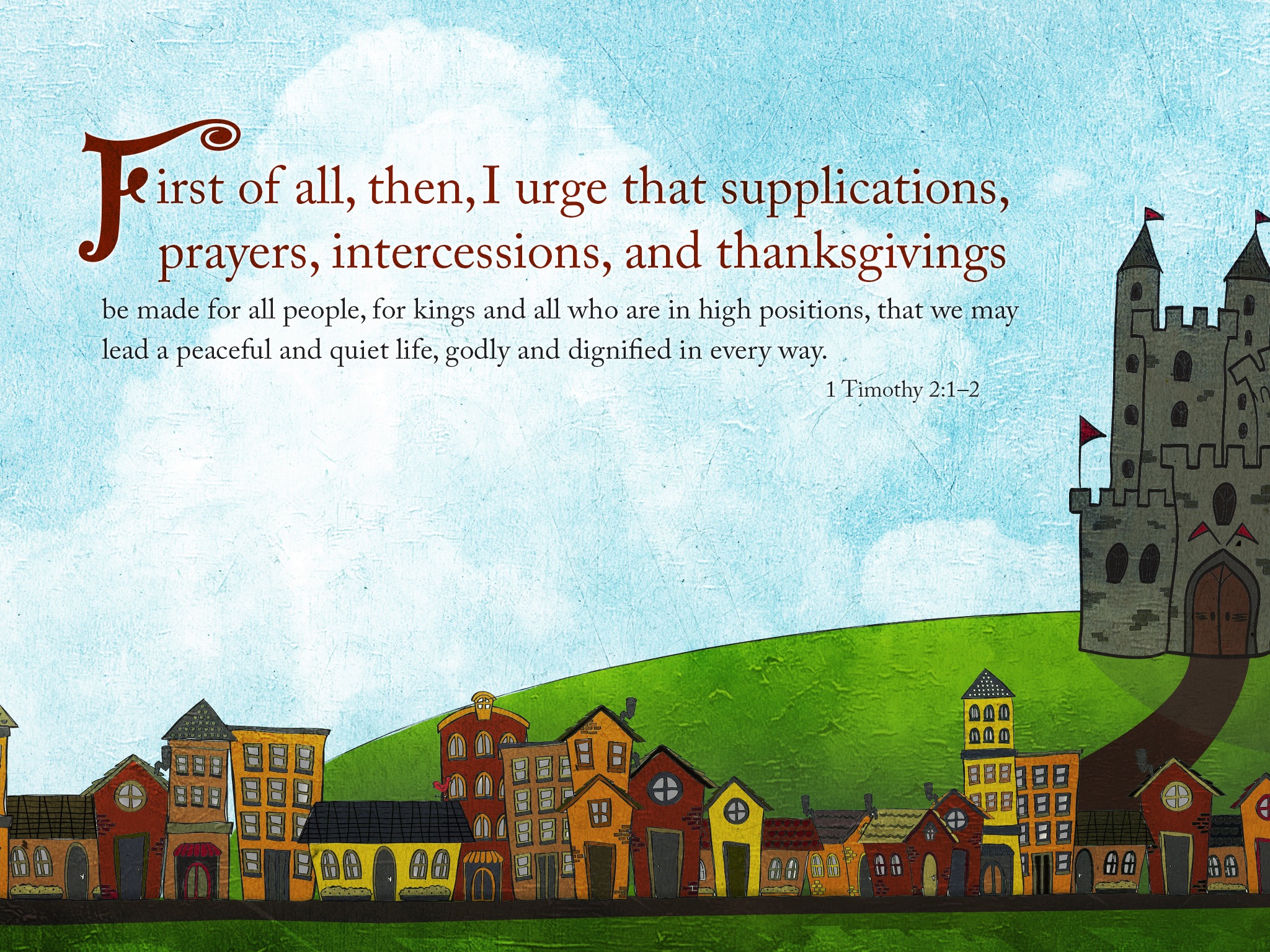
1 First of all, then, I urge that supplications, prayers, intercessions, and thanksgivings be made for all people, 2 for kings and all who are in high positions, that we may lead a peaceful and quiet life, godly and dignified in every way. 3 This is good, and it is pleasing in the sight of God our Savior, 4 who desires all people to be saved and to come to the knowledge of the truth. 5 For there is one God, and there is one mediator between God and men, the man Christ Jesus, 6 who gave himself as a ransom for all, which is the testimony given at the proper time.

Alleluia! Christ is risen!
He is risen indeed! Alleluia!

In the name of Jesus. Amen.

This should come as no surprise, but the Apostle Paul, who was inspired by the Holy Spirit to write 1 Timothy, was not an American. Here, Paul gives instructions about how a peaceful, quiet, godly, and dignified life will come about, and it isn’t through the separation of church and state. This peaceful life comes about by praying for all people, for kings, and for all who are in positions of authority. That means that Paul is instructs pastor Timothy to encourage his congregation to pray for Nero the emperor, the family and descendants of Herod, the different Roman governors who came after Pontius Pilate, and many others. In the context of our day, that means, Christian, you need to pray for your mayor; your city council and school board members; your state and national senators and representatives; the president; the judges at all levels; police and parole officers. We could go on and on and include all the bureaucrats who are appointed to positions of authority, but that would take too long.

We are to pray for those people in authority because God desires all to be saved and come to a knowledge of the truth. And just to be clear on this, Paul is, without question, saying there is a link between Christian prayers for civil authorities and the spread of the Gospel. The two go together according to this text. This really undermines the common understanding of the relationship between the church and the state, at least as it is talked about today.

In our country, it is good that the governing authorities don’t get to mandate or dictate that you be a Roman Catholic, Baptist, Methodist, or even Lutheran. Our founding fathers were wise when they wrote the Bill of Rights and decreed, “Congress shall make no law respecting an establishment of religion, or prohibiting the free exercise thereof.” But this does not mean that the Church and the State should stay in their separate corners and never have anything to do with each other. A lot more could be said about this, but the context for that would be better for a study on politics, culture, and religion – not a sermon.

For a sermon, which this is, it is better to get a Biblical perspective of how God has ordered this world for the benefit of us, His creatures. So, that’s what we are going to do.

To preserve and maintain order in creation, God has instituted the Three Estates – the Church, the Family, and the State. Through these Three Estates, God provides for His people and all creation. Now, many of you have heard me preach and teach about the Three Estates before, but it is good to be reminded of what these estates are and what they are to do.

Both the estate of the Church and the estate of the Family were established by God before the Fall into sin. God established the estate of the Church so there would be spiritual life, and spiritual life always comes through faith in God’s Word (Hab. 2:4; Ro. 1:17; Gal. 3:11; Heb. 10:38). The Church began when God told Adam to not eat of the Tree of the Knowledge of Good and Evil. As long as Adam didn’t eat that fruit, he had spiritual life through trusting God that evil was bad and if Adam gained knowledge of evil, he would surely die (Gen. 2:16-17). After the Fall, God gave the estate of the Church a new promise which was that He would send Jesus to forgive and save sinners and crush the devil’s head (Gen. 3:15). Today, the Church continues to proclaim the Gospel so more would believe in Christ, be saved, and have eternal life.

Also, before the Fall, God established the estate of the Family. The purpose of the Family is physical life. God created Adam and Eve and commanded them fill the earth and have dominion over it (Gen. 1:28-30). God loves people, He wants there to be more people, and He has given a husband and wife an important role in enlarging the number of people. God wants husbands and wives to have children and faithfully raise those children so they will grow up and have more children. The estates of the Church and Family were all that was needed before the Fall because they provided all what was necessary – spiritual life and physical life.

But we don’t live in the original goodness and perfection of creation anymore. All mankind fell into sin. Sinners will only look out for themselves. Left unchecked, sinners do whatever is right in their own eyes (Dt. 12:8; Jdg. 17:6, 21:25) and the world quickly falls into chaos and anarchy. So, after the Fall, God established the estate of the State, and just to be clear, the State is the governing authorities. Scripture is clear that every authority that exists is put in that position of authority by God (Ro. 13:1-2). Since the Fall, every emperor, every monarch, every president, prime minister, governor, legislator, judge, police officer, etc., has been put into his or her office by God Himself.

The State cannot give life, but giving life isn’t God’s purpose for the State. God gave the State to protect and preserve life in a world of sinners. In fact, we rightly recognize that the State only exists to protect and serve the estates of the Church and the Family. There will be no estate of the State in heaven. But the only way for the State to maintain order in a world of sinners is through punishment and the threat of punishment. So, it is good and right for the State to do things like setting speed limits, collecting taxes to maintain a strong police and military to protect the citizens, and have laws that allow for businesses to grow and thrive so people can have jobs that provide a living for families. The State is there to maintain peace, stability, and predictability in a world full of sinners.

The unfortunate thing about the State, and we repeatedly see this throughout history, is that the people in authority quickly let that authority go to their head. They often make life more difficult for those under their authority in all sorts of ways. That is why Paul here tells pastor Timothy to teach his congregation to pray for the authorities in the State with supplications, prayers, intercessions, and thanksgivings.

Now, with these four different words for prayer, you don’t need to get too worked up about them. They just summarize what you normally do in prayers. Supplications are prayers that you offer for others as though their problems are your problems. Prayers is the generic term that simply refers to petitioning or appealing to God. Intercessions are asking God to forgive the sins of others as though they are your own sins. Thanksgivings here doesn’t only mean that we are thankful for the authorities, though we should be; these thanksgivings are on behalf of others. We thank God for the mercies He has given to others as though He has given all those blessings to us. When things are good for others, they are good for us. In Jeremiah 29, God tells His people to seek the welfare of the city where they will be captive and exiled because it result in the welfare for God’s people in while they are in exile (Jer. 29:7). The same is true today. When those in authority are governing well and serving those under their authority, life is good.

Praying for the authorities in this way blesses us. God hears those prayers and answers them. Too often we might think that our prayers don’t actually do anything, but we are wrong. I’ve used this analogy before, but think of it this way: When a president or king is fighting a war, he has advisors. They sit around a table and strategize, consult, and plan together. Those advisors are important, and the person in charge values their input and alters his plans based on that discussion. Scripture teaches that you, Christian, you, child of God, are at that table. When God commands you to pray, He is inviting you into His war room to give your input as to how things should be handled on the battlefield. God wants your thoughts and ideas on how situations should be handled. God turns to you and asks, “My beloved child, what do you think we should do?” Your prayers are your response.

Another blessing that comes when we pray for authorities often gets overlooked. Our prayers give us a better perspective on God’s involvement in the world. God is not some divine clockmaker who just wound the gears and stepped back to let creation run on its own. No, He is deeply involved in all aspects of creation. Praying for the authorities helps remind you of that. Yes, God has given them power and control over many aspects of society and life, but who has power and control over those authorities? God Himself does.

This is why it especially important to pray for the authorities when they are governing in a way that contradicts how God would have them govern. Remember when Paul wrote these verses, Nero was the emperor. Paul says Christians should be praying for Nero, who was burning Christians to light his garden parties and would order Paul’s execution. Through your prayers for the authorities, God reminds you that they are not the ones who are ultimately in control. God is. Proverbs 21:1 says, “The king’s heart is a stream of water in the hand of the Lord; [the Lord] turns it wherever He will.” And if the authorities do evil, God Himself will hold them accountable. Remember that and your life will be a lot more peaceful and quiet, godly and dignified in every way.

Now, we’re going to abruptly change gears here. Vivian, this all brings me to you. Vivian, today you are Baptized. Today, Jesus has joined you to Himself by placing His name upon you (Mt. 28:19) and clothed you with Himself (Gal. 3:27). Vivian, in your Baptism, Jesus joined you to His death so that you have a Jesus-kind of death – in other words, a death that doesn’t last long and ends in resurrection (Ro. 6:3-11). Vivian, the God who desires all people to be saved has come and saved you. And, Vivian, as a congregation, we promise that we will pray for you that you will lead a peaceful and quiet life, godly and dignified in every way. 

Vivian, and all you saints, that life comes only because of Christ Jesus. He is the mediator between God and all mankind. The mediation He did was to give Himself on the cross, to shed His blood, and to lay down His life as a ransom for all and for you.

Dear saints, when you are surrounded by chaos and confusion on every side, call out to the Lord in prayer. He will listen and not reject your prayers (Ps. 66:19-20). And even though you will have tribulation in this world, Jesus, your Savior, has overcome the world (Jn. 16:33). May that fact give you eternal peace.

Alleluia! Christ is risen!
He is risen indeed! Alleluia!

Amen.

The peace of God, which surpasses all understanding, will guard your hearts and minds in Christ Jesus. Amen.

Ask & Receive – Sermon on John 16:23-33 for the Sixth Sunday of Easter

John 16:23-33

23 [Jesus says,] “In that day you will ask nothing of me. Truly, truly, I say to you, whatever you ask of the Father in my name, he will give it to you. 24 Until now you have asked nothing in my name. Ask, and you will receive, that your joy may be full.

25 “I have said these things to you in figures of speech. The hour is coming when I will no longer speak to you in figures of speech but will tell you plainly about the Father. 26 In that day you will ask in my name, and I do not say to you that I will ask the Father on your behalf; 27 for the Father himself loves you, because you have loved me and have believed that I came from God. 28 I came from the Father and have come into the world, and now I am leaving the world and going to the Father.”

29 His disciples said, “Ah, now you are speaking plainly and not using figurative speech! 30 Now we know that you know all things and do not need anyone to question you; this is why we believe that you came from God.” 31 Jesus answered them, “Do you now believe? 32 Behold, the hour is coming, indeed it has come, when you will be scattered, each to his own home, and will leave me alone. Yet I am not alone, for the Father is with me. 33 I have said these things to you, that in me you may have peace. In the world you will have tribulation. But take heart; I have overcome the world.”

Alleluia! Christ is risen!
He is risen indeed! Alleluia!

In the name of Jesus. Amen.

I’m a complete sucker for advertisements. My wife will confirm this. If I hear about a product, a service, or food on one of my favorite podcasts or on social media and the ad makes that thing even slightly appealing, I’m probably going to give it a try. Well, in this text, Jesus gives the best advertisement for prayer in all the Scriptures. Jesus says, “Truly, truly, I say to you, whatever you ask of the Father in My name, He will give it to you. Until now you have asked nothing in My name. Ask, and you will receive, that your joy may be full.”

Jesus means what He says here. Whatever you ask of God the Father in Jesus’ name, God will give it to you, so ask and you will receive. But we sinful humans take this statement from Jesus and tend to fall into one of two errors.

Some fall into the name-it-and-claim-it error. Some will preach that this statement of Jesus means that God will give you whatever you want. All you have to do is ask and believe enough. And it’s no wonder that those types of preachers are popular on television and make a lot of money preaching that. They’re wrong. And if you want that type of preaching, you’ll have to find another preacher because that isn’t what Jesus is teaches.

Jesus says that whatever you ask of the Father, in Jesus’ name, God will give it to you. This does not mean that throwing a quick, “in Jesus’ name,” to the end of your prayers is the magical “abracadabra” that gets God’s attention and make Him your slave so He must do your bidding. No. We have a sinful nature that does not desire the right things. So, if you pray for $500 M, if you really want it, and if you ask for it in Jesus’ name, that doesn’t mean that God is obligated to give it to you. (More on this later.) To pray in Jesus’ name is to pray according to Jesus’ will.

That leads us to the other error. And, in my opinion, this is more common among us (myself included). Too often, we have a fatalistic approach to our prayer, and here’s what I mean by that. We know that God is omniscient. He knows everything; He knows everything that will happen – past, present, and future. And we know that God is omnipotent, or all-powerful, and He rules over everything. Those are important truths that the Scriptures teach. But when we take those doctrines with us into prayer, we can come to the wrong conclusion that our prayer isn’t going to do any good or change anything because God has already determined what He will do and will do it no matter how we pray. But that line of thinking makes prayer pointless because our prayers won’t change anything. Well, that view is also just plain wrong.

The Bible teaches the opposite. Christian, when you pray, you pray as a child of God, and God reacts to your council and input on what is going on in the world. Picture it this way: When a president or king is fighting a war, he has advisors. They sit around a table and strategize, consult, and plan together. Those advisors are important, and the person in charge values their input and alters his plans based on that discussion.

Scripture teaches that you, Christian, you, child of God, are at that table. When God commands you to pray, He is inviting you into His war room to give your input as to how things should be handled on the battlefield. God wants your thoughts and ideas on how situations should be handled. God turns to you and asks, “My beloved child, what do you think we should do?” And your prayers are your response.

For your sermon homework today, you can chose one of three optional assignments (you’ll get extra credit if you do all three): The first would be to read Gen. 18:22 to the end of the chapter. There, God lets Abraham know about the judgment He is going to rain down on Sodom and Gomorrah. And Abraham intercedes for those cities and negotiates with God in prayer. Through Abraham’s intercession, God agrees to not destroy those cities if He finds ten righteous people there (Gen. 18:17-33). Prayer works.

Your second optional assignment is to reread our Old Testament lesson (Num. 21:4-9). There, God’s people sinfully complain about being in the wilderness and about the mana and quail that God daily provided for them. When God sends the fiery serpents to punish and judge them, the people ask Moses to intercede and pray for them. And God answers Moses’ prayer by providing the bronze serpent. And if anyone was bitten by the venomous snakes, they could look at the bronze serpent and be saved from death. Moses’ prayer worked and saved lives.

Your third optional assignment is to read Jonah 3. There, the people of Nineveh have heard Jonah preach about God’s impending judgment for their sins. After they hear that sermon, the king of Nineveh orders all the Ninevites to pray as a last resort. The king says, “Everyone needs to fast, pray, repent, and stop being evil. Who knows? Maybe God will relent of the disaster and judgment He is bringing upon us.” The Ninevites pray, and God responds by changing His mind. Jonah 3:10 says that prayer worked, “God relented of the disaster that He had said He would do to them, and He did not do it.”

I could have you look at a whole bunch of texts, but the reason I mention those three is because of the different degrees of proximity between the one praying and those being prayed for. Abraham prays that God would be merciful toward the people of Sodom and Gomorrah even though Abraham has no connection to their sin, and God responds. Moses prays for God to be merciful to the sinners all around him, and God responds. The king of Nineveh prays for God to be merciful to him (and, yes, the sinners around him), and God responds.

It is true that God always knows what is best to do, but when we pray, we are at the table as God’s advisors and counselors. He desires your input through your prayers. Now, I promised you that I’d come back to this. Again, God hasn’t bound Himself to answer every prayer exactly how we pray for it.

As a congregation, we’ve been praying for our dear sister, Phyllis. We’ve asked God to heal her and give her strength. Nine days ago, she died and is now with the Lord. But God has answered and is answeringour prayers. When Christ returns, Phyllis will rise again. Her body and soul will be put back together, and she will live eternally with no more pain, sorrow, tears, fatigue, etc. We have prayed and interceded for her. We have asked in Jesus’ name, and we are receiving the answers to those prayers. Maybe it isn’t the timing we wanted or in the way we wanted. But God always works all things together for good for those who love Him and are called according to His purpose (Ro. 8:28). He has promised!

Remember, even Jesus had one of His prayers denied initially. Jesus prayed to not go to the cross, “Father, if it is possible, let this cup pass from Me” (Mt. 26:39). That prayer from Jesus, your Savior, was the most futile and impossible prayer that has ever been prayed or will ever be prayed. Jesus’ death was the only answer for our sin. But God listened to Jesus’ prayer, and He loved to hear it. Jesus prayed that prayer without sinning, and God still answered Jesus’ prayer because Christ also prayed, “Nevertheless, not as I will, but as You will.”

Dear saints, don’t ever be embarrassed about praying to God for trivial and simple things. If you want something, it doesn’t matter how small or silly it is, pray for it. Whenever you ask God for something, you’re going to the right Source! You are asking your merciful, loving, generous, and kind heavenly Father for what you want. God will listen to your prayers and answer them to mold and shape what happens in this world, and He will use your prayers to help mold and shape you. Psalm 37:4 says, “Delight yourself in the Lord, and He will give you the desires of your heart.” When the Lord is what you want and desire, when His good gifts are the object of your delight, you have everything you want and desire.

So, pray. Prayer is your ultimate weapon against evil. Prayer is your defense spiritually and physically. Your prayers spring God into action with His divine power. So, be people of prayer, and if you haven’t been praying, start.

Before I conclude here, I want to give you three quick and easy prayers to put in your back pocket. I’ve preached this before, but it bears repeating. I think one of the best ways to be more regular and faithful in prayer is simply to do it more often, and these three little prayers can help with that. It might not feel like these prayers are important, but they absolutely are.

The first little prayer is for whenever you see something good happen. Pray, “God be praised.” It is good and right for you to verbally and mentally acknowledge and recognize that that good thing, whatever it is, has come from God.

The second little prayer is for whenever you see something bad or evil. Pray, “Lord, have mercy.” This is a perfect prayer in the face of any evil or disaster because God always desires to give you His mercy.

The third and final little prayer is for whenever you are making plans or looking to the future. Pray, “Lord willing,” or “If the Lord wills” (see Jam. 4:13-15). I think one of the most important lessons God was teaching us through COVID was a reminder that we are not in control. And I sincerely hope and pray we all take that lesson seriously. That prayer will help you remember that everything is in God’s merciful hands.

Dear saints, you have the ear of the One who created and rules all things. Jesus promises that whatever you ask in His name, God will give to you. So, pray and watch how God acts for your good and for the good of others. Amen.

Alleluia! Christ is risen!
He is risen indeed! Alleluia!

The peace of God, which surpasses all understanding, will guard your hearts and minds in Christ Jesus. Amen.