Discern – Sermon on Romans 12:1-5 for the First Sunday after Epiphany

Romans 12:1–5

1 I appeal to you therefore, brothers, by the mercies of God, to present your bodies as a living sacrifice, holy and acceptable to God, which is your spiritual worship. 2 Do not be conformed to this world, but be transformed by the renewal of your mind, that by testing you may discern what is the will of God, what is good and acceptable and perfect. 

3 For by the grace given to me I say to everyone among you not to think of himself more highly than he ought to think, but to think with sober judgment, each according to the measure of faith that God has assigned. 4 For as in one body we have many members, and the members do not all have the same function, 5 so we, though many, are one body in Christ, and individually members one of another.

In the name of Jesus. Amen.

You will be changed. Please note how that was worded. It isn’t, “You will change,” even though that’s true. It wasn’t, “You must change,” as though this is all up to you. According to this text, you will be (passively) changed. Here, you are given a passive command, which we can’t really translate well into English. What we have there in v. 2 could be translated, “Do not become conformed to this world, rather become transformed by the renewal of your mind.”

In other words, there are things that are going to mold, shape, and change you. But there are some things that should not do that, and there are some things that should.

First, don’t allow the world to change you. The word there is, actually, ‘age.’ “Do not become conformed to this age.” This age isn’t only this world; it’s also the demons, forces of evil, and the culture that pull on you. Our age seeks to conform you to itself. We’ll talk about things like peer pressure and, maybe, even societal pressure. We are to resist those. But we are also to resist the demonic pressure and self-imposed pressure to fit in with this evil age. All those things of this age try to press, pull, form, and mold you like you’re Silly Putty. 

Hopefully, enough of you have played with Silly Putty for this analogy to work. You can easily make Silly Putty do all sorts of things. My siblings, cousins, and I would play with Silly Putty at my grandparents’ home in Faith, SD. We’d take it out of the red egg container and roll it into a bouncy-ball and play catch. When we got tired of that, we’d smoosh the puddy into a flat oval, press it onto the newspaper ink, peel it off, and stretch out the letters and pictures left on the putty. You can make Charlie Brown’s head look even more ridiculous with a blob of Silly Putty. When we got tired of manipulating a particular smudge of ink, all we had to do was simply push, roll, and re-flatten the putty, and it was ready to do another one. The ink from each image never actually left the putty; instead, it just got absorbed into it.

A lot of Christians have allowed this age to work on them like putty. And there are all sorts of reasons they allow it. Maybe they don’t want to be laughed at, so they’ll go along with the theory of evolution and try to make it fit with the account of creation. It doesn’t. It can’t, but they try anyway. Maybe they don’t want to be considered a fundamentalist, so they will compromise on all sorts of things like marriage, sexuality, abortion, and whatever. Here, Paul says, “Don’t. Don’t do that!”

When you allow this age to press and pull and stretch you in different ways, you are in a dangerous place. Just like I’d get bored bouncing a Silly Putty ball around, this age will try to conform you into all sorts of things for all sorts of uses. And just like the ink never really leaves a blob of putty, some of the ways this age will play around with you will stick with you your entire life. Christian, don’t let this age play around with you as though you’re a blob of Silly Putty.

I just need to add here: This world does change you in ways that are fine. There are plenty of lessons to learn from people and organizations that aren’t necessarily Christian, but be careful with them. Have your filter up. Keep in mind what Php. 4:8 says, “Finally, brothers, whatever is true, whatever is honorable, whatever is just, whatever is pure, whatever is lovely, whatever is commendable, if there is any excellence, if there is anything worthy of praise, think about these things.”

All that being said, you are to allow change to come from other places. “Be transformed by the renewal of your mind.” What does that mean? We might wish that Paul had said, “Be transformed by keeping the Ten Commandments,” or, “Be transformed by praying at such-and-such a time.” That would be a lot easier to understand and do. But that’s not what Scripture says here. You aren’t given a set of instructions to do or accomplish. Instead, you’re given the result of this transforming. This transforming results in the renewal of your mind, and it results in an ability to discern the will of God. God wants you, as time goes by, to get better and better at testing and figuring out His will, which is good, acceptable, and perfect/complete.

Sometimes, we’ll talk about the Ten Commandments as God’s will, what He desires us to do. And that is true. God’s will is that you have no other gods, use His name rightly, keep the Sabbath, honor your parents, not kill, not commit adultery or steal or lie or covet. That’s God’s will – plain as day. But none of that takes discernment to figure out. God has clearly said it. “Thou shalt not murder.” When you get angry at someone and want to harm them, you don’t have to discern if you should or not. Don’t do it!

When Scripture says here that you should allow yourself to be transformed so that you can discern God’s will, it’s saying that there are times when God’s will is for you to do something or not do something, but He hasn’t clearly, explicitly said what His will is. Instead, you’re going to have to discern what you should do. Yes, the Commandments are there to help and guide you, but the Commandments don’t address every decision you have to make day by day.

For example. Let’s say your kids are behaving poorly. What should you do? There isn’t a Commandment that definitively addresses that. So, should you discipline them and make sure they feel your wrath? Do you go by Pro. 13:14, “Whoever spares the rod hates his son, but he who loves him is diligent to discipline him”? Maybe. That might be the most godly, loving thing you can do. Or, should you be patient with your kids? Should you follow Col. 3:21, “Do not exasperate your children, lest they become discouraged”? Should you pause, take a step back, patiently talk with them, try to understand what’s going on? Again, maybe. That might the godly, right thing to do.

How do you know which to pick – discipline or patience? The Bible says both are good. How do you navigate it? God has a will for that situation, but He hasn’t explicitly spelled it out in the Bible. God hasn’t said, “When thy child flips out after you deny their request for candy at Hugo’s in East Grand at 12:34 PM on Jan. 12th, 2025, here’s how you handle it. But if it’s at Ace Hardware, here’s how you handle it.” God has ways He wants you to live, but it might be difficult to know how to handle each particular situation that comes up moment by moment, day by day.

Should you give money to that person on the corner by Sam’s Club? Should you watch that show or movie? Here’s a good one: Should you engage with that comment on social media? Ha! Proverbs 26:4 says, “Answer not a fool according to his folly, lest you be like him yourself.” But in the very next verse, the Bible says, “Answer a fool according to his folly, lest he be wise in his own eyes.” You’ve got two verses back-to-back saying, “Don’t do it,” and, “Do it.” So, how do you know what to do?

I can’t tell you. No one can. In His wisdom, God has made these decisions challenging for us and require us to grapple and test and discern what we are to do. In other words, God wants us to do the difficult work of gaining and growing in wisdom. This is what it is to be transformed by the renewal of your mind. This renewal of your mind happens as you read the Bible. The Holy Spirit takes God’s Word and works on you, renewing and transforming you into what He wants you to be.

2 Tim. 3:16-17 says that all Scripture is inspired by God and is there to train you in righteousness that you may be complete, equipped for every good work. In other words, the Bible trains you and renews your thinking and mind. It transforms you. More and more, as time goes on, you are to be filled with God’s Word and bring it to bear in the decisions that are constantly coming at you each day.

This doesn’t mean you have to listen for a voice from heaven and have God directly speak to you. No. Don’t expect God to spell it out like that because that doesn’t take any work. Again, in His wisdom, God has made this more difficult, but that struggle is good for you and for me.

God wants this to be the rhythm of your life. Go about your life, make those decisions, and read the Scriptures. Evaluate how you made those decisions. Maybe, you’ll realize that you did poorly and didn’t do God’s will. Then, repent. Receive God’s forgiveness for that sin. Learn from your mistake. Do better the next time.

Maybe, you’ll realize you did well and that experience will make you better equipped to handle an even tougher decision in the future.

Then, armed with that experience and filled with wisdom from God’s Word, go, live a bit more. Make more decisions, and return again to the Scriptures. Live. Read the Bible. Live. Read. Constantly weave your life and God’s Word together. That work leads to godly discernment. It transforms and renews your mind.

Know that this transforming doesn’t happen very well if the only time you hear the Scriptures is when you’re here at church. Discerning God’s will is a life-long process. It takes work. But don’t forget that this is good work, and it is how God wants to be about His business of continually transforming you. And He isn’t treating you like a blob of Silly Putty. He’s sculpting you, or, even better, He’s metamorphosizing (that’s the word here translated ‘transform’) you into a living sacrifice that is holy and acceptable to God (Ro. 12:1).

Finally, I want to make sure we anchor all of this to the context – both of this passage and the whole book of Romans. Remember this is an appeal, an appeal that is based on the mercies of God. In other words, only Christians who have been freely and completely forgiven of their sins because of what Christ has done – only they can be transformed in this way.

Even with all the discernment you gain from God’s Word, even with a mind that is filled with biblical wisdom, there will be times where you fail to do God’s good, acceptable, perfect will. That’s when you flee again to His mercies, which are new every morning (Lam. 3:22-23). And remember what Scripture said just a few chapters earlier in Ro. 8:1, “There is therefore now no condemnation for those who are in Christ Jesus.” None. Zip. Zilch. Nada. No condemnation.

Yes, grow and be changed by God’s Word. Don’t be conformed to this age. Instead, grow in wisdom, be metamorphosized, and discern. And always know and trust that Christ’s mercy covers you, now and forever. Amen.

The peace of God, which surpasses all understanding, will guard your hearts and minds in Christ Jesus. Amen.

Keep Asking – Sermon on John 16:23-33 for the Sixth Sunday of Easter

John 16:23–33

23 In that day you will ask nothing of me. Truly, truly, I say to you, whatever you ask of the Father in my name, he will give it to you. 24 Until now you have asked nothing in my name. Ask, and you will receive, that your joy may be full.

25 “I have said these things to you in figures of speech. The hour is coming when I will no longer speak to you in figures of speech but will tell you plainly about the Father. 26 In that day you will ask in my name, and I do not say to you that I will ask the Father on your behalf; 27 for the Father himself loves you, because you have loved me and have believed that I came from God. 28 I came from the Father and have come into the world, and now I am leaving the world and going to the Father.”

29 His disciples said, “Ah, now you are speaking plainly and not using figurative speech! 30 Now we know that you know all things and do not need anyone to question you; this is why we believe that you came from God.” 31 Jesus answered them, “Do you now believe? 32 Behold, the hour is coming, indeed it has come, when you will be scattered, each to his own home, and will leave me alone. Yet I am not alone, for the Father is with me. 33 I have said these things to you, that in me you may have peace. In the world you will have tribulation. But take heart; I have overcome the world.”

Alleluia! Christ is risen!
He is risen indeed! Alleluia!

In the name of Jesus. Amen.

In this Gospel reading, Jesus gives us a command to pray. On the night He was betrayed, Christ said to the disciples, “Until now you have asked nothing in My name. Ask, and you will receive, that your joy may be full” (Jn. 16:24). So, according to Jesus if you want full joy, ask. That’s the command. ‘Ask’ in other words, pray. And the grammar there has a durative aspect to it. It is what you are to continually do. “Keep asking.” That has a different nuance to it than the way the ESV translates it here with just the word ‘ask.’

I don’t particularly like running. I know some of you here do, God bless your soul. I don’t, but when I was in junior high and high school, I ran cross country to help get me in shape for swimming season. At meets, people would stand along the course and cheer us runners on, and it would have been very frustrating if they said, “Run.” That’s what I was already doing. Instead, they would cheer, “Keep running.” Here, Jesus is doing something similar. He’s cheering you on by commanding you to keep asking and keep praying. And we need this encouragement because prayer is work.

Lately, the devil has doubled his efforts to discourage the work of prayer. That attack of Satan comes in many ways, but I’ve noticed it most often after someone commits an evil, heinous crime, politicians and pagans will say, “Prayers aren’t enough. We need to actually do something.” And we Christians, myself included, hear that and start to get at least a little shy about what prayer does. I know I’ve been guilty at times of saying things like, “Well, all we can do is pray.” God, forgive me.

Your prayers work. They work powerfully. They are not a waste of time. In Col. 4:2, 5, Scripture says, “Continue steadfastly in prayer,” and that call comes in the middle of several instructions which Paul says are, “making the best use of the time.” Christians are to use their time wisely and prayer is a good and wise use of your time because prayer does stuff. When you are praying, you aren’t wasting time. Praying isn’t setting aside important things to take a break. Prayer is the important thing. Christian, prayer is the most powerful, impactful thing you can do. A few verses later (Col. 4:12), Paul talks about a man named Epaphras who is “always struggling on your behalf in his prayers.” Does that sound like he’s taking some time off and relaxing? Nope! He’s doing something mighty and powerful by praying.

James 5:16 says, “The prayer of a righteous person,” and, yes, that is you, Christian, “The prayer of a righteous person has great power as it is working.” Prayer accomplishes things because of the power of the One to Whom you are praying. C.S. Lewis might be the most brilliant Christian thinker of the last hundred years, but he gets something wrong about prayer. He said, “[Prayer] doesn’t change God. It changes me.” Sure, yes, prayer changes us, but prayer changes God as well. Scripture teaches that God changes course because of prayer. He does something different than what He was going to do.

James 5:17-18 says that Elijah prayed fervently that it would not rain, and for three and a half years there was no rain. Then, he prayed that it would rain, and it did (1 Kgs. 17:1; 18:42-45). God told King Hezekiah to get ready to die. But he prayed, and God added fifteen years to his life (Is. 38:1-6; 2 Kgs. 20:1-6). Through the prophet Jonah, God told the people of Nineveh that they were going to be destroyed in forty days. But they prayed, and God changed His mind and did not do it (Jon. 3). In our Old Testament reading (Num. 21:4-9), God’s people were complaining about the bread that God was literally raining down from heaven for them to eat, so He sent fiery serpents to kill them. They prayed, and God delivered them because of their prayer. I could go on, but those are all crystal-clear examples of prayer changing what God was doing.

Picture God up in heaven. He is sturdy, calm, cool, collected. He’s got all His plans laid out of how He’s going to conduct the affairs of the world for the benefit of His people. When He Baptized you and made you His child (1 Jn. 3:1-3), He invited you into His “situation room.” There He is looking over His plans, and He asks you, “What do you think we should do here? How should this be handled?” You’d respond, “Um, well, I don’t know. You’re God. Shouldn’t You have this all under control and know how to run everything?” But God says, “Come on, now. I want to know what you think. What do you suggest?” So, you say, “Well, maybe You could move that thing over there. Send someone to preach Your Word over here. Heal this person. Bless that one.” And God says, “Ok. I like it. That’s the plan.”

Now, this doesn’t limit God in any way. The effectiveness of your prayers and the foreknowledge of God is a mystery that we cannot comprehend – similar to the doctrine of the Trinity and the two natures of Christ. How can there be one God yet three Persons? How can Jesus be 100% God and 100% man? We can’t understand or comprehend those things. But Scripture teaches them, so we believe them. The same thing is true about your prayer. Well, Scripture teaches that God is sovereign; He knows what will happen and isn’t your slave. And Scripture also teaches that your prayer changes what God will do. Just because you can’t fit those two things together logically, don’t throw one of them out to make it make sense to your logic.

Instead, see these two seemingly incompatible teachings of Scripture – God’s sovereignty and the power of prayer – see them as a further proof of God’s great love for you. The reason you ask and God responds is His love for you. Back to our Gospel reading, Jesus says in v. 26-27 (I’ll paraphrase a little bit), “Ask in My name. I don’t need to ask the Father for you because the Father Himself loves you.”

This is why God wants you to pray and brings you into His situation room. When you love someone, you permit them to affect and influence your actions, decisions, and directions. Think of a father who comes home from a rough day at work where everything went wrong. He’s frustrated and discouraged. He gets home and just wants to sit in his chair and watch the game. But he gets home, and his son asks, “Daddy, can you read this book to me?” That might not fit in with the father’s plans, but he loves his son and gladly sits on his bed and reads to him. And they spend time laughing and joking together.

When you love someone, you permit and even prefer to let them change what you want to do. Instead, you do what they want. And in that sacrifice, you and the person you love find joy.

Well, God is your perfect, loving Father, and He never tires of your asking. He loves you. He knows your sin and failures. Yet, the Father loves you because you love Jesus and have been forgiven much (Lk. 7:47). So, keep praying. Keep asking. Amen.

Alleluia! Christ is risen!
He is risen indeed! Alleluia!

The peace of God, which surpasses all understanding, will guard your hearts and minds in Christ Jesus. Amen.

Silently Accused – Sermon on Matthew 26:1-27:66 for Palm Sunday

Matthew 26:1-27:66

In the name of Jesus. Amen.

It doesn’t matter how familiar you are with a passage of Scripture, there’s always something more to see, to glean, to meditate on. That’s true for short, familiar passages, but it is certainly true for a long passage like this. While preparing this week, what struck me in a fresh way is what Matthew tells us in Mt. 27:20. The chief priests and elders persuaded the crowd to ask for Barabbas and destroy Jesus.

Of the four Gospels, Matthew is the sharpest on this. They don’t persuade the crowd to just kill, execute, or even crucify Jesus. They want Him destroyed. That’s their desire.

There is utter malice behind this. Jesus looks so weak. He had already been betrayed by Judas. The other eleven disciples fled when He was arrested. Peter denied even knowing Him. Jesus had been mocked, spit upon, beaten, bound, and whipped. And they still call for Jesus to be destroyed. The cruelty of wanting Jesus destroyed is absolutely astounding.

But through all of it, Jesus barely speaks. Jesus talks a lot at the beginning of this reading while He is with the disciples, but once He is arrested, He only speaks three more times before His death here in Matthew’s gospel. All these false accusations are thrown at Him, but He doesn’t respond to any of them. Jesus just stays passive and silent as He is accused. Again, He looks weak.

During His trial before Caiaphas, all sorts of false charges are brought against Jesus, but He simply stands there and receives them. He doesn’t say a word. He only talks when Caiaphas demands, “Tell us if you are the Christ, the Son of God” (Mt. 26:63). But then, Jesus says, “You have said so. But I tell you, from now on you will see the Son of Man seated at the right hand of Power coming on the clouds of heaven.”

It sure doesn’t look like Jesus is seated at the right hand of Power through the rest of His Passion. His silence looks like weakness, but that’s not how we should see it. It is powerful.

Jesus doesn’t speak again until Pilate asks Him, “Are you the King of the Jews?” There, Jesus says,“You have said so.” But again, as the chief priests and elders accuse Jesus before Pilate, Jesus is silent (Mt. 27:12). Even though Pilate asks Jesus to respond to all these accusations, Jesus still gives no answer, not even to a single charge. In His silence, Jesus looks weak and passive.

All of this reminds me of the scapegoat. Do you remember what God had commanded His people to do on the Day of Atonement (Lev. 16)? Each year, there were two goats. One was sacrificed and the blood of that goat allowed the high priest to enter the Holy of Holies. But the other goat, the scapegoat – it had a different purpose. The high priest laid both of his hands on the head of that goat and confessed all the iniquities, all the transgressions, and all the sins of the people. And God said that what happened there was that the high priest was placing all that sin on the goat’s head (Lev. 16:21).

And what do you suppose that goat did during that? It couldn’t object. The goat didn’t say, “Hey, what do you think you’re doing?” The goat remained passive and silent and simply received it. Once all those sins were placed on that goat’s head, it was led into the wilderness carrying all those sins away from the sinners (Lev. 16:22). The scapegoat and all those sins were destroyed, never to be seen again. Yes, the scapegoat was passive, but by it God powerfully removed those sins.

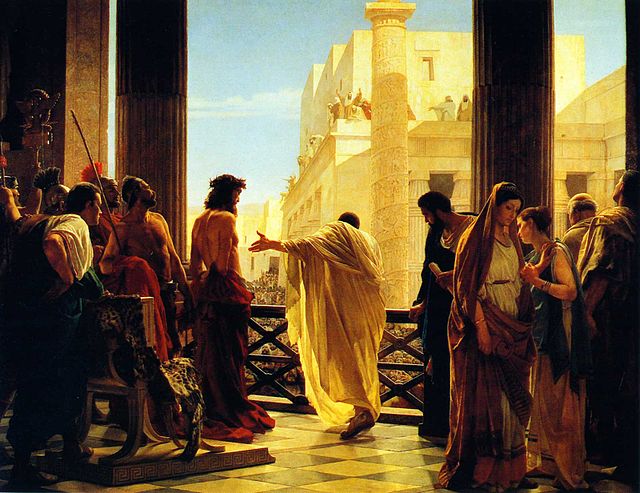
Pilate hears all these accusations and sees how Jesus is silent. He knows these religious leaders want Jesus destroyed for no good reason, but Pilate has an idea. Pilate has the notorious Barabbas in custody who had committed murder and started a riot and insurrection (Mk. 15:7; Lk. 23:18-19). Pilate puts Barabbas and Jesus forward as his nominees to potentially be released. It seems as though Pilate figured Barabbas was such a rotten individual and danger to society that the crowds would rather have Barabbas crucified for their own safety and protection. But the crowd calls out for Barabbas to be released and for Jesus to be crucified.

And that’s what Jesus wants too. So, Jesus stays silent, passive, and powerful.

It was God’s will that Jesus should be on the cross instead of Barabbas. By taking Barabbas’ place on that cross, Jesus also takes your place under God’s wrath against your sins.

God takes all this evil, malice, and injustice and uses it for your eternal good (Ro. 8:28). Jesus’ Passion isn’t a tragedy. It is God’s victory. In fact, this is the victory. Jesus’ silence in all of this isn’t weakness. It’s God’s power because this is God’s plan playing out. This is how God powerfully removes your sins from you as far as the east is from the west (Ps. 103:12). Jesus is crucified and heaven rejoices to see God’s great, powerful love for His creation. This is how God loves the world. This is how God loves you.

Jesus silently takes all those accusations, He is loaded up with all your sins, and He is led into the wilderness of death as He is crucified and destroyed. But death will no power over Him.

Dear saints, welcome to Holy Week. Easter is coming. Amen.

The peace of God, which surpasses all understanding, will guard your hearts and minds in Christ Jesus. Amen.