
Romans 12:16–21
16 Live in harmony with one another. Do not be haughty, but associate with the lowly. Never be wise in your own sight. 17Repay no one evil for evil, but give thought to do what is honorable in the sight of all. 18 If possible, so far as it depends on you, live peaceably with all. 19 Beloved, never avenge yourselves, but leave it to the wrath of God, for it is written, “Vengeance is mine, I will repay, says the Lord.” 20 To the contrary, “if your enemy is hungry, feed him; if he is thirsty, give him something to drink; for by so doing you will heap burning coals on his head.” 21 Do not be overcome by evil, but overcome evil with good.
In the name of Jesus. Amen.
Inspired by the Holy Spirit, Paul assumes and presupposes that you are going to encounter evil. In v. 17 he writes, “Repay no one evil for evil.” You aren’t told, “If something evil happens to you, don’t turn around and do something evil in return.” The assumption of evil is even clearer in v. 21, “Do not be overcome (or ‘defeated’ or ‘conquered’) by evil, but overcome (‘defeat’ or ‘conquer’) evil with good.” Again, evil things are going to happen both to and around you. And those evil things are either going to overcome you, or you will overcome those evil things by doing good – which is the most Christlike thing you can do.
Imagine a cattle rancher taking care of his cows – feeding them, branding and tagging them, vaccinating them, checking if they’re healthy, whatever – what is he going to step in while he’s walking through that cattle pen? Without a doubt, he’s going to step in manure, cow pies, poop. It’s going to get all over his boots, maybe even on his pants and coat. It’s going to happen.
Now as he’s doing his work, suppose you’re watching him from the fence. Are you going to ask him, “How do you feel about stepping in that manure?” No! If you did, the rancher would probably say something along the lines of, “It just comes with the territory.” If you asked him, “How many piles do you step in each week?” he’d probably laugh because he doesn’t think about it in the moment or dwell on it afterward. He’s just used to it. He has enough experience with cows to know that he can’t teach them to do their business in a specific corner of the yard. It’s going to be scattered all over, and he’s going to periodically step in it.
And the rancher isn’t going to bother trying to get retribution on the cows. He isn’t going to spread his own feces around so the cows step in it. “See how they like it.” No! For one thing, the cows aren’t going to care, and it’d be too much work – very unpleasant work. The only thing a cattle rancher can do when he steps in manure is simply wipe it off before he gets in his truck or goes into his house or when his boots get heavy and caked with it. When he steps in it, he doesn’t dwell on it later. Instead, he just keeps walking.
Dear saints, you already know this, but sometimes it’s just helpful to plainly say it. This world is a cattle yard. This world is full of all sorts of stinky, smelly, steaming piles of evil. Generally, you don’t intentionallystomp around in it. Most of the time, you do your best to avoid it, but at some point, you’re going to get end up coming into contact with the manure of evil. It isn’t pleasant. You don’t like it, and you are right to not like it. But you also need to recognize and acknowledge that, when you end up caked in the manure of evil, it isn’t as though something strange is happening to you (1 Pet. 4:12). Everybody faces evil things. Everybody steps in the cow pies of evil. Everybody has bad days, weeks, months, years, and decades. Everybody. It’s part of life. It doesn’t matter how careful or careless you are. In a fallen and sinful world, you’re going to encounter evil.
This simple truth from Scripture is actually a great comfort. It helps us orient ourselves the right way. We’re going to step in the cow pies of evil. In a broken, fallen world, evil is going to happen to us. When we are confronted with evil, the best thing we can do is the unpleasant work of wiping it off and move on. Responding to evil by doing evil isn’t going to help. Neither is dwelling on it. Yes, learn from the evil things that have happened. Maybe, you don’t put yourself or others in a similar situation. But you have to do your best to scrape it off and move on.
I know many of you have encountered evil, horrific things. You’ve been neck deep in the manure of evil. You are right to weep about it, and as our text last week called for, I weep with you (Ro. 12:15). It stinks and is utterly rotten. But there also is a point at which you need to move on. You live and walk in the cattle pen of a sinful, evil, broken world.
Sin and evil throws creation out of order. No matter how small a sin is, it throws the whole, entire universe off-kilter. Remember, it only took one sin in the Garden of Eden to bring pain, strife, and death to all of creation. All sin, whether it’s your own sin or sins committed against you, sin brings chaos and disorder to creation. Still, you can’t fight sin and evil with more sin and evil of our own, just like you can’t save someone from drowning by giving them a cup of water. You have to get them out of the water they’re drowning in.
When we see sin and injustice, we naturally want to fix it. Since we are made in the image of God, we want to bring order and justice back into the world. That is what vengeance is. Now, vengeance isn’t necessarily a bad thing. We’ve gotten so used to the word ‘vengeance’ being used in a negative way that we think vengeance is always evil. That’s not the case. Yes, vengeance can be evil when you think it’s exclusively your job to dole it out. But remember God Himself says, “Vengeance is Mine, I will repay.” Paul there is quoting Dt. 32:35. The same verse gets quoted again in Heb. 10:30. Throughout the Scriptures, both in the Old and New Testament, we hear that God promises execute vengeance on the wicked. All of Ps. 94, and many other places in the Psalms this is repeated. God is just. He will punish all sin and make creation right again. That is His job and His promise.
So, know these two things and get them drilled into your head: First, you will encounter sin and evil. And second, know that fixing sin is God’s dominion. He will do it. It’s not up to you. You aren’t God.
Yes, there are times when you are God’s instrument to execute vengeance. Parents, you are to discipline your kids (Pro. 13:24; 23:13-14; 29:15; Heb. 12:9-10). That calling has been given to you by God. And, to maintain order in society, God has given us rulers who have the God-given task of punishing sin with vengeance. Paul goes into that next in Ro. 13. Those earthly authorities are put there by God to be a terror to bad conduct (Ro. 13:3-4; 1 Pet. 2:13-14). But, generally speaking, we are to leave room for God to bring vengeance against sin.
Again, “Do not be overcome by evil, but overcome evil with good.” This is what Christ has done for you. Jesus did not let Himself be overcome by evil. It sure looked like it as He died on the cross. It appeared that evil had defeated Christ. But it didn’t. Not even close. Jesus overcame our evil with good. Good Friday indeed – the goodest [sic.] of good, when all the evil of this world was overcome, conquered, defeated, and crushed by the goodness of Christ.
Dear saints, this text is calling us to do the hardest thing in this broken world – to overcome evil with good. In other words, this text is calling us to be like Christ. The only way to do that is to let the goodness of Christ overcome both you and the evil within you. And when evil things happen to you, remember that evil person is another one for whom Christ died. Let the love and mercy of Christ fill you and spill out to others as well. Amen.
The peace of God, which surpasses all understanding, will guard your hearts and minds in Christ Jesus. Amen.

 6 But at midnight there was a cry, ‘Here is the bridegroom! Come out to meet him.’ 7Then all those virgins rose and trimmed their lamps. 8 And the foolish said to the wise, ‘Give us some of your oil, for our lamps are going out.’ 9 But the wise answered, saying, ‘Since there will not be enough for us and for you, go rather to the dealers and buy for yourselves.’ 10 And while they were going to buy, the bridegroom came, and those who were ready went in with him to the marriage feast, and the door was shut. 11 Afterward the other virgins came also, saying, ‘Lord, lord, open to us.’ 12 But he answered, ‘Truly, I say to you, I do not know you.’ 13 Watch therefore, for you know neither the day nor the hour.”
 But thanksgiving, yes it recognizes the goodness of the thing, but it looks past that and sees the goodness of the giver of the thing. This is why Christians can give thanks in all circumstances (1 Th. 5:18). Even in the tough stuff, even in difficult times, in sorrow, and in afflictions that come to us in this broken world, you can know that everything comes to you from the very same hands that were nailed to the cross for you.
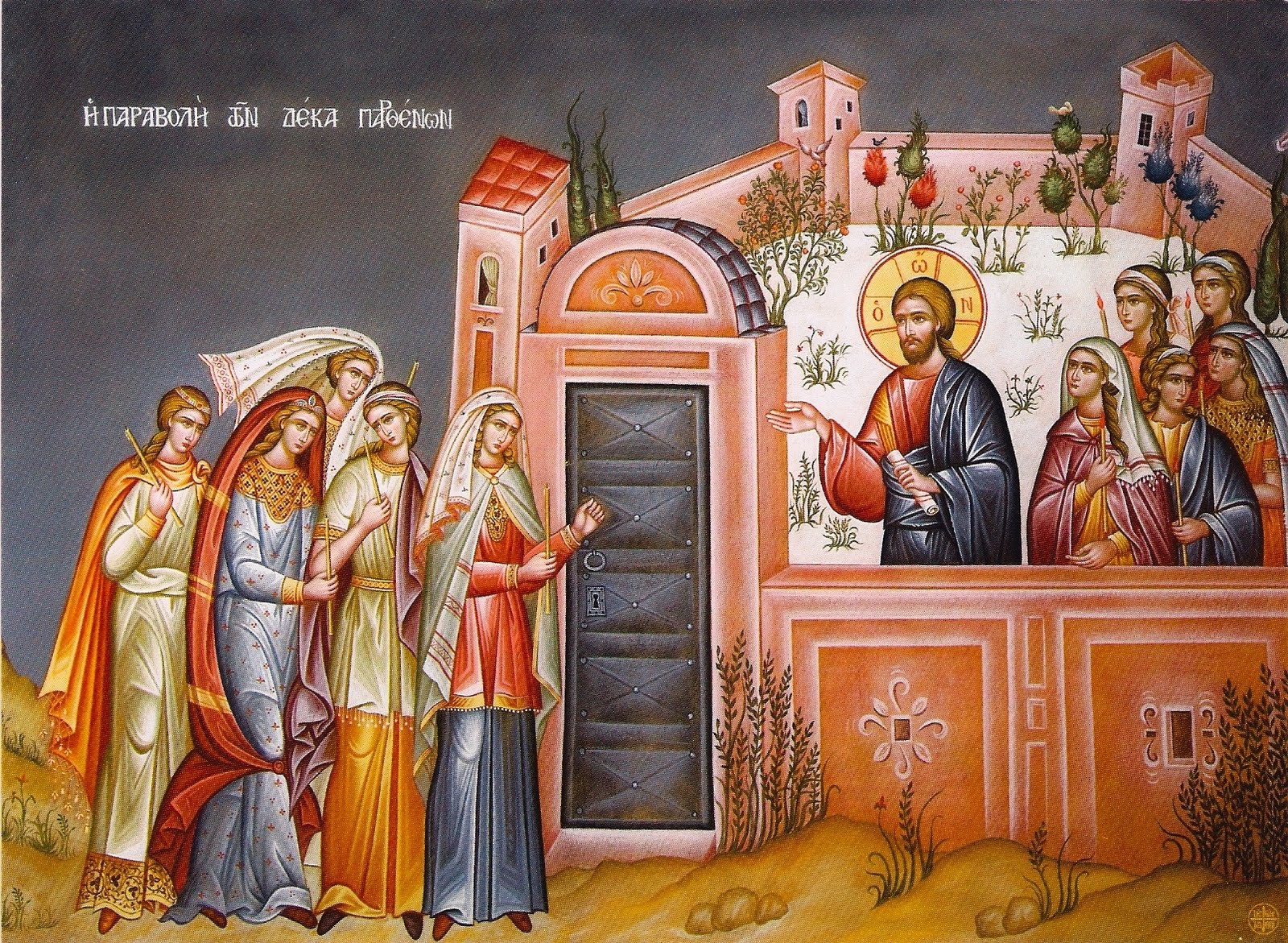 Now, to the parable. Honestly, it is very difficult, and the difficulty mainly lies in the fact that we don’t know enough about Jewish wedding customs in Jesus’ day to know why it was so important that these virgins have lit lamps when the groom arrived.
 There were ten fishermen – five wise who wore their life jackets the whole time they were on the boat and five foolish who drown because they figured they would have enough time to put them on when the storm hit.
 And remember that as the end approaches, as you continually see signs of Christ’s return, remember what that means for you. Christ says it means your redemption is drawing near (Lk. 21:28). The bridegroom is coming, and you are His bride. Jesus has purchased and redeemed you so that you are without spot, wrinkle, or blemish (Eph. 5:27).
 Pastorsamwise
You must be logged in to post a comment.