John 4:5–26 5 So he came to a town of Samaria called Sychar, near the field that Jacob had given to his son Joseph. 6 Jacob’s well was there; so Jesus, wearied as he was from his journey, was sitting beside the well. It was about the sixth hour.
7 A woman from Samaria came to draw water. Jesus said to her, “Give me a drink.” 8 (For his disciples had gone away into the city to buy food.) 9 The Samaritan woman said to him, “How is it that you, a Jew, ask for a drink from me, a woman of Samaria?” (For Jews have no dealings with Samaritans.) 10 Jesus answered her, “If you knew the gift of God, and who it is that is saying to you, ‘Give me a drink,’ you would have asked him, and he would have given you living water.” 11 The woman said to him, “Sir, you have nothing to draw water with, and the well is deep. Where do you get that living water? 12 Are you greater than our father Jacob? He gave us the well and drank from it himself, as did his sons and his livestock.” 13 Jesus said to her, “Everyone who drinks of this water will be thirsty again, 14 but whoever drinks of the water that I will give him will never be thirsty again. The water that I will give him will become in him a spring of water welling up to eternal life.” 15 The woman said to him, “Sir, give me this water, so that I will not be thirsty or have to come here to draw water.”
16 Jesus said to her, “Go, call your husband, and come here.” 17 The woman answered him, “I have no husband.” Jesus said to her, “You are right in saying, ‘I have no husband’; 18 for you have had five husbands, and the one you now have is not your husband. What you have said is true.” 19 The woman said to him, “Sir, I perceive that you are a prophet. 20 Our fathers worshiped on this mountain, but you say that in Jerusalem is the place where people ought to worship.” 21 Jesus said to her, “Woman, believe me, the hour is coming when neither on this mountain nor in Jerusalem will you worship the Father. 22 You worship what you do not know; we worship what we know, for salvation is from the Jews. 23 But the hour is coming, and is now here, when the true worshipers will worship the Father in spirit and truth, for the Father is seeking such people to worship him. 24 God is spirit, and those who worship him must worship in spirit and truth.” 25 The woman said to him, “I know that Messiah is coming (he who is called Christ). When he comes, he will tell us all things.” 26 Jesus said to her, “I who speak to you am he.”
In the name of Jesus. Amen.
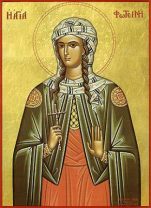 I want to begin today with a side note: Church tradition has some interesting information about this Samaritan woman. Her name is Photini which means “enlightened one.” Just after our text, Photini goes back to her village and invites everyone to come and meet Jesus who she says, “He told me all that I ever did.” The Samaritans meet Jesus and He stays there for two days. The many from the town believe in Jesus as the Savior of the world because Jesus’ words.
Church tradition then says that Photini traveled to Carthage where she continued to tell people about Jesus Christ. Apparently, she even spoke to the Roman emperor Nero’s daughter about Jesus, and Nero’s daughter became a Christian. However, Photini died as a martyr by Nero’s hand in AD 66.
Let’s look at the text:
Last week, we saw Nicodemus, a ruler of the Pharisees, coming to Jesus in the darkness of night. Nicodemus was respectable man; he would be the equivalent of a Supreme Court justice in our time. But Nicodemus comes to Jesus secretly.
Contrast that with this Samaritan woman. First of all, Samaritans integrated the worship of other false, pagan gods with worship of Yahweh (2 Kgs. 17:29-32). Secondly, she was a woman. Rabbis in Jesus’ day taught that men were not to talk to women in public – even their own wives. Third, this particular woman was also an outcast; she comes to the well well [sic] after all the other women would have been there in the cool morning to draw water. She was likely tired of everyone talking about her personal life with her five failed marriages and her current live-in boyfriend.
She comes to the well around noon, in the heat of the day to draw her water. She comes around the bend and finds Jesus sitting there on the well alone, dusty, and tired from His walking. “Give Me a drink,” Jesus says.
 The woman is surprised that Jesus, a Jewish man, would even speak to her. The Samaritans and the Jews didn’t get along. They are your typical Hatfield and McCoy feud. The Samaritans’ temple on Mt. Gerizim (the mountain that the woman refers to later) was destroyed by the Jews in 128 BC. The Samaritans retaliated a few years before Jesus was born by attacking Jerusalem and filling the temple area with the corpses of the dead. The only dealings Jews and Samaritans had were bitter and morbid.
Yet, Jesus says to the Samaritan woman, “Give Me a drink.” But Jesus is more interested in giving this woman the living water she needs than receiving the drink that His tired body needs. Jesus uses His own need to get this woman to realize her need to receive from Him. “If you knew the gift of God, and who it is that is saying to you, ‘Give Me a drink,’ you would have asked Him, and He would have given you living water.”
If she knew the gift of God, she wouldn’t be looking for fulfillment in man after man after man. If she knew the gift of God, she wouldn’t care that her neighbors had cast her out socially and that she was a complete loser in their eyes. If she knew the gift of God, nothing in this whole world would matter, except having Jesus, who gives everything.
John means for us to see this scene as a courtship scene. Now, Jesus isn’t seeking to marry this woman as we think of marriage. He wants this woman to become part of the Church which is His bride. Our marriages aren’t pictures of Christ’s relationship to us, instead the reverse is true. Jesus’ perfect, holy, faithful, grace-filled marriage to the Church is a picture of what our marriages should look like.
Sitting there on Jacob’s well is Jesus – the One greater than Jacob. Jacob had first met his beautiful bride to be, Rachel, at a well (Gen. 29:1ff; also see Gen. 24ff and Ex. 2:15-22). When Jacob saw Rachel, he wept because of her beauty. Jesus sees this woman with all of her sins and flaws, and wants her to believe in Him as the Messiah.
Jacob ended up having to work for fourteen years to marry Rachel. But Jesus, the One greater than Jacob, worked even harder enduring God’s wrath for this Samaritan woman’s sin – and all of mankind’s sin, even yours – to gain for Himself a bride, His Church.
You see, you have been more adulterous than this woman. In fact, you have whored yourself out to all sorts of sins thinking that in them you will find happiness. You are a slut seeking a husband in all the wrong places.
But there is Jesus who is always seeking to be your Husband. He is always true and faithful to you no matter how many other suitors you seek. Jesus has pledged His undying love and faithfulness to you. He invites you to drink from the well of living water which He has dug with His own hands. Though you are a sinner, in the eyes of Jesus you are the bride He desires most. He invites you to “dine at His table and drink from His cup. [In His eyes], you are the fairest of them all, for His kisses of grace have healed your scars, brightened your eyes, and transformed you from a beast to a beauty” (Chad Bird). Amen.[1]
The peace of God, which surpasses all understanding, will guard your hearts and minds in Christ Jesus. Amen.
[1] I am thankful to both a blog post by Chad Bird “Mirror, Mirror on the Wall: Jesus and the ‘Bad’ Samaritan Woman” http://birdchadlouis.wordpress.com/2014/03/18/mirror-mirror-on-the-wall-jesus-and-the-bad-samaritan-woman/ and an article by Dr. Peter J. Scaer “Jesus and the Woman at the Well: Where Mission Meets Worship” Concordia Theological Quarterly Vol. 67:1 January 2003 as inspiration for this sermon.
 Pastorsamwise
You must be logged in to post a comment.