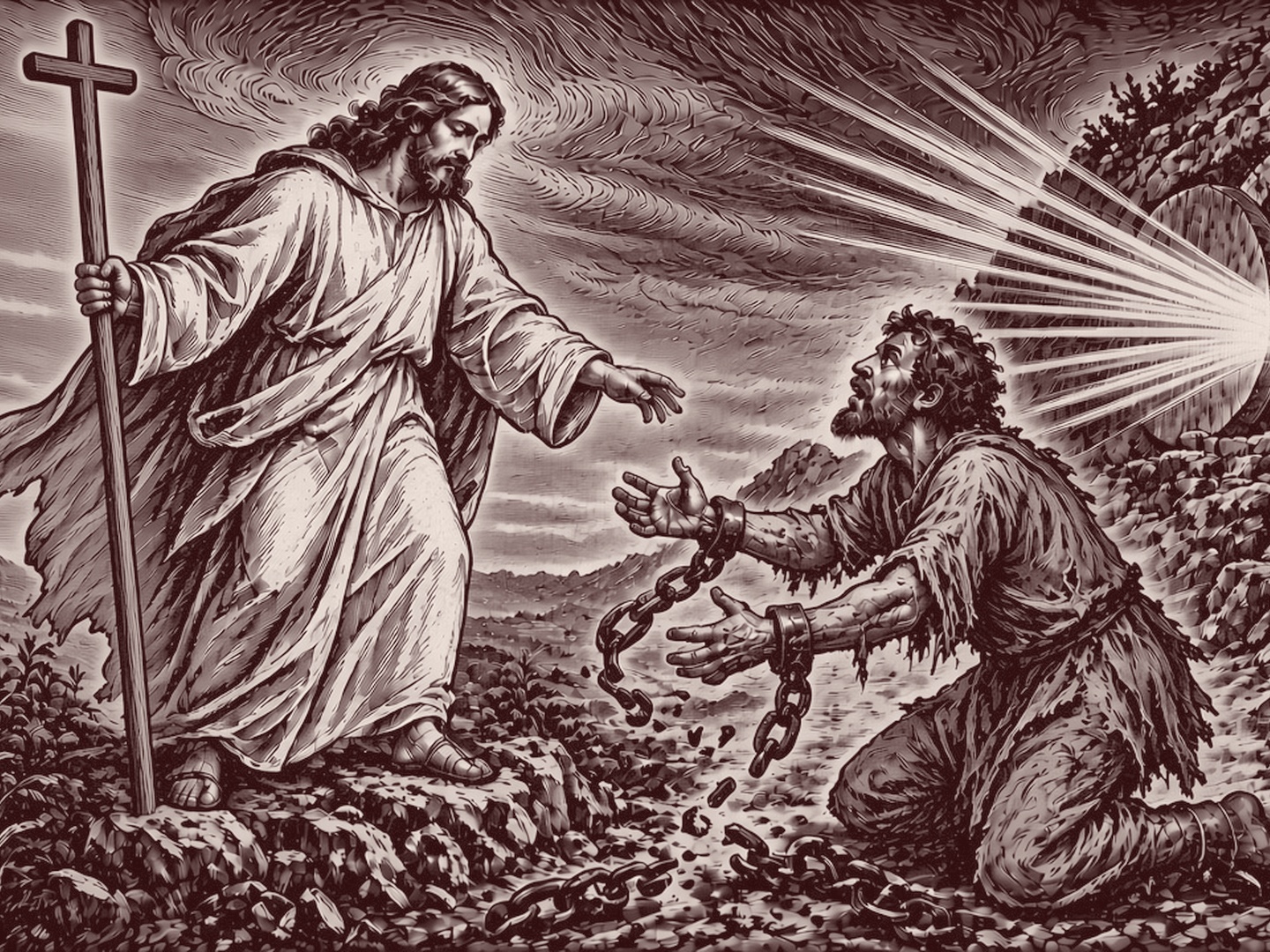
I Am the Resurrection & the Life – Sermon on John 11:17-27 for Good Friday

The Scripture readings for tonight’s service are Isaiah 53:4-6Psalm 102:1-212John 11:17-27Luke 23:33-38Luke 23:39-43John 19:25-27Mark 15:33-35John 19:28-29John 19:30; and Luke 23:45b-47.

In the name of Jesus. Amen.

Dear saints, on this Good Friday—just before we hear the seven words of Jesus from the cross—Jesus says to us, “I Am the Resurrection and the Life.”The first thing we need to have straight in our minds is that the Resurrection isn’t just a future event on God’s calendar. It isn’t only something that will happen on a particular day of a particular month of a particular year. No. The Resurrection is much more definite than that.

Instead of saying that He will cause a resurrection to happen, Jesus says that He is the embodiment of Resurrection and Life. The Resurrection is a Person. The Resurrection and the Life is your Savior, your Redeemer, your God who took on your flesh and blood. That means where Jesus is, there is the Resurrection and there is the Life.

It certainly is true that the Resurrection of all flesh is also something that will happen in the future. Jesus says, “An hour is coming when all who are in the tombs will hear My voice and come out”(Jn. 5:28-29). Christian, you rightly confess in the Creeds that you believe in “the Resurrection of the body, and the Life everlasting” (Apostles’) and that you “look for the Resurrection of the dead, and the Life of the world to come” (Nicene). But even now, believer, you are in the Resurrection and the Life. Jesus promises that though your heart may stop beating and you die, yet shall you live. Even better—Jesus goes one step further—you who live through faith in Christ shall never die (Jn. 11:25-26).

This is one of the most profound and comforting promises Jesus makes, but it is not easy to believe. After Jesus makes this promise, He asks Martha, “Do you believe this?” I don’t think there is any question that Jesus is asking Martha if she believes all four things He just said. 1) That He is the Resurrection. 2) That He is the Life. 3) That everyone who believes in Him will live even though he dies. And 4) That everyone who lives and believes in Him shall never die.

Martha’s answer seems incomplete. Notice, she doesn’t say, “Yes, Lord. I believe You are the Resurrection and the Life.” Instead, she answers, “Yes, Lord. I believe that You are the Christ, the Son of God, Who is coming into the world.” With that answer, there’s no question that Martha is a Christian. But she doesn’t—at least not yet—have the comfort that Jesus is the Resurrection and the Life. She believes Jesus is the Messiah. She believes that He is the Son of God who has come into the world. But it sounds like Martha doesn’t think that Jesus has the power to give life right now, right in the middle of her grief over losing her brother to death. 

I say that because in just a few verses, Jesus arrives at Lazarus’ tomb and tells the people to roll the stone away. And Martha says, “Lord, he’s been dead four days. If we roll the stone away, it’s going to stink” (Jn. 11:39). In other words, Martha thought it was too late for Jesus to do anything for her brother. But Jesus is about to show her the full reality of what she had confessed. Because Jesus is the Christ and the Son of God, He is also the Resurrection and the Life, and everyone who lives and believes in Him shall never die (Jn. 11:26).

Jesus arrives at Lazarus’ grave. The stone blocking the entrance to Lazarus’ tomb is rolled away. Jesus prays to His heavenly Father and cries out with a loud voice, “Lazarus, come out!” And I agree with whoever was the first to say that, if Jesus hadn’t called Lazarus—and only Lazarus—by name, then all the dead would have come out of the grave. “Lazarus, come out!” And Lazarus comes out from his grave alive (Jn. 11:41-46).

That day in the village of Bethany, death had to obey its Superior. But it isn’t long after this that the Resurrection and the Life marches straight into death’s jaws. On Good Friday, Jesus meets death face to face, not to demand the release of one man. He goes to defeat death once for all by giving Himself unto death.

It was the miracle of Jesus raising Lazarus from the dead that stirred the chief priests and Pharisees to plot Jesus’ death (Jn. 11:53). And our Lord wasn’t surprised by this. In fact, He had been repeatedly saying it would happen for much of His ministry. Jesus wasn’t surprised by their plot. It was the very reason He had come to earth. So tonight, we remember that the One who called Lazarus out of the tomb willingly goes into the tomb for you.

This also means, dear saints, that there is nowhere you can go that your Savior, who is the Resurrection and the Life, hasn’t been before. He knows what it is to be human—in every aspect—from conception to adulthood. He knows what it is to have friends and family who sometimes fail Him. He knows what it is to be hungry, thirsty, and tired. He knows what it is to be tempted (Heb. 4:15). He knows how it feels to mourn the death of loved ones (Jn. 11:34-36). He even knows death (Jn. 11:30).

Because the Resurrection and the Life has been in all those places, His holiness has sanctified them and left resurrection and life in His wake.

So tonight, dear saints, as you hear the seven words of Jesus from the cross, don’t hear them as the pitiful cries of a dying man. Instead, hear them for what they really are. They are the words of the Resurrection and the Life accomplishing your salvation and defeating death for you.

The Resurrection and the Life prays, “Father, forgive them, for they know not what they do” (Lk. 23:34) because He pays the full price for your forgiveness.

The Resurrection and the Life says to the thief on the cross, “Truly, I say to you, today you will be with Me in Paradise” (Lk. 23:43) because He is opening heaven even while He hangs under the sentence of death.

The Resurrection and the Life says, “It is finished,”(Jn. 19:30) because He has broken death’s power over you forever.

And the Resurrection and the Life says, “Father, into Your hands I commit My Spirit” (Lk. 23:46). His Body will be in the tomb for three days, but that same Body will rise again to bring Resurrection and Life to all who believe in Him.

Dear saints, tonight is not a funeral for Jesus because He is the Resurrection and the Life. Even though death is a powerful enemy, it is not possible for death to hold Christ (Act. 2:24). In Jesus’ crucifixion, death swallowed more than it could chew. His death has caused death itself to die. By Christ’s death, death itself is forever swallowed up in Resurrection victory (Is. 25:81 Co. 15:54).

Because you are joined to Him in faith, it cannot hold you either. As surely as He called Lazarus from the grave, He will also call you from yours. 

Believer, tonight, Jesus says to you, “I Am the Resurrection and the Life. Whoever believes in Me, though he die, yet shall he live, and everyone who lives and believes in Me shall never die” (Jn. 11:25-26). By the power of His life-giving Word, you can believe it. Amen.

The peace of God, which surpasses all understanding, will guard your hearts and minds in Christ Jesus (Php. 4:7). Amen.

I Am the Bread of Life – Sermon on John 6:35-51 for Maundy Thursday

The Scripture readings for tonight’s service are Psalm 111:1-6Deuteronomy 8:1-3Hebrews 9:11-15; and John 6:35-51.

In the name of Jesus. Amen.

On this very night—1,993 years ago—Jesus celebrated the final Passover feast with His disciples. When that meal was done, Jesus took bread, gave thanks, broke it, and gave it to His disciples, saying, “Take, eat; this is My Body, which is given for you. This do in remembrance of Me.”Then He took the cup, blessed it, and gave it to the disciples, saying, “Drink of it, all of you; this Cup is the New Covenant in My Blood, which is shed for you for the forgiveness of sins. This do, as often as you drink it, in remembrance of Me” (Mt. 26:26-28Mk. 14:22-24Lk. 22:19-201 Co. 11:23-25).

One year before that, right around this time of year—1,994 years ago (Jn. 6:4)—Jesus fed 5,000 men, plus women and children, near the Sea of Galilee. The very next day Jesus stood before that same crowd and declared, “I Am the Bread of Life.”

To understand this text, it’s helpful to have an idea of just who these people are. Like every child of Adam, they lived under the curse of sin which meant they could only eat bread by the sweat of their brow until they returned to the ground (Gen. 3:19). They lived in Galilee, which was a very fruitful land. But heavy taxes and tributes took 30-50% of what they earned. Those taxes meant that most of them could not own their own lands. Instead, they had to find work each day as day laborers. Getting daily bread first required them to find a job for that day. Then, they could eat by the sweat of their brow. They were not utterly destitute, but their lives were far more precarious ours. The line between food and starvation was always just a step behind them.

Then, Jesus came. With five loaves and two fish, He fed a stadium-sized crowd so that every stomach was full. And He could do that in an instant. That’s the kind of man you want to keep around. No more searching. No more sweating. No more fear that the table might be empty tonight. Here was security. Here was stability. Here was a Man who could roll back the curse of eating bread through sweat and toil.

The people tasted that bread. It filled them and carried them through the night. So, the next day they went looking for Jesus. Yes, they were chasing daily bread, but that desire wasn’t evil. They were trying to reach for Eden again. They longed to return to the initial goodness of God’s creation where He would feed them. They wanted to be done with the curse. Done with the thorns and thistles. Done with the pain and sweat and toil of getting daily bread. They wanted life as God had first given it.

In the verses leading up to our text, Jesus sees their hearts. He says, “You are seeking Me… because you ate your fill of the loaves.” But listen to what our Lord says next: “Do not work for the food that perishes, but for the food that endures to eternal life, which the Son of Man will give to you” (Jn. 6:26-27). Jesus is pointing them to something more and better than daily bread: “Don’t just chase after the kind of bread that keeps you alive for one more hour or day. Instead, chase after the Bread that gives you eternal life. I Am the Bread of Life.” Jesus had come to give them far more than a steady supply of bread for their bellies.

In our reading, Jesus presses the point even deeper: “I Am the Bread of Life. Your fathers ate the manna in the wilderness, and they died” (Jn. 6:48-49). Think about it. Their great-great-great-great-grandfathers ate heavenly bread that God rained down on them every morning for forty years in the wilderness. Each day, God gave what they needed to sustain them. Even though they were fed by very the hand of God, they still died. Every last one of them. God humbled them. God let them hunger so they would learn that man does not live by bread alone, but by every Word that comes from the mouth of God (Dt. 8:1-3).

Then, Jesus says something astonishing: “This is the Bread that comes down from heaven, so that one may eat of it and not die. I Am the Living Bread that came down from heaven. If anyone eats of this Bread, he will live forever. And the bread that I will give for the life of the world is My flesh” (Jn. 6:50-51).

Dear saints, do you hear echoes of something more, something better, than the daily manna that God provided? Here is a promise: Eat and never die. Eat and live forever. This is more than the reversal of thorns and thistles. Here is the undoing of death itself!

Jesus is promising a food that results in eternal life. Jesus is offering a new and better Tree of Life. At the end of Genesis 3, God would not let Adam and Eve eat from the original Tree of Life because that would mean living forever in their sin. So, God drove them out and sent the cherubim with a flaming sword to guard them from an eternal life in sin (Gen. 3:22-24).

But now the Son of God steps forward and says, “I have come to give you more than daily bread. I have come to give you Myself as Living Bread that will give you eternal life.”

Dear saints, the Tree that gives eternal life does not grow out of the ground in Eden. It was carried by Simon of Cyrene and planted on Golgotha by a Roman soldier (Mk. 15:21-25). The Fruit of that Tree does not blossom from a flower. It was nailed to that cross with iron spikes. Jesus Himself is the Tree of Life because He is the Bread of Life. He is the way to life without end.

Tonight, dear saints, Jesus has gathered you here so that you would eat that Bread.

He has brought you here to taste and see that the Lord is good (Ps. 34:8). He has brought you here so you would hear His Word and live. Jesus promises that you will live forever because you believe in Him. Your sins are forgiven. Jesus carried them in His Body to the cross. He has died for them. Christ has taken upon Himself not just your flesh and blood, but also your sin and shame. He suffered it all so He could give you Himself—the Bread that never perishes and the Life that never ends. With His Own blood your great High Priest has won an eternal redemption for you. He has cleansed your consciences so you can now serve the living God. Through Him and the New Covenant in His Blood, you have the promised inheritance (Heb. 9:11-14).

Dear saints, come. Come, eat. Come, drink. Come, believe. Come, live because your Savior is the Bread of Life. Amen.

The peace of God, which surpasses all understanding, will guard your hearts and minds in Christ Jesus (Php. 4:7). Amen.

The God of Justice – Sermon on Matthew 26:1-27:66 for Palm Sunday

Matthew 26:1-27:66

In the name of Jesus. Amen.

Good job. I know that is a hard reading, but it’s worth the effort. The accounts of our Lord’s Passion in the four Gospels are some of the most precious words ever written. I’d encourage you this week to read the other three accounts. Read Mark 14-15 one day, Luke 22-23 another day, and John 18-19 another. Reading those will prepare your heart and lips to cry out next Sunday, “He is risen indeed!”

Most of the time, we see the crucifixion of our Lord as an act of terrible injustice. Jesus – the only sinless person – is condemned to die a gruesome death. Even Pilate wrestles with the injustice as the crowds keep crying out for Jesus to be crucified (Mt. 27:15-23). He asks, “Why? What evil has he done?” But Pilate was too weak and timid to do the just thing and release Jesus, so he delivers our Lord to be crucified. There’s no question that, from a human standpoint, Jesus’ condemnation is utterly unjust.

But, in the cosmic view of things, the crucifixion, God is accomplishing the greatest act of justice ever. But this act of justice is going on ‘behind the scenes,’ so to speak. So, let me make the case for that, and you can tell me what you think after the service. We have to take a few steps back to see it clearly.

Six weeks ago, on the first Sunday of Lent, we considered Genesis 3 and the Fall. There, in the Garden of Eden, Satan tempts Adam and Eve to sin and rebel against God like he had. Why does he do that? Well, the devil knows he can’t defeat God and that he can’t be redeemed. So, the devil wants to hurt God, and the only way he can figure out how to hurt God is to come after us and try to sever us from God. So, he tempted our first parents to fall into sin, which they do. But God wasn’t about to let the devil have us. God promises to judge Satan by sending the Seed of the woman to crush his head (Gen. 3:15). In other words, God is saying, “I’m not going to let you have them. I will come and crush you.”

Now, fast-forward to Jesus’ temptation in the wilderness. In the first temptation, the devil says, “If you are the Son of God, command these stones to become bread” (Mt. 4:3Lk. 4:3). The devil says, In a sense, the devil was saying, “You’re God. Why should you go hungry when everyone else in the world is eating? Quit trying to save these people. Let me have them.” Of course, Jesus resists all of the devil’s temptations there in the wilderness. But the Gospel of Luke has an interesting line after those temptations are finished. He says, “And when the devil had ended every temptation, he departed from [Jesus] until an opportune time” (Lk. 4:13). In other words, the devil had more temptations for Jesus.

One of those ‘opportune times’ came after Jesus told the disciples that He would suffer, be killed, and rise again. Peter rebukes Jesus saying, “Far be it from You, Lord! This shall never happen to You.” And Jesus responds to Peter, “Get behind Me, Satan!” (Mt. 16:21-23). The devil was using Peter’s love of Jesus to try to get Him to abandon His mission of going to the cross. But another ‘opportune time’ is even more explicit in our text today as Jesus is on the cross.

Look again at Matthew 27:39-44. The crowds deride Jesus saying, “You who would destroy the temple and rebuild it in three days, save yourself! If you are the Son of God, come down from the cross.” And, “He saved others, he cannot save himself. Let him come down now from the cross, and we will believe in him. He trusts in God; let God deliver him, if He desires him.”

Satan was using those voices, that mocking and deriding. Picture it. There is Jesus. Naked. Beaten. Bloodied. A crown of thorns on His head. His back whipped to shreds. Nails through His hands and feet. He hangs there dying for their sins and suffering the wrath of God that they deserve. And the very people He’s doing all this for are saying these things to Him.

It’s easy to picture the devil whispering in Jesus’ ear, “Do you hear what they’re saying to you? Why are you doing this for them? You don’t have to do this! You said they would die because of their sin. I thought you are a God of justice? Let me have them. That would be fair. They don’t deserve to have you die for them. It would be just for you to abandon them.”

But Jesus resists the temptation. He wants to redeem you. It would not be just for Him to save Himself. Justice is Jesus getting back what belongs to Him. That’s you. The devil is a thief (Jn. 10:10) and a liar (Jn. 8:44), and Jesus will simply not let Satan have you.

In reality, justice is God winning you back from the clutches of sin, death, and the devil. Justice is God having you as His Own. Justice is you living under Him in His kingdom as He intended. That’s justice. And your God is a God of justice. A God of justice. A God of forgiveness. A God of grace and mercy.

This is why we regularly use 1 John 1:9 before our confession of sins. “If we confess our sins, He is faithful and just to forgive us our sins and cleanse us from all unrighteousness.”

Dear saints, your God is merciful and just (Ex. 34:6-7). Your Savior did not come down from the cross because He will not let the devil have you. In His mercy, He gives Himself for you. Christ perfectly obeyed God’s Law for you. Jesus suffers the punishment you deserve. As surely as His mercy is for you and your benefit, His justice is also for you and for your benefit. Psalm 89:14 shows us who God is, “Righteousness and justice are the foundation of Your throne; steadfast love and faithfulness go before You.” That truth is most clearly seen in the cross of Christ.

Dear saints, justice and mercy meet you this Holy Week. Jesus stays on the cross that you may be His Own. He refused to save Himself because He is determined to save you. Let His cross be your comfort and His empty tomb your sure hope, now and forever. Welcome to Holy Week. Amen.

The peace of God, which surpasses all understanding, will guard your hearts and minds in Christ Jesus (Php. 4:7). Amen.

I Am the True Vine – Sermon on John 15:1-8 for Midweek Lent 5

The Scripture readings for tonight’s service are Psalm 92:12-15Isaiah 5:1-7Galatians 5:16-26; and John 15:1-8.

In the name of Jesus. Amen.

One of the beautiful things about these “I Am” statements of Jesus is that, as we learn about who Christ is, we also learn about who we are. The first week, we heard Christ say, “I Am the Light of the world” (Jn. 9:5). That means we sit in darkness but are enlightened by Christ. The second week, we heard Christ say, “I Am the Door of the sheep” (Jn. 10:7). That means we are the sheep who have access through Him. The third week, we heard Christ say, “I Am the Good Shepherd” (Jn. 10:11). That means we’re His flock. Last week, we heard Christ say, “I Am the Way, the Truth, and the Life” (Jn. 14:6). That means we are the ones who are on the Way, who are given the Truth, and who are made to live in Him.

Tonight, Jesus says, “I Am the True Vine,” but before He even calls us the branches, He adds, “My Father is the Vinedresser” (Jn. 15:1). That means God the Father prunes us. Being pruned isn’t always pleasant. It often comes with pain and confusion. Branches don’t know why, or to what end, they’re being pruned. But the vinedresser, the gardener, does. Pruning is rarely comfortable, but it is always purposeful.

Most of you know a lot more about plants and gardening than I do, so know that I’m open to any tips or suggestions you may have for me after the service. Again, I’m not a gardener, but I have done some pruning. At our house, we have a couple of lilac bushes – one of which is at the corner of our house where we have our two biggest windows. If we want to be able to see out of those windows, we need to keep that lilac bush in check, so we prune it.

‘Prune’ might be too delicate a word. At least twice in the sixteen years we’ve lived in our house, I’ve taken a chain saw, gotten as low as possible to the ground, and hewed that sucker down. I’m no Paul Bunyan. But give me a chainsaw and I can fell a lilac bush. The first time I used the chain saw, I thought the bush would die. (There was a part of me that hopedit would die so we could plant something that is less work.) But, sure enough, the bush came back. More shoots sprouted off the stumps. Leaves budded. I don’t remember if the bush flowered the next year, but it certainly did the year after. Often, we hack it down, about to the bottom of the windows. It’s at least a biannual battle between us and the lilac bush. It’s amazing how resilient some plants are.

I hack away at that lilac bush just so I can see out of a window. But a good gardener prunes with a higher purpose. He doesn’t prune just so he can see a lot of dead stuff on the ground. He prunes so the plant will bear more fruit, and he knows how much pruning a plant can handle.

The pruning we endure only makes sense when we remember that Jesus is the Vine and we are the branches. We are not separate from Him. We wrongfully tend to think that Jesus is unaffected by the difficulties we face in this world. We imagine, since He has overcome death and has ascended into heaven, that He’s ‘semi-retired.’ It can seem that the risen and ascended Jesus is separate from our troubles, our difficulties, and our pain. That is not the case.

Dear saints, when the pruning comes – and it does come – Jesus is not watching from a distance. He is the Vine, and we are the branches. When there is difficulty, when there is pain, when there is pruning, Christ is right there in all of it. Remember when Paul encounters Jesus on the road to Damascus. Paul was persecuting Christians, throwing them into prison, and overseeing some of them being executed (Act. 8:1-39:1-2). Jesus appears to him on the road and says, “Saul, Saul,” (using Paul’s given name), “why are you persecuting Me?” Jesus takes Paul’s persecution personally because it is personal. What Paul was doing to the Church, he was doing to the Church’s Lord (Act. 9:4-5).

When you are pruned, so is Jesus. Now, Christ doesn’t need pruning because He’s the Vine. We need pruning because we’re the branches. Dear saints, know that when there is pruning, Jesus is right there with and in all of it. So, when you face anything painful, know that your heavenly Father is using that thing, whatever it is, as His pruning shears. And He is much more skilled and intentional and purposeful in pruning you than I am when I hack away at our lilac bush.

Dear saints, your Father’s pruning is painful. And it’s hard for us to imagine that things that are painful are good for us. When we go through those painful things, we often only see them as painful and difficult. You can hear that pain throughout the Psalms and in Job. A person is suffering and asks questions like, “How long?” or, “Why?” Those are fine, Scriptural questions to ask. But don’t just stop at that question, “Why?” because you won’t learn more.

Here, Jesus tells you why. He tells you that there is a purposeful plan. Your heavenly Father, the Vinedresser, prunes you so that you may bear more fruit. When there is pruning, it is so there can be fruit bearing.

If there is no pruning, no hardship, no pain, that’s the worst sign. Jesus says, “If anyone does not abide in Me, he is thrown away like a branch and withers; and the branches are gathered, thrown into the fire, and burned.” If you’re just growing in whatever direction you please and aren’t being pruned, the end result is burning.

Pruning or burning – those are the two possibilities that lie before us. Jesus doesn’t give us a third option of forever escaping things that are uncomfortable. Either we can be pruned now, or we can be burned later. Consider the outcomes of the two disciples, Judas and Peter. By the time Jesus says this, Judas has already left (Jn. 13:21-30) and has stopped abiding in Jesus, the Vine. Even though Judas feels the pain of betraying Jesus, he doesn’t repent. There is sorrow, but there’s no repentance. No repentance means there’s no pruning. So, Judas’ eternal destination is the fire (Jn. 17:12).

On the other hand, you have Peter. He promised that he would abide in Jesus (Jn. 13:37), but before the sun can rise, Peter denies Christ three times. Right after his third denial, the rooster crows. In Luke, we’re told that Jesus simply looks across the courtyard at Peter, and that glance is enough to make Peter weep bitterly (Lk. 22:60-62). There is pain there, but that glance from Jesus is enough to prune Peter. After the resurrection, Jesus doesn’t chide and scold Peter. That glance was all it took to trim off the suckers that would have kept Peter from bearing fruit. Peter’s pain turns into Peter’s repentance. Peter’s repentance turns into Peter’s faith. Peter’s faith turns into Peter’s restoration (Jn. 21:15-17), and Jesus tells Peter, “Follow Me. I have more pruning in store for you” (Jn. 21:18-22).

This kind of honesty from Jesus – that there will be pain, either from pruning or burning – it isn’t something I like to hear. But Jesus speaks truth. And a hard, honest truth is always better than the sweetest-sounding lie. In these verses, Jesus doesn’t promise comfort. He promises pruning. That pruning is proof that you abide in Him. And that pruning results in you bearing much fruit and revealing to the world that you are His disciples.

The promise of bearing fruit, much fruit, is already comforting. But Jesus gives you a further picture of what His goal, His endgame is. We didn’t read it, but down in John 15:16, Jesus says, “You did not choose me, but I chose you and appointed you that you should go and bear fruit and that your fruit should abide.”

Dear saints, your fruit does not wither and rot. It abides. Always green. Always bearing fruit that is always abiding (Ps. 1:1-3Jer. 17:7-8). Listen again to what Jesus says, “I Am the Vine. You are the branches. Whoever abides in Me and I in him, he it is that bears much fruit, for apart from Me you can do nothing” (Jn. 15:5). What Jesus intends for you, His branches, is bigger and greater than you can ask or imagine (Eph. 3:20). 

Dear saints, abide in Him the True Vine. In Him is the eternal Spring, in Him is fruitfulness, and in Him is life everlasting. Amen.

The peace of God, which surpasses all understanding, will guard your hearts and minds in Christ Jesus (Php. 4:7). Amen.

Call to Keep – Sermon on John 8:42-59 for the Fifth Sunday of Lent

John 8:42-59

In the name of Jesus. Amen.

We’re going to focus on what Jesus says in Jn. 8:51, “Truly, truly, I say to you, if anyone keeps My Word, he will never see death.”But before we do that, I’m sure you noticed as the text was read – Jesus is in the middle of an ugly, heated debate with this group John simply calls “the Jews” (Jn. 8:48). That simply means that Jesus was talking with a group of people that likely included scribes and Pharisees (Jn. 8:3), but it also included regular, everyday people who followed the teaching of the scribes and Pharisees.

We jumped into the middle of it, but this confrontation has been building for several verses. Back in Jn. 8:23-24, Jesus said, “You are from below; I am from above. You are of this world; I am not of this world. You will die in your sins unless you believe in Me.” In Jn. 8:40, Jesus exposes their plot to kill Him (Jn. 5:187:1), “You seek to kill Me, a Man who has told you the truth that I heard from God.”Jesus knows their secret plans even six months before they kill Him (Jn. 11:53Mt. 26:3-5Mk. 14:1-2). In this reading, you heard Jesus tell them, “You are of your father the devil who has always been a murderer” (Jn. 8:44), and, “You are not of God” (Jn. 8:47).

This is not what they teach in the evangelism class at seminary. Jesus isn’t being nice or winsome or polite. He isn’t trying to maintain the relationship just in case they change their minds someday. He isn’t being ‘nice’ for the sake of future possibilities. Maybe the books on evangelism need to be rewritten. Jesus’ main concern here is clarity. He isn’t being mean. Not at all! We’ll see that plainly in just a minute. He loves these people dearly. He just wants to be clear – crystal clear. He wants to tell the truth clearly. And the truth – hard as it is – is that these people are in a dire situation. Their eternal destiny is at risk. It would be unloving to not say these things to them.

Imagine you’re cooking supper on the stove, and you briefly step away to reach into the cupboard for the next ingredient. You see your four-year-old about to touch the burner. You wouldn’t quietly say, “Oh, my sweet, darling boy. Your hand should not go there.” No! You’d yell, “STOP!” You might not even get a “don’t touch that” out of your mouth. It might startle the kid so much that he starts crying, but those tears will dry long before any burn would ever heal, long before the blisters would go away.

Dear saints, I hope this encourages you. One thing you should take away from this text is that some people will simply be angry when you tell them the truth. They got angry at Jesus when He told them the truth, and they’ll get angry when you tell them the truth. In this whole conversation, Jesus isn’t being mean. He’s simply and clearly speaking the truth. He’s warning these very people of the dire danger they are in. And He’s doing it out of love for them.

How do they respond? “Are we not right in saying that you are a Samaritan and have a demon?” (Jn. 8:48). They start name-calling Jesus. This isn’t just a slur against Samaritans. It’s probably meant as an insult against Jesus’ mother, Mary. People knew that Mary was pregnant before she and Joseph got married (Mt. 1:19). Here, these people are implying that Mary slept around with Samaritans. They’re saying the sort of thing you’d hear in a locker room. To keep the sermon PG, they’re saying that she was ‘loose’ and that Jesus was an illegitimate child, a title that begins with a ‘b.’ On top of that, they accuse Jesus of having a demon and operating as an agent of the devil himself, trying to drag people into hell.

Look how Jesus responds to that, “Truly, truly, I say to you, if anyone keeps My Word, he will never see death” (Jn. 8:51). Do you hear that? He’s holding out a promise for them. After all the filth they just hurled at Him and His mother, Jesus shows them how much He loves them. Just the fact that He doesn’t throw up His hands and walk away is remarkably gracious by itself. But that He gives them this promise – the promise that they will never see death if they keep His word. Do you see how much Jesus loves them, even though He’s said some clear and difficult things to them? Despite their insults, Jesus is giving this promise to them. “If anyone keeps My Word.” He doesn’t say, “The people who keep My Word.” No! Anyone. The people He’s speaking to are included in ‘anyone,’ and so are you.

So, what does Jesus mean when He tells you today, “If you,” you listening to Jesus right now, “If you keep My Word, you will never see death”?

First, just to be clear, Jesus’ Word – the thing Jesus tells you to ‘keep’ (‘keep’ is a good translation; some translations will use ‘obey’ but that’s too narrow) – you are to ‘keep’ all of the Bible. Jesus doesn’t just refer to the red letters. Jesus says that all the Scriptures testify about Him (Jn. 5:39). Christ is the Word who became flesh (Jn. 1:14), the One who came not to abolish the Law and the Prophets, but to fulfill them (Mt. 5:17). So, if you keep the Lord’s Commandments, you will never see death.

That might get you squirming a bit. Rightly so. That’s what God’s Law is designed to do. But, Christian, you do keep God’s Commands. You do. Now, that doesn’t mean you are perfect or that you never sin. You do not always perfectly obey God’s Commands, but you do keep them. You order your life around them and conduct yourself according to them. When you sin, when you do what God forbids and fail to do what God demands, you keep Jesus’ Word by running back to Him. You confess your sin and trust His promise of forgiveness, mercy, and compassion.

And that faith, that trust, is the greater ‘keeping’ of Jesus’ Word (Jn. 8:24). Jesus’ Word, the Bible, is both Law and Gospel. You keep Jesus’ Word by striving, working, and obeying. You keep Jesus’ Word by repenting and confessing. And you keep Jesus’ Word by trusting and believing. They all go together. And that isn’t a high bar that you have to clear. This call to keep Jesus’ Word is simply a call to faith. And by the working of the Holy Spirit, He gives you that faith that keeps His Word (Eph. 2:8-9).

Here’s the promise Jesus gives to you who keep/believe His Word: You will neversee death. Never. In Jn. 11:26, Jesus puts it this way, “Everyone who lives and believes in me shall never die.” And He means it. That sounds strange, doesn’t it? How many people that we know and love, people who once sat in this sanctuary and were part of our lives, how many of them have we mourned? Links; Malms; Karin, Carol, John, Verdie, Harlen; Jim and, recently, Jeremy; Jim, Phylis, Clara, Ros; and your own dear family members. How can Jesus say they never saw death?

While it’s true that hearts stop beating, brains and bodies stop functioning. And the bodies of those saints have now been laid to rest. But Jesus simply says they have fallen asleep (Jn. 11:11-14Mt. 9:24). They didn’t die. They live now with Jesus and wait for their souls that God created to be rejoined with their bodies that God also created.

When you keep Jesus’ Word, your merciful God gives you eternal life. Eternal life, by definition doesn’t stop. You always have it – even if your body dies. In Romans 8:38-39, Scripture promises that death will not separate you from Jesus.

If Jesus returned today, our bodies would be immediately perfected (1 Co. 15:51). But let’s say that you go and find your loved ones who did die in the faith and ask them, “What was it like to die?” – you know what their answer will be? “I don’t know. I never died. Jesus was there with me the entire time.”

“Yea, though I walk through the valley of the shadow of death, I will fear no evil, for Thou art with me” (Ps. 23:4). Jesus is there. Right beside you. All the way through. This is Christ’s promise to you, believer. Keep Jesus’ Word and truly, truly you will never see death. Amen.

The peace of God, which surpasses all understanding, will guard your hearts and minds in Christ Jesus (Php. 4:7). Amen.
I Am the Way, the Truth, & the Life – Sermon on John 14:1-7 for Midweek Lent 4

The Scripture readings for tonight’s service are Psalm 25:4-10Isaiah 30:19-23aColossians 2:6-10; and John 14:1-7.

In the name of Jesus. Amen.

This text is so rich and beautiful. If it were a gemstone, it would glimmer and glisten in the light. If it were a meal, it would be a perfectly seasoned, 90-day dry aged ribeye cooked to a perfect medium rare. If it were a touch, a two-hour massage on a pristine beach. You can add any other sensation you’d like. This text is so comforting that it is has been used in a high percentage of the funerals I’ve officiated. In this text, Jesus, your Lord and Savior, says to you, “Let not your hearts be troubled. I’m preparing a place for you, so you can be with Me forever.” It’s absolutely wonderful and beautiful.

Sadly, unbelievers hate it. They find what Jesus says here utterly offensive. It chafes and grinds on them because of Jesus’ “I Am” statement. “I Am the Way, the Truth, and the Life. No one comes to the Father except through Me.” For pagan unbelievers, that’s like fingernails on a chalkboard. And sure, to a degree, the reason they recoil from it is the exclusive nature of what Jesus says. Today, people get really uneasy when it comes to right vs. wrong. They hate the idea of exclusive claims and objective truth so much that they’ll say absolutely absurd things like, “You have your truth, and I have mine,” and “Two plus two may equal four for you, but it can equal five or three or 1,743 for someone else.” It seems like that kind of ridiculous, radical relativism is on the decline, but it still has a powerful hold on many in our culture.

But I think people hate Jesus saying, “I Am the Way, the Truth, and the Life. No one comes to the Father except through Me,” for a different, but related, reason than its exclusivity. They find it offensive because they realize that statement implies something is deeply wrong with them, so wrong that there is only one way to fix it. If you walked up to a random person and shared the simple Gospel truth, “Jesus forgives you of your sins” (1 Jn. 2:2Tit. 2:11), they won’t hear that as good news. Instead, they’re going to hear what lies behind it and will push back, “You’re calling me a sinner? You’re not perfect! Who do you think you are? You’re not the judge of me. I’m basically a good person.” When they hear, “No one comes to the Father except through Me,” they understand what lies behind it. What lies behind it is that they are so broken that it literally takes an act of God Himself to fix them. And that’s offensive to them.

They might not have minded if Jesus said, “I am a way, a truth, and a life,” as though there were alternative ways, truths, and lifes [sic.]. They will grossly accuse God, “If God were really loving, he wouldn’t be so closed minded. If he really loved people, he’d make sure there were many ways to be saved.” Sigh. Dear saints, you can’t out-Gospel God. You can’t out-love the God who is love (1 Jn. 4:816).

Imagine everyone in the world was out wandering in the desert. It’s hot. Dry. We’re all getting sandblasted because of the wind. Suddenly, we see down in a valley, this beautiful city with pools and gardens and barbecue restaurants (see Is. 25:6). That city is where we want to be. But we see this tall, thick wall that goes all the way around it. We start to think that there’s no way to get in there. We start walking around the city scrounging for a way to get inside. Then, there it is. A door. A gate in that massive wall, and it’s wide open. There is a way in.

We start telling everyone else, “We can go in now. We can get out of this desert. We can cool off and wash and eat and live forever in the city!” But most of the people say, “I don’t want to go in that way. I want to go in over here.” We object, “But there’s no door over there.” “I know, but I’m not going through that gate.” “Why? It isn’t dangerous. You don’t have to crawl through a bunch of sewage or anything.” “I know, but I still don’t like it. Maybe the city council will put in another door over here. Or I’ll just keep walking into the wall and hope it disappears.”

There is a way to salvation and eternal life. Jesus is that way, and He is the only way. There is salvation in no one else, for there is no other name under heaven given among men by which we must be saved (Act. 4:12). When you talk with people who are offended and think there should be many ways, show them how ridiculous that is, but do it in a manner that is loving and kind. Don’t let them be deluded thinking that ‘one way’ is equivalent to ‘no way.’ There is a Way, and that Way is Jesus.

To get a better idea of why there is no other way, we have to do a little groundwork. Look at Jn. 14:2 again. Jesus gives this great promise, “In My Father’s house are many rooms. If it were not so, would I have told you that I go to prepare a place for you?” When Jesus says He’s going to prepare a place for you, He isn’t saying that there was something wrong with heaven. The problem wasn’t that Jesus needed to put an addition on because there wasn’t enough space. The problem wasn’t that heaven was messy and needed to get tidied up. The problem wasn’t that Jesus had to put new linens out and mints on the pillow. The problem wasn’t anything wrong with the Father’s house. The problem was in us. Jesus says this the night before His crucifixion, not His ascension. He is ascended as the King and Ruler of all creation. Right now, He is actively governing all things for your benefit (Mt. 28:18Eph. 1:20-221 Pet. 3:22). He isn’t doing some heavenly housekeeping.

This going to prepare a place refers to the cross. Jesus has to prepare a place for us in His Father’s house because God’s holiness and perfection is in that house. Sinners like us can’t survive that. The Father’s house is only for the holy, the perfect, the righteous. That isn’t us. Our sinful nature excludes us, and the fact that we continue to fall into sin slams the door in our face. 

So, when you hear Jesus say, “I go to prepare a place for you,” you can hear that as Him saying, “I go to prepare you for that place.” In other words, Jesus is saying, “I’m going to win your forgiveness. I am going to do everything necessary for your salvation. I’m going to take all your sin into Myself and pay for it all. Anything that would exclude you from being in My place by My side, I’m going to destroy. In return I’m going to give you My righteousness, My holiness, My perfection so that you belong there. By My work, you’ll fit right in.”

That’s the fix. That’s the solution. That’s the Way, and the only Way.

Because Jesus has died and risen again, He is the Way. All your law-breaking, all your sin, all the love you have failed to give has been taken from you (Jn. 1:29) and brought to the cross. There Christ prepared you for a place in the Father’s house.

Believer, when you die and show up at the door of the Father’s house, you’re going to find the door wide open. The angels will carry you in across the threshold saying, “This is where you belong,” because through faith, you are part of God’s family now. You heard in tonight’s Epistle (Col. 2:6-10), you have received Christ. You have been filled in Him, who is the Head of all rule and authority. Continue to walk in Him. Let Him gently guide you. I love how our Old Testament reading (Is. 30:19-23) put it, “Your Teacher will not hide Himself anymore…. And your ears shall hear a word behind you, saying, ‘This is the way. Walk in it.’”

Dear saints, your Savior is the Way, the Truth, and the Life. As the Way, He guides you to and in the Truth. As the Truth, He establishes you in Life. Tonight and every day of your life, Jesus says to you, Amen. “Let not your heart be troubled. I Am the Way, the Truth, and the Life.”

The peace of God, which surpasses all understanding, will guard your hearts and minds in Christ Jesus (Php. 4:7). Amen.

Devoted & Multiplied – Sermon on Acts 2:41-47 for the Fourth Sunday of Lent

Acts 2:41-47

In the name of Jesus. Amen.

It’s not uncommon to hear people – both Christians and unbelievers – say that the current Church is nothing like what depicted here on the day of Pentecost and the first days following Pentecost. You can hear heathen unbelievers say that Christians are just a bunch of selfish capitalist hypocrites while the Church here in Acts 2 was communist. I said it a few weeks ago, but I’ll say it again. Don’t let people who hate God and His Word interpret Scripture for you. Jesus didn’t institute a Communist church. Here, the believers are lovingly and willingly selling their possessions and giving them away. These brothers and sisters in Christ were saying, “What’s mine is yours.” Communism is different. Communism says, “What’s yours is mine. And we’ll make sure the state agrees, takes it from you, and gives it to someone else.” The early New Testament Church wasn’t Communist, but it was commonist [sic.]. There’s a big difference. Communism is when the state breaks the seventh Commandment, “Thou shalt not steal.”

But even Christians will lament and say that today’s Church isn’t like the believers here in Act. 2. They’ll say, “That was the real Church. It was vibrant, united, multiplying. And look at it now. It’s antiquated, old, dying.” They think we’ve lost something and that we need to get back to what we see in the early days after Pentecost.

That simply isn’t true. The pattern of life that those first Christians had is exactly what we have here – maybe not identically, but substantively. That isn’t to say that we are flawless – far from it. Do we have issues? Yup. That’s why we confess our sins every week. We do it for good reason. We are in constant need of God’s absolution. But the same living Lord who Baptized those 3,000 souls in May of 33 AD in Jerusalem is the same Savior who gathers us here in East Grand Forks in 2026. Christ’s work in them and among us is the same, and the pattern of life they had is the pattern we have.

After Peter’s Pentecost sermon pierced their hearts (Act. 2:37), those 3,000 repented, were Baptized for the forgiveness of their sins, and received the Holy Spirit. Then, what did they do? They devoted themselves to the apostles’ teaching and the fellowship, to the breaking of bread and the prayers.

That word translated ‘devoted’ is strong. It means they steadfastly persisted in these things. They held on to those things like a man clinging to a lifeline in a storm in the middle of the ocean. It wasn’t optional. It was essential. And notice what these pillars were. In our translation, it looks like there are four, but it might be only three. I’ll explain when we get there.

First, they devoted themselves to the apostles’ teaching. The apostles were the men Jesus had chosen, taught, and sent to be His witnesses (Act. 1:8). They proclaimed what they had seen and heard – the life, death, resurrection, and ascension of their Lord and Savior and your Lord and Savior. Through their teaching, the early Christians heard the voice of Christ Himself (Jn. 13:201 Th. 2:13). Jesus sent them to proclaim and teach how Moses, the Prophets, and the Psalms – all the Old Testament – pointed to Him (Lk. 24:44-48). Their teaching wasn’t just bland, mundane information. It was life-giving truth that nourished their souls day by day.

Second, the believers devoted themselves to “the fellowship.” The Greek word there is koinonia. It’s two Greek words smooshed together that mean ‘common’ and ‘union.’ The believers weren’t just acquaintances. They were family and a body (1 Co. 12:12ff) bound together by their unity with Jesus.

Next is “breaking of bread.” There’s no question that ‘breaking of bread’ here refers to Communion, the Lord’s Supper, where Jesus gives His true Body and Blood for the forgiveness of sins (Mt. 26:26-291 Co. 11:23-25). Grammatically, it could be that Luke intended that the “breaking of bread” is directly tied to the “fellowship” he just mentioned. I won’t get too technical about the grammar. (You’re welcome.) Luke might be mentioning two pairs of things the people were devoting themselves to – the apostles’ teaching and fellowship, as well as Communion and the prayers. But it’s also possible Luke is listing three things – 1) the apostles’ teaching, 2) the fellowship that comes from the breaking of bread in the Lord’s Supper (1 Co. 10:16), and 3) the prayers. When we meet Luke at Jesus’ feet, we can ask if he intended this to be three or four things.

Finally, the first Christians devoted themselves to the prayers. ‘The prayers’ here refers to the liturgical prayers they had been using before they believed in Christ. These prayers included the Psalms, the Lord’s Prayer, and the parts of the liturgies that had echoed in synagogues and temple for hundreds of years. Now, all of those prayers are now rightly centered on Jesus as the fulfillment of those Old Testament liturgies that had been established by God. In other words, the New Testament Church was devoting itself to corporate, collective prayers.

Dear saints, this is also a description of us. Every Sunday we gather around the apostles’ teaching as we hear it in the Gospel and Epistle readings. God’s Word is read, proclaimed, and applied to our lives by the power of the Holy Spirit. We share in the same fellowship because we are also Baptized into Christ and break bread in the holy Sacrament, receiving the medicine of immortality. And we pray together as our Lord taught us and as the Psalms direct us. Here in this building, week by week, we devote ourselves to the exact same things. So, the Church here in Acts 2 isn’t a distant memory of some bygone era of Christianity. It’s the living reality we are participating in right now – today and every week.

As we are devoted to those things, the Holy Spirit produces the fruit of the Spirit. Love and concern for our neighbor. Joy and peace that enable us to open our hands to share. Patience that calms us when we have to wait for God to provide. Kindness, goodness, faithfulness, gentleness, and self-control that are visible to others and appealing to them.

Think of how amazing this newly formed congregation is. Our Gospel reading today (Jn. 6:1-15) was Jesus feeding the 5,000 men plus women and children. Before the meal was distributed, Jesus gave this pop quiz to Philip and Andrew, “Where are we to buy bread so that these people may eat?”Both Philip and Andrew throw up their hands. Philip looks at their lack of money, and Andrew looks at the tiny bit of food they do have. Both say, “It isn’t enough.” So, Jesus takes the five loaves and two fish and multiplies them.

Dear saints, it’s nothing for Jesus to do that. It isn’t a problem for Him. And here in Acts 2, this fellowship is formed a little more than a year after the feeding of the 5,000. Apparently, Philip and Andrew get a retake on Jesus’ test. And they teach the crowd about how generously God gives. It wouldn’t surprise me at all if they taught the people how Jesus multiplied the bread and fish, which results in such a generous congregation. The same apostles who once despaired of not having enough become instruments through which the Holy Spirit creates this fellowship of radical generosity. “All who believed were together and had all things in common. And they were selling their possessions and belongings and distributing the proceeds to all, as any had need” (Act. 2:44-45).

What changed the apostles and their teaching? It wasn’t a new philosophy or political program. It was Christ’s resurrection. It was the fact that the Holy Spirit now dwelled in them (1 Co. 6:19-20). The One who multiplied loaves now multiplied faith, hope, and love in their hearts. Scarcity gave way to abundance – not because they had more stuff, but because they had a firmer devotion to Christ.

Dear saints, the same Gospel is at work among us. In a world gripped by fear of scarcity – too little money, too little time, too little security – Jesus invites us to trust His provision. He doesn’t always multiply literal bread and fish before our eyes, though He could. Instead, He multiplies grace through His appointed means. Through the apostles’ teaching preached and heard, He feeds our faith. Through fellowship, He binds us together so that no one suffers alone. Through the breaking of bread in Holy Communion, He gives us His very Self, Body and Blood, for the forgiveness of sin and strengthening of our faith. Through the prayers, He draws us into communion and fellowship with Himself and with the Father (Jn. 10:14-15).

Dear saints, we are the same Church with the same Lord and the same Savior. So, when doubts creep in and you wonder if God has forgotten you, the Word declares, “I will never leave you nor forsake you” (Heb. 13:5). When loneliness hits you hard, the fellowship of this congregation reminds you that you belong to a family bought with the Blood of Christ. When guilt weighs heavy, the Supper assures you, “This is My blood of the covenant, poured out for many for the forgiveness of sins” (Mt. 26:28). When anxiety about the future grips you, the prayers lift you to the throne, where God’s peace, which surpasses all understanding, guards your hearts and your minds in Christ Jesus” (Php. 4:7).

So, continue to devote yourselves to these things. Don’t treat them as optional add-ons to life. Make the apostles’ teaching in the Scriptures your daily nourishment. Read your Bible with your family at home. Meditate on it in quiet moments. Cherish the fellowship. Stay after service to talk. Hear and bear one another’s burdens (Gal. 6:2). Come often to the breaking of bread in the Lord’s Supper for your strengthening in faith. And join faithfully in the prayers – our regular services here in this building, where we confess the Creed, pray, sing the hymns, and lift our common supplications to our God who sits on the throne of all creation. These are the very conduits through which Christ pours His life into yours.

Jesus is here now in our midst (Mt. 18:20), and He calls you to His table where He gives you the benefit of His death and resurrection. Here, in this Sacrament, He joins you to God the Father through His Body given for you and His Blood shed for you. And because you are individually joined to God, you are also joined to one another. Forgiven together, fed together, united in the one holy Christian Church. Come, dear saints. Taste and see that the Lord is good (Ps. 34:8). Amen.

The peace of God, which surpasses all understanding, will guard your hearts and minds in Christ Jesus (Php. 4:7). Amen.
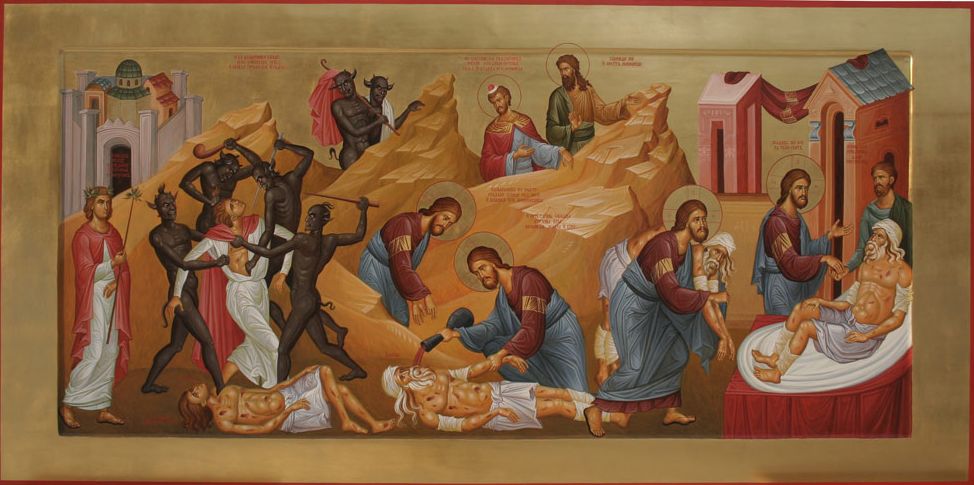
I Am the Good Shepherd – Sermon on John 10:11-18 for Midweek Lent 3

The Scripture readings for tonight’s service are Psalm 100Jeremiah 23:1-3Hebrews 13:20-21; and John 10:11-18.

In the name of Jesus. Amen.

Picture a father and his daughter. The father works every day to provide food, clothes, and a house for his little girl. His daughter puts on a dress and invites him to her tea parties with all her stuffed animals. Every night, that father sings to his little princess, tucks her snugly under the covers, kisses her forehead, and whispers, “I love you.” All of those actions – his work, his play, and his care –are all ways that father tells his daughter, “I love you.”

Keep picturing that same father and daughter. Now, she’s a teenager and the father is going to meet her at the county fair. He walks through the grounds and sees a crowd standing in a circle. They’re shouting. Dust is flying in the air. The father pushes his way to the center only to find three grown men shoving his daughter to the ground. She’s scraped up and dirty. Her shirt sleeve is torn. That’s his precious girl. So, the father leaps into the fray hollering, “That’s my daughter!” He fights fiercely. He takes some punches in his gut and a few blows to the back of his head, but he begins to get the upper hand. With all his might, he shoves the first man headfirst into a trailer. He spins, winds up, and punches the second man square in the face, knocking him out cold. He locks the third in a chokehold until the man slumps face-down in the dirt.

Now, which version of that father is loving? Is it the father who provides, has tea parties, and quietly tucks the girl in with a kiss? Or is it the father who immediately jumps into a fight, even though he is outnumbered, and rescues her with violence? It’s both, isn’t it? It’s both, and equally so. Tender care and fierce defense are two sides of the same love. The daughter interprets both as her father saying, “I love you, my daughter.”

I mentioned this last week, but it needs repeating. When Jesus declares, “I Am the Good Shepherd,” here, He’s addressing the Pharisees. So, this statement isn’t initially directed to believers to comfort them. It’s judgment on false shepherds. But as Jesus’ sheep, you overhear them and are comforted by them – and rightly so. It’s like the father yelling, “That’s my daughter!” not first to her but to warn the attackers that he’s coming for them. But she hears it and recognizes the echo of him whispering, “I love you, dear girl,” as she is tucked into bed.

This metaphor of God as the Shepherd of His people is all over the Bible. Many of those passages are spoken directly to God’s people as comfort. Isaiah 40:10-11, pictures God tending His flock, gathering lambs in His arms, carrying them in His bosom, and gently leading His sheep. Psalm 78:52 recalls how God led His people like sheep out of Egypt and guided them through the wilderness. And Psalm 23, of course, is David’s song of the tender care of his Shepherd.

But a number of other passages use the same image as a stern warning. Our reading tonight from Jer. 23:1-3 thunders against the shepherds who destroy and scatter the sheep of His pasture. God says, “I will attend to you for your evil deeds. Then I will gather My flock, bring them back to their fold, and they shall be fruitful.”

As I prepared for these services, I had a hard time deciding between using Jer. 23 and another text – Ezk. 34. (I went with Jeremiah because you’ll hear Ezekiel on Easter 3 in about a month.) But as I wrote this sermon, I wished I’d chosen Ezekiel because it lies behind what Jesus says to here in Jn. 10. So, let me summarize it for you now. Ezekiel 34 begins with God’s woe against faithless shepherds. They weren’t caring for God’s sheep; instead, they were using the sheep for their own comfort and benefit. They didn’t strengthen the weak. They didn’t heal the sick or bind up the injured sheep. They did not bring back the strayed or seek the lost sheep. The end result was that God’s flock was scattered over the face of the earth with no one to seek after them (Ezk. 34:1-6). So, God says, “I am against the shepherds and will require My sheep at their hand” (Ezk. 34:7-10).

Then, Yahweh, the Great ‘I Am,’ promises, “I, I Myself will search for My sheep. I will rescue them. I will gather them into their own land. I will feed them in good grazing land and rich pasture.” Then in Ezk. 34:15-16, Yahweh says, “I Myself will be the shepherd of My sheep, and I Myself will make them lie down. I will seek the lost, and I will bring back the strayed, and I will bind up the injured, and I will strengthen the weak.”

So, when Jesus proclaims, “I Am the Good Shepherd” (Jn. 10:11), He’s echoing that warning and promise from Yahweh back in Ezk. 34. So, hear this text in that light.

When you lie in the dust, surrounded by enemies, Jesus says, “I Am the Good Shepherd” (Jn. 10:11). He has come to rescue you because you are His. Jesus says, “The Good Shepherd lays down His life for the sheep,”(Jn. 10:1117). He has counted the cost and judged you to be worth His blood. Unlike the hireling who flees when he sees the wolf, Jesus stands firm by your side and will never abandon you (Jn. 10:12-13). Jesus knows you and you know him (Jn. 10:14). And notice how intimate this knowing is. Look again at Jn. 10:15, “Just as the Father knows Me and I know the Father.”Dear flock of God, you share that same, intimate fellowship with your Good Shepherd.

There’s one more beautiful aspect to this image of Jesus being your Good Shepherd. It isn’t directly from this text, so I’ve saved it for the end. In this text, Jesus only names the wolf as the enemy of His flock. But the wolf stands in for all your enemies of sin, death, and the devil. We can easily picture two-thirds of that. When the devil comes at you, Your Good Shepherd steps between you and his claws. When death and the grave opens its mouth wide, your Good Shepherd stuffs Himself into its jaws so fully that it gags and has to spit Him out three days later. It easy to picture how your Good Shepherd shields you from the devil and the grave.

But how does Your Good Shepherd stand between you and your sin? Your sin isn’t ‘out there’ like the death and the devil. Sin is the enemy within all of us – in our hearts and minds. In fact, we are sinners. So how could Jesus stand between us and sin? Well, it turns out that the Good Shepherd is also a sheep. Rev. 7:17 says, “The Lamb who sits in the midst of the throne [is your] Shepherd,” and He is the Lamb of God who takes away the sin of the world (Jn. 1:29).

Dear flock, your Good Shepherd sought you. He drew near to you. He came so close that He became one of you. He took on your flesh and blood so He could stand between you and the punishment you deserve because of your sin. Because of Jesus’ death and resurrection, all your enemies are utterly scattered. They flee at the sight of your Shepherd standing by your side.

Dear saints, your Good Shepherd has arrived. He will never leave or forsake you. He has died for you. He forgives all your sins. He is risen and will shepherd you through all the troubles of this life until He brings you to the joys of eternal life with Him in pastures that are forever green. Amen.

The peace of God, which surpasses all understanding, will guard your hearts and minds in Christ Jesus (Php. 4:7). Amen.

I Am the Door – Sermon on John 10:1-10 for Midweek Lent 2

The Scripture readings for tonight’s service are Psalm 118:19-2428-29Isaiah 26:1-3Hebrews 10:19-22; and John 10:1-10.

In the name of Jesus. Amen.

John 10 is widely known as the Good Shepherd chapter because it’s where Jesus has two “I Am” statements, “I Am the Door of the sheep; I Am the Good Shepherd” (Jn. 10:711). Both of those declarations are comforting. Very comforting for us. But in context, dear saints, both statements are actually judgment against the Pharisees because they have turned their back on Jesus, the Shepherd of their souls (1 Pet. 2:25).

Last week, we heard the beginning of Jn. 9 where Jesus declares “I Am the Light of the world.” Then, He healed the man who was born blind. A tense exchange follows. The Pharisees pressure the formerly-blind man to deny Jesus (Jn. 9:8-34). They fail. Instead, the man boldly confesses that only someone from God could perform such a miracle. Later, Jesus finds him again, and the man worships and believes in Christ (Jn. 9:35-38).

John 9 closes with Jesus saying, “For judgment I came into this world, that those who do not see may see, and those who see may become blind” (Jn. 9:39). The Pharisees hear this and ask Jesus, “Are we also blind?” Jesus responds, “If you were blind, you would have no guilt; but now that you say, ‘We see,’ your guilt remains” (Jn. 9:41). That conversation flows directly into our text tonight, “Truly, truly I say to you, he who does not enter the sheepfold by the door but climbs in by another way, that man is a thief and a robber” (Jn. 10:1-10). Notice that Jn. 10:6 says that Jesus is addressing this figure of speech to people who are identified only as “them” and “they.” The ‘them’ and ‘they’ are the Pharisees who have rejected Jesus as the Good Shepherd (Jn. 10:11). The Pharisees did not understand (Jn. 10:6).

Now, I admit that Jesus doesn’t explicitly say, “I Am the Good Shepherd,” until Jn. 10:11 – one verse after our text. But Jesus has implicitly said it. He begins by mentioning the sheepfold. In Jesus’ day, and still today, a sheepfold was often a cave that was partially closed by a rock wall along the opening. There was just a small gap so the flock could enter the sheepfold for safety or exit it to find pasture. The way that sheepfold was closed is that the shepherd would station himself at the opening and be the door himself. So, to reach the sheep, you had to go through the shepherd. If anyone tried to enter by a different way than through the door (i.e. the shepherd), that person was trying to harm the sheep.

Jesus is that Door because He is that Shepherd. Whoever enters through Him will be saved. When Jesus talks about going in and going out, He isn’t talking about being saved in the sheepfold vs. being not saved when you are out of the sheepfold. Instead, the saved are the ones who go in and the ones who go out and find pasture. The coming and going of the sheep (which needs to happen) is all through Him.

So, being in or out of the sheepfold isn’t equal to being saved or damned. The parable of the Lost Sheep in Lk. 15:1-7 is different in that way. Here, in or out doesn’t matter. Instead, the focus is on the fact that the saved have access through Jesus, the Door. That’s what saves. Christ is your Shepherd-Door. Because of Him, you are safe whether you are in or out. You have peace in the sheepfold, and you have freedom from danger when you are out in the pleasant pastures. Psalm 121:7-8 is a nice parallel to what Jesus says in Jn. 10:9, “The Lord will keep you from all evil; He will keep your life. The Lord will keep your going out and your coming in from this time forth and forevermore.”

With this image, Jesus also recalls parts of our Psalm tonight (Ps. 118:19-2428-29). This text takes place when Jesus is in Jerusalem for the Feast of Tabernacles (Jn. 7:2), when parts of Ps. 118 were sung. As the people entered the Temple during the feast, they would sing, “Open to me the gates of righteousness, that I may enter through them and give thanks to the Lord. This is the gate of the Lord; the righteous shall enter through it” (Ps. 118:19-20).

Jesus is the Door through which you have access to and encounter Yahweh, the Great “I Am.” By Christ’s blood, you can have confidence to enter the holy places. He has opened that way for you through His flesh (Heb. 10:19-20). 

Let me switch gears for a moment here. I can’t preach on this text without mentioning how the sheep hear the voice of the Shepherd, Who is also the Door.

In Jesus’ day, everyone owned a handful of sheep because that was how you got your clothing, milk, meat, and leather. But daily life – farming, cooking, chores – meant that people couldn’t tend the flock full-time. So, families in a neighborhood would combine their sheep into one larger flock of 60, 80, 100 sheep, and one person would shepherd them all. In large towns, there would be several different flocks that were tended by several shepherds.

By day, each shepherd would lead his flock to pleasant pastures. At night, the shepherd would bring his flock back into the village where there was a large sheepfold. And all the different flocks would spend the night together so most of the shepherds could go home and sleep. Only one of them would be the Door for the night as all the sheep slept in the pen.

In the morning, the shepherds returned to that pen where the flocks were all mixed together. You might think it would be chaotic to try and sort out which shepherd was responsible for which sheep. But, no. It wasn’t a problem. Each shepherd simply called his sheep by name, “Come, Long-ears. Up, White-nose. Let’s go, Stubby-legs.” Each sheep would hear the familiar voice of its own shepherd, and they would all follow him to go frolic in the fields for the day. That’s the picture Jesus uses throughout John 10.

Dear saints, you know the voice of your Shepherd. He softly, tenderly, and kindly calls to you in the Scriptures. Enter through Him and you will be saved. He calls you by name (Is. 43:1-2Jn. 10:3), and He has called you to life – abundant, eternal life in Him. Amen.

The peace of God, which surpasses all understanding, will guard your hearts and minds in Christ Jesus (Php. 4:7). Amen.

Faith Waits – Sermon on Matthew 15:21-28 for the Second Sunday of Lent

Matthew 15:21-28

In the name of Jesus. Amen.

Last week, we heard how the devil slithered into the Garden of Eden to tempt the woman (Gen. 3:1-21). That worm did what he always does and tried to create space between our first parents and God’s life-giving Word. And his scheme worked. They ate from the forbidden tree and fell into sin. Satan continues to do that work today. His tactic is to drive a wedge to distance you from God and God’s promises. His goal is to get you to doubt – leaving you isolated, anxious, and alone. Today, in this Gospel reading (Mt. 15:21-28), Jesus does the exact opposite work. Our Lord and Savior draws this Canaanite woman closer and closer to Himself and to God’s promises.

This mother comes to Jesus with a real problem. Her daughter is severely oppressed by a demon. At first, it looks like Jesus is the one creating space. He ignores her cries. He says that He’s only been sent for the lost sheep of Israel. He even calls her a dog. There’s no debating that Jesus is putting her through the ringer here. It looks like she should just quit and go home with a crushed spirit. But Jesus knows exactly what He’s doing. He knows and loves this woman and her daughter. He had come to redeem them and shed His blood for all their sin, just as He has come to redeem you from yours.

To see this, let’s try an analogy: Imagine an old tin bucket. It’s corroded, dented, and has several holes. That bucket can’t hold water, which is what a bucket is designed to do. To keep that bucket from running dry, it needs to be filled constantly. Dear saints, that’s us. We leak continuously. We have an inherited rustiness from the Fall and our original sin. The worries of this world keep poking more and more punctures into us. Disappointments open new cracks. Our sinful actions open up more holes. Satan’s accusations evaporate us like a blow torch. All of this empties us and would leave us bone-dry and bouncing through the desert of this fallen world. So, what’s the fix?

Well, according to Christ, we should learn from this woman. Jesus holds her before our eyes as an example by praising her, “O woman, great is your faith” (Mt. 15:28). That should get our attention. She is an example because she plants herself right next to Jesus, the Fountain of Living Water (Jn. 4:147:37-38Rev. 21:6). Even though it looks like the stream of God’s mercy that flows from Jesus isn’t for her, she presses in closer and closer and waits for the floodgates to open.

We don’t know how long this whole event takes. Matthew doesn’t tell us how long it was between the first moment she presents her problem to when Jesus finally praises her faith. It’s only eight verses, so it doesn’t take long to read. The way Matthew records this, it was probably an extended time.

It all starts with her initial plea and silence from Jesus. But she keeps crying out. You can see it in our translation in Mt. 15:22, “she was crying.” The force behind that verb is that this was a continual thing. “Have mercy on me, O Lord, Son of David!” Nothing. No response. The woman might have thought, “Maybe He didn’t hear me.” So, she cries out again, “Have mercy on me, O Lord, Son of David!” Still nothing. This keeps happening. “Have mercy on me, O Lord, Son of David!” Eventually the disciples get tired of it all. They’re probably wondering why Jesus is ignoring her. Did He suddenly go deaf? Did too much sand blow in His ears? Eventually, it seems that the woman tries to get Jesus’ attention through the disciples because they finally chime in, “Send her away, for she is crying out after us.” We don’t know how long this all went on. It could’ve been fifteen minutes; it could’ve been several hours.

But just imagine if you were there watching all of this unfold. You hear this woman asking and asking, “Have mercy on me, O Lord, Son of David!” Suppose you took this woman off to the side and asked her, “What are you doing?” She says, “Well, I’m praying.” So, you ask, “How’s that going? Is it working? Do you think it’s going to help your little girl?” She’d say, “I don’t know. He’s not answering me right now.” You might ask, “Well, why are you still praying? He’s obviously heard you, and if He was going to answer you, don’t you think that He would have by now? Why keep making a spectacle of yourself praying the same prayer over and over again?”

I mean, that’s reasonable. That’s how we conduct ourselves in normal conversations with other people. If people keep ignoring us, we just move on and go elsewhere. But this woman doesn’t do that. I think she’d respond to a statement like that by saying, “I’m waiting. I know who He is. He is my Lord. He is kind. He has come to destroy the works of the devil (1 Jn. 3:8). There is no one else who can help me. So, I’ll just keep waiting for Him.”

Finally, of course, Jesus does help her. Not only does Christ give her what she was pleading for, He also praises her. “O woman, great is your faith!” And that’s the point. Dear saints, faith presses in closer and closer to God and His promises. Faith hears (Ro. 10:17) all the things God has promised – mercy, grace, forgiveness, redemption, deliverance, eternal life. All these things are available only from one Source and that is our giving God. So, even if God seems to be ignoring our prayers and not giving what He has promised, faith waits.

This happens all over Scripture. Think of Jacob wrestling with God all night, refusing to let go until God blessed him (Gen. 32:22-32). Consider Hannah pouring out her longing for a child year after year after year (1 Sam. 1). How many of the Psalms ask some version of, “How long, O Lord?” (Ps. 136:379:589:4694:3)? Dear saints, your cries to God do not – they do not – go unheard.

Faith waits even though it isn’t easy. This extremely difficult because you know that God could immediately answer every single one of your prayers quicker than you can even snap a finger. Your merciful Father could make everything perfect in the blink of an eye. The last sentence in our text says, that woman’s daughter was healed instantly (Mt. 15:28). Christ could make everything right this instant. So, why does He make you wait? I don’t know, and I’m sorry that you have to wait. But I do know that God has promised to always give you what is good (Mt. 7:11Ro. 8:32).

What I do know is what Scripture says. We heard in our Old Testament reading (Is. 40:27-31), “They who wait for the Lordwill renew their strength.” And notice that wording. It doesn’t say, “They who wait for the Lord will become strong.” No. They will “renew their strength.” That means that strength is going to get depleted and will need to be renewed again and again and again. Think back to the rusty, leaky bucket. When your strength is depleted, when it has trickled and poured out of you, you need to be near the Source. Eventually, God will fix all your rust and cracks and holes. But not yet. For now, God lets those remain, and He promises that He will never let you run dry. He will keep filling you. He will renew you in His timing, which is not your timing. So wait, and it’s in that waiting that faith moves and presses in closer and closer to God.

Dear saints, each day has trials, and you are not equal to the task of those trials. And God’s desire is that each day you would come to Him and rely upon Him and His strength. That’s His design. His good and gracious plan is that He will be your Source of power and strength from which you dare never get far.

Wait for Him. Christ has you in His timing and in His strength. He has put all your enemies under His feet by His death and resurrection. He knows how best to rescue you. Your God, who makes these promises to you, is faithful, and He will do it (1 Th. 5:24). So, keep praying to Him, move closer to Him, and keep patiently and faithfully waiting. Amen.

The peace of God, which surpasses all understanding, will guard your hearts and minds in Christ Jesus (Php. 4:7). Amen.