1 Kings 3:1-15
1 Solomon made a marriage alliance with Pharaoh king of Egypt. He took Pharaoh’s daughter and brought her into the city of David until he had finished building his own house and the house of the Lord and the wall around Jerusalem. 2 The people were sacrificing at the high places, however, because no house had yet been built for the name of the Lord.
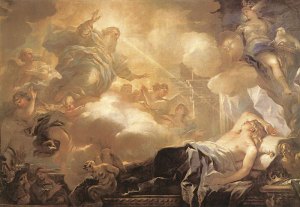
3 Solomon loved the Lord, walking in the statutes of David his father, only he sacrificed and made offerings at the high places. 4 And the king went to Gibeon to sacrifice there, for that was the great high place. Solomon used to offer a thousand burnt offerings on that altar. 5 At Gibeon the Lord appeared to Solomon in a dream by night, and God said, “Ask what I shall give you.” 6 And Solomon said, “You have shown great and steadfast love to your servant David my father, when he walked before you in faithfulness, in righteousness, and in uprightness of heart toward you. And you have kept for him this great and steadfast love and have given him a son to sit on his throne this day. 7 And now, O Lord my God, you have made your servant king in place of David my father, although I am but a little child. I do not know how to go out or come in. 8 And your servant is in the midst of your people whom you have chosen, a great people, too many to be numbered or counted for multitude. 9 Give your servant therefore an understanding mind to govern your people, that I may discern between good and evil, for who is able to govern this your great people?”
10 It pleased the Lord that Solomon had asked this. 11 And God said to him, “Because you have asked this, and have not asked for yourself long life or riches or the life of your enemies, but have asked for yourself understanding to discern what is right, 12 behold, I now do according to your word. Behold, I give you a wise and discerning mind, so that none like you has been before you and none like you shall arise after you. 13 I give you also what you have not asked, both riches and honor, so that no other king shall compare with you, all your days. 14 And if you will walk in my ways, keeping my statutes and my commandments, as your father David walked, then I will lengthen your days.”
15 And Solomon awoke, and behold, it was a dream. Then he came to Jerusalem and stood before the ark of the covenant of the Lord, and offered up burnt offerings and peace offerings, and made a feast for all his servants.
In the name of Jesus. Amen.
I remember watching the movie Aladdin as a kid. You know the story of the street rat stumbling upon a magic lamp and being granted three wishes by Robin Williams – I mean a genie. I remember daydreaming about what I would do if I was ever granted three wishes. Visions of piles of money, a huge mansion, and a peaceful life distracted my grade-school mind from long division; participles, infinitives, and gerunds; and plant science. In the movie, Aladdin decides that two wishes are enough for himself, and he promises to use his third wish to free the genie. You can certainly get a lot with two wishes. Most people would even be happy with one wish. One wish, rightly used, could solve most, if not all, your problems.
Solomon has just taken over as king. He blows out the candles on his coronation cake, and God tells him to ask for anything. “At Gibeon Yahweh appeared to Solomon in a dream by night, and God said, ‘Ask what I shall give you.’”
 Now, Solomon could have used a lot of things. Solomon was not David’s oldest son. Several of his brothers were in line before him to sit on the throne of David. But David chose Solomon to be king after him. The previous chapter, 1 Kings 2, is filled with Solomon wading through the mess of killing people who opposed him and David. It’s not easy becoming king. Solomon could have really used wealth and power to his advantage, as any new, young king could. But Solomon puts power and wealth to the side.
To our worldly minds, it looks like a mistake. It looks like Solomon wastes the biggest opportunity of his life. The all-powerful God of the universe says that He will give Solomon anything, but Solomon throws all worldly things away. He doesn’t ask for riches or power or fame. Solomon lets all those things go.
Instead, Solomon remembers how God had dealt with his father, David. Remember who Solomon’s mother was and how she became the king’s wife? David had lusted after Solomon’s mother, Bathsheba, while she was another man’s wife. David got Bathsheba pregnant, and to cover up his sin, he murdered her husband. But God was merciful and gracious toward David forgiving him of these terrible sins. And God showered David with great and steadfast love and mercy. And Solomon remembers all of that first and foremost.
Now when God tells Solomon to ask Him for anything, Solomon doesn’t treat God as just a magic genie who will grant one wish and go back into his lamp to sleep for a thousand years. Instead, he knows that his God is merciful and gracious. That’s a good kind of God to have around. So Solomon asks for an understanding mind.
Solomon recognizes that he is king only because of God’s great and steadfast love. He recognizes his inadequacies to be king and humbles himself. He asks God to give him discernment to govern God’s great people. By itself, this request shows wisdom, and it pleased God.
God grants Solomon’s request, and God says He will add even more. As icing on the cake, God says that He will, willy-nilly, throw in the riches and honor that Solomon didn’t ask for.
Now, I’d be a terrible preacher if I ended the sermon here and said, “Now, go be like Solomon.” You know what happens to Solomon. He is blessed with wisdom, and his wisdom makes him world-famous (1 Kgs. 10:24), but he recognizes the emptiness of wisdom and fame (Ecc. 1:12-18). Solomon is blessed with riches, but he wrote later that he was never satisfied with the wealth that God gave him (Ecc. 4:8, 6:1-2). Even a long life was not a blessing to Solomon. He said that, since he found no satisfaction in the good things God gave him, a stillborn child is better off than he was (Ecc. 6:3).
Wisdom is a gift from God, but wisdom itself is not the doorway to peace with God. Wealth is a gift from God, but all the riches in the world will not buy your way into eternal life. Solomon’s wisdom, wealth, fame, honor, and power distracted him. Through his life, Solomon forgot that God was the source of those blessings. As his grew older, Solomon saw the emptiness and vanity of all these good gifts from God.
So where should the sermon go from here?
Scripture speaks of another wisdom in 1 Cor. 2:7, a secret and hidden wisdom from God that looks foolish to the world. “In the wisdom of God, the world did not know God through wisdom, [therefore] it pleased God through the folly of what we preach to save those who believe” (1 Cor. 1:21). This wisdom is Jesus Christ and Him crucified. It is the wisdom that looks past the foolishness of God saving humanity through the death of a Man on a cross.
 Real wisdom finds God where He has said He is – even when it sounds foolish. Wisdom sees the King of kings born not in a capitol city but in the little town of Bethlehem. Wisdom finds the Good Shepherd not hunting wolves and bears but hidden in the manger. Wisdom sees a helpless infant as the Creator of the universe. Wisdom sees the death of a carpenter’s Son on a cross as the way God punishes of the sin of the world. Wisdom sees the emptiness of a tomb and believes that guilt is gone.
Anyone can see God’s power by looking around at creation. But only through faith can anyone see God delivering His grace through something as simple as the Word and Sacraments. Only by faith, can we find God working through bread and wine to forgive sins. Amen.
May the peace of God which surpasses all understanding guard your hearts and minds in Christ Jesus. Amen.
 Pastorsamwise
You must be logged in to post a comment.