John 20:19-31
19 On the evening of that day, the first day of the week, the doors being locked where the disciples were for fear of the Jews, Jesus came and stood among them and said to them, “Peace be with you.” 20 When he had said this, he showed them his hands and his side. Then the disciples were glad when they saw the Lord. 21 Jesus said to them again, “Peace be with you. As the Father has sent me, even so I am sending you.” 22 And when he had said this, he breathed on them and said to them, “Receive the Holy Spirit. 23 If you forgive the sins of any, they are forgiven them; if you withhold forgiveness from any, it is withheld.”
24 Now Thomas, one of the Twelve, called the Twin, was not with them when Jesus came. 25 So the other disciples told him, “We have seen the Lord.” But he said to them, “Unless I see in his hands the mark of the nails, and place my finger into the mark of the nails, and place my hand into his side, I will never believe.”
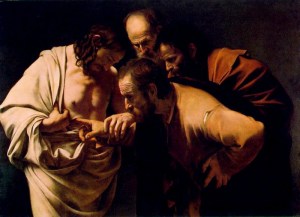 26 Eight days later, his disciples were inside again, and Thomas was with them. Although the doors were locked, Jesus came and stood among them and said, “Peace be with you.” 27 Then he said to Thomas, “Put your finger here, and see my hands; and put out your hand, and place it in my side. Do not disbelieve, but believe.” 28 Thomas answered him, “My Lord and my God!” 29 Jesus said to him, “Have you believed because you have seen me? Blessed are those who have not seen and yet have believed.”
30 Now Jesus did many other signs in the presence of the disciples, which are not written in this book; 31 but these are written so that you may believe that Jesus is the Christ, the Son of God, and that by believing you may have life in his name.
In the name of Jesus. Amen.
Christ is risen!
He is risen indeed! Alleluia!
Death died when Jesus rose. The stone is rolled away. Jesus escaped. The grave’s strength is spent. The guards could not keep Him. Death could not hold Him.
Thomas gets a bad rap. Was he doubting? Yes, of course, but no more doubting than the other disciples.
Our text starts on the evening Jesus rose from the dead. Peter and John had seen the empty tomb, and John believes (Jn. 20:8). Mary Magdalene and some of the other women see Jesus (Mt. 28:9-10). Two other disciples, who are not part of the Twelve, see Jesus on the road to Emmaus. And, at some point, Jesus appears to Peter privately (Lk. 24:34). Jesus is popping up all over the place, but the disciples are scared. Why were they scared?
On the day Jesus died, the Pharisees had gathered before Pilate. They remembered that Jesus had said that He would rise after three days. They figured that the disciples would steal Jesus’ body and fake a resurrection. So Pilate tells the Pharisees to set a guard and seal the tomb (Mt. 27:62-66). So the disciples know that there is an empty tomb. They know the Pharisees were afraid that the disciples might steal Jesus’ body and fabricate a resurrection. The ten disciples are afraid. So they go to the upper room, lock the door, and sit there terrified. They figure, at any moment, the guards were going to come and smash the door and do to them what they had done to Jesus.
 But the door doesn’t come crashing down; it isn’t unlocked; it doesn’t even open. Jesus simply appears there in the room with them to say, “Peace to you.” Jesus shows the disciples His hands and side, and the disciples were filled with joy. And Jesus repeats Himself, “Peace to you. As the Father has sent Me, even so I am sending you.” Then, Jesus breathes on them and says, “Receive the Holy Spirit. If you forgive the sins of any, they are forgiven them; if you withhold forgiveness from any it is withheld.” (More on that a little later.)
Now, Thomas wasn’t with them, and we don’t know where he was. The ten were gathered together with the doors locked because they were afraid. But Thomas isn’t there. Maybe he was out checking to make sure the other disciples were safe. Maybe he wanted to see if they had been arrested. Maybe Thomas was just out running errands. Eventually, Thomas does find the others. They tell him that they have seen Jesus. But Thomas says with some vulgarity, “Unless I see in His hands the mark of the nails and thrust (not just ‘place’ – lit. ‘throw’) my finger into the mark of the nails, and thrust my hand into His side, I will never believe.”
Now, our text jumps to one week later. The Sunday after the Resurrection, Thomas is with the disciples. Even though the ten had seen Jesus, even though Jesus had sent the disciples with His peace to forgive sins, the doors are locked again. Thomas has an excuse to be there but not the others. The ten should have been out speaking about the Resurrection and forgiving sins. But there they are, locked inside. It’s not just doubting Thomas – it’s doubting disciples.
They doubt just like you and I doubt. If you are like me – and I would be willing to guess you are – when you hear the words, “You are forgiven,” your mind goes back to that one sin or those several sins that you have committed. Sins that haunt and guilt and convict and remind you that you deserve hell. Sins that you would do anything to make sure no one ever learns about them. We doubt that Jesus’ forgiveness really covers those sins.
That’s why, dear saints, we need absolution – over and over and over again. That is what Jesus has called us to do. That is what Jesus has called me to do as your pastor.
I wouldn’t dare stand up here and say, “I forgive you of your sins,” unless Jesus had said that is what should be done when sins are confessed.
 Another pastor (Rev. Bryan Wolfmueller) uses this analogy: Imagine you are found guilty of a crime and locked in prison. As you sit there in prison, a judge looks over your case and rules that you are innocent. He sends an order to the guard of your prison to set you free. The guard comes with the keys, unlocks your cell, and releases you back into society. Now, who set you free, the judge or the guard? Honestly, the answer is both.
If the judge declares you innocent, but the guard doesn’t go to where you are and unlock your cell – you are stuck in prison. But if the guard, with no order from the judge, lets you go, you will live the rest of your life expecting to be arrested again because you haven’t been justly declared innocent.
Christ is your Judge, and because of what He has done, He declares you innocent. God then orders pastors – the people who have been given the keys (Mt. 16:19) – to go to where you are locked up and open your cell. That is why the absolution is given only “by Christ’s command and authority.”
But this authority isn’t just given to pastors to announce over congregations on Sunday mornings. Jesus gives all believers this authority too. You can announce this forgiveness. If someone comes to you and tells you about their sin and guilt and shame, you can tell them of Jesus death. Tell them that Jesus is the Lamb of God who takes away the sins of the world. Tell them that Jesus’ death takes away their sins, and His resurrection shows that God accepted Jesus’ sacrifice. And tell them, “I forgive you of your sins because of what Jesus has done.”
That is the Gospel message. That is the authority Jesus has given to the Church. That is the message Jesus has sent us into the world to announce. That is the peace that Jesus gives when He says, “Peace to you.” It is the peace that, because He died and rose again, sins are forgiven. They are gone. As far as the east is from the west, so far has Jesus removed our transgressions from us.
No locked door can hold Jesus back. No “secret” sin can match Jesus’ ability to forgive. Jesus is way better at forgiving than you are at sinning. Don’t be afraid anymore. Boldly go. Boldly forgive because:
Christ is risen!
He is risen indeed! Alleluia! Amen.
The peace of God, which surpasses all understanding, will guard your hearts and minds in Christ Jesus. Amen.
 Pastorsamwise
You must be logged in to post a comment.