Matthew 22:15-22
15 Then the Pharisees went and plotted how to entangle him in his words. 16 And they sent their disciples to him, along with the Herodians, saying, “Teacher, we know that you are true and teach the way of God truthfully, and you do not care about anyone’s opinion, for you are not swayed by appearances. 17 Tell us, then, what you think.  Is it lawful to pay taxes to Caesar, or not?” 18 But Jesus, aware of their malice, said, “Why put me to the test, you hypocrites? 19 Show me the coin for the tax.” And they brought him a denarius. 20 And Jesus said to them, “Whose likeness and inscription is this?” 21 They said, “Caesar’s.” Then he said to them, “Therefore render to Caesar the things that are Caesar’s, and to God the things that are God’s.” 22 When they heard it, they marveled. And they left him and went away.
In the name of the Father and of the Son and of the Holy Spirit. Amen.
The Pharisees think they have Jesus. Their little entourage of disciples and Herodians ask Jesus a yes or no question. They butter Jesus up first, “You are true, and you teach truthfully. You don’t care about opinions and aren’t swayed by appearances.” And you can just imagine the Pharisees back in the corner watching their disciples along with the Herodians (those who were sympathetic to Herod) talking with Jesus and the Pharisees are giving each other the elbow and snickering. Then the trap is set, “Is it lawful to pay taxes to Caesar or not?”
A little history is helpful here. For about 95 years, Israel had been a province of the Roman empire. Caesar had put Herod the Great on the throne to watch over Israel, so Herod and his sons who ruled after him were actually an extension of Caesar. Now, the Jews hated this Roman occupation and considered it to be punishment from God. The Jews thought that the Messiah was going to come and lead a rebellion against Rome and make them free from foreigners.
So, in the eyes of the Pharisees, when Jesus gets asked, “Is it lawful to pay taxes to Caesar or not?” there is no answer that Jesus can give that will not cause Him trouble. This question is like a sword pointed right at Jesus’ chest. If Jesus says, “Yes, pay the man,” the Jewish people will despise Jesus and stop following Him because He isn’t the Messiah they expected and wanted. But if Jesus says, “No, don’t pay taxes,” the Herodians will see Jesus as a rabble-rouser and have Him arrested and killed for trying to start a rebellion.
But Jesus sees right through it. “You hypocrites, show Me the coin for the tax. Whose picture and writing is this?” On that coin was a picture of Tiberius Caesar, and the writing said, “Son of the divine Augustus.” The fact that the disciples of the Pharisees had this coin showed they acknowledged Caesar’s rule over them. So, Jesus asks, “Whose coin is this?” the malicious hypocrites say, “Caesar’s.” And Jesus says, “Render to Caesar what is Caesar’s, and to God the things that are God’s.” If the question was a sword pointed at Jesus, Jesus snatches the sword out of their hand, and points it right at their throat.
We need to consider these phrases from Jesus. “Render to Caesar what is Caesar’s.” God is no anarchist; He has given order and authority in this world. We see this first in the family. God gave Adam a wife, Eve, to be his helper. And God gave Adam and Eve children. And God has given the 4th Commandment, “Honor thy father and thy mother.” When husbands, wives, and children recognize God’s intention and stay in their God-given roles, it is a beautiful thing. When husbands care, protect, and provide for their wife and children, when wives respect and support their husbands, and when children honor their parents, life is good. How many problems in this world would vanish if we followed God’s order for the family?
But God didn’t stop establishing order and authority with the family. God has also given authority to the state. Read Romans 13:1-7 and recognize that Paul was writing this while Nero (the guy who slaughtered Christians and was terribly wicked) was Caesar, and you will see that all earthly governments – even the most evil – are established by God. And this is also good.
Through the government, God provides for us. Through the government God has given teachers to help you and your children learn. Because of the government we have safe buildings and roads that help you get to work and move goods from one place to another.  Because of the government we have a police force, firefighters, and army to protect us. All of those things that we benefit from in this country are done by government and paid for by taxes. So, pay your taxes (Ro. 13:7).
Now, there is a place to discuss how much of a role the government has in these things and how much could be done better without the government getting in the way. And we can thank God for a country where we as citizens get a say in that through voting. But that falls outside the scope of this sermon.
Of course, it is true that governments and leaders can go beyond what they should do. They can rule in an evil way and make life hard. But God will hold them accountable for that. And those who are in positions of authority had better be careful so the Christians under them are praying for them rather than against them. That’s enough on, “Render to Caesar.”
“Render to God the things that are God’s.” First, what isn’t God’s? What thing exists that isn’t God’s? Remember that you belong to God. You were made in His image. Remember that God has made you a Christian. He has declared you righteous, forgiven, and holy. You need to reevaluate your worth and the worth of the work that you do in this life because everything you do – whether you are a parent, child, soldier, employee, or retiree – you do as a Christian.
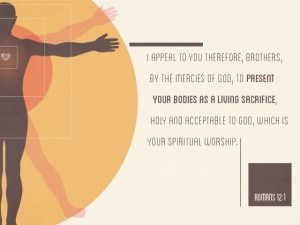 This means that your whole life is given to God. There isn’t one part of your life that is holy and another part that is neutral. Raising children, raking leaves, pumping gas, thanking the soldier for his service, and throwing frozen fish sticks or corn dogs into the oven – it is all service to God. Now, do we do all these things cheerfully? I don’t, and it is a safe bet to say that you don’t either. But we should still do them.
When a mother gets woken up in the middle of the night because her child wet the bed, she probably doesn’t get up immediately and cheerfully. She probably doesn’t say, “Thank You, God for an opportunity to show love to my child.” Instead, she might sinfully think to herself, “I wish I didn’t have that child.” But she gets up. She cleans the child, changes the pajamas, and washes the wet sheets even though she does it with sin. Praise God for that.
Even though her heart isn’t pure, she keeps God’s law of caring for her child in an outward way even though she sins in an inward way. But the child is still loved, provided for, and cared for. This should never be minimized. All of you who have sinfully grumbled at a task God put before you but did it anyway, thank you. You have rendered to God the things that are God’s.
 And your sinful heart? Well, that was Jesus’ job. He came and took all your sin. He suffered God’s wrath and died for it. Jesus rendered to God the things that are God’s. He gave Himself up as a ransom for us all. He has given Himself as a ransom for you. Amen.
The peace of God which surpasses all understanding will guard your hearts and minds in Christ Jesus. Amen.
 Pastorsamwise
[…] * Sam Wellumson: Matthew 22:15-22 – Jesus & Things * Lutheran Ladies Connection: Martin Luther on Growing Our Gifts * Brett Boe / Jason Gudim / Brian […]