Matthew 17:1-9
1 And after six days Jesus took with him Peter and James, and John his brother, and led them up a high mountain by themselves. 2 And he was transfigured before them, and his face shone like the sun, and his clothes became white as light. 3 And behold, there appeared to them Moses and Elijah, talking with him. 4 And Peter said to Jesus, “Lord, it is good that we are here. If you wish, I will make three tents here, one for you and one for Moses and one for Elijah.” 5 He was still speaking when, behold, a bright cloud overshadowed them, and a voice from the cloud said, “This is my beloved Son, with whom I am well pleased; listen to him.”
6 When the disciples heard this, they fell on their faces and were terrified. 7 But Jesus came and touched them, saying, “Rise, and have no fear.” 8 And when they lifted up their eyes, they saw no one but Jesus only. 9 And as they were coming down the mountain, Jesus commanded them, “Tell no one the vision, until the Son of Man is raised from the dead.”
 In the name of Jesus. Amen.
Peter, James, and John get to see Jesus in His divine glory. They get to see the dazzling white clothes and Jesus’ face shine like the sun. Peter, James, and John are very blessed to see Jesus’ glory on the mountain of Transfiguration.
John wrote about the glory he saw in the opening verses to his Gospel. “We have seen His glory, glory as of the only Son from the Father, full of grace and truth” (Jn. 1:14b).
Peter wrote about it too in our Epistle lesson today (1 Pet. 1:16-21). “We were eyewitnesses of His majesty. For when He received glory from God the Father, and the voice was born to Him by the Majestic Glory, ‘This is My beloved Son, with whom I am well pleased,’ we ourselves heard this very voice was borne from heaven, for we were with Him on the holy mountain.”
In this text we see why we confess in the Nicene Creed that Jesus is, “God of God, Light of light, very God of very God.” And it is truly awesome.
There with Jesus are Moses and Elijah. We don’t know how the three disciples knew it was Moses and Elijah. Maybe Jesus greeted them by name. But these two pillars of the Old Testament are there talking with Jesus. And Peter rightly recognizes, “Lord it is good that we are here. I’d love to make three tabernacles here, one for You and one for Moses and one for Elijah.”
We like Peter’s idea. We want to hold on to certain pleasant or awesome moments and avoid others that make us uneasy or uncomfortable. There are times when we get caught up in an incredible experience and want it to last forever. We want the glory to stick around and the exhilaration to continue. But whenever we have a “mountaintop experience,” it does eventually go away. We are changed by those moments, but the time comes when the buzz starts to fade. The recollection dims, and we are left with only the memories.
Those feelings and emotions are good things. They are gifts from God, but they are not the most important things. Too often, those feelings become like a drug. Instead of enjoying them when we have them, we start to seek a new high. More adrenaline. More warmth. More rush.
As good as those feelings and emotions are, God gives us better gifts. And Peter tells us about the most important of those gifts, again in our Epistle lesson. After Peter reflects on the awesomeness of the Transfiguration, he says, “We have the prophetic word more fully confirmed, to which you will do well to pay attention as to a lamp shining in a dark place, until the day dawns and the morning star rises in your hearts.”
Peter tells us that the Scriptures, what we have right before us now, are more sure and certain than what he saw in the Transfiguration because those Scriptures show us more than simply who we are in relation to God. Those Scriptures show us who God is in relation to us. He is the God who comes to redeem and save us.
That is what Elijah and Moses were talking about with Jesus. They were talking about how God is toward us. Matthew doesn’t tell us what Elijah, Moses, and Jesus’ conversation covered, but Luke does (Lk. 9:31). Luke tells us that these three men spoke of Jesus’ “exodus which He was about to accomplish at Jerusalem.” In other words, they were talking about the crucifixion.
In the Transfiguration, Peter, James, and John got to see who they are in relation to God. They get to see that Jesus is truly God in the flesh. His divinity brilliantly shines through His humanity. And because they see who they are in relation to God, they fall on their faces and are terrified.
But Jesus reaches out and shows them who He is in relation to them. Jesus touches them. Every other time this word for ‘touch’ is used in the Gospels, someone is healed. Jesus heals these disciples of their fear saying, “Rise, and have no fear.” And as they lift up their eyes, they see no one but Jesus only.
They behold the Son of God in the flesh. They behold the One whom the Law and the prophets foretold. They beheld the Lamb of God who takes away the sin of the world. They behold the One who is their beautiful Savior.
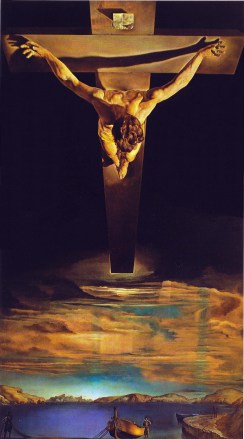 In the Transfiguration, Jesus is truly beautiful, divinely beautiful. But in there is another beauty that is better than the Transfiguration. The beauty of Jesus is what you see on the cross where God in the flesh dies for the disciples and for you to save you from your sin.
It is good for us to remember who we are in relation to God. Before God, we are unworthy, groveling worms who deserve nothing good and make silly suggestions about tents. But on the cross, we see who God is relation to us. He is the God who offers Himself even unto death to redeem, forgive, and save us.
Jesus’ Transfiguration beauty is great and awesome. But His better beauty is the fact that He is the Savior – your beautiful Savior. Amen.
The peace of God, which surpasses all understanding, will guard your hearts and minds in Christ Jesus. Amen.
 Pastorsamwise
You must be logged in to post a comment.