In the name of Jesus. Amen.
Throughout Scripture, God repeatedly makes Himself available to people on mountains. Working backwards through time, Jesus ascended into heaven from Mt. Olivet (Act. 1:12). Jesus was Transfigured on the top of a mountain (Mt. 17:1). Jesus preached His most famous sermon on the top of a mountain (Mt. 5:1); He even titled it the Sermon on the Mount – just kidding. Elijah met with God on the top of a mountain (1 Kgs. 19:8-18). God brought Moses to the top of a mountain to see the Promised Land before he died (Dt. 34:1-5). And, of course, God spoke the Ten Commandments to His people from the top of Mt. Sinai (Ex. 20).
In the Old Testament, God’s people had the understanding that heaven was up, hell was down, and earth was between. Because of that, mountains were places of worship. All that being said, when Abraham saw Mt. Moriah, it probably wasn’t an awe-inspiring moment. God told Abraham to take his only son to Mt. Moriah and offer him up as a sacrifice. Amazingly, Abraham was faithful and trusted. Our epistle text tonight (Heb. 9:22, 11:17-19) sheds some light on how Abraham could go through this. Abraham believed that God would raise Isaac from the dead. We get a hint of that in Gen. 22. Notice what Abraham says to his servants when he and Isaac leave them behind. The same subject governs all the verbs, “I and the boy will go over there and [I and the boy] will worship and [I and the boy] will come again to you” (Gen. 22:5).
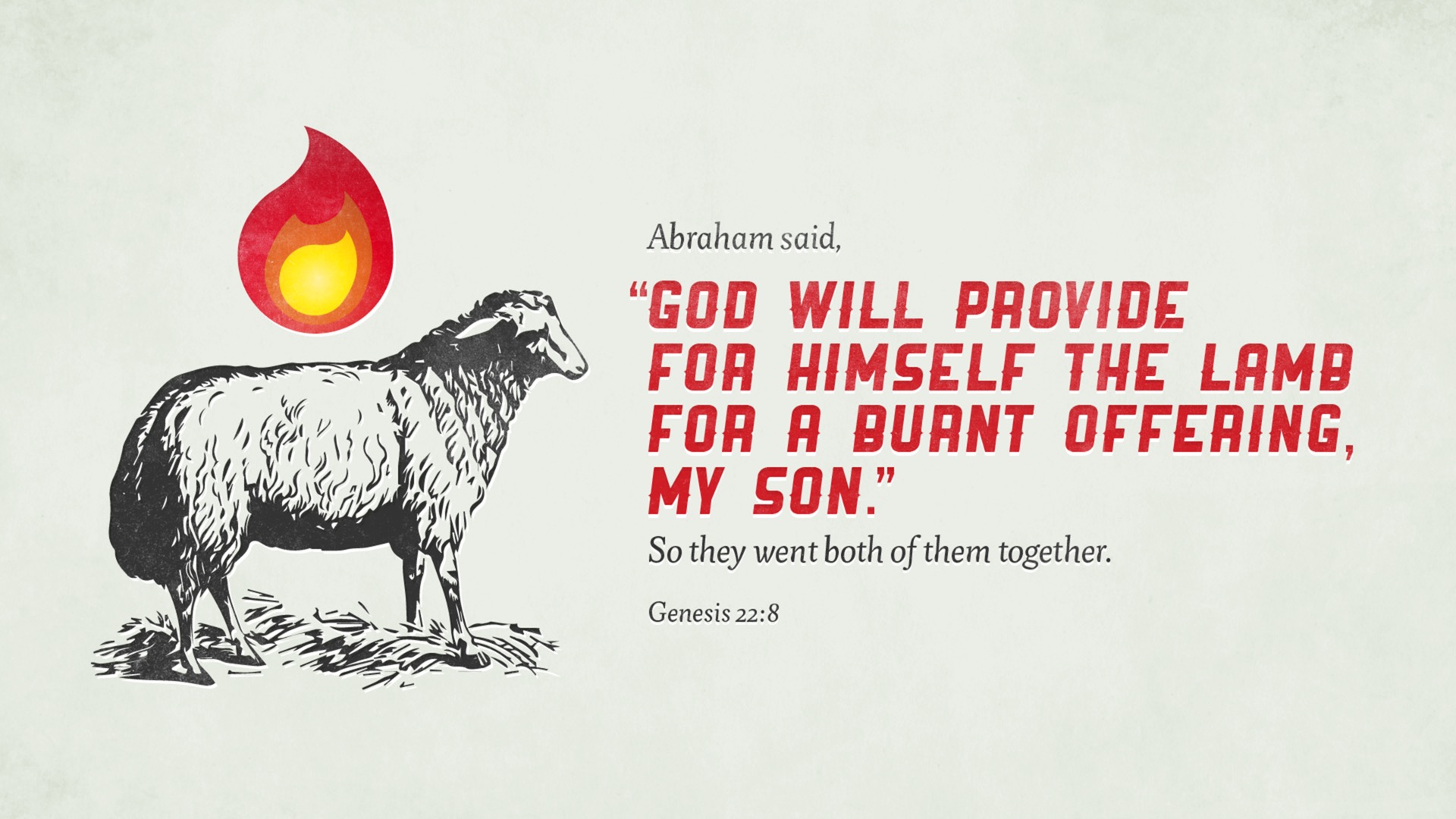
Abraham takes the wood and lays it on his son, and Isaac carries his own location of death. As they ascend the mountain, Isaac speaks up and asks the question of the day, “Behold, the fire and the wood, but where is the lamb for a burnt offering?” Abraham says, “God will provide for Himself the lamb for a burnt offering, my son.”
Now, we need to interrupt the text, slow down, and ponder Abraham’s answer. The Hebrew word here in v. 8 which gets translated ‘provide’ is a really bad translation. The Hebrew word actually means ‘to see,’ but basically every English version you can get your hands on will translate it as ‘provide.’ They say that the verb ‘to see’ here has the sense of ‘will see to it’ as in, “God will see to it Himself that there is a lamb.” But to translate it that way makes us miss something big because there is one other part of Abraham’s words here that we miss in English. The most literal, wooden translation of Abraham’s response to Isaac is, “God will see Himself – a lamb” (Dr. John Saleska). Hear that again: “God will see Himself – a lamb.”
Now, the story slows down giving every excruciating detail. They come to the place. Abraham builds the altar, lays the wood in order, binds Isaac, and lays him on top of the wood. Abraham reaches out his hand and takes the knife to slaughter his son. But the angel of the Lord steps in.
I’m not going to take the time to fully explain it in this sermon (ask me later if you’re interested), but the “angel of the Lord” in the Old Testament is Jesus. For now, the only proof I’ll offer is that the angel of the Lordspeaks as God Himself and uses God’s same words from earlier in the text. Notice He says, “You have not withheld your son, your only son, from Me.”
Abraham lifts up his eyes and “looked” (which is the same word that was translated ‘provide’ earlier) and there is a ram caught in a thicket by his horns. And Abraham offers up the ram as a burnt offering instead of his son. After all this, Abraham names that place, “Yahweh will see” (again, same word back in v. 8 and v. 13). And it became a saying, “On the mount of Yahweh it will be seen.”
For years, God would see on that same mountain, Mt. Moriah, the sacrifices of His people. It was on that very mountain that Solomon built the Temple and where the blood of animals was shed to atone for the sins of the people. On that mountain, God would accept the death and blood of another in place of His people who were under condemnation for their sins. And it’s no surprise that Jewish people admire this account of the sacrifice of Isaac highly – so highly, in fact, that they gave it a title, the Aqedah, which is the Hebrew word for ‘binding.’ In the Old Testament, Isaac is the only sacrifice that is ‘bound.’ And in the New Testament, there is only one other ‘bound’ sacrifice.
On a mountain just outside Jerusalem and within view of Mt. Moriah, Jesus offers the sacrifice of His body and blood. On Mt. Calvary, God sees the Lamb of God who takes away the sin of the world (Jn. 1:29) as Christ, your Savior, is bound to the cross by nails through His hands and feet. Even though Jesus was sacrificed on Mt. Calvary, He brought His atoning blood to the true Holy of Holies in the heavenly Temple (Heb. 9:11-12) and sprinkled it before God so you would have forgiveness, life, and salvation.
The journey from Mt. Moriah to Mt. Zion is the story of your deliverance from exile because Jesus is what Isaac could not have possibly been. Christ is the son, the only Son, the only begotten Son, whom God the Father loves. He carries the wood of the altar upon which He is sacrificed. His head was caught in a thicket of thorns. Jesus freely gives His life for your salvation, and the sacrifice isn’t interrupted. Jesus delivers forgiveness and life to you through the shedding of His holy and precious blood. Through faith in Him you will not ever perish but have everlasting life (Jn. 3:16).
God has seen. He has seen the sacrifice of Jesus, and because of that, heaven is eternally opened to you. Amen.
The peace of God, which surpasses all understanding, will guard your hearts and minds in Christ Jesus. Amen.
 Pastorsamwise
You must be logged in to post a comment.