The Battle – Sermon on Revelation 12:7-12 for the feast of St. Michael & All Angels

Revelation 12:7–12

7 Now war arose in heaven, Michael and his angels fighting against the dragon. And the dragon and his angels fought back, 8 but he was defeated, and there was no longer any place for them in heaven. 9 And the great dragon was thrown down, that ancient serpent, who is called the devil and Satan, the deceiver of the whole world—he was thrown down to the earth, and his angels were thrown down with him. 10 And I heard a loud voice in heaven, saying, “Now the salvation and the power and the kingdom of our God and the authority of his Christ have come, for the accuser of our brothers has been thrown down, who accuses them day and night before our God. 11 And they have conquered him by the blood of the Lamb and by the word of their testimony, for they loved not their lives even unto death. 12 Therefore, rejoice, O heavens and you who dwell in them! But woe to you, O earth and sea, for the devil has come down to you in great wrath, because he knows that his time is short!”

In the name of Jesus. Amen.

“Out of sight, out of mind.” Sometimes, you might use that phrase as an excuse, sometimes as a reason to procrastinate. It’s really easy to forget things that aren’t right in front of us. So, we make lists, set reminders on our phones, and put events on the calendar. Well, the Church has done exactly that for us today, September 29th, as we remember the angel, St. Michael, and all angels. Today, we remember that God has created all things, visible and invisible.

The Bible teaches a lot about angels, but it doesn’t answer every question we might have about angels and demons (which are just fallen angels). There’s a lot of garbage out there when it comes to angels. Be very discerning about what you hear, see, and read about angels. People have found that they can make a lot of money off the curiosity surrounding angels and demons. If you’re interested after the service, I can print a couple of my older sermons from a few years ago that overview what the Bible teaches about angels and demons. Today, as we consider this Epistle reading (Rev. 12:7-12), we’re mainly going to focus on the invisible, unseen battle that is currently raging around us. It’s something we need to see and recognize. We want it in our sight and on our mind because, through His Word, God gives us tremendous comfort in the midst of this battle.

The whole chapter of Revelation 12 teaches us about something that has happened and continues right now all around us. I know a lot of people think the events of Revelation are in the future, but that’s not necessarily the case. Some Christians will disagree with that. I promise I’ll show from Scripture why I firmly believe that Rev. 12 is both past and current and will continue until Christ returns.

To get a bit of context for what we heard, Rev. 12 starts with a scene of a pregnant woman who is about to give birth. The text says that her Child will rule the nations with a rod of iron (Rev. 12:5). Psalm 2 uses this same language and imagery of Jesus. In Psalm 2, the nations are raging and trying to get out from under God’s rule. In response, God sets His King and Son on the throne of Zion (Ps. 2:6-8), and He rules with a rod of iron and dashes those rebellious, earthly authorities like a clay pot (Ps. 2:9). Who is this woman about to give birth? As Christians, we know that the virgin Mary is the one who gave birth to Jesus, but this text isn’t referring to Mary. Here in Rev. 12, this woman is representative of the whole Church, all believers. The reason I say that will become clearer in a bit, so stick with me, please.

In Rev. 12 we are told that a great red dragon – in other words, the devil – is waiting there to devour Jesus immediately after He is born. But Jesus is caught up to God and to His throne (Rev. 12:5). Basically, John skips over Christ’s entire life, ministry, death, resurrection, and ascension. He does this to set up what happens to the Church. After she gives birth, the woman (who, again, is believers) flees into the wilderness where God has prepared a place for her to be protected and nourished. That’s the context for our reading.

Now, to the first verse of our text. There is war in heaven. That sounds weird. It’s heaven – a place where there is no more sorrow, crying, or pain (Rev. 21:4) – but this is what John sees. And think about this, the devil wasn’t able to devour Christ in a broken world. Not when He was an infant, not during Jesus’ life, not even in Jesus’ crucifixion and death. But he still tries to attack Jesus in heaven. Anyone with a half a brain knows that strategy isn’t going to work, but the devil’s hatred of God makes him absolutely foolish when it comes to battle strategy. Satan thinks he’ll fight to take Jesus off His heavenly throne, but the devil doesn’t get very far. King Jesus doesn’t even have to fight Himself. Instead, He sends His archangel Michael (see Jd. 9) who defeats the devil and permanently expels that worm and his angels (i.e. the demons) from heaven. God created Michael for that very purpose, and King Jesus doesn’t rob Michael of that glory. God lets Michael do his job of throwing the ancient serpent out of heaven.

Then, we hear this loud voice. Let’s walk through what this voice says. “Now the salvation and the power and the kingdom of our God and the authority of His Christ have come” (Rev. 12:10a) Think through this. We have salvation, right? Yes, of course we do! Jesus has the power and authority over all creation, right? Yes, He does! Before He ascends, Christ says, “All authority in heaven and on earth has been given to Me” (Mt. 28:18). Despite what we might experience, has the kingdom of God come? Yes! Jesus says when He casts out demons by the finger of God, that means that the kingdom of God has come (Lk. 11:20).

So, what does the loud voice from heaven say next? “The accuser of our brothers has been thrown down, who accuses them day and night before our God” (Rev. 12:10b). Remember our Gospel reading (Lk. 10:17-20). Jesus had sent the 72 disciples out to preach the arrival of the kingdom of God (Lk. 10:1-9). Our text is Jesus’ response when they return. He says that through their ministry He, “saw Satan fall like lightning from heaven” (Lk. 10:18). A couple weeks ago, we saw from Job how the devil was in heaven with the other angels accusing Job of loving God because God was nice to him (Job 1:9; 2:4-5). The devil wasn’t content to only accuse Job; he was accusing all Christians, and heaven was sick and tired of it. But now, Satan can’t do that anymore because Michael has thrown him out of heaven and God’s presence. Now, we need to hear a little more from the heavenly voice.

“And they have conquered him by the blood of the Lamb and by the word of their testimony, for they loved not their lives even unto death.” (Rev. 12:10b-11). Again, back in Lk. 10:17, the 72 disciples are excited because even the demons are subject to them in Jesus’ name. This is still true, believer. The devil and his demons are continually defeated as believers proclaim Jesus’ name. Michael has knocked him out of heaven, and God continues to kick Satan while he’s down through the feet of believers by the power of Jesus’ blood and by your witness and testimony (Ro. 16:20).

Finally, the voice from heaven concludes, “Therefore, rejoice, O heavens and you who dwell in them! But woe to you, O earth and sea, for the devil has come down to you in great wrath, because he knows that his time is short!” The victory in heaven means there is no place for the devil there anymore. But God, for reasons only He knows, hasn’t sent the devil to his final destination of the eternal fire of hell (Mt. 25:41). Not yet. The devil now has come to the earth where He viciously rages because he knows that his time is short.

That’s the end our text, but the rest of Rev. 12 shows that the woman who gave birth to the Child is still pursued by the dragon. But God protects her in the wilderness and nourishes her (Rev. 12:13-14). Every time the devil tries to destroy her, his efforts are stopped, thwarted, and defeated (Rev. 12:15-17). That’s why I said earlier that the woman isn’t Mary but the whole Church – which includes Mary, but isn’t only Mary. The devil continues his futile fight against the Church, but we believers are protected and win the victory by the blood of the Lamb.

Now, here’s what all of this means for us, and why it is such a comfort. All the troubles we face today are spiritual battles against the demons. Scripture says, “For we do not wrestle against flesh and blood, but against the rulers, against the authorities, against the cosmic powers over this present darkness, against the spiritual forces of evil in the heavenly places” (Eph. 6:12). All of those terms refer to the devil and demons. On the one hand, that verse reminds us that people are not our enemies. We do not have to fight against people because they are individuals who are loved, and whom Christ has died for. But that verse also reminds us that there is a constant spiritual battle going on all around us, and the victory has been won through our Savior, Jesus Christ. We conquer with Michael and all the heavenly host by the Blood of the Lamb.

Still, the battle rages on. We see this battle manifest itself in different ways. Abortion, public safety, the LGBTQ movement and all sorts of other topics – those are the different battle lines in the spiritual war going on all around us. Wherever our culture is fighting against God’s good order, that is where the battle lines have been drawn. And the victory doesn’t and won’t come from Congress, the White House, or through the ballot box. The victory comes at your dinner table. It comes in your home as you raise your children in the faith. It comes as you point others to Jesus, and as you faithfully carry out all your vocations. Wherever you testify about Christ, your Savior, there is the victory. The kingdom of God is strengthened and fortified as Christ is proclaimed, and it advances as unbelievers are brought into the kingdom through faith in Jesus.

Dear saints, this battle has been raging ever since the Fall into sin. Even when it appears as though the devil and his angels are gaining ground, remember that they are a defeated enemy. They cannot win. Jesus is on the throne, and He will never be removed. God calls you to be faithful. Keep confessing and testifying about Christ (Rev. 12:11). God has promised you His protection through the holy angels as you do what God gives you to do in this fight. And better than that, you have the victory through Jesus and His blood.

Your Lord, your Savior, your King, and your Captain invites you now to His Table to receive His very blood through which you gain the victory. Come and receive as He pours His mercy and forgiveness into you. Amen.

The peace of God, which surpasses all understanding, will guard your hearts and minds in Christ Jesus. Amen.

Friend, Move up Higher – Sermon on Luke 14:1-11 for the Seventeenth Sunday after Trinity

Luke 14:1-11

In the name of Jesus. Amen.

The game is afoot. This prominent Pharisee and his friends had invited Jesus to a Sabbath dinner party. Our Lord is in hostile territory. The Pharisees want to investigate how Jesus will behave on the Sabbath, and their focus is especially on seeing if He will work because that was strictly forbidden by their additional rules. Ironically, this means that they are working by keeping a close watch on Jesus. And Luke draws our attention to this sick man, “Behold, there was a man before [Jesus] who had dropsy.”

Now, Luke doesn’t come flat out and say this, but everything points to the fact that these Pharisees have intentionally set this situation up as a trap. The clues all point to the fact that this sick man was invited so they could test Jesus and see what He would do.

The man was sick with dropsy. The term for his condition today is ‘edema.’ It means that he is retaining water which causes his limbs to swell up in a gross way. In other words, you’d visibly see that this man isn’t well. On top of that, his swelling meant that he was unclean according to Lev. 13:2. This man’s sickness would normally have meant he wouldn’t get an invite to this Sabbath meal. Again, Luke doesn’t come straight out and say it, but there’s little question that this whole situation is set up to trap Jesus. But it doesn’t go too well for the Pharisees.

Throughout the Gospels, we see that Jesus knows what people are thinking (Mt. 9:4; Mk. 2:8; Lk. 5:22; Jn. 2:24-25). So, Jesus turns the tables and traps them. Notice that He initiates the confrontation by asking, “Is it lawful to heal on the Sabbath or not?” Of course, the answer is, “Yes, it’s lawful.” There are zero biblical laws against healing on the Sabbath. The reason there aren’t laws against it is simple. Who alone can heal disease? Only God can. Sure, doctors can treat diseases, but they can’t heal them. Throughout Scripture, God doesn’t give any laws against parting the Red Sea, turning water into wine, feeding 5,000 people with five loaves and two fish, or raising the dead on the Sabbath. The Bible doesn’t have one word against doing those things because God is the only one who can do any of that.

So, the hunters become the hunted, and the trappers, the trappeese [sic.]. The Pharisees are silent. Jesus heals the man and sends him off with a body that is no longer gross and swollen. And Jesus isn’t done interrogating these folks. “Which of you, having a son or [even] an ox that has fallen into a well on the Sabbath, wouldn’t make sure to pull him or it out?” And, again, they don’t answer because they can’t. They would do that lesser thing of rescuing their son or animal from a well on the Sabbath, so of course God – who, again, is the only one who can heal – would deliver someone from a sickness and grant that relief on the Sabbath.

Then, Jesus tells a parable about seating arrangements against them. While they were watching Jesus, He had been watching them. They had all been trying to get themselves into best possible spot at the feast. They were all jockeying for positions to show everyone else how important they were. I’m sure this is not how they imagined this entrapment dinner party would play out. Jesus keeps coming at them but not to condemn them; instead, Jesus is calling them to repentance.

Yes, the Pharisees are always trying to condemn Jesus. Yes, throughout the Gospels, they are the enemies of our Lord. And yes, Jesus warns us to not become like the Pharisees. But we have to remember that Jesus died for them too. Jesus loves the Pharisees and wants them to repent, to believe in Him, and to receive His forgiveness. So, when Jesus exposes the foolishness of the Pharisees, we shouldn’t stand on the sidelines and hope they get injured. 

Remember, all of us have a little Pharisee living inside of us. Our sinful nature desires to be noticed and praised for our own goodness and holiness. The creed of the Pharisee, and all of us little Pharisees, is, “I’m a good person,” and we will do everything in our power to try and prove that to others. But if we are trying to impress others with our morality, the only accolades we will receive will be from other sinners. If we are outside of faith in Christ, the only thing we will hear from God is, “Depart from Me, you cursed workers of lawlessness, into the eternal fire prepared for the devil and his angels” (Mt. 7:23; 25:41). 

We take God’s Law and misuse it to try and make ourselves look better than others. This is completely wrong. God didn’t give the Law for us to measure how we compare to others. God has given the Law for three purposes, and we have covered the three biblical uses of God’s Law recently, but it is always good to review those.

First, God’s Law shows us how creation works. The Commandments reveal how God has ordered things in creation. The theologians will describe this first use of the Law as a ‘curb’ that keeps us from driving off the road and causing damage to us and to others. Second, because God’s Law is a curb, it also shows us how sinful we are. This second use of the Law is a ‘mirror’ that reveals how wicked, wretched, and sinful we are. It brings us to repentance and faith in Christ. Third, God’s Law is a ‘guide’ which shows us how God wants us to live and how to love Him and love our neighbor. These three uses of the Law are clearly taught in Scripture. And 1 Tim. 1:8 says, “the Law is good if one uses it lawfully.”

Our problem is that we are like the Pharisees and use the Law in other ways that are not lawful. They are outside of how God intended the Law to be used. Instead of a curb, guide, and mirror, the little Pharisee in us tries to use the Law as a ladder. We foolishly attempt to use Law as a way to climb up to God. We wrongly imagine that if we do enough good works or climb a little higher than others then God will reward us. We wrongly use the Law as a foam finger cheering ourselves on, “I’m #1.” We misuse the Law as a podium trying to claim a spot that elevates us above others. The Law wasn’t intended to do any of that, but that’s how our sinful nature tries to use the Law over and over and over. Repent.

The Law puts us in our place. Again, it shows us how creation is ordered and works. That, then, shows us how far out of step we are with what God intends us to be and drives us to Him for His mercy and forgiveness. The sooner we learn this, the better. Because the only thing that can elevate us isn’t the Law. No thing can elevate us. Only God Himself can. And when we sinners repent, turn from our wickedness, abandon our own good works, and turn to Him for our righteousness and holiness, then, and only then, we become God’s friend, and He calls us higher. He elevates us.

Here’s the thing. Once God calls you, “Friend,” it almost doesn’t matter what He says after that. He could say, “Friend, unload the dishwasher,” or, “Friend, go rake the leaves.” If God calls you, “Friend,” that’s all you need. He knows all your sin, but He comes to you today and says, “You are My friend.” And He lifts you up. That’s what the absolution is. Jesus lifts you up, out of your sin, and says to you, “Friend, move up higher.” In Holy Communion Jesus calls you higher, to sit with Him at His table. Even your death is Jesus saying to you, “Friend, move up higher because I’ve made a way for you to live forever with Me.” 

You probably know the hymn What a Friend We Have in Jesus, but do you know what Jesus sings? What a Friend I Have in You. Dear saints, Jesus, and Jesus alone, lifts you up by saying, “Friend, move up higher.” Amen.

The peace of God, which surpasses all understanding, will guard your hearts and minds in Christ Jesus. Amen.

Given, Taken, Blessed – Sermon on Job 1:1-22 for the Sixteenth Sunday after Trinity

Job 1:1–22

In the name of Jesus. Amen.

In a sinful and broken world, no one escapes suffering (Jn. 16:33), and no one can make themself right before God. We clearly see that in the book of Job. But another thing that we see in Job is that God accomplishes His purpose, even in the midst of suffering.

Job was very blessed by God. Job had 7,000 sheep, 3,000 camels, 500 yoke of oxen, 500 female donkeys, and many servants. Job was the greatest of all the people of the east. Beyond that, Job had seven sons and three daughters. One of the things that makes Job great is all of these children. Our culture tries to make it seem like children a burden. It’s sad that today people will see parents with a lot of children and joke with them. “Oh, you must be so tired,” or, “Don’t you know about the birds and the bees?”

We need to stop that. If we are doing it ourselves or hear others doing it, we need to put an end to it. Children are a blessing; they are a heritage from God (Ps. 127:3-5). Don’t fall for the lies of Margaret Sanger and Planned Parenthood. A blessed life does not mean that you’re free of obligation to children. Children are a blessing from God and are to be embraced.

Job was the also the spiritual leader of his family. He was careful to make sure his children were raised well. The fact that Job offered sacrifices for his children points to him being a father who is raising his children in the Christian faith. There is a good reason to see that all of Job’s children are following their father in the faith, but I’ll wait until the end of the sermon to say more about that.

So, Job was very blessed in every temporal way by God. And Job was also spiritually blessed by God. Three times in the first two chapters, we are told that Job is blameless, upright, one who fears God, and turns away from evil. Two of those times, that description comes from the lips of God Himself. And let’s consider each of those briefly.

First, Job is blameless. In Hebrew, that word can also mean ‘perfect’ or ‘pure.’ This does not mean that Job is sinless. Sinless and blameless are similar words, but they aren’t identical in meaning. Job himself will say that he’s sinful (e.g. Job 13:23). So how can God say that Job is perfect, that he’s blameless? Well, this is something that God Himself gives to Job. When God says something about you, it is true. When God says that you are blameless, that makes you blameless. This blamelessness, this purity, this perfection that Job has is a gift from God.

Second, Job is upright. This isn’t talking about Job’s posture. It’s not like he went to the chiropractor regularly. Job is upright. Most of the time this word gets used in Scripture, it’s referring to God. God Himself is upright. There’s no twisted or crooked way about him. God is without fault and without error. Job is too. Again, this characteristic is something that God gives to Job. Whatever sins Job had committed, God had forgiven.

Third, Job fears God. Throughout the Bible, fearing God is linked to trusting God. The 1stCommandment in the Small Catechism is explained, “We should fear, love, and trust in God above all things.” Usually, when we think of being afraid, it means we don’t trust someone or something because it’s unsafe. But when the Bible talks about the fear of God, it is not to think that God is unsafe. It means if you turned away from God, then God becomes unsafe. When you turn to Him, then He is your Refuge and Strength (Ps. 28:8; 46:1). C.S. Lewis captures this really well in the Chronicles of Narnia. There’s a question about the character that corresponds to Jesus and if he is ‘safe,’ and the reply is, “Of course he isn’t safe, but he’s good.”

Fourth and finally, we’re told that Job turns away from evil. By the power of the Holy Spirit, Job turns away from evil things. Again, that’s what a Christian does. A Christian does not run headlong into doing sinful, evil things. Instead, a Christian turns away from them. Yes, we sin, and we sin often. But by God’s help, we strive to turn away from evil.

So, when God describes Job as blameless, upright, fearing God, and turning away from evil, God is saying that Job is a Christian. God says this about any of you who believe in Christ.

After this description of Job, we see him begin to suffer. And the cause of Job’s suffering is important. Satan is in heaven, and God starts to brag about Job to the devil. It’s almost like if a jewelry store was being robbed and the owner came out and said to the thief, “Hey, have you seen my rarest, most expensive diamond?” We don’t know why God draws attention to Job, but He does. And the devil doesn’t even bother arguing with God. The devil doesn’t push back or try to “fact-check” God, not at all. God is right. The devil and the demons have to agree with God when God says something. Make sure you recognize that. 

Instead, the devil pushes back on Job’s faith. Satan says that the only reason Job is blameless and upright is that God is nice to him. The devil says that if God takes those things away that Job will curse God to His face. Notice how arrogant the devil is. He’s basically saying, “Let me have at him and I’ll make sure that he ends up the way that I want him to be.” For reasons that I don’t understand, God lets the devil do it. Through the rest of the ch. 1, we hear what the devil does. The devil sends different calamities that take away all the blessings God had given Job.

And how does Job respond to all this loss? It’s remarkable, “Naked I came from my mother’s womb and naked I shall return. The Lord gave, and the Lord has taken away. Blessed be the name of the Lord.” Who was it that destroyed all those things? We have to say that it was the devil, and yet who allowed the devil to do that? God did. God gave the devil a long enough leash to take all those things away. And who does Job credit? He credits God. The Lord gave. The Lord has taken away. Blessed be the name of the Lord.

In ch. 2, which we didn’t read, the devil is allowed to go farther. Job hasn’t cursed God, so the devil asks God to let him go after Job’s body. And Job gets afflicted with sores all over his body. But still, Job does not curse God. You have to imagine how frustrated this made the devil. Satan figured he’d be triumphantly standing over Job while Job was groveling at his feet, but Job doesn’t even acknowledge Satan in any of his suffering. It’s absolutely remarkable. Job’s eyes, mind, and heart are fixed squarely on God even in the midst of suffering.

Job doesn’t go down the black hole of trying to figure out why he’s suffering. He simply recognizes that he is suffering, and in his suffering, Job places himself squarely in God’s gracious hands.

Christian, take note of this. Whenever you’re presented with trials, tribulations, and suffering, don’t bother with the why of your suffering. Instead, focus on Christ. 1 Pet. 4:12-13 says, “Beloved, do not be surprised at the fiery trial when it comes upon you to test you, as though something strange were happening to you. But rejoice insofar as you share Christ’s sufferings, that you may also rejoice and be glad when His glory is revealed.”

Suffering and evil are definitely related to each other, but that does not mean that suffering itself is evil. In fact, suffering is good. If you didn’t suffer when you touched a hot stove, you wouldn’t remove your hand from it. If criminals and murderers didn’t suffer with time in prison, then there’d be a lot more theft and murder.

Suffering is meant to bring about repentance and faith in Christ. Suffering isn’t evil, but that doesn’t mean that God demands that you enjoy your suffering. You are right to hope for the end of your suffering. God sent Jesus to relieve you from suffering. Christ entered into our suffering in order to bring us into His kingdom where there will be no more suffering.

Comfort in suffering comes from seeing that God has come into our world to suffer alongside of us and for us. That’s the real comfort for anyone who suffers in any way. The world sees suffering and it tries to eliminate it. So much of our world today is focused on death as the only solution to suffering. They’ll see a poor, single woman who is pregnant and say, “That baby has no chance of being happy, healthy, or successful. So, abort the baby.” The world sees a person going through horrible medical problems and says, “It’ll just be better to end that life now with a doctor assisted suicide.” The world’s only answers to suffering are barbaric.

God’s answer to suffering is that He sends Jesus, not to bring an end to the sufferer, but to defeat suffering through His suffering (1 Co. 15:54). Jesus is the “Man of Sorrows.” In your suffering you find your Savior, who has died and risen again for you, to deliver you.

What we heard today isn’t the end of Job’s story. Job gets everything back. In Job 42, we see God gave Job twice as much as he had before. There, Job has double the sheep, camels, oxen, and donkeys. But then we’re told that Job also had seven more sons and three more daughters. I told you I’d come back to it.

Now, wait a minute. Seven sons and three daughters? That’s what Job had before, isn’t it? Shouldn’t Job have had fourteen sons and six daughters? No. Job’s first ten children aren’t lost to him. This points to Job’s first ten children being saved. Job still has them, even though they died. They’ll be united with Job in the resurrection, because Job knows that his Redeemer lives. Christian, your Redeemer lives too. And like Job, your eyes shall see him and not another (Job 19:25-27). Come quickly, Lord Jesus (Rev. 22:20). Amen.

The peace of God, which surpasses all understanding, will guard your hearts and minds in Christ Jesus. Amen.
In Step with the Spirit – Sermon on Galatians 5:25-6:10 for the Fifteenth Sunday after Trinity

Galatians 5:25–6:10

25 If we live by the Spirit, let us also keep in step with the Spirit. 26 Let us not become conceited, provoking one another, envying one another. 

1 Brothers, if anyone is caught in any transgression, you who are spiritual should restore him in a spirit of gentleness. Keep watch on yourself, lest you too be tempted. 2 Bear one another’s burdens, and so fulfill the law of Christ. 3 For if anyone thinks he is something, when he is nothing, he deceives himself. 4 But let each one test his own work, and then his reason to boast will be in himself alone and not in his neighbor. 5 For each will have to bear his own load. 

6 Let the one who is taught the word share all good things with the one who teaches. 7 Do not be deceived: God is not mocked, for whatever one sows, that will he also reap. 8 For the one who sows to his own flesh will from the flesh reap corruption, but the one who sows to the Spirit will from the Spirit reap eternal life. 9 And let us not grow weary of doing good, for in due season we will reap, if we do not give up. 10 So then, as we have opportunity, let us do good to everyone, and especially to those who are of the household of faith.

In the name of Jesus. Amen.

Imagine that you are offered a choice between two pieces of property. You don’t get to build a house or start a business on this property; it’s just a piece of land for you to enjoy. The first plot is total mess. It’s filled with trash that’s gotten piled up along the rusty chain-link fence and around the scraggily, overgrown bushes. There are several rusty machines strewn haphazardly across the lot. Thistles, thorns, and nettles are all over the place. You can see huge anthills. There are wasp nests in the diseased and rotting trees which look like they’re about to fall down at any moment.

The second plot could be on the cover of a magazine. It has a new, perfectly stained wooden fence all around it. There are mature cedar and maple trees that give the property the perfect balance of sun and shade. The grass is green, thick, and meticulously maintained. It has a large garden with rich soil producing all kinds of vegetables. Colorful flowers are blossoming in all the right places. This second property is a little slice of Eden.

Now, which of the two lots would you choose to own? Which would you prefer to have at your disposal on a beautiful afternoon to sit and read a book while sipping your favorite beverage?

Maybe you wouldn’t want either. If you start to think about everything that is required to fix up the first or to maintain the second, both would require a lot of work. Maybe you’d just prefer to be neutral. In reality, there is no neutral. You cannot serve two masters (Mt. 6:24), but you will serve one.

Here, in Gal. 6:8, Paul says there are only two options for the kind of life you will have, Christian. “The one who sows to his own flesh will from the flesh reap corruption, but the one who sows to the Spirit will from the Spirit reap eternal life.” In other words, something is always being sown. It doesn’t matter if your life is currently dilapidated or flourishing – something is being sown and is contributing either to decay and disorder or to beauty and order. A harvest will come. Whatever is sown now will determine either the allure or the repulsiveness of what you harvest later.

So, what are you sowing now? Is it weeds or flowers? Thistles or produce? Chaos or beauty? Trash or nourishment? Disgust or delight? Whatever you sow, you will reap.

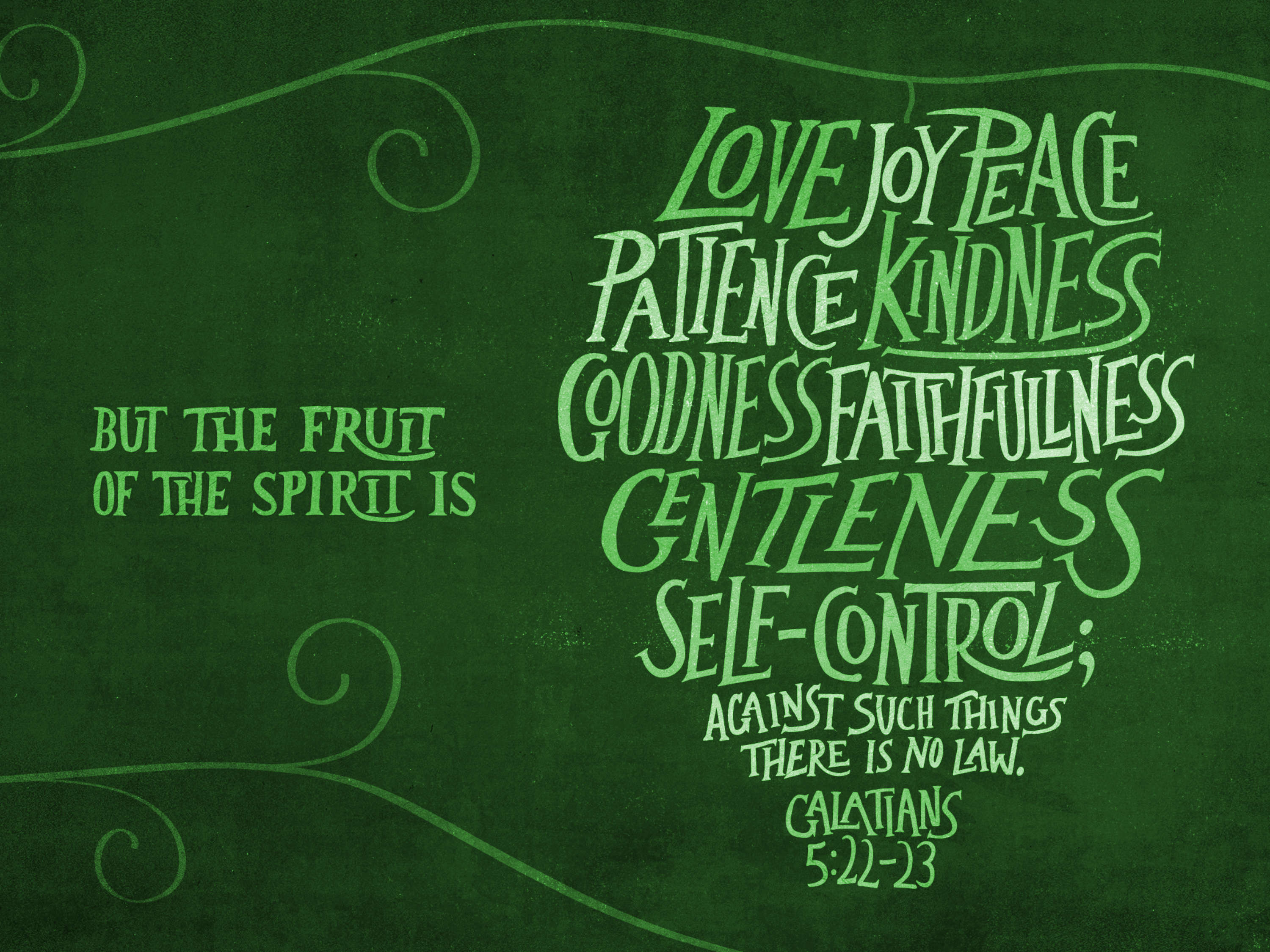
The good news is you are not alone in this sowing. You have help. Jesus says that He has come that you may have life and have it abundantly (Jn. 10:10). And Christ has given you the Holy Spirit, the Helper, who works the fruit of the Spirit within you. Jesus didn’t come to put you in neutral. Again, neutral isn’t possible. You aren’t given the Holy Spirit just so you grow. You are given the Holy Spirit so you can bear a bumper crop of the fruit of the Spirit – the fruit of love, joy, peace, patience, kindness, goodness, faithfulness, gentleness, and self-control (Gal. 5:22-23).

So, keep in step with the Spirit. Paul uses a military term there that refers to a line of soldiers marching in a row and following their commander. Paul lists several things that keep you in step with the Spirit: Restore those caught in transgression with gentleness. Keep watch on yourself. Bear the burdens of others. Share your blessings with the one who teaches God’s Word. Do not growing weary of doing good but persist. As you are given opportunity, strive to do good to everyone – especially to those who are of the household of faith (Gal. 6:1-10).

Yup, that is a lot of work. Keeping in step with the Spirit isn’t a cake-walk. But remember, you are always sowing something. Are you sowing to the flesh, which means you reap corruption? Or are you sowing to the Spirit, which will result in a harvest of limitless blessings now and eternal life in the age to come (Mk. 10:29-30)?

Now, I want to focus on one aspect of keeping in step with the Spirit because there are a couple phrases in this text that have always been a little confusing to me. In Gal. 6:2, Paul says, “Bear one another’s burdens,” but then just after in Gal. 6:5, he says, “Each will have to bear his own load.” It sounds like a contradiction.

When Paul says, “bear one another’s burdens,” he isn’t just saying that you need to just tolerate others. He’s calling you to do something that is inconvenient for you and requires a lot of effort. Bearing burdens was the task of a slave. You, believer, are to be a servant of others. Depending on the situation, that might mean bearing the financial burden of someone by giving them money or bringing them a meal while they are healing from a procedure. It might mean helping them do some work on their house. Bearing someone’s burden might simply mean listening to them as they talk about their worries and anxieties. Each situation will be different, but God has and will continue to give you the wisdom you need so you know how to go about bearing the burdens of others. So then, what do we do with Gal. 6:5, “Each will have to bear his own load”?

Paul uses two different words for ‘burden’ and ‘load.’ You can assist someone with their burden, but ultimately, they are responsible for their own load. Imagine you’re in a group hiking up a mountain. Everyone has their own pack filled with gear and supplies. But certain spots on that hike pose greater difficulty for some than others. A steep slope is easier for tall people like me, but the portions of the hike with low hanging branches are easier for short people like some of you. I’ll let you imagine other scenarios.

When others are injured or exhausted by their burden and come to places that are difficult for them, God calls you to help them get through that portion of the hike. And when you are struggling in other times and at other places, your brothers and sisters are there to assist you. Christians need each other. Yes, every Christian is ultimately responsible for his or her own load, but every Christian is also called to assist one another when the burden of that load is heavy.

Dear saints, you do this for others because you remember what Jesus has, continues, and will do for you forever. Jesus’ way with you could have been harsh. Because of your sin, because of the things you have done and left undone, Jesus could have given up on you. But He hasn’t and won’t. Jesus never wearied of doing good to and for you. He never asked, “Do I really have to heal another leper; expel another demon; forgive and save another from damnation?” He never did that. He never grew weary of you and your burdens. Not once. Not even possible. Instead, He has borne your burdens and carried your sorrows (Is. 53:4).

Christ’s way with you is always to give you His love, His peace. He always extends His patience, kindness, and gentleness. He loves to crown you with honor and glory you didn’t deserve. He loves to give you mercy and forgiveness you didn’t earn. He continually grants you peace that surpasses understanding.

So, keep in step with the Spirit because that keeps you in step with Jesus. He calls to you, “Come to Me, all who labor and are heavy laden, and I will give you rest. Take My yoke upon you, and learn from Me, for I am gentle and lowly in heart, and you will find rest for your souls. For My yoke is easy, and My burden is light”(Mt. 11:29-30).

Christ doesn’t ever promise that you will have an easy life, but He does promise to be with you through all the difficulties of this life and to bring you through (Jn. 16:33). He is with you, and He has blessed you with others to help and assist you.

Dear saints, as we sow to the Spirit, let us keep in step with the Spirit who will see us safely through. Yes, the march is hard, and the path is difficult. But keep in step with the Spirit because the harvest is coming. Amen.

The peace of God, which surpasses all understanding, will guard your hearts and minds in Christ Jesus. Amen.

Fruit – Sermon on Galatians 5:16-24 for the Fourteenth Sunday after Trinity

Galatians 5:16–24

16 But I say, walk by the Spirit, and you will not gratify the desires of the flesh. 17 For the desires of the flesh are against the Spirit, and the desires of the Spirit are against the flesh, for these are opposed to each other, to keep you from doing the things you want to do. 18 But if you are led by the Spirit, you are not under the law. 19 Now the works of the flesh are evident: sexual immorality, impurity, sensuality, 20 idolatry, sorcery, enmity, strife, jealousy, fits of anger, rivalries, dissensions, divisions, 21 envy, drunkenness, orgies, and things like these. I warn you, as I warned you before, that those who do such things will not inherit the kingdom of God. 22 But the fruit of the Spirit is love, joy, peace, patience, kindness, goodness, faithfulness, 23 gentleness, self-control; against such things there is no law. 24 And those who belong to Christ Jesus have crucified the flesh with its passions and desires.

In the name of Jesus. Amen.

Scripture uses many different metaphors when it comes to salvation and being a Christian. There are the optical metaphors of darkness vs. light (Is. 9:2; Jn. 1:5, 3:19; 1 Pet. 2:9) and blindness vs. seeing (Is. 35:5, 42:7; Act. 26:18). There are the medical metaphors of death vs. life (Eph. 2:5; Col. 2:13) and heart of stone vs. a heart of flesh (Ezk. 11:19, 36:26). Scripture uses familial metaphors of adoption (Ro. 8:15; Gal. 4:5; Eph. 1:5), being a son (Mt. 6:8-9; Lk. 15:11f) and child (1 Jn. 3:1-2). There is the metaphor of sheep and shepherd (Ps. 23; Ezk. 34-35; Jn. 10:1-18). There are many, many more, but today, we get the botanical metaphor of fruit.

The thing about fruit is that plants don’t produce fruit for themselves. The main function of a plant’s fruit is so it can reproduce. The fruit provides water and protection for the seeds of the plant. God also designed fruit to be tasty so it would be eaten, and the seed(s) in the plant is spread to produce other plants.

When this text contrasts the flesh and the Spirit, it talks about the ‘works’ of the flesh and the ‘fruit’ of the Spirit. Notice how the works of the flesh are all directed inwardly. These works are self-interested and self-serving. Paul lists 15 “works of the flesh.” The first 3 – sexual immorality, impurity, and sensuality – all have to do with carnal, bodily appetites or a desire for the flesh to assert itself over others. The next 2 – idolatry and sorcery – are sins against God, trying to put the self in place of God. The next 8 – enmity, strife, jealousy, fits of anger, rivalries, dissensions, division, and envy – are all things that separate individuals by prioritizing the self over another. And the final 2 – drunkenness and orgies – are sins of excess. Then, when Paul adds, “and things like these,” he admits that this list isn’t all the works of the flesh. He could have added more.

And Paul says all these works of the flesh are “evident.” You can see them. They are apparent, clear, plain, and obvious. It is certainly easy to see all these things in our world and in our culture. But do you suppose that Paul gives us this list so we can point out other people’s faults? No. If they’re evident, they don’t need to be pointed out. They’re out there for everyone to see. Instead, Paul wants us to see how these things are present in each of us. They are in and of our flesh. And by ‘flesh’ he doesn’t mean our skin, muscles, tissue, tendons, and bones. By ‘flesh’ here, Paul is saying that these things come from the poisonous root of our heart.

If we sinners were an apple tree, every apple we produced would be infected with disease, blight, and worms; it would be rotting, and withering. If you saw a tree like that, you wouldn’t think the problem was the individual apples. You’d know something was wrong with the tree. It has a disease that infects every branch and goes deep down to the roots. That tree needs to be torn down. In other words, we all need to repent.

There is a penalty for these works of the flesh. You don’t need to wonder if you deserve eternity in hell. You can know that you do. Scripture is crystal clear, “Those who (lit.) are doing such things will not inherit the kingdom of God” (Gal. 5:21b).

God be praised, there is a solution, a fix. Christ Jesus has come to deliver you from these works of the flesh. “Those who belong to Christ Jesus have crucified the flesh with its passions and desires” (Gal. 5:24). Christian, God has removed your heart of stone and given you a heart of flesh (Ezk. 11:19, 36:26). He has put a new spirit within you. He has given you the Holy Spirit. And the Holy Spirit produces fruit.

These nine different qualities are called ‘fruit.’ Notice that the word ‘fruit’ is singular. It’s not many fruits like the 15 works of the flesh. But these 9 fruit (sic.) of the Spirit belong together; love, joy, peace, patience, kindness, goodness, faithfulness, gentleness, and self-control. This fruit all grows on the same tree – out of you. And remember that fruit needs time to grow. It isn’t like you can manufacture this fruit artificially or mechanically. No. It needs to be planted, pruned, watered, and nourished (1 Co. 3:6-7).

Remember that the works of the flesh are evident, plain, visible. The same thing isn’t said about the fruit of the Holy Spirit. If you don’t see this fruit, continue to pray that the Holy Spirit will nourish all these things in you. The Holy Spirit will cause that fruit to grow, bloom, ripen, and spread. So, let’s just go through each of these 9 fruit individually. 

Love: This is the chief characteristic of how God is disposed toward you, believer. Scripture explicitly says that nothing can separate you from God’s love for you (Ro. 8:35, 38-39). The Spirit takes God’s love and pours it into your heart (Ro. 5:5). This love of God isn’t just warm, nice feelings; it is action evidenced by Jesus’ sacrificial love for you as He gave His life on the cross. That love of God is given to you so you can give it to others.

Joy: God’s love provides you a sure confidence about the future (Ro. 5:11). Whatever circumstances come your way, you know that you will be in eternal bliss. So, the darkness and pain of this world will cease. That brings joy as well as…

Peace: Your relationship with God is no longer filled with strife. Christ has ended your hostility toward God. You have God’s peace that surpasses understanding (Php. 4:7), and then, you can be at peace with others as well.

Patience: Because you have God’s love which gives joy and peace, you can be patient. Even though the world throws all sorts of chaotic things at you, you can patiently endure it (Ro. 8:25). And beyond that you have…

Kindness: Kindness is the active, merciful goodness that mirrors God’s kindness. You grow to forgive others as God has forgiven you (Eph. 4:32).

Goodness: The word here can also mean ‘generosity.’ Because God has infinite resources, you know that you will receive all good things from Him (Ro. 8:32). This frees you to be God’s conduit to generously give your good things to others.

Faithfulness: Again, God proves His faithfulness to you as He died for you on the cross. He is faithful to keep you from tests and temptations that are beyond your strength (1 Cor. 10:13). This creates a faithfulness in you toward others.

Gentleness: This is an interesting one. Gentleness means that you don’t get excessively angry when things are out of step with how God created the world. There are times when you will need to say hard things to others, things that cause them grief. But you say those hard things in a gentle way which produces repentance. Paul talks about this quite a bit in 2 Cor. 7:8-13. To be gentle requires the final aspect of the Spirit’s fruit…

Self-control: The Holy Spirit leads you to resist your own passions through self-control.

These nine fruit (sic.) of the Holy Spirit are under no compulsion or requirement. Unlike the works of the flesh that exclude sinners from the kingdom of God, these fruits aren’t how you earn entrance to God’s kingdom. Instead, as the Spirit has begun to create these things in you, He will bring all of it to completion (Php. 1:6).

How will the Holy Spirit cultivate this fruit? Jesus has the answer. In John 15:1-5, Jesus says, “I am the true Vine, and My Father is the Vinedresser. Every branch in Me that does not bear fruit He takes away, and every branch that does bear fruit He prunes, that it may bear more fruit. Already you are pruned,” (the ESV says ‘clean’ but it’s the same word Jesus just used). “Already you are pruned because of the Word that I have spoken to you. Abide in Me, and I in you. As the branch cannot bear fruit by itself, unless it abides in the vine, neither can you, unless you abide in Me. I am the vine; you are the branches. Whoever abides in Me and I in him, he it is that bears much fruit, for apart from Me you can do nothing.”

Dear saints, the Spirit will use Christ’s Word and create this fruit in you. Abide, remain steadfast in that Word, and this fruit will be produced. Again, if you don’t see things in your life, know that God continues to work on you, and that fruit will be there for the benefit of others. Amen.

The peace of God, which surpasses all understanding, will guard your hearts and minds in Christ Jesus. Amen.