Following the Shepherd – Sermon on 1 Peter 2:21-25 for the Third Sunday of Easter

1 Peter 2:21-25

Alleluia! Christ is risen! 
He is risen indeed! Alleluia!

In the name of Jesus. Amen.

This may or may not shock some of you, but I am old enough that I learned how to write in cursive in elementary school. My 2nd Grade teacher, Mrs. Ranum, would walk across the front of the classroom, lick her fingers to count out the right number of worksheets, plop them on the front desk of each row, and say, “Take one and pass the rest back.” Then we would spend time tracing those dotted lines with all the curves and loops. We’d swoop and swish across those lines again and again. All of that tracing was designed to give our young fingers and wrists the muscle memory so our letters would be legible.

Those dotted lines were the standard we all started with. But over time each of us developed our own unique style—some more legible than others. No two people have identical handwriting. 

Here in our text from 1 Peter, the apostle refers to Jesus as our “example,” and the Greek word he uses is hypogrammos. This word appears only here in the entire New Testament. Literally, it means something you write over or trace—like those dotted lines on the worksheets Mrs. Ranum handed out. When you trace something, there are many different ways to start and finish the strokes. Some are smoother than others. But the goal is always the same: your writing should resemble the the original.

Notice that Jesus is our hypogrammos in a very particular way. Peter is not calling us to trace Jesus in every way. You don’t trace Him so that you get left in the temple at age twelve, or walk on water, or multiply loaves for thousands of people, or heal the sick, or raise the dead. And it’s good that Peter isn’t calling you to trace Jesus in those ways, because you can’t do any of those things. Sure, God could do some of them through you, but none of those things are on Peter’s radar here.

Instead, the focus is to trace Jesus in the way He endured suffering—like a sheep before its shearers is silent (Is. 53:7). The verse just before our text says that when you do good and suffer for it and endure, this is a gracious thing in the sight of God (1 Pet. 2:20).

That is the kind of suffering to which you have been called. Because Christ also suffered for you, leaving you an example—a hypogrammos, a pattern to trace—so that you might follow in His steps. Jesus committed no sin, and absolutely no deceit in was found in His mouth. He spoke pure, unfiltered truth. And He suffered for it. When He was reviled, He did not revile in return. When He suffered, He didn’t threaten. He simply trusted that God would judge justly. In and through all of that, Jesus Himself bore your sins in His body on the tree, that you might die to sin and live to righteousness. By His wounds, you are healed (1 Pet. 2:21-24).

Dear saints, Peter wrote these words to Christians who felt like exiles and aliens in their own world and like scattered sheep far from home. Many of them were servants living under masters who could be harsh and unfair. For them, suffering was not theoretical. It was a daily reality. And Peter doesn’t coat it. He says plainly, “This is what you have been called to do.” Because following Jesus, your Shepherd, means walking in His steps, and those steps often lead through pain and suffering because we still live in a broken world.

But look at the pattern your Shepherd left—the hypogrammos that we are to trace. First, He was completely innocent. “He committed no sin, and no deceit was found in His mouth.” That’s an echo of the Suffering Servant song in Is. 53. Jesus didn’t deserve a single lash, a single insult, a single nail. Yet He took it all like a lamb led to the slaughter (Is. 53:7) without fighting back.

When they hurled insults at Him during His trial and on the cross, He didn’t fire back with clever comebacks or righteous anger. The soldiers mocked Him. The crowd shouted, “Crucify!” Even the thieves crucified beside Him joined in the abuse (Mt. 27:44). Yet, through all of that, Jesus remained silent. He didn’t threaten. Instead, He entrusted Himself to the One who judges justly. He prayed, “Father, forgive them” (Lk. 23:34). He handed all of His suffering over to His heavenly Father.

You and I can’t do exactly as Jesus did. We can’t do this without sin. We can’t shed holy, perfect blood to pay the price for the sins of the world. We can’t do that. But we can trace His pattern and follow His steps. We don’t have to demand our rights. Instead, we can quietly entrust ourselves to the God who sees every injustice.

Now, before we go any further, let’s be clear about what this is not. This is not a call to ignore evil. It does not mean you must stay in situations where you or your children are in danger. Peter is not giving a blank check for evil to run rampant. Instead, he is speaking to believers who are already doing good and suffering for it anyway. When the world hates you simply because you belong to Christ; when standing for truth costs you friends, or a promotion, or respect in the community—keep tracing your Shepherd’s steps. Do not repay evil with evil. Do not let bitterness take root. Instead, entrust yourself to the Judge who sees it all.

The reason we can do this is that Jesus didn’t just leave us an example. He has also given us the power to follow Him. The power of His own resurrected life. Look again at v. 24, “He Himself bore our sins in His body on the tree, that we might die to sin and live to righteousness. By His wounds you have been healed.”

Jesus is more than a model on the page. He is your Substitute. Dear saints, you have the comfort of knowing what Christ accomplished on the cross is for you and your eternal destiny. He took your wandering. He took your straying like sheep. He took your selfish instincts to either strike back or run away—He carried all of it in His own body to the cross. The stripes that should have fallen on us fell on Him. The death we deserved, He swallowed whole. And by those wounds you are healed. You are forgiven. You are made new.

That healing isn’t just a feeling in your heart. It’s a real dying and rising that happens every day. You die to sin and to the urge to lash out. You die to the desire to demand your own way and to nurse grudges. Now, you live to righteousness. You live in the freedom of those who know their Shepherd has already won the victory. So you don’t need to win or prove anything. It is done. Finished.

Whatever your suffering is—whether it’s physical, emotional, or the ache of loneliness—know that it is known by your God and Savior. Know that He isn’t ignoring you or your pain. Instead, He is using that pain to shape you to look more and more like your Shepherd.

You don’t trace those dotted lines alone. Through faith you have returned to the Shepherd and Overseer of your souls. Jesus isn’t standing at a distance shouting instructions. He is your living Shepherd who goes before you. He knows every valley because He walked through the darkest one first. He gathers you when you stray. He binds up your wounds with the same hands that still bear the scars. He leads you beside still waters even when the world feels like a raging storm.

Dear saints, the call to follow the Shepherd in suffering is not a burden meant to crush you. It is an invitation into the life Jesus has already lived for you and now lives in you by His Spirit. When you fail—and we all do—He does not cast you out. He brings you back, again and again, because His sheep hear His voice and follow Him (Jn. 10:27-28).

Dear saints, whatever suffering or injustice or hardship you face, look to your hypogrammos. Trace the steps of the One who suffered for you. Entrust yourself to the Father who judges justly. Die to sin and live to righteousness. By His wounds you have been healed. You belong to the Shepherd and Overseer of your souls. And He will not—never, not ever—lose one of His sheep. Amen.

Alleluia! Christ is risen! 
He is risen indeed! Alleluia!

The peace of God, which surpasses all understanding, will guard your hearts and minds in Christ Jesus (Php. 4:7). Amen.

Unexpected Peace – Sermon on John 20:19-31 for the Second Sunday of Easter

John 20:19-31

Alleluia! Christ is risen! 
He is risen indeed! Alleluia!

In the name of Jesus. Amen.

To get where we’re going, I want to pick up right where last week’s sermon left off with a little more ‘storytelling’ (true ‘storytelling’) about the day of Christ’s resurrection. Last week, we walked through the events of that first Easter morning, ending with Jesus meeting Mary Magdalene in the garden. Today’s Gospel text takes us the events of that same evening. But what happened in between?

Sometime after Jesus left the garden, He caught up with two disciples, who aren’t numbered with the Twelve, as they walked to Emmaus (Lk. 24:13-35). One was named Cleopas, but Scripture leaves the other unnamed. Emmaus was a small village, probably just a cluster of houses that were about an hour’s walk west of Jerusalem.[1] Like Mary in the garden, these two disciples didn’t recognize Jesus at first. Mark tells us He appeared to them in “another form” (Mk. 16:12). In other words, Jesus intentionally made Himself unrecognizable—at least at first.

Only when they reached Emmaus and sat down for a meal did it happen. Jesus took bread, blessed it, broke it, and gave it to them. Then their eyes were opened. They recognized Him, and He immediately vanished from their sight (Lk. 24:30-31). They rushed back to Jerusalem to tell the Eleven and everyone gathered with them (Lk. 24:33). It wasn’t just the Eleven. There were also the women who had been at the tomb that morning were there too, along with others. 

I also have to mention that sometime in the middle of all this, Jesus had appeared to Peter. We’re not sure when because Scripture doesn’t give any details of that meeting, but it clearly states in two separate places that it happened (Lk. 24:341 Co. 15:5). As the two disciples from Emmaus are telling the others about how they had walked with Jesus, eaten with Him, and finally recognized Him “in the breaking of the bread,” suddenly Christ appears right in their midst (compare Lk. 24:36Jn. 20:19). Jesus just popped into the room.

It shouldn’t have been possible. They had locked the doors—barricaded them, really. In those days, they didn’t have doorknobs or deadbolts like we do. Instead, they would lay a heavy beam across the door to keep it shut, but that didn’t stop the risen Jesus. He didn’t knock. He didn’t ask to be let in. He simply appeared. Unexpected, unannounced, and fullyrecognizable. He’s nothiding Himself from them. They know it’s Him.

Imagine the emotional rollercoaster they had ridden over the past 72 hours. The disciples had all vowed to follow Him even to death (Mt. 26:35Mk. 14:31). Yet when Jesus was arrested, they all fled (Mt. 26:56Mk. 14:50). They had abandoned Him. He had been brutally beaten, crucified, and buried. In their minds, all their hopes for salvation were buried with Jesus (Lk. 24:21). For them, it seemed that heaven was forever closed. But that morning, they heard from the women that He was alive. Raised. Resurrected. On the one hand, it seemed too good to be true (Lk. 24:41). On the other hand, it was terrifying because they knew how badly they had failed Him.

There He stood in their midst. But they didn’t know why He had come. They didn’t know what He was going to say or do to them.

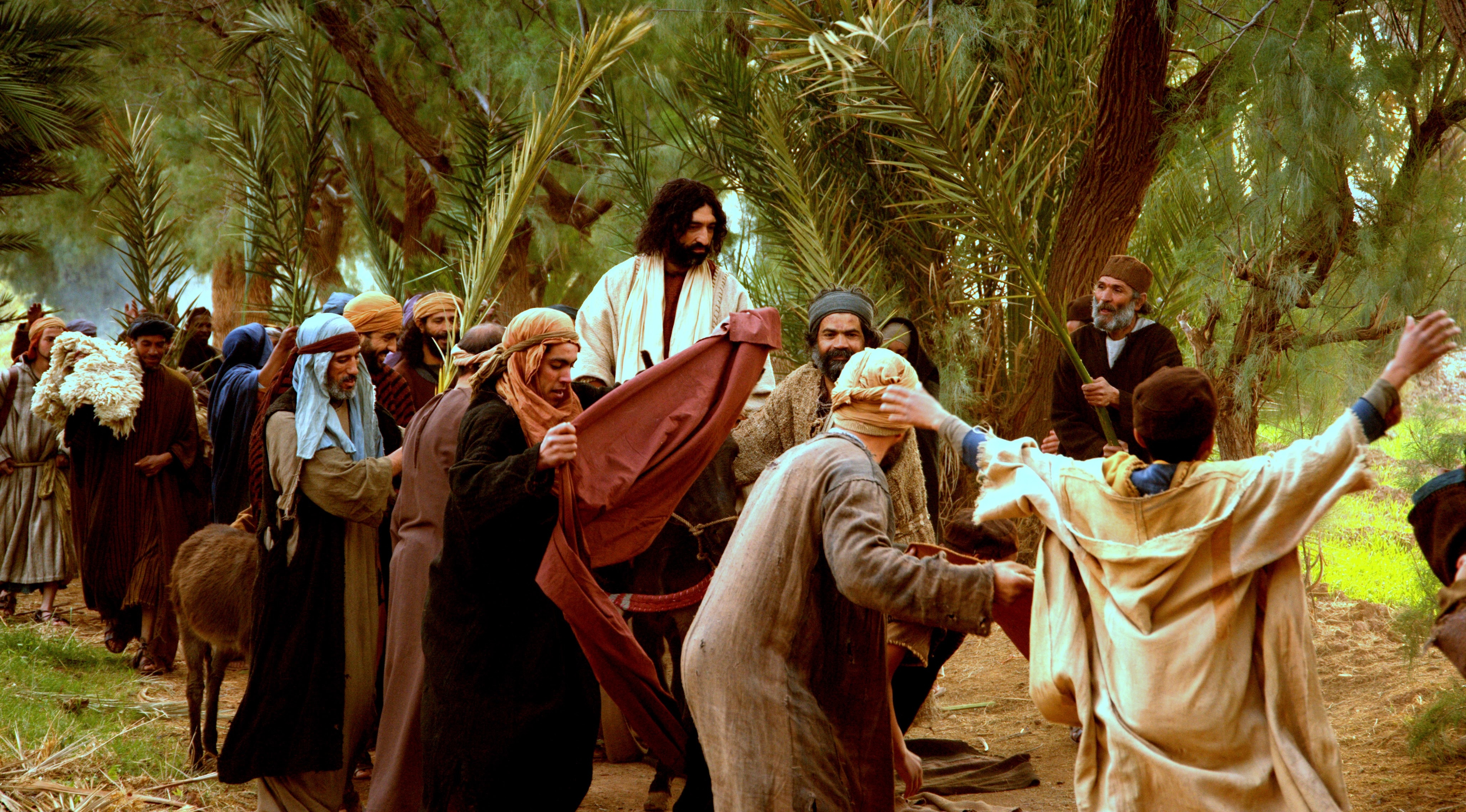
Remember Adam and Eve in the Garden of Eden. After they ate from the tree, they sewed fig leaves together to cover their nakedness and shame. Then they heard the sound of God walking in the Garden that evening, and they hid (Gen. 3:7-8). They hid because when you have utterly failed someone, the last place you want to be is with that person. But God was seeking them out. He still wanted to be with them. He called out, “Where are you?” (Gen. 3:9) and gave them chance after chance to repent (Gen. 3:9-13). Even though Adam and Eve didn’t repent and passed the blame around—Eve to the serpent, Adam to his wife and even to God Himself. They didn’t know that God had come to give them the promise that He would crush the serpent’s head through the Seed of the Woman (Gen. 3:15).

Here, Jesus had come to announce that crushing was done. He came to proclaim that sin, death, and Satan were defeated by His death and resurrection. So, He doesn’t wait for them to come to Him. Again, He seeks them out and steps right into the middle of their fear and failure. Christ opens His mouth, and His first words aren’t, “What happened?” or “Why did you fail so badly?” or “How could you?” Even before they can get out an, “I’m sorry,” Jesus unexpectedly says to them, “Peace be with you” (Jn. 20:19).

This isn’t just a normal greeting. This is Jesus’ full, total, complete absolution. He had come to bring peace. His words deliver the wholeness and reconciliation that He had purchased with His own Blood on the cross. The peace that the angels had announced at His birth is now fulfilled in His resurrection.

To drive the point home, Jesus shows them His hands and side (Jn. 20:20). The nail prints. The spear wound. They are still there. But they are not marks of defeat. They are badges of His victory. By those wounds you are healed (Is. 53:5). Now, seeing those wounds doesn’t cause them regret or sadness. Instead, they are changed. Terror turns to gladness. Fear gives way to joy.

Then Jesus says it again, “Peace be with you. As the Father has sent me, even so I am sending you.” He breathes on them and says, “Receive the Holy Spirit. If you forgive the sins of any, they are forgiven them; if you withhold forgiveness from any, it is withheld.” Just as God had breathed life into Adam at the beginning of creation (Gen. 2:7), Jesus, the Son of God and new Adam, breathes the Holy Spirit into His people that first day of the new creation (2 Co. 5:17). And He gives them—and through them His whole church—the authority to deliver forgiveness in His name.

Dear saints, this unexpected peace is for you too. Jesus still comes unexpectedly into our locked-up lives and spaces we barricade because of fear, guilt, and regret. He comes through every barrier you can put up because He loves you. He brings you His absolution because the price has been paid. His peace is for you. Your sin Is forgiven. The tomb is empty. Death is defeated.

Because He has given you this peace, Jesus also sends you with it. As He was sent to seek and save the lost (Lk. 19:10), so He sends you. In your homes, schools, neighborhoods, you are ambassadors of Christ’s peace (2 Co. 5:18-20). When your husband or wife, children or parents, coworker or classmate fails you, you get to deliver and speak Christ’s forgiveness.

Oakley, that brings me to you. Today you are Baptized. Jesus has placed His name upon you (Mt. 28:19) and joined you to His death and resurrection (Ro. 6:3-5). Christ has breathed His life into you and given you the Holy Spirit (Act. 2:38-39). Even when you sin and fail, Christ repeatedly comes to you bringing you the peace of His absolution.

Oakley and all you saints, keep close to Him. Hear His Word so you don’t run from Him but to Him in faith. Hear from Him again and again, “Peace be with you. I have died for you. I am risen for you. In Me, you have life both now and forever.”

Alleluia! Christ is risen! 
He is risen indeed! Alleluia!

The peace of God, which surpasses all understanding, will guard your hearts and your minds in Christ Jesus (Php. 4:7). Amen.

[1]Luke 24:13 (ESV) mentions that the distance from Jerusalem to Emmaus is “about seven miles.” There are four possible sites for Emmaus. The one that seems most likely is current day Mozah which is 3.5 miles from Jerusalem. It is possible that Luke calculated the round-trip distance.

The God of Justice – Sermon on Matthew 26:1-27:66 for Palm Sunday

Matthew 26:1-27:66

In the name of Jesus. Amen.

Good job. I know that is a hard reading, but it’s worth the effort. The accounts of our Lord’s Passion in the four Gospels are some of the most precious words ever written. I’d encourage you this week to read the other three accounts. Read Mark 14-15 one day, Luke 22-23 another day, and John 18-19 another. Reading those will prepare your heart and lips to cry out next Sunday, “He is risen indeed!”

Most of the time, we see the crucifixion of our Lord as an act of terrible injustice. Jesus – the only sinless person – is condemned to die a gruesome death. Even Pilate wrestles with the injustice as the crowds keep crying out for Jesus to be crucified (Mt. 27:15-23). He asks, “Why? What evil has he done?” But Pilate was too weak and timid to do the just thing and release Jesus, so he delivers our Lord to be crucified. There’s no question that, from a human standpoint, Jesus’ condemnation is utterly unjust.

But, in the cosmic view of things, the crucifixion, God is accomplishing the greatest act of justice ever. But this act of justice is going on ‘behind the scenes,’ so to speak. So, let me make the case for that, and you can tell me what you think after the service. We have to take a few steps back to see it clearly.

Six weeks ago, on the first Sunday of Lent, we considered Genesis 3 and the Fall. There, in the Garden of Eden, Satan tempts Adam and Eve to sin and rebel against God like he had. Why does he do that? Well, the devil knows he can’t defeat God and that he can’t be redeemed. So, the devil wants to hurt God, and the only way he can figure out how to hurt God is to come after us and try to sever us from God. So, he tempted our first parents to fall into sin, which they do. But God wasn’t about to let the devil have us. God promises to judge Satan by sending the Seed of the woman to crush his head (Gen. 3:15). In other words, God is saying, “I’m not going to let you have them. I will come and crush you.”

Now, fast-forward to Jesus’ temptation in the wilderness. In the first temptation, the devil says, “If you are the Son of God, command these stones to become bread” (Mt. 4:3Lk. 4:3). The devil says, In a sense, the devil was saying, “You’re God. Why should you go hungry when everyone else in the world is eating? Quit trying to save these people. Let me have them.” Of course, Jesus resists all of the devil’s temptations there in the wilderness. But the Gospel of Luke has an interesting line after those temptations are finished. He says, “And when the devil had ended every temptation, he departed from [Jesus] until an opportune time” (Lk. 4:13). In other words, the devil had more temptations for Jesus.

One of those ‘opportune times’ came after Jesus told the disciples that He would suffer, be killed, and rise again. Peter rebukes Jesus saying, “Far be it from You, Lord! This shall never happen to You.” And Jesus responds to Peter, “Get behind Me, Satan!” (Mt. 16:21-23). The devil was using Peter’s love of Jesus to try to get Him to abandon His mission of going to the cross. But another ‘opportune time’ is even more explicit in our text today as Jesus is on the cross.

Look again at Matthew 27:39-44. The crowds deride Jesus saying, “You who would destroy the temple and rebuild it in three days, save yourself! If you are the Son of God, come down from the cross.” And, “He saved others, he cannot save himself. Let him come down now from the cross, and we will believe in him. He trusts in God; let God deliver him, if He desires him.”

Satan was using those voices, that mocking and deriding. Picture it. There is Jesus. Naked. Beaten. Bloodied. A crown of thorns on His head. His back whipped to shreds. Nails through His hands and feet. He hangs there dying for their sins and suffering the wrath of God that they deserve. And the very people He’s doing all this for are saying these things to Him.

It’s easy to picture the devil whispering in Jesus’ ear, “Do you hear what they’re saying to you? Why are you doing this for them? You don’t have to do this! You said they would die because of their sin. I thought you are a God of justice? Let me have them. That would be fair. They don’t deserve to have you die for them. It would be just for you to abandon them.”

But Jesus resists the temptation. He wants to redeem you. It would not be just for Him to save Himself. Justice is Jesus getting back what belongs to Him. That’s you. The devil is a thief (Jn. 10:10) and a liar (Jn. 8:44), and Jesus will simply not let Satan have you.

In reality, justice is God winning you back from the clutches of sin, death, and the devil. Justice is God having you as His Own. Justice is you living under Him in His kingdom as He intended. That’s justice. And your God is a God of justice. A God of justice. A God of forgiveness. A God of grace and mercy.

This is why we regularly use 1 John 1:9 before our confession of sins. “If we confess our sins, He is faithful and just to forgive us our sins and cleanse us from all unrighteousness.”

Dear saints, your God is merciful and just (Ex. 34:6-7). Your Savior did not come down from the cross because He will not let the devil have you. In His mercy, He gives Himself for you. Christ perfectly obeyed God’s Law for you. Jesus suffers the punishment you deserve. As surely as His mercy is for you and your benefit, His justice is also for you and for your benefit. Psalm 89:14 shows us who God is, “Righteousness and justice are the foundation of Your throne; steadfast love and faithfulness go before You.” That truth is most clearly seen in the cross of Christ.

Dear saints, justice and mercy meet you this Holy Week. Jesus stays on the cross that you may be His Own. He refused to save Himself because He is determined to save you. Let His cross be your comfort and His empty tomb your sure hope, now and forever. Welcome to Holy Week. Amen.

The peace of God, which surpasses all understanding, will guard your hearts and minds in Christ Jesus (Php. 4:7). Amen.

War of Words – Sermon on Genesis 3:1-21 for the First Sunday of Lent

Genesis 3:1-21

In the name of Jesus. Amen.

Genesis 3 is the first battle in the war between the devil on one side versus God and mankind on the other side. Because mankind was the crown of God’s creation, Adam and the woman were Satan’s initial target in his war against God and what He has made. And God knew what He was doing when had Moses record this chapter for us. The Holy Spirit, I suppose, could have inspired Moses to simply write, “But they ate from the forbidden tree, and that’s why everything is messed up,” and move on to Gen. 4. Instead, the Holy Spirit inspired Moses to write a detailed account of what happened. One of the reasons for that is so we can see the way the devil continues to fight against God and us. When you are fighting against someone, it’s helpful to know the weapons, tactics, strategies, and goals of your enemy so you can know how counter those attacks. So, that’s what we’re going to do as we consider this text today.

First, the devil’s weapon: He has only one. The devil couldn’t wage his war against our first parents with stones or clubs or swords or horses or tanks or guns or bombs. He couldn’t use anything physical against them because God’s creation was good – so very good, in fact, that nothing physical could harm them. The devil used the only weapon available to him, and that weapon was words.

The most important thing about us is what we believe because what we believe is the foundation of everything else in our lives. Our belief affects what we do, what we say, what we feel, and how we react. So, the devil came into the center of God’s good creation, into the garden, with words to shatter our belief and to wage his war. And the devil uses the serpent as his tool to hurl those murderous words at our first parents. The devil could’ve used anything to toss his lies at Adam and the woman. Just like an enemy could hurl a stone at a you with his arm, a slingshot, a catapult, or by dropping it from a castle wall, the stone can do harm in any of those instances, but the weapon is the same.

Satan uses the serpent here, but the devil isn’t limited to snakes when he wages war on you. He’s very imaginative and crafty with the different methods he’ll use against you. He might use a book, a video, or the news to throw his weaponized words at you to get you to doubt God and His promises. That worm could use, for example, a doctor who gives you a perfectly accurate diagnosis, “You have this disease, this cancer and you have this long to live.” That doctor might be 100% correct with that diagnosis, but that could be the method that the devil uses to hurl satanic lies at you. Remember, the Son of God, your Savior, promises that death doesn’t get the last word on you, believer. He promises, “Whoever believes in Me shall never die. [The one who believes in Me] has [already] passed from death to life” (Jn. 11:265:24).

So, words are the devil’s weapon. Now, what are his tactics and strategies as he uses that weapon? His tactic is to create space, to open just enough room for you to doubt God. Getting you to doubt God is His goal, so more on that in a minute. His tactic and strategy is to separate and distance you from God and His promises. And it doesn’t take very much space. He can slither his way into the tiniest of cracks.

As that slimy worm talks to the woman here, he presents the possibility that God is holding something back and has denied her something. He wants to open up enough space to make her think that she’s insufficient. The thing you need to notice is that God actually was holding something back from the woman and from Adam. He was withholding the knowledge of evil. God never intended us to know, let alone experience and endure, evil. But God was, as He always is, infinitely good by withholding that knowledge of evil from them.

Consider how small the crack is that the devil used to plant that tiny seed of doubt. That loathsome worm says, “You will be like God, knowing good and evil” (Gen. 3:5), and that statement was true. God Himself agrees. We didn’t read all of Gen. 3, but in the verse right after our reading ended, God says, “Behold the man has become like one of Us in knowing good and evil” (Gen. 3:22). Here’s the thing: Adam and the woman were already created in the image of God (Gen. 1:27). So, do you see how tiny the crack is – like vs. in the image? It’s a tiny difference vocabularically [sic.], but it’s a massive difference theologically.

God did not create us to be exactly like Him. He did create us to bear His image, which is much better for us. We can’t handle being like God. That’s beyond our capacity and ability. It’s too much of a burden for us. Scripture teaches that the best way to combat the devil’s tactic of distancing us from God’s promises, to prevent that space being opened up, is to be content with who we are and content with what God made us to be.

Whenever you sin (no matter what particular commandment you break), you never break only one Commandment. You always break at least two, if not three. Scripture clearly teaches this, but we don’t often think of it this way. Both Col. 3:5and Eph. 5:5 tell us that coveting (9th and 10th Commands) is idolatry (1st Command). When you covet, you are putting yourself in the place of God. Coveting is you saying, “God has messed up. That thing over there,” whatever that thing is, “should be mine over here.”

That is idolatry of self and putting yourself in the place of God. If your sin goes no further, you’ve broken two commands. But if your sin does go further, you break more. Stealing starts with you coveting something someone else owns, which is idolizing yourself, and then you actually take it. Lying starts with you coveting the truth to be something different than it actually is – which, again, is idolizing yourself. Then, you lie to make yourself look better or make your neighbor look worse than he/she is.

Contentment is the counter strategy you have to use against the devil’s tactics. In Php. 4:11-13, Paul urges us toward contentment. He says, “I have learned the secret of facing plenty and hunger, abundance and need.” That secret is contentment. When things are good, be content and don’t seek more. When things are bad, be content. Know that God is in control – even of the evil things you experience, and He promises that He will provide (Mt. 6:331 Tim. 6:6).

Again, the devil’s weapon is words, and his tactic is to create space between you and God’s promises. But that worm’s goal is to get you to doubt God. Don’t! God is no liar. God is faithful. He’s true to His Word.

So, your goal when fighting against temptation should be twofold. First, know God’s Word – more and more, better and better. And second, use that Word. 

You need to know that word extremely well. The woman ended up adding to God’s Word when she says that God didn’t allow them to touch the tree (Gen. 3:3). That wasn’t what God said. God never forbade them to touch the tree (Gen. 2:16-17). But the woman adds to God’s command, which shows that she thought God’s Word was insufficient.

Also, notice how during the temptation, Adam is absolutely silent. He doesn’t respond, interject, or interrupt. Adam doesn’t do or say anything. He just sits there and listens while this all plays out. That’s never the right approach when the devil attacks. When facing temptation, don’t be like Adam. Instead, follow your Savior’s example.

In our Gospel text (Mt. 4:1-11), Jesus counters all three of the devil’s temptations with Scripture. With the temptation to turn stones into bread, Christ quotes God’s Word that focuses on God’s promise of provision (Mt. 4:3-4Dt. 8:3). Your life doesn’t consist in temporal, earthly food. Your life comes from every word that comes from God’s mouth.

When the liar (Jn. 8:44) realizes that Jesus is using Scripture to fight back, Satan tries to use Scripture against Jesus. Think of that. The devil tries to use God’s Word against the Word of God in the Flesh (Jn. 1:14). He says, “God has promised to protect You (Ps. 91:11-12), but have You ever tested that? Jump off this building and see if it’s actually true.”

Dear saints, Satan is still doing this today. Today, he’s using all sorts of voices to pluck Scripture out of context to try to accuse you. The devil will use people who hate God and His Word to quote God’s Word at you and to accuse you of ‘not being very Christ-like.’ Don’t fooled by that. 

Yes, of course, God will protect Jesus from every trouble. But God isn’t a worthless father who will bail his kid out of every trouble that kid gets himself into. To be able to counter the slimy attacks of the worm, you need to know your Bible and know it well so that you won’t be fooled by the satanic twisting of God’s Word. So, Christ counters with Scripture, “You shall not put the Lord your God to the test”(Dt. 6:16). 

Also, notice Jesus’ response to the third temptation. Yes, He quotes Scripture, but even before He does that, our Lord simply says, “Be gone Satan.” And the devil is forced to flee (Mt. 4:11). Sometimes, you simply need to do the same thing. Tell that vile worm, “Get out of here. I’m not falling for your lies, and I don’t want to listen to them anymore.” There’s a time to tell the devil, “Be gone, you little worm.” That’s a good strategy for you to resist Satan’s attacks.

Finally, dear saints, be comforted. You will fall in this war of words. You will fall into sin. But don’t despair. You have a God who seeks you out like He seeks Adam and the woman saying, “Where are you?” (Gen. 3:9). In that moment, know that God isn’t coming after you to punish you. He’s calling you back to Himself. Be quick to acknowledge and repent of whatever sin you have. Your Savior has come. He has crushed the serpent’s head (Gen. 3:15), and He knows the temptations you face because He was tempted in every way as you are, yet without sin (Heb. 4:15). So, He sympathizes with you and your weakness. Even better, He has paid the price for your sins with His own blood (1 Pet. 1:18-19). And He clothes you, not just with animal skins (Gen. 3:21), but with the perfect, spotless robe of His righteousness (Is. 61:10Php. 3:9).

So, fight the good fight (1 Tim. 6:2). Take up the weapons of righteousness and fight against the enemy of your soul. Your Savior is returning with the sound of His war trumpet (Mt. 24:311 Co. 15:52). And in that day, you will be forever changed to be like Him (1 Jn. 3:2) – immortal, at peace, at rest, and altogether alive. Amen.

The peace of God, which surpasses all understanding, will guard your hearts and minds in Christ Jesus (Php. 4:7). Amen.
Aligned – Sermon on Matthew 6:1, 16-21 for Ash Wednesday

Matthew 6:116-21

In the name of Jesus. Amen.

I thought about starting this sermon with a question, but I’m going to start with the answer first. So, here’s the answer, “No. Absolutely, positively, definitely not!” That’s the answer. You’re probably wondering, “Ok, pastor. What’s the question?” Here it is: “Is Jesus telling us to be hypocrites here?” Again, the answer is, “No way. No how. Nuh-uh.” One of the common definitions of a hypocrite is ‘someone who says one thing and does another.’ Or we can flip the order – a hypocrite is ‘someone who does one thing and says another.’

That definition is overly simplistic because here Jesus says that when you fast you are to make it look like you aren’tfasting. And Jesus isn’t telling you to be a hypocrite. So, we should probably get better get a better, more Biblical definition of what hypocrite is. A hypocrite is someone who removes God from the equation of everything they do.

Scripture clearly teaches that everyone knows that God exists. Ro. 1:19-21 says that God has revealed Himself in the things that have been made. But instead of acknowledging God, people do not honor Him as God or give thanks to Him. The short way to say that is that atheists don’t exist. Sure, there are liars who falsely call themselves atheists. They claim to believe that God doesn’t exist, but they’re lying to themselves.

So basically, a hypocrite is someone who seeks the approval of men rather than of God. Jesus repeatedly says so here in Mt. 6. Christ says that hypocrites sound a trumpet before they give so that they can be praised by others (Mt. 6:2). He teaches that hypocrites pray so that they can be seen by others (Mt. 6:5). In this reading, our Lord says that hypocrites make themselves look gloomy and miserable when they fast so they will be seen by other people (Mt. 6:16).

In other words, hypocrites do good works. But they do those good works to get the approval of other sinners instead of God. Again, they remove God from the equation. Ultimately, hypocrisy is idolatry. It makes people into little gods. And if you do good works for people, Jesus says that you already have your reward which won’t last. But Jesus promises that if you do your good works for God, you will be rewarded by God, and that reward will be eternal treasure that will last forever (Mt. 6:4618).

With all of that said, I’m going to give you the entire sermon in one sentence. Ready? There is a spiritual benefit to the bodily practice of fasting because fasting helps align our body and soul.

Christian, you are justified and saved by grace through faith and not your works (Eph. 2:8-9). Faith is not just something that happens in your heart and that’s it. No. Faith changes everything about you. Faith changes both your soul and your body. In other words, faith is lived out. We know this because God works on you to sanctify you, to make you more and more holy.

There are two aspects of sanctification. First, sanctification comes about when the Holy Spirit comes to live in you and gives you the strength to love God and love your neighbor. Sanctification is that growth in good works and acts of love. The second side of sanctification is that the Holy Spirit gives you strength to fight against your sinful flesh. Ro. 6:12-14 puts it this way, “Let not sin reign in your mortal body, to make you obey its passions.” In other words, don’t go on sinning. Don’t let yourself to continue living in sin.

That’s where fasting comes in. You can think of fasting as practice. Just like a basketball player will run ‘crushers’ and do dribbling and shooting drills so, when they face an opponent in a game, all of those things come naturally. Fasting is like doing those drills. It gives you the endurance and discipline and skill that you need to fight against sin when it really counts.

Before I go on, I have to add this. You can’t fast when it comes sinful actions. If you’re a kleptomaniac and habitual liar, you can’t say, “I’m going to fast from stealing and lying.” No! Those are sins; don’t do them. Fasting is temporarily denying yourself and not doing things that aren’t sinful. You do that so that you know what to do when you stand face-to-face with sinful lusts and desires.

Normally, we think about fasting as not eating. That is one way to fast. When you fast from eating and your stomach growls and starts preaching to you, “Hey, you should feed me,” you say to your stomach, “You’re not the boss. Man does not live by bread alone but by every word that proceeds from the mouth of God” (Mt. 4:4Dt. 8:3). Then, instead of eating, you read Scripture or pray. That discipline helps bring your body in alignment with your redeemed and forgiven soul.

So, I would encourage you, give fasting a try. It doesn’t have to be giving up food. Use your God-given wisdom to pick something that you regularly do and don’t do it for a certain amount of time. Let me give you a few possible examples:

Maybe, you decide that you won’t go on YouTube or social media for a few days, or you decide to limit yourself to a certain amount of time on those apps each day, or only during a certain window of the day. You get to pick. Then, when you have the desire to go on them outside of your window, read your Bible or pray or sing a hymn instead.

Maybe, you decide to give up watching a news program for a while. Instead of watching it, read the Psalms to remind yourself that God is in control. This will help you learn that the world won’t fall apart just because you don’t know what’s going on. Use that time to pray for our leaders.

Maybe, you normally listen to something on your headphones while you’re plowing snow. Instead of doing that, meditate on a passage of Scripture. Maybe, you set your alarm 15 minutes earlier and deny yourself that bit of sleep to pray for your family and friends or text them a Bible verse.

The possibilities are endless. By doing those things, you train your body and mind and bring them into alignment with your redeemed soul. You gain self-control and see that you have the strength to fight when you have desires that are actually sinful.

Yes, keep your fasting secret, but remember that Jesus promises that your heavenly Father sees your fasting and will reward you. In other words, fasting lays up treasures in heaven for you. And where your treasure is, there your heart will be also (Mt. 6:21).

Dear saints, know this – God loves you whether you fast or not. He has come to win your forgiveness and salvation, and His work is finished, complete, and perfect. Certain of that restored relationship with God, know that you are His, and you are free. Free to spend your life on things that matter. Free to store up eternal treasures in heaven. 

And your Savior freely invites you now to His table to receive the greatest treasure of His Body and Blood given and shed for you for the forgiveness of all your sins. Amen.

The peace of God, which surpasses all understanding, will guard your hearts and minds in Christ Jesus (Php. 4:7). Amen.
Scene 2 – Sermon on Matthew 18:21-35 for the Twenty-second Sunday after Trinity

Matthew 18:21-35

21 Then Peter came up and said to him, “Lord, how often will my brother sin against me, and I forgive him? As many as seven times?” 22 Jesus said to him, “I do not say to you seven times, but seventy-seven times.

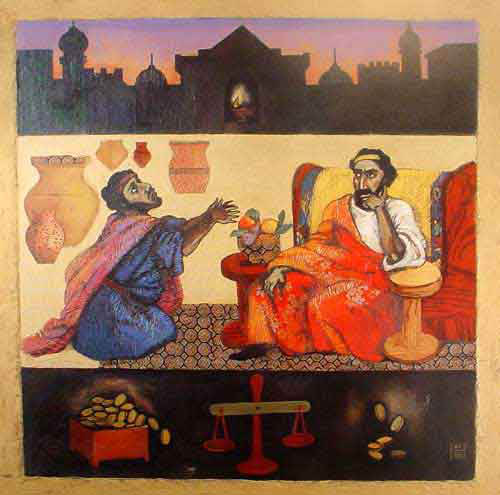
23 “Therefore the kingdom of heaven may be compared to a king who wished to settle accounts with his servants. 24When he began to settle, one was brought to him who owed him ten thousand talents. 25 And since he could not pay, his master ordered him to be sold, with his wife and children and all that he had, and payment to be made. 26 So the servant fell on his knees, imploring him, ‘Have patience with me, and I will pay you everything.’ 27 And out of pity for him, the master of that servant released him and forgave him the debt. 

28 “But when that same servant went out, he found one of his fellow servants who owed him a hundred denarii, and seizing him, he began to choke him, saying, ‘Pay what you owe.’ 29So his fellow servant fell down and pleaded with him, ‘Have patience with me, and I will pay you.’ 30 He refused and went and put him in prison until he should pay the debt. 31 When his fellow servants saw what had taken place, they were greatly distressed, and they went and reported to their master all that had taken place. 

32 “Then his master summoned him and said to him, ‘You wicked servant! I forgave you all that debt because you pleaded with me. 33 And should not you have had mercy on your fellow servant, as I had mercy on you?’ 34 And in anger his master delivered him to the jailers, until he should pay all his debt. 35 So also my heavenly Father will do to every one of you, if you do not forgive your brother from your heart.”

In the name of Jesus. Amen.

Jesus gives a sober warning at the end of this text. I’m going to reorder and tweak the way Jesus says it to make it crystal clear. Our Lord says, “If you do not forgive your brother from your heart, My heavenly Father will do to you what the king did to that first servant. He will demand you pay your debt and hand you over to the jailers for eternity.” Christian, you are forgiven, so you also must forgive. This is what Jesus is teaching with this parable. The parable has three scenes. And the order in which they happen is what makes Jesus’ point so powerful.

In Scene 1, the first servant (let’s call him ‘Vinnie’). Vinnie is hauled into the palace owing 10,000 talents to the king. Normally, a ‘talent’ is a unit of weight, not currency. Commentators are split on how we should understand what a talent’s value is. Some figure it’s a years’ pay; some say 20 years of wages. Either way, this is an impossible debt for an individual to pay off. After Vinnie’s debt is announced, the king commands that Vinnie, his wife, his children, and everything he has be sold. And Vinnie – notice what he begs for – he says, “Have patience with me, and I’ll pay you everything.” In other words, he asks for time. It’s ridiculous. Time? Time isn’t going to help! So, the king forgives the debt, he releases it. But debts are always paid by someone. They don’t just magically vanish. Here, the king pays. He swallows the debt and releases Vinnie. This is utter, unmerited mercy on the part of the king. End scene one.

The curtain rises and the spotlights illumine Scene 2, and we find Vinnie outside the palace. We’d expect him to be in a fantastic mood – smelling flowers and singing with birds. He’s forgiven and freed. But it sure doesn’t look like it by his actions. Vinnie spots his buddy (let’s call Vinnie’s buddy ‘Chuck’) who owed him 100 denarii, which is 100 days’ wages. That’s not an insignificant amount. But compared to what Vinnie was just forgiven – it’s pittance. Immediately, Vinnie grabs Chuck by the throat, throttles him, and demands, “Pay what you owe me.” And Chuck echoes almost word-for-word what Vinnie said in Scene 1. Chuck asks for time, but Vinnie doesn’t even give Chuck that. He has Chuck thrown into prison. Scene 2 ends with other servants informing the king how Vinnie had acted.

Now, just pause here. It’s intermission in the play of this parable. Let’s say you arrived late to the play and didn’t see Scene 1. All you know about it was that Vinnie is the character who owed 10,000 talents to the king. But you did watch all of Scene 2. What would you suppose happened in Scene 1? You would imagine that the king was still expecting Vinnie to pay the entire debt. The king must be breathing threats down Vinnie’s neck. That’s the only logical explanation. It’s the only way Vinnie’s actions are justified. And they would be just. It’s still futile; Vinnie won’t be able to choke enough throats to get out from under his debt. But at least it would make sense of his actions.

Dear saints, how many people know you are a Christian, but don’t have any idea about what goes on here? I mean, they might have an obscure idea that you’re coming here to meet with God. But they don’t necessarily know what goes on in this sanctuary between you and God while you’re here. So, ponder this: What does your Scene 2 say about the kind of God you have? Do your actions throughout the week accurately reflect on what God does here? Do people have the impression that the God you meet here is loving, kind, merciful, forgiving; or do they think your God is a harsh, cruel, punitive tyrant?

That’s all the time we have. Intermission’s over. The warning bell for Scene 3 just rang. And because we know what happened in the Scenes 1 and 2, we know exactly what’s going to happen in Scene 3. The king treats Vinnie precisely the way he deserves to be treated. Vinnie was given mercy, but he rejected that mercy by his actions. Vinnie demanded justice, so justice is what he gets. The king reinstates Vinnie’s debt, and justly so.

Dear saints, mercy has two sides. The first side of mercy is not getting what you deserve. Vinnie deserved to lose everything. He deserved to be sold with his family and possessions, but the king wanted to be merciful and not give Vinnie what he deserved. The second side of mercy is being given what you do not deserve. Vinnie had his debt forgiven and released by the king. He didn’t deserve it. I mean, Vinnie didn’t even have a grasp on how much debt he owed. Again, he had the delusion that time would help him. But the king doesn’t laugh at his idiotic request. No, the king was willing to release the debt and swallow it himself. Vinnie was given mercy, but he desperately demanded justice.

Here’s the thing: Mercy and justice are something only God can possess simultaneously. Only because of what Jesus has done on the cross can God be merciful and just to forgive and cleanse you from your sin (1 Jn. 1:9). Dear saints, God gives His mercy to you. It’s yours, but it is not something that you can keep for yourself and withhold from others. As soon as you try to hold on to God’s mercy and keep it only for yourself, you lose it. Forgiving others and being a forgiving person is not optional for a Christian. And this is hard.

Forgiving others, releasing someone from the retribution and retaliation that they deserve, is difficult. Some of you have been sinned against in ways that are so painful that I can’t even imagine. So, how do you go about being a person who forgives?

Let me give you two pastoral pieces of advice on how to be better forgivers. First, know that to forgive from the heart is something only a Christian can do, and the only reason a Christian can do it is what has happened in your Scene 1. Because of Christ’s death, God forgives your debt of sin. He separates it from you as far as the east is from the west (Ps. 103:12). The best way to grow as a forgiver is to recognize the massive debt that God has released for you.

Second, know that you aren’t going to forgive as perfectly God does. Pain and distrust will still be there. And forgiving someone does not mean that you have to become best friends. You can, and sometimes you must, forgive and still have boundaries to keep the one who has sinned against you away from you.

Forgiving is hard, but you can choose to forgive. That Holy Spirit-led choice is an act of a reborn disciple of Jesus. The emotions of pain and hurt and anger you have may slowly follow along in agreement. But, you might need to drag your emotions kicking and screaming behind you. Your emotions might take a long time to get on board with the choice to forgive. But one thing I would encourage you to do to help with that process is this: Name the sin.

If you’re angry and frustrated with someone for something, think concretely and specifically how you were sinned against. Figure out what commandment was broken when that person hurt you. We live in a sinful world. It’s naive to think that we are going make it out of here without having someone sin against us. You are going to be hurt in this world, and it will be painful. Your natural reaction to that hurt will be frustration, anger, and resentment. If you have that, name it. Name the sin that has been committed against you because then, it becomes something concrete, something you can identify. And being able to identify it, helps you realize what to do with that sin. It helps you realize that sin has been taken away by the Lamb of God.

You might be justified to want to strangle someone. But remember that God was justified to do that to you, and He didn’t. He didn’t. Instead, your God has released you and your debt for the sake of the complete payment of Jesus for your sin. He’s already done that here for you today in the Absolution, and He’s about to do it again here, at His Table. This is your Scene 1. Let that be reflected out there in your Scene 2. Amen.

The peace of God, which surpasses all understanding, will guard your hearts and minds in Christ Jesus (Php. 4:7). Amen.
Live Man Walking – Sermon on Ephesians 2:1-10 for the Eleventh Sunday after Trinity

Ephesians 2:1-10

1 And you were dead in the trespasses and sins 2 in which you once walked, following the course of this world, following the prince of the power of the air, the spirit that is now at work in the sons of disobedience— 3 among whom we all once lived in the passions of our flesh, carrying out the desires of the body and the mind, and were by nature children of wrath, like the rest of mankind. 4 But God, being rich in mercy, because of the great love with which he loved us, 5 even when we were dead in our trespasses, made us alive together with Christ—by grace you have been saved— 6 and raised us up with him and seated us with him in the heavenly places in Christ Jesus, 7 so that in the coming ages he might show the immeasurable riches of his grace in kindness toward us in Christ Jesus. 8 For by grace you have been saved through faith. And this is not your own doing; it is the gift of God, 9 not a result of works, so that no one may boast. 10 For we are his workmanship, created in Christ Jesus for good works, which God prepared beforehand, that we should walk in them.

In the name of Jesus. Amen.

“Dead man walking!” That phrase originated just over 100 years ago. It was called out when a death-row inmate was being marched through the prison halls to the execution chamber. When that phrase was shouted, the inmate was, obviously, still alive, but he was as good as dead. The inevitable was soon to happen, and judgment would be carried out. Imagine how lonely that soon-to-be-executed inmate would feel hearing that phrase, “Dead man walking.” Yes, he is still breathing, still has a beating heart, still alive, and still a part of humanity. But his demise is mere moments away.

Here, in the first three verses of this text, Paul might as well be calling out, “Dead man walking!” about each of us as he describes our former life in sin. Because of our sin, every one of us was marching to our imminent demise. Hopeless, doomed, and lonely.

God created us in such a way that we are connected to each other. We have all blossomed from the root of Adam. Since the poison of sin ran through his veins, it has spread through the entire plant of humanity. And it isn’t just the fact that you and I inherited Adam’s sin and are charged with a crime that he committed. No. We all willingly march straight forward into the deadness and rebellion against God that we have inherited from Adam.

We do not become sinners by sinning. We sin because we are, by nature, sinful and unclean. We sin against God in our every thought, word, and deed. We were born revolting and fighting against every notion that we should submit ourselves to the will of God, against every idea that we should serve our neighbor. In other words, we fight against what God created us to be. That’s a losing proposition. And yes, our life in sin is that broad road that has been traveled by every member of the human race. But it is still a long, lonely road.

But – that word can be so beautiful – “but God, being rich in mercy, because of the great love with which he loved us, even when we were dead in our trespasses, made us alive” (Eph. 2:4-5). God saw our lonely, helpless, hopeless state, and, in His great love for us, He did something about it. God be praised!

The ESV does a very good job with its translation here through v. 5-6; I just want to highlight it a bit further. Notice all the withs in v. 5-6. God, because of the great love with which He loved you, has made you alive together with Christ, raised you with Christ, and seated you with Christ in the heavenly places. God saw your situation, and He has joined you to and with Jesus. Now, you are alive with, raised with, and seated with your Redeemer and Savior who is the Lord and King of all creation.

Your place in heaven is secure because what is true of Christ is now true of you who have become incorporated into and joined with Him. Dear saints, Jesus became what you are, so that He could make you what He Himself is (St. Irenaeus).

Because of Jesus, no longer are you a lost, lonely “dead man walking.” Now, you are a “live man walking.” All this is yours by God’s grace, through God-given faith. It isn’t because you have made the right sacrifices or have done enough good works. It isn’t because of your efforts, your desiring, your deserving, your trying, or even your deciding. Nope! It isn’t because of your actions or work at all.

It’s only because God has worked faith in you so that you now cry out, “God be merciful to me, the sinner” (Lk. 18:13). Through Jesus, God Himself has made you alive with Christ, raised you with Christ, and seated you with Christ. Normally, when Scripture talks about Christ being seated, it adds that He is seated at God’s right hand. Over and over again, it does this (Ps. 110:1Mt. 26:64Mk. 14:6316:19Act. 7:56Ro. 8:34Eph. 1:20Heb. 1:3).

That’s why, when we confess the creed (either Apostles’ or Nicene), we confess that Jesus is “seated at the right hand of God the Father [Almighty].” But notice here in v. 6 that when Paul announces that you are seated with Christ, he doesn’t add the phrase “at God’s right hand.” That is because God’s right hand isn’t so much a place or location. Instead, it is a position of authority and honor.

Christ has been raised from the dead and has ascended into heaven where He is seated at God’s right hand with all power and authority in heaven and on earth. You are seated with Christ in the heavenly places, and yet you remain here on earth – but still in a position of authority because you are seated with Christ. No, you aren’t all-powerful or everywhere-present like Jesus. But, you do have a share in His authority as you live here on earth. Christian, you have risen with and are seated with Christ not in such a way that you are removed from this world. Instead, you are exalted here – in this world, in this life – with the divine honor of being God’s child.

God intentionally leaves you here to exercise that authority in His creation through your good works. That’s why God has prepared those good works for you to walk in. And – this needs to be abundantly clear – the good works that God has prepared for you to walk in are not some secret thing that God hasn’t revealed to you. You don’t have to go around searching for these good works as though they are hidden. These good works are all around you. And you find them in the people that God puts right, smack dab in front of you.

You have been raised from your deadness in sin to be living men who walk in the love for both God and your neighbor that He created you to have. God has made you His ‘workmanship,’ His work of art, shining His light in a dark, evil, lonely world that is following the prince of the power of the air.

God has made you alive, raised, and seated you with Jesus so that in the coming ages He can show you the immeasurable riches of His grace in kindness toward you in Christ Jesus.

I just have to say here that a text as beautiful and full and rich as this one is barely needs anything added to it. You can just read it over and over and it is enough. But let me preach a little more and change gears here:

The shooting this past Wednesday at Annunciation Catholic School in Minneapolis that left two dead and 18 wounded is a sober reminder to us: this world is very, very evil. The devil, the prince of the power of the air, is constantly at work in the sons of disobedience (Eph. 2:2). Satan along with his demonic forces of evil constantly tempt everyone to live out the passions and desires of our flesh, and it often appears to us as though the devil’s reign of evil has no limits. But God doesn’t and won’t let the devil roam unchecked (Job 1:10122:6Mt. 12:29Col. 2:15).

Even though it seems as though we are entering into a new era of martyrdom in our country and that the persecution of Christianity is increasing and inevitable, God has not given Satan free reign. Jesus is still on the throne and the Head of all things (Eph. 1:22). Jesus is still in control – even in this dark age (Eph. 1:21). Whatever the future holds, God’s grace is, and will remain, constant.

God does not change. He knows what He is doing, and He uses martyrdoms, as painful as they are, for good (Ro. 8:28).

God has delivered those two saints, those two young martyrs, to Himself in mercy, and they are free. God has also made them an example to us that some things are more precious and valuable than living. May God, in His mercy, give us all a measure of their spirit.

We were dead, but now we are alive because of God’s grace given to us by faith. Jesus Himself is our risen and living Savior. Even if we die, we live because Jesus lives, and in Him we live too. Amen.

The peace of God, which surpasses all understanding, will guard your hearts and minds in Christ Jesus (Php. 4:7). Amen.
Escape – Sermon on 1 Corinthians 10:6-13 for the Ninth Sunday after Trinity

1 Corinthians 10:6-13

6 Now these things took place as examples for us, that we might not desire evil as they did. 7 Do not be idolaters as some of them were; as it is written, “The people sat down to eat and drink and rose up to play.” 8We must not indulge in sexual immorality as some of them did, and twenty-three thousand fell in a single day. 9 We must not put Christ to the test, as some of them did and were destroyed by serpents, 10 nor grumble, as some of them did and were destroyed by the Destroyer. 11 Now these things happened to them as an example, but they were written down for our instruction, on whom the end of the ages has come. 12 Therefore let anyone who thinks that he stands take heed lest he fall. 13 No temptation has overtaken you that is not common to man. God is faithful, and he will not let you be tempted beyond your ability, but with the temptation he will also provide the way of escape, that you may be able to endure it.

In the name of Jesus. Amen.

When you’re nearing the end of a task or a project, that’s not the time to get lazy, sloppy, or careless. As you get near to the goal, you need to pay close attention to what you’re doing and finish strong and make sure that you are doing things right. You’ve maybe seen replays from football games where a receiver or kick returner makes an amazing play, outruns the defense, and is about to cross the goal line. But he starts celebrating a few inches too soon and drops the ball right before the endzone. That one, careless act erases everything that he did before.

Well, here, Paul says that the end (τέλος, ‘the completion’) of the ages has come (1 Co. 10:11). And remember, he’s saying this to Christians nearly 2,000 years ago. Since it was true way back then then, it’s even truer now. Paul is encouraging us to finish strong and cross the goal line. He says, “Let anyone who thinks that he stands take heed lest he fall,” (1 Co. 10:12). In other words, don’t fall away, don’t fumble the ball, when you are so close to Christ’s return.

Plain as day, Paul tells us exactly what might drag us down and cause us to fall. In the opening verses of 1 Co. 10, he invites us to think about all the ways God’s people sinned, rebelled, and were judged after God had delivered from slavery in Egypt. He reminds us how they fell into idolatry, sexual immorality, and grumbling, causing them to be destroyed. Paul says that those things took place as examples for us.

Even though they had had God’s protection under the cloud, even though they had God’s miraculous deliverance and passed through the sea, even though they were all baptized in the cloud and in the sea, even though they ate the same spiritual food we eat and drink the same spiritual drink we drink – even though they had all those blessings from God, they were overthrown. So, Paul warns us to not be like them. To not be idolatrous, going after our own golden calves, and to not indulge in sexual immorality. To not put Christ to the test and become destroyed.

We need to learn from their example so that we don’t stumble and fall into temptation and sin right before the end of the ages. Christ is returning, and we need to persevere. If you think that you stand on your own, repent. You’re in big trouble and are about to fall (1 Co. 10:12).

Paul concludes here in v. 13, “No temptation has overtaken you that is not common to man. But God is faithful, and he will not let you be tempted beyond your ability. But with the temptation, he will also provide the way of escape, that you may be able to endure it.”

So according to Scripture, we need to learn from from the failures of others, because we are also prone to fall. We face the same temptations they did, but God is – and always will be– faithful to provide the way of escape. Often in ways that we don’t expect.

Everyone faces the same temptations. Now, being tempted is not a sin. But coveting is a sin. That’s why God gives us the final two Commandments about coveting. Coveting is the stealth bomber of sin. It flies under the radar of your conscience. Your conscience usually detects the sins that you commit in an outward way. But the sin of coveting is committed in an inward way.

You might feel guilty about replying to your spouse or someone else in an angry way that is rude and inconsiderate. But you might not be too troubled about feeling anger if you don’t let that anger out. To be clear, both of those are sins need forgiveness. Both need repentance and faith. But the 9th and 10th Commandments about coveting show that God’s Law governs even our inner thoughts, feelings, and emotions. You’ve heard this before, but it’s worth repeating over and over again. Scripture equates coveting with idolatry (Col. 3:5Eph. 5:5).

Coveting is, basically, saying, “God, You messed up. That thing over there should be mine over here.” When we realize that coveting is idolatry and is how we place ourselves above God, then coveting becomes gross and disgusting. Don’t falsely desire what God hasn’t given you. Let God be God.

So, the devil, the world, and our own sinful flesh always tempt us first to covet. They will put things in front of us that we think should be ours. Coveting is the way in which we begin to break any/all of the commandments.

But look closely at verse 13, and you’ll see three comforting truths:

First, the temptations that you face are not unique. Yes, the devil, the world, and our own flesh will individually tailor certain temptations to each of us. But everyone is tempted by the same things. Maybe in different ways, maybe through different processes, but the things that tempt you are the same things that tempt others as well.

Second, God is faithful and will not allow you to be tempted beyond your ability. God knows precisely how much weight, how much pressure, of temptation you can bear. Imagine temptations as ropes or chains that the devil would use in order to pull you toward sin. Satan cannot use ropes or chains that are too strong for you. God simply doesn’t allow it. Those chains of temptation will completely snap at the exact weight that God Himself has determined. But also, realize what that means: 

Whenever you or I sin, we aren’t pulled into that sin by forces stronger than us. No. We just didn’t fight back long or hard enough for those cords to break. In other words, when we sin, we jump headfirst into those pits. So, fight back. Fighting temptation isn’t just a mortal combat for your physical life. It’s an eternal combat for your soul. If you want to see the chains of temptation snap, just read Mt. 4 or Lk. 4 to see how Jesus resists the devil’s temptations.

The third promise that God gives here in v. 13 is that God will provide the way of escape. You have an escape out of temptation. Sometimes, people will misconstrue v. 13 and say things like, “God won’t give you more than you can handle.” On the one hand that’s true, but it’s only half true. And half-truths are often worse than blatant lies. That phrase places all the weight of fighting temptation on you and your own psychological capabilities. That phrase is basically saying, “You just need to be mentally strong enough to handle it.” Well, God gives something much better than that. He gives a way of escape.

Think of Joseph. Joseph gets attacked by his brothers and thrown into a pit, but Joseph can’t handle staying in the pit the rest of his life. So, God gives an escape, and that escape is that he is sold as a servant to Potiphar in Egypt (Gen. 37:2839:1). Later, Joseph can’t handle Potiphar’s wife asking him day after day to fornicate with her. So, God gives Joseph another escape by putting him safely into an Egyptian prison (Gen. 39:7-20).

In Joseph’s life, we see that God causes all things – even things we think are bad or horrible – to work together for good for those who love Him and are called according to His purpose (Ro. 8:28). 

In every temptation, God gives a way of escape. I know that example of Joseph might not be comforting, so think of Paul himself. In 2 Cor. 12:7-10, he talks about having a thorn in his flesh. He prays three times that God would remove that thorn, but God’s response is simply, “My grace is sufficient for you, for My power is made perfect in weakness.”

It may be that your escape from temptation is only going to come through other trials, like it was for Joseph. Or, it may be that your escape from temptation is God’s promise of His continual grace, like it was for Paul. But ultimately, your way of escape is coming because Christ is returning.

Believer, Christ is returning to bring you to the new creation. The end/completion of the ages and the resurrection of the body is the ultimate escape from temptation. So, press on in your fight against temptation and sin.

Rose, that brings me to you. Rose, today you are baptized, not just into Moses, but into the name of the Father, Son, and Holy Spirit. Now, Rose, you bear His name (Mt. 28:19). Persist. Persevere. Fight against the temptations that the devil, world, and your own flesh will throw at you.

And all you dear saints, you fight too. To strengthen you in that fight, Jesus now invites you to His table. Here, He delivers His Body and Blood, given and shed for the forgiveness of all your sin. Here, you receive God’s grace and mercy. Here, you see God’s faithfulness to you. Resist, fight, flee temptation because the end of all things is at hand. Amen.

The peace of God, which surpasses all understanding, will guard your hearts and minds in Christ Jesus. Amen.

Pleased – Sermon on Luke 2:1-20 for Christmas Eve 2024

Luke 2:1–20

1 In those days a decree went out from Caesar Augustus that all the world should be registered. 2 This was the first registration when Quirinius was governor of Syria. 3 And all went to be registered, each to his own town. 4 And Joseph also went up from Galilee, from the town of Nazareth, to Judea, to the city of David, which is called Bethlehem, because he was of the house and lineage of David, 5 to be registered with Mary, his betrothed, who was with child. 6 And while they were there, the time came for her to give birth. 7 And she gave birth to her firstborn son and wrapped him in swaddling cloths and laid him in a manger, because there was no place for them in the inn. 

8 And in the same region there were shepherds out in the field, keeping watch over their flock by night. 9 And an angel of the Lord appeared to them, and the glory of the Lord shone around them, and they were filled with great fear. 10 And the angel said to them, “Fear not, for behold, I bring you good news of great joy that will be for all the people. 11 For unto you is born this day in the city of David a Savior, who is Christ the Lord. 12 And this will be a sign for you: you will find a baby wrapped in swaddling cloths and lying in a manger.” 13 And suddenly there was with the angel a multitude of the heavenly host praising God and saying, 

14 “Glory to God in the highest, 
and on earth peace among men, with whom he is pleased!” 

15 When the angels went away from them into heaven, the shepherds said to one another, “Let us go over to Bethlehem and see this thing that has happened, which the Lord has made known to us.” 16 And they went with haste and found Mary and Joseph, and the baby lying in a manger. 17 And when they saw it, they made known the saying that had been told them concerning this child. 18 And all who heard it wondered at what the shepherds told them. 19 But Mary treasured up all these things, pondering them in her heart. 20 And the shepherds returned, glorifying and praising God for all they had heard and seen, as it had been told them.

Grace, mercy, and peace is yours this night from God our Father and from our Lord, Jesus Christ. Amen.

The one thing you should learn from Christmas is that God’s greatest, most earnest desire and purpose is to be with you. That’s the “true meaning of Christmas.” Hollywood will give all sorts of other answers about what the “true meaning of Christmas” is – hope, joy, giving, family togetherness, whatever. To one degree or another, those are only related to God’s desire to be with you. Each of those things is only on the fringe of the purpose of Christmas. The birth of Jesus proves that God doesn’t want to be far away or disconnected from you. He wants to be with you. Each day. Every day. God wants to be with you, as close as possible – even within your own heart (2 Co. 1:22).

I say that because of how Luke records the event. The actual birth of Jesus only takes up a tiny fraction of the reading from Luke 2:1-20. In the first five verses, Luke tells us about the census that Caesar Augustus decreed. All the details in those verses – about Augusts, the fact that it was the first registration while Quirinius was governor in Syria, the fact that Joseph was from Nazareth but had to go to Bethlehem, etc. – all of that seems to be there because Luke wants you to know that what he records has been carefully researched. He’s paid attention to the details. He wants you to know that he got all of this exactly right.

Then, Luke simply records Christ’s birth. It is while Joseph and Mary are in Bethlehem that the time came for her to give birth. She gave birth, wrapped the Infant Jesus in swaddling cloths, and laid Him in the only place available – a manger – because there was no other place for them to be, except in that stable.

It’s remarkable, the way God inspired Luke to write this. The most important thing that has ever happened or will ever happen in all of history – the birth of Jesus – is simply stated. “She gave birth.” That’s it. The thing that gets the most focus, and what we will focus on tonight, is the announcement Jesus’ birth, which starts at v. 8.

Some shepherds are nearby watching over their flocks that night. It was an otherwise normal night for these shepherds. We don’t know how many shepherds there are, but we do know the number of angels that appear to them. At first, it’s one. One angel appears, but that angel isn’t the only thing that appears. The “glory of the Lord” also shines around the shepherds. And because of this, the shepherds are afraid. They are filled with a great (the word in Greek is μέγας), a mega fear. Why?

The source of their fear wasn’t that single angel. No, they are afraid because the glory of the Lord was shining around them. That’s the closest reference to their fear. Why would they be so afraid of God’s glory shining around them? Well, they’re afraid because even though God’s glory is a beautiful and wonderful thing, but it is only wonderful if sin isn’t part of the equation. When there is sin, we can’t stand in God’s presence. In Scripture, sinners are always terrified when they find themselves in God’s presence (Ex. 20:18; Jdg. 13:22; Is. 6:5).

Now, I’ll admit that the text doesn’t mention sin. God didn’t inspire Luke to tell us that the shepherds were filled with mega fear because they remembered that they were sinners. Sure enough. But Luke didn’t need to tell us they were afraid on account of their sin because he records what the angel tells them.

“Fear not, for behold, I bring you good news of great (there’s that word μέγας again). Good news of mega joy that will be for all people. For unto you is born this day in the city of David a Savior, who is Christ the Lord” (Lk. 2:10). 

This angel gives two reasons for the shepherds to not be afraid – the two “for” statements. The first because the angel gives to not be afraid is, “Because I bring you good news of great joy that will be for all people.” The source of this great joy is now (present tense) for these shepherds, but it’s not for the shepherds alone.

The angel makes it clear that this great joy that will be (future tense) for all people. That includes you! The good news was given to those five or ten or however many shepherds then, but the good news of mega joy continues to be given throughout the millennia. What the angel said then still echoes to all mankind, even right now, even as you are hearing it.

The second reason the angel tells them to not be afraid is, “Unto you is born this day a Savior, who is Christ the Lord.” Remember that the shepherds fear because God’s glorious presence makes them keenly aware of their sin, but the angel is quick to announce to them that there is a Savior from sin. So, let’s shorten the entire message from the angel. “Don’t be afraid; you have a Savior. He’s just been born.”

That proclamation is the solution to the shepherds’ fear. For the shepherds, the message was that very night that their Savior is born. For you here tonight, you also have nothing to fear because your Savior was born, about 2,021 years ago.

Every one of you here has a Savior. Maybe, you have believed that as long as you can remember. God be praised! Maybe, you used to believe that, but don’t believe it anymore. Maybe, you’ve never believed it. Your belief or unbelief doesn’t change the fact that your Savior is born, and I’m here tonight to tell you to believe it. Believe it because that’s how it benefits you.

Next, this one angel gives the shepherds a sign as proof that their Savior is born. They’ll find a Baby swaddled up and lying in a manger. And at the end of the text (Lk. 2:16-17), the shepherds find exactly that. There, swaddled up in a feeding trough, was the Savior of the whole world. What the angel announced to those shepherds and what that angel is announcing to you now is true. The sign proves it.

We need to go back, though, to what happens just after the shepherds hear this good news of mega joy. Right after the angel’s announcement, there appears with that one angel a huge army of the heavenly host.

The text doesn’t say that they this angel army came, arranged themselves into a choir, and began to sing. Instead, this army of angels appeared to the shepherds. From this, we are to understand that that massive troop of angels was there in that field the whole time. They just weren’t visible to the shepherds for a period, but now they are. This angelic host was present because they wanted to be there and listen to that one angel announce to the shepherds this good news of mega joy.

Angels aren’t like God. God is everywhere all the time. But angels aren’t; they aren’t omnipresent. But it is true that there are angels all around us even though we can’t see them. The Bible has all sorts of examples of angels being around people, but those people can’t see them (Num. 22:31; 1 Kg. 6:17). The night of Jesus’ birth, that angelic army choir wanted to watch as all humanity receives her King.

That angel army sings, “Glory to God in the highest, and on earth peace among men, with whom He is pleased!”

This song reveals that God is pleased with all mankind. The Greek word there for ‘pleased’ is εὐδοκία. It’s two words combined together. The first part is εὐ, which means ‘good,’ and δοκία, which means ‘thinking.’ In other words, the birth of Jesus proves that God is thinking good toward all humanity – every man, every woman, every boy, every girl. You. Everyone. God is pleased with you, and you can know this because He has sent a Savior to become one of you. That is your peace. Your peace is that you have the goodwill, the good-thinking of God in heaven.

Now, I don’t know all of you here tonight. I don’t know if all of you believe this or not. But I’m here tonight to tell you from God’s Word, from the mouth of God Himself, this message: The eternal, almighty, holy, all-powerful, all-knowing God has come to dwell among you in your flesh and blood to save you from your sin. You can believe it without a doubt.

God thinks good things about you. Even though you have sinned against Him and others whom He loves, God isn’t disappointed with you. God should be. Without a doubt He should be, but He isn’t. He isn’t shaking His head and regretting that He created you. No! He is pleased with you. He loves you. That’s why He comes to save you.

Jesus, God in the flesh, your Savior, has come to you, and that is why the angel choir sings.

Again, each one of you here tonight, if you know anything, know this: God doesn’t want to be far away or disconnected from you. He wants to be with you. Each day. Every day.

Your Savior is born. He is born to shed His blood, to redeem, to ransom, and to rescue you from your sin. God is pleased to save you, to remove your sin and my sin. He has come to remove your guilt and my guilt. That is why and how you can know that God is pleased with you. Amen.

The peace of God, which surpasses all understanding, will guard your hearts and minds in Christ Jesus. Amen.

The Bearing Lamb – Sermon on John 1:19-29 for the Fourth Sunday of Advent

John 1:19–29

19 And this is the testimony of John, when the Jews sent priests and Levites from Jerusalem to ask him, “Who are you?” 20 He confessed, and did not deny, but confessed, “I am not the Christ.” 21 And they asked him, “What then? Are you Elijah?” He said, “I am not.” “Are you the Prophet?” And he answered, “No.” 22 So they said to him, “Who are you? We need to give an answer to those who sent us. What do you say about yourself?” 23 He said, “I am the voice of one crying out in the wilderness, ‘Make straight the way of the Lord,’ as the prophet Isaiah said.” 

24 (Now they had been sent from the Pharisees.) 25 They asked him, “Then why are you baptizing, if you are neither the Christ, nor Elijah, nor the Prophet?” 26 John answered them, “I baptize with water, but among you stands one you do not know, 27 even he who comes after me, the strap of whose sandal I am not worthy to untie.” 28 These things took place in Bethany across the Jordan, where John was baptizing. 

29 The next day he saw Jesus coming toward him, and said, “Behold, the Lamb of God, who takes away the sin of the world!

In the name of Jesus. Amen.

The first few verses of this text are a little frustrating. A bunch of priests and Levites come to John the Baptizer and ask him, “Who are you?” John answers with a negative statement, “I am not the Christ.” I don’t think I’ve ever had a conversation similar to this.

Imagine you’re at, say, your spouse’s company Christmas party. You don’t know many of the people there. You know a lot of names because your spouse talks about all those coworkers, but you don’t really know them. Imagine your spouse is off in a corner talking to those coworkers leaving you with the other spouses of those coworkers. Things are a little awkward, so you try to strike up a conversation with someone. You lean over and ask, “What do you do for a living?” and get the reply, “I’m not the President of the USA.” You’d probably be looking for another conversation. 

That is how John replies. But these priests and Levites have come on a mission. They’ve been sent to figure out just who John is. So, they start aiming at all sorts of targets. “Are you Elijah?” “I am not.” “Ok. Are you the prophet?” “Nope.” “Argh. Who are you? Give us something. We have to give a report.”

Finally, John opens up, “I am the voice of one crying out in the wilderness, ‘Make straight the way of the Lord,’ as the prophet Isaiah said” (Is. 40:3). There, John is doing what he was sent to do; he points people to Jesus. And John keeps talking about Jesus like an excited kid, “Among you stands One you do not know, even He who comes after me, the strap of whose sandal I am not worthy to untie.” Then, the next day, John really gets going. He sees Jesus coming toward him and says, “Behold, the Lamb of God, who takes away the sin of the world.”

That is the most beautiful sermon you could ever hear, but I want to press in on it a little bit more. The words are familiar, but just like all the words of Scripture, there is always more to learn, more glean from those simple words. Today, focus on two of those words “takes away” (in Greek is actually only one word). That translation is a bit vague and nebulous.

You might think that is referring to what Jesus does on the cross, and in a sense, that is right. Jesus brings your sins to the cross and buries them by His death. But what John the Baptizer says here is a lot more specific than our translation makes it sound.

Nearly every English translation uses the phrase, “takes away.” The word there is a common one, and in a lot of places it’s a slam dunk that it means “take away.” In Luke 6:29-30, Jesus uses this word twice. He says if someone ‘takes away’ (same word) your coat, give him your shirt as well, and if someone ‘takes away’ your goods do not demand them back. In the parable of the Sower and the Seed, Jesus talks about the seed that falls along the path and the birds come and take it away (Lk. 8:12).

But this word also can clearly mean ‘to carry’ or ‘bear’ something. Jesus uses it in that way in Mt. 16:24 where He says, “If anyone would come after Me, let him deny himself and take up (there’s the word) his cross and follow Me.” There, Jesus isn’t saying that you should first take away your cross and then follow Him. He means that you pick up your cross, that you bear the weight and load of your cross, and you follow Him. That’s the idea of what John is saying here.

And John uses this word in the present tense. John points to Jesus and says, “Behold, the Lamb of God, who is bearing the sin of the world.” Jesus is the sin-bearing Lamb of God. For about three and a half years, starting at His Baptism and ending on Good Friday, Jesus bore and carried the weight and load of the guilt and sin of humanity.

The Bible talks about your sin and my sin in a lot of different ways: darkness, death, blindness, slavery, debt, alienation from and animosity toward God. The Bible talks about your sin being dirty, stinky, rotten. But here sin is described as heavy, as a weight bearing down on your soul (see also Heb. 12:1). The sins you and I have committed and the sins that have been committed against you, Jesus bears and carries them all.

Maybe, you remember the third verse of the hymn “It Came Upon a Midnight Clear.” 
“And ye, beneath life’s crushing load
whose forms are bending low,
who walk along the climbing way,
with painful steps and slow,
look now, for glad and golden hours
come swiftly on the wing;
O rest beside the weary road,
and hear the angels sing.” 

I just wish that verse was a little more clear about why those glad and golden hours come. They come because Jesus, the Lamb of God who bears the sin of the world, has lifted that crushing load. He has taken those sins and carried them.

That load of sin, that crushing burden, is taken from you by Christ. If you read on after our text, you’ll hear why John can say this. John saw the Spirit descend like a dove and remain on Jesus at His Baptism (Jn. 1:32). From that experience of being the one who Baptized Jesus, John knew that Jesus was the One whom God had promised would crush the serpent’s head (Gen. 3:15). John knew that Jesus was the scapegoat who would bear and carry the sins of all humanity into His grave (Lev. 16:21-22), which is now and forever empty.

John knew Isaiah’s message that God would send One who would bear our griefs, carry our sorrows, and have the iniquity of us all laid on Him (Is. 53:4-5). That One is Jesus. He is the Lamb of God who bears and carries the sins of the whole world.

This call from John is for all of you, for your hears to hear, “Behold the Lamb of God who bears the sin of the world.”

You see, your sin, my sin, all sin, has a place, a location. Sin is either on you, and you have to bear and carry its guilt for all eternity, or that sin is on Christ, the Lamb of God, who has already borne it for you. Why, why, would you keep carrying it? You can, sadly, you can continue to carry your sin. If you refuse to believe in Christ, that burden can remain on you. But that would be, frankly, foolish. Jesus has carried it for you. Believe that, and be unburdened. Through faith, your sin is on Christ, and you are saved.

Dear Iris, today you are Baptized. Today, Jesus has joined you to Himself by placing His name upon you (Mt. 28:19). Iris, Jesus, the sin-bearing Lamb of God, has lifted that burden and has now clothed you in His righteousness (Gal. 3:27), and you have been born of God (Jn. 3:3, 5). Iris, continue believing that.

Iris and all you here, know and believe that God is for you. He is on your side. Christ has done what you could not do for yourself. He has borne your sins. He bore, carried, and dealt with them once for all, for you. 

So, be unburdened, Jesus has come to save you by being the sin-bearing Lamb for you. Amen.

The peace of God, which surpasses all understanding, will guard your hearts and minds in Christ Jesus. Amen.