Luke 19:1-10
1 He entered Jericho and was passing through. 2 And behold, there was a man named Zacchaeus. He was a chief tax collector and was rich. 3 And he was seeking to see who Jesus was, but on account of the crowd he could not, because he was small in stature. 4 So he ran on ahead and climbed up into a sycamore tree to see him, for he was about to pass that way. 5 And when Jesus came to the place, he looked up and said to him, “Zacchaeus, hurry and come down, for I must stay at your house today.” 6 So he hurried and came down and received him joyfully. 7 And when they saw it, they all grumbled, “He has gone in to be the guest of a man who is a sinner.” 8 And Zacchaeus stood and said to the Lord, “Behold, Lord, the half of my goods I give to the poor. And if I have defrauded anyone of anything, I restore it fourfold.” 9 And Jesus said to him, “Today salvation has come to this house, since he also is a son of Abraham. 10 For the Son of Man came to seek and to save the lost.”
Grace, mercy, and peace to you from God our Father and from our Lord and Savior Jesus Christ. Amen.
For a long time, the residents of Jericho had watched as Zacchaeus climbed the ladder. Though Zacchaeus was small (lit. mikros), he had a big gig. The little runt of a man was the chief tax collector in the lavish, Palm Springs-esque vacation destination of the royal family, Jericho. He would make his way through the city fleecing taxes from the citizens. In all likelihood, only Zacchaeus knew how much the empire wanted in taxes from Jericho. Rome expected tax collectors to earn their wages by collecting more than was owed.
You can imagine the citizens’ disapproval as they watched, year after year, Zacchaeus’ house getting bigger and fancier, his gardens plusher, and the catering ridiculously expensive. Zacchaeus had made a pretty good life for himself at the expense of his neighbors. All the residents of Jericho knew that it was their hard-earned money that was paying for those luxuries, and they also knew that they couldn’t do a blessed thing about it.
Anyway, Zacchaeus was seeking to see who Jesus was. But it was going to be hard for him to get a view. Everyone hated him, so they weren’t going to let him get close to Jesus. And Zacchaeus was short so he couldn’t get a view from the back. [You know of course that Zacchaeus isn’t the shortest person in the Bible. Some think it is Ne-High-Miah, but they are wrong too. The shortest person in the Bible is in the book of Job, Bildad the Shuhite.]
Anyway, trying to get close to Jesus would be too risky for Zacchaeus. A huge crowd is thronging around the Man who had just healed the blind (Lk. 18:35-43). The hustle and bustle surrounding Jesus would be an opportune time for someone who was sick and tired of watching his money pay for Zacchaeus’ life of luxury to jab a knife into the chief tax collector’s back. By the time the crowd thinned out, Zacchaeus would be deader than dead and no one would care.
So Zacchaeus tries Plan B. He runs ahead of the crowd to the other side of town, finds a sycamore tree, which had branches low enough for the little pipsqueak to reach, and climbs into it. As Jesus exits Jericho, He looks up into the tree and spots Zacchaeus. The Savior looks at Zacchaeus. Though Jesus was initially passing through Jericho, Jesus invites Himself over, “Zacchaeus, hurry and come down. I must stay at your house today.”
So Zacchaeus does. He hurries down and receives Jesus joyfully. The rest of Jericho hates this. Jesus goes in to be the guest of the most deplorable resident of Jericho. The whole town is grumbling. But in his house, Zacchaeus gives his little speech about how he is going to give away his wealth. Half of his goods he will give to the poor, and if he has defrauded anyone (and he certainly has) he will restore it fourfold. For as much money as he had, Zacchaeus wasn’t very good accountant because this would have been impossible.
Jesus closes out the text, “Today salvation has come to this house, since he also is a son of Abraham. For the Son of Man came to seek and to save the lost.”
So what do we do with Zacchaeus? Do you teach our kids to be like him? Should you seek after Jesus and then make sure you do good works?
 Today, our congregation is focusing on missions. But today the church also celebrates the Reformation. The Reformation was certainly a rediscovery of the Gospel. But it was more than that too.
The Reformation was also a rediscovery of how difficult it is to be saved. You see, the church in Luther’s day taught her members to be like little Zacchaeus. They taught that Jesus was nice, but to be saved, you had to get to work. Put your money in the right place. Buy this indulgence to get yourself or someone you love out of purgatory. Make a pilgrimage. See these relics.
The Reformation rediscovered the truth of the Scriptures. You cannot work your way to God. You cannot climb your way up to Him. The Reformation rediscovered that with man, salvation is impossible, but not with God. All things are possible with God.
Sinner, the more you realize that you cannot do anything to make yourself right with God the more comfort you receive in what Christ has done for you. The story of Zacchaeus isn’t about Zacchaeus; it is about Jesus.
Zacchaeus got more than he bargained for. He wanted to see who Jesus was, but Jesus decided He was going to be Zacchaeus’ Savior. Zacchaeus climbed to try and get a glimpse of God, but he couldn’t get any higher than the branches. But Jesus had already descended to save sinners like Zacchaeus and sinners like you.
Zacchaeus climbs down from his tree, but Jesus will climb up to Jerusalem and ascend another tree.  Look up into that tree because on that tree, Jesus will bear Zacchaeus’ sins and your sins. On the tree of the cross, Jesus died for all the thieving and conniving of Zacchaeus as well as for all your sins.
Salvation came to Zacchaeus’ house because Jesus – the way, the truth, and the life – was there. Zacchaeus gets to host Jesus because Jesus invites Himself over. Jesus always ends up being the true host.
Jesus invites Himself here today. The Gospel says that Jesus has come to seek you. Salvation comes to this house today as Jesus absolves you and removes your sin as far as the east is from the west.
Jesus will leave Zacchaeus’ house and walk up the steep and dusty road to Jerusalem. The grumbling of the residents of Jericho, “He has gone in to be the guest of a man who is a sinner,” will soon change to, “Crucify Him. Send Him out of the city to die with the rebels.” Which is precisely what Jesus came to do.
“The Son of Man came to seek and to save the lost.” Jesus has come to seek and to save you. Amen.
The peace of God, which surpasses all understanding, will guard your hearts and minds in Christ Jesus. Amen.
 ‘God, I thank you that I am not like other men, extortioners, unjust, adulterers, or even like this tax collector. 12 I fast twice a week; I give tithes of all that I get.’ 13 But the tax collector, standing far off, would not even lift up his eyes to heaven, but beat his breast, saying, ‘God, be merciful to me, a sinner!’ 14 I tell you, this man went down to his house justified, rather than the other. For everyone who exalts himself will be humbled, but the one who humbles himself will be exalted.”
 Imagine that you joined a rebellion against a king and killed his advisors and judges. When you stand on trial before the king, are you going to say, “I know I did some pretty bad things, but I didn’t kill as many as the other rebels. And I killed my victims quickly. I made sure they were dead before attacking the next guy. Those other guys left your friends to suffer and die slowly”? That isn’t repentance. It is pride cloaked in humility, and it isn’t going to fly.
 The tax collector was sorry for his sins. He was humble before God as he beat his chest and cried for mercy, and he was humble before man as he stood far off. The tax collector confessed (out translation misses it), “God be merciful to me (lit.) the sinner.” The sinner. He didn’t know about anyone else’s sin, just his own. He begged for mercy and went home justified.
 2 He said, “In a certain city there was a judge who neither feared God nor respected man. 3 And there was a widow in that city who kept coming to him and saying, ‘Give me justice against my adversary.’ 4 For a while he refused, but afterward he said to himself, ‘Though I neither fear God nor respect man, 5 yet because this widow keeps bothering me, I will give her justice, so that she will not beat me down by her continual coming.’” 6 And the Lord said, “Hear what the unrighteous judge says. 7 And will not God give justice to his elect, who cry to him day and night? Will he delay long over them? 8 I tell you, he will give justice to them speedily. Nevertheless, when the Son of Man comes, will he find faith on earth?”
 She shows up day after day before the judge with her constant, persistent nagging. The judge’s response is despicable but hilarious, “Though I neither fear God nor respect man, yet because this widow keeps bothering me, I will give her justice, so that she will not beat me down by her continual coming.” That is where we get the same picture of prayer as wrestling with God like Jacob did. The phrase beat me down means, “give me a black eye.”
 Believer, you are justified by God. God has made you, His elect, baptized children just. If God declares that you are just, who could dare say otherwise? And because God declares that you are just, you can have the boldness to cry out to God for justice.
 Instead, Christ wants you turning back to Him, always crying to Him, “Lord, have mercy,” because that is who He is for you. He is the place where you find mercy. On this side of glory, faith is never satisfied. Faith wants more of what Jesus gives and wants to be where Jesus has promised to be. In this life, there will be disappointments, sorrows, and plenty of reasons for repentance. But faith continually turns back to Jesus and cries out, “Lord, have mercy.” And Jesus’ mercy endures forever.
 You heard Him. Jesus guaranteed it. They are coming. Our translation says, “Temptations to sin,” but that is very weak. Scandals, snares are sure to come. The image is something that causes your faith to fall flat on its face. This is eternally serious. Jesus is talking about things that trip up your faith.
 First of all, faith isn’t something that can be measured. And secondly, if you ask God for more faith, what you are saying is that the gift of faith that God has given you isn’t enough. You are saying that God needs do something more for you. When you ask for more faith, you aren’t looking at what God has done; you are looking at yourself, at your belly button.
 When the disciples asked Jesus to increase their faith, Jesus didn’t say, “Yes,” or, “No.” Instead, Jesus says, “If you had faith like a grain of mustard seed, you could tell trees to jump into the ocean and they would.” But God isn’t interested in you being a horticulturalist. Christians would have the best yards. “Hey, tree, you are really nice. I like you. Come over here to my yard.” Instead, God is interested in justifying you.
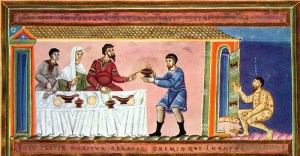
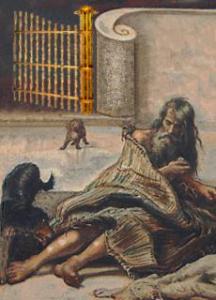 One man who would have had been wildly popular. The other’s only friends were the dogs who licked his sores. One man lived in a fabulous house that would have made the cover of Better Homes and Gardens. The other lives on the street. The curb was his pillow and the street was his bed.
 His request for a drop of water from Lazarus’ finger is denied. Abraham tells him, “Child, remember that you in your lifetime received your good things, and Lazarus bad things. Now, he is comforted and you are in anguish.” If Jesus had not continued to tell this parable, we might think that Jesus is condemning wealth and extoling poverty. But that is not the point. God wants you to have the blessings that He has given you. We know this because of the 7th Commandment, “Thou shalt not steal.” No this parable is not mainly about the evils of being rich. Instead it is about faith and the Word of God, the Bible.
 When you have the Scriptures, you have everything. You don’t need another message from God. You have Jesus who has risen from the dead to preach to you, not about the torment of hell, but about His mercy and forgiveness.
 5 So, summoning his master’s debtors one by one, he said to the first, ‘How much do you owe my master?’ 6 He said, ‘A hundred measures of oil.’ He said to him, ‘Take your bill, and sit down quickly and write fifty.’ 7 Then he said to another, ‘And how much do you owe?’ He said, ‘A hundred measures of wheat.’ He said to him, ‘Take your bill, and write eighty.’ 8 The master commended the dishonest manager for his shrewdness. For the sons of this world are more shrewd in dealing with their own generation than the sons of light. 9 And I tell you, make friends for yourselves by means of unrighteous wealth, so that when it fails they may receive you into the eternal dwellings.
 First, we have to be careful because we can’t press any of the parables too hard. The parables are meant to teach us, but we can take them too far. When we look at parables, we must find the main teaching and then see how the details shed light on the main point. If we look for meaning in every detail, we go too far and kill the parable. Think of the parables like pets. Some of them are sturdy like a dog. You can walk them, pet them, hug them, and even wrestle with them. Some of them are delicate like a butterfly. You can’t hug and wrestle a butterfly.
 When God became man, evil was turned on its head for doing evil. Putting Jesus on the cross, humanity’s greatest injustice, was God’s greatest act of mercy. Death gave way to life. The cross gave way to the empty tomb. Good Friday gave way to Easter. Now, your bill isn’t just reduced. It is eliminated, paid in full.
 Our text shows one scene and that is Jesus associating with the lowlifes, the riff-raff, the scum of the earth. Not only is Jesus talking with them, He is eating with them. Our text reveals this one scene, but two very different reactions to it.
 Heaven sees God doing exactly what He promised to do in our Old Testament lesson (Ezekiel 34:11-24). God is seeking His lost sheep. God is rescuing them from the places where they have been scattered. He is gathering them from the ends of the earth. He is feeding and making them lie down in the good pastures. Yahweh is bringing back the strayed, binding up the injured, and strengthening the weak. God is doing His God thing. He is showing His steadfast love and mercy.
 Remember how the multitude of the heavenly host came down the night Jesus was born and rejoiced? Do you hear what Jesus is saying in this verse? Heaven rejoices more over one sinner who repents than it would rejoice over ninety-nine Jesuses who needs no repentance. Every sinner on earth, everyone with inborn sin and everyone with actual sin. Every terrorist, adulterer, child pornographer. Every liar, every oath-breaker, every hypocrite, every braggart, every bully. Every selfish, prideful, bent-in-on-himself person through all of history who repents causes heaven to rejoice more than it did at the birth of Jesus. All because you are the fruit of Jesus’ labor.
 28 “For which of you, desiring to build a tower, does not first sit down and count the cost, whether he has enough to complete it? 29 Otherwise, when he has laid a foundation and is not able to finish, all who see it begin to mock him, 30 saying, ‘This man began to build and was not able to finish.’ 31 Or what king, going out to encounter another king in war, will not sit down first and deliberate whether he is able with ten thousand to meet him who comes against him with twenty thousand? 32 And if not, while the other is yet a great way off, he sends a delegation and asks for terms of peace. 33 So therefore, any one of you who does not renounce all that he has cannot be my disciple.
 Jesus counted the cost of being your Savior, and He deemed it worth every last drop of His holy and precious blood. Jesus gave up His glory, His throne, His dominion. He became your sin (2 Cor. 5:21). He died your death. Yes, He even hated His life. He did it all for you.
 4 But they remained silent. Then he took him and healed him and sent him away. 5 And he said to them, “Which of you, having a son or an ox that has fallen into a well on a Sabbath day, will not immediately pull him out?” 6 And they could not reply to these things.
 Everybody is watching each other, and every look is critical. It isn’t just to see who foolishly uses the dinner fork to eat their salad. No! The Pharisees are carefully watching Jesus, just waiting to catch Him doing something wrong. And Jesus has His eyes on them, watching as they stumble over each other for seats of honor. So much for Sabbath rest at this dinner party – it’s exhausting.
 Then, from the lowest place, Jesus is raised up. At His name, every knee shall bow and every tongue confess that He is King of kings and Lord of lords.
 Pastorsamwise
You must be logged in to post a comment.