Matthew 14:22-33 – Yahweh on the Water

Listen here.

Matthew 14:22-33

22 Immediately he made the disciples get into the boat and go before him to the other side, while he dismissed the crowds. 23 And after he had dismissed the crowds, he went up on the mountain by himself to pray.

When evening came, he was there alone, 24 but the boat by this time was a long way from the land, beaten by the waves, for the wind was against them. 25 And in the fourth watch of the night he came to them, walking on the sea. 26 But when the disciples saw him walking on the sea, they were terrified, and said, “It is a ghost!” and they cried out in fear. 27 But immediately Jesus spoke to them, saying, “Take heart; it is I. Do not be afraid.”
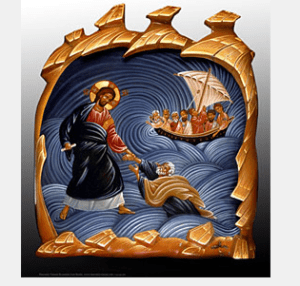
28 And Peter answered him, “Lord, if it is you, command me to come to you on the water.” 29 He said, “Come.” So Peter got out of the boat and walked on the water and came to Jesus. 30 But when he saw the wind, he was afraid, and beginning to sink he cried out, “Lord, save me.” 31 Jesus immediately reached out his hand and took hold of him, saying to him, “O you of little faith, why did you doubt?” 32 And when they got into the boat, the wind ceased. 33 And those in the boat worshiped him, saying, “Truly you are the Son of God.”

In the name of the Father and of the Son and of the Holy Spirit. Amen.

This text comes right on the heels of Jesus feeding of the 5,000. The crowds have been healed and fed. The disciples each have their basket of leftovers. And Jesus gets His time alone to pray. Jesus sends the disciples away in the boat. The wind picks up. The waves get higher. The way Matthew writes, there is are hints that the storm is demonic in nature. The boat is being beaten (lit. tortured, tormented). Tough as this night at sea is, it is not the wind, not the waves, not the storm that frightens the disciples. It’s Jesus. The disciples are afraid when Jesus shows up.

Jesus’ walking over the sea is filled with a meaning that we miss if we don’t understand the mindset of the people of Jesus’ day. In their minds, the sea is the manifestation of death. The sea is what swallows you whole and doesn’t spit you out again (Ps. 107:23-32). That is why in Revelation, when John sees the new creation, there is no more sea (Rev. 21:1). The sea is also the home of the dreadful sea creature, Leviathan (Job 41:ff).

So, when Jesus walks on the water, He isn’t only showing His power over creation; He is showing His power also over death. Jesus is treading under His foot the ancient serpent (Gen. 3:15). But the disciples don’t know that it is Jesus.

So, put yourself in their shoes (or in their boat). You have left Jesus up on the mountain and have been struggling to row the boat across the sea for hours. You are tired, wet, and frustrated. Now, around 3 AM, this figure comes strolling towards you over the sea, death, and the dreadful serpent.

They cry out in fear figuring Jesus was a ghost, a phantasm, maybe even the lord of death himself. But Jesus calls them out of fear and preaches Gospel to them, “Take courage. It is I. Do not be afraid.”

In English, we unfortunately lose the most important thing Jesus says here. Jesus isn’t just saying, “It’s Me.” He is saying, “I am.” Remember when Moses asked for God’s name (Ex. 3:14-15), God responded, “I am who I am.” God gives Himself the name Yahweh. Later, God will define what Yahweh means, “A God merciful and gracious, slow to anger, and abounding in steadfast love and faithfulness” (Ex. 34:6). Jesus is taking the divine name, Yahweh, and applying it to Himself.

Peter pipes up, and we have to dispel a common notion about Peter in this text. Peter walking on the water is not an act of faith. Peter’s request to walk out to Jesus comes from Peter doubting Jesus’ words. “Lord, if it is You, command me to come to You on the water.”

It is absurd that Peter makes this demand. Here is Peter doubting Yahweh in the flesh. Doubting the Creator of heaven and earth. Doubting the God who answered Job in our Old Testament Lesson (Job 38:4-18) saying, “Where were you when I laid the foundation of the world? Do you keep the sun rising and setting? Did you tell the waters, ‘You can come this far’? Have you been to the source of the sea? Have you walked in the recesses of the deep?”

But does Jesus scold Peter for his doubt? No. Jesus graciously tells Peter, “Come.”

Peter gets out of the boat, and he too treads on the sea, death, and the great serpent. Peter isn’t able to walk on the sea because of his faith. Peter walks on the waters because of the word of Jesus, “Come.” That one word carries Peter from the boat, across the water, toward Yahweh in the flesh.
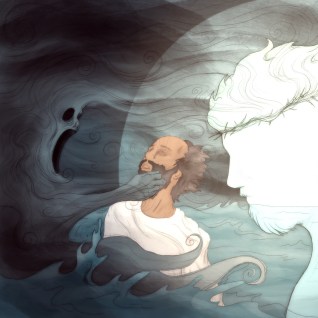
Peter Sinking in the Water Jesus SavesPeter strides well – for a bit. But then, he sinks. Notice what causes Peter to sink. More doubt. He becomes fearful. Peter doesn’t fear the storm, the waves, or his distance from the boat. He fears what is least threatening to him – the wind.

The same happens to you and me when we lose our focus on Jesus, the Word of Yahweh. If you focus on the things in this world good or bad, when we focus on ourselves and our circumstances, when we start to focus on anything that isn’t Jesus, we fall and sink like a stone.

That is why we need to be here week after week to hear God’s word and receive His grace and mercy. Don’t look to yourself. Don’t look in your heart because your heart will deceive you. Look to Jesus in His Word, in His Sacraments, in the gathering of two or three in His name because Jesus has promised to be there.

If Jesus can make Peter walk on water with the little word, “Come,” imagine what Jesus will do when He returns and says to you, “Rise.” You will.

As Peter sees he is sinking, he no longer doubts Jesus. Notice, he doesn’t cry out, “Lord, if it is You, save me.” Instead, he cries, “Lord, save me!” In that moment, Jesus is all that Peter has. And immediately, Jesus reaches out His hand and pulls Peter from the sea – from the jaws of death – and saves him. Whose grip matters at that moment? Only Jesus’.

Jesus asks Peter, “O you little faith, why did you doubt?” That is still a question for us today. Why do we doubt? We doubt because we don’t trust Jesus’ word. Satan’s question to Eve, “Did God really say?” still echoes in our ears.

But listen to what Jesus says to you in His Word, “Because of My death and My resurrection, you are forgiven. Justified. Made right with God.”

Don’t look to yourself. Don’t look at the storms, the wind, the waves, the depths of the sea. Don’t look at how you are doing at any given moment. Look to Jesus.

Truly, He is the Son of God. He is Yahweh who walks on the water, who treads down death, who crushes the serpent’s head. Whatever trouble, trial, or temptation you are facing, all you have in that moment of sinking is Jesus. Cry out to Him, “Lord, save me.” And He does.

Because that is what Jesus’ name means – Yahweh saves. Amen.

The peace of God which surpasses all understanding will guard your hearts and minds in Christ Jesus. Amen.

Matthew 14:13-21 – Inadequate, Enough, Excess

Listen here.

Matthew 14:13-21

13 Now when Jesus heard this, he withdrew from there in a boat to a desolate place by himself. But when the crowds heard it, they followed him on foot from the towns. 14 When he went ashore he saw a great crowd, and he had compassion on them and healed their sick.

15 Now when it was evening, the disciples came to him and said, “This is a desolate place, and the day is now over; send the crowds away to go into the villages and buy food for themselves.” 16 But Jesus said, “They need not go away; you give them something to eat.” 17 They said to him, “We have only five loaves here and two fish.” 18 And he said, “Bring them here to me.” 19 Then he ordered the crowds to sit down on the grass, and taking the five loaves and the two fish, he looked up to heaven and said a blessing. Then he broke the loaves and gave them to the disciples, and the disciples gave them to the crowds. 20 And they all ate and were satisfied. And they took up twelve baskets full of the broken pieces left over. 21 And those who ate were about five thousand men, besides women and children.

In the name of the Father and of the Son and of the Holy Spirit. Amen.

Jesus comes to that desolate place to withdraw. He had just received word that John the Baptizer had been beheaded. He wanted some time away to rest, but the crowd didn’t let this happen. Jesus had healed every cripple, cleansed every leper, and raised every corpse He met, so it was inevitable that people would constantly flock to Him.

Tired as He is, Jesus doesn’t ignore them. He doesn’t tell them to go away. He doesn’t complain or feel sorry for Himself. Jesus has compassion on them and heals them.

Now, we don’t know exactly what the disciples were doing as Jesus healed the masses. Were they sitting and watching? Were they directing traffic, making sure no one cut in line? Were they preaching? Whatever it was, the disciples seem to have some level of “compassion fatigue.”

The disciples know the crowd needs to eat. They don’t want to deal with it, so they make a logical suggestion, “Jesus, send them away so they can feed themselves.”

Jesus has a different idea, “Naw, you give them something to eat.” And the disciples balk at the suggestion. How can they feed the people? All they can see is their limitations and inadequacies. As proof that they can’t do anything, they say to Jesus, “We only have five loaves and two fish.”

Do you notice what they leave out? Sure, they have only five loaves and two fish, but they also have Jesus.

We fall into the same trap. The devil is always trying to trick us into thinking we have less than we actually possess. We look at the things we have – our bank and retirement balances, our house, and car. Then, we look at the things we don’t have. And the devil is pleased when our eyes and thoughts dart between the two. Because when we focus on what we have and what we don’t have, we overlook the needy around us and forget the God who can do more than we ask or imagine (Eph. 3:20).

The devil is pleased to keep us focused on these things because then we always insist that we are poor. We figure, “I have to provide for myself and my family.” We worry about what we might not have in the future. So, the food pantry, pregnancy center, and homeless shelter have to get along without our donation, and the church has to get along without our tithe. Repent.

Repent and see again this text. As familiar as it is, maybe you are bored with it. Imagine this scene playing out, and keep your mind’s eye on the disciples’ hands.

Five-thousand men plus women and children – a sea of people, Jesus tells the disciples, “You give them something to eat.” Twelve disciples equals twenty-four hands, but when you look in their hands, only one or maybe two hands hold a bit of a morsel. The rest of their hands are empty. What the disciples have is inadequate.

Jesus takes the little snack and says a blessing. Now, watch. Jesus puts the loaves and fish back into the disciples’ hands. And the disciples just keep doling it out to the crowds. Their hands deliver again and again and again as the throng eats and is satisfied. Every last one of them, even the gluttons, eats their fill. What goes through the disciples’ hands is enough.

But keep watching. The disciples meander through the crowd and gather the leftovers. They return to Jesus, and now there are no empty hands. All twelve of the disciples use both hands to carry a basket overflowing with leftovers – each basket containing more than they had to start with. What the disciples have now is an excess.

Inadequate, enough, excess – all in the span of a few verses. Jesus meets needs that are out of proportion to the resources available.

When the disciples said, “We have only five loaves and two fish,” they figured it was proof that they couldn’t do anything to meet the need. But Jesus says, “Bring what you have to Me.”

Jesus still says that today. When you look at the needs of your neighbor and see a lack in your finances, time, resources, and talents, Jesus says, “Bring what you have to Me.” And watch as Jesus multiplies what you have to serve those around you.

And when you see your sins, your failures, your hatred, your lust, and your coveting, Jesus says, “Bring what you have to Me.” And watch as Jesus covers them all in His blood.

Jesus doesn’t just meet your needs. He over-supplies, but not so that there is a waste. He fills your cup with His blessings so that it runs over, and the blessings spill out to your neighbor.

And your Savior, is here to pour more into your cup now. Jesus still feeds His people in the wilderness. He is here now to feed you with His Body and give you to drink of His Blood. He calls you to come to Him. “Come, everyone who thirsts. Come, buy and eat. Come, buy wine and milk without money and without price. Delight yourselves in My rich food. Incline your ear, and come to Me; hear, that your soul may live” (Isa 55:1-5). Amen.
The peace of God which surpasses all understanding will guard your hearts and minds in Christ Jesus. Amen.

Matthew 13:44-52 – Treasure

Listen here.

Matthew 13:44-52

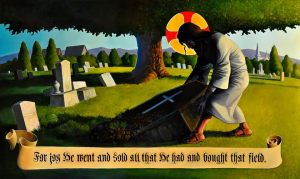
44 “The kingdom of heaven is like treasure hidden in a field, which a man found and covered up. Then in his joy he goes and sells all that he has and buys that field.

Copyright: Edward Riojas. Used by permission

45 “Again, the kingdom of heaven is like a merchant in search of fine pearls, 46 who, on finding one pearl of great value, went and sold all that he had and bought it.

47 “Again, the kingdom of heaven is like a net that was thrown into the sea and gathered fish of every kind. 48 When it was full, men drew it on the beach and sat down and sorted the good into containers but threw away the bad. 49 So it will be at the end of the age. The angels will come out and separate the evil from the righteous 50 and throw them into the fiery furnace. In that place there will be weeping and gnashing of teeth.

51 “Have you understood all these things?” They said to him, “Yes.” 52 And he said to them, “Therefore every scribe who has been trained for the kingdom of heaven is like a master of a house, who brings out of his treasure what is new and what is old.”

In the name of the Father and of the Son and of the Holy Spirit. Amen.

The kingdom of heaven, apparently, is like a lot of things. This is the third week in Matthew 13 where Jesus likens the kingdom of heaven to all sorts of things.

The kingdom of heaven is like a sower who sows seed, and there are enemies of that seed trying to keep it from producing fruit.

Last week, Jesus said that the kingdom of heaven is like a man who sows good seed in his field and an enemy tries to mess the whole thing up by sowing weeds in the same field. But the master isn’t willing to wipe the whole field out. Instead, he decides to wait it out, let the weeds and the wheat grow together, until the harvest and sort it all out then.

Jesus also says that the kingdom of heaven is like a grain of mustard seed. When it is planted its teeny-tiny, but it grows bigger than all the other plants. Also, the kingdom of heaven is like a little leaven in a huge batch of dough – it permeates the whole lump.

Today, the kingdom of heaven is like treasure hidden in a field, like a merchant in search of fine pearls, and like a fishing net.

To be sure, the kingdom of heaven is the greatest treasure and is of more value than anything you could possibly imagine. In fact, the treasure is so great that everyone everywhere should be willing to give up everything to get their hands on it. As Jesus says later in Matthew, “What will it profit a man if he gains the whole world and forfeits his soul?” (16:26). You could have it all, but in the end, if you don’t have Jesus, you don’t have jack squat.

But you and I don’t believe this. And it doesn’t matter how often or how convincingly Jesus says that the kingdom of heaven is beyond the greatest treasure imaginable. We aren’t willing to give everything up to attain the kingdom.

We are like the rich young man that comes to Jesus (Mt. 19:16-26) asking, “Jesus, what must I do to have eternal life?” Jesus says, “You know the Commandments. Don’t kill people or commit adultery. Don’t steal or bear false witness. Honor your father and mother. Basically, love your neighbor as yourself.” And the young man says, “Pish posh. I’ve been doing that my while life. There’s got to be more to it than that.” Jesus answers, “If you would be perfect, go, sell everything, give it to the poor, and you will have treasure in heaven. Then come, follow Me.” And the young man walks away unwilling to do what Jesus says it takes.

When we look at the first two parables about the treasure and the merchant searching for fine pearls, our natural inclination is to think that Jesus is telling us to do what He told the young man to do. Give it all up, let everything go, and enter the kingdom. In other words, be perfect and earn the kingdom.

But a vow of poverty won’t get you into the kingdom. Even if you sell everything you have in an effort to gain the kingdom of God, do you notice what you are doing? You’re holding on to something – yourself! You’re just interested in self-preservation, and you haven’t impressed God so that He will reward you.

If you see the parable of the hidden treasure or the merchant in search of pearls as an exhortation for you to give up everything for Jesus, you have it backwards. Repent.

The treasure and the pearl are not heaven or Jesus that we need to find and purchase. The field is not the church or even the Bible. The field is the cemetery where the bones of Adam and all his sons and daughters are buried. Jesus is the one who finds you, goes, and sells all He has to purchase you. The treasure and the pearl are you who are purchased not with silver and gold, but with Jesus’ holy and precious blood and with His innocent sufferings and death. Jesus gave up everything in order to make you His own.

And it probably doesn’t seem right to you, so you are wondering, “Pastor, if Jesus treasured me so much and I am part of His kingdom, why I still have so many problems in this world? Why do I still suffer?” Well, I’m glad you asked.

The answer for suffering and evil was already given, somewhat, in the parable of the wheat and the weeds. But it is also what the parable about the net is also getting at.

When you fish with a net, you catch all sorts of things: good fish, bad fish, eels, empty cans, boots, and tires. God isn’t about catching you each individually with a rod and hook. His love for the whole lot of this fallen world swallows us all up.

Jesus came to save the world – every last one of us. He died for you; He died for all. In Adam, all are condemned; in Jesus, the greater Adam, all are justified (Ro. 5:18). Because of the cross, every sin is answered for, and every sinner is atoned. In Christ, God was reconciling the world to Himself not counting your sins against you (2 Cor. 5:19).

And the day will come when you will be separated from the evil and garbage of this world caused by sin because, “God has chosen you to be a people for His treasured possession” (Dt. 7:6). God has loved you, chosen you, and in Baptism placed His name upon you.

And, as our Epistle lesson says, everything in this world, even the evil junk that surrounds you, God uses it all for your good (Ro. 8:28-39). Even when you were His enemy, He didn’t spare His only Son, but gave Jesus up for you. So, now that you are His own beloved child, what good thing will He hold back from you? The answer is – nothing, zilch, zip, nada.

You are His beloved treasure now and always. He rejoices at finding you and purchasing you. Amen.

The peace of God which surpasses all understanding will guard your hearts and minds in Christ Jesus. Amen.

Isaiah 55:10-13 & Matthew 13:1-9, 18-23 – Sprout

Listen here.

In the name of the Father and of the Son and of the Holy Spirit. Amen.

The Word of God always works. As surely as rain and snow make the ground wet, the Word of God works.
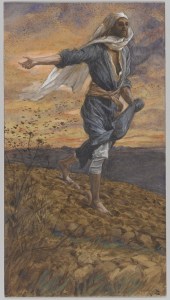
Time after time, Scripture makes this clear. In creation, God speaks, and things that don’t exist obey. Jesus speaks to a deaf man and his ears open (Mk. 7:31-37). And Jesus tells dead-as-a-doornail Lazarus to come out of the tomb, and he does. Romans 1:16 says, “For I am not ashamed of the Gospel, for it is the power of God unto salvation.” And Romans 10:17 says, “Faith comes by hearing, and hearing through the Word of Christ.”

But it doesn’t matter how clear Scripture makes it. It doesn’t matter how many times we read these verses from Isaiah or see countless examples in the Scripture that the Word of God works, we simply and sinfully do not believe this because there are times when it appears to us that God’s Word isn’t working. The results we expect just aren’t there. The Scriptures are pouring down, but where is the sprouting? Where is the fruit?

In our Gospel lesson (Mt. 13:1-9, 18-23), the Parable of the Sower and the Seed and its explanation, Jesus deals with our objections to the truth that God’s Word always works.

In the parable, Jesus teaches that God’s Word has enemies. The devil is first of those enemies. He is always trying to snatch away the Word as soon as the seed falls. Satan wants nothing more than to take that seed from you as soon as possible. That is why you have a hard time listening to sermons and why you get distracted when you read your Bible. Satan is always trying to steal God’s Word from you.

But there is another enemy of God’s Word. Trials, tribulations, and persecution also threaten the harvest that comes from hearing the Word of God. Troubles in this life tempt us into thinking that God is far away and has either abandoned us completely or isn’t interested in what is going on in our life. We wrongly think that, as a Christian, we should have less trouble and a better life than those who aren’t Christians. But Jesus never promised that. Jesus did not say, “Take up your Lazy Boy and follow Me.”

The Christian life isn’t easy. When tribulations and persecutions come, that isn’t the time to give up on God’s Word and retreat. Those trials should cause us to hold tighter to God’s Word. To sink our roots deeper into the promises that come only in the Scriptures.

Both the devil and the trials of this life are deadly enemies to the Word of God. But it is the third enemy, the cares of the world, the deceitfulness of riches, and the enticement of stuff that is striking – especially this time of year.

Imagine a man standing just outside the door of our church, and every Sunday he would hold out $1,000 to you as you approached. The $1,000 is yours, free and clear, so long as you don’t come into church and listen to God’s Word. Would you take it?

Sadly, you are lured away by less than that. That tournament your child is playing in keeps you from hearing God’s Word and receiving the promises of forgiveness, life, and salvation. The lake is really nice to visit this time of year, and a few Sunday mornings of fishing and relaxing are much more appealing than being in a pew. Or, and I am guilty of this too, we would rather watch one more episode on Netflix before bed rather than spending time in the Bible.

Psalm 119:72 says, “The [Word] of Your mouth is better to me than thousands of gold or silver pieces.”

Brothers and sisters, we all need to repent. Repent and once again hear the effective Word of God. Notice that even when these enemies of God’s Word prevent the harvest – they never succeed because the Word, the seed, is ineffective.

The seed of God’s Word always has life in it. Even if we are hard-hearted pavement, the Word has life. Even if the rocks prevent our roots from receiving nourishment, the Word grows. Even if the weeds of the pleasures of this life choke out the growth, the Word works.

Repent and hear again this promise: God’s Word does not ever, never ever, return empty but accomplishes the purpose for which it was sent. And remember that Jesus is the Word of God made flesh.

The Word was sent by the Father to dwell among us. Jesus, the Word of God, bore all the accusations the Law could throw against you and of which He was innocent. The Word was sent to the slaughter, to accept your guilty verdict and to be killed on the cross for crimes that you committed.

And He is risen. Jesus has broken down the gates of hell and opened heaven to you believer, that you might live. And still, constantly through His Word, He speaks you righteous. He declares you innocent, and there is no one left to accuse or speak a word against you.

Hear His Word now: You are forgiven. Your sins are gone. Now, go out in joy and be led forth in peace. Sprout, and bear fruit for His name. Amen.

The peace of God which surpasses all understanding will guard your hearts and minds in Christ Jesus. Amen.

Matthew 11:25-30 – Hidden & Revealed

Listen here.

Matthew 11:25-30

25 At that time Jesus declared, “I thank you, Father, Lord of heaven and earth, that you have hidden these things from the wise and understanding and revealed them to little children; 26 yes, Father, for such was your gracious will. 27 All things have been handed over to me by my Father, and no one knows the Son except the Father, and no one knows the Father except the Son and anyone to whom the Son chooses to reveal him.

28 “Come to me, all who labor and are heavy laden, and I will give you rest. 29 Take my yoke upon you, and learn from me, for I am gentle and lowly in heart, and you will find rest for your souls. 30 For my yoke is easy, and my burden is light.”

In the name of the Father and of the Son and of the Holy Spirit. Amen.

Jesus prays, “I thank you Father, Lord of heaven and earth, that You have hidden these things from the wise and understanding and revealed them to little children. Yes, Father, for such was Your gracious will.”

Hang on there, Jesus. What’s all this talk about God hiding things from the wise and understanding? I thought God wanted all people to be saved and come to a knowledge of the truth. What does God have against the wise and understanding?

Well, there are two kinds of wisdom – according-to-the-world wisdom and according-to-God wisdom. According the world, the wise are those who have it all figured out. An answer for every question. And it isn’t that God doesn’t love the according-to-the-world wise; it’s that they don’t want God or His love and mercy because the don’t want to need His mercy. Those who are wise according to the world want to be above God and not below Him.

The other kind of wisdom – the according-to-God wisdom – is to fear, love, and trust in God above all things. “The fear of the Lord is the beginning of wisdom” (Prov. 9:10).

So, Jesus’ prayer which opens this text is speaking against the according-to-the-world wisdom. “Thank You, Father, for hiding the treasures of Your kingdom from those who don’t think there are any treasure to be found. Thank You for hiding Your mercy from those who would rather crawl their way back to You than receive Your mercy. And thank You, Father, for hiding Your wisdom under the foolishness of the cross (1 Cor. 1:21-24). Thank You for hiding Your strength under weakness and Your victory under defeat. Thank You for revealing these things to little children.”

Little children. Jesus said that unless you become like one of them, you cannot enter the kingdom of heaven (Mk. 10:15). These “little children” are those who receive, trust, and depend – all characteristics that we are supposed to grow out of. And in this world, we should become independent, productive members of society. But none of us ever grow out of our need for God’s love and mercy.

As long as we are in this world, we are sinners. And, unlike wine and certain kinds of cheese, sinners don’t get better with age. That is what Paul was getting at in our epistle text (Ro. 7:14-25).

Paul tells his sad story. He is a man who truly wants to do good. He knows what is right, and he earnestly and honestly wants to do it. But he can’t. He always fails. He delights in God’s Law, but he also recognizes that he is a total, complete, abject sinner. “Wretched man that I am! Who will deliver me from this body of death?” Does he give up? No.

Instead, Paul knows the wisdom of God, “Thanks be to God through Jesus Christ our Lord! He has redeemed me. He has shed His blood and died on the cross for me.”

Blake, today you are baptized. Today, you are born again. Today, Jesus has chosen to reveal Himself to you. Stay childlike before God. Stay totally, completely, wholly dependent upon your Heavenly Father.

Blake, by the grace of God as you grow, you will learn many things. You will learn to crawl, stand, walk, and eat on your own. You will learn to ride a bike, read, and drive a car. Your life will be filled with assignments, deadlines, and all sorts of other pressures. You will learn how to be a productive member of society. And by God’s grace, you will become an independent, smart woman like your mother, your aunts, and your grandmother.

But don’t ever be fooled into thinking that you outgrow your dependence upon God.

Blake, and all you believers here today. You never outgrow your need for the love, mercy, and provision of God.

So, when you feel the weight of the world, don’t be afraid to recognize that you bear those burdens because of your sin. After the Fall, God said by the sweat of your brow that you would eat. Confess that it is because of sin that life is hard.

But then, hear Jesus’ constant invitation. “Come to Me all you who labor and are heavy laden, and I will give you rest. Take My yoke upon you, and learn from Me, for I am gentle and lowly in heart, and you will find rest for your souls. For My yoke is easy, and My burden is light.”

The Christian life is work. But always remember who is carrying the load. Jesus says, “All things have been handed over to Me by My Father.” Jesus bears every load, every weight, every burden.

Luther says that it is like a mule pulling a cart with a flea on its nose, and the flea pulls with all its might. Jesus bears the heavy load and lets you walk with Him as He carries you. Jesus’ yoke is easy and His burden is light because He bears the weight – not you. Jesus does the heavy lifting. And in Him – only in Him – you find the rest that you seek.

May this mystery be revealed to each of you here, for this is the Father’s gracious will. Amen.

The peace of God which surpasses all understanding will guard your hearts and minds in Christ Jesus. Amen.

Romans 7:1-13 – A Dead Dog

Listen here.

Romans 7:1-13

1 Or do you not know, brothers—for I am speaking to those who know the law—that the law is binding on a person only as long as he lives? 2 For a married woman is bound by law to her husband while he lives, but if her husband dies she is released from the law of marriage. 3 Accordingly, she will be called an adulteress if she lives with another man while her husband is alive. But if her husband dies, she is free from that law, and if she marries another man she is not an adulteress.

4 Likewise, my brothers, you also have died to the law through the body of Christ, so that you may belong to another, to him who has been raised from the dead, in order that we may bear fruit for God. 5 For while we were living in the flesh, our sinful passions, aroused by the law, were at work in our members to bear fruit for death. 6 But now we are released from the law, having died to that which held us captive, so that we serve in the new way of the Spirit and not in the old way of the written code.

7 What then shall we say? That the law is sin? By no means! Yet if it had not been for the law, I would not have known sin. For I would not have known what it is to covet if the law had not said, “You shall not covet.” 8 But sin, seizing an opportunity through the commandment, produced in me all kinds of covetousness. For apart from the law, sin lies dead. 9 I was once alive apart from the law, but when the commandment came, sin came alive and I died. 10 The very commandment that promised life proved to be death to me. 11 For sin, seizing an opportunity through the commandment, deceived me and through it killed me. 12 So the law is holy, and the commandment is holy and righteous and good.

13 Did that which is good, then, bring death to me? By no means! It was sin, producing death in me through what is good, in order that sin might be shown to be sin, and through the commandment might become sinful beyond measure.

In the name of the Father and of the Son and of the Holy Spirit. Amen.

God commands us to not want what we don’t have, “You shall not covet.” Such a small command. Not only is it small by the number of words, but it seems such a small, harmless thing to do. So what, if you covet your neighbor’s things? It’s not like you’re actually stealing. So what if you covet your neighbor’s wife or husband? It’s not like you’re actually committing adultery.

But that is exactly what the devil wants us to think. Satan wants us to minimize the sin of covetousness so that we fall into all sorts of other sins that harm ourselves and our neighbor.

Coveting is where sin starts. Remember King David? He was out enjoying his balcony one evening, and he saw Bathsheba, the wife of Uriah, bathing. David sinned by coveting his neighbor’s wife, but the sin didn’t stop there.

David had an affair with her – breaking 6th Commandment. To cover up his sin, David had Uriah killed – breaking the 5th Commandment. David took Bathsheba as his wife – breaking the 7th Commandment. In his actions, David lied – breaking the 8th Commandment. He dishonored his parents by not doing what they had taught him – breaking the 4th Commandment. By breaking all those other Commandments, David was not honoring God’s name and God’s Word – 2nd and 3rd Commandments. In all of this, David broke the 1st Commandment, serving his desires rather than the true God.

What started with breaking the 10th Commandment, “Thou shalt not covet thy neighbor’s wife,” turned into a Commandment-smashing spree.

Coveting is a lot more dangerous than we think it is. In Colossians 3:5, Paul says that coveting is idolatry. How can he say that? Well, think about it. At its core, coveting is you believing that God got it wrong when you don’t have what you want. You put yourself in the place of God and, in effect, say, “That thing should be mine.”

That is why God gave the Commandments about coveting. Like Paul did, we don’t give coveting a second thought, but it is deadly dangerous.

Think of your conscience like a radar that picks up the threats of sin. Your conscience radar can pick up the threat of murder, stealing, lying, etc. But coveting is like a stealth bomber. Your conscience doesn’t even notice it.

That’s why Paul says here, “I would not have known what it is to covet if the Law had not said, ‘You shall not covet.’ But sin, seizing an opportunity through the commandment, produced in me all kinds of covetousness. For apart from the Law, sin lies dead.”

Sin is like a sleeping dog, and the Law comes along and kicks it awake. God doesn’t let sleeping dogs lie – not when it comes to sin. God doesn’t want you to be ignorant of your sin and your deadness. So He gave the Commandments.

The Law cannot make you a better person, and the Law certainly cannot make you righteous. That is not why God gave the Law. God gave the holy, righteous, and good Commandments to show you just how dead you are in sin.

The Law always accuses and comes to kill you, sinner, by showing you that you do not fear, love, and trust in God above all things. The Law shows us all that we are covetous idolaters in our hearts and married to sin.

Repent. You were married to sin, but Jesus has come. God made Jesus, who knew no sin to be sin and to die to sin – for you. You were married to sin. But in Baptism, God joined you to Jesus so that you would die to sin and be married to another – to Jesus who has been raised from the dead. And now you are reborn in Jesus, and there is no condemnation for you who are in Christ Jesus.

Now, God looks at you and sees Jesus, His beloved child. The life you now live, you live by faith in the Son of God who loved you and gave His life for you (Gal. 2:20).

Believer, your Husband, your Savior Jesus, calls you to His table to receive His holy body and His precious blood to assure you once again that your sins are forgiven. He gives you His risen body and blood so that you may serve Him. Because of what Jesus has done, you belong to Him, now and forever. Amen.
The peace of God which surpasses all understanding will guard your hearts and minds in Christ Jesus. Amen.

Jeremiah 20:7-13 – A Dread Warrior

Listen here.

Jeremiah 20:7–13

7   O Lord, you have deceived me,
and I was deceived;

you are stronger than I,
and you have prevailed.

I have become a laughingstock all the day;
everyone mocks me.

8   For whenever I speak, I cry out,
I shout, “Violence and destruction!”

For the word of the Lord has become for me
a reproach and derision all day long.

9   If I say, “I will not mention him,
or speak any more in his name,”

there is in my heart as it were a burning fire
shut up in my bones,

and I am weary with holding it in,
and I cannot.

10 For I hear many whispering.
Terror is on every side!

“Denounce him! Let us denounce him!”
say all my close friends,
watching for my fall.

“Perhaps he will be deceived;
then we can overcome him
and take our revenge on him.”

11 But the Lord is with me as a dread warrior;
therefore my persecutors will stumble;
they will not overcome me.

They will be greatly shamed,
for they will not succeed.

Their eternal dishonor
will never be forgotten.

12 O Lord of hosts, who tests the righteous,
who sees the heart and the mind,

let me see your vengeance upon them,
for to you have I committed my cause.

13 Sing to the Lord;
praise the Lord!

For he has delivered the life of the needy
from the hand of evildoers.

In the name of the Father and of the Son and of the Holy Spirit. Amen.

In case you didn’t notice, Jeremiah isn’t too happy with the God who called him to be a prophet. And he’s plenty honest about it.

Jeremiah feels like Yahweh has deceived and tricked him. Jeremiah seems to be in a submission hold, and God isn’t letting him tap out. He is a laughingstock, and everyone is mocking him. God’s Word has become for him a source of anguish because Jeremiah continually has to preach the Law and announce the judgment and destruction that is coming upon God’s people.

If you want to know what life is like for a preacher, these verses let you inside. Jeremiah is ready to hang it up. He wants to be done preaching God’s Word. But if Jeremiah doesn’t preach, God’s Word becomes a burning fire in his heart and bones. He wants to quit, but he can’t. Here, Jeremiah unloads his frustration and despair.

Why? Why is Jeremiah fed up with being God’s prophet? Well, God called Jeremiah at a time when people were hardened against God’s Word, so God didn’t give Jeremiah a happy sermon to preach. The context of this text gives us a glimpse of this.

Back in Jeremiah 19:14-15, God sent Jeremiah to the courtyard of the Temple to preach, “Thus says Yahweh of hosts, the God of Israel, behold, I am bringing upon this city and upon all the towns all the disaster that I have pronounced against it, because they have stiffened their neck, refusing to hear My words.”

Did the people listen and repent? Nope. They didn’t like the sermon, so they just figured they’d get rid of the preacher. Pashhur, the priest, heard Jeremiah’s sermon and beat him. He put Jeremiah in stocks in the Temple.

The next morning, Pashhur came and let Jeremiah out of the stocks, but Jeremiah didn’t retract his sermon. He doubled-down. He preached right to Pashhur, “God doesn’t call you ‘Pashhur’ (which means ‘freedom’), but ‘Terror on Every Side.’ You will be a terror to yourself and to all your friends. You will watch as they are killed. You will see the city be destroyed and plundered. You and your friends will go captive into Babylon, and there you will die” (Jer. 20:1-6).

Jeremiah started with a bold sermon, and the persecution only made him more sassy – at least in public. But the first four verses of this text show how Jeremiah was on the inside. He wants out of the preaching business.

To my great shame, I must admit that I can sympathize with Jeremiah here as he cries out to God. There are times when, like Jeremiah, I say, “I am not going to mention God or speak in His name anymore,” because I get tired of people not listening. Forgive me.

And even though you (most of you, anyway) aren’t preachers, maybe you can empathize with Jeremiah too.

How often do you get mocked, ridiculed, and become a laughingstock to those around you for standing on the truths of God’s Word? It wears you out. How often are you timid to take a stand against the lies of the devil that have become so prominent in our culture and society? Too often, it is much easier to remain silent than to be called racist, bigoted, old-fashioned, and close-minded.

But, too often, because fear rejection, we end up fearing those who can kill the body more than the God who can destroy both the soul and body in hell (Mt. 10:28).

Repent. All of us need to repent.

In our Gospel lesson (Mt. 10:5a, 24-33), Jesus told us to expect persecution. The world called Jesus Beelezebul, the prince of demons, you can expect the same.

But always remember – in spite of whatever rebukes, chastisements, and rejection you may face – God is with you as a dread warrior. He has delivered your soul from death and your feet from falling.

Jesus, the dread warrior, has already faced your most dreaded foe. On the cross, Jesus went to battle with all the forces of evil. He defeated sin, death, and the devil. On that cross, Jesus was dreadful to look at. He was one from whom men hide their faces (Is. 53:3). Yet, Jesus has carried your griefs and sorrows. Upon Jesus, God laid all your iniquity and sin.
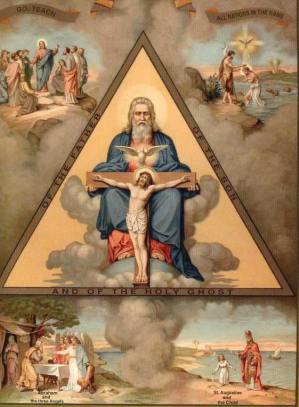
Because of Jesus’ crucifixion, you have been set free from sin and have become slaves to God (Ro. 6:22).

Go boldly from here, ready to face whatever the devil and the world may throw at you. You have Jesus, the dread warrior, at your side. In God you trust. What can man do to you? Amen.

The peace of God which surpasses all understanding will guard your hearts and minds in Christ Jesus. Amen.

Genesis 1:1 – 2:4 – In the Beginning, Trinity

Listen here.

Genesis 1:1-2:4

1 In the beginning, God created the heavens and the earth. 2 The earth was without form and void, and darkness was over the face of the deep. And the Spirit of God was hovering over the face of the waters.

3 And God said, “Let there be light,” and there was light. 4 And God saw that the light was good. And God separated the light from the darkness. 5 God called the light Day, and the darkness he called Night. And there was evening and there was morning, the first day.

6 And God said, “Let there be an expanse in the midst of the waters, and let it separate the waters from the waters.” 7 And God made the expanse and separated the waters that were under the expanse from the waters that were above the expanse. And it was so. 8 And God called the expanse Heaven. And there was evening and there was morning, the second day.

9 And God said, “Let the waters under the heavens be gathered together into one place, and let the dry land appear.” And it was so. 10 God called the dry land Earth, and the waters that were gathered together he called Seas. And God saw that it was good.

11 And God said, “Let the earth sprout vegetation, plants yielding seed, and fruit trees bearing fruit in which is their seed, each according to its kind, on the earth.” And it was so. 12 The earth brought forth vegetation, plants yielding seed according to their own kinds, and trees bearing fruit in which is their seed, each according to its kind. And God saw that it was good. 13 And there was evening and there was morning, the third day.

14 And God said, “Let there be lights in the expanse of the heavens to separate the day from the night. And let them be for signs and for seasons, and for days and years, 15 and let them be lights in the expanse of the heavens to give light upon the earth.” And it was so. 16 And God made the two great lights—the greater light to rule the day and the lesser light to rule the night—and the stars. 17 And God set them in the expanse of the heavens to give light on the earth, 18 to rule over the day and over the night, and to separate the light from the darkness. And God saw that it was good. 19 And there was evening and there was morning, the fourth day.

20 And God said, “Let the waters swarm with swarms of living creatures, and let birds fly above the earth across the expanse of the heavens.” 21 So God created the great sea creatures and every living creature that moves, with which the waters swarm, according to their kinds, and every winged bird according to its kind. And God saw that it was good. 22 And God blessed them, saying, “Be fruitful and multiply and fill the waters in the seas, and let birds multiply on the earth.” 23 And there was evening and there was morning, the fifth day.

24 And God said, “Let the earth bring forth living creatures according to their kinds—livestock and creeping things and beasts of the earth according to their kinds.” And it was so. 25 And God made the beasts of the earth according to their kinds and the livestock according to their kinds, and everything that creeps on the ground according to its kind. And God saw that it was good.

26 Then God said, “Let us make man in our image, after our likeness. And let them have dominion over the fish of the sea and over the birds of the heavens and over the livestock and over all the earth and over every creeping thing that creeps on the earth.”

27 So God created man in his own image,
in the image of God he created him;
male and female he created them.

28 And God blessed them. And God said to them, “Be fruitful and multiply and fill the earth and subdue it, and have dominion over the fish of the sea and over the birds of the heavens and over every living thing that moves on the earth.” 29 And God said, “Behold, I have given you every plant yielding seed that is on the face of all the earth, and every tree with seed in its fruit. You shall have them for food. 30 And to every beast of the earth and to every bird of the heavens and to everything that creeps on the earth, everything that has the breath of life, I have given every green plant for food.” And it was so. 31 And God saw everything that he had made, and behold, it was very good. And there was evening and there was morning, the sixth day.

1 Thus the heavens and the earth were finished, and all the host of them. 2 And on the seventh day God finished his work that he had done, and he rested on the seventh day from all his work that he had done. 3 So God blessed the seventh day and made it holy, because on it God rested from all his work that he had done in creation.

4   These are the generations
of the heavens and the earth when they were created,
in the day that the Lord God made the earth and the heavens.

In the name of the Father and of the Son and of the Holy Spirit. Amen.

If you held a grasshopper in your fist, what could the grasshopper know about you and your nature? Maybe two things. First the grasshopper would realize that you are big and powerful enough to hold him. And, second, the grasshopper would know that you are worth fearing because you could crush him in an instant.

The grasshopper would know more about itself as well – how small, weak, and helpless it is. And it might try to do different things to keep from being crushed – like wriggling around to creep you out so you drop it.

The same is true of us and knowing God. Left to our sinful selves, all we can know about God is that He is bigger and more powerful than us, and that He should be feared because He can destroy us. And you see people do all sorts of silly things they think will keep God from crushing them.

The ancient Greeks would do all sorts of things to appease the gods they thought were in control of the various parts of the universe. The Muslims do everything in submission to Allah to show their obedience. Today, atheists try wriggle their way out of God’s hand by lying to themselves that they aren’t in His palm. And, sadly, even us Christians try to do things that we think will make God more pleased with us. But all of that is based only on false perceptions of who God really is.

So, go back to thinking about a grasshopper in your hand. How could that grasshopper know more about you and your nature? For that to happen, you would have to become a grasshopper and talk to it in grasshopper terms and interact with it as a grasshopper.

This is what God has done for us in Jesus. Jesus, the eternal Son of God, came down in our likeness and our nature. If you want to know what God is like, the answer is found only in Jesus of Nazareth.

Apart from Jesus, all we can know about God is that He is big and powerful, but once Jesus enters the equation, we see that God truly is merciful and gracious just as He says He is. With Jesus in the picture, everything that God does becomes the story of how God loves us, creates and cares for us, redeems us, and sanctifies us.

As you heard the account of creation, I hope you had the opening verses of John’s Gospel running in the background of your mind informing what you were hearing. If not, here you go:

“In the beginning was the Word, and the Word was with God, and the Word was God. He was in the beginning with God. All things were made through Him, and without Him was not any thing made that was made. And the Word became flesh and dwelt among us, and we have seen His glory, glory as of the only Son from the Father, full of grace and truth. For from His fullness we have all received, grace upon grace. For the law was given through Moses; grace and truth came through Jesus Christ. No one has ever seen God; the only God, who is at the Father’s side, He has made Him known” (Jn. 1:1-3, 14, 16-18).

So, sinners, hear of God and how He is. Though you are a sinner, deserving nothing good and having nothing loveable about you, God died so that your sin could be set aside, answered for, and forgiven.

Because of this, you no longer need to be afraid of the God who, in the beginning created you. He is your Father because of Christ’s atonement on the cross.

Now, when you look at the Scriptures and see all of God’s actions, look at them through the lens of what Jesus has done for you on the cross. See how in the beginning, God the Father, Son, and Holy Spirit was there creating all things good. See how even now, God is sustaining all creation even though we have sinned against Him.

See how God moved the course of history so that at the fullness of time He sent His Son, born of a woman, born under the Law to redeem us who were under the Law (Gal. 4:4).

See how God the Holy Spirit uses the Scriptures to convict you concerning sin, righteousness, and judgment (Jn. 16:8).

When you are convicted of sin don’t flee from God. Flee to God because He has died for you. Be convicted of your righteousness recognizing that your righteousness does not come from what you have done, but what God has done for you in Christ. Be convicted of judgment knowing that when you appear before God with hands that are empty of good works, God sees all the works of Christ and His blood which covers you.

And know, that according to Jesus’ command, you have been baptized in the name of the Father and of the Son and of the Holy Spirit (Mt. 28:19). God has placed His name on you and will not ever forsake you.

The infinite, unfathomable, and incomprehensible God, in His boundless mercy, has created you. Though you sinned against Him, He has come and redeemed you. And He is pleased to lead and guide you through His Word.

Today, rejoice and sing, “Glory be to God the Father. Glory be to God the Son. Glory be to God the Holy Spirit. Glory be to the One, true God, now and forever because He has shown mercy to us.” Amen.

The peace of God which surpasses all understanding will guard your hearts and minds in Christ Jesus. Amen.

Acts 2:1-21 – Fireworks

Due to technical difficulties, no audio available.

Acts 2:1-21

1 When the day of Pentecost arrived, they were all together in one place. 2 And suddenly there came from heaven a sound like a mighty rushing wind, and it filled the entire house where they were sitting. 3 And divided tongues as of fire appeared to them and rested on each one of them. 4 And they were all filled with the Holy Spirit and began to speak in other tongues as the Spirit gave them utterance.

5 Now there were dwelling in Jerusalem Jews, devout men from every nation under heaven. 6 And at this sound the multitude came together, and they were bewildered, because each one was hearing them speak in his own language. 7 And they were amazed and astonished, saying, “Are not all these who are speaking Galileans? 8 And how is it that we hear, each of us in his own native language? 9 Parthians and Medes and Elamites and residents of Mesopotamia, Judea and Cappadocia, Pontus and Asia, 10 Phrygia and Pamphylia, Egypt and the parts of Libya belonging to Cyrene, and visitors from Rome, 11 both Jews and proselytes, Cretans and Arabians—we hear them telling in our own tongues the mighty works of God.” 12 And all were amazed and perplexed, saying to one another, “What does this mean?” 13 But others mocking said, “They are filled with new wine.”

14 But Peter, standing with the eleven, lifted up his voice and addressed them: “Men of Judea and all who dwell in Jerusalem, let this be known to you, and give ear to my words. 15 For these people are not drunk, as you suppose, since it is only the third hour of the day. 16 But this is what was uttered through the prophet Joel:

17 “‘And in the last days it shall be, God declares,
that I will pour out my Spirit on all flesh,
and your sons and your daughters shall prophesy,
and your young men shall see visions,
and your old men shall dream dreams;

18 even on my male servants and female servants
in those days I will pour out my Spirit, and they shall prophesy.

19 And I will show wonders in the heavens above
and signs on the earth below,
blood, and fire, and vapor of smoke;

20 the sun shall be turned to darkness
and the moon to blood,
before the day of the Lord comes, the great and magnificent day.

21 And it shall come to pass that everyone who calls upon the name of the Lord shall be saved.’”

In the name of Jesus. Amen.

It’s June 4, 2017. Here you are at church, and everything is much the same as it was last week. Some Scripture readings, confession of sins, absolution, little prayers here and there. Just another normal, predictable Sunday morning at Christ the King.

Well not, entirely ‘normal.’ Today is Pentecost. So, you hear about the giving of the Holy Spirit, and it is impressive, full of fireworks. A mighty rushing wind. People are filled with the Holy Spirit. Tongues of fire rest on those gathered together. Those 120 believers go out and preach the Gospel in the various languages of the world. Then, after this text, 3,000 new believers are added to the number of Jesus’ disciples.

All of this certainly is impressive, and we look at our little congregation gathered in the flatlands of northern Minnesota and wonder, “Where are all those signs today? Why aren’t we seeing the fireworks? Why aren’t thousands being added to our numbers?”

Remember when Elijah hid from Queen Jezebel after defeating the priests of Baal? Elijah fled to Mount Horeb and sat in a cave. A strong wind comes that tears the mountains and breaks the rocks, but the Lord was not in the wind. Then, there is an earthquake, but the Lord was not in the earthquake. Then, there is a fire, but the Lord was not in the fire. Finally there is a low whisper, and that is where the Lord is. From that thin sound, God speaks to Elijah (1 Kgs. 19:9-13).

The day of Pentecost is similar. All the fireworks of Pentecost are impressive, but those outward things confuse the people. Some even mock those who were preaching saying that they are crazy drunkards.

But it is when Peter preaches that things happen. Peter, who had been the Jesus-denying coward, is now preaching boldly. He tells the people how the prophecy from Joel – the signs in the sky and on the earth – is all fulfilled in Jesus. And Peter hammers the Law. This Jesus, the Son of God in the flesh, you crucified, but God has raised Him from the dead (Act 2:36).

And the people who had been mocking and ridiculing the disciples are cut to the heart and will ask when Peter’s sermon is done, “What shall we do?”

And Peter says, “Repent and be baptized every one of you in the name of Jesus Christ for the forgiveness of your sins, and you will receive the gift of the Holy Spirit. For the promise is for you and for your children and for all who are far off, everyone whom the Lord our God calls to Himself” (Act. 2:38-39).

The fireworks of Pentecost are impressive, but Pentecost isn’t impressive because of them. Earthquakes, winds, and fires happen even when the Holy Spirit isn’t there.

What really makes Pentecost impressive is what cannot happen without the Holy Spirit working through the Word proclaimed – repentance and faith.

Only by the Holy Spirit can you be called by the Gospel. Only the Holy Spirit can enlighten the darkness of your hearts through His gifts of Word and Sacrament. Only by the Holy Spirit working through these means are you kept in the true faith day after day.

It doesn’t matter if the Holy Spirit adds 3,000 people to the number of Christians in one day or if people are added one by one. The Spirit creating faith is always a miracle more impressive than strong, rushing wind or tongues of fire.

Even if the Word and Sacraments seem boring, they are the Gospel and the power of God unto salvation. Wherever believers are gathered together to receive these gifts and to confess their faith in Christ, there the Holy Spirit is working because no one can say, “Jesus is Lord,” apart from the Holy Spirit (1 Cor. 12:3).

The fireworks don’t prove that the Holy Spirit is at work. So what sign should look for if we want to gauge if the Holy Spirit is at work? Listen to Jesus, “But when the Helper comes, whom I will send to you from the Father, the Spirit of truth, who proceeds from the Father, He will bear witness about Me” (Jn. 15:26).

Whenever you hear about Jesus’ finished work for you, when you hear about Christ crucified, risen, and ascended for you, there the Holy Spirit is working to bring you to repentance and faith. May God grant this to us and kindle in our hearts the fire of His love. Amen.[1]

The peace of God which surpasses all understanding will guard your hearts and minds in Christ Jesus. Amen.

[1] I am thankful for a sermon by Rev. Timothy Winterstein as inspiration for portions of this sermon.

Luke 24:44-53 – Victory

Listen here.

Luke 24:44-53

44 Then he said to them, “These are my words that I spoke to you while I was still with you, that everything written about me in the Law of Moses and the Prophets and the Psalms must be fulfilled.” 45 Then he opened their minds to understand the Scriptures, 46 and said to them, “Thus it is written, that the Christ should suffer and on the third day rise from the dead, 47 and that repentance for the forgiveness of sins should be proclaimed in his name to all nations, beginning from Jerusalem. 48 You are witnesses of these things. 49 And behold, I am sending the promise of my Father upon you. But stay in the city until you are clothed with power from on high.”

50 And he led them out as far as Bethany, and lifting up his hands he blessed them. 51 While he blessed them, he parted from them and was carried up into heaven.
52 And they worshiped him and returned to Jerusalem with great joy, 53 and were continually in the temple blessing God.

In the name of Jesus. Amen.

Alleluia! Christ is risen!
He is risen indeed! Alleluia!

And, today, let’s add to our alleluias.

Alleluia! Christ is ascended!
He is ascended indeed! Alleluia!

This past Thursday marked forty days after Easter and one of the most important days for the Christian Church – the Ascension of Christ. The Ascension means that Jesus – the One who has redeemed you, shed His blood and died for you, and who is risen for you – this Jesus now sits on the throne and rules the entire universe. The Ascension proves that Jesus has won the victory over sin, death, and the devil.

In the Ascension, Jesus stopped being in only one place at a time. Remember in the Gospels how Jesus would appear even after He was raised? He appeared to Mary Madeline near the tomb. He appeared to the disciples minus Thomas in the upper room Easter evening, and again to all the disciples together a week later. Jesus appeared while disciples were fishing at the Sea of Galilee. And in 1 Corinthians 15, we read that Jesus appeared to 500 witnesses all at one time. In each of those appearances, Jesus was there in that one particular place.

Now, because of the Ascension, Jesus is everywhere all the time in all the world even though we don’t see Him. Remember, that Jesus said, “All authority in heaven and on earth has been given to Me. And behold, I am with you always, even to the end of the age” (Mt. 28:18, 20).

As the Introit –  Psalm 110:1, the third most quoted Old Testament verse in the New Testament – said about the Ascension, Jesus our Lord is seated at God’s right hand with His enemies as His footstool. And maybe, you’re objecting because the verse reads, “The Lord says to my Lord, ‘Sit at my right hand until I make your enemies your footstool.’” Don’t forget what our Epistle text (Eph. 1:15-23) also said. Christ was raised from the dead and seated at God’s right hand in the heavenly places above all rule, authority, dominion, and above every name that is named not only in this age but in the one to come and, “[God] put all things under [Christ’s] feet and gave Him as head over all things to the church.”

In His human flesh, Jesus, your Savior ascended to God. Now, His nail-scarred but resurrected feet press down upon every enemy of God and every enemy of yours. The Ascension is something to celebrate because the sin-forgiving, death-destroying body of Jesus now covers every corner of the earth. Jesus is with you always protecting you from all harm and giving you every blessing.

But the devil does not want you to rejoice and delight in this, and so Satan attacks you, believer.

The devil attacks all the things that Jesus has done, but he attacks unbelievers and believers in different ways. With unbelievers, the devil attacks Christ’s birth – Christmas. He assaults Christ’s death and resurrection – Good Friday and Easter. The devil does not want people to believe that God became man, that Jesus died, and that He rose again because to believe those things is to be saved.

But once you are a Christian, the devil does not stop his attacks. But with believers, the devil does not come straight at Jesus’ birth, death, and resurrection. Instead, the devil chips away at the joy and hope that you have because of Jesus’ Ascension.

From time to time there are videos online of people watching an iceberg break apart. You hear creaking and cracking. Smaller chunks of ice, the size of a car, fall into the ocean. Every now and then, bigger chunks the size of a house fall off. But then, suddenly, half of the iceberg, maybe the size of the new Vikings’ stadium, slips away into the water.

The Ascension of Jesus is like all those smaller chunks that the devil tries to chip away from us so that our whole faith is ripped away from us.

So the devil tries to deceive us into thinking that Jesus has up and abandoned us. Satan tries to turn up the volume on all the evil and wickedness going on in the world to drown out Jesus’ statement that He has all authority in heaven and on earth, that Christ is far above all rule, authority, power, and dominion.

So, Satan points us to the terrorist attacks. He shows us how ISIS blows up a concert in Manchester England, killing twenty-two people, and a couple days later, they shoot up a bus of Christians in Egypt killing twenty-nine of our brothers and sisters in Christ (ten ofThe Good Shepherd those were children). The devil tries to focus our attention on the mess of our national politics and economy. The devil points us to how small and insignificant the church appears to be in this world and how many are leaving the church and abandoning the faith.

And the devil puts all the chaos, all the wickedness, all the pain and suffering before us and shouts as loud as he can, “Did Jesus really say that He has all authority in heaven and on earth? If Christ’s enemies are His footstool, how can I do all these horrible things? You must be some fool to believe what Jesus says!”

And too often, we listen. We do not believe that Jesus even now rules and reigns to all eternity. We are robbed of our joy, the world sees us running around worried and panicked, and the devil laughs.

Repent.

The Ascension doesn’t promise us that you will always see Jesus crushing His enemies with our eyes. But the Ascension does promise that His victory is real. The Ascension means that no matter what you see with your eyes, what God says is stronger and more real than what you see.

Look at the end of this text and see how Jesus ascended. “Lifting up His hands He blessed [the disciples], and while He blessed them, He parted from them and was carried up into heaven.”

Jesus’ hands were lifted up in blessing, and Scripture never says that Jesus’ hands are lowered. Jesus doesn’t stop blessing you. Your God, your Savior, Jesus is at God’s right hand blessing you in His ascended victory, now and forever.

Alleluia! Christ is risen and ascended!
He is risen and ascended indeed! Alleluia! Amen.

The peace of God which surpasses all understanding will guard your hearts and minds in Christ Jesus. Amen.