Luke 15:1-3, 11-32
1 Now the tax collectors and sinners were all drawing near to hear him. 2 And the Pharisees and the scribes grumbled, saying, “This man receives sinners and eats with them.” 3 So he told them this parable:
11 And he said, “There was a man who had two sons. 12 And the younger of them said to his father, ‘Father, give me the share of property that is coming to me.’ And he divided his property between them. 13 Not many days later, the younger son gathered all he had and took a journey into a far country, and there he squandered his property in reckless living. 14 And when he had spent everything, a severe famine arose in that country, and he began to be in need. 15 So he went and hired himself out to one of the citizens of that country, who sent him into his fields to feed pigs. 16 And he was longing to be fed with the pods that the pigs ate, and no one gave him anything.
17 “But when he came to himself, he said, ‘How many of my father’s hired servants have more than enough bread, but I perish here with hunger! 18 I will arise and go to my father, and I will say to him, “Father, I have sinned against heaven and before you. 19 I am no longer worthy to be called your son. Treat me as one of your hired servants.”’ 20 And he arose and came to his father. But while he was still a long way off, his father saw him and felt compassion, and ran and embraced him and kissed him. 21 And the son said to him, ‘Father, I have sinned against heaven and before you. I am no longer worthy to be called your son.’ 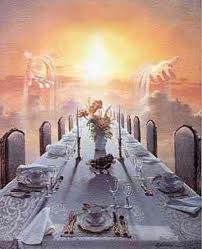 22 But the father said to his servants, ‘Bring quickly the best robe, and put it on him, and put a ring on his hand, and shoes on his feet. 23 And bring the fattened calf and kill it, and let us eat and celebrate. 24 For this my son was dead, and is alive again; he was lost, and is found.’ And they began to celebrate.
25 “Now his older son was in the field, and as he came and drew near to the house, he heard music and dancing. 26 And he called one of the servants and asked what these things meant. 27 And he said to him, ‘Your brother has come, and your father has killed the fattened calf, because he has received him back safe and sound.’ 28 But he was angry and refused to go in. His father came out and entreated him, 29 but he answered his father, ‘Look, these many years I have served you, and I never disobeyed your command, yet you never gave me a young goat, that I might celebrate with my friends. 30 But when this son of yours came, who has devoured your property with prostitutes, you killed the fattened calf for him!’ 31 And he said to him, ‘Son, you are always with me, and all that is mine is yours. 32 It was fitting to celebrate and be glad, for this your brother was dead, and is alive; he was lost, and is found.’”
Grace, mercy, and peace to you from God our Father and from our Lord and Savior Jesus Christ. Amen.
You know this parable. In fact, if you randomly approached someone on the street and asked them, I would venture to guess almost everyone you met would be able to give you at least a summary of the story. But they will inevitably flunk a theological quiz about what the parable means. That is because so mush of the teaching on this parable is so far off. To be fair, part of the fault lies in the fact that the story is, unfortunately, named The Prodigal Son.
This parable is not primarily about a son who is received back into the loving arms of his father. This parable is Jesus’ attempt to completely blow up the natural theology of us sinners.
Don’t miss the first three verses of Luke 15 because they are vital to understanding what Jesus is teaching in this parable. Tax collectors and sinners were all drawing near to Jesus. Imagine this. Jesus is always found with the drunkards at the biker bars and with the people who are under investigation for Ponzi schemes. The Pharisees didn’t like this at all. The mindset of the Pharisees was this: If God is mad at my sins, then He is pleased with my good works. Now, be careful here because your natural tendency is to look at the Pharisees and think, “Wow, that’s terrible of them. I don’t think like they do” Then you quietly pat yourself on the back for not being like them. But as soon as you do that, you have adopted the Pharisees theology which, again, is your natural theology.
Jesus tells three parables to destroy your natural theology – the lost sheep, the lost coin, and the prodigal son. Each of these parables has three main parts: something is lost (think ‘dead’), it is restored (think ‘resurrected’), and there is a party. Jesus concludes the parable of the lost sheep by saying this, “There will be more joy in heaven over one sinner who repents than over ninety-nine righteous persons who need no repentance.” He concludes the parable of the lost coin, “There is joy before the angels of God over one sinner who repents.” And the main point is that third part – the party. The party that ensues only after death and resurrection. We see this most clearly in the third parable which would be better titled, “The Waiting Father.”
In this parable, the younger son tells his father, “My life would be better if you were dead. In fact, why don’t you just pretend you are dead and give me what I’ll get when you finally are in the ground.” The father does exactly as the son asks and drops dead.
The son takes off. He lives high on the hog, and it’s fun while it lasts. But the inevitable comes sooner rather than later.  The money is gone, the economy turns south, and he is left with nothing. So he hires himself out. But the best job he can get is feeding pigs, and the pay – well it’s not so good. He can’t even afford food with his income, so he wishes he could eat the slop he is tossing to the little piggies. He realizes he’s going to starve. His current employer is a stiff. This pathetic son looks at his life and finds nothing.
But his dad, his dad is the best boss around, and his employees have more than enough to eat. He formulates this little speech, “Father, I have sinned against heaven and before you. I am no longer worthy to be called your son. Treat me as one of your hired servants.” Now, this may sound like repentance. But it’s not. Look closer. Teetering on the brink of death, this son formulates a plan to hold on to the possibility of carving out a life for himself.
His plan is to say to his dad, “Look, we both know each other, and we don’t have the best history. I know all of that. Can you just give me a job? I’ll work for you, and you don’t have to bother about me. Just deposit my wages in my account. I’ll stay out of your way, and you can stay out of mine.”
But when he finally meets his father, he doesn’t even get the chance to make his proposition. This son dies to his plan to hold onto his life because his dead-to-him father falls on him and kisses him. He interrupts the son mid offer. The father calls the servants to dress him, restore him, and kill the fattened calf so the whole town can celebrate. The dead son has been raised.
But not everyone is ready to die to their rights and party. The older son off living dutifully for his father – in fact double duty since his brother left – working away in the fields. He is so busy with his life that doesn’t even notice, at first, his brother’s return. This older son is just as lost as his brother had been (if not even more lost). He was simply lost in plain sight.
This older son learns about this party, and he starts opening fire on his father blaming the father for all his misery. “I have served you all these years,” bang. “I have never disobeyed your command,” Bang. “You haven’t given me a little to celebrate with my friends,” bang. Now, the son goes for the kill shot, “You don’t even see how much better I am than my brother. This sham of a son of yours comes home after devouring your property with prostitutes, and you kill the fattened calf for him,” BANG!
This is a picture of you and of me in our natural, fallen theology. You see, we are not the younger son in this parable. We are the older brother. We think God should reward us for our life of service to Him. We think that our obedience, devotion, and work have earned us something from God. We do this even with our confession and repentance.
The message of the Gospel is not that you confess your sins to get God’s forgiveness. Confession isn’t a transaction between the Lord and Giver of life and those who are clinging to life by a thread. That’s Pharisee reasoning, that is your natural, fallen, sinful theology thinking you can live and work your way back to God.
 The Gospel only works on those who are already dead. Confession is simply a corpse realizing, “Yup, I’m dead as dead. Only resurrection will help me.” The father accepted and received the son before he said a blasted thing. The father restored the son before he could even try to cling to life. And the father is even accepting of the older son longing for him to simply get over himself, his works, his obedience, and his life.
The father says, “Look at yourself, standing out in the yard living like a beggar when you own this place. Remember, I died and the inheritance has already been doled out. All that is mine is yours. And the only reason you aren’t having a good time is because you won’t drop dead to your dumb rules about how you think things should be run. Just die to your rights and works and obedience. Drop dead like us. We’re all dead in here, and we’re having a splendid time. Get in here and pour yourself a drink.”
This is the Gospel. Everything that belongs to God is yours because of Christ. God is simply waiting to throw a party. All you can do is drop dead. Drop dead to your works. Drop dead to your rights. Drop dead to any claim of reward or privilege you would make on God. Drop dead because you already are and enter the party.
And here’s the kicker. Here’s how we know the party has already started. Which character in this parable is Jesus? He’s not either of the sons. Is Jesus the Father? Maybe, in a sense. The clearest character in this parable relating to Jesus is the over-looked fattened calf. All a fattened calf does is stand around waiting to drop dead at a moment’s notice so people can have a party. And Scripture tells us that Jesus is the Lamb slain from before the foundation of the world (1 Pet. 1:19-21).
The party only comes through death and resurrection. Christ is risen. Risen centuries before any of you were born. The resurrection is today (1 Cor. 15:20-23). The party is now.
 And, now, here, at this altar, you have a seat at the party – the eternal feast of the marriage supper of the Lamb. This Supper is for those who are dead in their sin. If you think you deserve a seat at this party because of anything you have done, then it isn’t for you. Don’t come. This party is only for those dead in sin.
Here Jesus is inviting you to drop dead to your morality, your works, your efforts and enter into the party. Here is His crucified and risen body and blood to enter into your deadness so that you too will rise again. Amen.
The peace of God, which surpasses all understanding, will guard your hearts and minds in Christ Jesus. Amen.
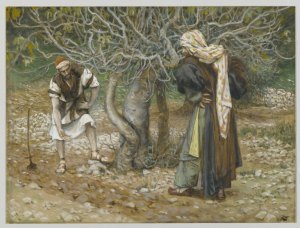 6 And he told this parable: “A man had a fig tree planted in his vineyard, and he came seeking fruit on it and found none. 7 And he said to the vinedresser, ‘Look, for three years now I have come seeking fruit on this fig tree, and I find none. Cut it down. Why should it use up the ground?’ 8 And he answered him, ‘Sir, let it alone this year also, until I dig around it and put on manure. 9 Then if it should bear fruit next year, well and good; but if not, you can cut it down.’”
 Jesus uses both of these things – the wickedness of a political authority and a tragic “act of God” – to remind us to live as repentant people. All tragedies and all acts of violence should remind us that we are sinners who deserve nothing good. God doesn’t owe us peace or long, healthy lives. God’s anger against our sin is real. And just because we are God’s forgiven, adopted children does not mean that we will have a wonderful life. We deserve to be slaughtered. We deserve to have towers pushed over on us. God’s anger is real, and death is what our sin has earned us. We, all of us, need to repent.
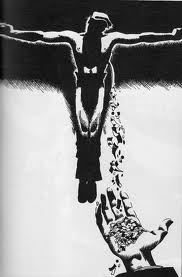 He is the very God who digs, prunes, and fertilizes. And He is not done with you. He refuses to stand by and watch as you grow fruitless and wild. He will not chop you down without first caring for you with His love. Jesus pours out His blood for you and showers his constant forgiveness upon you.
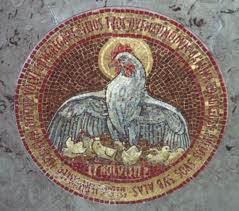 34 O Jerusalem, Jerusalem, the city that kills the prophets and stones those who are sent to it! How often would I have gathered your children together as a hen gathers her brood under her wings, and you were not willing! 35 Behold, your house is forsaken. And I tell you, you will not see me until you say, ‘Blessed is he who comes in the name of the Lord!’”
 We are just like those chicks. Rather than seeing Jesus’ wings as our place of refuge, we see them as smothering and confining. We don’t want to be stifled and cramped under His wings. Because of our sinful nature, our wills are hell-bent on remaining free and unfettered to run around rather than being protected in repentance under the wings of Jesus. We see the fire, and we are scared. But rather than trusting Jesus to protect us, we keep running around kicking up sparks, spreading the fire, and making things worse.
 Thankfully, Jesus’ will is stronger than yours. Jesus knows what it will cost for Him to spread His wings over you. And Jesus still resolves to go to Jerusalem. Jesus will continue to run His course. He will cast out demons and perform cures today and tomorrow, and on the third day will be finished. This is exactly what Jesus says on the cross. He cries out, “It is finished,” (Jn. 19:30 same word as in v. 32), and He gives up His spirit.
 3 The devil said to him, “If you are the Son of God, command this stone to become bread.” 4 And Jesus answered him, “It is written, ‘Man shall not live by bread alone.’”
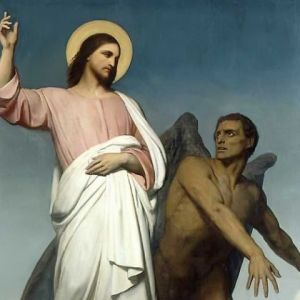 Finally, the devil takes Jesus to the top of the Temple, and the he goes back to questioning Jesus’ son-ship. “If You are the Son of God, throw Yourself down from here because God will not let you get hurt.” The devil even quotes from our Psalm this morning. Satan is being really tricksy here. He is saying, “God has said that He will protect You. Prove that you trust God’s promises to You.”
 What they saw must have woken them up quickly. Before them, the Son of God shines in open, unmistakable glory. Moses and Elijah are there speaking with Jesus about the departure (lit. ‘exodus’) of His cross and resurrection. This is a tremendous moment that Peter, James, and John want to hold on to. They love this shiny Jesus more than the Jesus who speaks so openly about dying. And Peter has a bright idea (pun intended) of his own. “Master, it is good that we are here. Let us make three tents, one for You and one for Moses and one for Elijah.”
 The Gospel says that Jesus is the Lamb of God who takes away the sins of the world. In other words, there is not one person for whom Christ did not die. His crucifixion appeases the wrath of God for all sin of all time. But imagine walking up to a total, complete stranger at the grocery store and telling them, “You are forgiven.” Now, some of them might be Christians and say, “Praise God!” Be I bet that most people and even some Christians would say something like, “Forgiven for what? I haven’t done anything wrong.” For someone who does not have a sense of their sin and guilt, the Gospel is offensive. This is the first way that the Gospel is offensive; it is out of an ignorance of sin and guilt.
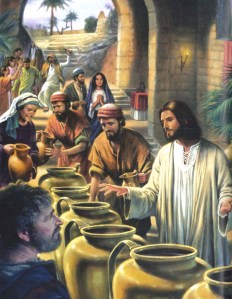 6 Now there were six stone water jars there for the Jewish rites of purification, each holding twenty or thirty gallons. 7 Jesus said to the servants, “Fill the jars with water.” And they filled them up to the brim. 8 And he said to them, “Now draw some out and take it to the master of the feast.” So they took it. 9 When the master of the feast tasted the water now become wine, and did not know where it came from (though the servants who had drawn the water knew), the master of the feast called the bridegroom 10 and said to him, “Everyone serves the good wine first, and when people have drunk freely, then the poor wine. But you have kept the good wine until now.” 11 This, the first of his signs, Jesus did at Cana in Galilee, and manifested his glory. And his disciples believed in him.
 Really, Mary? You are bringing the Son of God into this situation, and you’re doing it like this? Mary, you sound like a whiny child. Parents, you know what I’m talking about. Your kid lethargically walks up to you and says in their whiney little voice, “There’s nothing to eat.” You know that they are in a very ungrateful, impolite way they are asking you for food. It is very easy to get upset when our children approach us like this. I get upset. But notice the faith of your children in this. They feel a need, and where do they go? They go to you. They know that you provide food and so they present their need to you trusting that you will translate their statement into a request. And lovingly or, maybe, not so lovingly, you give them what they haven’t asked for simply because you are gracious.
 This most clearly seen on the cross. To the lost, rebellious, drunk-with-sin, unthankful human race, Jesus gives what is most precious and what should make all our hearts burst with gladness. Jesus gives His very blood and His perfect obedience to the Father.
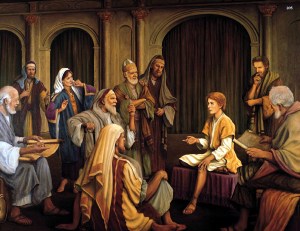 46 After three days they found him in the temple, sitting among the teachers, listening to them and asking them questions. 47 And all who heard him were amazed at his understanding and his answers. 48 And when his parents saw him, they were astonished. And his mother said to him, “Son, why have you treated us so? Behold, your father and I have been searching for you in great distress.” 49 And he said to them, “Why were you looking for me? Did you not know that I must be in my Father’s house?” 50 And they did not understand the saying that he spoke to them. 51 And he went down with them and came to Nazareth and was submissive to them. And his mother treasured up all these things in her heart. 52 And Jesus increased in wisdom and in stature and in favor with God and man.
 No one makes us angry. Rather, we give in to our anger and let it have the best of us. In our fight or flight instinct, we usually choose to fight, and we blame others for our overreactions.
 In those waters of my baptism, the all-consuming Flood of God condemned all that was unbelieving in me while God safely placed me in the ark of His catholic Church.
 Pastorsamwise
You must be logged in to post a comment.