The Bearing Lamb – Sermon on John 1:19-29 for the Fourth Sunday of Advent

John 1:19–29

19 And this is the testimony of John, when the Jews sent priests and Levites from Jerusalem to ask him, “Who are you?” 20 He confessed, and did not deny, but confessed, “I am not the Christ.” 21 And they asked him, “What then? Are you Elijah?” He said, “I am not.” “Are you the Prophet?” And he answered, “No.” 22 So they said to him, “Who are you? We need to give an answer to those who sent us. What do you say about yourself?” 23 He said, “I am the voice of one crying out in the wilderness, ‘Make straight the way of the Lord,’ as the prophet Isaiah said.” 

24 (Now they had been sent from the Pharisees.) 25 They asked him, “Then why are you baptizing, if you are neither the Christ, nor Elijah, nor the Prophet?” 26 John answered them, “I baptize with water, but among you stands one you do not know, 27 even he who comes after me, the strap of whose sandal I am not worthy to untie.” 28 These things took place in Bethany across the Jordan, where John was baptizing. 

29 The next day he saw Jesus coming toward him, and said, “Behold, the Lamb of God, who takes away the sin of the world!

In the name of Jesus. Amen.

The first few verses of this text are a little frustrating. A bunch of priests and Levites come to John the Baptizer and ask him, “Who are you?” John answers with a negative statement, “I am not the Christ.” I don’t think I’ve ever had a conversation similar to this.

Imagine you’re at, say, your spouse’s company Christmas party. You don’t know many of the people there. You know a lot of names because your spouse talks about all those coworkers, but you don’t really know them. Imagine your spouse is off in a corner talking to those coworkers leaving you with the other spouses of those coworkers. Things are a little awkward, so you try to strike up a conversation with someone. You lean over and ask, “What do you do for a living?” and get the reply, “I’m not the President of the USA.” You’d probably be looking for another conversation. 

That is how John replies. But these priests and Levites have come on a mission. They’ve been sent to figure out just who John is. So, they start aiming at all sorts of targets. “Are you Elijah?” “I am not.” “Ok. Are you the prophet?” “Nope.” “Argh. Who are you? Give us something. We have to give a report.”

Finally, John opens up, “I am the voice of one crying out in the wilderness, ‘Make straight the way of the Lord,’ as the prophet Isaiah said” (Is. 40:3). There, John is doing what he was sent to do; he points people to Jesus. And John keeps talking about Jesus like an excited kid, “Among you stands One you do not know, even He who comes after me, the strap of whose sandal I am not worthy to untie.” Then, the next day, John really gets going. He sees Jesus coming toward him and says, “Behold, the Lamb of God, who takes away the sin of the world.”

That is the most beautiful sermon you could ever hear, but I want to press in on it a little bit more. The words are familiar, but just like all the words of Scripture, there is always more to learn, more glean from those simple words. Today, focus on two of those words “takes away” (in Greek is actually only one word). That translation is a bit vague and nebulous.

You might think that is referring to what Jesus does on the cross, and in a sense, that is right. Jesus brings your sins to the cross and buries them by His death. But what John the Baptizer says here is a lot more specific than our translation makes it sound.

Nearly every English translation uses the phrase, “takes away.” The word there is a common one, and in a lot of places it’s a slam dunk that it means “take away.” In Luke 6:29-30, Jesus uses this word twice. He says if someone ‘takes away’ (same word) your coat, give him your shirt as well, and if someone ‘takes away’ your goods do not demand them back. In the parable of the Sower and the Seed, Jesus talks about the seed that falls along the path and the birds come and take it away (Lk. 8:12).

But this word also can clearly mean ‘to carry’ or ‘bear’ something. Jesus uses it in that way in Mt. 16:24 where He says, “If anyone would come after Me, let him deny himself and take up (there’s the word) his cross and follow Me.” There, Jesus isn’t saying that you should first take away your cross and then follow Him. He means that you pick up your cross, that you bear the weight and load of your cross, and you follow Him. That’s the idea of what John is saying here.

And John uses this word in the present tense. John points to Jesus and says, “Behold, the Lamb of God, who is bearing the sin of the world.” Jesus is the sin-bearing Lamb of God. For about three and a half years, starting at His Baptism and ending on Good Friday, Jesus bore and carried the weight and load of the guilt and sin of humanity.

The Bible talks about your sin and my sin in a lot of different ways: darkness, death, blindness, slavery, debt, alienation from and animosity toward God. The Bible talks about your sin being dirty, stinky, rotten. But here sin is described as heavy, as a weight bearing down on your soul (see also Heb. 12:1). The sins you and I have committed and the sins that have been committed against you, Jesus bears and carries them all.

Maybe, you remember the third verse of the hymn “It Came Upon a Midnight Clear.” 
“And ye, beneath life’s crushing load
whose forms are bending low,
who walk along the climbing way,
with painful steps and slow,
look now, for glad and golden hours
come swiftly on the wing;
O rest beside the weary road,
and hear the angels sing.” 

I just wish that verse was a little more clear about why those glad and golden hours come. They come because Jesus, the Lamb of God who bears the sin of the world, has lifted that crushing load. He has taken those sins and carried them.

That load of sin, that crushing burden, is taken from you by Christ. If you read on after our text, you’ll hear why John can say this. John saw the Spirit descend like a dove and remain on Jesus at His Baptism (Jn. 1:32). From that experience of being the one who Baptized Jesus, John knew that Jesus was the One whom God had promised would crush the serpent’s head (Gen. 3:15). John knew that Jesus was the scapegoat who would bear and carry the sins of all humanity into His grave (Lev. 16:21-22), which is now and forever empty.

John knew Isaiah’s message that God would send One who would bear our griefs, carry our sorrows, and have the iniquity of us all laid on Him (Is. 53:4-5). That One is Jesus. He is the Lamb of God who bears and carries the sins of the whole world.

This call from John is for all of you, for your hears to hear, “Behold the Lamb of God who bears the sin of the world.”

You see, your sin, my sin, all sin, has a place, a location. Sin is either on you, and you have to bear and carry its guilt for all eternity, or that sin is on Christ, the Lamb of God, who has already borne it for you. Why, why, would you keep carrying it? You can, sadly, you can continue to carry your sin. If you refuse to believe in Christ, that burden can remain on you. But that would be, frankly, foolish. Jesus has carried it for you. Believe that, and be unburdened. Through faith, your sin is on Christ, and you are saved.

Dear Iris, today you are Baptized. Today, Jesus has joined you to Himself by placing His name upon you (Mt. 28:19). Iris, Jesus, the sin-bearing Lamb of God, has lifted that burden and has now clothed you in His righteousness (Gal. 3:27), and you have been born of God (Jn. 3:3, 5). Iris, continue believing that.

Iris and all you here, know and believe that God is for you. He is on your side. Christ has done what you could not do for yourself. He has borne your sins. He bore, carried, and dealt with them once for all, for you. 

So, be unburdened, Jesus has come to save you by being the sin-bearing Lamb for you. Amen.

The peace of God, which surpasses all understanding, will guard your hearts and minds in Christ Jesus. Amen.

Coming Soon – Sermon on John 1:19-29 for the Fourth Sunday of Advent

John 1:19–29

19 And this is the testimony of John, when the Jews sent priests and Levites from Jerusalem to ask him, “Who are you?” 20 He confessed, and did not deny, but confessed, “I am not the Christ.” 21 And they asked him, “What then? Are you Elijah?” He said, “I am not.” “Are you the Prophet?” And he answered, “No.” 22 So they said to him, “Who are you? We need to give an answer to those who sent us. What do you say about yourself?” 23 He said, “I am the voice of one crying out in the wilderness, ‘Make straight the way of the Lord,’ as the prophet Isaiah said.” 

24 (Now they had been sent from the Pharisees.) 25 They asked him, “Then why are you baptizing, if you are neither the Christ, nor Elijah, nor the Prophet?” 26 John answered them, “I baptize with water, but among you stands one you do not know, 27 even he who comes after me, the strap of whose sandal I am not worthy to untie.” 28 These things took place in Bethany across the Jordan, where John was baptizing. 

29 The next day he saw Jesus coming toward him, and said, “Behold, the Lamb of God, who takes away the sin of the world!

In the name of Jesus. Amen.

My college buddies and I try to get together every year. We typically meet at a lake cabin that belongs to the family of one of the guys in our group. Sometimes, we’ll joke that the only reason we invite him is that we meet at his cabin. (He’s actually a great guy.) The majority of our time is spent sitting around a campfire. Since there are at least three eagle scouts and one borderline pyromaniac in that group, building and maintaining the fire is no problem.

We sit around those huge, burning logs sharing stories late into the night, but over the years, I’ve ended up being one of the first to go to sleep. Because I’m one of the first to bed, I’m also one of the first up and get back to the firepit in the morning. When I look at the place that was a roaring fire when I went to bed, all I can see is a pile of ash. The flames are all gone. But when I get down close to that gray ash heap, I can fell there are still hot embers underneath. All it takes to get the fire going again is a paper plate, a few twigs, and a little blowing.

Throughout the Old Testament, God had made promise after promise that the Messiah and Savior would come. Like a huge bonfire, the prophetic promises burned bright and hot. But then, God stopped sending the prophets, and the flames died down. For some 400 years, there was no word from God. By all appearances, there was nothing more than an ash heap, but under those ashes were glowing embers ready to ignite anything placed on them.

Those hot coals were detected with the old priest, Zechariah. The people of Jerusalem had heard the story of how he had seen a vision while he was serving in the Temple, and after that vision he wasn’t able to speak for nine months. The strange thing is that vision and silence coincided with his old wife, Elizabeth, getting miraculously pregnant and having a son. Zechariah was only able to speak again after his son was named John, which was reportedly the name given to him in that vision (Lk. 1:2-25, 57-80). And this John grew up to be a peculiar fellow. He lived out in the desert eating grasshoppers and wild honey.

Then, the breeze started to blow on the embers. John was out in the wilderness preaching and baptizing. He would say things that others were too shy to speak. John was calling soldiers, tax collectors, and everyone to repent (Lk. 3:7-17). The religious leaders didn’t have a problem with that call to repentance. The curious thing about this call to repent was the reason John gave, “for the kingdom of God is near.” Where did John get that idea?

John’s preaching had gotten the embers glowing from beneath the ashes, and now huge crowds of people were migrating from Jerusalem, Judea, and all around the Jordan to hear this preaching and to be baptized by John (Mt. 3:5-6). Just like sticks thrown on hot embers, flames were starting to flicker once again. And that is what got the attention of the religious big wigs in Jerusalem. So, they sent a delegation to John to ask him, “Who are you?”

John confessed, “I am not the Christ. No, I’m not Elijah. No, I’m not the prophet. I am the voice of one crying out in the wilderness, ‘Make straight the way of the Lord,’ as the prophet Isaiah said.” And John goes on to say, “There is One standing among you that you don’t know, and I’m not worthy to stoop down and untie His sandals.” The flames were growing higher and hotter.

Now, Scripture doesn’t say this for sure, but I like the idea that Jesus was present in that crowd when John says, “among you stands One you do not know,” because it was the very next day that John points to Jesus and says, “Behold the Lamb of God who takes away the sin of the world.” With that preaching, the log was thrown on the flames and a new bonfire ignited.

That new fire of Jesus’ ministry brought miracles, healing, and powerful teaching. It burned brightly scattering and dispersing the darkness of demons. But after three years of Jesus’ ministry, something happened. It looked like the fire completely collapsed and the flames appeared to go out as Jesus died on the cross, but they ignited again in His glorious resurrection. By His death and resurrection, Jesus, the Lamb of God, has taken away the sin of the world. Everyone quickly check. Are you part of this world? Ok. Then Jesus has taken away your sin.

This same Jesus is now ascended into heaven where He sits at God’s right hand interceding for you and pleading your case before God the Father. There, Christ your Savior continually reminds God the Father that the wrath and punishment you deserve has been fully paid by His holy and precious blood. With His nail-scarred hands, Jesus now points to you who trust in Him and says, “That one’s sins are removed as far as the east is from the west” (Ps. 103:12).

Yes, you live some 2,000 years after Jesus died and rose again. Sure, it might look like the light of the fire of Jesus’ ministry has been reduced to nothing more than a pile of ashes. But it’s looked like that before. And our perception can be deceiving. The embers are still there and hot. Christ is not as far away as He may seems to be. He is here. Jesus stands among you. He has promised, “Where two or three are gathered in My name, there I am among them” (Mt. 18:20). He declares to you, believer, “I am with you always, to the end of the age” (Mt. 28:20). 

Jesus has come once – born in a barn in Bethlehem. He is coming again in glory and power. And He is come now. It doesn’t matter how gray the ashes appear to be in this sinful world. The embers are glowing hot and bright underneath, ready to ignite at any moment.

Lord willing (Jam. 4:15), we will gather here again tonight to celebrate and remember the birth of our Savior, the Lamb of God who takes away the sin of the world. Celebrating the birth of Jesus helps to prepare us for His second coming. Believer, He came meek and humble when He was born in Bethlehem to be the Savior. That is why the angels could sing, “Glory to God in the highest, and on earth peace among men with whom He is pleased” (Lk. 2:14). That faith prepares you to welcome Him when He comes again in glory on the Last Day.

For those who do not have faith, Jesus’ second coming will be terrifying. There will be no angel to tell you, “Fear not for I bring you tidings of great joy” (Lk. 2:10). Because, when He comes again, He will come to judge the earth (Ps. 96:13, 98:9). You who have faith, you already know the outcome of that judgment. Jesus Himself will be your defense lawyer (1 Jn. 2:1) and judge who will declare you not guilty.

For anyone here who does not have faith in Christ, I love you too much to not tell you that – if you persist in your unbelief and sin – the outcome of your judgment on that day is certain. Jesus will say to you, “Depart from Me, you cursed, into the eternal fire prepared for the devil and his angels” (Mt. 25:41). So, quit your stubborn, self-centered, self-righteous ways. Repent of your sin, and believe in Jesus. He loves you and wants you for his own.

And for you, dear saints, Jesus is here now, and He is with you always. The day of His return is coming soon. The embers are still hot and ready to ignite. Come, Lord Jesus. Amen.

The peace of God, which surpasses all understanding, will guard your hearts and minds in Christ Jesus. Amen.

Gentle, Reasonable Rejoicing – Sermon on Philippians 4:4-7 for the Fourth Sunday of Advent

Philippians 4:4-7

4 Rejoice in the Lord always; again I will say, rejoice. 5 Let your reasonableness be known to everyone. The Lord is at hand; 6 do not be anxious about anything, but in everything by prayer and supplication with thanksgiving let your requests be made known to God. 7 And the peace of God, which surpasses all understanding, will guard your hearts and your minds in Christ Jesus.

In the name of Jesus. Amen.

Before I share a quote with you, I want to be clear on something: I am a Vikings fan, through and through. Have been and will be all my life. I feel like I need to say that because the quote comes from the former Green Bay Packers coach, Vince Lombardi. In 1967, the Packers’ kick returner, Travis Williams, scored a touchdown and danced in the endzone to celebrate. As he returned to the sideline, Lombardi told his excited rookie, “Travis, the next time you make it to the endzone, act like you’ve been there before.”

Now, I share that quote to help us get to the meaning of one particular word in this text; it’s in v. 5, “Let your reasonableness (the Greek word there is pronounced epieikēs) be known to everyone.” There really isn’t a good English equivalent for epieikēs, which is utterly unfortunate. Other translations will use words like gentleness, graciousness, and moderation, but each of those only convey one part of the word’s meaning. Epieikēs – refers to a strength that doesn’t need to prove anything to other people because that strength is accompanied with gentleness, meekness, and humility. We could compare it to scoring a touchdown, calmly handing the ball to the ref, and heading to the sidelines to get ready for the next play. A player who does that is confident enough to know that he has the strength and ability to find his way into the endzone again so he can be humble.

Now, all of that was to simply convey the meaning of epieikēs. When Paul wrote Philippians, he wasn’t writing to a football team, so let’s get to what this means for us Christians.

Dear saints, “Rejoice in the Lord always; again I will say, rejoice.” The life of a Christian is a life of rejoicing. Why can you be joyful always? Because you are a sinner who deserves nothing but God’s punishment, but that is not what God has given you. Instead, you have a Savior. Jesus, the eternal Son of God, has come in the flesh. He has taken your place. He lived a perfect, sinless life for you. He is the Lamb of God who takes away your sin (Jn. 1:29) and brings it to the cross where He endured the punishment that you deserved because of your sin (2 Cor. 5:21).

And in place of your sin, Jesus has fully forgiven you and has given you His perfect righteousness. When God looks at you, He sees His holy, beloved Son (Gal. 3:27). Nothing can take that away from you – not sickness, not financial troubles, not pesky relatives, not greedy politicians. Neither death nor life, nor angels nor rulers, nor things present nor things to come, nor powers, nor height nor depth, nor anything else in all creation, will be able to separate you from the love of God in Christ Jesus your Lord (Ro. 8:38-39). Now, that is reason to rejoice.

In your rejoicing, let that epieikēs – that confident, humble, gentle strength – be evident to everyone you encounter because Jesus, your Savior, is at hand. Christian, Jesus is coming back, and He will bring justice and righteousness. You don’t have to prove or assert yourself. You don’t have to make everything right in a fallen world. Jesus will come and do that. Just a few verses before our text, we are told that “our citizenship is in heaven, and from [heaven] we await a Savior, the Lord Jesus Christ” (Php. 3:20). So, when you face any type of adversity in this world, you can have a moderated, calm kindness and gentleness because you stand in the strength of Jesus who is going to fix everything that is broken and make everything right.

Yes, this world is going to throw all sorts of trials, tribulations, and adversities at you that will make you worried and anxious. But this text tells us what to do with those worries so our humble, gentle strength – our epieikēs – continues to be known to everyone. Turn those anxieties into your prayers. Whatever makes you worried and anxious, doesn’t need to dictate how you act. Instead, hand that thing over to God in prayer. God promises to take care of that thing in the way that is best for you and for those around you (Ro. 8:28).

Christian, the almighty, all-powerful God and Creator of all things is also your Redeemer. Rejoice! He freely gives you His salvation. In Isaiah 30:15, God makes a promise to you that explains why you can have this epieikēs; He says, “In returning and rest you shall be saved; in quietness and in trust shall be your strength.”

Dear saints, in Jesus you are sons and daughters of God and have the victory over every evil because His death on the cross has delivered you (1 Cor. 15:57). “Christ’s resurrection guarantees the victory of [you,] His brothers and sisters. Christ’s second coming brings the final fulfillment. And Christ, [your] Lord, is at hand.”[1] Amen.

The peace of God, which surpasses all understanding, will guard your hearts and minds in Christ Jesus. Amen.

Today’s sermon was abbreviated due to our Sunday School Christmas program.


[1] Rev. Dr. Normal Nagel. Selected Sermons of Norman Nagel. Concordia Publishing House, 2004. p. 27

The Lamb – Sermon on John 1:19-29 for the Fourth Sunday of Advent

John 1:19-29

19 And this is the testimony of John, when the Jews sent priests and Levites from Jerusalem to ask him, “Who are you?” 20 He confessed, and did not deny, but confessed, “I am not the Christ.” 21 And they asked him, “What then? Are you Elijah?” He said, “I am not.” “Are you the Prophet?” And he answered, “No.” 22 So they said to him, “Who are you? We need to give an answer to those who sent us. What do you say about yourself?” 23 He said, 

“I am the voice of one crying out in the wilderness, 
‘Make straight the way of the Lord,’ 

as the prophet Isaiah said.” 

24 (Now they had been sent from the Pharisees.) 25 They asked him, “Then why are you baptizing, if you are neither the Christ, nor Elijah, nor the Prophet?” 26 John answered them, “I baptize with water, but among you stands one you do not know, 27 even he who comes after me, the strap of whose sandal I am not worthy to untie.” 28 These things took place in Bethany across the Jordan, where John was baptizing.

29 The next day he saw Jesus coming toward him, and said, “Behold, the Lamb of God, who takes away the sin of the world!”

In the name of Jesus. Amen.

Nativity sets always include Joseph, Mary, and, of course, baby Jesus in the manger. Most will have figures that depict the shepherds and wise men (even though the wise men almost certainly did not arrive the night of Jesus’ birth). A lot of nativity sets will also incorporate animals. There might be a donkey because of the idea that Mary rode on a donkey. It very well might be that she did ride on a donkey from Nazareth to Bethlehem, but that is not recorded for us in Scripture. Nativity sets might include camels that the wise men supposedly rode, but again, even if they were there that night, Scripture doesn’t tell us if they rode on camels. But if there is one animal in a nativity set, it is probably a lamb. Of all the animals that should be part of our imagery of Christ’s birth, a lamb is at the top of the list.

Now, Jesus’ birth took place in Bethlehem which is located about five miles south of the Temple where God commanded that sacrifices be made. And the requirements for the sacrificial system at the Temple would have been immense. Each day, two lambs would be sacrificed – one in the morning and one in the evening. On top of that there were the sin offerings, peace offerings, and freewill offerings that individuals and families would bring at various times all would have required animals for sacrifice. And even beyond that, there were the animals needed for the extra sacrifices on festival days. So, all around Jerusalem, there would have been a large industry of raising animals that would be sacrificed at the Temple.

It is not a stretch to think that at least some if not most of the lambs the shepherds were tending the night of Jesus’ birth were destined to be sacrificed. It’s even possible that some of the animals who fed from the manger where Jesus was laid would also end up on the altar at the Temple. But there, in the center of it all, is Jesus – God in the flesh, the One who was born to be the one-time, forever sacrifice for your sins.

“Behold the Lamb of God who takes away the sin of the world.”

In this Gospel reading, the priests and Levites were sent to ask John the Baptizer, “Who are you?” John had been attracting massive crowds who were going out to hear his preaching and to be baptized. So, the big shot Pharisees back in Jerusalem wanted to know why John was doing what he was doing out there in the wilderness beyond the Jordan.

“Who are you, John?”

John confessed, “I am not the Christ. I am not Elijah. I am not the Prophet. I am the voice of one crying out in the wilderness, ‘Make straight the way of the Lord.’” Everything John does and says in this text points people away from himself and to Jesus, to the Savior, to the Lamb of God who takes away the sin of the world.

Dear saints, as we approach the birth of our Lord, there are all sorts of things that would grab our attention. Parties, pageants, and programs. Decorating, shopping, and wrapping. Cleaning, baking, and cooking. In the midst of the hustle and busyness of this season, don’t let your attention be grabbed only by the peripherals. Don’t be like the Pharisees, priests, and Levites who are only interested the stuff that is flashy and popular. One thing and one thing only is important this Christmas season: May you behold the Lamb of God who takes away the sin of the world.

He comes to you to take away your sin, to restore you into a right relationship with God, and to give you eternal life. Jesus comes to take away the sin of the world. That means your sin – every last bit of it – is taken away by Jesus.

This Christmas, may you be surrounded by God’s blessings – family, friends, food, gifts, and celebration. But in the midst of all of that, remember that you are secure for all eternity because of what Christ has done. He is your Savior, your Lamb of God who takes away the sin of the world. Amen.

The peace of God, which surpasses all understanding, will guard your hearts and minds in Christ Jesus. Amen.

Rejoice in Peace – Sermon on Philippians 4:4-7 for the Fourth Sunday of Advent

Listen here.

Philippians 4:4-7

4 Rejoice in the Lord always; again I will say, rejoice. 5 Let your reasonableness be known to everyone. The Lord is at hand; 6 do not be anxious about anything, but in everything by prayer and supplication with thanksgiving let your requests be made known to God. 7 And the peace of God, which surpasses all understanding, will guard your hearts and your minds in Christ Jesus.

In the name of Jesus. Amen.

In a year that has brought sickness, hardship, loneliness, isolation, frustration, and disappointment, this is a wonderful, beautiful reminder from God’s Word to rejoice. We are usually quick to rejoice and don’t need a reminder when things are light and easy. Instead, we need to be reminded to rejoice precisely when we do not feel like rejoicing and when we feel the pain and injustices of this world. And, please know, this call to rejoice isn’t a legal requirement. It is a Gospel invitation. “Rejoice in the Lord always; again I will say rejoice.”

Now, when Paul calls us to rejoice, it is not some shallow cliché. This isn’t a, “Don’t worry; be happy” or a “Hakuna Matata.” And it isn’t as though Scripture is saying, “Well, you should be happy because things could be a lot worse.” Instead, there is real cause for rejoicing. Rejoice because the Lord, your God, your Savior, and your Redeemer is at hand. He’s right here with you now, and He is with you always bringing His mercy and love.

Yahweh, the great “I am” (Ex. 3:14); the God of Abraham, Isaac, and Jacob; your Creator who is a God merciful and gracious, slow to anger and abounding in steadfast love and faithfulness (Ex. 34:6) – this very God has come for you, born of a woman born under the Law to redeem you who were under the Law (Gal. 4:4-5). Jesus came to give His life as a ransom for you while you were still His enemy (Ro. 5:10).

Dear saints, there is enough there for an eternity of rejoicing.

Now, when Paul wrote this call to rejoice always, he was sitting in prison, yet rejoicing. Paul knew pain and injustice – from both sides of the coin. Paul was a persecutor of the Church, and after Jesus met him, Paul was a persecuted member of the church. Paul knew what it was to throw people in prison and what it was to eat prison food. And even in his low moments, he reminds us that there is reason to rejoice, and that reason is, that no matter if things are going well or not, God is on your side.

As you rejoice in the faith and confidence that God is favorable toward you, our translation says, “let your reasonableness be known to everyone.” Other translations, instead of ‘reasonableness,’ will use ‘gentleness,’ or ‘moderation.’ Unfortunately, we don’t have a good English word for it. The idea of the word there is to have nobility and authority but acting in meekness and kindness while not using your position for yourself but for the sake of serving others. The word carries the idea of having every right to demand justice for yourself but using that right to bring mercy to anyone in need. Let that kind of noble, gentleness be known to all people.

And then – it is so interesting – as we rejoice and let our noble gentleness be known to people, we are to make our requests be made known to God. “Be anxious for nothing, but in everything with prayer and supplication let your requests be made known to God.”

Being a Christian does not mean that you never have any worries. But one of the reasons you can rejoice is that you can cast all your anxieties and cares upon God (1 Pet. 5:7) by turning those worries into prayers. In other words, whenever you are worried, turn those worries into prayers, leave them at God’s feet, and let God worry about them.

One of the best examples we have of this in Scripture is how King Hezekiah responds when Jerusalem is surrounded by the army of Assyria (see Is. 36-37 and 2 Kgs. 18:13-37). The king of Assyria is marching against Jerusalem is boasting that he is going to destroy the city. He continually mocks God saying that there is no one who can save Jerusalem from his army. King Hezekiah is terrified and anxious when he hears all of this. He tears his clothes and covers himself is sackcloth and takes a letter repeating all these threats, goes to the Temple, spreads out the letter before God, and prays.

And God answers. That night, God went out and struck down 185,000 in the camp of the Assyrian army. God’s people went to bed thinking that they were about to be destroyed, but when they woke up, they found themselves delivered.

Now, this is not mean that God will instantly deliver you from any and every trouble. But He will and, in fact, He already has rescued you. Christ will bring you and His entire Church into the glories of heaven where none of the troubles of this life can enter. That day will come as surely as if it had already arrived. This is why we rejoice.

We can rejoice in the Lord because we know that He rules and reigns over all things, and, in His mercy, He uses His power for our benefit. We rejoice in the Lord because Christ has buried our sins in the emptiness of His tomb. Your sins cannot accuse you anymore; they are gone.

Rejoice in the Lord always. Not just when you’re feeling religious or pious or healthy or happy. Rejoice in whatever condition you find yourself because when you’ve had a rotten day, or when your health is in jeopardy, or when your friend has turned against you, and when your finances are upside down, in any bad situation, you are no less a citizen of heaven than when everything is going your way.

Hudson, God be praised, today you are Baptized. Through the waters of your Baptism, God has joined you to Himself. You have been joined to Jesus’ death and resurrection (Ro. 6:3-6). You have been clothed with Christ (Gal. 3:27). Just as the heavens opened above Jesus when He was baptized, heaven’s gates are now open to you. That means everything Jesus was born to do and has done is now credited to your account.

All of this is to say – Hudson, Luke, Sarah, Maddie, Brayden, and all you saints – that today is a day to rejoice just as every day is to rejoice. God’s steadfast love toward you will never cease. His mercies will never come to an and. They are new each and every morning (Lam. 3:22-23).

Hudson, and all you saints, rejoice. The Lord is at hand, and you know why He comes. He comes to be your Savior. The Jesus who is coming again is the Christ of Calvary and the Christ Child born in Bethlehem. He is the only one who can bring you peace, and that peace is so great that it surpasses all understanding.

Hudson and all you saints, the Prince of Peace is coming to pour His righteousness upon you and make you His own. Know everything else through the fact that Jesus loves you. And His love for you will never fade or fail. Amen.

The peace of God, which surpasses all understanding, will guard your hearts and minds in Christ Jesus. Amen.

The Shortest, Most Beautiful Sermon – Sermon on John 1:19-29 for the Fourth Sunday of Advent

Listen here.

John 1:19-29

19 And this is the testimony of John, when the Jews sent priests and Levites from Jerusalem to ask him, “Who are you?” 20 He confessed, and did not deny, but confessed, “I am not the Christ.” 21 And they asked him, “What then? Are you Elijah?” He said, “I am not.” “Are you the Prophet?” And he answered, “No.” 22 So they said to him, “Who are you? We need to give an answer to those who sent us. What do you say about yourself?” 23 He said,

“I am the voice of one crying out in the wilderness,
‘Make straight the way of the Lord,’
as the prophet Isaiah said.”

24 (Now they had been sent from the Pharisees.) 25 They asked him, “Then why are you baptizing, if you are neither the Christ, nor Elijah, nor the Prophet?” 26 John answered them, “I baptize with water, but among you stands one you do not know, 27 even he who comes after me, the strap of whose sandal I am not worthy to untie.” 28 These things took place in Bethany across the Jordan, where John was baptizing.

Lamb of God who takes away the sins of the wolrd29 The next day he saw Jesus coming toward him, and said, “Behold, the Lamb of God, who takes away the sin of the world!”

In the name of Jesus. Amen.

A more beautiful sermon has never been preached than John’s short, little sermon there: “Behold, the Lamb of God, who takes away the sin of the world!” In this Gospel text, John does exactly what he was sent by God to do. He points everyone who was there listening to him and the rest of humanity, including us, to Jesus. In that thirteen-word, one sentence sermon, John takes all the theology of the Old Testament and all of the religious practices and ceremonies and worship God had given to His people and piles it all on Jesus. Christ fulfills it all (Jn. 5:39; Lk. 24:27; Ro. 15:8; 2 Cor. 1:20).

Consider the Day of Atonement. That day was the only day that someone could enter the most holy place in the Temple. Only the high priest could enter on that one day. On that day, the people took two rams and flipped a coin to determine which one would be sacrificed and which one would be the scapegoat.

The high priest would take the scapegoat and bring it into the midst of the people, place his hands on the head of the goat, and confess all the sins of all the people over the previous year (Lev. 16:21). All their idolatry, blaspheming, and Sabbath-breaking. All their rebelliousness. All their murderous and adulterous ways. All their theft, lying, and discontentment. All those sins would be placed on the head of the goat which would then be led into the wilderness and away from the people.

Hebrews 10(:3) says, “It impossible for the blood of bulls and goats to take away sins,” but those goats could and did preach about the One who would come and take away the sins of the people. Those goats pointed the people to the Messiah who would bear the sin of the world in His body (1 Pet. 2:24). That was the point of all the sacrifices in the Old Testament – to preach about Jesus who would remove sin. When you saw any of the sacrifices – a bull or sheep or ram or pigeon burning there on the altar – you knew that animal didn’t do anything, it hadn’t committed those sins. But it pleased God to take the sins of the people and have them relocated to that animal. And as you saw that animal being killed and burned, you realize, “That should be me, but God accepts the death of another, He accepts a substitute, for my sin.”

That is what John is doing when he points to Jesus and preaches, “Behold, the lamb of God, who takes away the sin of the world.” John is saying, “Here is the One who dies in your place. Here is Jesus, the One who has all of your sin upon Himself.”

John wasn’t just preaching about the fulfillment of the Day of Atonement and the sacrifices. He was also preaching about the fulfillment of the Passover (Ex. 12). Remember, the people were slaves in Egypt, and God sends plague after plague to get Pharaoh to let His people go, but Pharaoh refuses. So, in the final plague, Exodus 12_46 - Passover Blood marking the doorpostsGod sends the angel of death to go through the land of Egypt. But God’s people were to take a lamb. They were to slaughter that lamb and smear some of the lamb’s blood on the door of their house and eat the rest of the lamb roasted that night. And when the angel would see the blood on the door, he would pass by.
Again, when John points at Jesus, he is preaching, “Here is the one whose blood marks your door and guards you from the wrath of God.”

John is preaching about the fulfillment of Abraham’s sacrifice of Isaac. For years, God had promised Abraham that He would give Abraham a child in his old age and through that child God would bless all the nations of the world. Finally, Isaac was born, but God told Abraham to offer Isaac as a burnt offering (Gen. 22). God wasn’t testing Abraham’s obedience with this crazy command; He was testing Abraham’s faith. God had promised that through Isaac, He would raise up the Messiah. And Abraham believed God’s promise that he would have great-great-great-grandchildren through Isaac even if he sacrificed Isaac on top of the mountain. Hebrews 11(:17-20) says that Abraham figured that God would raise Isaac from the dead because God had to keep His promise. Abraham believed that Isaac, the child of promise, wouldn’t stay dead. Abraham believed that God would be faithful. But God provided another way of keeping the promise. The angel stopped Abraham’s hand from sacrificing Isaac. And there in the thorns was a ram caught by its horns, and it was sacrificed in Isaac’s place. After this, Abraham named that place “God provides” because God provided Himself as the sacrifice (Gen. 22:8).

And on that very mountain, the Temple would be built. On that mountain and in that Temple, God would continually accept the death of another in place of the children of promise. And now, John says, “Here is Jesus, the Lamb of God, the one who trades places with you, sinner.”

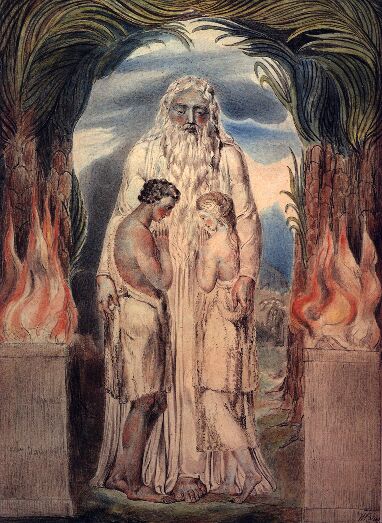
One more. Let’s go all the way back to the Garden of Eden (Gen. 3). Adam and Eve ate the forbidden fruit. They believed the devil’s lie instead of God’s Word. Their eyes are opened, and they realized they were naked. To try and cover their shame, they sewed fig leaves together. Those leafy clothes are like every other human religion; they don’t work. They don’t cover their sin and shame – especially when God shows up. Then, when God comes into the Garden, Adam and Eve try to hide from God. God gives them all sorts of chances to repent, but their sin has made them so afraid of punishment that they continually try to hide behind the leaves of their excuses. God warns them about the curses that have come because of their sin, but He also promises that He will send the Seed of the woman who will crush the serpent’s head.

God had said that on the day Adam and Eve ate that fruit they would surly die (Gen. 2:17), but they didn’t die that day. Instead, Adam and Eve watch God take an animal, who hadn’t done anything wrong, and kill it. This was the first time in all of creation that something died. Genesis 3-21 - God made clothes from skins.jpgGod hung that animal up and stripped the skin from its lifeless body as blood stained the ground. And God wraps that skin around the shameful, sinful bodies of Adam and Eve.
Scripture doesn’t record this, but it invites us to imagine Adam and Eve watching God do all of this. And you can imagine them in their shock and horror asking God, “Is this what it takes to cover our sin and shame?” And imagine God responding, “No. This is only preaching. There is a sacrifice to come.”

That sacrifice is Jesus, God’s own Son. Prior to Jesus, all of the Scriptures tell the story of Jesus coming to be that Lamb who takes away the sin of the world. And all of the Scriptures would have you believe that God lays on Jesus the sin and iniquity of you and me and of the whole world (Is. 53:6).

This short, beautiful sermon of John takes all of these pictures and points you to Jesus as the fulfillment – not the picture. He is the One who actually bears your sin in His body. This Jesus, who knew no sin, became your sin, so that in Jesus you might become the righteousness of God (2 Cor. 5:21).

Jesus is the Lamb of God who takes away the sin of the world. Did you catch that? The sin of the world. That means this Jesus takes away your sin. God’s anger falls on Jesus, not on you. When you see Jesus on the cross, you say, “That should be me. But Jesus, my Savior, has willingly taken my place under God’s wrath so that I can take my place with Him in eternal life.”

Dear saints, this Christmas remember that Jesus is born to be your Substitute and your Savior. He, and He alone, takes away your sin now and forever. Amen.[1]

The peace of God, which surpasses all understanding, will guard your hearts and minds in Christ Jesus. Amen.

[1] I am thankful for a sermon from Pr. Bryan Wolfmueller for much of the content of this sermon.

The Savior Who Is Not You – Sermon on John 1:19-28 for the Fourth Sunday in Advent

Listen here.

John 1:19-28

19 And this is the testimony of John, when the Jews sent priests and Levites from Jerusalem to ask him, “Who are you?” 20 He confessed, and did not deny, but confessed, “I am not the Christ.” 21 And they asked him, “What then? Are you Elijah?” He said, “I am not.” “Are you the Prophet?” And he answered, “No.” 22 So they said to him, “Who are you? We need to give an answer to those who sent us. What do you say about yourself?” 23 He said,

“I am the voice of one crying out in the wilderness,
‘Make straight the way of the Lord,’

as the prophet Isaiah said.”

John Points to Christ24 (Now they had been sent from the Pharisees.) 25 They asked him, “Then why are you baptizing, if you are neither the Christ, nor Elijah, nor the Prophet?” 26 John answered them, “I baptize with water, but among you stands one you do not know, 27 even he who comes after me, the strap of whose sandal I am not worthy to untie.” 28 These things took place in Bethany across the Jordan, where John was baptizing.

In the name of the Father and of the Son and of the Holy Spirit. Amen.

From 4th grade until I graduated High School, I spent too much time at swimming pools. Monday-Friday consisted in at least two hours of practice. And most weekends December–March and June–August were swim meets. In the summer, if my friends wanted to hang out, it usually meant we would go to the pool. Now, there are different sets of pool rules: one set for swim team members during practice and another set for everyone who comes for open swim.

I knew all the lifeguards because most of them were also on the swim team. During practice, they were teammates (even though, until I got to High School, they were much older than I was). But during open swim, they were no longer teammates. They were the authorities. I had to obey their commands and comply with their whistles. And, believe me, they made sure I got a whistle for every little infraction during open swim.

So, when I was old enough, I took the class to get my lifeguard certification so I too could get a job at the pool. I received that perforated card from the Red Cross with the words written in bold “Lifeguard Certification.” And I had ascended the ranks. I donned my white tank-top with the bold red cross, grabbed my whistle, shouldered my 50” rescue tube, and climbed to the throne of the lifeguard stand.

Now, I had authority. I could boss around the younger kids who were on the swim team when they came for open swim. I could bark commands at the college kids and adults who dared to hang on the rim of the poolside basketball hoop, run on the deck, dive in the shallow end, or take more than one bounce on the diving boards. The first few months of being on the stand, I was the Attila the Hun of lifeguards. All feared and obeyed me. (But, I’m sure, the swimmers and my fellow lifeguards thought I was ridiculous.)

The point of all that is this: Whenever we are unsure of our authority or position or status, we take every opportunity to assert ourselves to make sure that everyone around us can see that we are important, we are in charge, we have the answers. And, in our minds, those who can’t see that are just plain clueless. So, we respond to their ignorance about our greatness and importance by doubling down on insisting how important we are. The worst part is that we don’t see how sinful and stuffed with pride we have become, and we refuse to repent because we have justified ourselves in our minds.

John the BaptizerJohn the Baptizer was important. He was the forerunner of the Messiah and the last prophet. He was foretold in Scripture. He had the attention of all Judea and Jerusalem as they came out to him. And the religious authorities were sending envoys to him asking, “Who are you?” They wanted to find out exactly why John was doing what he was doing.

John could have easily persuaded and convinced everyone that he was something more than he actually was. But John confessed, and did not deny, but confessed, “I am not the Christ, not Elijah, not the prophet.”

John stayed in his God-given role, his God-given position, his God-given job, his God-given task, his God-given vocation, “I am not the Christ. I am the voice of one crying out in the wilderness, ‘Make straight the way of the Lord.’” Those two, brief confessions from John can also bring stability, peace, and joy into our lives. John confesses who he is not, and John confesses who he is. When you recognize and trust that you are not your own christ and that you have your own God-given calling and vocation, everything falls into its proper place.

You, like John, are not the Christ. Repeat after me, “I am not the Christ.” You do not have to justify yourself or your actions. Now, let me be clear, there may be times where you are falsely accused of doing wrong and you will need to set the record straight. But even in those instances, there is always some sin you have committed even if it was only a thought or wrong attitude. If we say we have nosin, we deceive ourselves and the truth is not in us (1 Jn. 1:8). So, rather than covering your tracks, rather than justifying yourself, rather than trying to be your own christ, your own savior, you are free. Free to ask for forgiveness – from God and from your neighbor.

There is freedom in saying, “I am not the Christ,” because there is a Christ, there is a Savior who is not you. Jesus, the Christ and Savior, sits at His Father’s right hand with His nail-scarred hands and feet. He vouches for you to God the Father saying, “I am the Christ. I am the Savior. I died and rose again to forgive that one there.”

So, confessing, “I am not the Christ,” brings peace and joy. But so also does John’s other statement, “I am the voice of one crying out in the wilderness…”

cropped-jesus-lamb-slain-silver-goldNow, you aren’t the voice of one crying out in the wilderness, but you are a Christian. And you are a Christian because there is a Christ. You bear His name. You are washed clean of all your sins in His blood. You hear Jesus’ Word. You pray His prayers. You live His life. You have been crucified with Christ. It is no longer you who live but Christ who lives in you (Gal. 2:20). This means that you have your own God-given calling, role, task, and vocation to carry out. So be faithful in those callings and vocations.

And rejoice. Rejoice because there is a Savior who is not you. In Him is your rest. In Him is your forgiveness. In him is your peace. “Rejoice the Lord always, again I will say rejoice. Let your reasonableness be known to everyone.” (Php. 4:4-5). You have no reason to be anxious about anything. You are the forgiven, ransomed, redeemed people of God. You have the Savior. You bear His name and have been made His royal children. And Christ the King, your Lord and Savior, He is at hand. Amen.

The peace of God, which surpasses all understanding, will guard your hearts and minds in Christ Jesus. Amen.

Who Are You? – Sermon for the Fourth Sunday of Advent on John 1:19-28

Listen here.

John 1:19–28

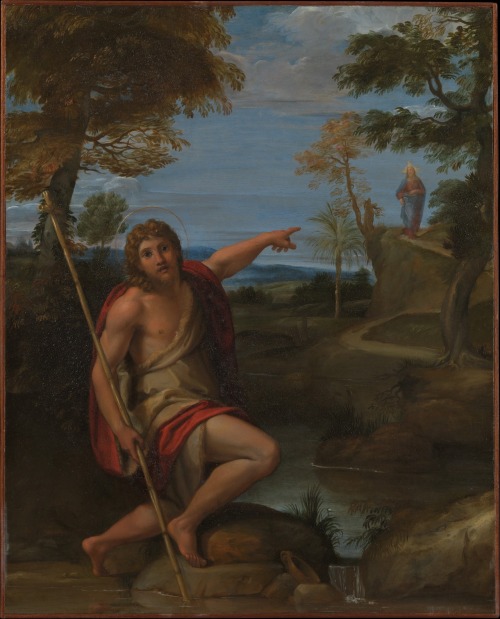
19 And this is the testimony of John, when the Jews sent priests and Levites from Jerusalem to ask him, “Who are you?” 20 He confessed, and did not deny, but confessed, “I am not the Christ.” 21 And they asked him, John the Baptizer“What then? Are you Elijah?” He said, “I am not.” “Are you the Prophet?” And he answered, “No.” 22 So they said to him, “Who are you? We need to give an answer to those who sent us. What do you say about yourself?” 23 He said,
“I am the voice of one crying out in the wilderness,
‘Make straight the way of the Lord,’
as the prophet Isaiah said.”

24 (Now they had been sent from the Pharisees.) 25 They asked him, “Then why are you baptizing, if you are neither the Christ, nor Elijah, nor the Prophet?” 26 John answered them, “I baptize with water, but among you stands one you do not know, 27 even he who comes after me, the strap of whose sandal I am not worthy to untie.” 28 These things took place in Bethany across the Jordan, where John was baptizing.
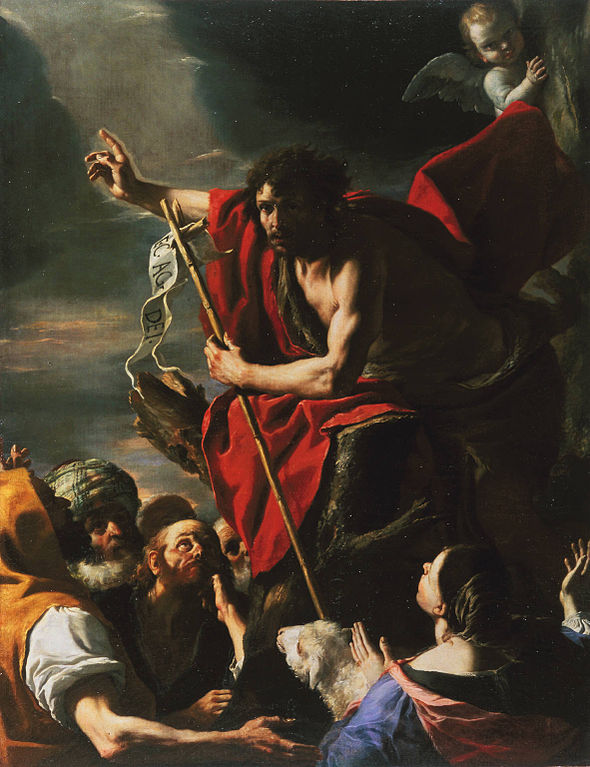
Grace, mercy, and peace be to you from God our Father and from our Lord and Savior, Jesus Christ. Amen.

Who are you, John? Well, his name means, ‘the Lord is gracious.’ John’s name was given to him not by his parents but from heaven itself (Lk. 1:13). So, when you insert the meaning of John’s name, our text opens saying, “This is the testimony, the witness, of God’s grace…”

Priests and Levites come from Jerusalem to ask John, “Who are you?”

If someone walks up to you and asks, “Who are you?” how do you answer? You maybe start with your name and tell them about your family. You talk about your job or what you are studying in school. The conversation might turn to your interests, hobbies, or pet-peeves.

John doesn’t do that. The priests and Levites come out into the wilderness to see this guy who has a large following, has his own disciples, and has baptized gobs of people from Jerusalem and Judea (Mt. 3:5-6). They want to know and so they ask, “Who are you?”

“Well, I’m not the Christ.” And you can just picture John go back to preaching and baptizing, and the priests and Levites scratching their heads.

Even though the picture we have of John in the Gospels is extremely intense, John must have been a bit of an introvert. But if we have a biblical understanding of who John is and what God had given him to do, this is a perfect answer.

John is the forerunner. He is the one sent by God to point people to God’s grace in Jesus. John is the one who prepares the way of the Lord. And when you are preparing the way for the Christ who is so great and mighty that you aren’t even worthy to untie His sandals, confessing that you aren’t Him makes a lot more sense.

Now, the priests were students of the Old Testament. They knew that the last word they had from God was that God would send Elijah (Mal. 4:5), the prophet who didn’t die but was taken into heaven. Malachi had prophesied that God would send His messenger before Him who would prepare for God’s coming into the Temple (Mal 3:1). There was even some in those days who thought that Elijah would return from heaven and be the Messiah. So, these priests and Levites ask, “Are you Elijah?” And John says, “Nope,” and goes back to baptizing.

Now, this may seem a little strange because Jesus will say that John is the Elijah whom Malachi spoke about (Mt. 11:14). But John’s denial is probably because of their misconceptions.

So, the priests and Levites think it over some more and ask, “Ok, are you the prophet?” incarnation of JesusAnd they ask this because of what we heard in our Old Testament lesson (Dt. 18:15-19). In that text, Moses told the people that God would raise up a prophet for His people from among them. And Moses made it very clear, “To Him you shall listen.”
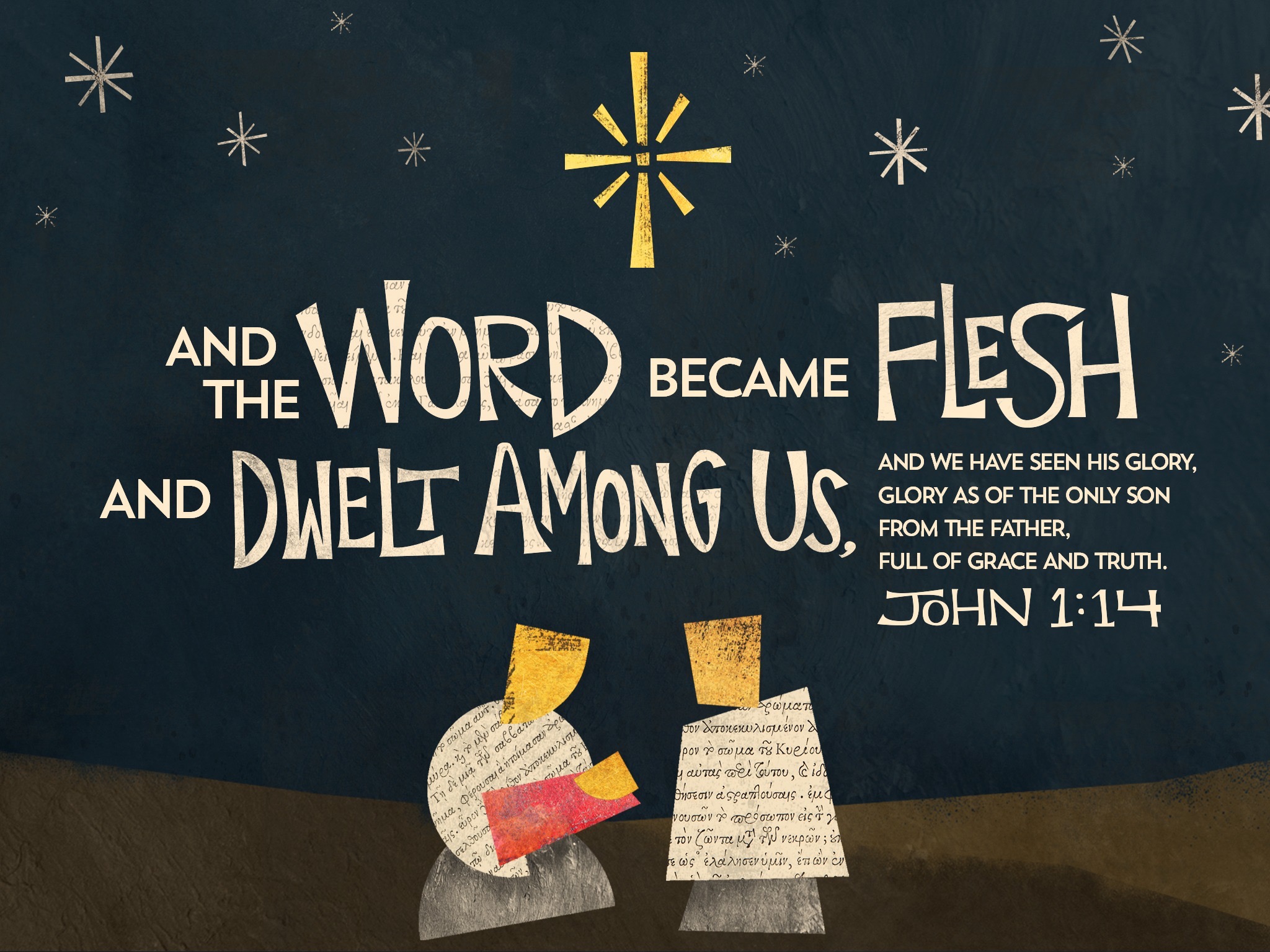
In that text, Moses reminds the people about the day when God gave the Ten Commandments on Mt. Sinai. The people were, well, terrified and asked Moses to not let God speak to them anymore. And God said, “Yeah, talking to them like that is too frightening for them. I’ll speak to them again in a way that doesn’t make them wet themselves. I’ll put my words in the mouth of my Prophet, and He will speak to the people.” God was referring to Jesus – the One who speaks God’s words of forgiveness, who makes God’s grace and truth known (Jn. 1:14). So, when John gets asked, “Are you the prophet?” again, he says, “No.”

The priests and Levites are done asking John, “Who are you?” because John isn’t interested in answering. “Fine, you won’t tell us who you are. But we need to tell the guys who sent us something. What do you say about yourself?”

And John still keeps the focus where it should be, “Listen, guys, I’m no one. I am simply a voice preaching in the wilderness preparing the way for the Lord.”

Now, what does all of this mean for us today? What can we learn from this text?

One thing we can learn from the priests and Levites is that even if someone has studied the Scriptures, it doesn’t mean they are teaching the Bible rightly. Don’t simply listen to someone’s preaching and teaching because they seem nice, can quote a verse periodically, and sound “Bibley.” Know the Bible. And if any preacher or teacher isn’t constantly pointing you to Jesus for the forgiveness of your sins, avoid them.

Second, see how John confesses right away that he is not the Christ. Don’t ever trust in yourself for your salvation. God delivers you. Like John, you are not the Christ. But thanks be to God, you don’t need to be. Jesus has come. He has delivered you from sin, death, and the devil. His birth, His death, His resurrection, and His ascension have secured a place for you to live forever with God who is full of mercy and grace.

John 1_14Finally, take a page out of John’s playbook and point people to Jesus. John has a laser-like focus on Jesus and isn’t interested in talking to people unless he is pointing them to Christ. Point others to the One who delivers them from sin. Point them to Jesus, the Lamb of God who takes away the sin of the world. Tell them that they don’t need to save themselves. Jesus saves them.

This is the testimony of John. This is the testimony of God’s grace. May that be our testimony as well. May that be our witness as we gather together and as we go out from here.

I look forward to celebrating the coming of God’s grace with you tonight as we rejoice in the incarnation of our Lord and Savior. Amen.

The peace of God, which surpasses all understanding, will guard your hearts and minds in Christ Jesus. Amen.