Serving the Body – Sermon on Romans 12:6-16 for the Second Sunday after Epiphany

Romans 12:6–16

6 Having gifts that differ according to the grace given to us, let us use them: if prophecy, in proportion to our faith; 7 if service, in our serving; the one who teaches, in his teaching; 8 the one who exhorts, in his exhortation; the one who contributes, in generosity; the one who leads, with zeal; the one who does acts of mercy, with cheerfulness. 

9 Let love be genuine. Abhor what is evil; hold fast to what is good. 10 Love one another with brotherly affection. Outdo one another in showing honor. 11 Do not be slothful in zeal, be fervent in spirit, serve the Lord. 12 Rejoice in hope, be patient in tribulation, be constant in prayer. 13 Contribute to the needs of the saints and seek to show hospitality. 

14 Bless those who persecute you; bless and do not curse them. 15 Rejoice with those who rejoice, weep with those who weep. 16 Live in harmony with one another. Do not be haughty, but associate with the lowly. Never be wise in your own sight.

In the name of Jesus. Amen.

When you stub a toe, your whole body reacts. Your face scrunches and grimaces in pain. Your arms and hands reach down to clasp the toe. Your throat groans, shrieks, or shouts. All of that happens naturally and instinctively. When you stub your toe, the rest of the parts of your body don’t say, “Who cares? That’s the toe’s problem.” I’ve never heard someone with knee, hip, or neck pain say, “The knee that is attached to me hurts,” or, “The neck that holds up this head hurts.” Instead, people say, “My knee hurts. My neck hurts.” And the whole body does what it can to help the part that hurts.

Dear saints, the Body of Christ is no different. When one part of the body suffers, the whole body is involved in that suffering. When one part rejoices, the whole body is involved (see also 1 Cor. 12:26). Being part of this congregation isn’t just about coming to hear the sermon. It’s about being a body, Christ’s Body. No one here is free to consider yourself separate or independent from anyone else here.

The reason I mention the Body of Christ is that today’s reading continues from last week’s. One time, Martin Luther preached on this text, and he said that starting the reading at v. 6 was the idea of someone who doesn’t understand the Bible. I think that’s an overstatement, but it is unfortunate to start at v. 6. Let me reread the final couple verses of last week’s Epistle, which lead up to this text but you didn’t hear today. Starting back at Ro. 12:4-5, “For as in one body we have many members, and the members do not all have the same function, so we, though many, are one body in Christ, and individually members one of another.” Then, our text continues, “Having gifts that differ according to the grace given to us, let us use them….”

The context of today’s text is that you are a member of a body – that’s what Christ intends for you. Yes, the whole Christian Church throughout the world and throughout time is the Body of Christ. Jesus is the One Head, and all Christians are the Body. But there’s no way this matters unless there is a local, in-person group of members. In other words, a congregation. Yes, there are Christians in Australia, Uganda, Brazil, and even Iowa. But you aren’t close enough to them geographically to do much for them. I know for a fact that there are Christians in Papua New Guinea because I know missionaries who have been there. But I haven’t met a single one of those believers. For them, I can’t do most of the things this text calls for. I can’t exhort, teach, or honor them. I can’t rejoice with them when they rejoice or weep with them when they weep. It’s just not possible.

This text wants each believer to focus on the parts of the Body of Christ that God has gathered around them. In other words, care for the people here, in this congregation. That’s why this is written to the Christian church in Rome. It’s why Paul uses the same analogy in his letter to the church in Corinth (1 Cor. 12). And God wants this same arrangement for us here and in every Christian congregation. That’s why it has been preserved for us in the Bible. God wanted this in Rome and Corinth 2,000 years ago, and He wants it here, now, among us.

And I have to say: You do a good job of this. When I teach new member classes, one of the most common things I hear is, “This place just feels like family.” So, please know that I’m not preaching this text to get on your case. I’m not rebuking you. Instead, just like a sprinter will keep training to get a faster time, there is always room for improvement.

We can improve at serving, contributing, leading, being merciful, loving, abhorring evil, holding fast to the good, honoring, and showing hospitality. Let’s consider one area where we can improve today from v. 15, “Rejoice with those who rejoice, weep with those who weep.” The reason for diving into this is that I recognize my own shortcomings in this. So, yes, your preacher today is preaching to himself. This is a, “Do as I say,” because it is what Scripture says, “not as I do,” because I fall short here.

Again, “Rejoice with those who rejoice, weep with those who weep.” First off, notice the prepositions there – with. God calls you to take on the joy and sadness of others. You aren’t called to fix people’s emotions or make them feel certain things. Instead, you join them in those emotions. As a poor example of this, think of Job’s friends; they got it half right. Job is sitting there in his horrific suffering, and his friends come to him. They were exactly right to do that. That’s where they should be. But their problem, which becomes a problem for Job, is that they try to fix everything, and they do an incredibly bad job at it.

Sure, there are times to rebuke, exhort, and encourage people. Scripture does call for that too (1 Tim. 5:20; 2 Tim. 4:2; Tit. 1:13; 2:15). But, dear saints, there are also times where you are to simply close your mouth, sit with others, cry and mourn with them if they’re sad, or jump and sing with them if they’re joyful.

This can be really hard, and for a variety of reasons. Again, we might be too quick to give advice, but another trap we easily fall into is comparing. When someone is struggling with something, it can be easy to share about a past struggle we had and make sure the other person knows how much worse we had it. Sometimes, just being there and listening to a person pour out their heart in sadness is exactly that that person needs.

As a good example of weeping with others, think about Jesus in Jn. 11. On Wednesday night, I taught through Jn. 11 where Jesus raises Lazarus from the dead. We won’t go through the whole thing, and I’m sorry to those of you who already heard this. But it’s worth hearing again. Jesus’ approach to Lazarus’ two sisters, Martha and Mary, and their grief is so interesting. Each sister talks to Jesus separately (Jn. 11:20-27, 32-34). Both of them say the same thing to Jesus when they see Him, “Lord, of You had been here, my brother wouldn’t have died.” But Jesus’ interaction with each of them is completely different.

So, the two sisters are dealing with the exact same problem – the sorrow for over the death of a brother. They both begin interacting with Jesus the exact same way. But Jesus comforts each of these sisters differently. For Martha, Jesus has words of consolation. “Your brother will rise again. I am the Resurrection and the Life” and so on (Jn. 11:23, 23, 25-26). But just a few verses later when Jesus consoles Mary, all He does is go to the tomb with her and weep with her (Jn. 11:33-35). Yes, Jesus calls Lazarus from the tomb and restores his life. But it’s that initial consoling Jesus has for each sister has a lot to teach us.

Here’s the lesson: get to know the different parts of Christ’s Body well enough so you know how to weep with them when they weep. If they’re already weeping, just be there for them. Join them in their sorrow. But when they aren’t weeping, make the effort to get to know them well enough so that, when they are weeping, you have a better idea of how to console them.

Finally, when you are weeping, know that people might not be able to do this well. But also know that Jesus does. Christ knows how to give you exactly what you need exactly when you need it. Jesus is here now. He invites you to His table to receive His Body and Blood. Here, Christ, the Great Consoler, continues to unite you as His Body and strengthen you in faith toward Him and in love toward one another. Amen.

The peace of God, which surpasses all understanding, will guard your hearts and minds in Christ Jesus. Amen.

Help – Sermon on Matthew 9:1-8 for the Nineteenth Sunday after Trinity

Matthew 9:1–8

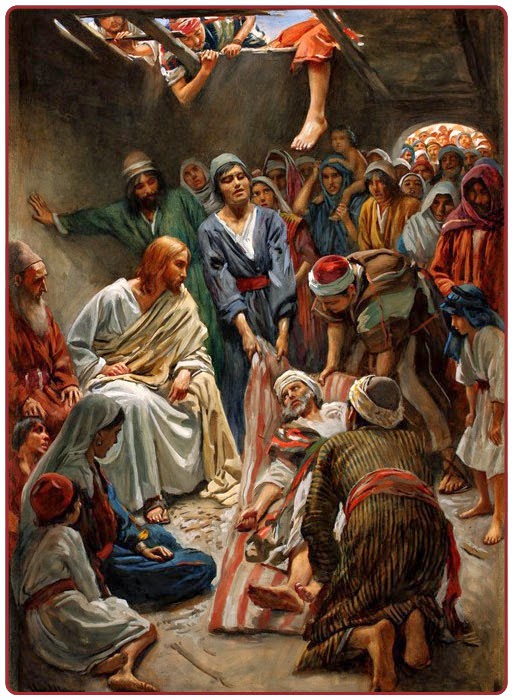
1 And getting into a boat he crossed over and came to his own city. 2 And behold, some people brought to him a paralytic, lying on a bed. And when Jesus saw their faith, he said to the paralytic, “Take heart, my son; your sins are forgiven.” 3And behold, some of the scribes said to themselves, “This man is blaspheming.” 4 But Jesus, knowing their thoughts, said, “Why do you think evil in your hearts? 5 For which is easier, to say, ‘Your sins are forgiven,’ or to say, ‘Rise and walk’? 6But that you may know that the Son of Man has authority on earth to forgive sins”—he then said to the paralytic—“Rise, pick up your bed and go home.” 7 And he rose and went home. 8 When the crowds saw it, they were afraid, and they glorified God, who had given such authority to men.

In the name of Jesus. Amen.

What do you suppose the friends of this paralyzed man thought when they heard Jesus? They had gone to a lot of trouble to bring him to Jesus. They had heard Jesus was at home (Mt. 9:1; Mk. 2:1), and people from all around knew that the power of God was with Jesus to heal (Lk. 5:17). We can imagine these friends going to the paralyzed man’s house and telling him, “Hey, Charles,” (he probably wasn’t named ‘Charles’ but go with me on this), “Hey Charles, Jesus is in town. We’re going to take you to Him and get you healed.”

They lift up Charles’ bed and lug him through the city streets. But when they get to where Jesus was, they find that too many people are there, and they can’t even get to the door (Mk. 2:2; Lk. 5:19). So, they take desperate measures. They lug Charles and his bed to the top of the house, tear open the roof, tie ropes on the corners of Charles’ bed, and lower him so he is before Jesus (Mk. 2:4). Charles’ friends are trying to catch their breath, wiping the sweat off of their foreheads, and giving each other tired fist bumps as they surround that gaping hole, thinking, “We did it. Jesus is going to heal our buddy so he can walk.”

But then, down in the house with dust swirling around them, Jesus looks at Charles, and Charles looks up at Jesus. And Jesus says those words, “Take heart, My son; your sins are forgiven.” I imagine those friends were thinking to themselves, “You’ve gotta be kidding me, Jesus. We brought Charles here so You could fix his body!”

We don’t actually know what the paralytics’ friends thought, but we do know what the scribes and Pharisees thought, “Jesus is a blasphemer. Only God can forgive sins” (Mk. 2:7; Lk. 5:21). They grumble. They scoff. They doubt. But Jesus knows their thoughts and hearts, just as He knew the faith and believing hearts of this man’s friends. And because Jesus knows both the faith of these friends and the grumbling of the scribes, we also know that Jesus knew the paralytic’s thoughts.

Maybe, the paralytic was initially excited at the prospect of being healed and using his limbs. But based on Jesus words to him, there is little doubt that Jesus told him exactly what he needed to hear. The first word Jesus says, “Take heart,” is the same command Jesus will give to the disciples when they are out in a huge storm in the middle of the sea. They are being beaten by the waves and wind. Jesus appears, and they think He’s a ghost. But Jesus calms them, “Take heart; it is I. Do not be afraid” (Mt. 14:27).

This paralytic man hears from Jesus the exact words he needed to hear as he was battered by legs that didn’t work and arms that couldn’t move. “Take heart, My son; your sins are forgiven.” As he was lying there before Jesus, maybe he figured Jesus would tell him how awful he had been and that his paralysis was punishment for his sin. But that’s not what Jesus says. Jesus tells him that in the midst of his suffering and horrible situation that he can be of good courage because his sins are forgiven.

Now, of course, Jesus ends up healing the man too. To silence the grumbling scribes and prove that He actually does have the authority to forgive sins, Christ heals the man.

That’s the main teaching of this text. Jesus proves that He has the authority on earth to forgive sins by healing the paralytic. And the crowds respond with fear and glorified God (notice how the text ends) who had given such authority to men. It’s plural. To men. Not just to the man, Jesus. To men.

That was true here, but it is even more evident on the evening of the Resurrection. Then, Jesus tells the disciples, “If you forgive the sins of any, they are forgiven them” (Jn. 20:23). Jesus, the One who has authority to forgive sins, delegates that authority to His Church, to all Christians. Because you have called me to be your pastor, I get to do that each Sunday morning. God uses my voice to proclaim His forgiveness to you. I get to be ‘the Absolution guy.’ It’s pretty cool. And please, don’t think I’m bragging. Believe me, I wouldn’t have the guts to say that if the Bible didn’t teach it. Forgiveness and absolution is the main point of this text.

But today, I want to draw special attention to this guy’s friends and their tenacity to help him by bringing him to Jesus. They know their friend’s need. They know Jesus is where he can get help. So, they do everything in their power to help him by bringing him to Christ.

Dear saints, you do this too. I know you do. But I’d like to point out three specific, concrete ways you do this because these things are easy to overlook. And when we overlook them, it’s easier to neglect doing them. Here are the three ways you help others by bringing them before Jesus, and they are in no particular order.

First, you help people by inviting them to church. Jesus promises to be here as we gather each and every week when He says, “Where two or three are gathered together in My name, there am I among them”(Mt. 18:20). You are eternally helping others when you bring them here, to God’s house and to the gate of heaven (Gen. 28:17) where Jesus meets them with His Word and forgiveness.

Second, you help people by praying for them. When you have an unbelieving family member or coworker who has some need. Help them by praying for them. As you lift others up in prayer, you are bringing them to and laying them before the feet of Christ. Don’t forget that. When someone is suffering, lift them up to Jesus in your prayers. Maybe Jesus won’t answer your prayers in precisely the way you expect. But He knows best how to help.

James 5:13-16 says that your prayers have great power. You don’t even have to tell the person you are praying for them. (Usually, I think letting them know you are praying for them is a good idea. But there might be times [e.g. if they are really deep in unbelief and hatred of God] you don’t. Use your God-given wisdom.) Even if they don’t share their problems with you, pray for them anyway. They might not share their struggles, but they probably tell you the ways they have been blessed. That same section of James 5 says that when someone is cheerful, you can give a prayer of thanks to God for the blessings He has provided.

Third, you help people by forgiving them. The forgiveness you have received from God frees you to forgive others when they sin against you. Christian, your gracious disposition toward them and toward the world is a way that the light of Christ shines through you (Mt. 5:14-16).

All of that brings me to you, Cooper. Cooper, today you are Baptized. Today, your parents have helped you by bringing you to Jesus who also says to you, “Take heart, My son; your sins are forgiven. I have joined you to My death and resurrection (Ro. 6:3-8). I have clothed you in My righteousness (Gal. 3:27), given you the new birth of water and the Holy Spirit (Jn. 3:3, 5) and made you My child.”

Cooper, and all you saints, you are before Jesus right now. He invites you to His Table where He feeds you with His Body and Blood for the forgiveness of all your sins. As you walk out of here today, remember that you have new life in Christ. Use your freshly given strength to help and serve your neighbor. Amen.

The peace of God, which surpasses all understanding, will guard your hearts and minds in Christ Jesus. Amen.

The Battle – Sermon on Revelation 12:7-12 for the feast of St. Michael & All Angels

Revelation 12:7–12

7 Now war arose in heaven, Michael and his angels fighting against the dragon. And the dragon and his angels fought back, 8 but he was defeated, and there was no longer any place for them in heaven. 9 And the great dragon was thrown down, that ancient serpent, who is called the devil and Satan, the deceiver of the whole world—he was thrown down to the earth, and his angels were thrown down with him. 10 And I heard a loud voice in heaven, saying, “Now the salvation and the power and the kingdom of our God and the authority of his Christ have come, for the accuser of our brothers has been thrown down, who accuses them day and night before our God. 11 And they have conquered him by the blood of the Lamb and by the word of their testimony, for they loved not their lives even unto death. 12 Therefore, rejoice, O heavens and you who dwell in them! But woe to you, O earth and sea, for the devil has come down to you in great wrath, because he knows that his time is short!”

In the name of Jesus. Amen.

“Out of sight, out of mind.” Sometimes, you might use that phrase as an excuse, sometimes as a reason to procrastinate. It’s really easy to forget things that aren’t right in front of us. So, we make lists, set reminders on our phones, and put events on the calendar. Well, the Church has done exactly that for us today, September 29th, as we remember the angel, St. Michael, and all angels. Today, we remember that God has created all things, visible and invisible.

The Bible teaches a lot about angels, but it doesn’t answer every question we might have about angels and demons (which are just fallen angels). There’s a lot of garbage out there when it comes to angels. Be very discerning about what you hear, see, and read about angels. People have found that they can make a lot of money off the curiosity surrounding angels and demons. If you’re interested after the service, I can print a couple of my older sermons from a few years ago that overview what the Bible teaches about angels and demons. Today, as we consider this Epistle reading (Rev. 12:7-12), we’re mainly going to focus on the invisible, unseen battle that is currently raging around us. It’s something we need to see and recognize. We want it in our sight and on our mind because, through His Word, God gives us tremendous comfort in the midst of this battle.

The whole chapter of Revelation 12 teaches us about something that has happened and continues right now all around us. I know a lot of people think the events of Revelation are in the future, but that’s not necessarily the case. Some Christians will disagree with that. I promise I’ll show from Scripture why I firmly believe that Rev. 12 is both past and current and will continue until Christ returns.

To get a bit of context for what we heard, Rev. 12 starts with a scene of a pregnant woman who is about to give birth. The text says that her Child will rule the nations with a rod of iron (Rev. 12:5). Psalm 2 uses this same language and imagery of Jesus. In Psalm 2, the nations are raging and trying to get out from under God’s rule. In response, God sets His King and Son on the throne of Zion (Ps. 2:6-8), and He rules with a rod of iron and dashes those rebellious, earthly authorities like a clay pot (Ps. 2:9). Who is this woman about to give birth? As Christians, we know that the virgin Mary is the one who gave birth to Jesus, but this text isn’t referring to Mary. Here in Rev. 12, this woman is representative of the whole Church, all believers. The reason I say that will become clearer in a bit, so stick with me, please.

In Rev. 12 we are told that a great red dragon – in other words, the devil – is waiting there to devour Jesus immediately after He is born. But Jesus is caught up to God and to His throne (Rev. 12:5). Basically, John skips over Christ’s entire life, ministry, death, resurrection, and ascension. He does this to set up what happens to the Church. After she gives birth, the woman (who, again, is believers) flees into the wilderness where God has prepared a place for her to be protected and nourished. That’s the context for our reading.

Now, to the first verse of our text. There is war in heaven. That sounds weird. It’s heaven – a place where there is no more sorrow, crying, or pain (Rev. 21:4) – but this is what John sees. And think about this, the devil wasn’t able to devour Christ in a broken world. Not when He was an infant, not during Jesus’ life, not even in Jesus’ crucifixion and death. But he still tries to attack Jesus in heaven. Anyone with a half a brain knows that strategy isn’t going to work, but the devil’s hatred of God makes him absolutely foolish when it comes to battle strategy. Satan thinks he’ll fight to take Jesus off His heavenly throne, but the devil doesn’t get very far. King Jesus doesn’t even have to fight Himself. Instead, He sends His archangel Michael (see Jd. 9) who defeats the devil and permanently expels that worm and his angels (i.e. the demons) from heaven. God created Michael for that very purpose, and King Jesus doesn’t rob Michael of that glory. God lets Michael do his job of throwing the ancient serpent out of heaven.

Then, we hear this loud voice. Let’s walk through what this voice says. “Now the salvation and the power and the kingdom of our God and the authority of His Christ have come” (Rev. 12:10a) Think through this. We have salvation, right? Yes, of course we do! Jesus has the power and authority over all creation, right? Yes, He does! Before He ascends, Christ says, “All authority in heaven and on earth has been given to Me” (Mt. 28:18). Despite what we might experience, has the kingdom of God come? Yes! Jesus says when He casts out demons by the finger of God, that means that the kingdom of God has come (Lk. 11:20).

So, what does the loud voice from heaven say next? “The accuser of our brothers has been thrown down, who accuses them day and night before our God” (Rev. 12:10b). Remember our Gospel reading (Lk. 10:17-20). Jesus had sent the 72 disciples out to preach the arrival of the kingdom of God (Lk. 10:1-9). Our text is Jesus’ response when they return. He says that through their ministry He, “saw Satan fall like lightning from heaven” (Lk. 10:18). A couple weeks ago, we saw from Job how the devil was in heaven with the other angels accusing Job of loving God because God was nice to him (Job 1:9; 2:4-5). The devil wasn’t content to only accuse Job; he was accusing all Christians, and heaven was sick and tired of it. But now, Satan can’t do that anymore because Michael has thrown him out of heaven and God’s presence. Now, we need to hear a little more from the heavenly voice.

“And they have conquered him by the blood of the Lamb and by the word of their testimony, for they loved not their lives even unto death.” (Rev. 12:10b-11). Again, back in Lk. 10:17, the 72 disciples are excited because even the demons are subject to them in Jesus’ name. This is still true, believer. The devil and his demons are continually defeated as believers proclaim Jesus’ name. Michael has knocked him out of heaven, and God continues to kick Satan while he’s down through the feet of believers by the power of Jesus’ blood and by your witness and testimony (Ro. 16:20).

Finally, the voice from heaven concludes, “Therefore, rejoice, O heavens and you who dwell in them! But woe to you, O earth and sea, for the devil has come down to you in great wrath, because he knows that his time is short!” The victory in heaven means there is no place for the devil there anymore. But God, for reasons only He knows, hasn’t sent the devil to his final destination of the eternal fire of hell (Mt. 25:41). Not yet. The devil now has come to the earth where He viciously rages because he knows that his time is short.

That’s the end our text, but the rest of Rev. 12 shows that the woman who gave birth to the Child is still pursued by the dragon. But God protects her in the wilderness and nourishes her (Rev. 12:13-14). Every time the devil tries to destroy her, his efforts are stopped, thwarted, and defeated (Rev. 12:15-17). That’s why I said earlier that the woman isn’t Mary but the whole Church – which includes Mary, but isn’t only Mary. The devil continues his futile fight against the Church, but we believers are protected and win the victory by the blood of the Lamb.

Now, here’s what all of this means for us, and why it is such a comfort. All the troubles we face today are spiritual battles against the demons. Scripture says, “For we do not wrestle against flesh and blood, but against the rulers, against the authorities, against the cosmic powers over this present darkness, against the spiritual forces of evil in the heavenly places” (Eph. 6:12). All of those terms refer to the devil and demons. On the one hand, that verse reminds us that people are not our enemies. We do not have to fight against people because they are individuals who are loved, and whom Christ has died for. But that verse also reminds us that there is a constant spiritual battle going on all around us, and the victory has been won through our Savior, Jesus Christ. We conquer with Michael and all the heavenly host by the Blood of the Lamb.

Still, the battle rages on. We see this battle manifest itself in different ways. Abortion, public safety, the LGBTQ movement and all sorts of other topics – those are the different battle lines in the spiritual war going on all around us. Wherever our culture is fighting against God’s good order, that is where the battle lines have been drawn. And the victory doesn’t and won’t come from Congress, the White House, or through the ballot box. The victory comes at your dinner table. It comes in your home as you raise your children in the faith. It comes as you point others to Jesus, and as you faithfully carry out all your vocations. Wherever you testify about Christ, your Savior, there is the victory. The kingdom of God is strengthened and fortified as Christ is proclaimed, and it advances as unbelievers are brought into the kingdom through faith in Jesus.

Dear saints, this battle has been raging ever since the Fall into sin. Even when it appears as though the devil and his angels are gaining ground, remember that they are a defeated enemy. They cannot win. Jesus is on the throne, and He will never be removed. God calls you to be faithful. Keep confessing and testifying about Christ (Rev. 12:11). God has promised you His protection through the holy angels as you do what God gives you to do in this fight. And better than that, you have the victory through Jesus and His blood.

Your Lord, your Savior, your King, and your Captain invites you now to His Table to receive His very blood through which you gain the victory. Come and receive as He pours His mercy and forgiveness into you. Amen.

The peace of God, which surpasses all understanding, will guard your hearts and minds in Christ Jesus. Amen.

Life in the Vineyard – Sermon on Matthew 20:1-16 for Septuagesima Sunday

Matthew 20:1–16

1 “For the kingdom of heaven is like a master of a house who went out early in the morning to hire laborers for his vineyard. 2 After agreeing with the laborers for a denarius a day, he sent them into his vineyard. 3 And going out about the third hour he saw others standing idle in the marketplace, 4 and to them he said, ‘You go into the vineyard too, and whatever is right I will give you.’ 5 So they went. Going out again about the sixth hour and the ninth hour, he did the same. 6 And about the eleventh hour he went out and found others standing. And he said to them, ‘Why do you stand here idle all day?’ 7 They said to him, ‘Because no one has hired us.’ He said to them, ‘You go into the vineyard too.’ 8 And when evening came, the owner of the vineyard said to his foreman, ‘Call the laborers and pay them their wages, beginning with the last, up to the first.’ 9 And when those hired about the eleventh hour came, each of them received a denarius. 10 Now when those hired first came, they thought they would receive more, but each of them also received a denarius. 11 And on receiving it they grumbled at the master of the house, 12 saying, ‘These last worked only one hour, and you have made them equal to us who have borne the burden of the day and the scorching heat.’ 13 But he replied to one of them, ‘Friend, I am doing you no wrong. Did you not agree with me for a denarius? 14 Take what belongs to you and go. I choose to give to this last worker as I give to you. 15 Am I not allowed to do what I choose with what belongs to me? Or do you begrudge my generosity?’ 16 So the last will be first, and the first last.”

In the name of Jesus. Amen.

The Bible refers to Christians as many things. Christians are God’s sons (Ro. 8:14; Gal. 3:26), daughters (2 Cor. 6:18), children (Mt. 6:9; Ro. 8:16; 1 Jn. 3:1), and heirs (Ro. 8:17; Gal. 4:7). All Christians are called the bride of Christ (Eph 5:25-27) and the body of Christ (Ro. 12:4-5; 1 Cor. 12:27). The Bible will refer to you Christians as sheep with Jesus as your Shepherd (Jn. 10:1ff). There are all sorts of other things I could mention, but in this parable, Jesus calls you workers or laborers in God’s vineyard, and that is what we are going to focus on.

In the parable, the vineyard is the kingdom of God or the Church, the master is Jesus, and, Christian, you are in this parable as a worker who was brought into the vineyard by Jesus. Some of you were brought in early and some later, but you were all brought in by the invitation of Christ. You were brought in to the kingdom of God for a purpose.

Christ has called you into His kingdom not just to lounge around and dangle your toes in the pool while you get a tan. No, He has work for you to do. Husbands and fathers; wives and mothers; children; students; employees with a boss or business owners with staff; citizens of cities, states, and countries – all of these are tasks put in front of you as you work for God in His kingdom. There are times when the work Jesus puts in front of you is hard, difficult, and requires more strength than you can muster on your own. There are times when that work is easier. But it doesn’t matter how challenging or easy the work is, it is work in God’s kingdom.

And this parable harkens back to our origins, back to what God created us to be. Remember how it was at the beginning of creation and before the Fall? God creates everything, plants a garden, and puts Adam and Eve there so they could work it and keep it (Gen. 2:15). Those of you who have been attending our adult class Sunday mornings will, hopefully, remember this. Those two responsibilities – to work and to keep the Garden of Eden – are the same duties that God gives to the priests who served in the Tabernacle and Temple (Num. 3:7-8, 8:26, 18:5-6); the Hebrew words are the same. God didn’t just create Adam and Eve to be gardeners, they were guardians of sacred space. So, this parable refers to how God calls you to be guardians of the sacred space of His kingdom.

This vineyard, the kingdom of God, is a blessed place. Yes, there’s work to do. You have tasks and responsibilities to faithfully carry out, and at times you will struggle and even fail in those responsibilities as laborers in the vineyard. But remember, Scripture doesn’t only call you a laborer; again, you are also a child of God. As a laborer in God’s vineyard and as a child of God, you are part of the family business. Now, please know that I’m going to push past the boundaries of the parable a bit here (i.e. this goes a bit past the scope of the parable), but it is still in line with what the Scriptures teach.

In a family business, the children get all sorts of perks, freedom, and leeway that regular employees, who aren’t part of the family, don’t get. Now, I don’t know enough about vineyards to know if they regularly use tractors, but sick with me on this for a minute. Imagine a normal vineyard with a worker who crashes the tractor because he’s being careless or reckless. That guy is probably going to get fired. But if one of the vineyard owner’s own children makes the same mistake, sure he might get a lecture or not be allowed to drive the new tractor that replaces the one he broke, but he’s still going to be in the business because he’s family.

Now, what might that look like for you as a laborer in God’s vineyard? Again, as a Christian, you are working in God’s vineyard no matter what you are doing. You adults – in your job, whatever it is; in your home with your spouse and children; or in your town, state, and country – every responsibility is vineyard work that God gives you to do. You kids – at home, you empty the dishwasher, make your bed, brush your teeth; in your school, whatever subject you are studying or even being a friend to others at recess – all of that is vineyard work.

There are times you are going to mess up in that vineyard work. You’re going to burn the supper. You’re going to bomb the spelling, math, or science test. But you’re family, so there is forgiveness and mercy extended. You’re still going to be in the vineyard. Sure, you’ll have lessons to learn (and, sometimes, those lessons won’t be pleasant). You might be relegated to different tasks that better fit your abilities (see 1 Cor. 12:21-26). But you’re still in the vineyard because you’re family. Ultimately, the only failure is not learning from your mistakes and doing better the next time.

According to the parable, the thing that gets you thrown out of the vineyard is being angry with the master because of his generosity and goodness toward others (Mt. 20:13-15). But now, I have to add this just briefly: None of that is an excuse to be lazy or reckless with your labor in the vineyard. Remember, the better you work in the vineyard, the more you will benefit. So, take your work in the vineyard of God’s kingdom seriously, but also know that your place in the vineyard is safe and secure.

Ok, back inside the boundaries of the parable and to the elephant in the room – the wages. 

In the parable, the only place outside of the vineyard is the marketplace. Markets are where goods and money are exchanged. This thing costs so much, and if you don’t have enough, tough cookies. The marketplace operates only in justice. Now don’t get me wrong, justice is a good thing. We need justice, but because we are sinners, justice is a terrifying thing. God be praised that we have a God who is merciful andjust (Ro. 3:26; 1 Jn. 1:9). The marketplace is where the master of the vineyard finds his laborers and calls them out of it. Notice how the master says to the eleventh-hour workers, “Why do you stand here idle all day?” They don’t respond, “Well, we like it here.” No. The marketplace is a terrible place to be as it is presented in this parable. When the master says, “You go into the vineyard too,” they don’t respond, “Aw man, now we have to work.” They willingly and joyfully go into the vineyard.

Again, notice how the judgment in this parable is being tossed out of the vineyard because the grumblers didn’t like the master’s pay scale based on mercy and generosity. Dear saints, we want to remain in the vineyard where we are benefactors of Jesus’ death and resurrection. Because of what Jesus has done, we are in the vineyard where we get better than our sins deserve.

The parable is not just a description of the last day and final judgment. The parable is also about the life of faith. Some of you have said something like this to me, “Pastor, I don’t really like this parable. I’ve been a Christian my whole life and worked in God’s kingdom. And Jesus is saying that all I’ve done as a worker in His kingdom doesn’t really matter because anyone who converts on their deathbed or in a foxhole gets treated the same way I will. I know this is a wrong attitude, but I still don’t like what the parable teaches.” 

I’ve done my best to address that in the past, but after studying this week, I’ve got an answer that is better than what I remember sharing in the past. If you look back to the end of Mt. 19, the context of when Jesus tells this parable is also recorded in Lk. 18:18-30. Luke doesn’t record this parable, but Jesus tells this parable in the context of Peter’s little brag and question, “Jesus, we disciples have left our homes and everything and followed you. What are we going to get?” (see Mt. 19:27 & Lk. 18:28). And in Lk. 18:29-30, Jesus promises, “Truly, I say to you, there is no one who has left house or wife or brothers or parents or children, for the sake of the kingdom of God, who will not receive many times more in this time, and in the age to come eternal life.”

Did you catch that? Jesus promises eternal blessings and rewards to you in the life to come, but you also get blessings and rewards in this life for your labor in His kingdom. That’s what Jesus says. And He wouldn’t say it if it weren’t meant to be enticing to you to do the work that He has for you in His kingdom. Plus, consider this: you know what those eleventh-hour workers, who got paid the same denarius as those who worked the whole day, you know they did the next day? They got up and worked a full day in the vineyard. They got more strength, more endurance, more experience, and did what they could for the benefit of the vineyard.

Finally, and I’ll leave you with this: Remember your Christian life is work and labor in the vineyard. Jesus doesn’t tell the parable about the owner of a factory that produces sweatpants or sneakers or frozen French fries. No. It’s about a vineyard. Vineyards exist to produce wine which God gives to make glad the heart of man (Ps. 104:15). The work you do in Christ’s kingdom brings joy, rest, and feasting to you and to those around you. May we all be diligent and faithful and joyful as we live out our faith in the life of the vineyard. Amen.

The peace of God, which surpasses all understanding, will guard your hearts and minds in Christ Jesus. Amen.

Love & Respect – Sermon on Ephesians 5:22-33 for the Second Sunday after Epiphany

Ephesians 5:22–33

22 Wives, submit to your own husbands, as to the Lord. 23 For the husband is the head of the wife even as Christ is the head of the church, his body, and is himself its Savior. 24 Now as the church submits to Christ, so also wives should submit in everything to their husbands. 

25 Husbands, love your wives, as Christ loved the church and gave himself up for her, 26 that he might sanctify her, having cleansed her by the washing of water with the word, 27 so that he might present the church to himself in splendor, without spot or wrinkle or any such thing, that she might be holy and without blemish. 28 In the same way husbands should love their wives as their own bodies. He who loves his wife loves himself. 29 For no one ever hated his own flesh, but nourishes and cherishes it, just as Christ does the church, 30 because we are members of his body. 31 “Therefore a man shall leave his father and mother and hold fast to his wife, and the two shall become one flesh.” 32 This mystery is profound, and I am saying that it refers to Christ and the church. 33 However, let each one of you love his wife as himself, and let the wife see that she respects her husband.

Paradise, Provision, & Protection – Sermon on Genesis 2:7-25 for the Seventh Sunday after Trinity

Genesis 2:7-25

7 Then the Lord God formed the man of dust from the ground and breathed into his nostrils the breath of life, and the man became a living creature. 8 And the Lord God planted a garden in Eden, in the east, and there he put the man whom he had formed. 9 And out of the ground the Lord God made to spring up every tree that is pleasant to the sight and good for food. The tree of life was in the midst of the garden, and the tree of the knowledge of good and evil.

10 A river flowed out of Eden to water the garden, and there it divided and became four rivers. 11 The name of the first is the Pishon. It is the one that flowed around the whole land of Havilah, where there is gold. 12 And the gold of that land is good; bdellium and onyx stone are there. 13 The name of the second river is the Gihon. It is the one that flowed around the whole land of Cush. 14 And the name of the third river is the Tigris, which flows east of Assyria. And the fourth river is the Euphrates.

15 The Lord God took the man and put him in the garden of Eden to work it and keep it. 16 And the Lord God commanded the man, saying, “You may surely eat of every tree of the garden, 17 but of the tree of the knowledge of good and evil you shall not eat, for in the day that you eat of it you shall surely die.”

18 Then the Lord God said, “It is not good that the man should be alone; I will make him a helper fit for him.” 19 Now out of the ground the Lord God had formed every beast of the field and every bird of the heavens and brought them to the man to see what he would call them. And whatever the man called every living creature, that was its name. 20 The man gave names to all livestock and to the birds of the heavens and to every beast of the field. But for Adam there was not found a helper fit for him. 21 So the Lord God caused a deep sleep to fall upon the man, and while he slept took one of his ribs and closed up its place with flesh. 22 And the rib that the Lord God had taken from the man he made into a woman and brought her to the man. 23 Then the man said,

“This at last is bone of my bones
and flesh of my flesh;

she shall be called Woman,
because she was taken out of Man.”

24 Therefore a man shall leave his father and his mother and hold fast to his wife, and they shall become one flesh. 25 And the man and his wife were both naked and were not ashamed.

In the name of Jesus. Amen.

In our Gospel lesson today (Mk. 8:1-9), we heard how Jesus fed 4,000 men plus women and children (see Mt. 15:38). In that desolate place, Jesus provided a little taste of the paradise He had created mankind to enjoy. Those crowds had been listening to Jesus teach for three days and now had nothing to eat. So, Jesus temporarily removes the curse of sin. Without having to sweat and toil for their food (Gen. 3:19), Jesus provided bread and fish so the people could eat and be satisfied. Now, this text from Genesis 2 shows how God created Adam and Eve to enjoy life before they brought the curse of sin to every aspect of our lives.

In full disclosure, I extended this lesson (originally it stops at Gen. 2:17) so we can see how God ordered creation in paradise to include two of the Three Estates. First is the Estate of the Church, second is the Estate of the Family (both of those are instituted before the Fall), and the third Estate is the Estate of the State (which was instituted after the Fall). I’ve preached on the Three Estates in the past and, if you’re interested, I can point you to some resources on this topic. But I wanted to take a little time today to focus on the second Estate, the Estate of the Family, and specifically consider the center of the family which is husband and wife living together in holy marriage.

To just briefly recall what the Three Estates are: In this lesson, we heard how God instituted the Estate of the Church when He told Adam to not eat of the Tree of the Knowledge of Good and Evil or he would die. This statement from God established the Church because you cannot be righteous without faith. Scripture repeatedly says, “the righteous shall live by faith” (Hab. 2:4; Ro. 1:17; Gal. 3:11).

Before they sinned, Adam and Eve had everything good from God because of the perfection of creation, so, to be righteous, they needed a promise of God to believe. That promise was implied when God gave the command to not eat from the Tree of the Knowledge of Good and Evil. In other words, God’s command there also included a promise which was, “Evil is bad. Trust Me on this.” So, with this command and promise, Adam and Eve could have by faith what God never intended them to have by experience. God didn’t want humanity to experience evil and death by sight, only by faith. Through the Estate of the Church, God provides eternal life. And even now, after the Fall, God provides eternal life through the Estate of the Church through faith in Christ.

The second Estate, the Estate of the Family, was also instituted by God before the Fall when God took Adam’s rib and formed Eve. God told Adam and Eve, “Be fruitful and multiply and fill the earth and subdue it” (Gen. 1:28). Even after we became sinners through the Fall, we know that God blesses and wants the Estate of the Family to continue because God repeats this command to Noah and his descendants after the Flood (Gen. 9:1). Through the Estate of the Family, God provides physical life as husbands and wives have children.

Just very briefly, the third Estate, the Estate of the State, was instituted only because of and after the Fall. There isn’t a direct passage of Scripture where God establishes the State; however, Scripture does plainly teach that the State is a good gift from God in both Romans 13:1-7 and 1 Peter 2:13-17. In those passages, Scripture teaches that the State is not a terror to good conduct but to bad and that the State carries out God’s wrath on the wrongdoer. The Estate of the State is limited in what it can do. The State cannot give life; it can only preserve and protect life through the threat of punishment.

And this means that the Estate of the State is the only one of the three that is temporary. When Christ returns, there will be no more need of the State because there will be no more sin. So much of our time today is, frankly, wasted focusing on politics and what is going on in our government. Don’t get me wrong, the State is important. The State and the authorities God has placed over us matter, and they are good gifts from God to protect life in a fallen world. But what is going on in your Family is vastly more important than anything that happens in the State. So, let’s put more of our focus and attention there.

With all of that in mind, we’ll focus now on the center of the Estate of the Family – marriage.

In Genesis 1, Scripture gives an overview of the entire creation. We see how, in six days, God created the heavens and earth – sun, moon, stars, galaxies, planets, oceans, continents, plants, birds, fish, animals, and humanity. The conclusion of each day of creation notes that there was evening and morning. Then, God rests on the seventh day, blessing and sanctifying it. The interesting thing about the seventh day is that there is no mention of evening and morning. In a very real way, the picture is that the day of blessing and rest doesn’t end. Now, in Gen. 2, the clock rewinds, and the focus shifts. Here in our text, we move from the big picture of all creation to the little world that we experience – human life. And we see that human life is centered around marriage.

Now, I want to be clear at the outset here. When I say that all human life is centered around marriage, that doesn’t mean that all people grow up in a home where a perfect husband and perfect wife have perfect kids. To be sure, sin has brought a brokenness to the Estate of the Family. God be praised if you grew up in a family with a father and mother and siblings. But even when that isn’t the case, marriage is still the center of human life. If you aren’t married or never will be married, you are here because of a marriage. Yes, some of you have been adopted into a family and are blessed through God’s invention of marriage with a father and mother. But even when that isn’t the case and you grew up without a father or a mother, your parents engaged in sex which an act of marriage. And even when someone is conceived through rape – in other words, someone has committed a grievous sin and stolen an act intended for marriage – that child is a blessing from God (Ps. 127:3). And, please, if you would like a fuller explanation on that statement or need any pastoral or professional psychiatric care if, please, please, please let me know. The many ways that family exists apart from God’s design for marriage just shows how sin has utterly broken what God designed for us.

The second half of this text (v. 18-25) is where God establishes the Estate of the Family and holy marriage. Again, in Gen. 1 we get the big picture of creation, God creates man and woman in His image (Gen. 1:26-30). But in Gen. 2:18, we get the detailed creation of man and woman and family, God creates the man first. Then, God says something totally unexpected. Over and over in the larger picture of creation, God sees what He has made and says, “It is good.” But in v. 18, God says, “It is not good that the man should be alone.” God created Adam first, and knew that Adam needed a helper compatible, complementary, and harmonizing for him.

Man alone is not good. So, God brings all the animals to Adam, and Adam gives them names. But still no suitable helper is found. God puts Adam to sleep and takes part of Adam’s side. Our translation which reads ‘rib’ is a bit polite and sterile. The Hebrew word there means ‘side’ or ‘rib cage.’ The teaching of Jewish rabbis can help explain the significance of this. God didn’t take Adam’s hair to create Eve. Then, she would have been over him. God didn’t use Adam’s feet or toes to create Eve. Then, she would have been below him. Instead, God took Adam’s side, or rib cage, so she would be next to him, beside him, and near his heart.

Take special note, please, of v. 19. God formed every beast of the field and bird of the heavens out of the ground. But Adam was created differently. Look back at Gen. 2:7. Adam, like the animals, was formed out of the dust of the ground, but God added to that dust the breath, or spirit, of life. Now, when God creates the woman, He doesn’t just gather up another bit of earth, form the woman, and breathe life into her. Instead, God takes a part of Adam and forms the woman.

So, follow me here. I know this sounds like repetition, but it isn’t, it’s building: Man alone is not good. That doesn’t mean that man alone is bad, he just isn’t good. To make mankind good, God creates a woman from man’s side to be man’s helper. By the creation of the woman, Adam is less than he was before God put him to sleep. But when Adam wakes up, he is more than he was before. After the creation of the woman, man is good. And this goodness comes about because as a married man, Adam is more than he was before. Now, he is complete, but this complementary, completeness comes from outside of himself. Only after this marriage is creation “very good” (Gen. 1:31).

All this action of God is why Jesus says that every marriage is a union that God arranges. When Jesus is asked about divorce by the Pharisees, He quotes Gen. 2:24 and says, “What God has joined together, let not man separate” (Mt. 19:6). And here is why this is important for you. To those of you who are married, and to those of you who will, one day (God willing) be married, you don’t ever have to wonder if you made a mistake along the way. When you are married and look at your spouse, you can always know that your marriage is God’s will for you. God is the One who joined you together as husband and wife. And this is also why being widowed is so painful. When a spouse dies, part of the living spouse is gone. So, God be praised that Christ has come to undo the curse of sin and death.

Also, because God joins husband and wife together, you can know that your marriage is good in the eyes of God. He joined you together, and everything that God does is good. Even when things are hard, this is a sign that your marriage is good because the devil attacks all good things that God has given. In our day, marriage is viewed cynically as some sort of outdated, antiquated institution. Sadly, a lot of people think marriage is restrictive, boring, and painful.

But study after study after study shows that marriage is much more likely to lead to fulfillment and happiness than any other alternative. All the surveys indicate that the number of couples who are happy in their marriage is extremely high. Studies also show that, even of those who are not happy in their marriage, two-thirds of them will become happy if they stay together. There’s a lot of talk today about believing science. Well, the science clearly shows that marriage is much more fulfilling, rewarding, and joy-bringing than what most people think.

Marriage is hard work, but even that is good. Any married couple can tell you this. Sometimes people think that the best marriages happen without any work or effort and when the couple is perfect and completely compatible with each other. And this leads people to think that the best marriages allow each person in that marriage be simply be themself and never change. But love, true love, doesn’t come naturally or easily. Love is work. Love is effort.

If we were perfect, sure, love would be easy. But every husband is an imperfect man, and every wife is an imperfect woman. Everyone here, including myself, we are all imperfect. Each of us is self-centered and self-absorbed. And this isn’t good. Our selfish nature hurts ourselves and those around us, and our self-centeredness never leads to more happiness for ourselves. It leads only to more pain and misery.

But know this: we are most fulfilled when we are emptied of ourselves and pour ourselves out in love and service to another person. People are happiest when they are serving and giving. And God has given no better setting to serve someone else than in marriage.

Yes, marriage is hard. The sinful self revolts against the changes and sacrifices that marriage requires. No two sinners are compatible. Any parent knows that when you put two kids together in a room, it only takes a while for the self-centeredness of each to take over. So, don’t despair if your marriage gets hard. Instead, rejoice because God loves you and has put you into the institution of marriage so you can have Him working on you through your marriage.

Finally, no consideration of marriage would be complete without the truest picture of marriage – Christ and the Church. At the end of Ephesians 5, Paul quotes v. 24 of our text, “Therefore a man shall leave his father and his mother and hold fast to his wife, and they shall become one flesh.” Then, Paul says something absolutely wonderful. He writes, “This mystery is profound, and I am saying that it refers to Christ and the Church” (Eph 5:32).

Dear saints, you are the Bride of Christ. You were formed from what Christ did on the cross. God put Jesus, your Savior, into the sleep of death. And from His pierced side, came water and blood. From that water, you are given the new birth from above, and from that innocent, forgiving blood, you are saved. God has made you to be bone of Christ’s bone, and flesh of Jesus’ flesh. Because of what Jesus has done, you can and do stand before the holy God unashamed, righteous, holy, blameless, and innocent. God be praised! Amen.

The peace of God, which surpasses all understanding, will guard your hearts and minds in Christ Jesus. Amen.

Three Circles of Protection – Sermon on Matthew 6:24-34 for the Fifteenth Sunday after Trinity

Listen here.

Matthew 6:24-34

24 “No one can serve two masters, for either he will hate the one and love the other, or he will be devoted to the one and despise the other. You cannot serve God and money.

25 “Therefore I tell you, do not be anxious about your life, what you will eat or what you will drink, nor about your body, what you will put on. Is not life more than food, and the body more than clothing? 26 Look at the birds of the air: they neither sow nor reap nor gather into barns, and yet your heavenly Father feeds them. Are you not of more value than they? 27 And which of you by being anxious can add a single hour to his span of life? 28 And why are you anxious about clothing? Consider the lilies of the field, how they grow: they neither toil nor spin, 29 yet I tell you, even Solomon in all his glory was not arrayed like one of these. 30 But if God so clothes the grass of the field, which today is alive and tomorrow is thrown into the oven, will he not much more clothe you, O you of little faith? 31 Therefore do not be anxious, saying, ‘What shall we eat?’ or ‘What shall we drink?’ or ‘What shall we wear?’ 32 For the Gentiles seek after all these things, and your heavenly Father knows that you need them all. 33 But seek first the kingdom of God and his righteousness, and all these things will be added to you.

34 “Therefore do not be anxious about tomorrow, for tomorrow will be anxious for itself. Sufficient for the day is its own trouble.”

In the name of Jesus. Amen.

Today, Jesus preaches to us against worry by making fun of it. Jesus asks, “Which of you by being anxious can add a single hour to his span of life?” (v. 27). Christ is making a joke. Literally, Jesus says, “Which of you by worrying can add a cubit,” a measurement of length, “to your life?” which is, of course, measured in time. I don’t know a lot of tall, elderly people, but my grandfather, who died in his 80’s, was 6’ 2”. When I saw him never thought, “Wow. Grandpa must have worried a lot.” Jesus even makes fun of us worriers. When our translation quotes Jesus asking, “Will He not much more clothe you, O you of little faith?” He is actually calling us a name – “you little faiths” or “little faithers.”

In His preaching, Jesus invites us wise and noble humans to slow down and hear the preaching of birds and flowers. When birds need food, they don’t go to the little bird grocery store where all the food grown by farmer birds is sold. It’s almost as if Jesus was inviting you to imagine certain types of birds working in each role. (Finches would be at the grocery tills – fight me.) Birds don’t keep their food in cupboards and pantries in their nests. Flowers don’t look for best sales of the season for clothes, but they are splendidly clothed. In His wisdom, God has ordered creation in such a way that He takes care of feeding birds and clothing the grass. The birds and grass trust Him, and Jesus says we should as well.

Kids, whenever you are studying science – botany, biology, anatomy, astronomy, physics, etc. – you get a small peek into all the ways we have observed how God has ordered creation. And the more scientists discover, the more we see about the complexity, intricacy, and beauty of God our Father and Creator. God put thought and wisdom and detail into every part of creation as He spoke it into existence. All of creation was designed by God to both continue and sustain life. He does it for birds and plants and animals and planets and stars and galaxies. And He does it for you.

And it is with that thought, I want to take a step back and consider how God gives order to provide for us and protect us, the pinnacle of His creation. As we see this wonderful and beautiful order, Jesus invites us to not worry when we are tempted to do so.

In His wisdom, God has given order to our lives by creating and instituting, what theologians call, “the Three Estates”: The Three Estates are the Church, the Family, and the State (or government), in that order are the three circles of protection that God has graciously given. Science cannot observe and study this, but from God’s Word we can see how God has woven these Three Estates into the fabric of creation to provide for you and protect you. When we consider what is going on in the world through the lens of the Three Estates, it helps shape and guide our thinking in a biblical way so that we do not worry. And even though things can get bad (and, even, currently are bad) in these estates, these estates cannot be completely overthrown or destroyed.

Each of the Three Estates has a “source” or when it was instituted. A “form” or what it consists of. And an “end” or goal. So, let’s talk about each of these:

First, the estate of the Church. The estate of the Church was instituted and has its source at the Tree of the Knowledge of Good and Evil. And this will take a bit of explaining. We are always and only righteous and holy through faith. Scripture repeatedly says, “the righteous shall live by faith” (Hab. 2:4; Ro. 1:17; Gal. 3:11).

Before they fell into sin, Adam and Eve had everything good from God because of the perfection of creation, so they needed a promise of God to believe. That promise was implied when God gave the command to not eat the fruit of the Tree of the Knowledge of Good and Evil (Gen. 2:16-17). In other words, God’s command included a promise which was, “Evil is bad. Trust Me on this. When you find out what evil is, it won’t go well for you. In fact, you’ll die.” So, with this command and promise, Adam and Eve could have by faith what God never intended them to have. God didn’t want humanity to experience evil or death by sight, only by faith.

The estate of the church takes the form and consists of the Word of God preached and believed. As long as Adam and Eve believed God’s Word, they had the pure Church. God be praised that now, even after the Fall, we still have the Church which continued when God promised that the Seed of the woman, Jesus, would deliver and rescue us from death (Gen. 3:15).

Finally, the end or goal of the Estate of the Church is for us to have eternal life with God. So, we have, first, the Church: instituted by God’s promise before the Fall (and sustained after the Fall), with the goal and end of eternal life.

The second estate instituted by God to protect and provide for humanity is the Estate of the Family. The Estate of the Family has its source and was instituted also before the Fall when God took Adam’s rib and formed Eve. Then, God told Adam and Eve, “Be fruitful and multiply and fill the earth and subdue it” (Gen. 1:28). Even after the Fall, we know that God wants the Estate of the Family to continue because God repeats this command to Noah and his descendants after the Flood (Gen. 9:1).

The Estate of the Family takes the form of and us made up by husband, wife, and children.

And the end or goal of the Estate of the Family is also life, but, unlike the Estate of Church, the Family provides temporal, physical life. So, we have the Family: again, instituted by God before the Fall (and sustained after the Fall), with the goal and end physical life.

The Estate of the State is a little more complex because it was instituted only after the Fall. And there isn’t a direct passage of Scripture where God clearly establishes the Estate of the State. However, Scripture does clearly teach us that the Estate of the State is a good institution of God in both Romans 13:1-7 and 1 Peter 2:13-17 where Scripture teaches that the State is not a terror to good conduct but to bad and that the State carries out God’s wrath on the wrongdoer.

A couple possibilities of when God establishes the Estate of the State could be: When God sent the cherubim to guard the way to the Tree of Life (Gen. 3:22-24). By prohibiting Adam and Eve from eating from the Tree of Life, God was protecting them from living forever in sin. Some suggest that the Estate of the State was instituted after the murder of Abel, and there are some good arguments for that, but for the sake of time I’m not going to get into that now.

The Estate of the State takes the form of and uses the instrument of the sword and punishment. In other words, the State uses either punishment or the threat of punishment to protect and preserve life. Think of it this way, God established the State to bring about ‘little death.’ To the State God has given the tools of rules, punishments, jail, even execution and war to prevent more or bigger death.

Try this as an example: your car can probably go over 100 mph. But the authorities that God has established in the State have brought about a ‘little death’ for your car through speed limits. You have to drive down Columbia at or under 40 mph. because driving 100 mph. would endanger the lives of others. And if you refuse to obey the law, there is the threat of punishment through a speeding ticket, or, if you actually do drive 100 mph. down Columbia, you should be thrown in jail for reckless endangerment.

The goal of the Estate of the State is to preserve life. Because it is impossible for the state to give life, it’s only function is to preserve life through the means of that ‘little death.’ An analogy for this would be when a surgeon cuts open a person to do surgery on their heart or to remove a tumor. This brings about pain and death, but in an effort to preserve life. So, we have the State: instituted by God after the Fall, with the goal and end preserving life through punishment or “little death.”

Now, this ordering of creation has very important ramifications. When we worry about what is going on around us, the Three Estates let us see how God has provided these three circles of protection. The Three Estates also helps shape what we are to do. We are to be faithful citizens of the State by voting and following the laws that the State gives to protect life. We are to be faithful to our Family by being good parents and obedient children. And we are to be faithful members of Christ’s Church by trusting Him and growing in God’s Word and faith.

We are constantly bombarded with news, and it is easy to get caught up with what is going on in Washington D.C. or St. Paul or Bismarck. We tend to get so focused on the coming election and what is happening in the government – both at the federal and state level. With the economy in a bad place, an open seat on the Supreme Court, and pandemic, we start to think that the State has to do something, and the State does have a place to make rules and laws to protect life. But then – when you throw in riots, fires, hurricanes, masks, and social distancing – it is easy for us to look to the State for things that God hasn’t given the State to do. There certainly may be a place for the State to have care and direction when it comes to those things as well. And there is also a place for polite discussion and disagreement on what level and to what degree the State should or shouldn’t make those decisions.

But in all of this, we should recognize that the State exists only to protect life by minimizing death. It also means that the Estate of the State has nothing to do and has no purpose apart from the Estate of the Church and the Estate of the Family. Since life does not exist apart from the Church and the Family, there is nothing for the State to do without the Church or Family. So, the State is the most temporary and the least important of the Three Estates because it only exists to serve and protect the life that comes only through the Church and the Family.

Also, it is important for each of the Three Estates to “stay in their own lane.” Pastors should not shepherd their flock like a president or king. Families should not look to the State or the Church to provide for them. Politicians should not guide on what is right and moral. We could go on and on, but I hope you get the point. (And we can talk about all this later too.)

The end of all this, dear saints, is this: A lot of our worry (at least for me and what I see on social media) comes from what is going on in the State. Repent! It shouldn’t be this way. Yes, the State is important. The State and the authorities God has placed over us matter and are there to protect life. But what is going on in your Family much more important than what happens in the State. Put more of your focus and attention there.

Remember that Jesus promises to provide for your family. Jesus hasn’t given you permission to worry about anything. If Jesus wants to give you permission to worry about something, He’ll be sure to let you know. But until then, go about your work. And worrying is not work – even though it often feels like it. Worrying takes a lot of time and energy, but worrying isn’t productive. Remember, God has promised, and He will provide – even if it means sending ravens or a miraculous provision of flour and oil like He did in our Old Testament text (1 Kgs. 17:8-16). While you remember that what happens in your family is more important than what is going on in the State, even more important than what is going on in your family is what is going on at here at Church.

Here God provides everything you need for eternal life. He has given Christ to go to the cross, shed His blood, die, and rise again for your justification. He continues to pour out His mercy upon you from this very altar with this holy Supper. Sure, things are currently bad in the state. Maybe, things are even not so great in your family. But both could certainly be worse. Remember, God still protects and provides everything you need for eternal life through the Estate of the Church. And no matter what happens in this world, the gates of hell will never overcome Christ’s Church (Mt. 16:18). Don’t be anxious. Don’t worry, little faithers.

I want to close here with what Jesus says when He preaches almost the exact same sermon in Luke 12:29–31. Your Savior says, “Do not seek what you are to eat and what you are to drink, nor be worried. For all the nations of the world seek after these things, and your Father knows that you need them. Instead, seek His kingdom, and these things will be added to you. Fear not, little flock, for it is your Father’s good pleasure to give you the kingdom.” Amen.

The peace of God, which surpasses all understanding, will guard your hearts and minds in Christ Jesus. Amen.

Illusions & Safety – Sermon on Genesis 11:1-9 for the Day of Pentecost

Listen here.

Genesis 11:1–9

1 Now the whole earth had one language and the same words. 2 And as people migrated from the east, they found a plain in the land of Shinar and settled there. 3 And they said to one another, “Come, let us make bricks, and burn them thoroughly.” And they had brick for stone, and bitumen for mortar. 4 Then they said, “Come, let us build ourselves a city and a tower with its top in the heavens, and let us make a name for ourselves, lest we be dispersed over the face of the whole earth.” 5 And the Lord came down to see the city and the tower, which the children of man had built. 6 And the Lord said, “Behold, they are one people, and they have all one language, and this is only the beginning of what they will do. And nothing that they propose to do will now be impossible for them. 7 Come, let us go down and there confuse their language, so that they may not understand one another’s speech.” 8 So the Lord dispersed them from there over the face of all the earth, and they left off building the city. 9 Therefore its name was called Babel, because there the Lord confused the language of all the earth. And from there the Lord dispersed them over the face of all the earth.

In the name of Jesus. Amen.

In the midst of fear and anxiety over a virus, when we see a man unjustly killed in the streets of Minneapolis by an officer who is supposed to serve and protect the public, when we see a police officer killed in the line of duty in our community, when we see violent riots and evil thugs destroying property and livelihoods, it is easy to be scared and afraid. It is easy to wonder what is going to happen next. All of these things constantly remind us of our frailty and mortality. Where do we go to find refuge and safety?

We need to remember that the only safety, the only refuge, the only shelter we have is found in the arms of the God who died and rose again to deliver us from sin, death, and the devil. Our safety lies only in the God whose hands still bear the scars that set us free. Only one tower of safety exists, and that is the unshakable, unwavering, impenetrable fortress of the Christian Church.

Today is Pentecost, and we have heard how God gathers those whom He had scattered in the ruins of Babel to welcome them into the tower of the Church where they will be safe forever.

Today, we rejoice that we have been gathered together as the Body of Christ after our time of exile. It has been seventy-seven days since we last gathered together as a congregation (if Siri was correct when I asked her how many days it has been since March 15th which is when we last gathered here). The account of the Tower of Babel is a very fitting reminder that our only safety is found in the Christian Church. Every other thing that we consider safe is nothing more than an illusion. To get at why the account of the Tower of Babel teaches this, we have to go back a couple chapters before this text.

Back in Genesis 9[:18-29], Noah and his family have survived the flood and are off the ark. Scripture tells us that Noah became a man of the soil, planted a vineyard, got drunk on his wine, and fell asleep naked in a cave. Noah’s son Ham saw Noah’s nakedness and joked about it with his brothers Shem and Japheth. After learning about this, Noah curses Ham’s son, Canaan. And Ham was furious about this. Now, Ham had another son named Cush, and Cush bore Noah’s great-grandson named Nimrod. He was named Nimrod before it was an insult. Scripture tells us, that Nimrod “was the first on earth to be a mighty man” (Gen. 10:8), and Nimrod’s kingdom was Babel which we hear about in this text.

Most of the time when we hear the people of Babel talk about their plan, we think their final statement about trying to avoid being spread over the face of the earth is the singular point of rebellion against God’s command for them to fill the earth. But it appears as though there was even more defiance and hatred of God going on. Scripture also tells us that the people were building this city and tower to make a name for themselves, and they wanted their tower to have its top in the heavens.

The ancient Jewish historian Josephus has an interesting theory about what the people of Babel were trying to do. He draws this theory from other commentaries on Genesis that are much more ancient than him. The theory goes like this:

Ham hated his father, Noah, for cursing him. But even more so Ham hated God because God was really the one judging him for his sin against Noah. And Ham was angry that God would judge the world for their sin through the Flood. Ham hated the idea that he and all people should be accountable to God and have to answer for their sins. Ham passed this hatred down to his son Cush who passed this hatred down to Nimrod.

So, the theory about what is going on at Babel is not that a bunch of people have decided to live together in a big tower. Instead, the mighty man, Nimrod, has gathered people together and said that together they can be greater than God. Their desire is to be stronger than and overcome the God who would judge them. In other words, they want to be their own little ‘g’ god. They figured they could build a tower so high that the true God could not drown them like the generations before them. Even though God had promised that He would never do that again. But they didn’t trust God’s promise, so they are going to try and make themselves safe from God’s wrath.

Now, the Holy Spirit didn’t inspire this theory, and Scripture doesn’t give us these details. But still, it is a very good theory. First, it clearly explains what the people were trying to accomplish. They weren’t trying to build a tower to get closer to God; instead, they were trying to protect themselves from God and His anger over their sin. It explains why God saw their plan with such hostility and put a swift end to their work. The theory is also consistent with how sinners repeatedly respond to the judgment of God.

All sinners attempt to carry on the legacy of Nimrod. Kings and leaders of every generation do the same thing. Think of Nebuchadnezzar who built his idol and demanded that everyone bow down to it. When Shadrach, Meshach, and Abednego refused to bow down and worship it, Nebuchadnezzar threatened them with the burning fiery furnace and boasted, “Who is the god who will deliver you out of my hands?” (Dan. 3:15). Nebuchadnezzar thought that he was stronger and more fearful than any other god. Of course, the true God came down and delivered them, so they came out of the furnace without even the smell of fire and smoke on them. But this pattern of leaders setting themselves up as greater than God still continues today.

Throughout history, communist dictators have declared that that the state is god who will provide everything for their people. They try to build a tower of government to their own glory and gather everyone as one. These communists burn and destroy churches and cathedrals in a futile attempt to remove Christ from His throne and usurp His claim to have all authority in heaven and on earth (Mt. 28:18). They insist that their rule is stronger than the God who can destroy them. But the illusion of their glory always falls. Their towers crumble and their leaders are buried.

Even now, governors and heads of departments of health say they are doing things to keep people safe. But safety is not something they can offer. And we are tragically being reminded of that. Despite their executive orders and guidelines and restrictions, people contract the virus and die. People are killed in the streets by evil men who are supposed to protect them. And even the police officers aren’t safe.

Of course much of the time, our leaders have the best interest of the people they govern in mind with protocols and protections. But we see – we clearly see – that safety is not something the earthly authorities can offer. They can offer protection, but those protections have limits. Nothing in this fallen, sinful earth can offer you safety. Earthly safety is always an illusion in a fallen, broken world like ours.

Dear saints, remember that in Christ alone is your safety. I’ve been talking to many people lately who mention they have trouble sleeping. They wake up with worries and doubts about their future – physically, economically, socially, etc. The best thing to do when you are filled with fear and sense the lack of security is to go to the Scriptures. And Psalm 4:8 is the best verse I can think of in those times of uncertainty. It is a comforting reminder, “In peace I will both lie down and sleep; for You alone, O Lord, make me dwell in safety.”

Every generation since Babel has seen how God scatters the proud in the thoughts of their hearts and brings down the mighty from their thrones (Lk. 2:51-52).

So, dear saints, even as you see God tearing down today’s towers that seem to offer safety, have no fear. The God who is to be feared, and the God who tears down our illusions of safety is the same God who has sent His own Son to deliver you. The God who would pull down the mightiest kingdoms and empires of this world has Himself established a fortress and tower that cannot be overcome. The safety He offers often doesn’t look like much, but look around you. Here is that tower. From the rubble of earthly Towers of Babel and from the scattered peoples, God has established His holy Christian Church.

Built upon the Rock of Jesus Christ, the Church is the impenetrable fortress of safety which not even the gates of hell can overcome (Mt. 16:18). Wherever the Gospel is proclaimed, the very sinners who have been scattered throughout the world are gathered together not to overcome God, but to be overcome by His love and mercy.

On this day of Pentecost, God comes to those who are standing in the ruins of the Tower of Babel and puts something taller and higher before your eyes. He sets the cross of Christ before and gathers you here, and at the cross you see the judgment of God against sin that you could not take. Looking in faith to the cross, you see that God’s anger is no more because God has poured out every last bit of His anger against your sin upon Jesus. The God who had the right to condemn you for your cruelty and foolishness condemns His Son in your place. At the cross you see God’s judgment has not been poured out on you but on Christ. At the cross, you see that all your pride is of no value because Jesus’ blood has been poured over you and has erased it. At the foot of the cross you see that God’s love has found you and taken away your sin.

As you stand in the rubble of the towers that you would build to protect yourself from God’s wrath, look to the cross of Christ and see that Jesus has finished building the only tower that can hide you from the wrath of God. And, now that there is no anger of God left to consume you, see the empty tomb. See that because Christ has walked out of the grave triumphant over death see that there is now a room in that tower reserved with your name, and know that you have a place in the fortress of God’s love.

Dear saints, don’t ever settle for any illusions of safety. Find your refuge in your Savior. For you who believe, the tower of Christ will never fall because you have permanent and eternal shelter in Jesus’ forgiveness. And, in Christ, you will be safe forever. Amen.

The peace of God, which surpasses all understanding, will guard your hearts and minds in Christ Jesus. Amen.

The Church: Gathered & Sanctified – Sermon on the 3rd Article of the Apostles’ Creed for Midweek Lent 5

The Scripture readings used for tonight’s service were Psalm 50; Acts 2:22-47; and John 17:17-26.

Listen here.

I believe in the Holy Spirit; the holy Christian Church, the communion of saints; the forgiveness of sins; the resurrection of the body, and the life everlasting. Amen.

What does this mean?

I believe that I cannot by my own reason or strength believe in Jesus Christ my Lord or come to Him; but the Holy Spirit has called me through the Gospel, enlightened me with His gifts, and sanctified and preserved me in the true faith; in like manner as He calls, gathers, enlightens, and sanctifies the whole Christian Church on earth, and preserves it in union with Jesus Christ in the one true faith; in this Christian Church, He daily forgives abundantly all my sins and the sins of all believers, and at the last day will raise up me and all the dead and will grant everlasting life to me and to all who believe in Christ. This is most certainly true.

In the name of the Father and of the Son and of the Holy Spirit. Amen.

The Holy Spirit works to call, gather, enlighten, and sanctify the whole Christian Church on earth. One of the greatest records of the Holy Spirit doing exactly this is what you just heard from our Epistle lesson Acts 2[:22-47] which occurred on the day of Pentecost.

But to see the whole picture we have to go back to fifty days prior to Pentecost when Jesus was crucified. Remember the first recorded words of Jesus when He was nailed to the cross? “Father forgive them, for they know not what they do” (Lk. 23:34). But after Jesus says this, the silence is deafening. No one is there to proclaim God’s forgiveness. No voice from heaven announces, “Yes, I forgive them.” Instead, Luke just continues to record how the soldiers cast lots to divide Jesus’ clothing and how the crowd mocks, scoffs, and jeers at Jesus. If we only had Luke’s Gospel, we wouldn’t know the answer to Jesus’ prayer, “Father forgive them.” But, thanks be to God, we know how God answered Christ’s prayer because the Gospel of Luke has a sequel – the book of Acts.

In that Epistle lesson, Luke records how Peter preaches to the people on the day of Pentecost. In that sermon, Peter points his finger to those gathered around him and rightly says that they were the very ones who delivered Jesus into the hands of evil men to be crucified. They delivered the Lord of Life unto death. But God raised Jesus from the dead. When they heard this, the Holy Spirit led them to cry out, “What shall we do?” And Peter responds, “Repent and be baptized every one of you in the name of Jesus Christ for the forgiveness of your sins, and you will receive the gift of the Holy Spirit” (Acts 2:38).

That very day, the Holy Spirit worked through the Word of God, and 3,000 people repented, were baptized, and received the gift of the Holy Spirit. They were baptized, and they were forgiven. Just fifty days after Jesus’ death, some of the very people who placed Him on the cross are given salvation. As Peter says, they were saved from that crooked generation (Act. 2:40), but what were they saved to?

This is an extremely important thing to recognize. To be saved means that you are taken fromsomething and transferred to something else. You get saved from a sinking ship, to a floating ship (or to land). You get saved from quicksand to solid ground. You get saved from a burning house to a place that isn’t on fire.

A lot of Christians today think they are saved from this crooked generation of the world to a solitary life with just themselves and Jesus. But Jesus was crucified, dead, buried, and is risen to create His holy Christian Church. The Holy Spirit doesn’t save us so that we can be with Jesus alone.

Some Christians think they are saved from their old, sinful way of life to a less sinful life. A lot of churches cater to this idea and offer different series of self-help sermons: “Five Tips to be a Better Parent,” “Seven Steps to Improve Your Marriage,” “Four Habits of Being a Good Employee,” etc. Of course, there are many passages of Scripture that give us good, godly instruction on each of those things. God cares about how you raise your children, treat your spouse, and work at your job. But those are not the only passages of Scripture, and that is not the main focus of Scripture. The Holy Spirit has much more for you than being a better person.

To be a Christian is to be saved from this crooked generation, but Luke, in that passage from Acts, tells us what those first Christians were saved to. They were saved to be the Church led by the Holy Spirit. And what is it the Holy Spirit leads them to?

The text tells us exactly what they are led to. “And they [the first believers] devoted themselves to the apostles’ teaching and the fellowship, to the breaking of bread and the prayers” (Act. 2:42).

Let’s take each of those in order:

First, the Holy Spirit led them to devote themselves to the apostles’ teaching. The only place these first Christians could get the apostles’ teaching was by going directly to the apostles themselves. They would need to be where Peter, James, John, Matthew, or Thomas etc. was to get that teaching. The first Christians would gather around the apostles to hear them preach and teach Jesus crucified, died, risen, and ascended for the forgiveness of their sins. And as time went on, believers could read and hear the apostles’ teaching in the letters that have been accepted as Holy Spirit-inspired Scripture.

Today, you can go to all sorts of churches that do have God’s Word, but they don’t actually teach what the Scriptures teach. Instead, many churches try to explain away what God’s Word says. Some are blatantly and obviously departing from the Scriptural teaching that a sinful, immoral life is fine with God. Some are less obvious and teach things that are nothing more than what you could get from a life coach or motivational speaker. Christian, the Holy Spirit leads you to devote yourself to the apostles’ teaching. And if any preacher or I ever start to explain away what the Scriptures clearly teach, run away from me as though I were a foaming-at-the-mouth, rabid wolf.

Second, the Holy Spirit led the first believers to be devoted to the fellowship. Christians desire to be together. They desire to share common things. These things included one faith, one Lord, one Baptism, one God and Father, one Spirit (Eph. 4:4-6). But it also included their stuff. They were very generous in showing mercy and giving to the needy. They were a people who, led by the Holy Spirit, bared one another’s burdens. And, dear saints, that is something we desperately need today.

Third, the Holy Spirit led the first believers to devote themselves to the breaking of bread. They celebrated the Lord’s Supper as Jesus instituted it. Jesus gave the gift of Holy Communion for His Church to gather around and receive the blessing of His life-giving Body and His forgiving Blood.

A quick note on this during this time of pandemic and quarantine: From God’s hand, we have been given a chance to repent. Maybe, we have gotten lazy and thought that the holy things of God were normal. Maybe we assumed we would always have access to them. Let’s repent of that and remember how precious and gracious God is in giving them to us. But, please, also remember that even though we cannot receive it together as a congregation, I am happy and delighted to serve you as your pastor with the gift of Christ’s Body and Blood here or at your home. Just let me know. And pray that the day when we can receive the Sacrament together once again may come soon!

Fourth, and finally, the Holy Spirit led the first believers to devote themselves to the prayers. They interceded to God on behalf of others. They prayed with thanksgiving for the gifts that God had given them. They prayed in worship to the God who is merciful and gracious. These prayers characterized their life together.

Dear saints, Jesus forgave the very ones who crucified Him. By the working of the Holy Spirit through the preaching and teaching of the apostles, God called, gathered, enlightened, and sanctified them just as He calls, gathers, enlightens, and sanctifies you. The Holy Spirit calls you out of yourself and your own self-interests to be the Body of Christ. The Holy Spirit has called you out of darkness into His marvelous light (1 Pet. 2:9). By the power of the Holy Spirit working in and through you, let your light sine so that others may see your good works and give glory to your Father in heaven (Mt. 5:16).

To close out this series on the Creed, dear saints, know that you have been created by the Father, redeemed by the Son, and sanctified by the Holy Spirit. The holy, blessed Trinity loves you and has made you His own. Rejoice in His eternal lovingkindness toward you. Amen.

The peace of God, which surpasses all understanding, will guard your hearts and minds in Christ Jesus. Amen.

Excuses – Sermon for the Second Sunday of Trinity on Luke 14:15-24

Listen here.

Luke 14:15-23

15When one of those who reclined at table with him heard these things, he said to him, “Blessed is everyone who will eat bread in the kingdom of God!”

16But he said to him, “A man once gave a great banquet and invited many. 17And at the time for the banquet he sent his servant to say to those who had been invited, ‘Come, for everything is now ready.’ 18But they all alike began to make excuses. The first said to him, ‘I have bought a field, and I must go out and see it. Please have me excused.’ 19And another said, ‘I have bought five yoke of oxen, and I go to examine them. Please have me excused.’ 20And another said, ‘I have married a wife, and therefore I cannot come.’ 21So the servant came and reported these things to his master. Then the master of the house became angry and said to his servant, ‘Go out quickly to the streets and lanes of the city, and bring in the poor and crippled and blind and lame.’ 22And the servant said, ‘Sir, what you commanded has been done, and still there is room.’ 23And the master said to the servant, ‘Go out to the highways and hedges and compel people to come in, that my house may be filled. 24For I tell you, none of those men who were invited shall taste my banquet.’”

In the name of the Father and of the Son and of the Holy Spirit. Amen.

Once, there was a young child whose parents loved him very much. They taught him the Scriptures, and the child was gradually learning to repeat the passages his parents read to him. The child grew, and it was time to train him to use the toilet. His parents would sit him on the potty chair and give him privacy to do his business. This child, schooled in the Scriptures, had a signal to his parents when he needed help cleaning himself after going number 2. He would recite from our text, “Come, for everything is now ready.” Thankfully, his parents were not like those who offered excuses in the parable. They were loving and went and cared for his needs.

The men who make excuses to escape going to the king’s banquet are treating the invitation like it is a call to help wipe a toddler’s derriere. They simply aren’t interested in going to the banquet because they thought they had something better to do, and they don’t care about the repercussions if they are absent. They are comfortable insulting the king, his invitation, and his feast because they have treasures on earth. They don’t realize that, unlike the feast, the invitation is not eternal.

The point of the parable is easy to see. Not everyone goes to heaven. Those who do not think they need God’s grace will find that, outside of His grace, there is only eternal loneliness and torment. As our hymn just said:

But they who have … resisted His grace
And on their own virtue depended,
Shall then be condemned and cast out from His face,
Eternally lost and unfriended.
Have mercy upon us, O Jesus![1]

At the time of death or when Jesus returns, the invitation is withdrawn. Those who reject the invitation will get what they want. They won’t have to offer any more excuses to the king and his messengers. Those who continually reject God’s invitation will one day be free of God, but they will be eternal prisoners of themselves.

Invite as many as you find to the wedding feastSo, this parable should give us an urgency. There is still room for more at the feast. We should be those who go out and call more of the poor, crippled, blind, and lame. We should go out to the highways and hedges and compel more to come in. And we wouldn’t even have to go far from this very place. How many Muslim refugees do we have living less than one block away? They play in our yard and use our trees for shade. Jesus wants them to come to His feast as much as He wants you.

But this parable should hit each and every one of us harder because of the context. And when this parable hits us harder, we will become more eager to extend the invitation of Christ the King.

Here is why this parable should crush us – it isn’t just that it exposes our sinful hesitation to share the Gospel with others. Jesus tells this parable in response to a statement, “Blessed is everyone who will eat bread in the kingdom of God.” In its context, that is a heretical benediction.

Now, don’t get me wrong. At face value, it is true. Everyone who eats bread in the kingdom of God is blessed. But the person who says this is, at that very moment, eating with Jesus. In that context, this statement would be like a newlywed husband getting to the hotel on his wedding night and saying to his bride, “Today was nice, but I’m really looking forward to my retirement party.” The man who says, “Blessed is everyone who will eat bread in the kingdom of God,” doesn’t realize that he is, in truth, living in that present blessing. The blessed existence he that would come sometime in the future was going on right around him.

Wherever Jesus is, there is the kingdom of God. Jesus came preaching that the kingdom of God was at hand (Mk. 1:14-15). And just a couple of chapters earlier in Luke’s Gospel, Jesus said that because He was casting out demons by the finger of God that God’s kingdom had come (Lk. 11:20).

You see, the person sitting there with Jesus at the table was sitting with the present King and eating with God incarnate. So, this parable speaks to us today about being at church. When God’s people gather together to hear God’s Word and receive His gifts, there is the kingdom of God. So, if you are looking forward to going to heaven and being with Jesus, you should also look forward to coming to church because it is a foretaste of eternity with Jesus.

Each of the men who offer excuses in the parable aren’t saying that they never want to go to the party; they just want to go when it is more convenient for them. And their excuses show that they view the things of the world as more important than eternal things.

The pleasures and cares of this world are dangerous to faith when we appreciate and love them more than the blessing of gathering with our Lord and Savior and brothers and sisters in Christ here every Sunday morning.

Wedding Feast of the LambWeekends at the lake, sport tournaments, and even time with family are all blessings from God. But when those things keep us from gathering around God’s Word in the place where God says He meets with us, they are deadly. They are idols. When you are not in church for whatever reason on any given Sunday, you are missing the blessing of being and feasting with God.

The king is angry with those who offer excuses. And notice – this is the most amazing thing that is hard to wrap our minds around – the king is angry because all he wants is for them to be there with him. The king is angry because he wants these people to have the good and joyous things he has for them. God is much more desirous of giving to and helping us than we are of receiving or asking for those things (Luther).

Repent. Repent of your excuses. Jesus has died and shed His blood so that the sinful excuses you would offer are washed away. They are removed as far from you as the east is from the west. And know that God’s invitation stands. “Come. Come to my feast. Come and receive what you could never earn or deserve. Come, you who are worthy. Come, you who are unworthy. Come, for all the blessings of heaven are here for you for free. Come, for everything is now ready.”Amen.

The peace of God, which surpasses all understanding, will guard your hearts and minds inChrist Jesus. Amen.

[1]“There Many Shall Come” Ambassador Hymnal #627. Magnus Brostrup Landstad.