Unlocked – Sermon on John 20:19-31 for the Second Sunday of Easter

John 20:19–31

19 On the evening of that day, the first day of the week, the doors being locked where the disciples were for fear of the Jews, Jesus came and stood among them and said to them, “Peace be with you.” 20 When he had said this, he showed them his hands and his side. Then the disciples were glad when they saw the Lord. 21 Jesus said to them again, “Peace be with you. As the Father has sent me, even so I am sending you.” 22 And when he had said this, he breathed on them and said to them, “Receive the Holy Spirit. 23 If you forgive the sins of any, they are forgiven them; if you withhold forgiveness from any, it is withheld.”

24 Now Thomas, one of the twelve, called the Twin, was not with them when Jesus came. 25 So the other disciples told him, “We have seen the Lord.” But he said to them, “Unless I see in his hands the mark of the nails, and place my finger into the mark of the nails, and place my hand into his side, I will never believe.” 

26 Eight days later, his disciples were inside again, and Thomas was with them. Although the doors were locked, Jesus came and stood among them and said, “Peace be with you.” 27 Then he said to Thomas, “Put your finger here, and see my hands; and put out your hand, and place it in my side. Do not disbelieve, but believe.” 28 Thomas answered him, “My Lord and my God!” 29 Jesus said to him, “Have you believed because you have seen me? Blessed are those who have not seen and yet have believed.”

30 Now Jesus did many other signs in the presence of the disciples, which are not written in this book; 31 but these are written so that you may believe that Jesus is the Christ, the Son of God, and that by believing you may have life in his name.

Alleluia! Christ is risen!
He is risen indeed! Alleluia!

In the name of Jesus. Amen.

Normally, I try to have one main theme or point in my sermons. Today, I’m throwing that out the window, and you’re going to get three mini-sermons. Yes, each of them is mini.

Sermon #1 – Jesus unlocks the New Creation. When God the Father created the world, He formed man from the dust of the ground and breathed into his nostrils the breath of life, and man became a living creature (Gen. 2:7). Now in our Gospel text here, the resurrected Son of God stands among His disciples the very evening He rose, and He breathes on them saying, “Receive the Holy Spirit. If you forgive the sins of any, they are forgiven them; if you withhold forgiveness from any it is withheld” (Jn. 20:22-23).

The way the Holy Spirit inspired this to be written, we are supposed to see those two things – Jesus’ breathing on the disciples and also what He says about the Holy Spirit and forgiveness – as one action. In other words, Jesus’ statement is how Jesus breathes on the disciples. With the breathing of those words, Jesus is unlocking the new creation to you, believer. You who are in Christ through faith, you are a new creation; the old has passed away and the new has come (2 Cor. 5:17).

Sermon #2 – Locked doors don’t matter to Jesus. This text drops us into the room with the disciples Easter evening, so 1,991 years and seven days ago. It had been a chaotic day. Angels were appearing and talking to people. The resurrected Jesus has been popping up all over the place. Even with all of that going on throughout the day, the disciples and the women are gathered together in a house with the doors locked because they were afraid.

Luke in his Gospel also tells us about that evening (Lk. 24:36-49), and the way Luke records it, it seems like there is a disagreement between them all. It seems like some of them believe Jesus is raised, but some of them think something else is going on because Luke says that even when they see Jesus they think He is a ghost (Lk. 24:26-27). 

The way John words things here in v. 19, it makes it seem like Jesus invisibly goes through the locked door, but once He’s through He is suddenly visible. But listen to how Luke records it (Lk. 24:36): “As they were talking about these things, Jesus Himself stood among them, and said to them, ‘Peace to you!’” The way that is worded makes it seem like Jesus was right there the whole time, and He suddenly appears – He makes Himself visible – while they are all confused and trying to make sense of everything that had been going on that day.

Then, Jesus asks for some food, and He eats a piece of broiled fish because, of course, ghosts wouldn’t be able to eat food. Then Jesus shows them His hands, feet, and side (just like He does here). The disciples touch Jesus. Not only do they see Him, they also feel Him hug Him. Who knows? Maybe they even gave Him high fives and fist bumps.

Now, here’s the point of mini sermon #2: Just because you can’t see Jesus with your eyes, that does not mean that He isn’t here. Jesus promised, at least a few months before His crucifixion, “Where two or three are gathered in my name, there am I among them” (Mt. 18:20). Dear saints, Jesus is really, truly, actually here with us this morning. If He wanted to, He could appear and ask for something to eat. Anyone carrying a can of sardines? But even better, He is here and will give you His Body to eat and His Blood to drink. Jesus is here. So, believe.

Sermon #3 – Jesus has some unlocking for you to do. When Jesus gives the Holy Spirit, He gives Christians the authority to forgive and to bind sin (Jn. 20:22-23). Remember when the lame man was lowered through the roof to be before Jesus (Mt. 9:1-8; Mk. 2:1-12; Lk. 5:17-26); what did Jesus say to him? “Your sins are forgiven.” The Pharisees grumbled because they rightly said that only God can forgive sins. Then, Jesus proves He is God and has authority to forgive sins by healing the man. Well, the one who has the authority to forgive sins extends that authority to His Church the same day He rose from the dead.

I’ve used this analogy about absolution before, but it’s helpful and worth hearing it again. Imagine you are found guilty of a crime and locked in prison. As you sit in your cell, a judge looks over your case and rules that you are innocent. He sends an order to the guard of your prison to set you free. The guard comes to your cell with the keys, unlocks the door, walks you out of the prison, and releases you back into society. Now who set you free – the judge or the guard? Honestly, the answer is both. The judge uses his authority to free you, and the guard uses his hands and feet to free you. Both things work together – the judge’s authority and the guard’s releasing because of that authority. 

When we gather together as God’s people here in God’s house, it is right for us to confess our sins together. And it is right for the man you have called to be your pastor – which is me – to proclaim God’s absolution and forgiveness for those sins. In the church, the pastors are the guys with the keys (Mt. 16:18-19). And please know that I wouldn’t have the guts to declare that forgiveness if Scripture didn’t clearly say that is what I, as the pastor, am to do. That is why the absolution is “by Christ’s command and authority.”

And this authority isn’t only given to pastors to announce over congregations. Jesus gives all believers this authority. You can announce this forgiveness. If someone comes to you and tells you about their sin and guilt and shame, point them to Jesus. Tell them that Jesus is the Lamb of God who takes away the sins of the world. And tell them, “I forgive you of your sins because of what Jesus has done. And I do that because that’s what Jesus Himself would do.”

Dear saints, Jesus is way better at forgiving than you are at sinning. The absolution is a great gift that Jesus has given to the Church. That is the message Jesus has sent us into the world to announce (Jn. 20:21). That is the peace that Jesus gives when He says, “Peace to you.” It is the peace that declares those sins are gone. As far as the east is from the west, so far has Jesus removed our transgressions from us (Ps. 103:12).

Dear Ava, that brings me to you. Ava, today you are Baptized. Today, Jesus has joined you to Himself by placing His name upon you (Mt. 28:19) and clothed you with Himself (Gal. 3:27). In your Baptism, Jesus joined you to His death so that you have a Jesus-kind of death – in other words, a death that doesn’t last long and ends in resurrection (Ro. 6:3-11). Ava, you have been born of God; stay in the faith which overcomes the world (1 Jn. 5:4).

Our service today opened with 1 Pet. 2:2, “Like newborn infants long for the pure spiritual milk of the Word.” May all of us continually be fed and nourished by that Word that unlocks our sin and opens the way to eternal life. Amen.

Alleluia! Christ is risen!
He is risen indeed! Alleluia!

The peace of God, which surpasses all understanding, will guard your hearts and minds in Christ Jesus. Amen.

Christ’s Suffering as Proof of God’s Love for Us

The Scripture readings for tonight’s service are
Psalm 85; Hosea 14:1-2; 1 John 4:17-21; and John 15:1-17.

In the name of Jesus. Amen.

I was listening to a couple of pastors talk about sermons and preaching yesterday, and one of them said something that was as insightful as it was obvious; I just hadn’t heard it put so bluntly. The pastor basically said, “Every evangelical sermon is a commentary on Genesis 3 and the Fall.” Especially lately, it seems like my sermons keep referring back to Gen. 3. First of all, if you’re sick of that, I’m sorry that I’m not sorry. And second, tonight, rather than attempting to hide it, I’m just going to embrace it because it ties so closely to our Old Testament reading (Hos. 14:1-2).

After those fateful bites of forbidden fruit, Adam and his wife’s eyes are opened, and they knew that they were naked and exposed. When they heard the sound of their Creator walking in the garden, they hid themselves from His presence. God calls out to Adam, “Where are you?” God wasn’t looking for information; instead, He was giving Adam a chance to repent and return. But Adam says that he was trying to hide from God because he was naked. In other words, he had nothing. He was exposed and afraid because there was nothing He could offer God after disobeying the command to not eat from that one tree.

But the fact that he didn’t have anything to offer God didn’t stop Adam from trying. All Adam could come up with was to offer some pitiful, evil excuses for his sin. “The woman whom You gave to be with me, she gave me fruit, and I ate” (Gen. 3:12). With those words, Adam tries to blame his wife first, but ultimately, he tries to blame God. While I’ve always found that absurd, Adam did have some logic in trying that.

Think about this for a minute: When God created, He did it through words. Because Adam was created in God’s image, his words also had power over creation. God brought every living creature to Adam and whatever he called it, that was its name (Gen. 2:19). But when Adam fell into sin, that image of God and verbal power was lost. His lips and tongue had been infected with sin and were full of lies (Ro. 3:13-14). After eating the forbidden fruit, Adam’s words didn’t have the same power over reality that they had before. Blaming God didn’t work. Those pathetic excuses failed to rectify the situation. But with his nakedness exposed, Adam figured he had nothing else to offer God.

Now, here’s where the reading from Hosea comes in because God tells us what to offer Him when we have been separated from Him due to sin. God calls His people to return to Him because they had stumbled in iniquity and were completely exposed as sinners. But notice how they called are to return – not empty, naked, and bare. They to return with something. They are given words to take with them as they return. What words are given? “Take away all iniquity.” Those are bold words for sinners to place on their lips, but there is a reason they can and should.

First of all, those words are God-given. God gives those words and wants to hear those words. Second, those words recognize the presence of sin and iniquity and transgression that needs to be dealt with. And third and most importantly, those words recognize that sin can only be removed by God Himself. And this confession, “Take away all iniquity,” is, at the same time, both the confession of the existence of sin and the confession that God needs to remove that sin, which is exactly in line with who God has promised to be.

Right after the Fall, God promised that the Seed of the woman would come and crush the serpent’s head. He did the work of covering Adam and the woman’s nakedness and shame with animal skins. He had defined Himself as a God who is merciful and gracious, slow to anger and abounding in steadfast love and faithfulness keeping steadfast love for thousands, forgiving iniquity and transgression and sin (Ex. 34:6-7). God has promised to be the Sin Absolver.

Our Psalm tonight (Ps. 85) opens by remembering how God had been favorable, restored fortunes, forgiven iniquity, covered sin, and withdrawn His wrath and anger. Then, it takes those things God had done and says, “God, do it again! Give us your favor, restore our fortunes, forgive our iniquity, cover our sin, withdraw Your wrath and anger again.”

To ask God to do all of that again assumes that God loves us even though we are sinners. But that isn’t just an assumption. God has proven that love. Jesus said, “Greater love has no one than this, that someone lay down his life for his friends.” Christ went a step beyond that. Jesus has shown and demonstrated God’s love for us, in that, while we were still sinners – not friends, but sinners and enemies of God – Christ came and died for us (Ro. 5:8). God sent His Son to suffer and be the atoning sacrifice for your sin (1 Jn. 4:10). 

Dear saints, when you return to God, you are to return with these promises, these works, these demonstrations of God’s love for you. You remind and point God back to the suffering and death of Jesus, your Savior. In His suffering and death, you have been given full, undeniable proof of God’s love for you. His love was made manifest when He sent Jesus so that you might live through Him (1 Jn. 4:9).

And this love of God produces fruit that lasts and abides (Jn. 15:16). Go and tell others about this love of God. Jesus has suffered for sin of the world (1 Jn. 4:14). Teach them the words with which God wants them to return. He is ready to hear that they are sinners, and He is eager to forgive them for the sake of Jesus’ suffering which reconciles us, returns us to God, and gives us life now and forever. Amen.

The peace of God, which surpasses all understanding, will guard your hearts and minds in Christ Jesus. Amen.

No Question – Sermon on Jonah 3:1-10 for Ash Wednesday

Jonah 3:1-10

1 Then the word of the Lord came to Jonah the second time, saying, 2 “Arise, go to Nineveh, that great city, and call out against it the message that I tell you.” 3 So Jonah arose and went to Nineveh, according to the word of the Lord. Now Nineveh was an exceedingly great city, three days’ journey in breadth. 4 Jonah began to go into the city, going a day’s journey. And he called out, “Yet forty days, and Nineveh shall be overthrown!” 5 And the people of Nineveh believed God. They called for a fast and put on sackcloth, from the greatest of them to the least of them. 

6 The word reached the king of Nineveh, and he arose from his throne, removed his robe, covered himself with sackcloth, and sat in ashes. 7 And he issued a proclamation and published through Nineveh, “By the decree of the king and his nobles: Let neither man nor beast, herd nor flock, taste anything. Let them not feed or drink water, 8 but let man and beast be covered with sackcloth, and let them call out mightily to God. Let everyone turn from his evil way and from the violence that is in his hands. 9 Who knows? God may turn and relent and turn from his fierce anger, so that we may not perish.” 10 When God saw what they did, how they turned from their evil way, God relented of the disaster that he had said he would do to them, and he did not do it.

In the name of Jesus. Amen.

For several reasons, I don’t preach with props, but if I did tonight’s sermon would begin the sermon with a ‘clapperboard’ – one of those things used during the filming of movies and TV shows. “Jonah called to preach to Nineveh; take two.” “Action!”

We know about the ‘out-take.’ Instead of going to preach to Nineveh, Jonah ran the other direction. He was thrown overboard in a stormy sea, swallowed by a great sea creature, and submerged to the depths of the sea to be digested and die. It looked like Jonah’s refusal to preach to Nineveh would be his own undoing. But from the depths, Jonah prayed to God for mercy, and God heard. God answered from heaven and sent out His steadfast love and faithfulness (Ps. 51:3). God is merciful, but His mercy takes different forms in different situations. In Jonah’s case, mercy looked like being whale vomit instead of becoming whale poo.

God gave Jonah a second chance, “Arise, go to Nineveh, that great city, and call out against it the message that I tell you.” Jonah preached a one-course sermon of Law, “Yet forty days, and Nineveh shall be overthrown!” Notice what the sermon doesn’t do. It does not accuse the people of specific sins. It doesn’t name any of Nineveh’s many evils (Jon 1:2). The sermon only does one thing – it calls Nineveh’s future into question. This is just an aside: In your conversations with unbelievers, be on the lookout for opportunities to point people to the return of Christ, the final judgment, and end of the world (Act. 17:31). Those may be the windows where God will shine the light of the Gospel into the darkness of people’s hearts.

Well, Jonah’s doomsday sermon was used by the Holy Spirit to change the hearts of the Ninevites. From the greatest to the least of them, they called for a fast. Even the king of Nineveh descended from his throne to sit in sackcloth and ashes. He gave a command to all the people of Nineveh, “Fast. Don’t eat or drink. Call out mightily to God. Turn from evil and violence. Who knows? God may turn from His fierce anger against us, so we may not perish.” This wasn’t a revival, it wasn’t a reawakening, it was an initial awakening. But also notice that for the Ninevites this was a shot in the dark. At best it was a, “Maybe,” a “Let’s give this a try,” a, “What if?”

Well, their blind shot at repentance paid off. “God saw what they did, how they turned from their evil way, God relented of the disaster that He said He would do to them, and He did not do it” (Jon. 3:10).

Dear saints, as we begin this repentant season of Lent, you have something better than the preaching of Jonah. You have God’s sure and certain promise forever etched in the Scriptures, “If we confess our sins, He is faithful and just to forgive us our sins and to cleanse us from all unrighteousness” (1 Jn. 1:9). That verse is so important because it contains a promise. We can, and probably should, understand it as, “When we confess our sins, God is faithful and just to forgive us and cleanse us.” Whenever you bring your sins to God, He responds with His forgiveness and mercy.

In Greek, the word ‘confess’ is two words smashed together – ‘same’ and ‘words.’ So, when you confess something, you have the same words as someone or something else. This means that biblical confession of sins has two parts. To confess your sins, you say what God says about those sins. First, you say that those sins are horrible, they are deserving of death, they separate you from God, they harm your neighbor, they earn eternal damnation. That’s what God says about your sins, and when we confess our sins, we have those same words. That’s the first part of confession. But don’t ever stop there!

Keep saying the same words about your sin that God clearly says in His Word. Those sins have been removed from you by Jesus who became sin (2 Cor. 5:21), and God has laid your sin on Christ (Is. 53:4, 6). Those sins are died for by Christ who bore them to the grave which is now empty (Col. 2:14). Those sins are removed from you as far as the east is from the west (Ps. 103:12).

Dear saints, there is no question whatsoever about how God will respond when you confess and cry out to Him for mercy. The answer is the cross and the empty grave. Because of what Christ has done, you, sinner, are forgiven (1 Jn. 2:2). Amen.

The peace of God, which surpasses all understanding, will guard your hearts and minds in Christ Jesus. Amen.

Reconsidering Repentance – Sermon on Luke 15:1-32 for the Third Sunday after Trinity

Luke 15:1-32

In the name of Jesus. Amen.

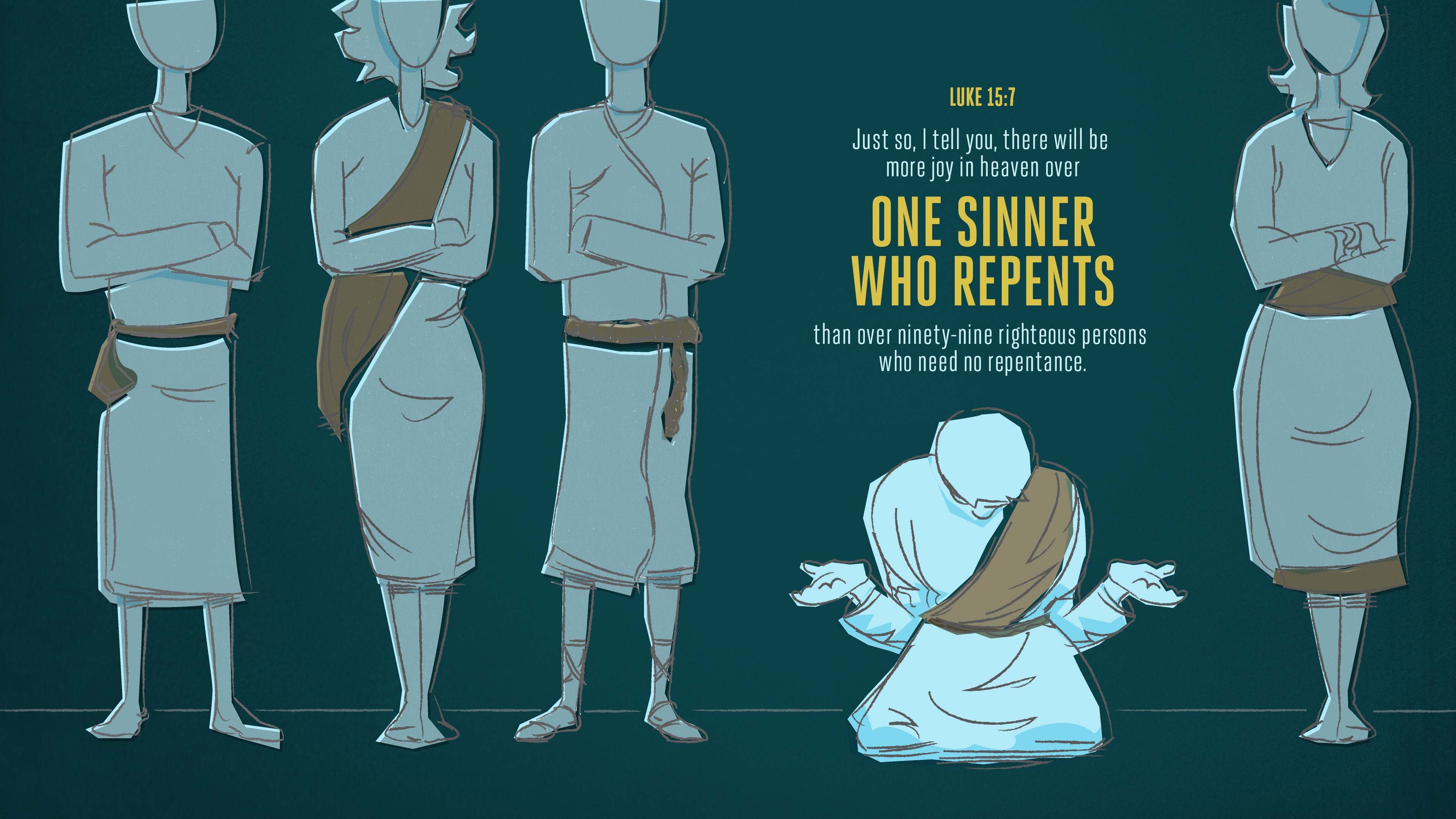
The night Jesus was born, shepherds were out in the field keeping watch over their flocks. A multitude of the heavenly host arrived praising God and saying, “Glory to God in the highest, and on earth peace among those with whom He is pleased.” Heaven was filled with rejoicing the night of Jesus’ birth because your Savior had come to rescue you from sin, death, and the devil. Now, in this Gospel lesson, Jesus says, “There will be more joy in heaven over one winner who repents than over ninety-nine righteous persons who need no repentance” (Lk. 15:7).

Well, there aren’t ninety-nine righteous persons who need no repentance; there has only ever been One righteous person who needed no repentance, Jesus Christ. This is probably a little ridiculous and silly, but should we imagine the joy of those angels the night of Jesus’ birth is multiplied by 99 plus a bit more when one sinner repents? Well, joy isn’t measured in units, so forget about attempting the math problem. But we can know from Jesus’ own lips that heaven rejoices more at the repentance and salvation of one sinner than it rejoiced over Christ’s birth.

Because Jesus brings the topic up in this text, the question for us today is: What is repentance? The word translated ‘repent’ or ‘repentance’ simply means “a change of mind,” but throughout the New Testament, you will find that repentance refers to a complete spiritual change. In fact, many of the times you come across the word ‘repent’ in Scripture it carries the whole idea of conversion.[1] The Bible does not teach that repentance is one step in some twelve-step salvation program. Salvation is instantaneous; just like in creation, God speaks, and it is. And salvation is always an act of God’s grace. “For by grace you have been saved through faith. And this is not your own doing; it is the gift of God, not a result of works, so that no one may boast” (Eph. 2:8-9). The Bible does teach that repentance is necessary for salvation, but if we see repentance as something we do, as our little contribution, then salvation is no longer a free gift. It would be dependent on you. 

So, let’s reconsider repentance, what it is and what it looks like from this parable Jesus teaches.

The Pharisees and scribes are complaining that Jesus receives sinners. Luke tells us that Jesus’ response to their grumbling is telling them “this parable” – singular. Luke could have said, “so He told them these three parables,” but he doesn’t. “This parable.” One parable. Three sections, parts, or chapters – it’s fine to think of it that way – but it’s one parable. And I’ve said it before, but I’ll say it again: we typically know these three sections or chapters of this one parable as the lost sheep, the lost coin, and the prodigal son. But it would be better if we referred to them as the seeking shepherd, the seeking woman, and the seeking father because that would help us keep the emphasis on the right syllable when it comes to seeing what Jesus teaches about repentance.

Now, in the first two sections of this parable, it’s a little hard to see where repentance comes into the stories. A sheep gets lost, the sheep gets found, and the shepherd throws a party. A coin gets lost, the coin gets found, and the woman throws a party. Just looking at the stories, we would probably conclude that Jesus isn’t teaching about repentance. He’s just talking about salvation. But Jesus concludes both of those sections by talking about heaven’s joy over repentance, so repentance has to be in there somewhere. According to those two parts of the parable, repentance is nothing more than the lost being found and restored by the owner. Then, the owner celebrates because of the joy of restoration.

Now, you might be saying, “Pastor there’s a lot more to repentance than the lost being found and restored. To repent, you have to feel bad about what you’ve done. You have to recognize the hurt and pain you have caused. You need to be scared because of the punishment that’s coming. You need to want to do better. That’s repentance.” To which I have to say, “Well, not according to this parable.” Guilt, shame, fear of punishment, and resolve to do better are all right responses when it comes to our sin, and all of those things may accompany repentance from time to time. But they aren’t necessary for repentance to be true or genuine.

A lost sheep might be scared. I don’t know enough about sheep to know if they feel remorse, but a lost sheep might wish it had never wandered away from the flock. A lost sheep might try to find its way back to the herd. But in the first section of this parable, the repentance of that sheep is somewhere in the shepherd’s finding and carrying this sheep back to the pen. In the second section of the parable, the coin doesn’t have any feelings or sorrow. A lost coin just sits in the crack gathering dust. And the repentance of that coin is nothing more than the woman picking it up and putting it back in her purse. So, these first two sections picture repentance as something God does to the lost.

Just so you know I’m not making this up: In Acts 10-11, we are told the story about how Peter went to preach at Cornelius’ house. Cornelius was a Gentile, so a lot more could be said about the whole story, but I’m going to keep it short. Peter arrives there and preaches about Jesus’ death and resurrection. Peter’s Pentecost sermon is very similar in it’s content, but unlike that Pentecost sermon, Peter doesn’t hammer everyone with heavy Law. He just says that Jesus died and rose again, and he announces that everyone who believes in Jesus receives the forgiveness of sins. The people who hear that sermon are filled with the Holy Spirit and are Baptized. All of that takes place in Acts 10. When you get into Acts 11, Peter is in Jerusalem and is being accused of hanging out with the wrong crowd (similar to Jesus here in Lk. 15). Peter simply relays the story of what happened. And the response is incredibly interesting. The Jerusalem church leaders respond, “Then to the Gentiles also God has granted repentance that leads to life” (Act. 11:18). Dear saints, repentance is a gift given by God.

Now, when we get to the third section of the parable, things are a little different. In the third chapter of the parable, it sure sounds like the younger son is repentant. But where does his repentance take place? Now, we have to set this up a little bit.

The third section of the parable has three main characters – a father and his two sons. The younger son tells his father to drop dead. That’s how you get an inheritance. Basically, the younger son tells his dad, “I want my share of your stuff, but I want it without you.” And the father gives it to him. Now, this would have meant public shame for the father because it would have involved selling off at least 1/3 of his estate to give the money to his little brat of a son. The son takes the cash and blows it all. He becomes so desperate in his effort to stay alive that he hires himself out to a pig farmer and is jealous of the slop the pigs are eating. 

Now, just a quick aside here. This also gives us a picture of what our sin does. Our sin isn’t just us getting lost. Sin is worse than a sheep aimlessly wandering away from the flock or a coin getting dropped. No, our sin makes us lower than and jealous of pigs.

Sitting there in the pigpen, the son starts crafting a speech. And that speech sounds like repentance, but it isn’t. Instead, the younger son realizes his father’s employees have plenty of food, and he’s dying of starvation. He plans to go to his father and say, and listen carefully, “Father, I have sinned against heaven and before you.” So far, completely true and right. “I am no longer worthy to be called your son.” No duh. “Treat me as one of your hired servants.” Now, all of this, again, sounds like repentance. He recognizes the stupidity of his actions and the ramifications of his rebellion. But it’s that last part that shows the brat’s real intention. He wants his dad to give him a job so he can have some food. The interesting thing that I had never noticed is the wording Jesus uses in this part of the parable.

Jesus doesn’t use the normal word for a servant which is doulos. A servant, a doulos, would live on the estate of the master and would even eat meals with the master’s family. But the younger son uses a different word here, misthios. A misthios is someone who would commute to work at the estate. A misthios would have no relationship with the master except when it was time to get paid for work done. His speech just shows how lost and unrepentant he still is. He still wants the benefits his dad can offer, but he doesn’t want anything to do with his dad. In his despair, he’s basically saying, “Dad, I screwed up big time. Can you just help me to stay alive? I won’t bother you and you won’t have to bother with me.” That’s his prepared speech.

He starts his walk home. But as he rounds the corner, his father comes running to him, embraces him, and kisses him. The son begins his speech, “Father, I have sinned against heaven and before you. I am no longer worthy to be called your son.” But the father, the father doesn’t care. He restores him to his rightful place as a son. “Bring the best robe and a ring and shoes; put them all on him. Kill the fattened calf and let’s throw a party. For this my son was dead, and is alive again; he was lost, and is found.” It is in that love and finding and restoration of the father that the son is granted repentance. 2 Corinthians 7:10 says, “Godly grief produces a repentance that leads to salvation without regret, whereas worldly grief produces death.” The son had a worldly grief that would have left him in the death of a lost relationship with his father. But the father here lets the godly grief of his lost son, that true and right realization of what he had done, produce a repentance that leads to salvation and complete restoration. The son doesn’t get to finish his speech. He doesn’t get to be misthios, a hireling. He gets to be a son again – nothing more, nothing less.

Now, I know this sermon is getting long, but I have one more thing, so please bear with me. I made a big deal about this chapter being one parable with three sections. Well, the third section has two parts. There is still the issue of the older son. The older son, who never left, was out working in the field. He comes home, hears the partying, learns what is going on, and is livid. He refuses to join the party. And even though this older son never left his father, he is just as lost as the younger son was back in the pig stye.

And here is why I bring this up. We wrongly think that God is happy when we are doing everything we are supposed to. We think God is happy with us when we are consistent, strong, and can show all the things we’ve accomplished. But that isn’t the case. Your heavenly Father is only happy when His children are forgiven and together with him at the feast. That is why the father leaves his own party and pleads with this older son to come back into the fold.

Dear saints, stop dwelling on your unfaithfulness and sin. Yes, you’ve been the rebellious younger son. But your heavenly Father has sought you out and heaven rejoices at your repentance and salvation. Stop dwelling on your obedience and work for God; don’t be the entitled older brother. Yes, go serve, love, and do your good works diligently, but don’t think that God is going to throw a party for your commandment-keeping.

Heaven rejoices with God when He brings you back into His grace and mercy where nothing is earned or deserved. Instead, it is all freely given for the sake of Jesus, your Savior. Amen.

The peace of God, which surpasses all understanding, will guard your hearts and minds in Christ Jesus. Amen.


[1] Clear examples would include Mt. 4:17; Lk. 5:32; 13:3; 16:30; 24:47; Act. 11:18; 2 Cor. 7:10.

Forgiven & Blessed – Sermon on John 20:19-31 for the Second Sunday of Easter

John 20:19-31

19 On the evening of that day, the first day of the week, the doors being locked where the disciples were for fear of the Jews, Jesus came and stood among them and said to them, “Peace be with you.” 20 When he had said this, he showed them his hands and his side. Then the disciples were glad when they saw the Lord. 21 Jesus said to them again, “Peace be with you. As the Father has sent me, even so I am sending you.” 22And when he had said this, he breathed on them and said to them, “Receive the Holy Spirit. 23 If you forgive the sins of any, they are forgiven them; if you withhold forgiveness from any, it is withheld.”

24 Now Thomas, one of the twelve, called the Twin, was not with them when Jesus came. 25 So the other disciples told him, “We have seen the Lord.” But he said to them, “Unless I see in his hands the mark of the nails, and place my finger into the mark of the nails, and place my hand into his side, I will never believe.” 

26 Eight days later, his disciples were inside again, and Thomas was with them. Although the doors were locked, Jesus came and stood among them and said, “Peace be with you.” 27 Then he said to Thomas, “Put your finger here, and see my hands; and put out your hand, and place it in my side. Do not disbelieve, but believe.” 28 Thomas answered him, “My Lord and my God!” 29 Jesus said to him, “Have you believed because you have seen me? Blessed are those who have not seen and yet have believed.”

30 Now Jesus did many other signs in the presence of the disciples, which are not written in this book; 31 but these are written so that you may believe that Jesus is the Christ, the Son of God, and that by believing you may have life in his name.

Alleluia! Christ is risen!
He is risen indeed! Alleluia!

In the name of Jesus. Amen.

The evening of the Resurrection, Jesus seeks out the disciples just like He sought Adam and Eve when they hid themselves behind some fig leaves in the Garden. Fear had reduced those ten disciples to a bunch of dead bones (Ezk. 37:1-14). It was only ten of them because Judas had betrayed Jesus, and Thomas wasn’t there. Where was Thomas? The text doesn’t specifically say, but we do have some clues from Scripture. So, put on your Sherlock Holmes hats, and let’s do some deductive reasoning together.

Early that morning, Peter and John saw the empty tomb and the neatly folded burial cloths (Jn. 20:1-10). And throughout the day, Jesus had been appearing to all sorts of people. First, to Mary Magdalene (Jn. 20:11-18), and shortly after that, to the other women who had gone to the tomb (Mt. 28:9-10). At some point, Jesus appears to Peter privately (Lk. 24:34) and to two other disciples, who were not part of the twelve, on the road to Emmaus (Lk. 24:13-35). So, Jesus is popping up all over the place, but the disciples have locked and imprisoned themselves in that upper room afraid for their lives.

They knew that the Pharisees had Pilate set a guard at the tomb to keep the disciples from trying to fake a resurrection (Mt. 27:62-66). These ten disciples are afraid that a bunch of soldiers are out looking for them to kill them just like they had killed Jesus. So, again, why isn’t Thomas there? The Gospel of John seems to suggest that Thomas wasn’t afraid. Thomas has been given the unfortunate nickname ‘doubting Thomas,’ but he may have been bolder and more fearless than the other disciples. Back in John 11, which was probably just a few weeks before the crucifixion, Thomas was ready to die with Christ. In John 11, Jesus suggests that they all go to Judea where He will raise Lazarus. Eleven of the disciples aren’t too keen on the idea because Jesus was almost stoned there twice (Jn. 8:59, 10:31), but Thomas speaks up, “Let’s go with Him that we may die with Him” (Jn. 11:16).

So, back to the day of Jesus’ resurrection: Peter and John tell the other disciples that they had found the tomb empty. Mary Magdalene reports that she has seen and talked with Jesus (Jn. 20:18). The other women tell the disciples that they have seen and talked with angels and with Jesus (Lk. 24:10-11). The two disciples who were on the road to Emmaus and Peter all say that they have seen Jesus (Lk. 24:33-35). All these reports of Jesus’ resurrection are coming in, which might have made Thomas curious. Now, Scripture doesn’t say explicitly, but it isn’t a stretch to imagine that Thomas isn’t behind those locked doors because he is out trying to find Jesus. If he gets caught by the soldiers and killed, so what? He is ready to die with Jesus.

But while Thomas is away, Jesus appears to the ten, speaks peace to them, shows them His wounds, breathes the Holy Spirit on them, and sends them out to with the authority to forgive sins. Then, Jesus leaves. At some point, Thomas comes back and the ten say, “Jesus was here, and you just missed Him.” Thomas is frustrated, and he doesn’t respond well at all. He defiantly says, “Unless I see in His hands the mark of the nails, and place my finger into the mark of the nails, and place my hand into His side, I will never believe.”

It ends up, all eleven disciples had locked themselves up, just in different ways. Ten had locked themselves in the prison of the fear of death, but Thomas has locked himself in the prison of unbelief because he hasn’t seen what the others have seen. Well, those prison bars and doors aren’t a problem for Jesus. Christ appears through the locked doors of fear to forgive the sin of the ten. And Jesus gives the disciples the authority to forgive sins saying, “If you forgive the sins of any, they are forgiven them; if you withhold forgiveness from any, it is withheld.” Then, one week later, Jesus will appear to Thomas and unlock the doors of unbelief. But let’s consider for just a minute how Jesus gives the ten the authority to forgive sins.

Think back to when Jesus healed the paralytic who was lowered through the roof (Mt. 9:1-8; Mk. 2:1-12; Lk. 5:17-26). Instead of healing the guy right away, Jesus says to him, “Your sins are forgiven.” The Pharisees grumbled at this saying that only God could forgive sins. So, Jesus heals the paralytic proving that He has the authority to forgive sin. Now, on Easter evening, Jesus passes that authority on to the disciples and, ultimately, all Christians.

Sin has put all humanity behind bars in the prison of death. But Jesus has come to give release to everyone who is in captivity to sin (Lk. 4:18; Is. 61:1). Because God has called me to be the pastor here, I am called to give that same release of sin. It is why, after we have confessed our sins and receive the absolution, I say, “As a called and ordained servant of Christ and by His command and authority, I declare to you the entire forgiveness of all your sins.” Because Jesus has the authority to forgive and passed this authority to all Christians, it is as though Jesus is doing it Himself. Think of it this way.

Imagine you are guilty of a crime and in jail. As you sit there in prison, a judge across town rules that you are innocent. That ruling doesn’t do you any good until that judge sends an order to the guard of your prison to set you free. Then, the guard comes with the keys, unlocks your cell, and releases you back into society. Now, in that scenario, who set you free, the judge or the guard? Honestly, the answer is both.

If the judge declares you innocent but the guard doesn’t go to your cell and open the door, you are still behind bars. On the other hand, if the guard lets you out without any order or declaration from the judge, you are free, but you will live the rest of your life waiting to be arrested because you haven’t been justly declared innocent.

Now, non-Christians live as though the guard has let them out, but the judge hasn’t issued the ruling that they are set free. They are like Thomas on the evening of the resurrection. Jesus has taken the punishment they deserve and forgiven them of all their sins, but that freedom doesn’t do them any good because they don’t believe that they are really, truly free.

Christian, that is where you come in. You can announce this forgiveness to others. If someone comes to you and tells you about their sin and guilt and shame, you can tell them of Jesus’ death and resurrection. Tell them that Christ is the Lamb of God who takes away the sins of the world, and His resurrection shows that God accepted Jesus’ sacrifice. And tell them, “I forgive you of your sins because of what Jesus has done.”

There is another side to this. Some Christians are like the ten disciples. They live as though the judge has issued the ruling, but they stay in their cell as though the guard hasn’t let them out. So, they remain in prison fearing that that freedom will get them in trouble. Dear saints, when you hear the absolution, it is nothing more than the guard letting you out of the prison of sin and death by Jesus’ ruling that you are forgiven. You really are free, and your sins are removed from you as far as the east is from the west (Ps. 103:12).

That is the Gospel message. That is the authority Jesus has given to the Church. That is the message Jesus has sent us into the world to announce. That is the peace that Jesus gives when He says, “Peace to you.” It is the peace that, because He died and rose again, sins are forgiven. They are gone.

I want to close with Jesus’ response to Thomas’ confession, “My Lord and my God.” Jesus replies, “Have you believed because you have seen Me? Blessed are those who have not seen and yet have believed.”

Jesus is speaking about you there. The risen Jesus had you in mind when He spoke those words. You have not seen Your resurrected Savior in the flesh. You don’t see the marks in Jesus’ hands and side. Instead, you see crosses that remind you of the death that Christ died for you. You see the Font where Jesus delivers to you His mercy and forgiveness and washes away your sins. You see an altar on which nothing has ever been sacrificed but which Jesus uses as His table to feed you bread and wine which Jesus says is His risen Body and Blood.

You do not see, but you hear the same proclamation of Jesus, “Peace to you.” That peace is yours because Jesus Christ, true God, begotten of the Father from all eternity is crucified, died, and was buried. He is risen again to give you His peace and the forgiveness of all your sins now and for all eternity. Dear saints, you are forgiven and blessed by your crucified and risen Lord and Savior.

Alleluia! Christ is risen!
He is risen indeed! Alleluia!

Amen.

The peace of God, which surpasses all understanding, will guard your hearts and minds in Christ Jesus. Amen.