Luke 10:17-20
 17 The seventy-two returned with joy, saying, “Lord, even the demons are subject to us in your name!” 18 And he said to them, “I saw Satan fall like lightning from heaven. 19 Behold, I have given you authority to tread on serpents and scorpions, and over all the power of the enemy, and nothing shall hurt you. 20 Nevertheless, do not rejoice in this, that the spirits are subject to you, but rejoice that your names are written in heaven.”
In the name of Jesus. Amen.
As I mentioned at the beginning of the service, our texts today would have us consider the work of God’s holy angels. Now, there are some who, when they talk about angels, say all sorts of things that are not biblical. And I have to admit that because there is so much false teaching and beliefs about angels that I have had a tendency to not preach or teach about them very much. So, let’s fix that by first considering what the Scriptures do teach about the angels.
The word “angel” means “messenger” in both Hebrew and Greek (מַלְאָךְ, ἄγγελος). Angels are spiritual beings who were created during the first six days of creation. We know this because before the six days of creation there was only God (Jn. 1:1-3) and after the sixth day, God rested from all His work. There is good evidence that the angels were created in the first three days because of what God says in Job 38:4-7. “Where were you when I laid the foundation of the earth? … Who determined its measurements? … On what were its bases sunk or who laid its cornerstone when the morning stars sang together and all the sons of God shouted for joy?” God seems to be talking about the third day of creation when He created the land and sea, and the singing of the morning stars and shouting of the sons of God was the angels (see also Job 1:6).
We know that God created a huge number of angels; Heb. 12:22 says they are innumerable. The angels were all created good by God (Gen. 1:31), but at some point before the devil tempted Adam and Eve, Satan led a significant number of angels in rebellion against God and they fell. Those fallen angels, we now call demons. More on that later, but from here on, know that if I use the term ‘demons’ I am simply referring to those fallen angels.
There are orders and classes of angels – Cherubim (Gen. 3:24; Ps. 80:1), Seraphim (Is. 6:2), archangels (1 Th. 4:16). There are also greater and lesser demons (Lk. 11:15, 18-19).
Even though angels are spirits, they can move and manipulate material things. They are able to take Lot and his family by the hand to get them out of Sodom before God destroyed it (Gen. 19:16). So, when you or someone you love has a close call, it very well may be that God’s angels have protected you.
Scripture teaches that angels have power and strength (Ps. 103:20; 2 Th. 1:7) which is greater than ours, and they use their strength to guard and protect us from things that would overpower us (Ps. 91:11-13). Demons are also strong. Scripture says that the devil holds unbelievers securely captive in his kingdom (Lk. 11:21-22), and believers can only withstand the attacks of Satan in the power of God (Eph. 6:10-17).
The angels’ work is to sing praises to God (Is. 6:3; Lk. 2:13) and to fight on our behalf (Ps. 104:4; Heb. 1:14); in other words, their tools are the song and the sword. A fantastic text about angels fighting on behalf of God’s people is found in 2 Kgs. 6[:8-23] where Elisha and his servant get surrounded by the army of Syria during the night. Elisha’s servant gets up early in the morning (maybe to get the newspaper or the milk or something) and sees this army surrounding the entire city. He runs inside to tell Elisha and says, “Alas, my master! What are we going to do?” But Elisha calmly says, “Do not be afraid, for those who are with us are more than those who are with them.” Elisha asks God to open the eyes of his servant so that he can see what is going on. 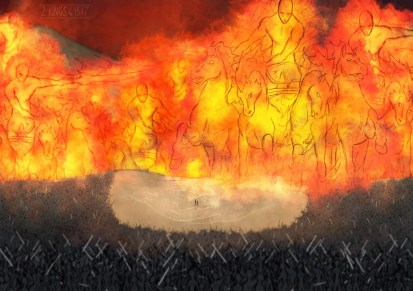 And the young servant sees a huge host of angels with horses and chariots of fire all around Elisha. The Syrian army rushes in toward them. Elisha simply prays that the entire army would be struck with blindness, and they are. Then Elisha leads this blinded army straight into the capitol of Israel where they are all captured. In this account, we see the unfolding of what is said in Ps. 34:7, “The angel of the Lord encamps around those who fear him, and delivers them.”
Scripture teaches that angels are sent in particular to serve children (Mt. 18:10), believers in their vocations (Ps. 91:11-12), and those who are dying (Lk. 16:22). It is very possible that each believer has an angel or squad of angels for protection. In Mt. 18:10, Jesus says, “See that you do not despise one of these little ones. For I tell you that in heaven their angels always see the face of my Father who is in heaven” (see also Act. 12:15). And Heb. 1:14 says that the angels are “ministering spirits sent out to serve for the sake of those who are to inherit salvation.”
Scripture teaches that angels were present at the giving of the Ten Commandments at Mt. Sinai (Dt. 33:2; Gal. 3:19). Angels are sent to proclaim the conception (Lk. 1:26), birth (Lk. 2:11), and resurrection of Christ (Lk. 24:5-7). In fact, angels remain at the empty tomb even after Jesus left.
We should not pray to angels as though they are the ones responding to our prayers. Every time in Scripture that someone begins to worship an angel, the angel protests and directs worship to God (esp. Rev. 22:8-9). Also, we shouldn’t listen to angels unless they are pointing us to Jesus Christ and Him crucified. Paul plainly says in Gal. 1:8, “But even if we or an angel from heaven should preach to you a gospel contrary to the one we preached to you, let him be accursed.”
Many Christians have stories about being helped in a particular situation by someone who suddenly appeared and wasn’t seen again. It may indeed be that God sent an angel to help and defend. Also, there are times when Christians have helped someone who was in trouble, and they have a sense that something was different about that encounter. It may be than an angel appeared to give an opportunity to the Christian to serve in a particular way. Heb. 13:2 says, “Do not neglect to show hospitality to strangers, for thereby some have entertained angels unawares.”
Finally, and maybe most importantly, we should realize that angels are present with us right here and now as we are gathered in worship. Hebrews 12:22-24 says that in church we have “come to Mount Zion and to the city of the living God, the heavenly Jerusalem, and to innumerable angels in festal gathering…” Jesus says that the angels in heaven are joyful over one sinner who repents (Lk. 15:7, 10). As we confessed our sins earlier, a whole host of angels whom we cannot see or hear rejoiced as they heard Christ absolve and free us from our sins. In fact, Heb. 1:14 calls angles ‘liturgizing’ spirits (the ESV translates λειτουργικός as ‘ministering’). Using the liturgy is a way that we connect our worship with the worship of the angels in heaven, which is why we draw the words and order of our liturgy from the words of Scripture.
So, there is a quick overview of the Scriptural teaching of angels. Now, to our texts. First this Gospel lesson:
Jesus had sent these seventy-two ahead of Him to preach and heal in every town He was about to go Himself (see Lk. 10:1-12). And Jesus didn’t beat around the bush; He plainly tells them, “Behold, I am sending you out as lambs in the midst of wolves.” Their mission was already dangerous, but to top it all off, Jesus tells these lambs to march out in the midst of wolves with no resources – no moneybag, knapsack, or sandals. They would be housed and nurtured by the people who welcomed them. Jesus told them to heal the sick and say to the people, “The reign (βασιλεία) of God has come near to you.”
We hear them joyfully report that the demons – the evil, fallen angels – were subject to them in Jesus’ name. They saw victories in their various spiritual battles. But then Jesus says that something even greater was going on that they couldn’t see. While those seventy-two were proclaiming the reign of Jesus, Christ says, “I saw Satan fall like lightening from heaven.” More was going on than these seventy-two could see. It was more than just isolated, individual battles.
And in our Epistle text (Rev. 12:7-12), we heard how the archangel Michael was given the privilege of throwing Satan (‘Satan,’ by the way, means ‘accuser’), the deceiver of the whole world,  down and out of heaven. How was Satan cast down? The text is clear. Satan was cast out by the blood of the Lamb.
Now, there are Christians who would disagree with what I am about to say here, but I think we should see Jesus’ proclamation to the seventy-two of seeing Satan falling from heaven and the text in Rev. 12:7-12 as confirmation that the shedding of Christ’s blood and the preaching of the Gospel of the reign of Christ was what cast Satan down from heaven.
This means that Satan is no longer able to accuse you before God which is what he was constantly doing day and night before God in heaven (Rev. 12:10). Remember the book of Job? Satan was there in heaven accusing Job of Job’s sins before God by saying that the only reason Job loved God was because God was nice to Job (Job 1:8-11, 2:1-5). But now, Satan has been expelled from heaven, and that is good news.
However, there is also a warning at the end of that Epistle text. Satan is no longer able to accuse you before God because he has been expelled from God’s presence. But that doesn’t mean he is done accusing. The devil can’t accuse you before God anymore, but he can and does try to accuse you in your conscience, and he is very good at that. He will say that your sins are too many or too great to be forgiven. The accuser now roams about like a roaring lion seeking to devour you (1 Pet. 5:8), constantly whispering in your ear, “Did God really say, ‘Your sins are forgiven’?”
Dear saints, when the devil does this, he needs to be expelled from your conscience. How is this done? It is done with the same weapons that Michael and the angels used – the blood of the Lamb, and the word of your testimony (Rev. 12:11).
Dear saints, when you confess your faith that Christ has been crucified and shed His blood for you, you expel Satan from your conscience. When the devil whispers his accusations, confess that Jesus is the Lamb of God who takes away the sins of the world (Jn. 1:29). Tell Satan, “Christ has taken my sins. So, if you want to talk to someone about my sins, you can’t talk to me about them anymore. Jesus has taken them as His own. Christ owns them now. He has died and shed His blood for them.” And the devil has no reply to that testimony.
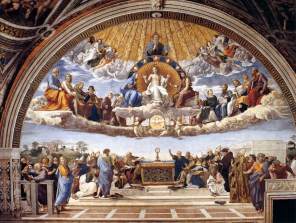 So today, dear saints, come to Jesus’ table and receive His body given for you. Receive His blood which was shed for you for the forgiveness of your sins knowing that neither death nor life, nor angels nor rulers, nor things present nor things to come, nor anything else in all creation, will be able to separate you from the love of God in Christ Jesus your Lord (Ro. 8:38-39).
Satan has been expelled from heaven, and he is expelled from your conscience by the blood of your Savior. In Jesus’ name. Amen.
The peace of God, which surpasses all understanding, will guard your hearts and minds in Christ Jesus. Amen.
 Pastorsamwise
You must be logged in to post a comment.