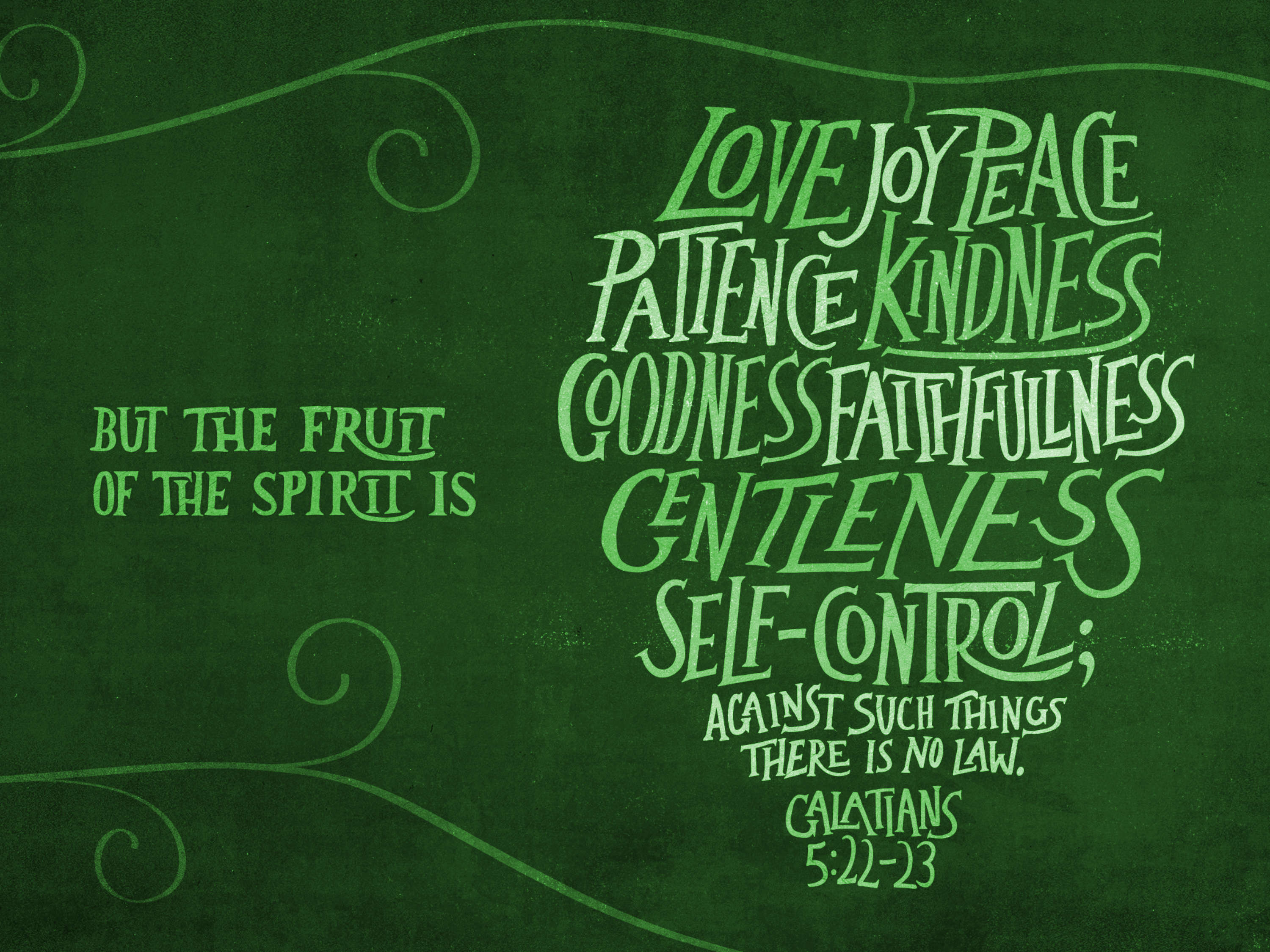
Galatians 5:16–24
16 But I say, walk by the Spirit, and you will not gratify the desires of the flesh. 17 For the desires of the flesh are against the Spirit, and the desires of the Spirit are against the flesh, for these are opposed to each other, to keep you from doing the things you want to do. 18 But if you are led by the Spirit, you are not under the law. 19 Now the works of the flesh are evident: sexual immorality, impurity, sensuality, 20 idolatry, sorcery, enmity, strife, jealousy, fits of anger, rivalries, dissensions, divisions, 21 envy, drunkenness, orgies, and things like these. I warn you, as I warned you before, that those who do such things will not inherit the kingdom of God. 22 But the fruit of the Spirit is love, joy, peace, patience, kindness, goodness, faithfulness, 23 gentleness, self-control; against such things there is no law. 24 And those who belong to Christ Jesus have crucified the flesh with its passions and desires.
In the name of Jesus. Amen.
Scripture uses many different metaphors when it comes to salvation and being a Christian. There are the optical metaphors of darkness vs. light (Is. 9:2; Jn. 1:5, 3:19; 1 Pet. 2:9) and blindness vs. seeing (Is. 35:5, 42:7; Act. 26:18). There are the medical metaphors of death vs. life (Eph. 2:5; Col. 2:13) and heart of stone vs. a heart of flesh (Ezk. 11:19, 36:26). Scripture uses familial metaphors of adoption (Ro. 8:15; Gal. 4:5; Eph. 1:5), being a son (Mt. 6:8-9; Lk. 15:11f) and child (1 Jn. 3:1-2). There is the metaphor of sheep and shepherd (Ps. 23; Ezk. 34-35; Jn. 10:1-18). There are many, many more, but today, we get the botanical metaphor of fruit.
The thing about fruit is that plants don’t produce fruit for themselves. The main function of a plant’s fruit is so it can reproduce. The fruit provides water and protection for the seeds of the plant. God also designed fruit to be tasty so it would be eaten, and the seed(s) in the plant is spread to produce other plants.
When this text contrasts the flesh and the Spirit, it talks about the ‘works’ of the flesh and the ‘fruit’ of the Spirit. Notice how the works of the flesh are all directed inwardly. These works are self-interested and self-serving. Paul lists 15 “works of the flesh.” The first 3 – sexual immorality, impurity, and sensuality – all have to do with carnal, bodily appetites or a desire for the flesh to assert itself over others. The next 2 – idolatry and sorcery – are sins against God, trying to put the self in place of God. The next 8 – enmity, strife, jealousy, fits of anger, rivalries, dissensions, division, and envy – are all things that separate individuals by prioritizing the self over another. And the final 2 – drunkenness and orgies – are sins of excess. Then, when Paul adds, “and things like these,” he admits that this list isn’t all the works of the flesh. He could have added more.
And Paul says all these works of the flesh are “evident.” You can see them. They are apparent, clear, plain, and obvious. It is certainly easy to see all these things in our world and in our culture. But do you suppose that Paul gives us this list so we can point out other people’s faults? No. If they’re evident, they don’t need to be pointed out. They’re out there for everyone to see. Instead, Paul wants us to see how these things are present in each of us. They are in and of our flesh. And by ‘flesh’ he doesn’t mean our skin, muscles, tissue, tendons, and bones. By ‘flesh’ here, Paul is saying that these things come from the poisonous root of our heart.
If we sinners were an apple tree, every apple we produced would be infected with disease, blight, and worms; it would be rotting, and withering. If you saw a tree like that, you wouldn’t think the problem was the individual apples. You’d know something was wrong with the tree. It has a disease that infects every branch and goes deep down to the roots. That tree needs to be torn down. In other words, we all need to repent.
There is a penalty for these works of the flesh. You don’t need to wonder if you deserve eternity in hell. You can know that you do. Scripture is crystal clear, “Those who (lit.) are doing such things will not inherit the kingdom of God” (Gal. 5:21b).
God be praised, there is a solution, a fix. Christ Jesus has come to deliver you from these works of the flesh. “Those who belong to Christ Jesus have crucified the flesh with its passions and desires” (Gal. 5:24). Christian, God has removed your heart of stone and given you a heart of flesh (Ezk. 11:19, 36:26). He has put a new spirit within you. He has given you the Holy Spirit. And the Holy Spirit produces fruit.
These nine different qualities are called ‘fruit.’ Notice that the word ‘fruit’ is singular. It’s not many fruits like the 15 works of the flesh. But these 9 fruit (sic.) of the Spirit belong together; love, joy, peace, patience, kindness, goodness, faithfulness, gentleness, and self-control. This fruit all grows on the same tree – out of you. And remember that fruit needs time to grow. It isn’t like you can manufacture this fruit artificially or mechanically. No. It needs to be planted, pruned, watered, and nourished (1 Co. 3:6-7).
Remember that the works of the flesh are evident, plain, visible. The same thing isn’t said about the fruit of the Holy Spirit. If you don’t see this fruit, continue to pray that the Holy Spirit will nourish all these things in you. The Holy Spirit will cause that fruit to grow, bloom, ripen, and spread. So, let’s just go through each of these 9 fruit individually.
Love: This is the chief characteristic of how God is disposed toward you, believer. Scripture explicitly says that nothing can separate you from God’s love for you (Ro. 8:35, 38-39). The Spirit takes God’s love and pours it into your heart (Ro. 5:5). This love of God isn’t just warm, nice feelings; it is action evidenced by Jesus’ sacrificial love for you as He gave His life on the cross. That love of God is given to you so you can give it to others.
Joy: God’s love provides you a sure confidence about the future (Ro. 5:11). Whatever circumstances come your way, you know that you will be in eternal bliss. So, the darkness and pain of this world will cease. That brings joy as well as…
Peace: Your relationship with God is no longer filled with strife. Christ has ended your hostility toward God. You have God’s peace that surpasses understanding (Php. 4:7), and then, you can be at peace with others as well.
Patience: Because you have God’s love which gives joy and peace, you can be patient. Even though the world throws all sorts of chaotic things at you, you can patiently endure it (Ro. 8:25). And beyond that you have…
Kindness: Kindness is the active, merciful goodness that mirrors God’s kindness. You grow to forgive others as God has forgiven you (Eph. 4:32).
Goodness: The word here can also mean ‘generosity.’ Because God has infinite resources, you know that you will receive all good things from Him (Ro. 8:32). This frees you to be God’s conduit to generously give your good things to others.
Faithfulness: Again, God proves His faithfulness to you as He died for you on the cross. He is faithful to keep you from tests and temptations that are beyond your strength (1 Cor. 10:13). This creates a faithfulness in you toward others.
Gentleness: This is an interesting one. Gentleness means that you don’t get excessively angry when things are out of step with how God created the world. There are times when you will need to say hard things to others, things that cause them grief. But you say those hard things in a gentle way which produces repentance. Paul talks about this quite a bit in 2 Cor. 7:8-13. To be gentle requires the final aspect of the Spirit’s fruit…
Self-control: The Holy Spirit leads you to resist your own passions through self-control.
These nine fruit (sic.) of the Holy Spirit are under no compulsion or requirement. Unlike the works of the flesh that exclude sinners from the kingdom of God, these fruits aren’t how you earn entrance to God’s kingdom. Instead, as the Spirit has begun to create these things in you, He will bring all of it to completion (Php. 1:6).
How will the Holy Spirit cultivate this fruit? Jesus has the answer. In John 15:1-5, Jesus says, “I am the true Vine, and My Father is the Vinedresser. Every branch in Me that does not bear fruit He takes away, and every branch that does bear fruit He prunes, that it may bear more fruit. Already you are pruned,” (the ESV says ‘clean’ but it’s the same word Jesus just used). “Already you are pruned because of the Word that I have spoken to you. Abide in Me, and I in you. As the branch cannot bear fruit by itself, unless it abides in the vine, neither can you, unless you abide in Me. I am the vine; you are the branches. Whoever abides in Me and I in him, he it is that bears much fruit, for apart from Me you can do nothing.”
Dear saints, the Spirit will use Christ’s Word and create this fruit in you. Abide, remain steadfast in that Word, and this fruit will be produced. Again, if you don’t see things in your life, know that God continues to work on you, and that fruit will be there for the benefit of others. Amen.
The peace of God, which surpasses all understanding, will guard your hearts and minds in Christ Jesus. Amen.
 Pastorsamwise
You must be logged in to post a comment.