Innocent Blood – Sermon on Matthew 26:1-27:66 for Palm Sunday

Matthew 26:1-27:66

In the name of Jesus. Amen.

Matthew is the only one of the four Gospels that tells us what happened to Judas after Jesus was arrested and condemned (Mt. 27:3-10). Judas was overcome with regret and guilt because he knew that God had cursed anyone for taking a bribe to shed innocent blood (Dt. 27:25). Our translation says that Judas “changed his mind” (Mt. 27:3). In Greek, it’s one word (μεταμέλομαι) that is similar to the word for repentance (μετανοέω), but the change of mind Judas had was only one-sided. And here’s what the text conveys: Judas was very sorry. He wished that what he had done could be undone. He regretted his betrayal, but Judas did not repent the way Christians repent. Christian repentance has two parts. It includes the regret and change of mind Judas had. But saving repentance goes one step further. Christian repentance also trusts and believes in God’s grace and mercy given on account of Jesus’ death and resurrection (Mk. 1:15). Judas was lacking that faith and trust.

That lack of faith in God’s mercy is why Judas goes to the chief priests and elders. He doesn’t know where else to turn even though he had been taught better. Sadly, Judas brings his confession to the wrong place. Judas went to the Temple which had been the place of forgiveness (1 Kgs. 8:30), but the night before, Jesus had clearly told Judas and the rest of the disciples that He was instituting the New Covenant (Jer. 31:33-34) in His Blood for the forgiveness of sin (Mt. 26:26-29). The result was that Judas went to the very ones who had been seeking Jesus’ death (Mt. 26:14-15). Judas knew where he needed to go for forgiveness – he had been told just a few hours earlier. But instead of going to Jesus, he sought forgiveness where it could not be found.

Judas’ confession of sin and his action of returning the thirty pieces of silver were both right. He had betrayed innocent blood and returning the payment he received for his sin was what he should do. But his sorrow and penance could not undo what he had done; it could not remove the guilt of his sin. The chief priests and elders were supposed to be forgivers, absolvers, and ministers of atonement. Yet, after hearing Judas’ confession, they refuse to lift the burden of guilt from him. Instead, they bind Judas’ sin and betrayal on his head. “What is that to us? See to it yourself” (Mt. 27:4). What a chilling, horrific thing to say to someone who is crushed with guilt.

Throughout the Gospels, those religious leaders had tried to convict Jesus of sin. They would accuse Jesus and the disciples of eating with defiled hands (Mt. 15:1-20) and of eating and associating with tax collectors and sinners (Lk. 15:1-2). They were always trying to trap Jesus (Mt. 22:15-40). You would think that they would at least tell Judas something like, “Don’t worry, Jesus isn’t innocent. He’s a sinner. He’s dangerous. He’ll bring trouble to all of us with his teaching.” But they don’t. They don’t try to convince Judas that Jesus was guilty. They don’t even offer that little shred of comfort to Judas. It appears as though they also know that Jesus was innocent. Back in Mt. 23:2-4, Jesus rightly said of them, “They tie up heavy burdens, hard to bear, and lay them on people’s shoulders, but they themselves are not willing to move them with their finger.”

If the chief priests and elders had offered Judas forgiveness, it would have required them to admit their own guilt. Again, they were the ones who conspired with Judas to shed Jesus’ innocent blood. But instead of repenting, they insisted they were doing the right thing in condemning Jesus. So, they become absurdly hypocritical.

After Judas throws the pieces of silver in the Temple, they quickly work to get that money out of the Temple because it is blood money. They recognize they cannot put the bounty they had placed on Jesus’ head back in the holy treasury because it is unclean money (Dt. 23:18). But (here’s the hypocrisy) they were the ones who defiled that holy money. They were the ones who took it from the treasury. They were the ones who turned that silver into blood money using it to pay Judas for his betrayal (Mt. 26:15).

While it is tempting to despise the chief priests and Judas, in Christian humility we need to recognize that we do just as they did. Too often, we are filled with sinful desires and passions and make any excuse to attempt to justify them. Too often, we will do all sorts of horrific things and try to hide them under the guise of holiness while we ignore the carnage it wreaks on others. Too often, we are like Judas and don’t realize how destructive our behavior is until it’s too late. When we do, finally, realize the great harm we have done, it can lead us to despair. And despair is a dangerous place to walk. Judas despairs of all hope and kills himself. Judas is condemned, not because he kills himself, and not even because he betrayed Jesus. Jesus’ death covered even Judas’ sins of suicide and betrayal. Judas is condemned because he died outside of faith in Jesus’ grace and mercy. Jesus calls Judas the “son of destruction” (Jn. 17:12) and says that it would have been better for Judas if he had never been born (Mt. 26:24). Jesus never says anything like that about His sheep.

Please allow me a brief aside here: Suicide, self-murder, is not the unforgivable sin. Can people commit suicide and still be a Christian? Yes. To those of you who have lost someone to suicide, you can have comfort in the promises of Scripture. Christ Himself is the man of sorrows, acquainted with grief (Is. 53:3). When someone is walking in grief, depression, and even in the valley of the shadow of death, Jesus is with them (Ps. 23:4) and desires to save them (1 Tim. 2:4). In that deathly vale, Jesus calls to them, “Come to Me, all who labor and are heavy laden, and I will give you rest” (Mt. 11:28). All that being said, suicide is an evil death and is never the answer to despair.

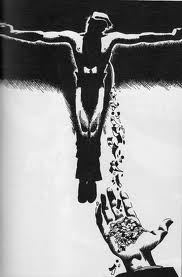
The answer to all sin and despair is in the innocent Blood of Jesus which has been shed for you. His innocent Blood was shed to cleanse you of your guilty blood. Whenever you recognize your guilt and sin against God, bring those sins to Christ. Let Him deal with them because He has dealt with them in His death and resurrection. He is the Lamb of God who takes away the sin of the world (Jn. 1:29). 

The answer to sin is the innocent Blood of Jesus that He freely gives to you in Holy Communion. And now, Jesus invites you to His table to receive that Blood which He will put in your mouth. Here, Jesus’ innocent Blood becomes your blood. Dear saints, come, take, eat, and drink the perfect, innocent Blood of your Savior which He has shed for the forgiveness of all your sins. Amen.

The peace of God, which surpasses all understanding, will guard your hearts and minds in Christ Jesus. Amen.

Miracle Sandwich – Sermon on Matthew 9:18-26 for the Twenty-Fourth Sunday after Trinity

Listen here.

Matthew 9:18-26

18 While he was saying these things to them, behold, a ruler came in and knelt before him, saying, “My daughter has just died, but come and lay your hand on her, and she will live.” 19 And Jesus rose and followed him, with his disciples.

Woman with the Issue of Blood20 And behold, a woman who had suffered from a discharge of blood for twelve years came up behind him and touched the fringe of his garment, 21 for she said to herself, “If I only touch his garment, I will be made well.” 22 Jesus turned, and seeing her he said, “Take heart, daughter; your faith has made you well.” And instantly the woman was made well.

23 And when Jesus came to the ruler’s house and saw the flute players and the crowd making a commotion, 24 he said, “Go away, for the girl is not dead but sleeping.” And they laughed at him. 25 But when the crowd had been put outside, he went in and took her by the hand, and the girl arose. 26 And the report of this went through all that district.

In the name of the Father and of the Son and of the Holy Spirit. Amen.

One text; two miracles. One story begins, but before it finishes, another story takes place. Why would Matthew (along with Mark [5:22-43] and Luke [8:41-56], who also tell us about this event) lump these two miracles of Jesus together? Why make this miracle sandwich? Why take these two slices of bread – the healing of the woman who had a discharge of blood and the raising of a girl – and mash them together? The most obvious answer is that this is how it actually happened. But there are also important lessons for us to learn in this ‘holy hoagie.’ Those lessons are what makes this ‘supernatural sub-sandwich’ so delicious. So, let’s take a bite!

For the top slice of bread, we see Jesus is approached by a ruler. We learn from Mark and Luke that he is a ruler of the synagogue and named Jairus, and he is there to get Jesus to come and heal his daughter who is at the point of death. Matthew, inspired by the Holy Spirit, tells the story as quickly as possible. So, Matthew introduces Jairus as a father asking Jesus to raise and restore life to his dead daughter. But Mark and Luke let us know that Jairus had left his dying daughter to come to Jesus.

Notice Jairus’ faith. Jairus doesn’t offer any compelling reasons that Jesus should come to his house. He doesn’t mention his life of service in the synagogue. He doesn’t say how well-behaved his daughter is. He doesn’t make promises of how he will change his behavior if Jesus does this for him. Jairus simply believes that Jesus’ touch has life, so he says, “Come and lay Your hand on her, and she will live.” And Jesus confirms Jairus’ faith by going with him.

But as Jairus leads Jesus through the streets to his house, there is a problem. The crowd is getting in the way. People are all coming to get a glimpse of Jesus and pressing in on Him (Mk. 5:24). Jairus keeps his eyes forward, darts through the people, and pushes his way through the throngs merging to get close. Every moment is precious. Every second matters. But suddenly, Jairus notices that Jesus is no longer with him.

Jesus has stopped. Jairus makes his way back to find Jesus, and there He is chit-chatting with a woman which is the bottom slice of bread in our sandwich.

This woman had been suffering with a discharge of blood for twelve years. She had gone to every doctor and specialist she could find, but her every effort failed. Every bill she paid didn’t bring the relief she needed. Her last penny had been spent (Lk. 8:43), and yet her life was still slowly draining away. But this woman had an idea.

She thought to herself, “If I only touch the fringe of Jesus’ cloak, I will be,” (not, “healed,” or, “made well,” as our translation puts it), “I will be saved.”

Now, to any rational person, this is silly and even boarders on superstition. But notice her faith. Yes, it is uneducated; her doctrine is severely lacking. She doesn’t believe all the right things. Apparently, she doesn’t believe Jesus is God because she’s going to sneak up on Him, and you can’t sneak up on God; He knows everything. Also, all the other times Jesus healed people, He spoke to them or, at least, knew about them and their need. And this woman thinks, what? That she can steal what she needs from Jesus. Yes, her faith is silly and even infantile. There wasn’t anything special about Jesus’ clothing. Jesus wore the same types of clothing that everybody else wore. The type of stuff you would get at Eddie Bauer or Kohl’s today. But this woman has it in her mind that Jesus is so mighty, so powerful, and so gracious that just a brush of His cloak will save her.

So, she gets close enough, reaches through the crowd, touches Jesus’ garment, and is instantly healed (Mk. 5:29). And Jesus stops to confirm her faith. Jesus looks her in the eye and tells her, “Take heart, daughter; your faith has saved,”(again not, “made well,” as our translation says), “your faith has saved you.”

Now, back to Jairus. Don’t forget about him. While Jesus is speaking to the woman, someone from Jairus’ house arrives to tell him, “Your daughter is dead; don’t trouble Jesus any more” (Lk. 8:49). Imagine what the devil must have been doing in that moment to Jairus’ faith. But Jesus hears this and confirms and strengthens Jairus’ faith by saying, “Do not fear; only believe” (Lk. 8:50).

Arriving at the house, Jesus sees all the people gathered there to weep and mourn. And Jesus talks to them, and what He says is something that, to our ears, sounds as silly as the belief that Jesus’ clothes can heal. Raising of Jairus DaughterHe says to the mourners, “Go away, for the girl is not dead but sleeping.” And the mourners laugh, mocking Jesus and His words.

But Jesus isn’t concerned with their mockery. He marches straight into the house, takes the girl by the hand, and lifts her out of death just as easily as you would help your kid up after you have tied her shoe.

One text; two miracles. The healing of the woman and the raising of Jairus’ daughter from the dead. Two slices of good wholesome bread. But what makes this miracle sandwich so tasty; what is the Miracle Whip? Pun intended. What can we learn from this text?

Several things:

Go ahead and pray for things that seem silly or even impossible. Your prayers – whether they are big, small, or impossible – are not a bother to our Lord. Don’t be shy with your prayers. If you hold back on your prayers, you are showing that you don’t trust God. If you want your team to win the game, if you want a good parking spot, if you want your spouse to rise from the dead, ask God. He won’t laugh at your prayers any more than a mother would laugh at her four-year-old for saying he wants to be a dragon. Trust God with your desires – all your desires. He loves you. Don’t be afraid to ask. He already knows your desires anyway.

Also, don’t look at how things are going on in your life when you should be listening to Jesus. When your money is tight and you don’t know how you are going to make it. When you are arguing with your spouse and begin to wonder if they really love you or if your relationship will ever be the same. When your children fall into sin and make you doubt every parenting decision you ever made. When your health is so deep in the toilet and the pain is more than you can handle. In all those times, don’t let sin creep in and make you doubt God’s goodness, power, or love for you. Let Jesus’ words remind you that even if He doesn’t heal you like He healed the woman with the issue of blood, Resurrection Pulled out of DeathHe will raise you from the dead when He returns in glory. Even if you don’t get the things you want now, Christ will give you everything on the Last Day.

Finally, realize that, “True Christian worship is faith fighting against despair.”[1] When life seems hopeless or impossible, when the winds of despair blow, recognize that these are the temptations and assaults of the devil. In all those moments, Christ says to you what He said to Jairus, “Do not fear; only believe.”The greatest worship you can offer is to trust Christ’s words over everything you see, feel, and experience.

Listen to the words of Jesus. He is there to comfort you. He has delivered you from the domain of darkness and transferred you to His kingdom. He has redeemed you. He has forgiven you. And nothing in this life can ever take that away from you. Amen.

The peace of God, which surpasses all understanding, will guard your hearts and minds in Christ Jesus. Amen.

[1]Treatise on the Power and Primacy of the Pope, 44 (Kolb-Wengert, 338).

The Vineyard of Grace – Sermon for Septuagesima on Matthew 20:1-16

Listen here.

Matthew 20:1–16

1 “For the kingdom of heaven is like a master of a house who went out early in the morning to hire laborers for his vineyard. 2 After agreeing with the laborers for a denarius a day, he sent them into his vineyard. 3 And going out about the third hour he saw others standing idle in the marketplace, 4 and to them he said, ‘You go into the vineyard too, and whatever is right I will give you.’ 5 So they went. Going out again about the sixth hour and the ninth hour, he did the same. 6 And about the eleventh hour he went out and found others standing. And he said to them, ‘Why do you stand here idle all day?’ 7 They said to him, ‘Because no one has hired us.’ He said to them, ‘You go into the vineyard too.’ 8 And when evening came, the owner of the vineyard said to his foreman, ‘Call the laborers and pay them their wages, beginning with the last, up to the first.’ 9 And when those hired about the eleventh hour came, each of them received a denarius. 10 Now when those hired first came, they thought they would receive more, but each of them also received a denarius. 11 And on receiving it they grumbled at the master of the house, 12 saying, ‘These last worked only one hour, and you have made them equal to us who have borne the burden of the day and the scorching heat.’ 13 But he replied to one of them, ‘Friend, I am doing you no wrong. Did you not agree with me for a denarius? 14 Take what belongs to you and go. I choose to give to this last worker as I give to you. 15 Am I not allowed to do what I choose with what belongs to me? Or do you begrudge my generosity?’ 16 So the last will be first, and the first last.”

Hiring the Laborers in the VineyardIn the name of the Father and of the Son and of the Holy Spirit. Amen.

Too often, we forget that Jesus lived in history. Just as we have well-known stories in our day that form and shape our understanding of the world, so did Jesus and the people of His day. Today, if someone says, “I have a Cinderella story to tell you…” you know how the story will go – rags to riches. Well, in Jesus’ day, there was a famous parable that is remarkably similar to this one before us. This parable had been told during the funeral sermon of a well-known rabbi who died when he was only twenty-eight years old. The parable went like this:

A king hired laborers to work in his vineyard. After watching the men work for a couple of hours, he noticed one had a lot more ability than the rest. So, the king invited that laborer to spend the rest of the day with him eating and relaxing while the rest continued to work. At the end of the day, the king lined everyone up to pay them. The one who only worked two of the twelve hours was paid the same as those who had worked all day. The others complained. But the king replied, “This man worked with so much skill that he accomplished as much in two hours as you did in twelve. So, don’t complain; I’m being fair.”

Santa's Nughty ListThe point of this parable at the twenty-eight-year-old’s funeral was that this famous rabbi had done enough good works to go to heaven early. In other words, be good, do good, and get rewarded. Santa Claus anyone?

Now, there is a kernel of truth to that parable. It is right, proper, and just to reward good works. If you tell your kids they cannot play outside until their rooms are clean and one gets it done more quickly, it is right to not make them wait until the other is finished. The same goes for everyday life. Rewarding good works is the expected thing. It is fair and right to pay according to work done. But there is no grace in that.

Jesus’ parable this morning stands that other parable on its head. Our Lord isn’t teaching about fair wages or justice. He is teaching us about grace. Jesus retells the well-known parable, and in Jesus’ version, a bunch of lazybones who show up just before the checks are written get paid as though they had worked all day.

This is how it is in the kingdom of God. In the kingdom of God, bums who don’t work get rewarded for the work of others. But too often, we complain about this just like those in the parable.

When others are happy or blessed, we grumble and complain. We get covetous and envious. When someone gets a shiny, new toy, we think of all the reasons they don’t deserve it. We murmur to ourselves and others that they must have cheated someone else or gotten it by some undeserving means.

Because of our sin, we like generosity and mercy when we benefit, but not when others do. In our pride, we can even become embarrassed when we receive a generous gift or a simple act of kindness. Think of the rabid feminists who believe that a man opening a door for a woman is an act of micro-aggression.

We are prideful people who are always measuring. We look at our lives and works and compare them against those of the people around us, and somehow, we always end up on top. We keep score and expect God to notice. But then, when things go wrong, when we recognize our failures, our pride causes us to swing into despair. But even in our despair, we keep measuring. We know that we don’t measure up. And our despair makes us wonder if God loves us. Repent.

Repent and see the comfort of this parable. It teaches us that the kingdom of God is not a kingdom of fairness or equal pay. If that were the case, if God’s kingdom was where people got what they deserved, we would all spend eternity in hell. God’s kingdom, God’s vineyard, is a vineyard of grace.

With the Gospel, there is no room for pride or boasting in what we do because there is no doing on our part. Everything has been done by Christ, and we simply benefit because of His work. We who were dead in our sins, enemies of God, and children of wrath are raised, pardoned, and transferred into God’s kingdom.

Rescued from DeathAnd, with the Gospel, there is no room for despair. God’s love has been poured out for you to save you. In Christ, God has won your salvation on the cross. On the cross, Jesus bore the heat of the day, the heat of God’s wrath. And you, believer, get His wages.

Rejoice. The kingdom of heaven is the opposite of the kingdoms of men. You don’t earn. You don’t pay. The goods are given for free. It would drive any man-made business into the ground, but God doesn’t care. God isn’t out to make a living. He is out to give away His kingdom.

In Christ’s kingdom, grace reigns, sins are forgiven, and wretched orphans are made to be beloved children. Amen.

The peace of God, which surpasses all understanding, will guard your hearts and minds in Christ Jesus. Amen.