
Order in the Court – Sermon on Luke 6:36-42 for the Fourth Sunday after Trinity

Luke 6:36-42

In the name of Jesus. Amen.

I’ve said it before, and I’ll say it again: Jesus’ words, “Judge not,” might currently be the most quoted portion of Scripture. I don’t have any data or statistics to back up that statement. It’s just an observation. The reason it’s so popular is that every person who has ever existed has a conscience that is judging them. Everyone’s conscience recognizes that things they have done and said and thought are wrong—whether they are bad, hurtful, or just plain evil. Everyone has a conscience that makes an argument and a case against them. Everyone’s conscience testifies against them that they are guilty. This is true for me. That is true for you. That is true for everyone you meet.

The only way to silence that guilt is by the blood of Jesus. Sadly, that doesn’t stop anyone from trying to silence that guilt in other ways. Ripping this statement of Jesus out of context is one of those ways. Often, when someone demands that you, “Judge not,” that is their own futile attempt to tell their own conscience to stop condemning them. That person probably recognizes their guilt but is trying to silence it.

Everyone is constantly making judgments of other people. (Ironically, when someone throws these words of Jesus in your face, “Judge not,” they are making a judgment.) Now, in some instances, our judgments do go against what Jesus is commanding us not to do. In other instances, judging is what God calls individuals to do. Today, I want to examine the Scriptures to see when we can—and even must—make judgments and when we must not make judgments. The difference between the two has eternal consequences.

Let’s start with situations where Scripture teaches that God commands you to make judgments. I’ve included a table of Scripture passages in the bulletin in case you want to look them up later.

The first one is in your vocations (e.g. Eph. 6:4Ro. 13:3-4Pr. 31:9). If you’re in law enforcement, God has given you the task of making constant judgments—both for and against people. When you get pulled over by a police officer, you can’t fight a ticket by saying, “Jesus says, ‘Judge not.’ So, you can’t give me that ticket.” That officer is doing a good work by giving you that ticket. The same goes for judges. When they render judgments and prison sentences and rulings, they are doing good works that God has placed them in those positions to do. Parents, you need to make judgments all the time. When your kids get into an argument, you need to judge who needs to be punished. You need to make judgments if it’s ok for your child to go to that friend’s house based on what you know about the character of their parents. You need to make judgments on what is and isn’t good to feed your kids, what time they need to go to bed, how much screen time they have or don’t have. If you own a business, you need to make judgments on how much that employee should be paid, what products and services you provide, who to hire and fire. In any of those vocations, you can’t neglect that responsibility. God put you there to make those judgments. If you neglect that responsibility because Jesus says, “Judge not,” know that is not the way a Christian should act. Make those judgments with the wisdom God has given you, and know that those judgments are good and pleasing in God’s sight.

The second place you are to make judgments is in areas of doctrine. You need to be judging if you are hearing and reading true teaching that aligns with God’s Word or if it is false teaching that contradicts God’s Word. In Matthew 7:15-20 (a text you’ll hear in just a few weeks), Jesus says, “Beware of false prophets, who come to you in sheep’s clothing but inwardly are ravenous wolves.” You have to do that. For the good of your soul, you must do it. And the only way you can do that is to make judgments. 1 John 4:1 and a whole slew of other passages call believers to make these judgments of doctrine. As a believer, you have this responsibility from Jesus Himself.

Third, Christians are given the duty to judge fellow Christians. Every Christian congregation is designed by God to be a place where believers hold each other accountable. A congregation isn’t just a country club where we all support each other no matter what. Hopefully, you are finding kindness, support, generosity, and whatnot. But believers are also called to hold each other accountable. Galatians 6:1 says, “Brothers,” so it’s talking to Christians, “Brothers, if anyone is caught in any transgression, you who are spiritual should restore him,” and here’s the important part, “restore him in a spirit of gentleness. Keep watch on yourself, lest you too be tempted.”

Dear saints, you are your brother and sister’s keeper. You need to be on the lookout. If one of your fellow Christians is flirting with a spiritually dangerous position, you are to warn them. And if a fellow believer warns you, take it seriously. Don’t just lash back, “Well, you’re being judgmental, and Jesus says, ‘Judge not.’” No! That’s his responsibility. At the end of 1 Corinthians 5, Paul says, “What have I to do with judging outsiders? Is it not those inside the church whom you are to judge?” And Paul there uses the same word Jesus uses here. Jesus says, “Judge not,”and Paul, inspired by the Holy Spirit says, “You’re supposed to judge believers.”

So far, this is what Jesus is not forbidding when He says, “Judge not.” It’s important for us to remember what He isn’t saying so we aren’t ashamed to do the good works He has given us to do. Jesus has put you in certain places—certain courtrooms—where you are to make judgments. In your vocations, in areas of doctrine, and holding other believers accountable. In those places, make those judgments because Scripture has given you that calling.

Now, to what Jesus is forbidding. He is warning us against our futile attempts to remove Him from the judgment seat.

Imagine the heavenly courtroom. There, we belong in the defendant’s chair. In that divine courtroom, we stand guilty. Our conscience knows it. Anyone else in there knows it. The Judge knows it most of all. We are guilty. We have no possible defense. Our mouths are silenced (Ro. 3:19). But the Holy Spirit reveals God’s mercy in the Scriptures. We know the character of our Judge. He is merciful. That’s why Jesus says, “Be merciful, even as your Father is merciful.”

The Judge who sits on the bench is your own Father in heaven. He desires to forgive you—and He does. He declares that you are not guilty for the sake of Jesus. Christ made the full payment for your all sins on the cross. When Jesus talks about the good measure, pressed down, shaken together, running over, He is not talking about grain. He is talking about the forgiveness He pours out on you. He gives you so much forgiveness that you can’t contain it all.

This mercy is for you and for the other defendants in that courtroom. Your neighbors—your spouse, your child, your parents, your fellow Christian, all who believe in Christ—receive the same verdict, the same abundant mercy. The cross paid for their sins too. That’s how it is in God’s courtroom. In your heart, you might think that you are able to sit on the judgment seat. But you are wrong. You don’t belong there. And all your efforts to take that seat are futile.

The order in God’s courtroom is clear: God sits on the judgment seat full of abundant, divine mercy (Ro. 2:1614:10Jn. 5:22). We remain in the defendant’s chair, receiving it. And because Jesus’ sacrifice was for the sin of the world (Jn. 1:291 Jn 2:2), our neighbor is forgiven too. But here is our problem: We are tempted to change that order. We gladly receive the mercy for ourselves, but when God forgives our neighbor—especially the one who has sinned against us—we object. Our hurt runs deep. The betrayal stings. So, in our hearts we rise from the defendant’s chair, push the merciful Judge aside, and try to take the bench ourselves.

There are many ways we try to do this. We make people feel bad for things that Scripture doesn’t condemn. We treat others harshly and pepper our conversations with condescending or belligerent words. We plot ways to make them feel the same pain they have caused us. We give them the silent treatment and cut them out of our lives. We act as though they aren’t our neighbor anymore. These are just some of the ways we try to seize the judge’s seat.

Dear saints, that is wrong. Repent. That is not how we are to treat a person for whom Christ has died. You are commanded to love that neighbor and be merciful as your Father is merciful. Reach out. Do what you can to reconnect. Call them. If you don’t think you can talk to them without yelling, write them an email. If even that is hard, at least act as though you aren’t angry—not only when you are around that person, but even when you think of that person. You might be surprised that your heart will start to follow your actions.

And let me just say that love might need to look different in different situations. Depending on how that person has sinned against you, you might need help in figuring out how to love that neighbor. As your pastor, I’m here to help. If we can’t figure it out together, I can help connect you with someone who can. Please know that I’m here for that.

Dear saints, you cannot remove Jesus from His judgment seat any more than you can remove Him from the cross. It is finished. The sins of the world—yours and your neighbor’s—are paid for. That will not change. It is done. The cross is complete. Thanks be to God for His mercy to us. Amen.

The peace of God, which surpasses all understanding, will guard your hearts and minds in Christ Jesus (Php. 4:7). Amen.
Daily – Sermon on Luke 15:1-10 for the Third Sunday after Trinity

Luke 15:1-10

In the name of Jesus. Amen.

Luke 15 is a well-known chapter with three parables. Even though you only heard the first two today, you know the third one—the parable often called “The Prodigal Son.” It would probably be better if it were called “The Merciful Father” or something along those lines. The three parables belong together as one unit.

One of the common misconceptions we can have about these parables is that they only deal with conversion. But Jesus makes it clear—especially when He makes His concluding comments on these first two—that they deal with repentance, not just conversion. Of course, repentance is present in conversion, but it is also present in the daily life of a Christian. Before the confession of sins in our service, we regularly refer to 1 John 1:8-9, “If we say we have no sin, we deceive ourselves, and the truth is not in us.” Not only is John writing that to Christians, he also includes himself in that statement. “If we say we have no sin…” The Apostle John recognizes that he has sin, and if he were to say otherwise would mean that the truth is not in him.

Today, I want to consider these two parables in that light because it helps us see that each and every day of our lives, we are that one lost sheep and one lost coin. We’re going to do that based on what we believe, teach, and confess from Luther’s Small Catechism from the section on Baptism. In your bulletin, you’ll find that I’ve printed the fourth question and answer. I’ll read the question, and I’d like all of us to read the answer that is drawn from Romans 6:4 and its context.

“What does such Baptizing with water signify? It signifies that the old Adam in us, together with all sins and evil lusts, should be drowned by daily sorrow and repentance and be put to death; and that the new man should daily come forth and rise to live before God in righteousness and holiness forever.”

The Christian life is marked by daily repentance. Christian, as long as you still have breath in your lungs, you have a need to repent. The old Adam in each of us needs to be drowned daily. These parables aren’t just about unbelievers; they are about us.

This is clear from v. 1 of the text, “The tax collectors and sinners were all drawing near to hear Him.” Notice why they are coming to Jesus. They aren’t just coming to be close to Jesus or have a meal with Him. They do get those things, but that isn’t the purpose of their coming to Jesus. They are coming to hear Him. What sort of things would they be hearing from Jesus?

Jesus wasn’t teaching only about love and acceptance. He was clearly showing and declaring God’s mercy. He taught that He was going to suffer, die, and rise for sinners (Lk. 9:2244-4512:5013:32-3317:2518:31-33). So, yes, He was teaching them the Gospel. But that wasn’t all He was teaching. Jesus was also clearly teaching the Law.

If you just look at the context of what Jesus had been teaching right before this chapter, you get a better idea of what these sinners and tax collectors were hearing from Jesus (Lk. 14:26-33). Christ was teaching, “If anyone comes to Me and does not hate his own father,” (happy Father’s Day) “If anyone comes to Me and does not hate his own father and mother and wife and children and even his own life, he cannot be My disciple” (Lk. 14:26). Jesus goes on to talk about counting the cost of following Him (Lk. 14:27-32). And He concludes by saying, “Any one of you who does not renounce all that he has cannot be My disciple” (Lk. 14:33).

A lot of people today—especially in the month of June—will say, “Jesus loves you just the way you are.” There is some truth there, but it’s only a half truth, which is very dangerous. Sure, Scripture teaches that Jesus loves you just the way you are, but the full truth is that Jesus has no intention of leaving you just the way you are. That full truth is much, much better news. Jesus loves you even though you are a sinner. Sinners are enemies of God, and Jesus came to reconcile sinners to become friends and sons of God who are made holy and blameless (Ro. 5:10Col. 1:21-22).

The Pharisees and scribes were grumbling (Lk. 15:2) because they wrongly thought that Jesus was simply welcoming sinners without calling them to turn from their sin. But that wasn’t the case, was it? No! Not when we see these parables in their context. Jesus knew exactly what kind of people were coming to hear Him. That’s why He proclaimed both the Law and the Gospel. He knew the gravity of their sins—the cheating, the waste, the lies, the pain they caused others and God.

Take that idea into these two parables—especially as they describe how the shepherd and the woman seek to find the lost sheep and the lost coin. The shepherd doesn’t wait for the sheep to feel lost or to bleat for help. It’s possible that the sheep didn’t even know it was lost. The woman doesn’t wait for the coin to ask for help from the dusty crack in the floor. The coin definitely didn’t know it was lost. Both the shepherd and the woman do whatever is necessary to find what was missing. And they both do it with joy.

Again, this seeking and finding is not a one-time event for unbelievers. This is the daily rhythm of your life as a Christian. Jesus does whatever is necessary—again and again—to find you when you go missing in the wilderness and cracks of sin. He doesn’t wait for you to feel your lostness. He doesn’t sit back and wait for you to take the first step. He takes the initiative daily, and He does it with a divine heart full of mercy.

In Ezekiel, God asks, “Have I any pleasure in the death of the wicked, and not rather that he should turn from his way and live?” (Ezk. 18:23). In Jeremiah, God speaks about His wayward child, “As often as I speak against him, I do remember him still. Therefore my heart yearns for him; I will surely have mercy on him, declares the Lord” (Jer. 31:20).

Theologians will use a term to talk about how God calls sinners out for their sin through the Law. They call it God’s “alien” or “strange work” (Is. 28:21) because God describes Himself as merciful and gracious, slow to anger and abounding in steadfast love and faithfulness (Ex. 34:6-7). When God threatens, judges, and calls to repentance, He does that so He can do His “proper work” of forgiving, restoring, and delivering His mercy (1 Sam. 2:6), which is the work He delights to do. Even though His work through the Law is His “alien work,” He does it joyfully because His heart longs for you to be His own. He remembers you with mercy even though it means that He must speak against you and your sin through His Word.

That is what is happening every time you gather together here and every time you hear God’s Word. He is seeking you even while your old, sinful nature clings to you and needs daily drowning. He doesn’t wait for you to be sufficiently sorry or desperate. He comes to you in the preaching of His Word (Ro. 10:17). He seeks you out wherever you are—in whatever desolate wilderness or dusty corner your sins have led you. He picks you up, lays you on His shoulders, and rejoices to bring you home.

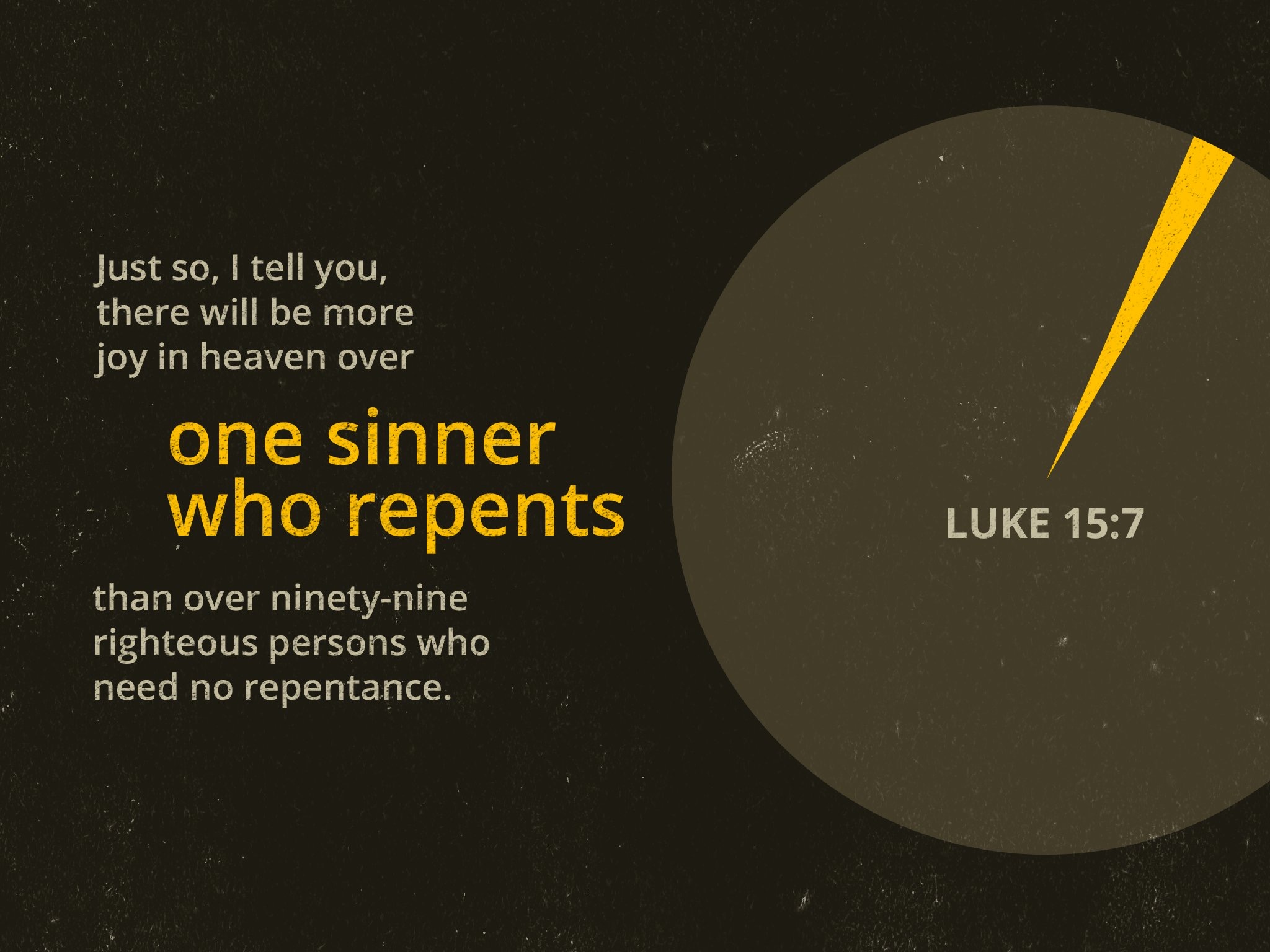
Dear saints, God does not expect you to become like the ninety-nine righteous persons who need no repentance (Lk. 15:7) or like the nine coins that never get lost. Those are the ones who falsely imagine they have moved beyond the need for daily repentance. Every day, you are the one. Every day, you are the lost sheep who is carried home. You are the coin He searches for diligently. And your Savior has great joy in daily seeking and restoring you.

Here, Jesus teaches that what brings joy to heaven is not your consistency or your record of good works—even though God delights in the fruit of faith. But what moves Christ and all of heaven to rejoicing is when you receive God’s forgiveness. When you believe the Absolution. When you receive Christ’s Body and Blood that forgive you and strengthen you.

Dear saints, your Savior does not merely tolerate your daily repentance, He seeks it. He gives it (Act. 11:185:312 Ti. 2:25). And He rejoices in it with exceeding joy. Amen.

The peace of God, which surpasses all understanding, will guard your hearts and minds in Christ Jesus (Php. 4:7). Amen.

Aligned – Sermon on Matthew 6:1, 16-21 for Ash Wednesday

Matthew 6:116-21

In the name of Jesus. Amen.

I thought about starting this sermon with a question, but I’m going to start with the answer first. So, here’s the answer, “No. Absolutely, positively, definitely not!” That’s the answer. You’re probably wondering, “Ok, pastor. What’s the question?” Here it is: “Is Jesus telling us to be hypocrites here?” Again, the answer is, “No way. No how. Nuh-uh.” One of the common definitions of a hypocrite is ‘someone who says one thing and does another.’ Or we can flip the order – a hypocrite is ‘someone who does one thing and says another.’

That definition is overly simplistic because here Jesus says that when you fast you are to make it look like you aren’tfasting. And Jesus isn’t telling you to be a hypocrite. So, we should probably get better get a better, more Biblical definition of what hypocrite is. A hypocrite is someone who removes God from the equation of everything they do.

Scripture clearly teaches that everyone knows that God exists. Ro. 1:19-21 says that God has revealed Himself in the things that have been made. But instead of acknowledging God, people do not honor Him as God or give thanks to Him. The short way to say that is that atheists don’t exist. Sure, there are liars who falsely call themselves atheists. They claim to believe that God doesn’t exist, but they’re lying to themselves.

So basically, a hypocrite is someone who seeks the approval of men rather than of God. Jesus repeatedly says so here in Mt. 6. Christ says that hypocrites sound a trumpet before they give so that they can be praised by others (Mt. 6:2). He teaches that hypocrites pray so that they can be seen by others (Mt. 6:5). In this reading, our Lord says that hypocrites make themselves look gloomy and miserable when they fast so they will be seen by other people (Mt. 6:16).

In other words, hypocrites do good works. But they do those good works to get the approval of other sinners instead of God. Again, they remove God from the equation. Ultimately, hypocrisy is idolatry. It makes people into little gods. And if you do good works for people, Jesus says that you already have your reward which won’t last. But Jesus promises that if you do your good works for God, you will be rewarded by God, and that reward will be eternal treasure that will last forever (Mt. 6:4618).

With all of that said, I’m going to give you the entire sermon in one sentence. Ready? There is a spiritual benefit to the bodily practice of fasting because fasting helps align our body and soul.

Christian, you are justified and saved by grace through faith and not your works (Eph. 2:8-9). Faith is not just something that happens in your heart and that’s it. No. Faith changes everything about you. Faith changes both your soul and your body. In other words, faith is lived out. We know this because God works on you to sanctify you, to make you more and more holy.

There are two aspects of sanctification. First, sanctification comes about when the Holy Spirit comes to live in you and gives you the strength to love God and love your neighbor. Sanctification is that growth in good works and acts of love. The second side of sanctification is that the Holy Spirit gives you strength to fight against your sinful flesh. Ro. 6:12-14 puts it this way, “Let not sin reign in your mortal body, to make you obey its passions.” In other words, don’t go on sinning. Don’t let yourself to continue living in sin.

That’s where fasting comes in. You can think of fasting as practice. Just like a basketball player will run ‘crushers’ and do dribbling and shooting drills so, when they face an opponent in a game, all of those things come naturally. Fasting is like doing those drills. It gives you the endurance and discipline and skill that you need to fight against sin when it really counts.

Before I go on, I have to add this. You can’t fast when it comes sinful actions. If you’re a kleptomaniac and habitual liar, you can’t say, “I’m going to fast from stealing and lying.” No! Those are sins; don’t do them. Fasting is temporarily denying yourself and not doing things that aren’t sinful. You do that so that you know what to do when you stand face-to-face with sinful lusts and desires.

Normally, we think about fasting as not eating. That is one way to fast. When you fast from eating and your stomach growls and starts preaching to you, “Hey, you should feed me,” you say to your stomach, “You’re not the boss. Man does not live by bread alone but by every word that proceeds from the mouth of God” (Mt. 4:4Dt. 8:3). Then, instead of eating, you read Scripture or pray. That discipline helps bring your body in alignment with your redeemed and forgiven soul.

So, I would encourage you, give fasting a try. It doesn’t have to be giving up food. Use your God-given wisdom to pick something that you regularly do and don’t do it for a certain amount of time. Let me give you a few possible examples:

Maybe, you decide that you won’t go on YouTube or social media for a few days, or you decide to limit yourself to a certain amount of time on those apps each day, or only during a certain window of the day. You get to pick. Then, when you have the desire to go on them outside of your window, read your Bible or pray or sing a hymn instead.

Maybe, you decide to give up watching a news program for a while. Instead of watching it, read the Psalms to remind yourself that God is in control. This will help you learn that the world won’t fall apart just because you don’t know what’s going on. Use that time to pray for our leaders.

Maybe, you normally listen to something on your headphones while you’re plowing snow. Instead of doing that, meditate on a passage of Scripture. Maybe, you set your alarm 15 minutes earlier and deny yourself that bit of sleep to pray for your family and friends or text them a Bible verse.

The possibilities are endless. By doing those things, you train your body and mind and bring them into alignment with your redeemed soul. You gain self-control and see that you have the strength to fight when you have desires that are actually sinful.

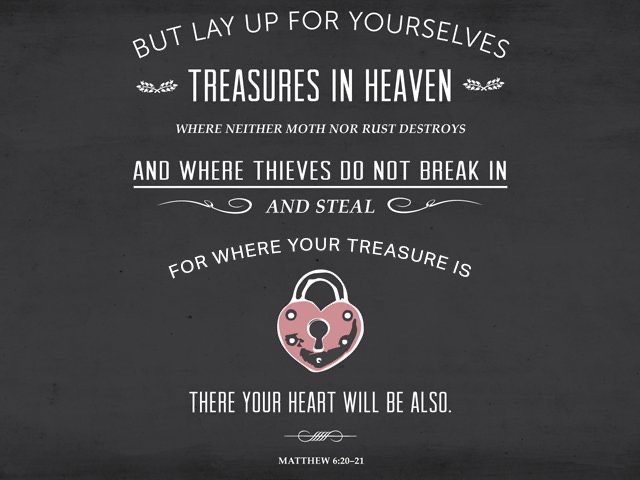
Yes, keep your fasting secret, but remember that Jesus promises that your heavenly Father sees your fasting and will reward you. In other words, fasting lays up treasures in heaven for you. And where your treasure is, there your heart will be also (Mt. 6:21).

Dear saints, know this – God loves you whether you fast or not. He has come to win your forgiveness and salvation, and His work is finished, complete, and perfect. Certain of that restored relationship with God, know that you are His, and you are free. Free to spend your life on things that matter. Free to store up eternal treasures in heaven. 

And your Savior freely invites you now to His table to receive the greatest treasure of His Body and Blood given and shed for you for the forgiveness of all your sins. Amen.

The peace of God, which surpasses all understanding, will guard your hearts and minds in Christ Jesus (Php. 4:7). Amen.

The Word Among Us – Sermon on John 1:14-18 for Midweek Advent 3

John 1:14-18

In the name of Jesus. Amen.

Moses saw some amazing, glorious things during his lifetime. It began when he was an 80-year-old shepherd for his father-in-law. Moses saw and talked with God at the bush that burned but wasn’t consumed (Ex. 3:1-2). When Moses approached the bush, God told him to remove his sandals because he was standing on holy ground (Ex. 3:5), so Moses hid his face because he was afraid to look at God. Rightly so.

Later, as we heard in tonight’s Old Testament reading (Ex. 33:18-34:8), Moses got a lot bolder than he was back at the burning bush. He asked to see God’s glory. God agreed but with a big caveat. “Ok, Moses, I’ll let you see all My goodness and will proclaim My name, Yahweh, before you. But you cannot see My face, for man shall not see Me and live.” In short, God’s presence is dangerous for fallen mankind. God has to hide His glory from sinners. So, God put Moses in the cleft of a rock and shielded Moses with His hand. And God only removed His hand after He had passed by so Moses could see His back.

There in the cleft of the mountain, God revealed Himself. But even better than that, God proclaimed and defined what His name means, “Yahweh, a God merciful and gracious, slow to anger, and abounding in steadfast love and faithfulness.” Moses was the only human on the mountain when he saw God’s glory (Ex. 34:3) because God had something better in mind for how to reveal Himself to His people.

Shortly after God appeared to Moses, God’s people constructed the Tabernacle. God had told them build the Tabernacle so He could dwell among them (Ex. 29:45-46Lev. 26:11-12). God needed to contain His holiness and glory in a way that His people could approach Him without being destroyed. That is why the Tabernacle was constructed the way it was. For God to dwell among His people, the priesthood, the sacrifices, the blood, the incense, and all sorts of offerings were required.

Even with all the safeguards of the Tabernacle, it was only on one day out of the year, the Day of Atonement, that the high priest, and only the high priest, could enter the Holy of Holies where God dwelled. And even then, the high priest would have to change his clothes fourteen times, wash himself almost 10 times, and offer dozens of sacrifices to safely approach the awesome, holy glory of God. That’s the theology of the Tabernacle. Yes, God wanted to dwell with His people, but they needed protection from His holiness and glory so they wouldn’t be consumed.

But now, here in John 1:14, John says, “the Word became Flesh and dwelt among us.” Now, the Greek word translated ‘dwelt’ is skēnē, which literally means ‘tabernacled.’ “The Word became flesh and tabernacled among us.” Because of this fact, we can truthfully sing, “Veiled in flesh the Godhead see; / Hail th’ incarnate Deity, / Pleased as Man with man to dwell; / Jesus, our Immanuel.” And this is the wonder of all wonders.

The Incarnation, the fact that God became one of us, is how God reveals Himself and His glory to us. Yes, God wraps Himself in flesh, but He wraps Himself in a different way than how you use wrapping paper. When you wrap your gifts, you are trying to keep the gift a secret from the person you are giving it to until he or she opens it. Once they tear the wrapping paper off the gift, the gift isn’t a secret anymore. The Incarnation isn’t like that – it isn’t a secret. Instead, it’s a mystery. And the difference between a secret and a mystery is that a secret is no longer a secret once it is revealed. A mystery is different. A mystery remains a mystery even after it is revealed, and the more you think about a mystery the more mysterious it becomes.

The Eternal Word wraps Himself in flesh so He can tabernacle and dwell with you. In Col. 2:9, Scripture says, “In [Christ] the whole fullness of the Deity dwells bodily.” Jesus does this so you can see and behold His glory, glory as of the only Son from the Father. And this Eternal Word who tabernacles with you is full of grace and truth.

Back in our Old Testament reading, God proclaimed that He is the God who abounds “in steadfast love and faithfulness.” Without getting into too much grammar and vocabulary stuff, that is very phrase – ‘steadfast love and faithfulness’ – that John is picking up when he says that Jesus is “full of grace and truth.” But notice the difference here in Jn. 1. Jesus doesn’t just proclaim that He abounds in grace and truth like He did when Moses was safely nestled in the cleft of the rock. No. Now in Christ, God reveals it.

The Eternal Word humbled and emptied Himself by being born in the likeness of men. God came in human form and became obedient to the point of death, even death on a cross (Php. 2:8). And from the fullness of Christ’s grace and truth, you receive grace on top of grace (Jn. 1:16).

Dear saints, Jesus makes God known. He reveals what God thinks of you. He gives you His grace, and on top of that, He gives you more grace, and more grace, and more grace…

I want to close these Advent services pondering that:

In our normal, human lives, growing up and maturing is a gradual shift from dependence to independence. When you’re born you are totally dependent on others doing things for you – feeding, cleaning, clothing, sheltering, protecting, etc. And as you grow, you become more independent. You don’t need others as much because you can do it yourself.

Spiritual growth is the opposite. Growing and maturing in faith is becoming more and more like a child (Mt. 18:3-4). Being a stronger Christian is learning that you are needy, learning that you need to borrow all that you are and all that you have from Jesus. Dependent upon Him, you receive grace upon grace from His fullness. That is how you mature as a believer. You receive from Him more and more.

That is precisely why the Eternal Word became flesh. He did it so He could dwell with you. So He could live for you. So He could die for you. So He could rise again for you. So He could ascend into heaven and rule over all creation for you. So He could forgive you. So He could give you His mercy. So He can give you grace upon grace. And so you could live and reign forever and ever with Him. Amen.

The peace of God, which surpasses all understanding, will guard your hearts and minds in Christ Jesus (Php. 4:7). Amen.

Moved Up – Sermon on Luke 14:1-11 for the Seventeenth Sunday after Trinity

Luke 14:1-11

1 One Sabbath, when he went to dine at the house of a ruler of the Pharisees, they were watching him carefully. 2 And behold, there was a man before him who had dropsy. 3 And Jesus responded to the lawyers and Pharisees, saying, “Is it lawful to heal on the Sabbath, or not?” 4 But they remained silent. Then he took him and healed him and sent him away. 5And he said to them, “Which of you, having a son or an ox that has fallen into a well on a Sabbath day, will not immediately pull him out?” 6 And they could not reply to these things. 

7 Now he told a parable to those who were invited, when he noticed how they chose the places of honor, saying to them, 8 “When you are invited by someone to a wedding feast, do not sit down in a place of honor, lest someone more distinguished than you be invited by him, 9 and he who invited you both will come and say to you, ‘Give your place to this person,’ and then you will begin with shame to take the lowest place. 10 But when you are invited, go and sit in the lowest place, so that when your host comes he may say to you, ‘Friend, move up higher.’ Then you will be honored in the presence of all who sit at table with you. 11 For everyone who exalts himself will be humbled, and he who humbles himself will be exalted.”

In the name of Jesus. Amen.

Everyone is religious. Everyone has a belief in what is good and right and true as opposed to what is evil and wrong and false. And in the end, there aren’t hundreds of religions. There are only two. One is true. The other is false. And we can put a title on each of these religions: the true religion of the Gospel of Jesus Christ, and the false religion of the law.

The true religion of the Gospel is faith in our Lord, Jesus Christ, who is the Way, the Truth, and the Life (Jn. 14:6). This true religion believes that God is merciful. It believes that we are made right with Him because of the cross. It believes God is gracious and forgives us despite our sin against His good and holy Law. The false religion of the law wrongly imagines that we have to reconcile ourselves to God by our own works and efforts. Even though the false, pagan religions of Hinduism, Islam, Buddhism, etc. – those all serve false gods instead of the true God. But they all operate in the same manner and under the same premise. And that premise boils down to this: You need to work yourself out of the messes of this world.

In this Gospel reading, it’s that false religion of the law that Jesus is attacking because that is the religion these Pharisees. They have placed the full weight of their trust in the idea that they can make themselves right with God and the world. But their religion is weaker than a house of cards.

Before we continue, one thing needs to be crystal clear. The Pharisee heresy isn’t exclusive to Pharisees. It’s a heresy that’s in all of us. It’s our default operating system because of our sinful nature. Normally, when we think about our sinful nature, we think of it as the part of us that drives and moves us toward sinful actions. And that is true, our sinful nature certainly does that. But it does more than just that. Our sinful nature also invents our own standards, morals, and commandments that are simpler than God’s standard of total, complete perfection.

This is why the Pharisees invented and added all their extra laws to God’s Commands. For example, the Pharisees took the 3rdCommandment, “Remember the Sabbath day to keep it holy,” and because they believed in their false religion of the law, they figured, “Let’s really get after keeping the Sabbath holy to make God happy with us.” So, they added all sorts of extra rules and regulations. They decided you could only walk 2,000 cubits (or about two-thirds of a mile) on the Sabbath because walking further than that would be considered the work of travel. In a futile effort to please God, Pharisees debated if it was ok to walk in the rain on the Sabbath because if you got rain on your clothes and went inside, that could be considered the work of delivering water. I don’t know anyone who drinks water from rain-soaked clothes. I wonder why they didn’t consider walking in rain on the Sabbath the work of doing laundry.

But they would also come up with all sorts of ways to get around their additional Sabbath laws. So, with the 2,000 cubit limitation on walking, they decided that, if you considered the whole town your home, then you could walk as far as you wanted so long as you stayed in town. They decided that if you walked in the rain on the Sabbath, you could just take off your clothes before you entered your house and leave them outside because then you weren’t delivering water. Can you imagine that? “Honey, I’m home.”

Now, we can laugh at how ridiculous this is because – it is. But we do the same sorts of things. Christ is clear that, when we get angry, it is the same as murder (Mt. 5:21-22). But rather than repent of our anger and receive God’s forgiveness, we do all sorts of mental gymnastics to try to justify our breaking of the 5th Command. But the Pharisee inside each of us also does something even worse. When our conscience still bothers us because of our sin, when it isn’t quieted by our mental justification of that sin, we recruit. We recruit and gather others around us. We tell them about whatever it was that made us angry – usually, in a way to make our anger seem right and just. We do that because we want others to confirm and affirm our sin. But it doesn’t matter if you could get the entire world to agree with you. God doesn’t care about the consensus you build, no matter how large it is. If God says it’s sinful, it’s sinful. Period. End of story.

Now, all of that was to build to this point: Dear saints, God’s view of what is right or wrong, what is good or bad, and what is holy or evil – that’s the only opinion that matters. That is what Jesus is getting at in this text – especially with the parable He tells in v. 8-11.

This parable isn’t like any other parable that Jesus tells. In fact, it is so unique that it won’t appear in most lists of Jesus’ parables that you can find. But Luke clearly calls it a parable in v. 7, so a parable it is. I would guess that the confusion about it being a parable stems from the fact that, at face value, it’s an etiquette lesson of how to be a good guest at a wedding feast. Basically, don’t automatically sit yourself in a place of honor because the host might see someone who is more important than you. Then, the host is going to tell you to sit somewhere else and give the more important person the seat of honor. If that happens, you’ll end up sitting somewhere obscure because all the other good seats are taken. Instead, Jesus says to sit in a low, undesirable place so the host can honor you saying, “Hey, friend. You deserve better. I’m going to move you up here.”

Again, this is just good, wise advice. But this advice is also a parable because there is a deeper theological truth here. Discovering that truth hinges on one thing. In this “etiquette parable” whose opinion matters? The host’s. Only the host’s. It doesn’t matter if everyone else at the wedding feast thought you were the most important person there. If the host tells you another guest gets the seat of honor, it’s his feast. So, the other guy gets it.

Here’s the point. Don’t move yourself up. Instead, be moved up by God. In that parable, the host is God Himself. His opinion of you and your honor – that’s the only thing that matters. So, there are times where you have to tell the little Pharisee inside of you to shut up and stop trying to clamor for honor and recognition and accolades. The opinions of others (and even your own opinions), they don’t matter (1 Co. 4:3-5). And Jesus, the Son of God, clearly tells you what He finds honorable and shameful in the last verse of this reading. “Everyone who exalts himself will be humbled, and he who humbles himself will be exalted” (Lk. 14:11).

If you are trying to exalt yourself and be impressive by your self-chosen good works, it isn’t going to go well for you. God is going to come into the banquet hall and say to you, “No. You don’t get to sit here.” And where will that leave you? Ultimately, it’ll leave you outside and in the darkness (Mt. 22:13). Instead, sit in the lowest seat, and don’t worry if others ask, “What are you doing there? Why are you putting up with that lowly, humiliating spot?” Don’t worry about being in positions that others think are shameful. God the Host is going to come Himself and say, “Friend, why are sitting way down here? Move up higher.”

One of the things Jesus is doing with this parable is He’s giving you God’s perspective on your simple, normal, everyday callings and vocations and works. Don’t ever forget that God is the One who has put you in those vocations and given you those works. Even if they don’t look flashy or impressive to the world, they are exactly the places where God has put you and given you holy work to do. If you stop and think about it, what higher seat is there than the seat God gives you?

To understand this better, imagine two people. The first is a devout monk who has abandoned the world to live a life of holiness. He takes a vow to get up every night at 2 AM and pray for three hours. Every night, this monk deprives himself of sleep; goes into a chapel to burn incense; lies face-down on a stone floor; and earnestly prays. The second person is a mom. At 2 AM, she gets woken up by the cries of her newborn because he’s sick with a stuffed, runny nose and has a full, stinky diaper. Exhausted, she stumbles around the room. She gets her hands into the snot and poop. She cleans and comforts and feeds the child. And she spends hours to finally rock him back to sleep.

Both of them are getting up at 2 AM. Both are doing work instead of sleeping. But which one is more holy, exalted, and honorable – the monk who chose to take that vow? Or the mom who received her child from God Himself? Of course it’s the mom.

Think of Paul in today’s Epistle reading (Eph. 4:1-6). In v. 1, he wrote, “I therefore, a prisoner…” I mean how low can you get? Paul is there in prison – rats running across his feet, muck oozing down the walls, mold in the air. And Paul writes, “I a prisoner for the Lord, urge you to walk in a manner worthy of the calling to which you have been called.” Paul recognized that, even in prison, he’s the Lord’s prisoner. It wasn’t Caesar or a king or a governor. God put him there. And if God, his loving heavenly Father, put him there, what better or more honorable place could there be?

Dear saints, the religion of the Gospel is the only thing that moves you up. You don’t need all the Pharisaical nonsense that vainly tries to get God to clap for you and give you accolades. One, it’s not going to work. And two, God has already given you important, holy works to do. Those works are pleasing to Him; those works show your love for Him by showing love for your neighbor. 

So, walk in a manner worthy of the calling to which you have been called. And you’ve been called God’s friend. God’s saints. God’s holy ones. God’s children. The work God gives you is worthy and holy. So, do that work with all your might.

Dear saints, you have the true religion which is faith that God is the One who moves you up. Not yourself. Not ever yourself. You are moved up, exalted, and honored by the holy and righteous God who calls you, “Friend.” And He calls you, “Friend,” solely because of what Christ has done on the cross for you. Amen.

The peace of God, which surpasses all understanding, will guard your hearts and minds in Christ Jesus (Php. 4:7). Amen.
Live Man Walking – Sermon on Ephesians 2:1-10 for the Eleventh Sunday after Trinity

Ephesians 2:1-10

1 And you were dead in the trespasses and sins 2 in which you once walked, following the course of this world, following the prince of the power of the air, the spirit that is now at work in the sons of disobedience— 3 among whom we all once lived in the passions of our flesh, carrying out the desires of the body and the mind, and were by nature children of wrath, like the rest of mankind. 4 But God, being rich in mercy, because of the great love with which he loved us, 5 even when we were dead in our trespasses, made us alive together with Christ—by grace you have been saved— 6 and raised us up with him and seated us with him in the heavenly places in Christ Jesus, 7 so that in the coming ages he might show the immeasurable riches of his grace in kindness toward us in Christ Jesus. 8 For by grace you have been saved through faith. And this is not your own doing; it is the gift of God, 9 not a result of works, so that no one may boast. 10 For we are his workmanship, created in Christ Jesus for good works, which God prepared beforehand, that we should walk in them.

In the name of Jesus. Amen.

“Dead man walking!” That phrase originated just over 100 years ago. It was called out when a death-row inmate was being marched through the prison halls to the execution chamber. When that phrase was shouted, the inmate was, obviously, still alive, but he was as good as dead. The inevitable was soon to happen, and judgment would be carried out. Imagine how lonely that soon-to-be-executed inmate would feel hearing that phrase, “Dead man walking.” Yes, he is still breathing, still has a beating heart, still alive, and still a part of humanity. But his demise is mere moments away.

Here, in the first three verses of this text, Paul might as well be calling out, “Dead man walking!” about each of us as he describes our former life in sin. Because of our sin, every one of us was marching to our imminent demise. Hopeless, doomed, and lonely.

God created us in such a way that we are connected to each other. We have all blossomed from the root of Adam. Since the poison of sin ran through his veins, it has spread through the entire plant of humanity. And it isn’t just the fact that you and I inherited Adam’s sin and are charged with a crime that he committed. No. We all willingly march straight forward into the deadness and rebellion against God that we have inherited from Adam.

We do not become sinners by sinning. We sin because we are, by nature, sinful and unclean. We sin against God in our every thought, word, and deed. We were born revolting and fighting against every notion that we should submit ourselves to the will of God, against every idea that we should serve our neighbor. In other words, we fight against what God created us to be. That’s a losing proposition. And yes, our life in sin is that broad road that has been traveled by every member of the human race. But it is still a long, lonely road.

But – that word can be so beautiful – “but God, being rich in mercy, because of the great love with which he loved us, even when we were dead in our trespasses, made us alive” (Eph. 2:4-5). God saw our lonely, helpless, hopeless state, and, in His great love for us, He did something about it. God be praised!

The ESV does a very good job with its translation here through v. 5-6; I just want to highlight it a bit further. Notice all the withs in v. 5-6. God, because of the great love with which He loved you, has made you alive together with Christ, raised you with Christ, and seated you with Christ in the heavenly places. God saw your situation, and He has joined you to and with Jesus. Now, you are alive with, raised with, and seated with your Redeemer and Savior who is the Lord and King of all creation.

Your place in heaven is secure because what is true of Christ is now true of you who have become incorporated into and joined with Him. Dear saints, Jesus became what you are, so that He could make you what He Himself is (St. Irenaeus).

Because of Jesus, no longer are you a lost, lonely “dead man walking.” Now, you are a “live man walking.” All this is yours by God’s grace, through God-given faith. It isn’t because you have made the right sacrifices or have done enough good works. It isn’t because of your efforts, your desiring, your deserving, your trying, or even your deciding. Nope! It isn’t because of your actions or work at all.

It’s only because God has worked faith in you so that you now cry out, “God be merciful to me, the sinner” (Lk. 18:13). Through Jesus, God Himself has made you alive with Christ, raised you with Christ, and seated you with Christ. Normally, when Scripture talks about Christ being seated, it adds that He is seated at God’s right hand. Over and over again, it does this (Ps. 110:1Mt. 26:64Mk. 14:6316:19Act. 7:56Ro. 8:34Eph. 1:20Heb. 1:3).

That’s why, when we confess the creed (either Apostles’ or Nicene), we confess that Jesus is “seated at the right hand of God the Father [Almighty].” But notice here in v. 6 that when Paul announces that you are seated with Christ, he doesn’t add the phrase “at God’s right hand.” That is because God’s right hand isn’t so much a place or location. Instead, it is a position of authority and honor.

Christ has been raised from the dead and has ascended into heaven where He is seated at God’s right hand with all power and authority in heaven and on earth. You are seated with Christ in the heavenly places, and yet you remain here on earth – but still in a position of authority because you are seated with Christ. No, you aren’t all-powerful or everywhere-present like Jesus. But, you do have a share in His authority as you live here on earth. Christian, you have risen with and are seated with Christ not in such a way that you are removed from this world. Instead, you are exalted here – in this world, in this life – with the divine honor of being God’s child.

God intentionally leaves you here to exercise that authority in His creation through your good works. That’s why God has prepared those good works for you to walk in. And – this needs to be abundantly clear – the good works that God has prepared for you to walk in are not some secret thing that God hasn’t revealed to you. You don’t have to go around searching for these good works as though they are hidden. These good works are all around you. And you find them in the people that God puts right, smack dab in front of you.

You have been raised from your deadness in sin to be living men who walk in the love for both God and your neighbor that He created you to have. God has made you His ‘workmanship,’ His work of art, shining His light in a dark, evil, lonely world that is following the prince of the power of the air.

God has made you alive, raised, and seated you with Jesus so that in the coming ages He can show you the immeasurable riches of His grace in kindness toward you in Christ Jesus.

I just have to say here that a text as beautiful and full and rich as this one is barely needs anything added to it. You can just read it over and over and it is enough. But let me preach a little more and change gears here:

The shooting this past Wednesday at Annunciation Catholic School in Minneapolis that left two dead and 18 wounded is a sober reminder to us: this world is very, very evil. The devil, the prince of the power of the air, is constantly at work in the sons of disobedience (Eph. 2:2). Satan along with his demonic forces of evil constantly tempt everyone to live out the passions and desires of our flesh, and it often appears to us as though the devil’s reign of evil has no limits. But God doesn’t and won’t let the devil roam unchecked (Job 1:10122:6Mt. 12:29Col. 2:15).

Even though it seems as though we are entering into a new era of martyrdom in our country and that the persecution of Christianity is increasing and inevitable, God has not given Satan free reign. Jesus is still on the throne and the Head of all things (Eph. 1:22). Jesus is still in control – even in this dark age (Eph. 1:21). Whatever the future holds, God’s grace is, and will remain, constant.

God does not change. He knows what He is doing, and He uses martyrdoms, as painful as they are, for good (Ro. 8:28).

God has delivered those two saints, those two young martyrs, to Himself in mercy, and they are free. God has also made them an example to us that some things are more precious and valuable than living. May God, in His mercy, give us all a measure of their spirit.

We were dead, but now we are alive because of God’s grace given to us by faith. Jesus Himself is our risen and living Savior. Even if we die, we live because Jesus lives, and in Him we live too. Amen.

The peace of God, which surpasses all understanding, will guard your hearts and minds in Christ Jesus (Php. 4:7). Amen.

Pause – Sermon on Luke 18:31-43 for Quinquagesima Sunday

Luke 18:31–43

31 And taking the twelve, he said to them, “See, we are going up to Jerusalem, and everything that is written about the Son of Man by the prophets will be accomplished. 32 For he will be delivered over to the Gentiles and will be mocked and shamefully treated and spit upon. 33 And after flogging him, they will kill him, and on the third day he will rise.” 34 But they understood none of these things. This saying was hidden from them, and they did not grasp what was said. 

35 As he drew near to Jericho, a blind man was sitting by the roadside begging. 36 And hearing a crowd going by, he inquired what this meant. 37 They told him, “Jesus of Nazareth is passing by.” 38 And he cried out, “Jesus, Son of David, have mercy on me!” 39 And those who were in front rebuked him, telling him to be silent. But he cried out all the more, “Son of David, have mercy on me!” 40 And Jesus stopped and commanded him to be brought to him. And when he came near, he asked him, 41 “What do you want me to do for you?” He said, “Lord, let me recover my sight.” 42 And Jesus said to him, “Recover your sight; your faith has made you well.” 43 And immediately he recovered his sight and followed him, glorifying God. And all the people, when they saw it, gave praise to God.

In the name of Jesus. Amen.

Generally, when we let our imagination go wild, we like to be the heroes. Boys imagine hitting a grand slam in Game 7 bottom of the 9th two outs down by three, or they imagine they are the receiver who dives to catch the hail Mary as time expires to win the Super Bowl. Girls imagine they are Cinderella dancing the night away with Prince Charming, and getting engaged after he returns her glass slipper. Even when it comes to Bible stories, we like to imagine that we are Joshua toppling the walls of Jericho or David slaying Goliath or Elijah defeating the prophets of Baal.

In the two parts of today’s text – the Passion prediction and the healing of the blind man – the only hero is clearly Jesus, and He fully embodies the perfect love that was described in our Epistle reading (1 Co. 13:1-13). This is the third time Jesus explains to the disciples that He is going to Jerusalem to be betrayed, mocked, shamefully treated, spit upon, flogged, crucified, and raised from the dead. But the disciples don’t understand Jesus, the saying is hidden from them, and they could not grasp what Jesus said.

Still, Jesus’ love is on full display. Jesus is patient with and kind toward them. He is not irritated or resentful at their thick skulls. Jesus is going to Jerusalem and will endure all these things because His love does not insist on its own way. Instead, Christ submits to His Father’s will in perfect obedience.

By going to the cross, Jesus will bear all things. All the burdens, all the sins, all the transgressions, all the iniquities, all the wrongdoings, all the evil, all the brokenness of this fallen world – Jesus will bear all of it in His body (1 Pet. 2:24). He does it all for you. Jesus’ journey from His throne in heaven, down into your flesh. His fasting and temptation in the wilderness. His path through the lands of Israel with no place to lay His head (Lk. 9:58). His teaching, healing, casting out demons, forgiving, and restoring. His triumphal entry. His betrayal. His suffering. His death. His burial. His three day rest in the tomb. His resurrection. His ascension. And His continual rule and authority over all things is a journey of love for you.

Jesus’ entire work is directed outward. He didn’t need to do any of that to benefit Himself, and He doesn’t do it for His own, personal gain. He does it because He loves you. And this love of Jesus wasn’t based on your loveliness. It was based on the fact that the God the Father loves you and wanted to rescue you. So, Jesus, God the Son, loved you and did everything necessary to save you.

God hated seeing what sin and death had brought to His creation, so He did something about it by undoing sin and death by the death and resurrection of Jesus. Christ lived the life we were unable to live. He obeyed the whole will and Law of God that we were unable to obey. He took up His cross, endured punishment that you and I deserved, and gave up His dying breath. All of this is done for you.

Jesus does all of this with full knowledge. None of it surprised Him. Christ knew exactly what is going to happen to Him. And still, He goes and does all of this to love you with His perfect, pure love. 

Back in Lk. 9:51, we are told that Jesus had “set His face to go to Jerusalem.” In other words, Jesus is determined to do this loving thing for you. He was focused on redeeming creation, on getting there, and accomplishing it. He goes toward Jerusalem in love.

Day after day, Jesus gets closer to His goal until He arrives in the city of Jericho, which is about fifteen miles from Jerusalem. He’s close – about a day’s journey from the city. But Jesus isn’t in a rush. Sometimes, when you have to do things that you know are going to be unpleasant and painful, you just want to get it over with and put in your rearview mirror. Again, Jesus doesn’t do that. Instead, He paused along His way through Jericho.

Christ hears the blind man’s cry, “Son of David have mercy on me.” Jesus doesn’t say, “I’ve got more important things to do. I’m going to have mercy on you when I get to Jerusalem and go to the cross.” No. Our Lord stops.

The cry for mercy from any corner of His creation gets Jesus’ full attention. He commands that the blind man be brought to Him. Jesus asks him, “What do you want Me to do for you?” “Lord, let me recover my sight.” And in love, Jesus gives the man the mercy he desired. “Recover your sight; your faith has made you well.”

Jesus’ mission to be the Savior of all creation does not stop Him from pausing to give His mercy to the individual He meets along the way. He pauses and heals him.

Dear saints, Lent begins on Wednesday, and Lent is a good time for us to pause and consider all that God has done for us. Today, pause and ponder whom you are most like in this text. Again, we’re not the hero; we’re not Jesus. Instead, sometimes, we’re like the disciples who do not understand or grasp what God is doing for us and saying to us. Sometimes, even though God has plainly and clearly spoken, we are blind and don’t understand what God is doing.

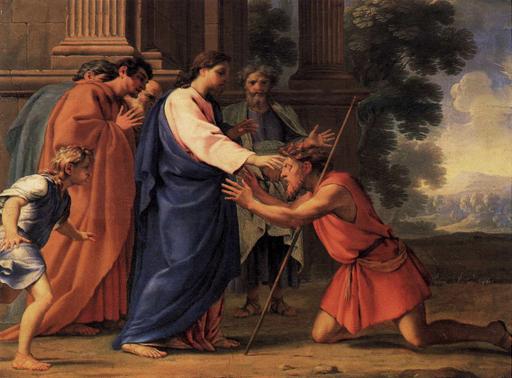
Sometimes, we are broken like the blind man. Even though the blind man could not see with his physical eyes, he understands who Jesus is and what He has come to do. Despite his physical blindness, he has faith that Jesus can and will restore what is broken. So, when Jesus is present, he cries out for mercy. And Jesus gives him the mercy, restoration, and healing that he needed. Maybe, like the blind man, you look foolish to the world how you relentlessly call out to Jesus for His mercy.

Whom are you more like? It probably depends on the day, maybe even the moment.  Whether you don’t have any clue of what God is up to like the disciples or whether all you can do is cry out for mercy, the thing to do is follow Jesus.

Notice that even though the disciples don’t get all the things that God had said through Jesus and through the Scriptures, even though they are blind in their hearts and minds – what do they do? They go with Jesus. They follow Him to Jerusalem and the cross. The blind man, even though he could not see anything until Jesus gave him the sight he desperately wanted, what did he do? He followed too.

Whether you understand what God is up to or not, the conclusion is the same. Follow Jesus. Follow Him to the cross. No matter where you are in your journey through life, no matter how much you understand what God is doing, no matter how much you need from God, no matter how much God has already given you, follow Jesus to the cross.

Stay the course. And as you go with Christ, He will give you ample reasons to glorify God and give Him praise. Amen.

The peace of God, which surpasses all understanding, will guard your hearts and minds in Christ Jesus. Amen.

A Fresh Look – Sermon on Matthew 20:1-16 for Septuagesima Sunday

Matthew 20:1–16

1 “For the kingdom of heaven is like a master of a house who went out early in the morning to hire laborers for his vineyard. 2 After agreeing with the laborers for a denarius a day, he sent them into his vineyard. 3 And going out about the third hour he saw others standing idle in the marketplace, 4 and to them he said, ‘You go into the vineyard too, and whatever is right I will give you.’ 5 So they went. Going out again about the sixth hour and the ninth hour, he did the same. 6 And about the eleventh hour he went out and found others standing. And he said to them, ‘Why do you stand here idle all day?’ 7 They said to him, ‘Because no one has hired us.’ He said to them, ‘You go into the vineyard too.’ 8 And when evening came, the owner of the vineyard said to his foreman, ‘Call the laborers and pay them their wages, beginning with the last, up to the first.’ 9 And when those hired about the eleventh hour came, each of them received a denarius. 10 Now when those hired first came, they thought they would receive more, but each of them also received a denarius. 11 And on receiving it they grumbled at the master of the house, 12 saying, ‘These last worked only one hour, and you have made them equal to us who have borne the burden of the day and the scorching heat.’ 13 But he replied to one of them, ‘Friend, I am doing you no wrong. Did you not agree with me for a denarius? 14 Take what belongs to you and go. I choose to give to this last worker as I give to you. 15 Am I not allowed to do what I choose with what belongs to me? Or do you begrudge my generosity?’ 16 So the last will be first, and the first last.”

In the name of Jesus. Amen.

What is the greatest gift given in this parable?

At first glance, we think that it’s the denarius, that full day’s wage, handed to the workers who showed up last. But that’s the wrong answer. All the workers – those who were hired at the eleventh hour, the ninth hour, the sixth hour, the third hour, and right way at daybreak – they all get the same coin. It looks like the later you come, the greater the gift you receive. We think the only ones who don’t receive a gift are those who worked all day. They simply get what they had agreed to, what they bargained for – an honest day’s wage for an honest day’s work. But the denarius is not the greatest gift in the parable.

The greatest gift is a place in the vineyard. All of these workers – no matter what time of day they were hired – all of them started out in exactly the same place. They were all stuck in the marketplace with no prospects, no future, no income. None of them had anything until the master came to call them into his vineyard.

None of the workers got into the vineyard on their own. All of them knew they needed work to provide for their families. But they had no shot at that until the master called them into his vineyard. Before the master called them, they apparently didn’t even know there was a vineyard or how to get there, otherwise they could have gone to his house, knocked on the door, and asked for work. But that’s not what happens. Instead, the owner comes to them, seeks them, finds them, and promises to give them what they need. It’s the master who brings them all of them in. So, into the vineyard they all go – each at the time of day when the master called – not one moment before, not one moment after.

Back up just a bit and imagine the thought process of the workers hired first. They went to the marketplace because, in that part of the world in Jesus’ day (and still today), people who didn’t have normal, secure, regular jobs, they would gather at a certain spot in the marketplace in hope of being hired. Again, the people who were hired at the beginning of the day had nothing, no money, no job, no prospects. So, as the sun rises and as they march toward the vineyard, they’re excited about the master’s promise of an honest day’s pay for an honest day’s work. That promised denarius motivated them. Throughout the day, all of their work and toil and enduring all the heat and sweat was tolerable because that denarius meant life for each of them and for their families.

The only thing that spoiled it, the only thing made that denarius unappealing, was the fact that others also received the denarius. Seeing others get the same denarius was the only thing that robbed those first workers of their joy in the denarius. To say it bluntly: comparison is the thief or joy.

Imagine a company has two positions open. You apply and are given one of the positions, and you love everything about your new job. You like the environment, your coworkers, and $100,000 per year compensation. But then, you find out that the person hired for the other position – who is doing the same job, working the same hours, and has the same experience as you have – imagine finding out that person makes $101,000. How would that change your perception of your job and salary? If you’re selfish like me, I’m sure your attitude would change. You’d feel cheated. You’d complain. It’d ruin your whole perception of your new job. But here’s the thing: nothing has actually changed. Your paycheck didn’t diminish. The environment around you didn’t get worse. Nothing has been taken from you. You haven’t lost anything. The only thing that has changed is your perception. Someone else has gotten something that you don’t think they deserve. Repent.

Dear saints, God’s grace isn’t only for you. It is certainly given to you, but you aren’t the only one who gets or needs it. Please, please don’t be so foolish as to demand that God give you what you deserve because what you deserve is an eternity in hell. God doesn’t want to give you what you deserve. He wants you to be in His vineyard. And, yes, He has work for you to do there.

Look again at v. 12-15. When the workers hired first grumble about their denarius and all the hard work they did in the scorching heat, the master doesn’t fight or question their claim. He doesn’t diminish the work they have done. Not one bit. The only objection the master against their grumbling is that he’s being completely fair with them. His generosity doesn’t mean they were short-changed. The owner simply says, “If you don’t like my generosity, take what is yours and go. You’re free to leave my vineyard and go back to the marketplace.”

Dear saints, yes, this is a parable about working in God’s kingdom, and I titled this sermon “A Fresh Look” because we all need to be reminded that life in God’s kingdom does require work. God’s call to be a Christian is a call to much work. Jesus says, “If anyone would come after Me, let him deny himself and take up his cross and follow Me” (Mt. 16:24). That calling from your Savior is a call to work. But there is so much joy in your work in God’s kingdom. That’s not to say that all of the work is pleasant and easy.

Dear saints, there are many things in this world that require work, but the work itself is good. There is work, there is labor, there are difficulties involved in all good things. For example, being a parent is work – a lot of work, and even a lot of unpleasant work. Parents have to get up in the middle of the night, change poopy diapers, suck snot out of the noses of the babies. I don’t know anyone who thinks those things are pleasant or anyone who enjoys doing those things. But none of those things mean the baby isn’t a delight or a joy to be around. And there is blessing in doing them. People are happier and more content when they give of themselves and serve others. Yes, the work is its own reward.

Christian, you have been brought into God’s vineyard. A vineyard is a place where there is plenty of work to be done, but the purpose is not to produce grapes. Vineyards exist to produce wine which makes glad the heart of man (Ps. 104:14-15). Life in God’s kingdom is to live where work is done, but that work culminates in joy and feasting. The whole point of your work and labor and toil in God’s kingdom is to join God in producing joy.

Dear saints, you’re going to leave here and head back to your labor, back to your work, back to the heat and sweat and toil of your God-given vocations. But before you do, God invites you to His table to feast. Come and enjoy a foretaste of the feast to come. Come and receive the joy of receiving Christ’s Body and Blood given and shed for you for the forgiveness of all your sin. Come to the feast. Then, go. God still has vineyard work for you to do. Amen.

The peace of God, which surpasses all understanding, will guard your hearts and minds in Christ Jesus. Amen.

Location – Sermon on Luke 18:9-14 for the Eleventh Sunday after Trinity

Luke 18:9–14

9 He also told this parable to some who trusted in themselves that they were righteous, and treated others with contempt: 10 “Two men went up into the temple to pray, one a Pharisee and the other a tax collector. 11 The Pharisee, standing by himself, prayed thus: ‘God, I thank you that I am not like other men, extortioners, unjust, adulterers, or even like this tax collector. 12 I fast twice a week; I give tithes of all that I get.’ 13 But the tax collector, standing far off, would not even lift up his eyes to heaven, but beat his breast, saying, ‘God, be merciful to me, a sinner!’ 14 I tell you, this man went down to his house justified, rather than the other. For everyone who exalts himself will be humbled, but the one who humbles himself will be exalted.”

In the name of Jesus. Amen.

Most of you are familiar with the phrase, “The three most important factors in real estate are – location, location, location.” A house here in East Grand Forks would probably be triple the cost if you moved it to Los Angeles County. For some reason, want to live there. I’ll gladly take winter.

A similar thing could be said about sin. The three most important factors about sin are – location, location, location. To be clear, I’m not talking about where sin is committed geographically. Speaking a lie to a massive crowd of people is just as damning as lying to yourself in your own mind without ever moving your lips. By referring to sin’s location here, I’m talking about where the sin resides. Sin has a place. Either sin is on you, or sin is on Jesus, the Lamb of God who takes away the sin of the world (Jn. 1:29).

We have this wrong tendency to think of sin as something abstract and floating around somewhere. There is no sin outside of the one who is committing it. Sin starts in the heart. Jesus says, “Out of the heart come evil thoughts, murder, adultery, sexual immorality, theft, false witness, slander” (Mt. 15:19). A sinner isn’t simply a person who commits sins. All people, besides Jesus, commit sin. Being a sinner means to be a person who is outside of God’s fellowship, outside the kingdom of God, someone who belongs with the demons. That is why we need Jesus to be the Savior of sinners. He changes the location of the sin. He removes it from the sinner as far as the east is from the west (Ps. 103:12).

Now, with that in mind, let’s consider the parable, which is about as straightforward as it gets. We’re told that the audience is people who are sinners with sin residing in them but still trusted in themselves and their own righteousness while treating others with contempt. Jesus also gives a clear conclusion to the parable, “Everyone who exalts himself will be humbled, but the one who humbles himself will be exalted.” But to get a fuller sense of what Jesus is teaching here we need to set the picture of what is going on in the parable. The people who originally heard this would have been familiar with what goes on in the Temple, but we probably aren’t.

Two men went up into the Temple, which is God’s house (1 Kgs. 8:13, 27), and they go for a specific purpose – to pray and worship. In English, we typically think of prayer as an individual thing. Sure, we will pray the Lord’s Prayer and say grace before a meal with others. But normally we think of prayer as an individual thing and worship as a corporate, communal thing. But the people in Jesus’ day had one word for both prayer and worship. These two men go to the place of worship at the same time. What kind of service are they attending?

They would have been at the Temple for the atonement offering, which was the only service that took place every day in the Temple, and it occurred twice each day – once at dawn and again at three in the afternoon. The service would begin by the altar for sacrifice. An unblemished lamb was slaughtered, and its blood was sprinkled on the altar following a precise ritual.

This sacrifice was a reminder of how God covered the sin, nakedness, and shame of Adam and his wife by providing garments of animal skins after they fell into sin (Gen. 3:21). It showed that God would accept the death of another in place of the sinner. As the atonement lamb was sacrificed, certain prayers were offered with the sound of silver trumpets and cymbals. The people would sing a Psalm. A priest would go into the Holy Place where he would offer incense, praying that the sacrifice would be pleasing to God. Then, when the priest entered the Holy Place with that incense, the people would offer their private prayers to God.

But the Pharisee’s prayer directly contradicted everything that was happening around him in the Temple. He thanks God that he is acceptable because of who he is and who he is not, what he has not done and what he has done. His prayer in that context would be like coming here on Good Friday and praying, “God, I’m sure glad I’m not like all these sinners around me who need Jesus to die for their sins.” It’s utterly blasphemous.

But the tax collector’s prayer harmonizes with the service in at least two very specific ways. First, when the tax collector prays, “God be merciful to me, a sinner,” he isn’t using the normal word for ‘mercy.’ Many times in the Gospels, we hear people with sickness, disease, or other affliction cry to Jesus, “Have mercy” (Mt. 15:22, 20:31; Lk. 18:38-39). That’s always a good prayer to ask God for blessings you haven’t earned and the relief that you don’t deserve. But the tax collector’s prayer uses a different word. We could translate his prayer as, “God, atone me. God, reconcile me. God, make me what I should be.” That’s the first way his prayer harmonizes with the service. He is praying that the atonement that is taking place there in the Temple and the sacrifice being offered would do what God had promised it would do and remove his sin from him (Lev. 4:35).

Second, his prayer harmonizes with the service because this tax collector recognizes that he is the sinner who needs atonement. He needs to be reconciled. He needs to have his sin, his shame, his guilt removed. Again, that’s precisely what that service was pointing to. That is what the tax collector looked to, and that is why he went down to his house justified.

Now, there is a danger in this parable. We know that the really good, moral Pharisee did not go home justified, but this sinful tax collector did. The danger that can arise for us then is to think that everything about the Pharisee is bad. Be careful with that. It is good and right to not be extortioners, unjust, adulterers. It is good to fast and give tithes. That is all good stuff. There is another side to the coin of the Pharisee’s prayer. We might be tempted to pray, “God, I thank You that I am not like other men, self-righteous, pretentious, holier-than-thou types, or even like this Pharisee. I’ve given You my heart, dedicated my life to You, and made You my Lord.” Do you see what that does? It locates our eyes off of Jesus – the One who atones for our sin (1 Jn. 2:2).

The location of your sin matches where you look. If you look to yourself, your sin is on you. If you look to Christ, your sin is gone, defeated, eternally removed.

Let me close with an analogy: Imagine you had to cross some terrifying span. Far below at the bottom of that span are all the things you fear most – snakes, rats, lava, rough seas, or sharks. You fill in whatever is scariest. But there is a bridge that spans that gap. What would you look to for confidence in crossing that gap? You’d look to the bridge. You’d see if it was well-built, sturdy, and strong. You wouldn’t look inward to see if you have enough confidence in the bridge. And you build confidence in the bridge by looking at the bridge.

So, dear saints, where are you looking? Are you looking toward things you have done – either good works or your own humility? If so, you should have no confidence whatsoever.

Look to Jesus. His sacrifice, His blood, His death, His resurrection is enough. Looking there, you go to your house justified by God’s sure and certain declaration. Amen.

The peace of God, which surpasses all understanding, will guard your hearts and minds in Christ Jesus. Amen.

The Gift of Time – Sermon on Luke 16:1-13 for the Ninth Sunday after Trinity

Luke 16:1–13

1 He also said to the disciples, “There was a rich man who had a manager, and charges were brought to him that this man was wasting his possessions. 2 And he called him and said to him, ‘What is this that I hear about you? Turn in the account of your management, for you can no longer be manager.’ 3 And the manager said to himself, ‘What shall I do, since my master is taking the management away from me? I am not strong enough to dig, and I am ashamed to beg. 4 I have decided what to do, so that when I am removed from management, people may receive me into their houses.’ 5 So, summoning his master’s debtors one by one, he said to the first, ‘How much do you owe my master?’ 6 He said, ‘A hundred measures of oil.’ He said to him, ‘Take your bill, and sit down quickly and write fifty.’ 7 Then he said to another, ‘And how much do you owe?’ He said, ‘A hundred measures of wheat.’ He said to him, ‘Take your bill, and write eighty.’8 The master commended the dishonest manager for his shrewdness. For the sons of this world are more shrewd in dealing with their own generation than the sons of light. 9 And I tell you, make friends for yourselves by means of unrighteous wealth, so that when it fails they may receive you into the eternal dwellings.

10 “One who is faithful in a very little is also faithful in much, and one who is dishonest in a very little is also dishonest in much. 11 If then you have not been faithful in the unrighteous wealth, who will entrust to you the true riches? 12 And if you have not been faithful in that which is another’s, who will give you that which is your own? 13 No servant can serve two masters, for either he will hate the one and love the other, or he will be devoted to the one and despise the other. You cannot serve God and money.”

In the name of Jesus. Amen.

The scam was over. His gig had been discovered. The pink slip was coming because this manager’s Ponzi scheme had been reported to his boss. Now, the rich man was going to cut ties with his crooked manager. But rather than sitting around and stewing about how everything had gone wrong, instead of denying the charges, fighting the accusations, or making excuses, the manager gets busy. His paychecks had dried up, but the manager recognized that he had something much more valuable than his salary. He had time, and he was going to use that time to his advantage.

This scoundrel manager scrambles to make sure that he’ll still have a bite to eat and a place to stay now that the gravy train had made its last stop. He calls in all the people who owed the rich man a debt. We only get to hear two of the conversations, but all of them get called in, and you can imagine those debtors were nervous and afraid as they are brought into the office one by one. No one likes calls from the debt collector.

The manager knows their fear, and he uses it to his advantage. He asks all of the debtors, “How much do you owe? Ufda. Yes, I can see why you’re worried about that. Well, I have some good news for you. I’m going to make things easier. Take that debt, and lower it.” And all these debtors leave the office with a lighter burden, feeling better about their own future, and extremely grateful toward this soon-to-be jobless manager. And he will go home at the end of the day with no job and no prospects but a lot of new friends. Of course, those friends were gotten by deception and cheating, but they had become his friends.

Now, this is probably Jesus’ most confusing parable. It’s one of only a couple times that Jesus holds up someone who does bad things as an example. Another one comes later in Luke 18:1-8 where Jesus tells the parable of the unrighteous judge who grants justice to the widow who keeps badgering him for justice. In that parable, Jesus teaches that bad people will sometimes do the right thing. But here, Jesus teaches that bad people do bad things and sometimes get good results – at least for themselves.

To help make sense of it, let’s try an analogy. If I said, “Barry Bonds hit a lot of home runs,” what would you think of that statement? Honestly, it doesn’t matter what you think because it’s true. Bonds stands alone at the top of list of all baseball players in history for hitting the most home runs. It’s undeniable. Of course, the reason he hit a lot of his home runs is that he cheated by taking steroids, but he still hit more baseballs over the fence than anyone else. But that doesn’t, necessarily, mean that other players who hit lots of home runs are cheaters. Managers will still encourage their players to hit the ball far and hard even though some do it by cheating. Jesus wants you, Christian, to be shrewd. That doesn’t mean He want you to cheat. But He does want you to be shrewd in ways that invest in the kingdom of God.

We still probably wonder, “Why wouldn’t Jesus use a different parable with a character who is more respectable to teach us to be shrewd?” Honestly, I don’t know the answer. From the rest of the Gospels, it’s clear that Jesus isn’t in favor of theft and cheating. He doesn’t approve of this guy’s stealing and dishonesty (see Mt. 5:17-37). The manager is a crook, thief, and scoundrel. But Jesus does want us Christians to imitate and emulate this manager’s shrewdness. Simply stated, it all boils down to these three ways he is shrewd: One, the manager recognizes who he is. Two, the manager recognizes he temporarily has at his disposal things that will not last or endure. And three, he knows how to use things that are slipping away to secure a future for himself. Let’s dissect each of those.

First, Jesus wants us to be shrewd like the manager and rightly recognize who we are. When the manager heard that his pink slip was coming, he recognizes that he’s about to lose all of his income and that there’s no one to blame except himself. But more importantly, he recognizes that he either can’t or won’t do certain things. He isn’t strong enough to work in construction, and he’s too ashamed to stand on a corner holding a cardboard sign with a sad story which will move people in such a way that they give him money. The guy is brutally honest with himself about himself and his situation.

Jesus wants us to have that same shrewdness. Christ wants us to recognize who we are as sinners. We do this here every week with our confession of sins. We confess that we are, by nature, sinful and unclean and have sinned in thought, word, and deed. We confess that we need to flee to God’s infinite mercy which He freely gives for the sake of Christ’s death and resurrection. It is good and right that we do that here and receive Jesus’ forgiveness which He gives to all of us through the absolution (Jn. 20:23). And it is good to confess our sins each and every day and hear God’s sure, certain promise of forgiveness and mercy.

Second, Jesus wants us to be shrewd like the manager by recognizing what does not last. The manager’s career was fleeting. He’s in the process of being fired, and because his career doesn’t last, his income isn’t a stable fixture either. The only thing he has is time, but that won’t last either. Eventually, the rich man will send guards to bring the paperwork back to the headquarters. So, the manager acts quickly. He sees that every second is a gift, so he uses every precious second. This manager shrewdly recognizes that time is a lot more valuable than money.

Dear saints, time is always short because time is always a gift. We take time for granted, but we strive for money. This is backwards. If you found a $200 recurring charge on your bank account had no idea what that $200 was going toward, you would investigate. But how much time do we waste each day or week or month and barely even notice?

Your income of time doesn’t and can’t increase. The amount of time everyone has is the same. You can’t save time to use later in your retirement. Still, time flies away, and we think little about it. The gift that you always have the same amount of is time. So, what are you doing with it? In the parable, the rich man realizes how intelligent and shrewd this manager was in his use of the gift of time. The manager used his time to secure a future for himself by treating the time he had as something incredibly precious. Jesus wants us to do the same. Which leads us to the third way Jesus wants us to be shrewd like the manager and that is to use things that are fleeting – especially the gift of time – to our advantage.

You don’t have any guaranteed time. None at all. Every second you are breathing in and out is a gift. What are you doing with that gift? Are you investing your time in things that last like hearing God’s Word, growing in your faith, training your children, and building up your brothers and sisters in Christ? Stop acting that you are in charge of your life. Be reconciled to God now. If you have accounts to settle, if you have something to confess to God or to someone else, now is the time to do that. If you have something important to do, today is the day for that very thing. The only things that will last are what God says will last. Everything else will fail.

Jesus wants us children of light to make friends for ourselves by means of ‘unrighteous wealth,’ in other words, Jesus wants us to make friends by means of things that will not last, by means of things that will fade away. A time will come when you have to speak to the Master and explain what you have done with the temporary gifts that He has given to you.

Dear saints, as you see everything else fail and fade, also see that the cross is not going away. Jesus’ hands are still wounded for you. Christ’s blood has still paid for all of your life. God’s will for you in Christ Jesus is that you be reconciled to God. Jesus is the same today, yesterday, and forever (Heb. 13:8). Time doesn’t touch Jesus, so your time with Him cannot touch you. Invest in Him. Put your time in Him, not in things that fail.

You, child of God, be shrewd. Pour yourself in lasting things. Confess, forgive, love, and receive the promises of God knowing the time is precious. Invest in what lasts, and you will reap a rich and lasting reward because Christ and His kingdom will never fail. Amen.

The peace of God, which surpasses all understanding, will guard your hearts and minds in Christ Jesus. Amen.