Follow – Sermon on Matthew 26:1-27:66 for Palm Sunday

Matthew 26:1-27:66 & John 12:12-19

In the name of Jesus. Amen.

Most of you here today have known the story of Jesus’ life for as long as you can remember. For that, God be praised! You know that the Palm Sunday welcome will quickly move to the bitter account of Jesus’ Passion that we just finished reading.

But imagine that you didn’t know. Imagine attending our service and hearing all of this for the first time. Imagine all of it was new. You hear about Jesus being welcomed into Jerusalem with the shouts of, “Hosanna,” as He rides into Jerusalem on a donkey. Then, not even half an hour later, you hear about Jesus’ crucifixion. You might wonder, “What changed? How did this turn around so quickly? Why are the people who were shouting, ‘Hosanna, blessed is he who comes in the name of the Lord,’ now shouting for Jesus to be crucified?”

Hearing all of this for the first time would probably be shocking to you. But, again, you know the story of Jesus’ life. You know how it begins with Jesus being born in Bethlehem. You know how it ends with Jesus’ resurrection and ascension. Jesus knew this too.

As He rode into Jerusalem on that day nearly 2,000 years ago, Jesus knew. He knew that the palm branches that were being waved to welcome Him as the king would be followed by the whip that would be waved across His back. Jesus knew that the shouts of, “Hosanna,” would soon turn to shouts of, “Crucify.” Jesus knew that the jackets across the road would morph into the soldiers, gambling for His clothes. Riding into Jerusalem on a donkey, Jesus knew that He would ride out of Jerusalem lifeless and laid on a bier. We don’t know if Jesus heard the Pharisees saying, “The whole world is going after him.” But Jesus knew that, in a few short days, almost everyone would turn their back on Him. Christ knew that, soon, it would be just a couple of men – Joseph of Arimathea and Nicodemus (Jn. 19:38-40) – and a few women who would lay Him in the tomb.

Jesus knew all of this as He triumphantly went into Jerusalem. He wasn’t surprised by anything that happened the following Thursday or Friday. That was the reason He went into Jerusalem. Christ wasn’t surprised by the change between that Sunday and Friday. He went knowing exactly what was going to happen, knowing exactly what was going to take place, knowing that He would be betrayed, knowing that Judas mark Him as the one the soldiers should arrest, knowing that Peter would deny Him, knowing that His disciples would flee.

Jesus knew all of it. He knew that he would suffer. He knew that He would be mocked. He knew that He would be ridiculed and beaten. He knew that He would be stripped. He knew the crown of thorns would be pressed onto His head and nails driven through His hands and feet. Jesus knew all of this. Christ knew that the reason He was going to Jerusalem was so that He could suffer, die, and rise again for you (Lk. 18:31-33).

Jesus knew that He was going to bear all of humanity’s sins before God, the Judge. Jesus – the perfect, sinless Son of God, who knew no sin – He became sin so that you, through faith, might become the righteousness of God (2 Co. 5:21). And Jesus followed through with His Father’s plan to save you.

Conceivably, we could plead innocent of all the injustices that Jesus faced – the betrayal, the denial, the false accusations, the beating, the whipping, the mocking, the scorning. We weren’t there. We didn’t do those things to Him. We would probably not be convicted of killing of Jesus before any earthly judge and jury. We could honestly say that we weren’t shouting, “Crucify, crucify Him!” We weren’t calling for Barabbas to be released and innocent Jesus be crucified. We weren’t daring God by calling for the guilt Christ’s blood to be upon us and upon our children.

Dear saints, we could say Jesus did not die because of us, but please believe that He dies for us. He goes to the cross on our behalf and in our place. Isaiah says that the Lord laid on Jesus the iniquity of us all (Is. 53:6). That leaves no doubt, no question, we – you and I – are why Jesus is on the cross.

Yet, that isn’t the entire story either, is it? Out of His love for you, Jesus willingly went to the cross. He went for the joy that was set before Him (Heb. 12:2) – the joy of winning you as His own.

The eternal Son of God did not count equality with God a thing to grasp at all costs. Instead, He emptied Himself and took the form of a servant. He was born in the likeness of men. In other words, God Himself was willing to be seen in your flesh and blood. But Jesus went lower. He humbled Himself by becoming obedient to the point of death, even a cursed (Gal. 3:13) cross kind of death (Php. 2:5-8) so that you could be reconciled to Him. Dear saints, have that same mind of Christ.

Even as the whip followed the palm branches; the shouts of, “Crucify,” followed the, “Hosannas”; the gambling for Jesus’ clothes followed the coats laid out on the road; let us also follow Jesus this Holy Week.

Follow Him to the upper room, where He gives His Body and Blood for the forgiveness of sins (Mt. 26:26-28). Follow Him to His trial, where He is falsely accused. Follow Jesus out to the hill of Golgotha, where He is forsaken by God (Mt. 27:46). Follow Jesus as He goes to the tomb, but let’s not stop there either.

Continue to follow Jesus out of the tomb, out of death, out of all that we deserve because of our sins. Follow Jesus, having His mind, having His humble attitude, having received His gracious love and mercy by faith. Follow Him and extend His humble, sacrificial love to others until that great day when every knee shall bow and every tongue confess that Jesus Christ is Lord. Amen.

The peace of God, which surpasses all understanding, will guard your hearts and minds in Christ Jesus. Amen.
A Different King with a Different Glory – Sermon on John 12:12-19 and Matthew 26:1-27:66 for Palm Sunday

John 12:12-19 & Matthew 26:1-27:66

In the name of Jesus. Amen.[1]

October 21st and 22nd 331 BC, Alexander the Great of Greece made his triumphal entry into the city of Babylon after conquering it. And we have a historical account of Alexander’s entry into the city.[2]

While Alexander was approaching Babylon, some went up on the walls of the city to watch their new king enter, but most went out to meet him. For miles, the road into Babylon was carpeted with flowers. At regular intervals, silver altars were placed on both sides of the road heaped with frankincense and perfumes. Herds of cattle and horses were in the procession as well as lions and leopards in cages. Large choirs sang the praises of Alexander. The Babylonian cavalry marched along with all their equipment and horses. Alexander himself was surrounded by an armed guard as he rode in his chariot, and the people of the city followed him. Finally, this massive, impressive parade approached the gates, and Alexander entered the palace. Now that is a triumphal entry. Miles of people, soldiers, animals, and all sorts of pageantry following the king. It was a display of might, power, and authority.

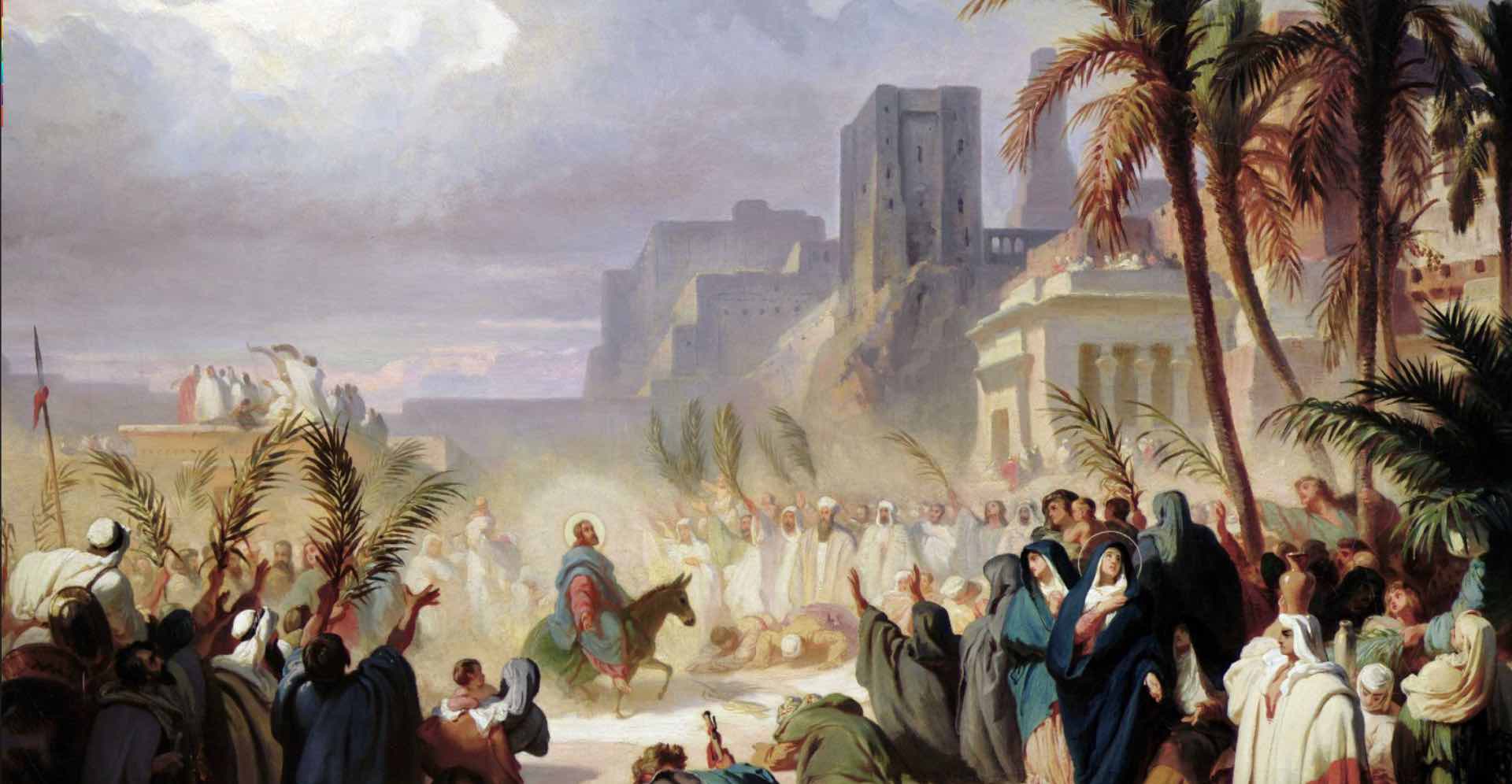
Have Alexander’s entry into Babylon in mind as you consider the entry of Jesus into Jerusalem. On Palm Sunday, the crowds went out to meet Jesus. They waved palm branches and laid them and their cloaks (Mt. 21:7) on the road before Jesus. They cried out, “Hosanna,” which means “Save us now! Blessed is he who comes in the name of the Lord, even the King of Israel!”

They find Jesus sitting – not on a chariot, war horse, camel, or elephant. Jesus sits and rides a donkey – a beast that helped people carry burdens and was used for normal, everyday work. And this fulfilled the prophecy of Zechariah 9:9, “Rejoice greatly, O daughter of Zion! Behold, your king is coming to you; righteous and having salvation is he, humble and mounted on a donkey.”

This entrance of Jesus into Jerusalem is His triumphal entry. But unlike Alexander’s entry, it is humble, lowly, and peaceful. Jesus arrives in Jerusalem as King but not as a normal king. He certainly has power, strength, and glory, but He isn’t intimidating, either to the citizens of His kingdom or to those outside His kingdom. Jesus does not come to demonstrate His might. He comes to demonstrate His love. He comes not to conquer Jerusalem or the world; instead, He comes to conquer your sin and death by His own death on the cross.

Jesus told Pilate, “My kingdom is not of this world” (Jn. 18:36). Jesus is a different kind of king with a different kind of glory. He is a king who has come to die for His subjects – for you. Christ’s glory is to be humble and take the form of a servant. Jesus is a king who is obedient to the point of death, even death on a cross (Php. 2:5-8). And the cross is His triumph. Because Jesus has given Himself unto death for you, God has highly exalted Him and given Him the name above all names. Dear saints, Jesus comes with mercy, and He comes for you. Welcome to Holy Week. Amen.

The peace of God, which surpasses all understanding, will guard your hearts and minds in Christ Jesus. Amen.


[1] This sermon has been adapted from a sermon by Pr. Bryan Wolfmueller.

[2] The account was written by Quintus Certius Rufus and can be found here.

A King for the Stubborn – Sermon on Matthew 21:1-9 for the First Sunday of Advent

Matthew 21:1-9

1 Now when they drew near to Jerusalem and came to Bethphage, to the Mount of Olives, then Jesus sent two disciples, 2 saying to them, “Go into the village in front of you, and immediately you will find a donkey tied, and a colt with her. Untie them and bring them to me. 3 If anyone says anything to you, you shall say, ‘The Lord needs them,’ and he will send them at once.” 4 This took place to fulfill what was spoken by the prophet, saying, 

5   “Say to the daughter of Zion, 

     ‘Behold, your king is coming to you, 
humble, and mounted on a donkey, 
on a colt, the foal of a beast of burden.’” 

6 The disciples went and did as Jesus had directed them. 7 They brought the donkey and the colt and put on them their cloaks, and he sat on them. 8 Most of the crowd spread their cloaks on the road, and others cut branches from the trees and spread them on the road. 9 And the crowds that went before him and that followed him were shouting, 

     “Hosanna to the Son of David! 
Blessed is he who comes in the name of the Lord! 

Hosanna in the highest!”

In the name of Jesus. Amen.

Imagine that you are on the gameshow Family Feud. I’ll pretend to be the host, Steve Harvey. “We asked 100 people: What word would you use to describe a donkey?” Yeah, I bet “stubborn” would be worth 97 points. This past week, I did a lot of reading on donkeys and found an article titled, “Fourteen Reasons a Donkey Is an Ideal Hiking Companion.”[1] A few of my favorite sarcastic reasons: They don’t engage in chit-chat but are very good listeners. Big ears. They kick really hard and are, basically, the Chuck Norris of the equine family. They aren’t interested in social media, so you won’t freeze at the summit while you wait for them to try and get the perfect shot to post in Instagram.

But some of the more serious reasons are: They will carry your stuff for you. They have great endurance. They are focused and surefooted in all types of terrain. Donkeys have great memories and can remember areas they have been up to 25 years previously. They are a good judge as to whether or not a path or situation is potentially dangerous, and it’s nearly impossible to persuade a donkey to take a path that it considers sus (sic.). (For you old, out-of-tough folks, that means ‘suspicious.’) And that last reason is why most people consider them to be stubborn. If a donkey senses danger, it won’t budge.

Remember Balaam’s donkey? Balaam was riding his donkey to go curse the people of Israel on behalf of the king of Moab (1 Kgs. 22). God was angry at Balaam for going and sent the angel of the Lord to stand on the road with a drawn sword. The donkey saw the danger, but Balaam didn’t. The donkey went off the road and into a field, so Balaam struck his donkey. Then, the angel stood in a narrow path with a wall on both sides. The donkey moved to the side, right against the wall, which smushed Balaam’s foot, so he struck her again. Then, the angel went to another narrow place. This time donkey lay down, and Balaam struck her again.

So, God opened the donkey’s mouth to speak to Balaam, “What have I done to you, that you have struck me these three times?” Balaam complains to his donkey that she has made him look like… well, another word for ‘donkey.’ And the donkey responded, “You have ridden me your whole life. Do I normally treat you this way?” Balaam answered, “No.” Finally, God opened Balaam’s eyes to see the angel of the Lord with his sword drawn, and Balaam fell on his face.

Balaam’s donkey was being stubborn and refusing to walk near the angel of the Lord because it was good for the donkey, but it was also good for her rider. The stubbornness of donkeys is one of their best qualities. It protects them and their companions.

It’s interesting that the donkey Jesus rode in our text didn’t sense the danger ahead for its Rider and dig in its heels. Maybe, that donkey didn’t realize that sinful man is even more stubborn than a donkey.

Donkeys are supposed to be stubborn, but we aren’t. Quite honestly, when it comes to being stubborn, we sinners are far more guilty than donkeys. The Old Testament prophets – especially Jeremiah – talk about how we stubbornly refuse to listen to God. Our old nature is a wild, unmanageable donkey (Jer. 2:23-24). We have stubborn hearts that turn us aside from God’s way (Jer. 5:23). Too often, we allow our stubborn, sinful hearts to lead us in gratifying our fleshly desires. We are not loving toward God or our neighbor. Instead, we dig our heels into the ground and demand our own way. And when we do run, it is generally toward sin and away from God. Repent.

There’s no way to know if the donkey Jesus rode into Jerusalem knew about the danger that lay ahead for its Rider, but Christ certainly knew. And that is why He rode forward. Christ came to be the King for stubborn sinners. He knew the suffering He would endure for you, and your stubborn heart is no match for your King’s loving and merciful heart. Today, you hear how He comes to save you, humble and mounted on a donkey.

And for us stubborn sinners, that is good news. He doesn’t come as a conquering king on a war horse or elephant. He comes humble and mounted on a beast of burden. Jesus comes to carry your burden of sin on His shoulders to the cross where He will be even more humble and lowly and die for your sins.

And now, Christ does for you just what He did for that donkey He rode into Jerusalem. In the Absolution, Jesus has sent His disciple with authority to come and untie you from your sin (Jn. 20:22-23). He has loosed you from your stubbornness in sin and freed you to go with Him bearing your cross as His willing disciple.

As we begin the season of Advent (which means ‘coming’), we want to remember all the comings of Christ, our King and Savior. He came in Bethlehem: born of a woman, born under the Law to redeem you who were under the Law (Gal. 4:4). On the Last Day, He will dome again in glory with all the angels to judge the living and the dead.

But we don’t want to forget that Christ still repeatedly comes now in humility in His Word and Sacraments. He comes to give you what you could never earn or deserve – a place in His eternal kingdom. He washes away your stubborn stains of sin and makes you clean, righteous, and holy. For that, God be praised. Amen.

The peace of God, which surpasses all understanding, will guard your hearts and minds in Christ Jesus. Amen.


[1] https://www.thehikinglife.com/2020/02/14-reasons-why-a-donkey-is-the-ideal-hiking-companion/