24 “No one can serve two masters, for either he will hate the one and love the other, or he will be devoted to the one and despise the other. You cannot serve God and money.
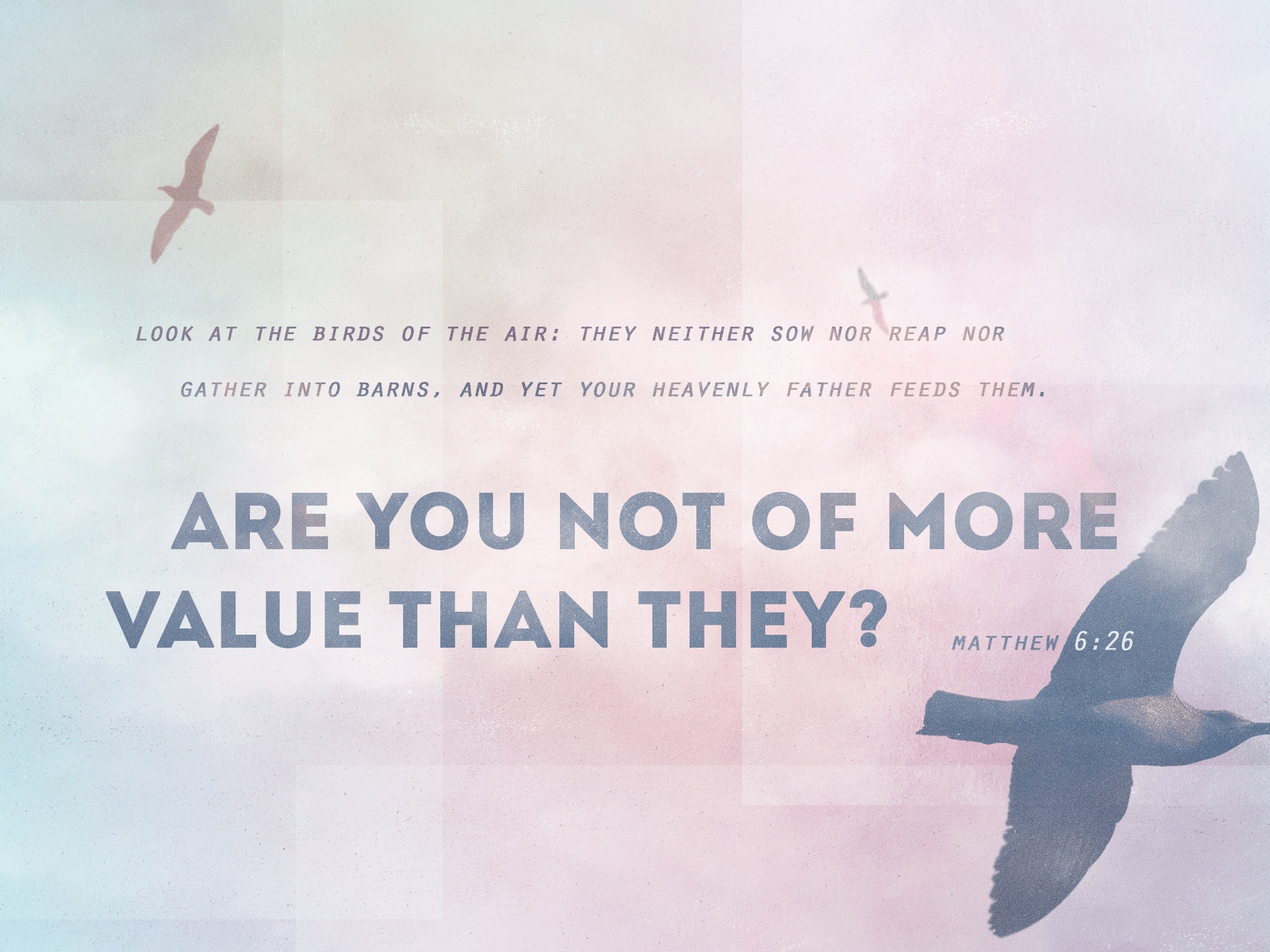
25 “Therefore I tell you, do not be anxious about your life, what you will eat or what you will drink, nor about your body, what you will put on. Is not life more than food, and the body more than clothing? 26 Look at the birds of the air: they neither sow nor reap nor gather into barns, and yet your heavenly Father feeds them. Are you not of more value than they? 27 And which of you by being anxious can add a single hour to his span of life? 28 And why are you anxious about clothing? Consider the lilies of the field, how they grow: they neither toil nor spin, 29 yet I tell you, even Solomon in all his glory was not arrayed like one of these. 30 But if God so clothes the grass of the field, which today is alive and tomorrow is thrown into the oven, will he not much more clothe you, O you of little faith? 31 Therefore do not be anxious, saying, ‘What shall we eat?’ or ‘What shall we drink?’ or ‘What shall we wear?’ 32 For the Gentiles seek after all these things, and your heavenly Father knows that you need them all. 33 But seek first the kingdom of God and his righteousness, and all these things will be added to you.
34 “Therefore do not be anxious about tomorrow, for tomorrow will be anxious for itself. Sufficient for the day is its own trouble.”
In the name of Jesus. Amen.
If you ask anyone if they worry, I’m sure the answer would be, “Yes,” so long as that person is honest. People are worried about all sorts of things. You turn on the news and find anchors talking about wars and conflicts; high taxes and wasteful spending; poverty and greedy corporations; diseases and medicines; heatwaves and cold spells; fires and droughts and floods; and all sorts of other things.
They put all that in front of you, go to a quick commercial break, and then talk about the mental health crisis in our country. Isn’t that ironic? They produce a news broadcast, which is filled with all kinds of stories that their viewers can’t do anything about, and are shocked by reports about the amount of stress in our culture. We live in what is, probably, the safest time in history, but people are still worried about all sorts of things.
So, what can you do to improve your mental health? First, you can probably consume a lot less news than you do. Second, you can take the advice of ‘experts.’ Now, I will say that, when it comes to any health advice, it’s hard to know whom you can and cannot trust. That being said, psychologists, psychiatrists, dietitians, and doctors all seem agree that, if you are anxious or worried, it’s good for your mental health to spend more time outside. Simply getting some fresh air and being in sunlight, even if there’s cloud cover, is good for an anxious mind. If you’re worried, the common consensus and treatment plan is to start with this: Go outside.
The mental health ‘experts’ will say things like, “Studies show that going outside is good for you and reduces anxiety.” I wonder how much money has been spent and how many hours have been wasted to come up with the exact same prescription Jesus just gave when He preached this 2,000 years ago. Jesus says to you, “Do not worry/be anxious. Instead, go outside to look at birds and lilies.” But don’t just look; also, consider the birds and flowers. God cares for them without them needing to worry.
Now again, everyone has anxiety; everyone worries. We shouldn’t. Worry is a sin. Three times here, Jesus Christ, the Son of God, commands you, “Do not worry/be anxious.” I wonder if one of the reasons we struggle so much with the sin of worry is that we don’t have a right understanding of what worry even is. The word ‘worry’ isn’t in the Ten Commandments, but worry is a sin against the 1st Commandment to have no other gods, and it’s a sin against the 9th and 10th Commandments about coveting.
We wrongly think that worry is just a lack of trust. And sure, worry is a lack of trust, but that’s only small part of the sin. Worry is also something much worse and much more twisted than that. Worry is a misplaced trust. When you worry, you are placing too much trust in the wrong thing(s). Worry takes God out of the equation. Anxiety is caused when you wrongly believe God is disinterested or completely absent from every day, minute, and second your life.
As humans, God created us to have trust, to be trusting creatures. When we aren’t giving that trust to God, it isn’t that we stop trusting. There isn’t a vacuum of trust. Instead, our trust goes to the wrong things and places.
When you’re worried about your finances, you are placing too much trust in a piece of paper. You wrongly believe that the cash in your wallet or the numbers in your bank account are what feeds, clothes, and houses you. When you’re worried about getting a promotion or keeping/finding a job, or when you’re worried about what others think of you or your reputation, you are placing too much trust in someone else’s opinion of you. When you’re worried about sickness or getting a particular diagnosis, you’re placing an inordinate amount trust in doctors and medicine to be able to fix you or in your body to heal itself. When you’re worried about the weather, you’re placing too much trust in created things that are all controlled by God. In short, worry is a problem within you and within me. It’s a form of idolatry that places too much trust in the wrong things.
So, again, don’t worry; go outside. Go into creation to see the things that Jesus points you to – to birds and grass. Christ could have pointed to elephants, bears, camels, or cows. All of those things require large amounts of food to stay alive. Jesus could have said, “Look at how your heavenly Father feeds the elephants with the huge amounts of food they need.” But He doesn’t. Instead, He points you to little birds that eat seeds or berries or worms. Even though there are tens of billions of birds in God’s creation, each one of them receives that little bit of food it needs from the hand of God.
Jesus could have pointed to the beautiful, majestic mountains and how God adorns them. Or, He could have told you to look at the tall, massive trees with thousands of leaves. But He doesn’t. Christ points to lilies, and the lilies Jesus speaks about here aren’t the lilies we know from Eastertime. Those don’t grow in Galilee. The flowers Jesus refers to here are tiny and grow along the grass in the fields. They are similar to the white clover we have around here. That clover is pretty, but it isn’t something you plant. And, if you want to have the best lawn on the block, you’re going to try to get rid of clover because it’s more of a nuisance – a pretty nuisance, but still a nuisance.
The point is this: Jesus directs you to look at how your heavenly Father feeds and clothes the littlest things. Since He cares for those tiny parts of His creation, isn’t He going to take care of you? You, who are the crown of creation. You, who are much, much, much more valuable – valuable enough for God to shed His blood for you.
So, don’t worry; go outside. Look at creation to see God’s provision. But also, and more importantly, don’t worry; go outside. Go outside of yourself, outside of your mind and your sinful idolatry.
In a real sense, Jesus is calling you to take a hard, defiant stand against things that would cause you to worry and say to those things, whatever they are: “Listen, you (thing that I’m worried about). You are not my God. My God is eternal and all-powerful. My God spoke all things into existence. That same God took on flesh and blood so He could die for me, so He could pay for my sin, and so I could live forever with Him. So, listen, you dollar bill, are you really going to come and demand that I worry about you? You, pain or sickness or the grave, want me to worry about you? Why would I give you that false worship? Why would I put you in the place of God? I don’t need you because I have Jesus. He’s the Lord of heaven and earth with all authority (Mt. 28:18), and He’s promised that He uses that authority for my benefit (Eph. 1:21-23). My Lord Jesus already warned me about how you will try to get me to worship you with my worry. You aren’t worth it. My Savior said that in this world I would have trouble, but I can take heart because He has overcome the world” (Jn. 16:33).
Christian, you don’t need to worry because Jesus has come out of the grave, and He has promised that you, believer, will come out of your grave too.
Notice that Jesus doesn’t say, “There isn’t anything to worry about.” Instead, He says, “Don’t worry.” Don’t worry because your Jesus is bigger than whatever you’re worried about. And Jesus adds, “Do not be anxious about tomorrow, for tomorrow will be anxious for itself. Sufficient for the day is its own trouble.” In other words, Jesus says that He gives plenty of things for you to care about each day. Each day has its own cares. So, why bring tomorrow’s cares into today? Instead, rejoice in God’s provision today, and trust in His provision tomorrow.
Tomorrow is clouded in the unknown, but tomorrow is also clothed with God’s promises to be with you, to never leave or forsake you (Dt. 31:6; Mt. 28:20), to provide all that you need, and to protect you with His power and might. God will care for you. He’s promised.
Now, that doesn’t mean that you get to be lazy or idle. Scripture is clear on that too (1 Th. 4:11; 2 Th. 3:10; Pr. 10:4). In each moment, God gives you work to do, and He has promised to bless you in that work. There’s a quote from a Swedish theologian and pastor, Bo Giertz, and I really like the way the way he balances things. He wrote, “We should of course work as if all depended on us and pray as if it all depended on Him.” Do what God has given you to do right now. But everything that falls outside the scope of what you can do right now, all of that falls into the nail-scarred hands of your merciful God.
The things that God sets before you today are the things that should have your attention. With all your strength and effort, do everything God gives you to do knowing that God promises to give you the strength you need for the future He will give you.
Dear saints, pour yourself into the tasks God gives you knowing that He loves you and promises to provide for you. He promises to give you the strength you need to face each moment. So, work and trust. And when you are worried, go outside. Look at God’s provision for the little things of creation. He values you more than birds and grass. And go outside of yourself. Dive into His promises that He delivers to you in His Word. Promises that will never fade or fail. Amen.
The peace of God, which surpasses all understanding, will guard your hearts and minds in Christ Jesus (Php. 4:7). Amen.

 Pastorsamwise
You must be logged in to post a comment.