Enthroned – Sermon on Luke 24:44-53 for the Ascension of Our Lord (Observed)

Luke 24:44-53

44 Then [Jesus] said to them, “These are my words that I spoke to you while I was still with you, that everything written about me in the Law of Moses and the Prophets and the Psalms must be fulfilled.” 45 Then he opened their minds to understand the Scriptures, 46 and said to them, “Thus it is written, that the Christ should suffer and on the third day rise from the dead, 47 and that repentance for the forgiveness of sins should be proclaimed in his name to all nations, beginning from Jerusalem. 48 You are witnesses of these things. 49And behold, I am sending the promise of my Father upon you. But stay in the city until you are clothed with power from on high.”

50 And he led them out as far as Bethany, and lifting up his hands he blessed them. 51 While he blessed them, he parted from them and was carried up into heaven. 

52 And they worshiped him and returned to Jerusalem with great joy, 53 and were continually in the temple blessing God.

Alleluia! Christ is risen!
He is risen indeed! Alleluia!

And today, we will add.

Alleluia! Christ is ascended!
He is ascended indeed! Alleluia!

In the name of Jesus. Amen.

Back in our epistle reading (Act. 1:1-11), Luke gave us a few more details about Jesus’ ascension than he gave us in this Gospel reading. I still have some questions about how this took place. How fast did Jesus ascend? Was it a constant speed from start to finish, or did He accelerate? If so, how fast did He go from 0-60, and what was His top speed? Of course, those details don’t really matter; if they did, Scripture would have told us. Once Jesus is out of sight, both Acts and this account of Jesus’ ascension shift our focus to the disciples.

As the disciples watch Jesus ascend, they gaze into heaven as a cloud takes Him out of their sight (Act. 1:9). Even though Jesus’ isn’t visible, they continue to stare into the sky. This leaves us with more questions. How long did they stare, was it minutes or hours? Did they talk with each other? Did anyone pass by and look up with them trying to see what they were gazing at? Again, we don’t know, and Scripture leaves us to have a holy, sanctified curiosity about those details. What is important is what the angels say when they arrive, “This Jesus, who was taken up from you into heaven, will come in the same way as you saw Him go into heaven.” Then, the disciples return to Jerusalem with great joy, and were continually in the Temple blessing God.

For three years, they had followed Jesus, enjoying His presence and teaching. They had watched Him heal the sick and raise the dead. Now, He is gone, and they didn’t know how long He will be away. But there they are in the Temple filled with joy and blessing God. You would think that the disciples would have felt lonely, abandoned, or even afraid – similar to how they felt between Jesus’ crucifixion and when He appeared to them after the resurrection, but they aren’t. They aren’t because their minds have been opened to understand all the Old Testament (Lk. 24:44-45), so they know Jesus’ ascension means that He is enthroned over all creation.

Jesus doesn’t ascend to heaven because He is leaving or abandoning us. He ascends to take His rightful seat next to God the Father on the throne of creation. Dear saints, right now your Savior rules and reigns over all things. But too often, we think that Jesus’ ascension is similar to how sleazy dads will say they are going out for cigarettes but never return. That isn’t the case. The ascension is not a farewell, it’s a coronation. Jesus has not left you as orphans (Jn. 14:16-18). When Jesus ascended, He didn’t desert you and vacate the world; instead, Christ was enthroned as King of all creation with all authority in heaven and on earth (Mt. 28:18). This is true even though it doesn’t always feel like it.

Down here on earth, we see Christians being persecuted in China, Egypt, and all over the planet. We see churches that used to proclaim the forgiveness of sins but now abandon every single doctrine of the Scriptures and even actively promote sin. We see all this and ask, “What kind of a king would allow this to happen?” And the devil whispers in our ear that the reason these things happen is because Jesus is an absent king.

We see wars and hear rumors of wars. We watch as economies and cultures crumble and collapse. We see a large portion of our nation fighting with all their strength to be able to kill their own children in the womb. We see evil, violent people shooting in our cities and schools in Buffalo and Uvalde. And the devil lies to you saying, “If your King Jesus were still here, this wouldn’t be happening. He would whip these wicked people into shape. But He’s gone and I get to have my way down here.”

You see and feel your sins. You dive back into those transgressions of lust, greed, pride, and covetousness. You know that you should joyfully bow your head in thankfulness for all the gifts God has given you. You know you should open your Bible and bathe in God’s promises of mercy and grace. Yet, you’re perpetually unhappy and dissatisfied. You know you should be at peace, but you are always filled with anxiety because it appears as though Jesus isn’t listening to your prayers. And in all of this, you think, “If Jesus were here, I wouldn’t be struggling with these things. If I could just see Jesus, I wouldn’t give into these temptations and fears.”

Dear saints, repent. The truth is that even if Jesus were physically present and visible on earth, your life wouldn’t be any different. During His earthly ministry, Jesus healed the sick, cast out demons, and raised the dead. Jesus preached the Gospel to the lost souls of this world. For three years, God in the flesh proclaimed His kingdom to those under the devil’s power. And yet, they still didn’t recognize or acknowledge Him. Instead, they persecuted Him, spit on Him, and put Him to death. And during that same time, Jesus’ own disciples, who stood next to Him and touched Him, they denied Him, betrayed Him, and fled from Him.

Even though your doubt and sorrow scream otherwise, and even though the devil pushes you to discontentment and nudges you toward the cliff of unbelief, know that you wouldn’t be any better off if Jesus were standing right here in front of your eyes. And that is why Jesus ascended into heaven and went to His coronation and is, even now, enthroned over all things.

Jesus, the eternal Son of God, has ascended and brought His human flesh into God’s presence. Through faith, you are a co-heir of His glory and a brother to the King Himself. Christ is seated at God’s right and is telling His Father that you are worthy of eternal life because He has buried every sin you could ever commit through His death and resurrection. Jesus has fulfilled His promise to send the Holy Spirit, and whenever you hear His Word, the Holy Spirit is present with you. Now you, Christian, bring evidence of the saving power of Jesus wherever you go, tearing lost souls out of Satan’s grip.

As the Gospel spreads throughout the earth in every generation, Christ has been and continues to be present with His church. Even though He is hidden from our eyes, He is here claiming us as His own and delivering us into His kingdom. In the Absolution, Jesus is shredding and destroying the devil’s claim over you. Christ is present in His Supper healing and restoring you with His true Body and Blood (1 Cor. 10:16, 11:29-30). And because of His ascension, Jesus is able to do this in more than one place at one time. Because Jesus is ascended, He can unite every patch of His kingdom throughout the world and all time. Through His Word and Sacrament, Jesus brings you to Mt. Zion, the heavenly Jerusalem. He unites you with innumerable angels in festal gathering and with the whole assembly of the firstborn who are enrolled in heaven (Heb. 12:22-23). And from His throne, Jesus, your Savior, is the King who hears every one of your prayers.

So, when the devil and the world are screaming at you that Jesus is absent, come to your church, and here you will find your King. Come, receive His gifts, and stand in His promised, though invisible, presence. Whenever you see evil and darkness, remember it isn’t happening because Christ has abandoned you; it is happening because He is with you and has claimed you as His own. This makes you a target for the devil, but Satan will always fail in his futile, vain attempts to snatch you from the nail-scarred hands of Jesus, your Savior.

Dear saints, you have been raised with Christ, so seek the things that are above, where Christ is, seated at the right hand of God. Set your minds on things that are above, not on things that are on earth. For you have died, and your life is hidden with Christ in God. And when Christ, who is your life, when He appears, then you also will appear with Him in eternal, splendid glory (Col. 3:1-4).

Jesus, your Savior and brother, ascended with His hands raised in blessing, and He still blesses you from His eternal throne. And He will return again in blessing to usher you into His eternal kingdom.

Alleluia! Christ is risen!
He is risen indeed! Alleluia!

Alleluia! Christ is ascended!
He is ascended indeed! Alleluia! Amen.

The peace of God, which surpasses all understanding, will guard your hearts and minds in Christ Jesus. Amen.

Eden to Heaven – Sermon on Genesis 3:22-24 & Revelation 22:1-5

Genesis 3:22-24 & Revelation 22:1-5

In the name of Jesus. Amen.

God created you to live in perfection. In six days, God created everything in the universe. He created light and darkness. He placed the sun, moon, stars, and galaxies in their places. God established land, sea, and plants and filled the earth with birds, fish, and every kind of animal. And God planted the garden of Eden. Only after all that was completed did God create the crown of creation – man and woman. And Adam and Eve were placed in the Garden of Eden to work it and keep it.

But it wasn’t the kind of work that we experience – it was pure joy. There was no need to look at the forecast to see what the weather would be. No worries about gas prices and inflation. No crisis. No war. No disease or pandemic. Everything was in perfect harmony. In God’s own estimation, all that He created was good, in fact, very good (Gen. 1:21). Best of all was the perfect relationship that existed between God and man. God freely giving and man graciously receiving. Even the one command that God gave was gracious, “Of the tree of the knowledge of good and evil you shall not eat, for in the day you eat of it you shall surely die” (Gen. 2:17).

Now, some suggest that God put the tree of the knowledge of good and evil in the garden so Adam and Eve could choose to trust or reject God. But this is not the case. God’s prohibition to eat from that tree was a promise for Adam and Eve to believe. Just track with me for a minute here. Scripture repeatedly says, “The righteous shall live by faith” (Hab. 2:4; Ro. 2:17; Gal. 3:11; Heb. 10:38). In other words, to be righteous is to have faith. We know that for us sinners to be righteous is to have faith in Jesus as our Savior. But what kind of faith did Adam and Eve have before the Fall? They already knew the mercy, goodness, and graciousness of God because they constantly experienced it in everything that God had given and in everything God was to them. So, what is it that Adam and Eve believed before the Fall that made them righteous through faith?

Well, at some point in those first six days, God created the angels. Now, Scripture doesn’t tell us specifically when, but at some point in those days of creation the devil and demons rebelled and fell. In other words, evil existed. When God banned Adam and Eve from eating from the tree of knowledge of good and evil, God was giving a promise, “Evil exists, and I just want you to trust Me on this. When you find out what evil is, it won’t go well for you, in fact, you’ll die.” So, Adam and Eve could go to the tree of the knowledge of good and evil and know, “What a good God we have. He has given us everything and doesn’t want us to experience or even know what evil is.”

But, as you heard in Sunday’s Old Testament lesson (Gen. 3:1-21), Satan stirred up discontentment in Adam and Eve. The devil told Eve that she could become something more than God had created her to be. Satan said that she would become like God. So, deceived as she was (Gen. 3:13; 2 Cor. 11:3), Eve took the fruit. Adam was even worse; he wasn’t deceived and knew exactly what he was doing (1 Tim. 2:14). They both sinned and fell. They took. They ate. Their eyes were opened. They had become something more. You heard God say it Himself tonight, “Behold, the man has become like one of us in knowing good and evil” (Gen. 3:22).

But Adam and Eve knowing evil wasn’t better. Not even close. Now, because the head of creation had fallen into sin, creation fell with him (Ro. 8:20-21). And Adam and Eve were sent into exile – away from God’s presence, away from the Garden of Eden, and away from the tree of life which was now guarded by the cherubim and a flaming sword. But God sent them into this exile with a new promise to believe. A promise that paradise would be restored to them when the seed of the woman would come and crush the serpent’s head (Gen. 3:15). And it was through faith in that promise that God went with them.

Dear saints, you and I live in exile. We wander about sinfully trying to become like God by our own works, but all our effort is curved in upon itself. Instead of being like our giving God, we seek after our own comfort and desires. Unlike God who is generous and giving, we try to pile up riches for ourselves. We try to create our own little gardens of Eden in an attempt to regain the paradise we lost. But we never achieve the perfection we long for. The treasures we acquire quickly fade and fall apart in our hands.

We cannot return from this exile by our own reason or strength. Yet, God walks alongside us, calling us back unto Himself. Out of His great love for us, He continues to give us promise after promise. And God delivers on every one of His promises. He has sent Jesus into this world of exile to bring us back to paradise. He comes to us who are bent over in our sin and frees us. He delivers us from the bondage of Satan (Lk. 13:16) and gives us rest. He announces to us that because of what He has done by His death and resurrection, we will be eternally restored. While Jesus was on the cross, He told the thief next to Him, “Today, you will be with Me in paradise” (Lk. 23:43). That word ‘paradise’ means ‘an enclosed garden.’

In our reading from Rev. 22:1-5 tonight, we get a picture of that garden of paradise. And that is what lies ahead for you, dear saint. Through faith in Jesus, you are righteous. Your destination is the bright crystal river, the tree of life yielding its twelve kinds of fruit, and leaves for the healing of the nations. There you will see God’s face, and there will be no more night. You will need no light of lamp or sun, for you will be restored to God, and He will be your light. Your time in exile has an end. And there, in eternal bliss, you will reign forever and ever. Amen.

The peace of God, which surpasses all understanding, will guard your hearts and minds in Christ Jesus. Amen.

Today – Sermon on Matthew 6:24-34 for the Fifteenth Sunday after Trinity

Matthew 6:24-34

[Jesus says,] 24 “No one can serve two masters, for either he will hate the one and love the other, or he will be devoted to the one and despise the other. You cannot serve God and money.

25 “Therefore I tell you, do not be anxious about your life, what you will eat or what you will drink, nor about your body, what you will put on. Is not life more than food, and the body more than clothing? 26 Look at the birds of the air: they neither sow nor reap nor gather into barns, and yet your heavenly Father feeds them. Are you not of more value than they? 27 And which of you by being anxious can add a single hour to his span of life? 28 And why are you anxious about clothing? Consider the lilies of the field, how they grow: they neither toil nor spin, 29 yet I tell you, even Solomon in all his glory was not arrayed like one of these. 30 But if God so clothes the grass of the field, which today is alive and tomorrow is thrown into the oven, will he not much more clothe you, O you of little faith? 31 Therefore do not be anxious, saying, ‘What shall we eat?’ or ‘What shall we drink?’ or ‘What shall we wear?’ 32 For the Gentiles seek after all these things, and your heavenly Father knows that you need them all. 33 But seek first the kingdom of God and his righteousness, and all these things will be added to you.

34 “Therefore do not be anxious about tomorrow, for tomorrow will be anxious for itself. Sufficient for the day is its own trouble.”

In the name of Jesus. Amen.

Of all the things we humans do, there is nothing more pointless and draining than worrying and being anxious. A reasonable argument could be made that worry is a bigger waste of time than watching television, playing endless video games, or scrolling on your phone all day. Anxiety not only fills our mind and distracts us from doing productive things, it can, depending on how anxious we are, also zap us of physical energy. But now, kids, listen to me carefully: Don’t use that statement to argue with your parents when they tell you to stop wasting time watching TV or whatever. You don’t have my permission to say, “But pastor says it’s better than being worried.”

How many times have you been really worried and incredibly anxious about something, but then everything fell into place and life simply moved on? We all remember times when we have been incredibly worried, but it can be easy to forget what we were worrying about because everything worked out just fine. God gave you what you needed, and you made it through. There are other times you weren’t worried about anything, and God still gave you what you needed. So, whether you are anxious and worried or not, God provides.

Three times in this text, Jesus commands you, “Do not worry.” One other time He asks almost sarcastically, “Why do you worry?” Jesus cares a lot about us not worrying because He has an interest in your confidence and trust. He doesn’t want you to be anxious. In this text, Jesus makes two things clear: First, God wants to and does give you everything you need for life. And second, God wants you to have confidence that He will give you everything you need.

We sit in strong, solid, well-built homes that have cupboards, pantries, and refrigerators full of food. In fact, we often end up throwing perfectly good food away. We have dressers, closets, and storage bins filled with more clothes than we could ever use, but we wonder if God cares about us. Birds and grass have a lot to teach us about trusting our Creator.

God cares for the birds by feeding them. Each day, every bit of food eaten by every bird on the planet was put there by God. God knows you need food just like a bird does. He’ll make sure you have it. God cares for the flowers by clothing them more splendidly than Solomon was ever clothed. If God clothes the grass like that, He will make sure you have what you need.

We live in a world surrounded by unbelievers who are always worried about the future. The sad fact is that they think their worry actually accomplishes something. Christ doesn’t want you to live like that. Jesus says you are free to seek first the kingdom of God and His righteousness, and all these things – food, clothing, house, home, money, goods, etc. – will be given to you as well.

Listen, God promises that if your regular source of food and clothing is depleted or cut off, He will provide another one. Our Old Testament lesson (1 Kgs. 17:8-16) is a great example. God sent a drought to punish Israel during the days of Elijah, so God told Elijah to live by a brook named Cherith promising, “I have commanded the ravens to feed you there” (1 Kgs. 17:4). Scripture doesn’t say how long Elijah lived there with the crows waiting on him, but as the drought went on, the brook dried out, and that is where our text picks up. God tells Elijah to go the city of Zarephath because, “I have commanded a widow there to feed you” (1 Kgs. 17:9). That line really struck me this week. 

For however long he lived at Cherith, Elijah had become accustomed to the ravens flying to him and providing his food because God had commanded them to feed him. Now, he gets to Zarephath, but this widow doesn’t come up to him and say, “There you are. Diner is at my place. God commanded me to feed you.” Not even close! Elijah watches this widow picking up a couple of sticks and asks her for a drink of water, and the woman heads off to get it. Only then does Elijah decide to add a bite of bread to his order, and the woman doesn’t say, “No way! I can’t give you anything.” Instead, her response is, basically, “I’ve only got enough ingredients for my son and I to have a bite. I’m grabbing these sticks so we can bake it, eat, and die.” I wonder if this is how Elijah recognizes that she is the one God had commanded to feed him. Then, there is the promise that the flour and oil will not run out until God would send rain and provide relief from the drought (1 Kgs. 17:1416). Again, once Elijah’s supply of food from the ravens was gone, God provided Elijah another supply of food.

Dear saints, God will provide all you need for this life until He calls you to heaven. And in the New Creation, God will provide you with a feast of rich food for all eternity (Is. 25:6). He has promised!

Now, all of that brings us to v. 34 which is where I really want to focus our attention, and if your mind has been wandering, come back. After telling us to not be anxious about what we will eat, drink, or wear, Jesus says, “Do not be anxious about tomorrow.” Again, Jesus has given us ample reasons to not worry about food and clothing, but I honestly don’t know many, if any, people who are anxious about those things. (God has certainly blessed us!) But I do know a lot of you here are worried about what will happen tomorrow, a month from now, a year from now, and in the coming decades.

Some are worried about the virus and the variants. Some are worried about what long-term side effects the vaccines might have. Some are worried about the government becoming too authoritative. Some are worried the government isn’t doing enough to stop the virus or terrorists, and with the 20th anniversary of 9/11, some are worried about another terrorist attack on our soil. Some are worried about the world becoming more and more hostile toward Christians. All of this can pile up and make us worried about the world our kids, grandkids, and great grandkids will live in. But Jesus straight up tells us, “Do not worry about tomorrow.”

Now, I’ve been trying to figure out a way to say this succinctly since Tuesday, and I still haven’t found it. So, bear with me. When Christ commands us, “Do not worry about tomorrow,” Jesus almost gives us permission to worry about today, but it’s like we are to draw a line at the end of the day and not have any worry whatsoever about anything past that line. To be sure, Jesus tells us to not worry about our life – food, clothing, etc., but the evil and ugly things we face today are enough for us. And we are to do everything God gives us to do to confront and combat those evils each day God gives us.

Here’s what I mean, with all of Jesus’ talk about not worrying, we can fall off the other side of the horse and become sinfully passive and idle. We might be tempted to think we don’t ever have to work or do anything to combat the evils we face and think God will just take care of everything. Well, that isn’t right either. For example, it is a sin to pray for a hole when God has given you a shovel.

And since each day has enough evil of its own, don’t let tomorrow’s evil distract you with worry from the evil you face today. Jesus promises that He will give you everything you need to meet the evil, ugly challenges of today. And, if He gives you another day tomorrow, He will do it again.

For example: Some of you have watched the pain family endures while their child is being treated for cancer. Some of you have actually gone through this. But for those of you who haven’t, you might think, “I could never handle that. I don’t have the strength.” You were right. God hasn’t called you to do that – at least not yet. But Jesus doesn’t want you to worry about that diagnosis coming tomorrow because it distracts you from meeting the challenges and evil God has called you to face today. If the day comes when God calls you to meet that evil (or any evil like that), Jesus promises to give you the strength to meet that evil each and every day it is yours to endure.

You see, when you get to the end of the day and are completely worn out, remember, God designed your tank to be empty at the end of the day. So, go to sleep in peace (Ps. 4:8). And when you wake up again, be ready to face the trouble that comes your way that day.

Above all, remember what Christ has done by taking on our flesh. Jesus Himself got hungry and thirsty and tired and hot and cold, so He knows the struggles you face. He endured it all without a shred of worry because He trusted that God the Father would provide the strength He needed to endure it. Even as He went to the cross, carrying all your sin of doubt and anxiety, He entrusted Himself to God (1 Pet. 2:23), and there on the cross Jesus provided what you needed most – His forgiving blood shed for you. On the cross, Christ overcame and defeated all the evils of every day that you face and opened the kingdom of heaven to you.

So, when you face the evil of each of your todays, remember that God has promised to take care of it.Ps. 37:32-33 says, “The wicked watches for the righteous and seeks to put him to death. The Lord will not abandon [the righteous] to [the wicked’s] power or let him be condemned when he is brought to trial.” That means that none of the devil’s charges against you can stand in God’s court, and nothing that the world can throw at you will ever change that.

Dear saints, be comforted and be at peace. Your God knows what you need to face today and all your future todays. And He will provide the strength you need. He has promised. He is faithful. He will surely do it (1 Thes. 5:24). Amen.

The peace of God, which surpasses all understanding, will guard your hearts and minds in Christ Jesus. Amen.

The Evil Eye – Sermon on Matthew 20:1-16 for Septuagesima Sunday

Listen here.

Matthew 20:1-16

1 “For the kingdom of heaven is like a master of a house who went out early in the morning to hire laborers for his vineyard. 2 After agreeing with the laborers for a denarius a day, he sent them into his vineyard. 3 And going out about the third hour he saw others standing idle in the marketplace, 4 and to them he said, ‘You go into the vineyard too, and whatever is right I will give you.’ 5 So they went. Going out again about the sixth hour and the ninth hour, he did the same. 6 And about the eleventh hour he went out and found others standing. And he said to them, ‘Why do you stand here idle all day?’ 7 They said to him, ‘Because no one has hired us.’ He said to them, ‘You go into the vineyard too.’ 8 And when evening came, the owner of the vineyard said to his foreman, ‘Call the laborers and pay them their wages, beginning with the last, up to the first.’ 9 And when those hired about the eleventh hour came, each of them received a denarius. 10 Now when those hired first came, they thought they would receive more, but each of them also received a denarius. 11And on receiving it they grumbled at the master of the house, 12 saying, ‘These last worked only one hour, and you have made them equal to us who have borne the burden of the day and the scorching heat.’ 13 But he replied to one of them, ‘Friend, I am doing you no wrong. Did you not agree with me for a denarius? 14 Take what belongs to you and go. I choose to give to this last worker as I give to you. 15 Am I not allowed to do what I choose with what belongs to me? Or do you begrudge my generosity?’ 16 So the last will be first, and the first last.”

In the name of Jesus. Amen.

Follow the eyes of those who worked all twelve hours of the day. These laborers woke up before the sun rose. They crawled out of bed, rubbed their eyes, had breakfast, and made their way to the marketplace hoping to be hired so they could put food on the family table. As the morning light begins to illumine the city, they see the vineyard owner coming toward them. He calls them to work in his vineyard offering an honest day’s pay for an honest day’s work – one denarius. Off they go into the vineyard. When they get there, they see their tasks and get busy. They dig, and they till, and they prune, and they water, and they pull weeds, and they harvest. Whatever needs to be done in the vineyard, they get at it.

Then, as the morning sun continues to rise, these twelve-hour workers see their friends who hadn’t been hired at first, but now they are arriving in the vineyard. They had been hired just before Price is Right comes on. At this point, the guys who got to the vineyard first had been working for three hours, so they know what tasks could use a few extra hands. They all get to working as productively and efficiently as possible. A few more hours go by, and at the sixth hour during their lunch break, they see more of their buddies arriving to work in the vineyard. So, again, they reorganize and reprioritize where each of them will be laboring, and it’s back off to work.

As the day goes on and the temperature rises, they grab some water, and see more of their pals coming to work in the vineyard. It’s the ninth hour – about three o’clock. Those twelve-hour workers see that the vineyard is getting pretty full, but they welcome their friends and get back to the grind.

Then, as the sun is setting and the temperature begins to dip, they see even more workers arriving. The day is basically over, so it’s strange that more workers are arriving. But whatever. The twelve-hour workers know that they’ll soon be getting their wages, their denarius. They look forward to returning to their homes and proudly show the fruits of their labor. They anticipate the hugs from their kids and kisses from their wives. They’re ready to sit down to a nice dinner, get cleaned up, and contentedly lie down in their beds after an honest, fulfilling day’s work. They are pleased with themselves because they have done what was needed to provide for their families.

Finally, the sun begins to set, and the evening light clings to the sky. The workers put all the tools away and line up to receive their wages. But the full-day workers see that they are going to have to wait for their pay. Their buddies who came just in time for cleanup are going to get paid first. But then, they see the oddest thing. The guys who basically arrived just in time to get paid are getting a full denarius. These twelve-hour workers see that shiny denarius, a full day’s wage, landing in the clean hands of the one-hour workers. Their eyes get wide. They are so busy giving each other high fives and imagining what they are going to do with their extra windfall that they don’t even notice that those hired at the ninth hour get a denarius, same with those who came in at the sixth and those at the third.

So, there they are, standing in front of the foreman. They hold out their hand expecting to see lots of shiny coins. But they feel the weight of a single, solitary denarius in their palms. They look at that currency and despise it. What had sounded good, right, and reasonable in the morning is now detestable, despicable, and revolting in their eyes. So, they angrily look toward the vineyard owner, and the same is true of him. In the morning, he had appeared as a fair and honest man who would provide work and pay for them and their families, but now he looks like an unfair, unjust, inequitable scoundrel. And they complain.

The vineyard owner patiently listens to their protests, but they haven’t been shorted. It’s no skin off their backs. They didn’t get any less. So, the vineyard owner looks square into the eyes of those sour-faced workers and asks, “Where’s the foul? Didn’t we agree for a denarius? All those coins belong to me, so why do you think you get to decide what I do with them? Am I not allowed to do what I choose with what belongs to me?” And our translation says, “Do you begrudge my generosity?” But literally, the Greek there says, “Is your eye evil because I am good?”

And there it is. The vineyard owner was good – good and generous. He provided jobs and income for the people of his community. In fact, he was better than good. He was gracious. He freely gave more than the vast majority of his workers deserved. The evil eyes only pop up in those who think they deserve more than they are given. And those eyes are evil because they look more at themselves and their work instead of at the mercy and generosity of the vineyard owner.

None of these workers decided on their own to work for the master. Every one of them was called and sent only by the initiative of the vineyard owner. No one went to knock at his door to ask for a job, and no one volunteered to work for him when he came into the marketplace. Each of them was called, and each of them was called at the precise time the owner called them. He went and retrieved them.

Here’s the point, Christian: You were called by God. Period. He came. He called you into His service. He gave you work to do. You didn’t seek to work for Him. God called you into His kingdom when it pleased Him. If it had pleased God to hire everyone at dawn and have them work an entire day, he would have.

If you think God owes you better than He has given, if you think you have earned what He gives for free, you too have an ugly, evil eye. In fact, you have lifted yourself above God and put yourself on His throne. But it won’t work, you aren’t above God. When Jesus comes again on the Last Day, the first will be last, and Jesus Himself declares what that means. The last are told to take what is theirs and leave the vineyard. If this parable rubs you the wrong way, that’s the sentence you need to look at.

The true gift in the parable is hidden in that sentence. It isn’t just about the denarii that the vineyard owner graciously doles out. A permanent place in the vineyard is at stake. For those who have the evil eye of pride, there is nowhere else to go and they are sent away empty-handed. If we are really honest, we cannot claim anything as our own. Everything we have is gift. By grace we are saved, not as a result of works. No one can boast (Eph. 2:8-9).

But that sentence of judgment – when the vineyard owner says, “Take what belongs to you and go” – is a gracious statement for you, believer. You just have to open your eyes to see the benevolence, generosity, and mercy of God.

To those who don’t invoke their rights or complain about the generosity of God, they remain in the vineyard. You don’t just get a day’s wage for little work. In His mercy, God gives you the whole vineyard! Your generous God doesn’t treat you as workers, but as sons. Dear saints, God doesn’t pay you wages. He gives you an inheritance. The vineyard is yours.

Rejoice. The kingdom of heaven is the opposite of the kingdoms of men. You don’t earn. You don’t pay. The goods are given for free. It would drive any man-made business into the ground, but God doesn’t care. God isn’t out to make a living. He is out to give away His kingdom.

In the kingdom of God, there is no room for pride or arrogance or boasting in what we do because there is no doing on our part. Everything has already been done by Christ. We simply benefit because of His full and complete work. We who were dead in our sins, enemies of God, and children of wrath are raised, pardoned, adopted, and transferred into God’s kingdom. As we heard in our call to worship, God saves a humble people, but the haughty eyes He brings down (Ps. 18:27).

And look! Jesus now invites you to come have a seat at His table and taste of the joys of His finished work for you. Amen.

The peace of God, which surpasses all understanding, will guard your hearts and minds in Christ Jesus. Amen.

Flight to Fight – Sermon on Matthew 2:13-23 for the Second Sunday of Christmas

Listen here.

Matthew 2:13-23

13 Now when they had departed, behold, an angel of the Lord appeared to Joseph in a dream and said, “Rise, take the child and his mother, and flee to Egypt, and remain there until I tell you, for Herod is about to search for the child, to destroy him.” 14 And he rose and took the child and his mother by night and departed to Egypt 15 and remained there until the death of Herod. This was to fulfill what the Lord had spoken by the prophet, “Out of Egypt I called my son.” 

16 Then Herod, when he saw that he had been tricked by the wise men, became furious, and he sent and killed all the male children in Bethlehem and in all that region who were two years old or under, according to the time that he had ascertained from the wise men. 17 Then was fulfilled what was spoken by the prophet Jeremiah: 

18 “A voice was heard in Ramah, 
weeping and loud lamentation, 

     Rachel weeping for her children; 
she refused to be comforted, because they are no more.” 

19 But when Herod died, behold, an angel of the Lord appeared in a dream to Joseph in Egypt, 20saying, “Rise, take the child and his mother and go to the land of Israel, for those who sought the child’s life are dead.” 21 And he rose and took the child and his mother and went to the land of Israel. 22 But when he heard that Archelaus was reigning over Judea in place of his father Herod, he was afraid to go there, and being warned in a dream he withdrew to the district of Galilee. 23 And he went and lived in a city called Nazareth, so that what was spoken by the prophets might be fulfilled, that he would be called a Nazarene.

In the name of Jesus. Amen.

We don’t always understand God’s ways. That’s the understatement of the year – young though it is. God’s ways and thoughts are too high and too wonderful for us to understand (Is. 55:8-9).

For example, take the Old Testament promises of the Messiah. When the wise men first came seeking Jesus because of the star, Herod asked the chief priests and scribes where the Christ was to be born (Mt. 2:1-6). The scholars told Herod that the Scriptures taught that Christ would be born in Bethlehem (Mic. 5:2). We also just heard that the Messiah would come out of Egypt (Hos. 11:1), and He would be called a Nazarene. Bethlehem, Egypt, Nazarene – no wonder people had a hard time recognizing that Jesus was the fulfillment of the prophecies of the Messiah. You can see how it would be hard to wrap your mind around all this without the Gospel of Matthew mapping out the fulfillment point by point.

While all of that fulfillment of Scripture could be its own sermon, that isn’t what we are going to focus on today. Instead, we are going to focus on how God’s ways and actions are so different from ours – especially when it comes to how God deals with evil.

The slaughter of the boys of Bethlehem who were two years old and under is one of the most horrific events in all of Scripture. Jesus is protected while those boys are killed. Their only “crime” is that they resemble Jesus in gender and age. We hear this and our minds are often filled with questions. “Couldn’t God have intervened?” “Why didn’t God warn all the fathers of Bethlehem in dreams?” “Why does Jesus get spared while the rest of the boys aren’t?” “Why couldn’t God just kill Herod and spare the baby boys?”

Whenever we stand face to face with evil, we ask the “why” questions. Many people use the presence of evil to argue that God is weak or doesn’t even exist. They will say that if there is a God, He certainly wouldn’t let things like this happen. If God is merciful and loving, if He is omniscient (all-knowing), omnipresent (everywhere present), and omnipotent (all-powerful), why doesn’t God use all those “omnis” to do something about evil?

These questions have been something that humanity has wrestled with ever since the Fall into sin. Part of the reason we ask those questions is because we aren’t those “omnis” and could only deal with one evil at a time. And because we could only deal with one evil at a time, we would handle it only with punishment. But because God is all of those “omnis,” He can address evil with grace and forgiveness.

Also notice that those questions only focus on the evil of this world and spend no time considering if God has done something about evil – which He has. It’s like when a kid is having a rotten day and emphatically states, “Nothing good ever happens to me.” (I’ve been that kid.) You can try to point out the good things that have happened, but the kid dismisses all of those. And sure, if you don’t count anything good that happens in your life, it will be filled with badness and evil.

The whole book of Job deals the problem of evil and God’s goodness. I highly recommend you read Job, but when you do, know that Job’s three friends are all off base – they give wrong answers. And even Job can go a bit too far at times. But make sure listen to Job’s fourth friend, Elihu (Job 32-37). And especially listen to how God answers Job at the end of the book. Hopefully, this sermon will be a help to understand both the book Job and the goodness of God in the presence of evil. And to get to an answer to how there can be a good God when there is so much evil, you have to go back to the fact that God’s ways and thoughts are higher and more wonderful than ours.

First of all, when we consider evil in the light of God’s goodness, we have to remember that we cannot blame God for the evil in the world because God is not to blame. Secondly, and more importantly, God has addressed, overcome, and defeated evil, but not in the way we would expect. In fact, the infant Jesus being whisked away to Egypt was part of how God addressed the evil of this fallen world.

Jesus ran to Egypt to be God’s answer to all evil. One of the key verses to understanding all of this is Romans 12:21 which says, “Do not be overcome by evil, but overcome evil with good.” Hear that again, “Do not be overcome by evil, but overcome evil with good.” This is how the Gospel always works and how it has to work because you cannot force good into evil.

In His omnipotence, God had the power to wipe out sin right away when Adam and Eve fell. But He is not that kind of god. That kind of god would not be the God of the Bible. The God who created you is a God who is merciful and gracious, slow to anger and abounding in steadfast love (Ex. 34:6-7). So, to overcome the evil in this fallen, sinful world, God did something unimaginably good. And in His goodness, He came to earth to deal an eternal blow to all evil.

Jesus fled from Herod, not because He was allowing Herod to continue being an evil, bloodthirsty, power monger. Instead, Jesus came to save even wicked King Herod from his evil.

On His journey to and from Egypt, Jesus passed by Mt. Sinai where He gave the Law which condemned the sins of Herod and your sins. And Christ came to keep and fulfill that Law because you and the Herods of this world couldn’t keep it. Because of His love for you, Jesus fled from His homeland so that you and all sinners could return to yours. Jesus made Himself a sojourner and refugee so that you and all humanity could have an eternal home.

The flight to Egypt looks like weakness, but it is not. It shows Christ’s almighty power. Don’t forget that the humble, helpless Infant traveling through the wilderness is the Creator of heaven and earth. In His extreme humility, God came down to earth, to stand in your place, to fulfill the Law on your behalf, and to suffer and die with your evil and sin laid upon Himself. Without His humility, everyone would be eternally bound to our sin and evil. In other words, Jesus’ flight to Egypt is how God fights evil. He flees this evil in order to fight and defeat all evil for all time. Again, His ways are not our ways.

Whenever you see and experience evil, resist the temptation to focus and dwell on the evil. Instead, focus on Jesus. And in the context of this text, focus on that Child who is the object of God’s attention. Jesus is whisked off to Egypt to escape the sword of Herod. Christ couldn’t die by Herod’s sword; He had to die on the cross. Jesus is God’s Child, the promised Seed of the woman who would crush the head of the serpent and deal decisively with sin, death, and evil once for all.

Saving those baby boys of Bethlehem would have spared them and their mothers’ tears, but it would not have saved them or the world from sin and damnation. If we can discern anything at all about God’s plan and agenda, it’s that He’s committed to saving the entire world – not just bits and pieces of it. God isn’t content with saving just a handful of people here and there – He’s after the world, the entire cosmos. He created everything by His Word, He intends to redeem and save all people from their sins by Jesus, the Word made flesh.

Seeing how God delivers the world from evil by overcoming it with the good of Jesus dying and rising again, that stands as a call for us to follow His example. We are so quick to want to get back at those who have wronged us, but that is precisely why we are in the mess we are in today.

So, what do we do with the baby killing Herods who appear to become more and more emboldened? How do we defeat their evil designs? How do we join with God to overcome the evil of our day?

We do it with good. We love who persecute and slander us (Mt. 5:441 Pet. 3:9). We love the sinners for whom Jesus died (Ro. 12:201 Tim. 2:1-4). We pray for their conversion to the truth while we confess the saving truth to them. And as our Epistle text (1 Pet. 4:12-19) said when we suffer according to God’s will we entrust our souls to our faithful Creator while we do good (v. 19).

Just as the almighty God hid His power under the appearance of weakness while Jesus fled from Herod’s anger, God still today hides His almighty power under the humble forms that the Gospel takes among us. God’s Word is still powerful to save sinners and to usher them into Christ’s kingdom of grace.

And here and now, God brings the power of the Gospel to us sinners. Here, Christ feeds you with His Body and Blood to deliver to you the forgiveness He has won for you. And with this holy Sacrament, He strengthens you to go and do good to your neighbor even when it is difficult. So, come. Be fed, be forgiven, and be strengthened to overcome evil with the goodness that Christ pours into you. Amen.

The peace of God, which surpasses all understanding, will guard your hearts and minds in Christ Jesus. Amen.

Miracle Sandwich – Sermon on Matthew 9:18-26 for the Twenty-Fourth Sunday after Trinity

Listen here.

Matthew 9:18-26

18 While he was saying these things to them, behold, a ruler came in and knelt before him, saying, “My daughter has just died, but come and lay your hand on her, and she will live.” 19 And Jesus rose and followed him, with his disciples.

Woman with the Issue of Blood20 And behold, a woman who had suffered from a discharge of blood for twelve years came up behind him and touched the fringe of his garment, 21 for she said to herself, “If I only touch his garment, I will be made well.” 22 Jesus turned, and seeing her he said, “Take heart, daughter; your faith has made you well.” And instantly the woman was made well.

23 And when Jesus came to the ruler’s house and saw the flute players and the crowd making a commotion, 24 he said, “Go away, for the girl is not dead but sleeping.” And they laughed at him. 25 But when the crowd had been put outside, he went in and took her by the hand, and the girl arose. 26 And the report of this went through all that district.

In the name of the Father and of the Son and of the Holy Spirit. Amen.

One text; two miracles. One story begins, but before it finishes, another story takes place. Why would Matthew (along with Mark [5:22-43] and Luke [8:41-56], who also tell us about this event) lump these two miracles of Jesus together? Why make this miracle sandwich? Why take these two slices of bread – the healing of the woman who had a discharge of blood and the raising of a girl – and mash them together? The most obvious answer is that this is how it actually happened. But there are also important lessons for us to learn in this ‘holy hoagie.’ Those lessons are what makes this ‘supernatural sub-sandwich’ so delicious. So, let’s take a bite!

For the top slice of bread, we see Jesus is approached by a ruler. We learn from Mark and Luke that he is a ruler of the synagogue and named Jairus, and he is there to get Jesus to come and heal his daughter who is at the point of death. Matthew, inspired by the Holy Spirit, tells the story as quickly as possible. So, Matthew introduces Jairus as a father asking Jesus to raise and restore life to his dead daughter. But Mark and Luke let us know that Jairus had left his dying daughter to come to Jesus.

Notice Jairus’ faith. Jairus doesn’t offer any compelling reasons that Jesus should come to his house. He doesn’t mention his life of service in the synagogue. He doesn’t say how well-behaved his daughter is. He doesn’t make promises of how he will change his behavior if Jesus does this for him. Jairus simply believes that Jesus’ touch has life, so he says, “Come and lay Your hand on her, and she will live.” And Jesus confirms Jairus’ faith by going with him.

But as Jairus leads Jesus through the streets to his house, there is a problem. The crowd is getting in the way. People are all coming to get a glimpse of Jesus and pressing in on Him (Mk. 5:24). Jairus keeps his eyes forward, darts through the people, and pushes his way through the throngs merging to get close. Every moment is precious. Every second matters. But suddenly, Jairus notices that Jesus is no longer with him.

Jesus has stopped. Jairus makes his way back to find Jesus, and there He is chit-chatting with a woman which is the bottom slice of bread in our sandwich.

This woman had been suffering with a discharge of blood for twelve years. She had gone to every doctor and specialist she could find, but her every effort failed. Every bill she paid didn’t bring the relief she needed. Her last penny had been spent (Lk. 8:43), and yet her life was still slowly draining away. But this woman had an idea.

She thought to herself, “If I only touch the fringe of Jesus’ cloak, I will be,” (not, “healed,” or, “made well,” as our translation puts it), “I will be saved.”

Now, to any rational person, this is silly and even boarders on superstition. But notice her faith. Yes, it is uneducated; her doctrine is severely lacking. She doesn’t believe all the right things. Apparently, she doesn’t believe Jesus is God because she’s going to sneak up on Him, and you can’t sneak up on God; He knows everything. Also, all the other times Jesus healed people, He spoke to them or, at least, knew about them and their need. And this woman thinks, what? That she can steal what she needs from Jesus. Yes, her faith is silly and even infantile. There wasn’t anything special about Jesus’ clothing. Jesus wore the same types of clothing that everybody else wore. The type of stuff you would get at Eddie Bauer or Kohl’s today. But this woman has it in her mind that Jesus is so mighty, so powerful, and so gracious that just a brush of His cloak will save her.

So, she gets close enough, reaches through the crowd, touches Jesus’ garment, and is instantly healed (Mk. 5:29). And Jesus stops to confirm her faith. Jesus looks her in the eye and tells her, “Take heart, daughter; your faith has saved,”(again not, “made well,” as our translation says), “your faith has saved you.”

Now, back to Jairus. Don’t forget about him. While Jesus is speaking to the woman, someone from Jairus’ house arrives to tell him, “Your daughter is dead; don’t trouble Jesus any more” (Lk. 8:49). Imagine what the devil must have been doing in that moment to Jairus’ faith. But Jesus hears this and confirms and strengthens Jairus’ faith by saying, “Do not fear; only believe” (Lk. 8:50).

Arriving at the house, Jesus sees all the people gathered there to weep and mourn. And Jesus talks to them, and what He says is something that, to our ears, sounds as silly as the belief that Jesus’ clothes can heal. Raising of Jairus DaughterHe says to the mourners, “Go away, for the girl is not dead but sleeping.” And the mourners laugh, mocking Jesus and His words.

But Jesus isn’t concerned with their mockery. He marches straight into the house, takes the girl by the hand, and lifts her out of death just as easily as you would help your kid up after you have tied her shoe.

One text; two miracles. The healing of the woman and the raising of Jairus’ daughter from the dead. Two slices of good wholesome bread. But what makes this miracle sandwich so tasty; what is the Miracle Whip? Pun intended. What can we learn from this text?

Several things:

Go ahead and pray for things that seem silly or even impossible. Your prayers – whether they are big, small, or impossible – are not a bother to our Lord. Don’t be shy with your prayers. If you hold back on your prayers, you are showing that you don’t trust God. If you want your team to win the game, if you want a good parking spot, if you want your spouse to rise from the dead, ask God. He won’t laugh at your prayers any more than a mother would laugh at her four-year-old for saying he wants to be a dragon. Trust God with your desires – all your desires. He loves you. Don’t be afraid to ask. He already knows your desires anyway.

Also, don’t look at how things are going on in your life when you should be listening to Jesus. When your money is tight and you don’t know how you are going to make it. When you are arguing with your spouse and begin to wonder if they really love you or if your relationship will ever be the same. When your children fall into sin and make you doubt every parenting decision you ever made. When your health is so deep in the toilet and the pain is more than you can handle. In all those times, don’t let sin creep in and make you doubt God’s goodness, power, or love for you. Let Jesus’ words remind you that even if He doesn’t heal you like He healed the woman with the issue of blood, Resurrection Pulled out of DeathHe will raise you from the dead when He returns in glory. Even if you don’t get the things you want now, Christ will give you everything on the Last Day.
Finally, realize that, “True Christian worship is faith fighting against despair.”[1] When life seems hopeless or impossible, when the winds of despair blow, recognize that these are the temptations and assaults of the devil. In all those moments, Christ says to you what He said to Jairus, “Do not fear; only believe.”The greatest worship you can offer is to trust Christ’s words over everything you see, feel, and experience.

Listen to the words of Jesus. He is there to comfort you. He has delivered you from the domain of darkness and transferred you to His kingdom. He has redeemed you. He has forgiven you. And nothing in this life can ever take that away from you. Amen.

The peace of God, which surpasses all understanding, will guard your hearts and minds in Christ Jesus. Amen.

[1]Treatise on the Power and Primacy of the Pope, 44 (Kolb-Wengert, 338).

What’s Wrong with You? – Sermon on Matthew 9:1-8 for the Nineteenth Sunday after Trinity

Listen here.

Matthew 9:1-8

And getting into a boat he crossed over and came to his own city.

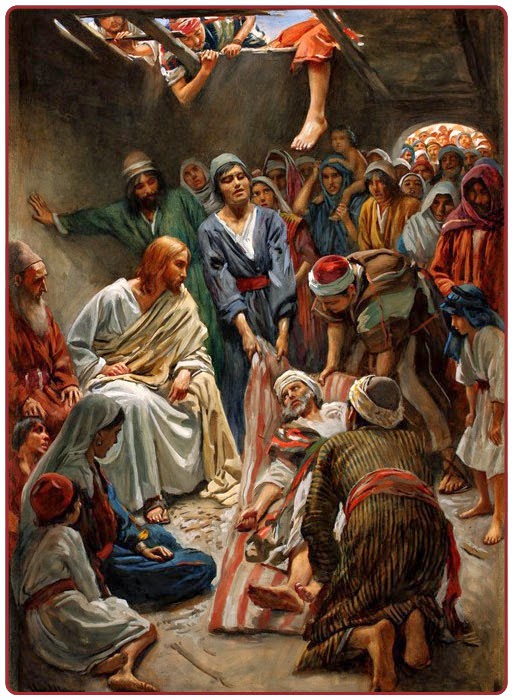
Jesus Heals the Paralytic Lowered from the RoofAnd behold, some people brought to him a paralytic, lying on a bed. And when Jesus saw their faith, he said to the paralytic, “Take heart, my son; your sins are forgiven.” And behold, some of the scribes said to themselves, “This man is blaspheming.” But Jesus, knowing their thoughts, said, “Why do you think evil in your hearts? For which is easier, to say, ‘Your sins are forgiven,’ or to say, ‘Rise and walk’? But that you may know that the Son of Man has authority on earth to forgive sins”– he then said to the paralytic – a “Rise, pick up your bed and go home.” And he rose and went home. When the crowds saw it, they were afraid, and they glorified God, who had given such authority to men.

In the name of the Father and of the Son and of the Holy Spirit. Amen.

What’s wrong with you? Self-diagnosis is one thing. But if someone were to follow you for a week, see everywhere you went, hear everything you say, and know your every thought, what would they say is your biggest problem?

Maybe, they would say you spent too much time on your phone and not enough time paying attention to your kids. Maybe, they would say that you spread rumors about people when you don’t really know the facts. Maybe, they would sayyou get angry too easily and quickly.Maybe, they would say that you are lazy and waste time at your job. Or maybe, they would say that your schedule is too full and you are neglecting more important things.

Getting an outside, impartial observer can be helpful in diagnosing your problem. But even people who have total access to your life might not correctly diagnose your biggest, most central flaw.

Now, imagine the scene in this house. Jesus is in His hometown. Mark tells us (Mk. 2:1-12) that Jesus is in His own house preaching the Word of God to the people gathered there. So many people come to hear Him that there isn’t any more room inside the house. But imagine that you are one of the people who are blessed to be inside.

As Jesus preaches, you notice sounds of footsteps coming from the roof. Then you start to hear faint sounds of scraping and pounding making the walls shake slightly. Some sprinkles of dust fall from the ceiling. A few blows later, and a thin beam of light hits the floor. You look up toward that hole and you can just barely make out the shape of fingers reaching through the hole. Suddenly,the hole expands as a bunch of rubble falls to the floor. Dust and straw fill the room. You turn your head away for a moment so that the dust doesn’t fall into your eyes. And then, when it sounds as though the debris has settled, you look up once again and notice a huge bundle being slowly lowered by four ropes.

The bundle finally reaches the floor, and the sheets fall flat revealing a man. He lies there. One arm is bent over his chest and the other lies motionless stretched out at his side. His legs are crossed, but in the most unnatural way. You wait to see him maneuver himself into a more comfortable position, but he doesn’t. In fact, the only sign of life is his eyes darting back and forth and his chest rising as he breathes a little frantically. You diagnose the problem: this man is paralyzed. And you think to yourself, “Well, whoever brought him here did the right thing. If anyone can help this man, it’s Jesus.”

Jesus looks up at the hole in the roof. He sees the faces of the people who have safely lowered their friend down. Then, Christ looks at the man and says, “Take heart, my son; your sins are forgiven.”

Think about this for a moment. This man’s biggest problem seems to be apparent to everyone but Jesus. The friends are probably up on the roof thinking to themselves, “Wait, what? We didn’t lug him up here, rip off the roof knowing that we’ll have to fix it ourselves, and lower him down to get forgiveness. What gives?”

But Jesus knows what this man’s biggest problem is. Christ knows what this man needs most. But don’t run too quickly with this either. Yes, the forgiveness of sins is what we need for our eternal welfare. Forgiveness is more important than food, clothes, shelter, and the ability to walk. But Jesus doesn’t always forgive people before He heals them.

In fact, in all the previous healings in Matthew, Jesus doesn’t follow this order. Chapter 8 contains Jesus’ first healing in Matthew. Jesus heals a leper and doesn’t absolve him. Then, He heals the centurion’s servant, but Jesus doesn’t announce forgiveness there. He heals Peter’s mother-in-law and large crowds with no mention of forgiveness. He casts out demons from two men, no absolution. And as chapter 9 continues, Jesus keeps healing, but He’ll tell people that they are healed because of their faith in Him. And we can’t (at least we shouldn’t) conclude that in those instances Jesus cared more about their physical well-being than forgiveness.

Put that on the back-burner for a moment because Jesus isn’t done diagnosing people’s problems.

Ministry of Word and Sacrament, Keys IconAfter telling the paralytic, “Take heart, your sins are forgiven,”Jesus diagnoses the scribes’ problem. They were grumbling in their minds thinking, “Just who does this guy think he is? Forgiving sins is God’s job.” But Jesus, knowing their thoughts, said, “Why do you think evil in your hearts?”

Notice that. Jesus says that doubting that He, a man, has the authority to forgive sins is evil. He doesn’t beat around the bush. Jesus calls out their evil. And He proves that He has the authority to forgive sins. He tells the paralytic, “Rise, pick up your bed and go home,”and the paralytic does, which proves that Jesus does indeed have the authority to forgive sins.

What’s your problem? I hope you see that it doesn’t matter so much what your problem is when you see that Jesus knows what it is (He does), and Jesus fixes the problem (whatever it is).

See Jesus’ pastoral heart. Jesus calls Himself the Good Shepherd, and ‘shepherd’ is what ‘pastor’ means. Jesus, the Good Shepherd, knows the needs of His flock, His sheep. Answering the question, “What’s your problem?” isn’t so important because Jesus knows what your problem is. He correctly diagnoses it and fixes it.

While everyone in that house – the listeners, the scribes, and the friends who lowered that man down from the roof – might have been scratching their heads when Jesus tells this paralytic that his sins are forgiven, the paralytic lying there heard the exact words he needed to hear. He needed to hear that his sins had been removed from him as far as the east is from the west, so that is precisely what Jesus gave him.

The scribes needed to hear Jesus call out their evil. And the crowds needed to see that God had given men (plural [foreshadowing Jesus giving the authority to forgive sins to all Christians]) the authority to forgive sins on earth (Mk. 2:10). Jesus gives each person exactly what they needed.

So, you here today, what’s your problem? Well, Jesus, the Good Shepherd, is here today. Surely, the Lord is in this place even if you, like Jacob in our Old Testament text, didn’t know it. This is the gate of heaven (Gen. 28:10-17), right here in this sanctuary. Jesus is here to give you exactly what you need. Jesus is here to give you His Word, Law and Gospel. Jesus has called you to put off your old sinful self, to put away your sin, and to be renewed in your minds (Eph. 4:22-28).

Communion Cross with JesusJesus is here, here to give you exactly what you need. He comes to give you His Body which was hung on a cross to endure the wrath of God for your sins. He comes to give you His Blood which He shed for the forgiveness of your sins. Whatever your problem is – even if you are unclear what it is – Jesus is here to deliver you from it. Amen.

The peace of God, which surpasses all understanding, will guard your hearts and minds in Christ Jesus. Amen.

The Finger of God – Sermon for the Third Sunday in Lent on Luke 11:14-28

Listen here.

Luke 11:14–28

14 Now he was casting out a demon that was mute. When the demon had gone out, the mute man spoke, and the people marveled. Jesus Rebuking Demon15 But some of them said, “He casts out demons by Beelzebul, the prince of demons,” 16 while others, to test him, kept seeking from him a sign from heaven. 17 But he, knowing their thoughts, said to them, “Every kingdom divided against itself is laid waste, and a divided household falls. 18 And if Satan also is divided against himself, how will his kingdom stand? For you say that I cast out demons by Beelzebul. 19 And if I cast out demons by Beelzebul, by whom do your sons cast them out? Therefore they will be your judges. 20 But if it is by the finger of God that I cast out demons, then the kingdom of God has come upon you. 21 When a strong man, fully armed, guards his own palace, his goods are safe; 22 but when one stronger than he attacks him and overcomes him, he takes away his armor in which he trusted and divides his spoil. 23 Whoever is not with me is against me, and whoever does not gather with me scatters.

24 “When the unclean spirit has gone out of a person, it passes through waterless places seeking rest, and finding none it says, ‘I will return to my house from which I came.’ 25 And when it comes, it finds the house swept and put in order. 26 Then it goes and brings seven other spirits more evil than itself, and they enter and dwell there. And the last state of that person is worse than the first.”

27 As he said these things, a woman in the crowd raised her voice and said to him, “Blessed is the womb that bore you, and the breasts at which you nursed!” 28 But he said, “Blessed rather are those who hear the word of God and keep it!”

Grace, mercy, and peace be to you from God our Father and from our Lord and Savior, Jesus Christ. Amen.

Some people will never believe. Their hearts are so hardened that, no matter how great a sign they see from the hand of God Himself, they still refuse to believe. This doesn’t mean that we should stop proclaiming the Gospel to them or stop praying for them. It is just reality. And, in fact, it is a call to further prayer because we recognize that conversion is always, always a work of the Holy Spirit chiseling away at sin-hardened hearts.

Jesus casts a mute demon out of a man. Some marveled. Some were still seeking from a sign from heaven. And some accused Jesus of casting out the demon by the power of Beelzebul (which means ‘lord of the flies’ a derogatory title for Satan stating that the devil is the lord of the dung heap).

Now, as illogical as the accusation is, we need to see how that it infinitely more blasphemous. Jesus delivers a man from a demon that made him mute. But people say, “Jesus is doing the devil’s work.”

And we need to pause here because nothing has changed. This world still calls good evil and evil good. If you are pro-life, you are sexist who just wants to control women’s bodies. If you stand for marriage as God created it or believe that men are men and women are women, you are homophobic.

Believer, this world hates God and hates Jesus, and it hates you too because you are God’s child. We live in a world that constantly stands good and evil on their heads. And the sooner you admit it, the better.

Jesus shows how ludicrous the claim that He is casting out demons by the power of Beelzebul. Instead, Jesus says it is by the finger of God that He is casting out demons which means that the kingdom, the reign, of God has come among those who scoff at wheat Jesus is doing.

This expression Jesus uses “the finger of God” is interesting. That phrase is only used four times in the Bible. You heard it in our Old Testament lesson (Ex. 8:16-24). Pharaoh’s magicians recognize that the plague of gnats is the finger of God coming in judgment against them. In Exodus 31[:18] and Deuteronomy 9[:10], Scripture talks about God’s finger writing the Ten Commandments on the stone tablets. Now here, Jesus talks about God’s finger casting out demons. The point is that Jesus casting out demons is a fulfillment of the Law and a plague on hell. Jesus tells demons to go and they have to go.

Then, Jesus tells something like a parable. He says that when a strong man [the devil] who is fully armed guards (and keep that word ‘guards’ in the back of your mind because it comes up again in a little bit) his house [the world] his goods [sinners] are safely under his lordship. But Jesus says that when one stronger than him [Jesus] is going to come and attack him, take away his armor, and divide the spoil [you].

Jesus says that He has come to rob the devil’s house and you are the spoils, the treasure, the plunder that Jesus is taking out of the devil’s cellar. He has won, redeemed, purchased, and grabbed you from the devil’s clutches. All by the power of His finger.

He has pulled you out of darkness and into His marvelous light. And notice what Jesus says, “Whoever is not with Me is against me.” There is no spiritual neutral ground. You are either rescued by Jesus and delivered into His kingdom, or you are held captive in the devil’s domain. And if you are not filled by the Holy Spirit, then the demons come back, and your last state is worst than the first.

So how do you know if you are in the kingdom of God or in the kingdom of the devil? Well, Jesus answers that. A woman says to Jesus, “Blessed is the womb that bore you, and the breasts that nursed you.” Now, Mary was certainly blessed. She is the mother of our Lord. But Jesus says, even better than being His mother is to hear the Word of God and keep (there is that same word used about the devil ‘guard’) it.

Though you were guarded by Satan, Jesus has come and rescued you with His finger transferring you to His kingdom. Now, you guard the Word that Jesus used to deliver you from Satan.

Cross and CommunionGuard it. Keep it. Take it. Eat and drink it. Because Jesus joins that Word of deliverance and forgiveness of sins to bread and wine. With His little finger, He destroyers the stronghold and armor of the devil. He claims you as His own. And He guards and keeps you now and for all eternity. Amen.

The peace of God, which surpasses all understanding, will guard your hearts and minds in Christ Jesus. Amen.