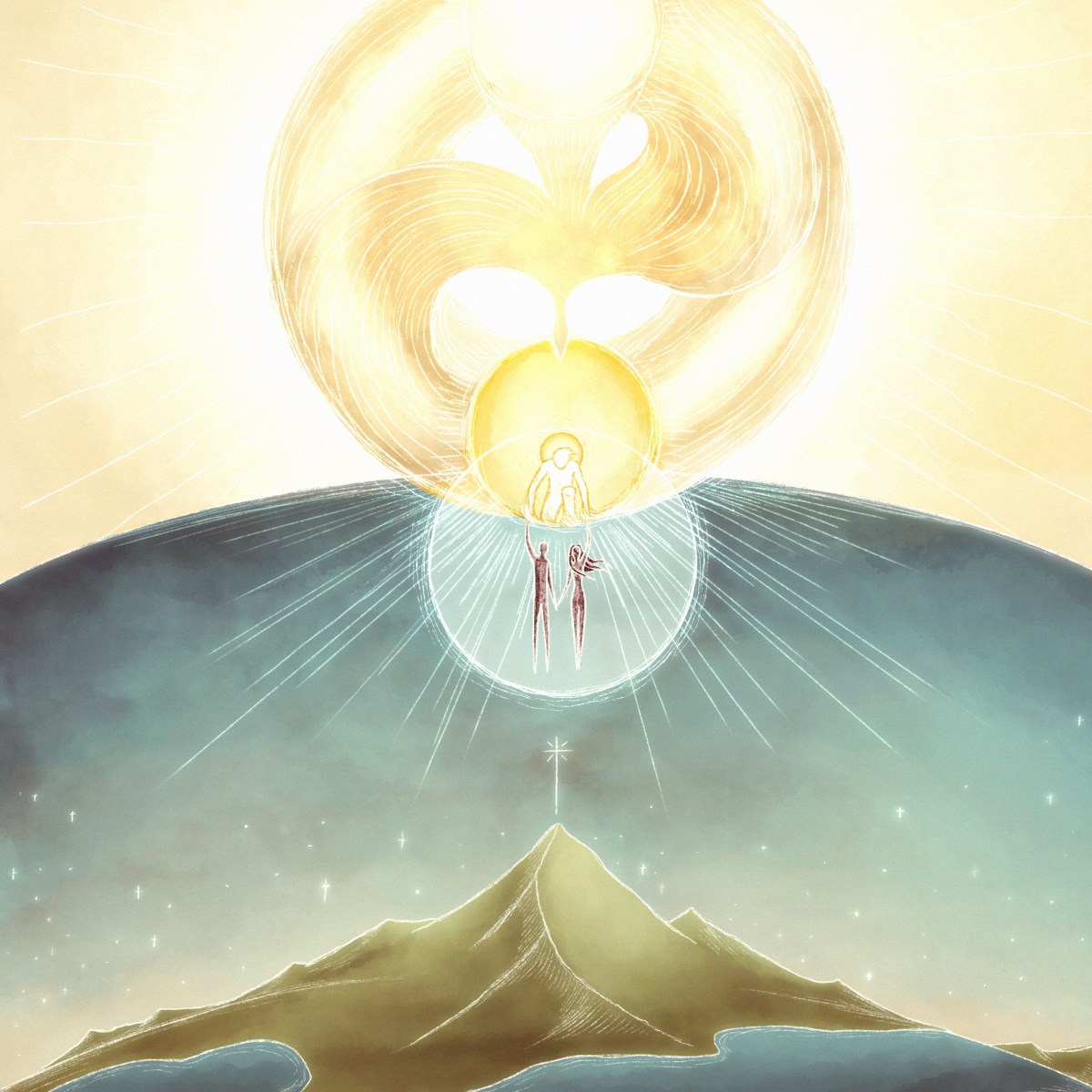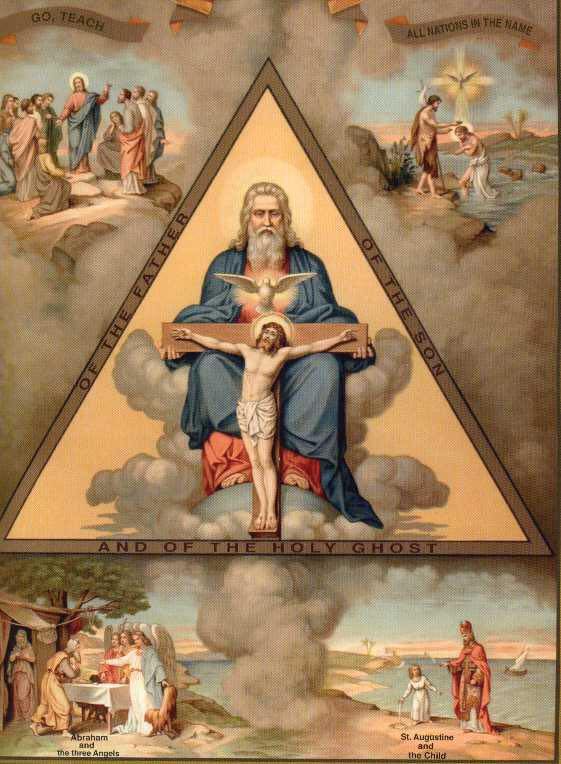
Holy Conversation – Sermon for Holy Trinity Sunday on the Athanasian Creed with Isaiah 6:1-8 as the Starting Point

Isaiah 6:1-8

In the name of Jesus. Amen.

We will get into this text from Isaiah a bit, but right off the bat, two things need to be addressed. The first is that second-to-last line of the Athanasian Creed we just confessed. In your bulletin, it’s on p. 6. It’s the line that reads: “Those who have done good will enter eternal life, and those who have done evil will go into everlasting fire.” That can sound like we’re confessing that salvation is based on works. But that line (as well as the line before it) is basically quoting what Jesus says in John 5. Jesus says that the hour is coming when all who are in the tombs will hear His voice. Then, our Lord says, “Those who have done good to the resurrection of life, and those who have done evil to the resurrection of judgment” (Jn. 5:28-29). So, we should ask ourselves, “Since this is what we confess in the Athanasian Creed, are we wrong when we say that we are saved by grace alone through faith alone?” The answer is a resounding, “No!”

The tension arises because of how we define ‘good.’ Because we are sinners, we grade goodness on a curve. When a one-year-old child takes her first tedious, wobbly steps, her parents praise her. They don’t expect her to glide across the room like at 27.78 mph like Usain Bolt. Scripture tells us that God’s standard for goodness is perfection and holiness (Mt. 5:481 Pet. 1:15-16). So, how do we get this perfection? The Bible is clear that it is only through faith.

The Bible defines what works aren’t good. Romans 14:23 says, “Whatever does not proceed from faith is sin.” And Hebrews 11:6 says, “Without faith it is impossible to please [God].” By faith you are pleasing to God because God counts that faith as righteousness (Gen. 15:6Hab. 2:4Ro. 4:3ff). By faith, God takes away all your sin and adds to you the perfect obedience and every good work of Jesus. By faith, you have done good and will enter eternal life. Romans 4:5says, “To the one who does not work but believes in Him who justifies the ungodly, his faith is counted as righteousness” (cf. Ro. 9:30-321 Co. 1:30Php. 3:9Gal. 2:16).

So, that’s the first thing. Yes, the Bible speaks about a judgment of those who have done good and those who have done evil. And the Bible teaches that goodness only comes through faith in the crucified and risen Jesus Christ.

The second thing I want to address is the history of Trinity Sunday. Holy Trinity Sunday exists because the laity—the average Christians in Alexandria, Greece, Rome, and England—wanted to have a festival to celebrate the Trinity. The clergy resisted, arguing that every Sunday was already dedicated to the worship of God the Father, Son, and Holy Spirit. But the laity were right. Let me just throw out one caveat before I go further. I’m summarizing several hundred years of Church history here. Don’t picture this as something that happened at a congregational annual meeting or at the AFLC Annual Conference.

The clergy only saw the Trinity as a doctrine, and the Church didn’t have feasts for doctrine. The Church doesn’t have an “Original Sin Sunday.” But the laity rightly kept pushing because the Trinity isn’t just a doctrine. It’s a Person (or Persons, plural). If we only see the Trinity as a doctrine to be learned, we’re missing something very important. The Trinity is who God is—Father, Son, and Holy Spirit. Today, we celebrate that we worship one God in three Persons and three Persons in one God.

Now, to this Isaiah text. I’ve preached on it in the past, and if you want, I can give you those sermons later. Just to quickly summarize, Isaiah has this vision of the holy, holy, holy God sitting on the throne. Isaiah is terrified because he knows he’s a sinner. God sends a seraph to deliver forgiveness exactly to the location that Isaiah felt his sin—to his lips. There are weeks’, if not months’, worth of sermons on those first seven verses. But I want to limit our focus today on Isaiah 6:8.

This is a text you might have memorized. But don’t let your familiarity with it make you miss the wonder here. Listen carefully. Isaiah writes, “I heard the voice,” singular, one voice. “I heard the voice of the Lord,” again, singular, one Lord. “I heard the voice of the Lord saying, ‘Whom shall I send,’” singular, one Sender. But that voice of the Lord rephrases the question, “Who will go for Us?”—plural. Multiple. More than one.

Do you hear what is happening there? The Lord is having a conversation, but this conversation isn’t with the seraphim. They’re too busy worshipping and calling out, “Holy, holy, holy.” God is speaking within Himself. The One God in three Persons—Father, Son, and Holy Spirit—is having fellowship and communicating within the Trinity. And this text from Isaiah isn’t the first time this happens.

On the sixth day of creation God said, “Let Us make man in Our image, after Our likeness” (Gen. 1:26f). After the Fall, God says, “Behold, the man has become like one of Us in knowing good and evil” (Gen. 3:22). At the Tower of Babel, God says, “Let Us go down and there confuse their language” (Gen. 11:7). Scripture also clearly teaches that God is one: “Hear, O Israel: The Lord our God, the Lord is one” (Dt. 6:4). In the first Commandment, God says, “You shall have no other gods before Me,” singular (Ex. 20:3). 

The Old Testament makes clear that there is a plurality and singularity in God. The key to unlocking this mystery is found best in the New Testament. God is one in essence, but also three distinct Persons—Father, Son, and Holy Spirit. Those three Persons have always existed in perfect relationship with one another. You know this from Sunday School and Confirmation, but let it play out in your mind today.

Before the world existed, before the Fall into sin, before God created mankind—in fact before anything was created—your triune God was already planning your salvation. Scripture says that Jesus is the Lamb who was slain before the foundation of the world (1 Pet. 1:19-20). Jesus teaches that you who believe will inherit the kingdom that was prepared for you from before the foundation of the world (Mt. 25:34). The book of Revelation says that your name was written in the Book of Life before anything was created (Rev. 13:817:8). Ephesians says that your Triune God chose you to be holy and blameless in Christ from before the foundation of the world (Eph. 1:4). So, let this be clear in your mind: All three Persons of the Trinity—Father, Son, and Holy Spirit—have eternally been conversing about you and your salvation.

Dear saints, this is the wonder of the God we worship. He is not just an idea or some principle. He is personal. In the Scriptures, in the Absolution, in your Baptism, at His Table, the Triune God says “I” to you. He says, “I have loved you with an everlasting love” (Jer. 31:3). He comforts you, “I, I am He who blots out your transgressions for My own sake” (Is. 43:25). He promises, “I am with you always, to the end of the age”(Mt. 28:20). And because He is personal, you get to answer. You get to pray, “You are my God” (Jn. 20:28Ps. 31:1463:188:1). You get to say, “You have redeemed me” (Ps. 31:5). You get to cry out, “You are my Refuge and my Strength” (Ps. 18:246:1) Salvation is God’s work, but is notjust a one-way transaction. It is real fellowship with the living God who has always been in conversation within Himself and who now invites you into that conversation.

In that conversation, God calls you to have a part and input through prayer. Here in Isaiah, the Trinity speaks about the mission of bringing salvation to the lost by asking, “Whom shall I send, and who will go for Us?” (Is. 6:8). And Isaiah was brought into that conversation, so he can respond, “Here am I! Send me.”

Dear saints, you do not go about in this world as a nameless servant. You go out as one who is known by God Himself. The Father who has always spoken to the Son now speaks to you as His own dear child. The Son who has always answered the Father unites you to Himself so that you belong to Him. The Spirit who has always shared in their fellowship now dwells in you and teaches you to cry out, “Abba, Father” (Ro. 8:15). This is personal. This is the God who thinks of you, who acts for you, and who feels compassion toward you. He is not far off. He speaks, and you can answer.

You have all of this because of my favorite line in the Athanasian Creed. It’s near the bottom of p. 5 of your bulletin and the last non-bold. It rightly confesses that Jesus is both God and Man but still One Christ, “one, that is to say, not by changing the Godhead into flesh but by taking on the humanity into God.” Ponder that today and every day.

In the incarnation of the eternal Son of God, God took on humanity into God. Part of who God is now is that He has a human body just like yours. The holy, eternal, all-knowing, omnipresent God lifted humanity unto Himself by becoming flesh and dying, rising, and ascending into heaven.

Dear saints, this is why we have Trinity Sunday. We are not celebrating an abstract doctrine. We are celebrating the living, personal God—who is Father, Son, and Holy Spirit—who loved you enough to send the Son for your redemption, and who now speaks to you so that you can answer Him.

Do not settle for knowing about the Trinity. Know the Triune God who speaks. The Father who sent the Son is your Father. The Son who was sent for you has made you His own. The Spirit who proceeds from them both (Jn. 14:2616:7Gal. 4:6) dwells in you and teaches you to speak with God in prayer. This is not just some doctrine that we talk about on Trinity Sunday. This is the daily wonder of your life in Christ.

Cleansed by His Blood and sent by His Spirit, you belong to the personal God who has always been in conversation—and who has now included you in it. Amen.

The peace of God, which surpasses all understanding, will guard your hearts and minds in Christ Jesus (Php. 4:7). Amen.

Eternal Wind, New Fire – Sermon on Acts 2:1-21 for the Day of Pentecost

Acts 2:1-21

In the name of Jesus. Amen.

Today we celebrate Pentecost, the day the Holy Spirit came with wind and fire. The Holy Spirit came in a special way to enable those believers in Christ—back in Acts 1:15, we read there were about 120 of them—the Holy Spirit enabled those believers to speak in languages from every nation under heaven (Act. 2:58-11) that they didn’t previously know. In those languages, they preached about Jesus to the crowds. And 3,000 souls were added to the Christian Church.

This sermon is going to focus on the Holy Spirit, but I do want to point out that the Holy Spirit doesn’t get mentioned much in this text. You’d think Pentecost would be all about the Holy Spirit, but He’s only mentioned twice in v. 4, and two more times in the passage Peter quotes from the prophet Joel (Act. 2:17-18; see Joel 2:28-32). When you go home today, read the rest of Acts 2, which will give you all of Peter’s sermon and the response of the crowd who hears that preaching. The majority of the text is pointing to Jesus and His death, resurrection, and ascension. That is the work of the Holy Spirit. The Holy Spirit points people to Jesus as He calls, gathers, enlightens, sanctifies, and preserves the entire Christian Church in the true faith.

Dear saints, what that means is that if you want to know if the Holy Spirit is present and working, you simply need to ask, “Am I being pointed to Jesus? Is Jesus is being proclaimed as the crucified, risen, and ascended Savior?” According to Jesus’ clear teaching, when He is being proclaimed, that is how you can know without a doubt that the Holy Spirit is at work (Jn. 15:2614:26). More on that later.

There are three things I want to highlight about the Holy Spirit, and they build on each other.

First, the Holy Spirit is a Person. He is not some force, electrical current, or emotion that bubbles up from inside us. He is a person. It can be easy to forget this about the Third Person of the Trinity. We know persons who are fathers. We know persons who are sons. The Holy Spirit is also a person of the one true God. He is not simply the Father or the Son at work in a new way. The Holy Spirit shares the same divine being with the Father and the Son. Scripture shows us this in clear ways.

At the baptism of Jesus, the Holy Spirit descended on Jesus in the form of a dove while the Father spoke from heaven (Mt. 3:16). Later in Acts, Ananias and his wife, Sapphira, get asked, “Why are you lying to the Holy Spirit?” (Act. 5:1-11). You don’t lie to a force. You can only lie to a person. Scripture clearly teaches that the Holy Spirit is the third Person who is distinguishable from the Father and the Son. Jesus Himself calls Him the “Comforter” (Jn. 14:16), and He says the Spirit “proceeds from the Father” and is sent by the Son (Jn. 15:26Gal. 4:6). All of this shows us that the Holy Spirit is not just stirring of our heart or a power or force. He is the Third Person of the one true God, and He works according to His own divine will (1 Co. 2:10-12).

We must also be careful to distinguish the Person of the Holy Spirit from the gifts He gives. Paul writes, “There are varieties of gifts, but the same Spirit” (1 Cor. 12:4). The Spirit Himself is not the same as the gifts He distributes. He is the Giver, not the gift. Knowing this preserves us from chasing after dramatic experiences or thinking the Spirit is only present when something unusual happens. The Holy Spirit is always the same, whether He works quietly or with visible signs.

The first point is the Holy Spirit is a person. The second point is this: the Person of the Holy Spirit has always been at work. It isn’t as though He was twiddling His thumbs from eternity past and only got going at Pentecost.

The Holy Spirit who appeared at Pentecost was already active long before. He was hovering over the waters at creation (Gen. 1:2). He led Moses and the people through the desert (Is. 63:11-14Neh. 9:19-21). He was in the prophets, moving them to speak God’s Word (2 Pet. 1:21). Isaiah promises that the Spirit who is upon the prophet will remain upon the Church forever (Is. 59:21). The Spirit has always been at work to make believers holy. That’s why David prayed, “Take not Your Holy Spirit from me” (Ps. 51:11). The Spirit who gives faith and new life has never been absent from God’s people.

Scripture even talks about the Holy Spirit’s work in and through people who aren’t believers. The evil prophet Balaam prophesied by the Spirit, though he was an unholy man (Num 24:2ff). King Saul and his men prophesied under the Spirit’s power. In 1 Samuel 19, Saul was hunting David. He sent out a band of men to find David, but they find Samuel instead. The Holy Spirit comes upon them and they start to prophesy. Saul sends a second and third wave of men and they begin to prophesy too. So, King Saul goes himself, and the same thing happens to him. But listen to what Scripture says, “[Saul] stripped off his clothes and prophesied… and lay naked all that day and all that night” (1 Sam. 19:18-24). That’s crazy! That’s not a good way to prophesy. But what that shows is that the Holy Spirit can work through a deranged Saul as a mark of the Spirit’s judgment upon Israel’s first king.

Before Jesus was crucified, Scripture tells us that the high priest, Caiaphas, spoke a true prophecy by the Spirit, even though he opposed Jesus (Jn. 11:47-53). The Spirit can work where and how He wills. But this is the point: the Holy Spirit has always been at work in the world and in the Church. Pentecost was not the beginning of His activity. Instead, it was a new and visible outpouring of the same eternal Spirit for the sake of spreading the Gospel to all people.

So, first: the Holy Spirit is a person. Second, the Holy Spirit has always been at work. Now, third: the Holy Spirit’s main work is to point you to Jesus, your Savior.

Everything the Spirit does serves this one purpose. At Pentecost, the signs—the sound of the eternal wind and the tongues of new fire—served to draw attention to and gather people for the preaching that followed. Peter stood up and preached an ordinary Christian sermon about the death, resurrection, and ascension of Jesus. Through that preaching the Holy Spirit worked repentance and faith in 3,000 hearts. The signs pointed people to the Word, and the Word pointed to Jesus.

That is still how the Holy Spirit works today. He does not point us to ourselves, to our feelings, or to dramatic experiences. He points us to Jesus. Jesus said, “When the Helper comes, whom I will send to you from the Father, the Spirit of truth, who proceeds from the Father, He will bear witness about Me” (Jn. 15:26). Jesus teaches that the Holy Spirit “will teach you all things and bring to your remembrance all that I have said to you” (Jn. 14:26). The test is simple: if Jesus is being proclaimed as the crucified, risen, and ascended Savior, the Holy Spirit is at work. If the focus has shifted somewhere else, the Spirit is not the one driving it.

The Holy Spirit reorients us so that we see Jesus more clearly, but He does not erase who we are. The apostles were still the same men after Pentecost. Peter was still Peter and those fishermen were still fishermen. But now their understanding, their gifts, and their direction in life were reoriented around Christ and His mission. In just fifty-three days, Peter went from being someone who wouldn’t even admit that he knew Jesus before a servant girl by a campfire (Jn. 18:17-18) to someone who openly declared to a massive crowd that they had killed the Lord and Christ (Act. 2:36).

Dear saints, the same Spirit works in you. He takes your personality, your background, your gifts, and even your weaknesses, and He reorients them so that you serve the mission of proclaiming Jesus to a lost world. That intentional proclamation of the Gospel is the fruit of the Holy Spirit. The fruit of the Spirit is love, joy, peace, patience, kindness, goodness, faithfulness, gentleness, and what? Self-control (Gal. 5:22-23). Dear saints, don’t forget that self-control is the result and visible fruit of the Spirit’s work. A sort of chaotic spontaneity is not evidence of the Holy Spirit. Self-control is. The Spirit produces the self-control in you to use who you in an ordered, faithful way for the good of others and the glory of Christ.

The Holy Spirit still comes to us today through the ordinary means He has given—through Word and Sacrament. In Baptism He pours out the washing of regeneration and renewal (Titus 3:5). He gives new birth (Jn. 3:5) and true faith in the heart. The Holy Spirit continually points you to Jesus for the forgiveness of your sins. In the Lord’s Supper He strengthens that faith and keeps you in the one true faith. Through these gifts the same personal Holy Spirit who has always been at work continues to call, gather, enlighten, sanctify, and preserve you in Jesus Christ.

Dear saints, on this Day of Pentecost give thanks to God for the Holy Spirit. He is the Third Person of the one true God, sharing the same divine being with the Father and the Son. He has always been at work in the Church and in the world. His main work is to point you to Jesus, your crucified, risen, and ascended Savior. And He does that work still today right here, as He reorients you with self-control so that your life serves the mission of Christ.

The eternal wind still blows. That new fire still burns. If you want to know if the Holy Spirit is present and working, do not look for any wind and fire. Look to Jesus. Is He being proclaimed as the Savior who died for your sins, rose for your justification, and ascended to rule over creation for your benefit? If that is what you are hearing, then you can be certain the Holy Spirit is at work. He is pointing you to Jesus, and in Jesus you have forgiveness, life, and salvation.

Come, Holy Spirit, fill the hearts of Your faithful people and kindle in us the fire of Your love. Amen.

The peace of God, which surpasses all understanding, will guard your hearts and minds in Christ Jesus (Php. 4:7). Amen.
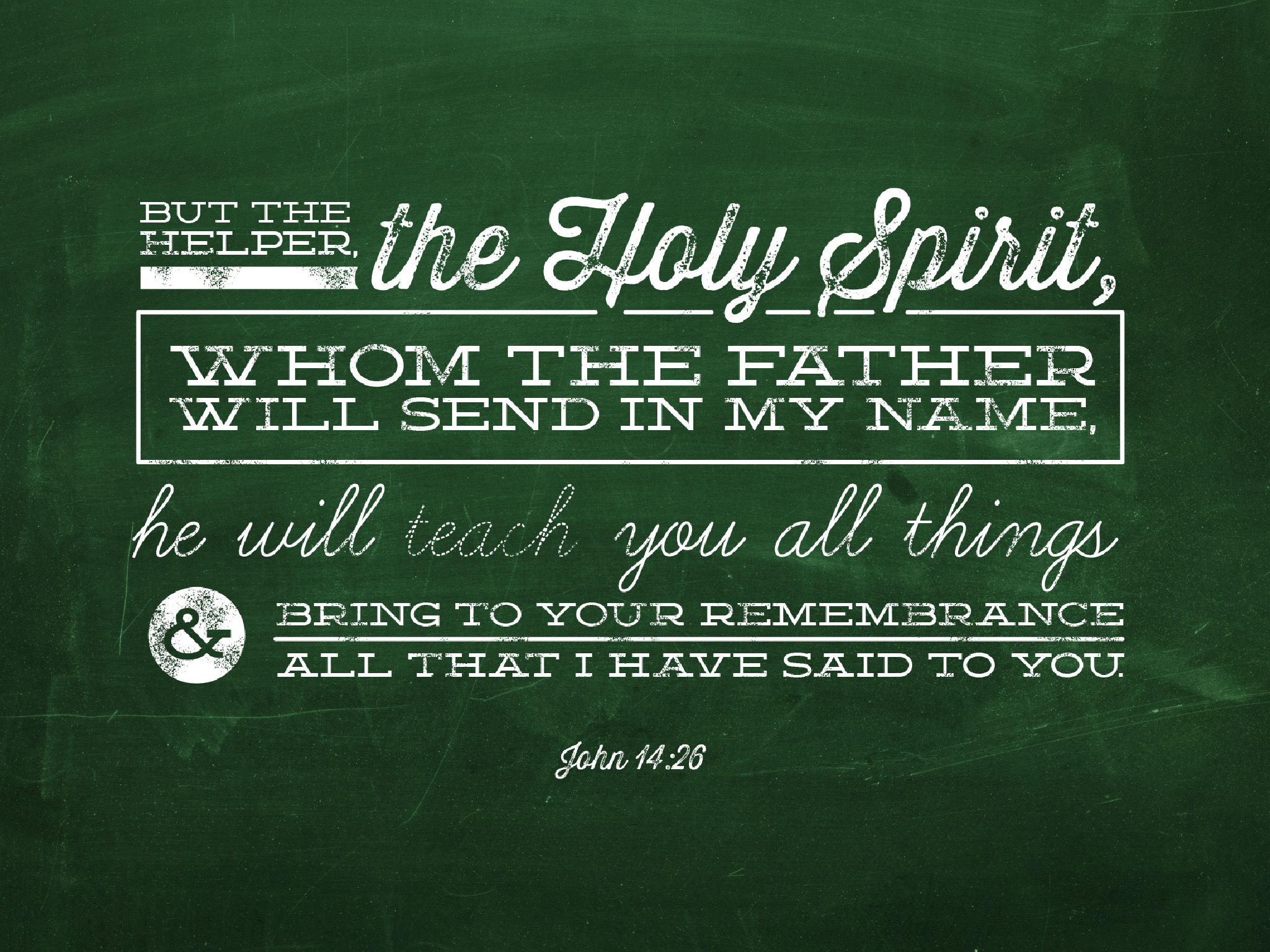
From, Through, & To – Sermon on Romans 11:33-36 for Holy Trinity Sunday

Romans 11:33–36

33 Oh, the depth of the riches
and wisdom and knowledge of God!
How unsearchable are his judgments
and how inscrutable his ways! 
34 “For who has known the mind of the Lord, 
or who has been his counselor?” 
35 “Or who has given a gift to him 
that he might be repaid?” 
36 For from him and through him and to him are all things.
To him be glory forever. Amen.

In the name of the Father and of the Son and of the Holy Spirit. Amen.

Who has seen the ocean? Probably everyone has seen the ocean. If you haven’t, I can show you a picture or video after the service and, technically, you will have seen the ocean. But a picture or video doesn’t do the ocean justice. It isn’t the same as seeing it in person with your own eyes. So, how many of you have been to the ocean and have seen it, smelled it, and felt it?

Now, which ocean(s) – the Pacific, Atlantic, Indian, Arctic, Antarctic? Maybe you have seen each of them, but how much of them have you seen? Did you see a bit of it from a beach? Have you been on a boat where no land is in sight? “Water, water everywhere and not a drop to drink.” Even then, you only saw just shy of three miles of ocean before the curve of the earth pulled the rest of it away from your sight. And your field of vision only allowed you to see so much without turning your head or spinning around in circles, which, if you are prone to seasickness, is not something I would recommend. And even if you’ve been so far out to sea that no land was in sight, you can only say that you’ve skimmed the surface of the ocean – literally.

Have you seen what’s in the ocean and on its floor? Have you been able to snorkel or scuba dive to see what’s down there? How deep have you gone? Twenty, fifty, one-hundred feet? I have one friend who has dived to somewhere near that depth. As far as I know, I don’t know anyone who has been 1,000 feet below the surface of the ocean. The average depth of the ocean is about 2.3 miles deep. Some people have gone that deep. But think about the deepest part of the ocean, Challenger Deep, which is nearly 7 miles below sea level. Twelve people have walked on the moon, but only three have ever been down there.

Many people have gone up into space, orbited the planet hundreds of times, and have seen the majority of the oceans’ surface. But they haven’t been through all the oceans at all the depths to see what lies underneath the surface. So, I ask again, have you seen the ocean? Ultimately, no one can claim to have seen the oceans in their entirety. The best anyone can accurately say is, “I’ve seen a tiny fraction of the ocean.” The oceans are too big, too wide, too deep for anyone to see very much of it. But still, we wouldn’t call someone a liar if they said that they have seen the ocean. To see part of it is to truthfully say that you’ve seen it.

All of that is to set this up: These verses come at the tail end of Paul’s main theological treatise in Romans. In the first eight chapters, Romans is a thorough skimming of the surface of theology. It has dealt with the fact that no one is righteous in the way that God demands. Because of that everyone deserves death and condemnation. But God, in His mercy, has delivered the very righteousness He demands to those who have faith in Christ. By believing that God has come in the flesh of Jesus; believing that Christ suffered, bled, and died; and believing that He rose again for you, you are righteous – as righteous as Jesus is righteous. 

Then, Paul dives deeper into the depths of the theological ocean. He writes about how God delivers that faith through His gracious choosing of you. Inspired by the Holy Spirit, Paul talks about the doctrines of election and predestination. Believer, you are saved exclusively because of what God has done. Jesus has done the work to deliver, rescue, and save you from your sin. The Holy Spirit has called you through God’s Word, given you faith to believe, and will sustain your faith as He works through the Scriptures (Ro. 10:17). Your salvation is entirely based on God’s mercy (Ro. 8:29-33) and the fact that He chose you to be in Christ from before the foundation of the world (Eph. 1:4-5). The culmination of Paul’s short dive into the doctrine of predestination comes in the verse just before this text where his conclusion is, “God has consigned all to disobedience, that He may have mercy on all” (Ro. 11:32).

Now, the doctrine of predestination is a huge topic, and I’m not going to go into it today. I have preached on it the past. And if you ever have questions about it, please feel free to talk with me. (I enjoy having any theological conversations.) The only reason I mention predestination here is to set up the context of the praise that we heard in this reading. God’s mercy in delivering salvation to us unworthy sinners leads to this doxology, this song of praise that is our reading: “Oh, the depth of the riches and wisdom and knowledge of God! How unsearchable are His judgments and how inscrutable His ways!”

Whenever we study theology, no matter what branch of theology is being studied, we come to a point where we realize the simple truth that God is bigger than us. God has revealed much to us in His Word, but He hasn’t revealed everything. His riches, wisdom, and knowledge go to a depth that we cannot reach. His ways are inscrutable and inconceivable. It isn’t just that they are hard to understand they are far, far beyond our comprehension. Just like how you’ve only seen a small sliver of the ocean, but you haven’t seen the whole thing. The more I study theology and the Bible, the more I realize there is to learn. It’s a regular occurrence for me to be reading a passage and suddenly realize, “I’ve never noticed that before.” Christian, there’s always more to be learned and meditated on when it comes to theology and the Bible. More and more and more and more. And it is always a joy and delight to discover more.

Today is Holy Trinity Sunday which ends the festival half of the Church year which began in Advent. The Advent, Christmas, Epiphany, Lent, Easter, and Pentecost seasons focus on God’s work for us by coming, declaring, suffering, dying, rising, ascending, and sending the Holy Spirit. Now, on Trinity Sunday, we recognize that the work of our salvation is exclusively brought about by the plan and efforts of the one God who is Father, Son, and Holy Spirit. So, Trinity Sunday is a fitting time to pause, step back, and simply praise God for all He has done, accomplished, and delivered to us. Even though we’ve spent the past six months considering what God has done to save us, we’ve just barely scratched the surface. Even when we do it again and again, there is still more.

We can’t know God’s mind. We can’t advise Him. We can’t give or offer anything to Him. That’s why Paul closes in v. 36 with this doxology, “From Him and through Him and to Him are all things.”

Consider each of those in order. “From Him,” God the Father is the source and Creator of all things. “Through Him,” God the Son has set all things in order and gives them to us. “And to Him,” the God the Holy Spirit directs all things so they find their end and meaning in this one God.

Rejoice because this One unfathomable, inscrutable, inconceivable God took it upon Himself to create, redeem, and sanctify you. So, “to Him be glory forever.” In the name of the Father and of the Son and of the Holy Spirit. Amen.

The peace of God, which surpasses all understanding, will guard your hearts and minds in Christ Jesus. Amen.

The Lasting Legacy of Pentecost – Sermon on Acts 2:1-21, 36 for the Day of Pentecost

Acts 2:1–21, 36

1 When the day of Pentecost arrived, they were all together in one place. 2 And suddenly there came from heaven a sound like a mighty rushing wind, and it filled the entire house where they were sitting. 3 And divided tongues as of fire appeared to them and rested on each one of them. 4 And they were all filled with the Holy Spirit and began to speak in other tongues as the Spirit gave them utterance. 

5 Now there were dwelling in Jerusalem Jews, devout men from every nation under heaven. 6 And at this sound the multitude came together, and they were bewildered, because each one was hearing them speak in his own language. 7 And they were amazed and astonished, saying, “Are not all these who are speaking Galileans? 8 And how is it that we hear, each of us in his own native language? 9 Parthians and Medes and Elamites and residents of Mesopotamia, Judea and Cappadocia, Pontus and Asia, 10 Phrygia and Pamphylia, Egypt and the parts of Libya belonging to Cyrene, and visitors from Rome, 11 both Jews and proselytes, Cretans and Arabians—we hear them telling in our own tongues the mighty works of God.” 12 And all were amazed and perplexed, saying to one another, “What does this mean?” 13 But others mocking said, “They are filled with new wine.” 

14 But Peter, standing with the eleven, lifted up his voice and addressed them: “Men of Judea and all who dwell in Jerusalem, let this be known to you, and give ear to my words. 15 For these people are not drunk, as you suppose, since it is only the third hour of the day. 16 But this is what was uttered through the prophet Joel: 

17 “ ‘And in the last days it shall be, God declares, 
that I will pour out my Spirit on all flesh, 
and your sons and your daughters shall prophesy, 
and your young men shall see visions, 
and your old men shall dream dreams; 
18 even on my male servants and female servants 
in those days I will pour out my Spirit, and they shall prophesy. 
19 And I will show wonders in the heavens above 
and signs on the earth below, 
blood, and fire, and vapor of smoke; 
20 the sun shall be turned to darkness 
and the moon to blood, 
before the day of the Lord comes, the great and magnificent day. 
21 And it shall come to pass that everyone who calls upon the name of the Lord shall be saved.’

36 Let all the house of Israel therefore know for certain that God has made him both Lord and Christ, this Jesus whom you crucified.”

In the name of Jesus. Amen.

With all the amazing things that happened on the Day of Pentecost, it’s easy to miss the most amazing thing God did when He poured out the Holy Spirit on all flesh (Act. 2:17; Joe. 2:28-29). Our attention is so quickly and easily grabbed by the wowie-zowie things, that we get distracted from the lasting gift that God bestows with this giving of the Holy Spirit. Pentecost is about the sounds, not the sights. It’s about the audible rather than the visible. The work of the Holy Spirit is not so much in what is seen as in what is heard.

Yes, there are tongues of fire that rest on those believers, but as best as we can tell, those tongues of fire were only seen by the 120 Christian believers who had gathered together in one place (Act. 1:15). Notice, there is the sound of a mighty, rushing wind (Act. 2:2), but curtains aren’t flapping, dust isn’t flying, hats aren’t blowing down the street. It’s only the sound, and that sound fills the house where they are gathered. These 120 believers are filled with the Holy Spirit and are given the ability to speak in languages that represented every nation that existed, but they hadn’t ever learned those languages (Act. 2:5, 8-11).

It is that sound of wind that draws the bewildered multitude to the apostles (Act. 2:6). The people from all those nations weren’t drawn like moths that saw a flame; no, they were drawn by the sound. And those people heard something even more amazing. They heard those believers declaring the mighty works of God in their native languages. For some, that message led to further curiosity, “What does this mean?” But for some, it led to mocking, “They are drunk and filled with wine” (Act. 2:13).

Now, consider that accusation as I slightly modernize it. Imagine you are there in that crowd. All the people from Italy are standing around someone who’s speaking Italian, and they’re listening intently because they can understand. All the Brazilians gather around the guy speaking Portuguese. All the people from France, and 22.8% of the Canadians who speak French, are listening to someone speaking French. You hear the guy who’s speaking American,[1] and you can understand everything because it is being spoken fluently. You hear the Gospel. You are told that God came in the flesh of Jesus. You hear that He suffered, bled, died on the cross, rose again from the dead, and ascended into heaven. And you hear that Christ did all of this to forgive you of your sins and give you eternal life.

After hearing that message in American, you go over to the people who speak Portuguese (because, of course, people who speak French are rude) and you ask in one of the ‘commercial, business’ languages – either Greek, Latin, or Aramaic – what they heard. And it’s the same Gospel message. The only difference was that they heard it in Portuguese – fluent, articulate Portuguese. So, it’s clear that these Galilean hillbillies are speaking languages they didn’t know. Your conclusion would probably not be, “Oh, they must be drunk.” Getting drunk doesn’t endow a person with fluency in another language. In short, it probably wasn’t the act of speaking in other languages that elicited that accusation; instead, it was probably the content of what was being said. “You’re saying that God came to earth as a human. But He did it to die, and by that death I’m forgiven? You must be drunk.”

But the sounds of Pentecost still aren’t done. Peter stands up, and here is where we see the most amazing thing about Pentecost. Peter doesn’t stand up to perform a visible sign. He doesn’t heal the sick, cast out demons, or raise the dead. Peter stands up to speak and preach a Holy Spirit-inspired sermon to the entire crowd. That should be astounding to us.

We know Peter and what kind of man he was just fifty-three days before Pentecost. A young servant girl had simply asked Peter if he knew who Jesus was, and that led to Peter denying Jesus three times (Mk. 14:66-72). But now Peter, filled with the Holy Spirit, preaches to a crowd of over 3,000 people. And it is a bold sermon. He doesn’t hold back. He does point to Jesus with the sermon, but not with loud Gospel overtones.

I’ll just summarize his sermon. “Men of Israel, Jesus was here just a short time ago. He did all sorts of miracles, and you know about them. You know He was sent by God, yet you put Him to death. Now, we have seen Him raised from the grave. This Jesus has now ascended into heaven. He has all authority in heaven and on earth, and He will use that authority for the sake of His Church until He has put all His enemies under His feet. That’s a big problem for you because you put Him to death and are His enemy. You’re in trouble. Amen.”

It’s a sermon that would have been highly criticized in seminary because it doesn’t really contain any Gospel. How does a guy like Peter preach like that, especially because he preaching that accusation against himself? Peter knows his own guilt. The only explanation is that Peter was filled with the Holy Spirit and emboldened in a remarkable way. The sermon itself is a miracle. But then, the response to that sermon is even more miraculous.

Over 3,000 people ask, “What can we do?” Before this, the crowds had heard some amazing things and wondered what it all meant, but now? Now, they are cut to the heart (Act. 2:37), and they recognize their guilt. This is amazing because most of them probably were not present in the crowd on Good Friday crying out, “Crucify, crucify Him.” The foremost expert on the history and practices of this time, a guy named Alfred Edersheim, says that there may have been some overlap but the majority of the people there for the Day of Pentecost weren’t there for the Passover. So, Peter is addressing a crowd of hardened sinners who could have offered all sorts of excuses arguing for their innocence of Jesus’ death. But over 3,000 of them don’t. They confess and repent with a simple, “What shall we do?” (Act. 2:37).

And Peter adds a postscript to his sermon and tells them, “Repent and be baptized in the name of Jesus Christ for the forgiveness of your sins, and you will receive the gift of the Holy Spirit” (Act. 2:38). That very day, 3,000 souls were saved. 

They were given faith. They were also given and filled with the Holy Spirit. But that filling of 3,000 people with the Holy Spirit is so understated. Luke doesn’t tell us about another mightier wind that rushed even louder. No. They confess, repent, get Baptized, and are filled with the Holy Spirit. They are saved. How were they saved? Through the Holy Spirit’s work of pointing sinners to Jesus in simple preaching and through the Holy Spirit’s working through water and the Word. And through those means, the Holy Spirit creates faith.

Dear saints, that same miraculous work of the Holy Spirit through preaching continues today. In fact, that is what is happening even now. It is through God’s Word proclaimed by the mouth is this sinner that the Holy Spirit is creating, strengthening, and sustaining your faith. Right now, through God’s Word, the Holy Spirit is filling this place and pointing you to Jesus (Jn. 15:26).

Don’t think for one minute that the Holy Spirit isn’t working just because you don’t see whatever you think might be evidence of the Holy Spirit. The lasting legacy of Pentecost is that the Holy Spirit points sinners to Christ. Jesus Himself said that’s the Holy Spirit’s work (Jn. 15:26). Right here, right now, the Holy Spirit is calling, gathering, enlightening, sanctifying, and preserving you in the one true faith. He is here abundantly forgiving you of your sin. And the Holy Spirit invites you now to Jesus’ table where He will work through other means, through bread and wine which are Jesus’ Body and Blood. Come, receive, and be filled with the Holy Spirit. Amen.

The peace of God, which surpasses all understanding, will guard your hearts and minds in Christ Jesus. Amen.


[1] Yes, I know ‘American’ isn’t an official language.

Charismatic Vocation – Sermon on 1 Corinthians 12:1-11 for the Tenth Sunday after Trinity

1 Corinthians 12:1–11

1 Now concerning spiritual gifts, brothers, I do not want you to be uninformed. 2 You know that when you were pagans you were led astray to mute idols, however you were led. 3 Therefore I want you to understand that no one speaking in the Spirit of God ever says “Jesus is accursed!” and no one can say “Jesus is Lord” except in the Holy Spirit. 

4 Now there are varieties of gifts, but the same Spirit; 5 and there are varieties of service, but the same Lord; 6 and there are varieties of activities, but it is the same God who empowers them all in everyone. 7 To each is given the manifestation of the Spirit for the common good. 8 For to one is given through the Spirit the utterance of wisdom, and to another the utterance of knowledge according to the same Spirit, 9 to another faith by the same Spirit, to another gifts of healing by the one Spirit, 10 to another the working of miracles, to another prophecy, to another the ability to distinguish between spirits, to another various kinds of tongues, to another the interpretation of tongues. 11 All these are empowered by one and the same Spirit, who apportions to each one individually as he wills.

In the name of Jesus. Amen.

Paul began this letter to the Christians in Corinth by saying that God had given them all knowledge, speech, and every spiritual gift they needed. Paul said that Jesus would sustain them guiltless until He returns (1 Cor. 1:4-8). With this glowing opening, you would expect the Corinthian congregation to be getting along splendidly. But you would be wrong.

There were divided groups that claimed loyalties to different former pastors causing dissension in the congregation. The members were suing each other in civil, secular courts. They were neglecting the poor. A man was having an illicit relationship with his father’s wife and bragging about it. Some members were getting drunk at Communion. On top of all that, there were even disputes about who was more holy based on the spiritual gifts they had received. So, the context of these verses is Christians fighting with each other over spiritual gifts and who was better because of them. That’s what the text is addressing. Now, I’m not preaching on this text because there is fighting here at Christ the King over who is more spiritual or less spiritual.

The reason I’m preaching on this text today is to encourage you to use the gifts the Holy Spirit gives you in your everyday lives. There is a tendency for all of us – please note that I’m including myself here – to be timid when it comes to living out our faith. I think a lot of that timidness has to do with ignorance about spiritual gifts. Paul begins by saying that he does not want us to be ‘ignorant’ about spiritual gifts. I know our translation says ‘uninformed,’ but the word there isn’t so much about a lack of information, rather it is about a lack of understanding, so ‘ignorant’ is probably better. So today, we want to grow in our understanding of spiritual gifts: what they are, how they are received, and how God uses them.

First, what are the spiritual gifts? The New Testament uses six different words or phrases to talk about spiritual gifts. I’m not going to go through all of them, but the Greek term χάρισμα is the most common and Paul uses that word twice in this text (v. 4 & 9). Yes, it is where we get our word ‘charisma.’ Χάρισμα means ‘gift of grace’ or ‘gracious gift.’ 

Scripture has two different lists of these gifts of grace, one is here in 1 Cor. 12:7-11, 27-30, and the other list is Ro. 12:6-8. The interesting thing is that the two lists aren’t the same. And there are many other verses throughout the New Testament that talk about other χάρισμα even though they aren’t included in a list. Many theologians suggest, and I tend to agree, that the lists are different and other χάρισμα are mentioned elsewhere because these lists aren’t intended to be comprehensive. In other words, there are more spiritual gifts than the ones listed.

There are some things that Scripture calls χάρισμα that we wouldn’t expect to be called ‘spiritual gifts.’ Here’s some of the surprises: service (διακονία where we get our word ‘deacon’); teaching; encouragement; generous giving; leadership; being merciful; a word of wisdom, guidance, or knowledge; faith (not what we would call ‘saving faith’ but an abundant trust and confidence in God’s provision); discernment of spirits; being an apostle; helpful acts; even chastity within marriage and outside of marriage – all of these are spiritual gifts, they are all χάρισμα. A lot of them aren’t so spectacular, but Scripture still calls them χάρισμα.

Second, how are the spiritual gifts received? According to our text (v. 4-7), these gifts are given through the Holy Spirit, but the Holy Spirit doesn’t ever work alone. Instead, the entire Trinity is involved. These various gifts are given by the Spirit; the varieties of places to serve are given by the same Lord (i.e. Jesus Christ, the Son). And the varieties of activities are empowered by the same God (think God the Father). We don’t determine what gift or gifts we receive, it’s up to our Triune God. And God will provide whatever gift we need to fulfill our Christian duty to our neighbor.

One of the ways we are ignorant when it comes to spiritual gifts is that we tend to confuse spiritual gifts with natural talents. I think one of the reasons we confuse the two is that there have been spiritual gift tests and inventories for decades that focus more on where we think we have talents and interests. Natural talents are certainly gifts of God, but spiritual gifts are what God the Father, Son, and Holy Spirit gives you as you carry out the various callings God gives you in life.

Another problem that makes us ignorant of spiritual gifts is that we confuse the order of things. We think the talents we have should determine the callings we pursue. But repeatedly in Scripture and in your own life, it ends up being the opposite. You are called to do something, and the Holy Spirit equips you with the spiritual gifts you need to do it. You’ve probably heard the phrase, “God doesn’t call the equipped; He equips the called.” It’s a little trite, and that phrase can be wrongly interpreted to mean that we don’t need to train or prepare ourselves – i.e. the phrase can be used as an excuse to be lazy. But with a proper understanding, it’s not a bad saying.

You Christian parents, even if you planned on when you would begin having children, you probably quickly realized that there were a lot of things you didn’t know and skills you didn’t have to be a good parent. But the Holy Spirit has given and will give you what you need when you need it. Most often, God doesn’t equip us with gifts in advance. Instead, He gives us exactly what we need exactly when we need it to minister to others as we serve in our vocations. Wherever God calls you, He will give you whatever you need to minister to that person in that situation (Mt. 10:19-20).

Finally, how does God use the spiritual gifts He gives us? Paul will go on after our text to use the analogy of our bodies (1 Cor. 12:12-26). Your body has many different parts that all need each other. Eyes need ears and toes and noses and hearts and livers and kidneys. No part of the body can say that is doesn’t need the others. In the same way, each Christian is part of the body of Christ and is dependent upon the other members. Just as all the parts of your physical body work together to do one common thing – keep you alive – all the parts of the Body of Christ work together to do one common thing – proclaim the Gospel, the forgiveness of sins through Jesus’ death and resurrection.

I know I’ve used the term ‘vocation’ quite a bit in the past, but it is good to revisit it and be clear about what a vocation is in a theological and spiritual sense. When we talk about ‘vocation’ in the Scriptural sense, it means your office or your relationship to the person or people God has placed in your life at any given moment. Every moment of every day God puts you into a relationship with another person where you have different responsibilities. Those are your vocations.

As a silly example, if you find yourself in a moving car, you have one of two possible vocations. Either your vocation is to be a driver, which means your tasks are to drive safely, follow the traffic laws, don’t cause danger to others, and get to your destination safely, or, if you aren’t the driver, your vocation is to be a passenger and your responsibilities are to not make the driver’s vocation more difficult than it needs to be.

Here is the good news, God gives you all the gifts you need to fulfill your vocation every moment of every day. So, rather than filling out inventories and reading books to try to discover your spiritual gift, or your χάρισμα, simply ask yourself, “Who is my neighbor right now, and what is my vocation to that neighbor? How does God want me to serve this person/people?” and Scripture promises that everything will fall into place.

We should expect the Holy Spirit to give us what is needed in each situation we encounter. We should expect and pray that the Holy Spirit will give us what is needed based on whom and what God presents to us. Be attentive.

If you are talking with someone who is going through a lot of problems, the Holy Spirit is calling you to the vocation of being a supportive brother or sister in Christ. Then, pray for the spiritual gifts, the χάρισμα of encouragement, wisdom, knowledge, and compassion depending on the situation. If you are struggling in your marriage, pray for the χάρισμα of chastity, faith, and service. If you are playing with your kids, pray for the χάρισμα of joy and generous giving of your time and energy. If you are at work and have a difficult task, pray for the χάρισμα of service, leadership, or helpful acts. I could go on, but I think you get the idea.

Constantly let your vocation shape your prayers for the spiritual gifts you need in that moment, and watch God act. God loves to hear those prayers. He has promised to answer them. And God the Father, Son, and Holy Spirit will gift, equip, and empower you as He freely gives you the gifts you need to love and serve your neighbor. Amen.

The peace of God, which surpasses all understanding, will guard your hearts and minds in Christ Jesus. Amen.

In This Way, God Loved the World – Sermon on John 3:1-17 for Holy Trinity Sunday

John 3:1–17

1 Now there was a man of the Pharisees named Nicodemus, a ruler of the Jews. 2 This man came to Jesus by night and said to him, “Rabbi, we know that you are a teacher come from God, for no one can do these signs that you do unless God is with him.” 3 Jesus answered him, “Truly, truly, I say to you, unless one is born again he cannot see the kingdom of God.” 4 Nicodemus said to him, “How can a man be born when he is old? Can he enter a second time into his mother’s womb and be born?” 5 Jesus answered, “Truly, truly, I say to you, unless one is born of water and the Spirit, he cannot enter the kingdom of God. 6 That which is born of the flesh is flesh, and that which is born of the Spirit is spirit. 7 Do not marvel that I said to you, ‘You must be born again.’ 8 The wind blows where it wishes, and you hear its sound, but you do not know where it comes from or where it goes. So it is with everyone who is born of the Spirit.”

9 Nicodemus said to him, “How can these things be?” 10 Jesus answered him, “Are you the teacher of Israel and yet you do not understand these things? 11 Truly, truly, I say to you, we speak of what we know, and bear witness to what we have seen, but you do not receive our testimony. 12 If I have told you earthly things and you do not believe, how can you believe if I tell you heavenly things? 13 No one has ascended into heaven except he who descended from heaven, the Son of Man. 14 And as Moses lifted up the serpent in the wilderness, so must the Son of Man be lifted up, 15 that whoever believes in him may have eternal life.

16 “For God so loved the world, that he gave his only Son, that whoever believes in him should not perish but have eternal life. 17 For God did not send his Son into the world to condemn the world, but in order that the world might be saved through him.

In the name of Jesus. Amen.

Sometimes, broad, general statements are more comforting than pointed, specific statements. I heard a church historian tell the story about Martin Luther being asked if he wished that John 3:16 read, “For God so loved Martin Luther, that He gave His only Son…” And Luther said, “No! I’d be searching my entire life for another guy named ‘Martin Luther.’”

Does God love you? How do you know? “For God so loved the world,” and you are part of the world, “that He gave His only-begotten Son that you who believe in Him will never perish but have everlasting life.” Yes. God loves you. He loves you. Yesterday, God loved you. Three months ago, God loved you. Five years ago, God loved you. While you were a sinner, God loved you (Ro. 5:8). Before you were born, God loved you. Two thousand years ago as Jesus carried His cross out of the gates of Jerusalem, God loved you. Before the foundation of the world, God loved you. Christian, according to Revelation 13:8, God wrote your name in the Book of Life even before He said, “Let there be light” (Gen. 1:3).

John 3:16 is probably the most familiar verse of Scripture in our day and is the “ABC’s and 1, 2, 3’s” of the faith. Today, we’re going to graduate “Christianity 101” and consider John 3:16 as “Christianity 201.” We’re going to dissect two words of the verse – the words ‘for’ and ‘so’ – because those words help us understand the context and meaning of the verse.

We’re going to spend most of our time on the word ‘for,’ so bear with me. Because the verse starts with the word ‘for,’ we have to consider the context. That word ‘for’ ties John 3:16 to what comes before it, which is Jesus recalling how Moses lifted up the serpent in the wilderness (Num. 21:4-9), which was our Old Testament reading three weeks ago.

There, God’s people had been sentenced to forty years of wandering in the wilderness (Num. 14:28-35). During that time of exodus, the people become impatient and said the only reason Moses lead them out of slavery in Egypt was so they would die in the wilderness (Num. 21:5). They complained about the food God was miraculously and faithfully raining down upon them each day. So, God sends fiery serpents to bite the people, and many of them die. Finally, they ask Moses to pray that God would take away the serpents. God answers their prayer, but not by taking the serpents away. Instead, God gives them the cure for the venom. God instructs Moses to make a bronze serpent, set it on a pole, and tell the people to look at if they are bitten and they would be cured of the venom and live.

This God-given cure seems odd, but consider it for a minute. The dead, bronze serpent lifted up on the pole is the God-given sign that God is destroying their enemy and killing it. By looking at the serpent, they believe that God is defeating their enemy and that He is in control. That faith is what saves them. Now here in John 3, Jesus says that just as the serpent was lifted up in the wilderness, so must He be lifted up. In other words, the people were saved in the wilderness by looking at an image of their defeated enemy.

Now, this is a little more challenging to grasp, but it’ll be worth it. When Jesus is on the cross, He quotes Psalm 22:1, “My God, My God, why have You forsaken Me?” (Mt. 27:46; Mk. 15:34). Psalm 22 is one of the most vivid descriptions of the crucifixion – almost more vivid than what the Gospels record for us. The Psalm says, “all who see me mock me… they wag their heads” (Ps. 22:7) which we see happening in Mt. 27:39 and Mk. 15:29. The Psalm says, “They divide my garments among them, and for my clothing they cast lots,” (Ps. 22:18; Jn. 19:24). The Psalm says, “They have pierced my hands and feet,” (Ps. 22:16). I could go on, but you should just read Ps. 22 with the crucifixion in mind today.

The verse from Ps. 22 we need to focus on today is Ps. 22:6 which says, “I am a worm and not a man.” When Jesus quotes Psalm 22 from the cross, He is stating He is a worm and not a man. Now, stick with me here. Satan’s lies in the Garden deceived the woman; she ate (Gen. 3:13; 1 Tim. 2:4), and Adam also ate. Our first parents sinned, and their sin brought the poison of death and corruption to all mankind. So, on the one hand, Jesus crucifixion places the sins of the world on Jesus, the new Adam, and punishes those sins there.

But, ultimately, the source and origin of that sin is the devil. The serpent’s deceiving poison brought sin and death into the world. That is why God promises to crush the serpent’s head (Gen. 3:15). This is why John 3:16 is tied to Moses lifting up the serpent in the wilderness. When we look to Jesus’ crucifixion, God wants us to see that Christ is defeating sin at it’s source which is the serpent. Most cultures and languages, including our own, make a connection between worms, serpents/snakes, and dragons. Here in John 3, Jesus says that He is the serpent who is hung on the cross for the salvation of the world. In other words, Jesus utterly defeats sin at its source.

When you look upon Jesus who is crucified for you, you believe that Jesus has taken the punishment for all sin and all evil. God made Jesus, who knew no sin, to be sin so that in Jesus you might become the righteousness of God (2 Cor. 5:21).

That brings us to the other word, ’so.’ The word there in Greek isn’t a magnifier or amplifier. It does not mean, “God loved the world so much.” The Greek word there means, “in this way.” God loved the world in this way, that He gave His only-begotten Son to utterly defeat sin and the origin of sin on the cross. Now, you who believe in Him will not ever perish, but have everlasting life. This is the way God loved the world.

God is love (1 Jn. 4:8, 16), but that can only be true because of the Trinity. For there to be love, there must be something to love. If God were one, He could not have love as part of His essence. Love would not be essential to His existence. A god who is only one could think highly of himself, but that isn’t love. Only with the Trinity it is possible for God to be love. There is an eternal love of the Father for the Son and Spirit, a love of the Son for the Spirit and Father, and a love of the Spirit for the Father and Son. This perfect relationship of love has eternally existed in the one God who is Father, Son, and Holy Spirit.

In God Himself, there has always been an object of love. No other religion can say that love is essential to who God is because no other religion confesses the Trinity. Ever since the creation, that perfect, eternal love that has always existed between Father, Son, and Holy Spirit now flows from God to us, His creatures. And we know that because God gave His Son to save and forgive us on the cross.

The Father and the Son and the Holy Spirit is God. The Son has done for us what we could not do for God. Jesus has come and was perfectly obedient to all of God’s commands. Because He is God, Jesus can render His perfect obedience back to God on our behalf. And the Holy Spirit creates faith in that work of Jesus.

Dear saints, all of this is to say that because God is Triune, He can perfectly love and save you by grace. Because God is Father, Son, and Holy Spirit, you are not simply His slaves or pets. No. You are the object of His love. God the Father has created you out of pure love. God the Son has redeemed you out of pure love. And God the Holy Spirit has sanctified you out of pure love. You are saved and redeemed to be God’s children.

Jesus, the eternal Son of God, has come into the world not to condemn you, but in order that you might be saved through Him. Blessed be the holy Trinity. Amen.

The peace of God, which surpasses all understanding, will guard your hearts and minds in Christ Jesus. Amen.

Triune Forgiveness – Sermon on Isaiah 6:1-7 for Holy Trinity Sunday

Isaiah 6:1-7

1 In the year that King Uzziah died I saw the Lord sitting upon a throne, high and lifted up; and the train of his robe filled the temple. 2 Above him stood the seraphim. Each had six wings: with two he covered his face, and with two he covered his feet, and with two he flew. 3 And one called to another and said: 

“Holy, holy, holy is the Lord of hosts; 
the whole earth is full of his glory!” 

4 And the foundations of the thresholds shook at the voice of him who called, and the house was filled with smoke. 5 And I said: “Woe is me! For I am lost; for I am a man of unclean lips, and I dwell in the midst of a people of unclean lips; for my eyes have seen the King, the Lord of hosts!” 

6 Then one of the seraphim flew to me, having in his hand a burning coal that he had taken with tongs from the altar. 7 And he touched my mouth and said: “Behold, this has touched your lips; your guilt is taken away, and your sin atoned for.”

In the name of Jesus. Amen.

Today, I have five observations to consider from this text.

1. What Isaiah sees is remarkable but not unique. Isaiah had this vision of God when he was in the Temple. But it’s important to note that Isaiah was not the high priest, so this vision didn’t take place while Isaiah was in the Most Holy Place. Isaiah wasn’t even a priest, so this vision couldn’t have been when Isaiah was in the Holy Place either. Isaiah was a prophet called by God, but he was normal guy. In other words, Isaiah would have been in the courtyard of the Temple with all the other regular worshippers. You can basically think of this vision as what Isaiah sees when he goes to Church. He’s normal guy in a normal place at a normal time, but what he sees is extraordinary. 

Dear saints, there are things going on around us right now that we cannot see or hear. But just because our senses don’t pick them up doesn’t mean they are any less real than the things we can perceive with our senses. The Bible teaches that there are angels all around us all the time protecting us and ministering to us. Jesus Himself teaches us that He is present with us and seated on His throne with all authority in heaven and earth (Mt. 28:18, 20; 18:20). And that is always true whether you are at church or not. 

But when you are in church, the same things Isaiah saw in this vision are here and present with you. Hebrews 12:22-24 says, “You have come to Mount Zion and to the city of the living God, the heavenly Jerusalem, and to innumerable angels in festal gathering, and to the assembly of the firstborn who are enrolled in heaven, and to God, the judge of all, and to the spirits of the righteous made perfect, and to Jesus, the mediator of a new covenant.” In other words, here in this sanctuary you are in God’s domain. The angels and archangels, the seraphim and cherubim are all here. Surrounding you are all God’s people, Christians from every time and age, present here worshipping, glorifying, and praising God with you. You can’t see them, but that doesn’t make their presence any less real.

What Isaiah sees here is always true when God’s people gather together. In other words, it isn’t as though God was normally far, far away, but then, one time, He came close enough for Isaiah to see Him. No Isaiah simply is allowed to see the reality of God’s presence which was and is normally invisible. Dear saints, when you come into this place, see with your ears. The triune God – Father, Son, and Holy Spirit – along with all the angels and all the saints of all time are present right here with us.

2. Notice this reality that Isaiah sees. Isaiah sees the Lord sitting upon a throne. And Scripture leaves us no doubt. Isaiah sees Jesus. The Gospel of John spells it out. Isaiah sees Jesus, the eternal Son of God and the second Person of the Trinity (Jn. 12:36-41). Above Jesus, Isaiah sees the seraphim. These are one of the types of angels that Scripture tells us about. Their name means ‘burning ones.’ These angels have six wings. Two of the wings are used to cover the seraph’s face; two cover the seraph’s feet; and two are used to fly. Now, the interesting thing is that these seraphim are already holy. The don’t have any sin, but even they need to cover their creatureliness before the awesome holiness of God.

That brings us to their song. The seraphs sing, “Holy, holy, holy is the Lord of armies; the whole earth is full of His glory.” Their song is repetitive, three holy’s. It is true that the Hebrew language will use repetition for emphasis. God is holy, holy, holy. But those three holies could also be translated as, “Holy One, Holy One, Holy One.” Three holy Ones – again, Father, Son, and Holy Spirit. The angels are praising one God, but three distinct holy Ones. Now, Isaiah can only see the Son, but he hears the praise of each Person of the Trinity. And we know that all three persons of the Trinity are there because just after our text, the triune God asks, “Whom shall I [sg.] send, and who will go for Us [pl.]?”

3. Look at Isaiah’s response. Standing in the presence of the holy Trinity, Isaiah is terrified. Isaiah says, “Woe is me! For I am lost; for I am a man of unclean lips, and I dwell in the midst of a people of unclean lips.” We need to dissect this a little bit. Notice that Isaiah starts with a conclusion before moving to his confession. Isaiah’s conclusion is, “Woe is me! For I am lost.” That’s his understanding of the situation and what he thinks is going to happen to him. But his conclusion is wrong. It’s wrong not only because that isn’t what happens, but it’s also wrong because it is a denial of who God is.

When Isaiah says, “I am lost,” thinks he is about to be cut off and damned. He figures God has finally come to judge him and condemn him to hell. This is wrong and, frankly, disappointing. Remember Isaiah was in the Temple. The Scriptures clearly teach that the whole purpose of the Temple, the reason it was there, was so God could dwell among His people and forgive their sins (2 Chr. 6:21, 27). God had defined Himself as the God who is merciful and gracious slow to anger and abounding in steadfast love and faithfulness… forgiving iniquity and transgression and sin (Ex. 34:6-7).

Imagine coming to church. You hear the absolution. In the sermon, you are pointed to Jesus as the Lamb of God who takes away your sin. You receive the Body and Blood of Jesus for the forgiveness of your sins. Then, you have a vision like Isaiah’s and your response is, “Well, I’m going to hell.” That’s ludicrous, but that’s Isaiah’s conclusion here! Dear saints, the whole point of everything we do here at church is to remove any doubt and increase your faith that God has forgiven all of your sins – every last one of them – for the sake of Jesus’ death and resurrection. As disappointing as Isaiah’s conclusion is, we would probably do the same. Repent. God isn’t lying to you when He delivers His grace and mercy to you here in this place. You are forgiven, made holy, continually given the perfect righteousness of Christ. Amen?

Now, Isaiah’s confession and recognition is right. He is a sinner. He does have unclean lips, and the people around him have unclean lips. This means he deserves God’s wrath and judgment, but His conclusion is still false.

4. Isaiah’s guilt has a location. Sin isn’t just floating around as some nebulous, philosophical idea. No. Isaiah recognizes his sinful lips. But didn’t Isaiah have sinful feet? What about corrupt eyes? A lustful groin? An idolatrous heart? So, why does Isaiah focus on his lips?

The best guess is that the devil somehow knew God was about to call Isaiah to be a prophet. To be a prophet requires the use of your lips and mouth to speak the Word of God. So, Satan probably made extra effort that day to point Isaiah to how he sinfully used his lips to make Isaiah feel guilt and shame with the very instrument God would use Isaiah to minister.

The devil does this all the time. He will point out the sin and iniquity of the very gifts God wants us to use in fulfilling our callings and vocations in service to Him and our neighbor. This is true for all Christians, but today I want to address you fathers since I won’t be here next week.

Fathers, first of all, happy Fathers’ Day a week early. You fathers, the devil will do this to you. Satan will try to point you to your failures as a husband and father. And it will be easy for him to do this because you do fail. Sometimes, you are too harsh; other times you have been too lax in disciplining your children. You don’t show the kindness and love you should, and you have not been the father God intends you to be. But those sins do not disqualify you from being a father to your children. One of the most important things fathers can teach their children is confessing when you sin and asking for forgiveness. Again, your failures do notdisqualify you from being a father. Fathers, if you are still alive and still have children, God calls you to be a father. And God will equip and enable you to be exactly the father that your children need. Which brings us to the fifth and final observation.

5. The glory of the triune God is His forgiveness and mercy. Because there is one God and three Persons – because God is Father, Son, and Holy Spirit – God is both just and merciful, both just and loving. If God were only one, this couldn’t be the case. But because God is Father, Son, and Holy Spirit, God the Son can satisfy God’s just demands, and He has. Jesus has done for you what you could not do for God. Jesus renders His perfect obedience to the Father, and the Holy Spirit delivers to you the peace of forgiveness in Christ as He works on you through the Scriptures. Just don’t think that the Father is the only member of the Trinity who is just, that the Son is the only member who is loving and merciful, and that the Holy Spirit is the only member who works out your salvation. That isn’t the case either.

Dear saints, what God did for Isaiah, He does for you as well. It wasn’t the coal that removed Isaiah’s sin. It was God’s promise. Yes, God attached that promise to the coal which made it the instrument that delivered that promise to Isaiah. But God’s promise is attached to more things than that one coal that burned up millennia ago. God has attached His promise of mercy and forgiveness to the water of your Baptism. When those waters touched your body, your guilt was taken away, and your sin atoned for. When you heard the absolution earlier, those words entered your ear, and your guilt was taken away, and your sin atoned for. When you eat and drink the Body and Blood of Christ, your guilt is taken away and your sin atoned for.

God the Father, Son, and Holy Spirit is here today to bring you His mercy and grace freely given because of Christ. You are clean, and God sends you from here back out into the world with a free, spotless conscience (Heb. 10:19-25). Amen.

The peace of God, which surpasses all understanding, will guard your hearts and minds in Christ Jesus. Amen.

Very Good – Sermon on Genesis 1:1-2:3 for the Twenty-first Sunday after Trinity

Genesis 1:1-2:3

1 In the beginning, God created the heavens and the earth. 2 The earth was without form and void, and darkness was over the face of the deep. And the Spirit of God was hovering over the face of the waters. 

3 And God said, “Let there be light,” and there was light. 4 And God saw that the light was good. And God separated the light from the darkness. 5 God called the light Day, and the darkness he called Night. And there was evening and there was morning, the first day. 

6 And God said, “Let there be an expanse in the midst of the waters, and let it separate the waters from the waters.” 7 And God made the expanse and separated the waters that were under the expanse from the waters that were above the expanse. And it was so. 8 And God called the expanse Heaven. And there was evening and there was morning, the second day. 

9 And God said, “Let the waters under the heavens be gathered together into one place, and let the dry land appear.” And it was so. 10 God called the dry land Earth, and the waters that were gathered together he called Seas. And God saw that it was good.

11 And God said, “Let the earth sprout vegetation, plants yielding seed, and fruit trees bearing fruit in which is their seed, each according to its kind, on the earth.” And it was so. 12 The earth brought forth vegetation, plants yielding seed according to their own kinds, and trees bearing fruit in which is their seed, each according to its kind. And God saw that it was good. 13 And there was evening and there was morning, the third day. 

14 And God said, “Let there be lights in the expanse of the heavens to separate the day from the night. And let them be for signs and for seasons, and for days and years, 15 and let them be lights in the expanse of the heavens to give light upon the earth.” And it was so. 16 And God made the two great lights—the greater light to rule the day and the lesser light to rule the night—and the stars. 17 And God set them in the expanse of the heavens to give light on the earth, 18 to rule over the day and over the night, and to separate the light from the darkness. And God saw that it was good. 19 And there was evening and there was morning, the fourth day. 

20 And God said, “Let the waters swarm with swarms of living creatures, and let birds fly above the earth across the expanse of the heavens.” 21 So God created the great sea creatures and every living creature that moves, with which the waters swarm, according to their kinds, and every winged bird according to its kind. And God saw that it was good. 22 And God blessed them, saying, “Be fruitful and multiply and fill the waters in the seas, and let birds multiply on the earth.” 23 And there was evening and there was morning, the fifth day. 

24 And God said, “Let the earth bring forth living creatures according to their kinds—livestock and creeping things and beasts of the earth according to their kinds.” And it was so. 25 And God made the beasts of the earth according to their kinds and the livestock according to their kinds, and everything that creeps on the ground according to its kind. And God saw that it was good. 

26 Then God said, “Let us make man in our image, after our likeness. And let them have dominion over the fish of the sea and over the birds of the heavens and over the livestock and over all the earth and over every creeping thing that creeps on the earth.” 

27 So God created man in his own image, 
in the image of God he created him; 
male and female he created them. 

28 And God blessed them. And God said to them, “Be fruitful and multiply and fill the earth and subdue it, and have dominion over the fish of the sea and over the birds of the heavens and over every living thing that moves on the earth.” 29 And God said, “Behold, I have given you every plant yielding seed that is on the face of all the earth, and every tree with seed in its fruit. You shall have them for food. 30 And to every beast of the earth and to every bird of the heavens and to everything that creeps on the earth, everything that has the breath of life, I have given every green plant for food.” And it was so. 31 And God saw everything that he had made, and behold, it was very good. And there was evening and there was morning, the sixth day. 

1 Thus the heavens and the earth were finished, and all the host of them. 2 And on the seventh day God finished his work that he had done, and he rested on the seventh day from all his work that he had done. 3 So God blessed the seventh day and made it holy, because on it God rested from all his work that he had done in creation.

In the name of Jesus. Amen.

An overture is a medley that opens an opera, suite, or play, and it introduces the different songs you will hear through the whole work. Movies used to do this often. Most of you are probably familiar with The Sound of Music. The movie begins with scenes of the mountains and fields surrounding Salzburg, Austria, and after Julie Andrews frolics through the grass singing “The Hills Are Alive,” the overture begins. The overture continues several more measures of “The Hills Are Alive,” but then transitions into “Do-Re-Mi,” followed by, “A Few of My Favorite Things,” which morphs into “Something Good,” and closes with a brief hint to “Climb Every Mountain.” There aren’t any lyrics in the overture, so you don’t know that part of the song, but you get to hear the melody so it sticks in your mind and you are able to recognize it when the actual song enters the movie. Not every song gets into the overture, but it gives you an idea of the significant events that are coming up in the film.

Well, the text we just heard is the overture of all of Scripture. So much of what the Bible teaches is introduced in these verses, but too often we miss them because we’re so familiar with the account of creation. So, we’re going to do our best to open our ears to hear the themes that are introduced in this text. We will catch some of the melodies presented to us, so that when the rest of Scripture gives us the lyrics, we can recognize the music behind the song. Just so you know, because there is so much packed into these verses, we aren’t going to be able to hit everything. Sorry.

Right off the bat, we are introduced to one of the great, mysterious theological truths of Scripture – we serve a triune God. In Hebrew, the third and fourth words are ‘God’ and ‘created.’ The interesting thing is that the word for ‘God’ is Elohim, which is a plural word, but the verb for ‘created’ is singular. This would sound really weird to a Hebrew-speaker reading it. Imagine if you read, “The painters (pl.) cleans (sg.) their brushes.” It’s a little jarring.

On top of that, in v. 2-3, you are introduced to each of the three Persons of the Trinity (especially if you know the rest of your Bible). You see the Spirit of God hovering over the waters. (The Holy Spirit’s connection to water is a whole theme of Scripture by itself, but we’re not going to dive into that today.) The Holy Spirit is over the water. God the Father speaks. And the Word that is spoken is Jesus who was in the beginning with God through whom all things were made (Jn. 1:3).

We see a return to this theme of the Trinity in v. 26 where God says, “Let us make man in our (pl.) image (sg.) after our (pl.) likeness (sg.).” Then, v. 27 says with poetic beauty, “So God (pl.) created (sg.) man (sg.) in His (sg.) own image, in the image of God (pl.) He created (sg.) him (sg.); male and female He created (sg.) them (pl.).” Just briefly, as a sidenote, part of us being created in the image of God is that we share with God a plurality. Our one God has a plurality of three, one mankind has a plurality of two. This is why I would encourage you to not use someone’s “preferred pronouns” – especially if those pronouns are the plural, they/them. That is a demonic attempt to twist and mangle God’s creation and to make an individual more than he or she actually is. Moving on.

The second part of the overture I’ll point out today is that God is a God of order (1 Cor. 14:33). And we see this in the details of what is created each day. In v. 2, we are told that the earth is without form and void. In days 1-3, God creates defined spaces that give form and order, and in days 4-6, God fills those spaces. You can think of it as God creating a shelf on days 1-3 and God filling those shelves days 4-6. Day one, God creates light and time; then on day four, God fills it with sun, moon, and stars. Day two, God creates the atmosphere and waters; then on day five, God fills those spaces with birds and fish. Day three, God creates land and plants; then on day six, God fills the space with animals and mankind. 

This is so beautiful. God doesn’t just build the house of creation. He also fills and decorates it. Because God creates with this order, we can say that wherever and whenever we see disorder, there are evil forces working against God. Satan brought that disordering when he tempted Adam to fall into sin, and we see that continued work of the devil and demons wherever there are attempts to bring anarchy, chaos, and confusion. After the Fall in Gen. 3, the rest of the Bible is about God bringing order back into a sin-sick, chaotic creation.

The third movement of this overture we will highlight is the movement from darkness to light. Verse 2tells us that before God spoke over the formlessness and void, there was darkness over the face of the deep. Before God creates, there is darkness, but then God speaks, “Let there be light,” and there was light. And notice how each of the first six days end with the refrain, “and there was evening and there was morning the ___ day.” So, each day of the creation account begins with darkness and moves toward light.

In our culture today, we mark the beginning of a day at midnight, and this is totally fine. We’re just using the way the Roman empire counted time. The Hebrew culture considers the start of the next day to be right around sunset, which would be about 6 PM because they are closer to the equator than we are. So, they have kept that theme of a day moving from darkness to light. And in the Church, we do this as well. Christmas begins in the “eve.” When it is dark, we celebrate the birth of Christ, and the day moves toward the light.

The interesting thing is that when we get to the seventh day, the pattern “there was evening and morning” that we have heard six times, is broken. There is only mention of the fact that there is a seventh day. So, this entire account moves from chaos and darkness to order and eternal, never-ending light. The book of Revelation shows the conclusion and culmination of this beautiful movement from darkness to light. Rev. 21:23-25 tells us that the eternal city of God will have no sun or moon for the glory of God gives it light and there will be no night there.

Since we’re talking about this seventh day with no darkness, we’ll move to the next beautiful piece of this overture – the eternal day of rest. The seventh day is totally unique in three ways. First, God doesn’t speak a single word on the seventh day. God is silent because the heavens and the earth were finished, completed. God has said all that needed to be said, and His creative Word continues to work to this day as it echoes through His creation. All of creation continues to run and exist because of the Word of God.

The second way the seventh day is unique is that it is blessed. On day five, God blessed the sea creatures and birds to be fruitful and multiply, filling the waters and the air. On day six, God blesses mankind to be fruitful and multiply filling, subduing, and having dominion over the earth. it. (Many people today are calling for population control. They say there are too many people on the planet. Dear saints, this is a demonic thought. God created the world to be filled with people, and He blesses us for the purpose of filling the world.) But then, God finishes creation by blessing a day. It is God’s intention to use the blessed seventh day to bless His people – both physically with rest from work, and spiritually with His holiness being conveyed from God to people.

The third way the seventh day is unique is that it doesn’t have an end in the text. The text makes the seventh day eternal and open. Even though we have fallen into sin, God has given us access to the seventh day of eternal rest until Jesus comes again in glory on the Last Day. Hebrews 3-4 encourages us to listen to God’s Word and enter God’s rest. Hebrews 4:9–10 says, “So then, there remains a Sabbath rest for the people of God, for whoever has entered God’s rest has also rested from his works as God did from His.”

Dear saints, there are so many wonderful themes here in the account of creation, but the one that tops them all is the power of the Word of God. Through His Word, God created all things in six days, and since sin entered the world, God has used His Word to bring the sin-induced chaotic creation back into order and rest. So, God sent His Son, Jesus, the Word made flesh, into the world. Colossians 1:19-20 says, “In [Christ Jesus] all the fullness of God was pleased to dwell, and through Him to reconcile to Himself all things, whether on earth or in heaven, making peace by the blood of His cross.”

The God who says, “Let there be ____,” and that which does not exist obeys, He now says to you, “Your sins are removed from you as far as the east is from the west” (Ps. 103:12), and they are. He says to you, “I am the resurrection and the life. Whoever lives and believes in Me shall never die” (Jn. 11:25-26), and it is true. He says to you, “Come to Me, all you who labor and are heavy laden, and I will rest you” (Mt. 11:28), and you find peace.

Dear saints, this is very good indeed. God has created, redeemed, and sanctified you. Trust in what Christ has done, and you will find your eternal rest with God and will all His saints. Amen.

The peace of God, which surpasses all understanding, will guard your hearts and minds in Christ Jesus. Amen.

Triune Love – Sermon on John 3:1-17 for Holy Trinity Sunday

John 3:1-17

1 Now there was a man of the Pharisees named Nicodemus, a ruler of the Jews. 2 This man came to Jesus by night and said to him, “Rabbi, we know that you are a teacher come from God, for no one can do these signs that you do unless God is with him.” 3 Jesus answered him, “Truly, truly, I say to you, unless one is born again he cannot see the kingdom of God.” 4 Nicodemus said to him, “How can a man be born when he is old? Can he enter a second time into his mother’s womb and be born?” 5 Jesus answered, “Truly, truly, I say to you, unless one is born of water and the Spirit, he cannot enter the kingdom of God. 6 That which is born of the flesh is flesh, and that which is born of the Spirit is spirit. 7 Do not marvel that I said to you, ‘You must be born again.’ 8 The wind blows where it wishes, and you hear its sound, but you do not know where it comes from or where it goes. So it is with everyone who is born of the Spirit.”

9 Nicodemus said to him, “How can these things be?” 10 Jesus answered him, “Are you the teacher of Israel and yet you do not understand these things? 11 Truly, truly, I say to you, we speak of what we know, and bear witness to what we have seen, but you do not receive our testimony. 12 If I have told you earthly things and you do not believe, how can you believe if I tell you heavenly things? 13 No one has ascended into heaven except he who descended from heaven, the Son of Man. 14 And as Moses lifted up the serpent in the wilderness, so must the Son of Man be lifted up, 15 that whoever believes in him may have eternal life.

16 “For God so loved the world, that he gave his only Son, that whoever believes in him should not perish but have eternal life. 17 For God did not send his Son into the world to condemn the world, but in order that the world might be saved through him.”

In the name of Jesus. Amen.

John 3:16 might be the most recognizable verse of all Scripture. It has, rightly, been called “the Gospel in a nutshell.” That being said, there is a common misconception about one little word of the verse – the word “so.” Most of the time, we understand “so” to mean “so much,” so we read into the verse, “God loved the world so much that He gave His only-begotten Son….” However, the Greek word that gets translated as “so” has a different nuance. It actually means, “in this way.” Here’s how it comes across in Greek, “For God loved the world in this way, that He gave His only-begotten Son, that whoever believes in Him should not perish but have eternal life.”

God the Father loved you by sending His only-begotten Son to die and rise again for you. It is one thing for a person to love you by sacrificing his own life for you. But your God goes further by giving His eternally beloved Son so that you might be saved through Him. In other words, if you ever have doubts about God’s love for you, you only need to look to the cross and empty tomb. By the concrete, historical, provable action of God sending Jesus to shed His blood, die, and rise again for you, God has loved you. That love has not, will not, and can not ever change.

In a lot of ways, that’s enough of a sermon right there, but you’re going to get more.

Today is Trinity Sunday. Scripture teaches that there is one God in three Persons and three Persons in one God. So, as Christians, we worship one God who is Father, Son, and Holy Spirit.

It’s easy for us as Christians to think that there is the God we know and love, but then there are a bunch of guys on the fringe of Christianity called “theologians.” These stuffy guys dress weirdly, have no social skills, and like talking about this thing called “the Trinity,” while go about the important things of real life. I hope this sermon is a beginning of seeing how doctrine – and specifically the doctrine of the Trinity – sparks a joy and wonder in our God who is Father, Son, and Holy Spirit.

The doctrine (or teaching) of the Trinity is the first mystery of the Christian faith. The doctrine of the Trinity is not a secret. A secret is something that you keep to yourself, and if you tell it to another person it isn’t a secret anymore. A mystery is something that, even if you say it and confess it, is still a mystery and above our comprehension.

Let’s start with a quick overview of the Trinity.

Even though the word “Trinity” is never used in Scripture, it is a concept that Scripture presents, so we believe, teach, and confess it. And the word “Trinity” is a helpful term that has been used by Christians going way back to the late 100’s AD. “Trinity” smashes two words together – tri meaning “three” and unity meaning “oneness.” This week, I came across how “Trinity” is communicated in sign language, and it is absolutely beautiful. You hold up three using your thumb, index, and middle finger on one hand behind your other hand; then, you move those fingers underneath and to the front of your other hand to hold up your single index finger.

First, let’s talk about the unity of the Trinity. In the Old Testament, God gave His people a creed to confess, and it opens like this, “Hear O Israel the Lord our God, the Lord is one” (Dt. 6:4). We Christians worship one God, yet the testimony of Scripture is that this one God is also three Persons.

The Trinity is taught in the opening chapter of the Bible (especially when we understand creation in light of the rest of the Scriptures). The very first verse of Scripture says, “In the beginning, God created the heavens and the earth.” The Hebrew word for “God” is אֱלֹהִים (Elohim) and is the most common Old Testament name for God. The interesting thing about the Hebrew word Elohim is that the word is plural in form, but throughout the Old Testament the verbs that follow Elohim are singular.

Also, at creation, you have God the Father creating, God the Holy Spirit hovering over the face of the waters, and God the Son being the Word of God that creates as it is spoken. Admittedly we only rightly understand this when we know what is taught in Jn. 1[:1-3, 14], “In the beginning was the Word, and the Word was with God, and the Word was God…. All things were made through Him, and without Him was not any thing made that was made…. And the Word became flesh and dwelt among us…” We also get to hear the Trinity having a conversation before the creation of Adam and Eve. God says (and listen to the pronouns), “Let us make man in our image, after our likeness” (Gen. 1:26). Then Scripture goes on to say (again listen to the numbers in the nouns and pronouns), “So Elohim (pl.) created man (sg.) in His (sg.) own image, in the image of Elohim (pl.) He (sg.) created him (sg.); male and female He created them (pl.)” (Gen 1:27).

This is an aside, but part of the way that mankind bears the image of God is to have more than one person of the same nature and essence. Humanity has a plurality – male and female. This is why so much of the current push to normalize transgenderism is demonic. There is no other way to say it. The transgender movement isn’t a just a rejection of the way God created a person with boy parts or girl parts. It’s also a rejection of the true God who is plurality in unity. On the one hand, I hope this gives us more compassion toward those who have been deceived by the transgender movement. And on the other hand, I hope it helps us recognize the wickedness of the satanic nature of those who promote transgenderism. As the Church, we need to start preparing ourselves now to welcome back those who have undergone hormone treatments and mutilating surgeries because many of them will eventually realize how they have been deceived. In the next five to twenty or so years, we Christians will need to be ready to give the Gospel in loving, kind ways. I know there is a lot to explore there, but we’ll leave that for another time.

Back to the Trinity.

Now, there are some who will say that the three Persons of the Trinity are simply different ways that the Bible will talk about God. In other words, they say that in the Old Testament, God is depicted as the Father, in the Gospels as the Son, and ever since as the Holy Spirit. This error was given a name, “modalism.” Modelists wrongly say that there is just one God and Father, Son, and Spirit are just different titles for that one God. However, that can’t be the case. Already, we have seen all three Persons in creation, but we also see all three Persons distinctly and individually show up at the Baptism of Jesus (Mt. 3:13-17; Mk. 1:9-11; and Lk. 3:21-22). There you have Jesus, the Son, in the Jordan River, the Holy Spirit descending on Jesus in the form of a dove, and God the Father saying, “This is My beloved Son in whom I am well pleased.”

Now, everything said so far is pretty basic, and you have hopefully heard all of that at some point in your life. But I wanted to review that before we take it a step further. Because it is only with a right understanding of the Trinity that Scripture beautifully teaches two essential, joyful, wonderful things. First, that God is love. And second, that God is just and merciful.

Scripture teaches that God is love (1 Jn. 4:8, 16), but that can only be true because of the Trinity. If God were one, He could not be love. Here’s how that works: God is eternal and has always existed. And for God to be love, there has to be an object of His love. If God were one, He could not have love as part of His essence. Love would not be essential to His being. A god who is one and not triune could think highly of himself, but that wouldn’t be love; it would be pride. But with the Trinity it is possible for God to be love. There is an eternal love of the Father for the Son and Spirit. A love of the Son for the Spirit and Father. And a love of the Spirit for the Father and Son. This perfect relationship of love has eternally existed in the one God who is Father, Son, and Holy Spirit.

So, in God Himself, there has always been an object of love. Islam and Judaism cannot say that love is essential to who God is because they do not confess the Trinity. Now after creation, that perfect, eternal love that has always existed between Father, Son, and Holy Spirit, that love flows from God to us, God’s creatures. God shares that love with us. And, again, we see this most clearly in God giving His Son to save and forgive us.

And because God is love, the blessed Trinity can be merciful and just to forgive us and cleanse us from all unrighteousness.

I’m going to pick on Islam to make this point. The false god of Islam is Allah, and the Koran radically teaches that Allah is one. In fact, the Koran intentionally makes fun of Christianity for teaching that the true God is Triune. But again, a god who is one cannot have love as part of his essence. So, for Muslims, Allah has always existed from all eternity, but he existed as a solitary being and cannot have love as part of his essence. A false god like Allah can only be just; he cannot be merciful and loving toward sinners. In short, if god were only one, the story of that one god and his creatures is the story of an all-powerful master with naughty slaves. Maybe that false god could get his slaves back into his service, but he cannot love his slaves and they certainly cannot be his children.

But the true God is Triune. That means that God is perfectly just, but He is also merciful. Because God is Triune, God can provide Himself the sacrifice for sin as Abraham tells Isaac in Gen. 22:8. Salvation can only be by grace if God is Triune. If anyone but God Himself had to provide the sacrifice and satisfaction for sin, first, it wouldn’t be enough – it would not be sufficient. And second, it wouldn’t be by grace.

And if the Holy Spirit were not God, what possible right would He have to bring us into a relationship with God. If the Holy Spirit isn’t God and just a creature, He doesn’t know the mind of God. If the Holy Spirit isn’t God, He is no more use to us than an angel.

But the Father and the Son and the Holy Spirit is God. The Son has done for us and in our place what we could not do for God. Jesus has come and been perfectly obedient to all of God’s commands. Because He is God, Jesus can render that perfect obedience to God on our behalf. And the Holy Spirit works faith in that work to the Father and Son.

Dear saints, all of this is to say that because God is triune, He can perfectly love and save you by grace. Because God is Father, Son, and Holy Spirit, you are not simply His slaves or pets. You are the object of His love. God the Father has created you out of pure love. God the Son has redeemed you out of pure love. And God the Holy Spirit has sanctified you out of pure love. You are saved and redeemed to be God’s children.

Jesus, the eternal Son of God, has come into the world not to condemn you, but in order that you might be saved through Him. Blessed be the holy Trinity. Amen.

The peace of God, which surpasses all understanding, will guard your hearts and minds in Christ Jesus. Amen.

When You Want to Know the Unknowable God – Sermon on Romans 11:33-35 for Trinity Sunday

Listen here.

Romans 11:33–36

33 Oh, the depth of the riches and wisdom and knowledge of God! How unsearchable are his judgments and how inscrutable his ways!

34 “For who has known the mind of the Lord,
or who has been his counselor?”

35 “Or who has given a gift to him
that he might be repaid?”

36 For from him and through him and to him are all things. To him be glory forever. Amen.

In the name of the Father and of the Son and of the Holy Spirit. Amen.

If someone asked you to summarize who God is, how would you do that? How long would it take; how many words would you need? Maybe you would answer with one of the three Creeds. Hopefully you have at least one (the Apostles’) or two (the Nicene) of them memorized. The Athanasian Creed, which we just confessed, is probably the best summarization of who God is according the Scriptures, but I don’t know anyone who has that beast memorized. To answer the question, “Who is God?” with one of the three Creeds is probably the most concise way, and still, to be honest, it is only arrogance that says, “I can tell you exactly who God is.”

God’s judgements are unsearchable and His ways are inscrutable, or, as one of my favorite characters from The Princess Bride would say, “Inconceivable.” Thanks, Vizzini. 1 Timothy 6:16 says that God dwells in unapproachable light. So, to say we have a handle on Him is nothing short of arrogance.

We heard in our Old Testament text (Is. 6:1-7) when Isaiah saw God in the Temple the day he was called to be God’s prophet. Later, in Isaiah 40[:22], Isaiah gives us another image of what God is like. In that text, God isn’t high on the throne surrounded by seraphim and glorious in His holiness. No, there Isaiah tells us that God sits on the circle of the earth, and all the inhabitants are like grasshoppers.

As a kid, I remember catching many grasshoppers during recess on the playground at Rickard Elementary in Williston. Back then, my fourth-grade mind wasn’t very philosophical, but I wonder what those grasshoppers knew about me. At best, they knew two things. First, that I was strong and powerful enough to hold them, and second, that I could – if I wanted to – crush and destroy them. No, I didn’t do that. How much more can we, who are like grasshoppers before the triune God, know about the nature of God?

Isaiah continues on about us grasshoppers in ch 40, “Lift up your eyes on high and see who has created [everything; God has] brought out their host by number, calling them all by name; by the greatness of His might and because He is strong in power, not one is missing” (Is. 40:26).

The God who spoke into the void and created the universe bringing light and life is much more vast and powerful and complex than we could possibly imagine. One glance at the night sky shows God’s power; one peer at a blade of grass shows His intricacy. It’s no wonder that Isaiah concluded about God, “The nations are like a drop from a bucket and are accounted as dust in the scales…. All nations are as nothing before Him, they are accounted by Him as less than nothing and emptiness” (Is. 40:15, 17).

If this is true of all the powerful nations, vast kingdoms, and mighty empires of history, how much less significant are we singular individuals who get pushed and pulled along in the crowds and throngs of people throughout history? For most of us, the past three months have been the biggest reminder that our lives are constantly threatened. We have always guarded ourselves against things that would overwhelm us. When the threats of war, a global pandemic, murder hornets, riots, and random, violent acts are part of the daily and hourly news, we are reminded that our times are not in our own hands. Our times are in God’s hands.

Every person knows that there is a higher power (Ro. 1:20-21), and that we will have to give an account to our Creator. Our conscience constantly reminds us that we are answerable to our Maker, and before Him we all stand guilty. We rightly have every reason to be afraid of God because He expects more from us than we can ever give. God calls us to be holy as He is holy (Lev. 19:2). When we hear that, we, like Isaiah, cry out, “Woe is me; for I am lost!” Repent. Repent, but do not despair.

My fellow grasshoppers, God became a grasshopper just like you. Jesus, the eternal Son of God, shows you who God is and how God is. He came claiming to be God. He said things only God can say, did things only God can do, and accepted worship that belongs only to God. The Son of God came and confronted you as a Man. “The Word became flesh, and dwelt among us” (Jn. 1:14). The eternal, all-knowing, all-powerful, everywhere-present God was seen and heard and touched (1 Jn. 1:1-2).

So, fellow grasshoppers, to know Jesus is to know God and to know what God is like – at least as best as we can possibly know Him. God became a man, went to the cross, and took the wrath and punishment that you deserve. Jesus died for the ungodly; He died for you.

In Jesus, we see best what God is like. He loves you. Even though there was nothing lovable in you and me as sinners, He loved you so that He gave His only-begotten Son. That is love. God loves the sinful and unlovable who could do nothing in return is the truest and purest form of love. God died so that your sin, which separated you from Him would be set aside and forgiven so that you could be His own children.

Through Jesus, and through Him alone, God is your Father. He is the Way, the Truth, and the Life, and no one comes to God the Father except through Christ (Jn. 14:6). God is not your Father because He is your Creator. Even though atheists reject Him as Father and Creator, they still have Him as their Creator.

The good news for us grasshoppers is that God only has forgiven children. And through Jesus, the Son of God, we have forgiveness. To reveal this knowledge to us, God the Father and God the Son have given and sent God the Holy Spirit. The Holy Spirit doesn’t point you to Himself. He gets behind you and swings you around to behold Jesus in faith. As 1 Cor. 12:3 says, “No one can say that Jesus is Lord except by the Holy Spirit.” The Holy Spirit does His work through the Scriptures. Through the Word of God, the Holy Spirit is always active, getting hold of you, pointing you to Jesus, and making you the children of the Father.

So, to know God and know what the Holy Trinity is like is to see what God does. If you want to know the unknowable God, look to His actions. That’s the best way to get to know Him. See His actions, and most importantly see His action of redeeming you through Christ.

God is bigger than our understanding and bigger than His revelation of Himself to us. We understand Him even less than grasshoppers understand the fourth grader who holds them. Even though we are often confused and baffled by God, we are not in complete and fearful ignorance. Even though God has not shown us all of Himself – how could He? – He has shown us enough of Himself to show us that there is mercy and forgiveness for us sinners.

God makes Himself known to us through His Word and delivers Himself to us in His Sacrament. There He shows us what He is like and gives to us what we need because He gives us what Christ won and purchased for us.

Even though we cannot fathom all that He is, He has shows us enough of Himself and His nature that we can know that we have been saved through and by Him. God has shown us that in Him is mercy and forgiveness for us sinners. God is only found by His revealing of Himself. We cannot go to Him, but He comes to us – to you. He shows us what He is like and gives us what Christ has achieved. And we receive Him with thankful and faithful hearts. From Him and through Him and to Him are all things. To Him be glory forever. Amen.

The peace of God, which surpasses all understanding, will guard your hearts and minds in Christ Jesus. Amen.