Where – Sermon on John 6:1-15 for the Fourth Sunday of Lent

John 5:1-15

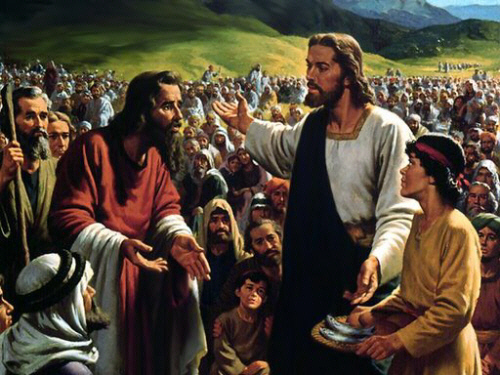
1 After this Jesus went away to the other side of the Sea of Galilee, which is the Sea of Tiberias. 2 And a large crowd was following him, because they saw the signs that he was doing on the sick. 3 Jesus went up on the mountain, and there he sat down with his disciples. 4 Now the Passover, the feast of the Jews, was at hand. 5 Lifting up his eyes, then, and seeing that a large crowd was coming toward him, Jesus said to Philip, “Where are we to buy bread, so that these people may eat?” 6He said this to test him, for he himself knew what he would do. 7 Philip answered him, “Two hundred denarii worth of bread would not be enough for each of them to get a little.” 8 One of his disciples, Andrew, Simon Peter’s brother, said to him, 9 “There is a boy here who has five barley loaves and two fish, but what are they for so many?” 10 Jesus said, “Have the people sit down.” Now there was much grass in the place. So the men sat down, about five thousand in number. 11Jesus then took the loaves, and when he had given thanks, he distributed them to those who were seated. So also the fish, as much as they wanted. 12 And when they had eaten their fill, he told his disciples, “Gather up the leftover fragments, that nothing may be lost.” 13 So they gathered them up and filled twelve baskets with fragments from the five barley loaves left by those who had eaten. 14 When the people saw the sign that he had done, they said, “This is indeed the Prophet who is to come into the world!” 

15 Perceiving then that they were about to come and take him by force to make him king, Jesus withdrew again to the mountain by himself.

In the name of Jesus. Amen.

Maybe you’re like me and hate tests. I thought one of the greatest benefits of finishing my schooling was that I wouldn’t have to take any more tests. Ha! Kids, I’m sorry to burst your bubble, but if you think that the end of school means the end of tests, you’re wrong. Life is full of tests. Sure, those tests aren’t turned in to be corrected with a red pen, recorded in a book, and reflected on a report card. But there are plenty of tests throughout your life.

Specifically, God gives tests. Like it or not, God regularly gives you tests. 1 Peter 4:12 says that you should not be surprised when fiery trials come to test you. Next week, we’ll consider Gen. 22:1-14 where God tells Abraham to take his beloved son, Isaac, and offer him as a burnt offering. When Heb. 11:17 comments on that event, it says that God was testing Abraham.

Listen to these verses from James 1 because they beautifully and clearly tell us what God is doing when He gives us these tests. “Count it all joy, my brothers, when you meet trials of various kinds, for you know that the testing of your faith produces steadfastness. And let steadfastness have its full effect, that you may be perfect and complete, lacking in nothing” (Jam. 1:2-4). James goes on to say later in that chapter, “Blessed is the man who remains steadfast under trial, for when he has stood the test he will receive the crown of life, which God has promised to those who love him” (Jas. 1:12).

So, Scripture is clear that, when God gives these tests, it’s never to see if we can pass the test. God is not testing us because He needs to find out information. God isn’t up in heaven thinking, “I wonder if he’s a good enough Christian,” or, “I wonder if she really trusts Me. I’d better give a test.” No! God is not sitting up in the clouds trying to figure out if a student has learned enough. God knows everything, and He doesn’t need to put your scores in a grade book.

Instead, God tests us to produce endurance and steadfastness in us. God’s testing molds and shapes us. Those tests move us toward completion. They bring about endurance, character, and hope (Ro. 5:3-5). In other words, the tests God gives are for your benefit. Through those tests, God is stretching you and strengthening your faith.

Here in John 6, Jesus tests Philip by asking, “Where are we to buy bread, so these thousands of people may eat?” (Jn. 6:6). Again, Jesus isn’t testing Philip because it’s been a while since He recorded a score under Philip’s name. Jesus isn’t using this test to set up Philip for failure. Instead, Jesus is testing Philip to bring something about for Philip. Jesus wants to produce something in him, to work in him. When Jesus wants to do something in a person and produce something in a person, He does it perfectly.

It would be verydangerous for us to think that Jesus is trying to get Philip to fail and fall into sin. Instead, Jesus tests Philip to bring something about in Philip. And it’s clear and simple to see what Jesus wants to produce in Philip, “Hey Philip, where are we going to buy bread for these folks?” And Philip responds, “Money will not help in this situation.” That’s the thing Jesus wanted to produce in Philip. Jesus wanted Philip to know that money cannot feed this crowd. Jesus wanted Philip to know that money isn’t always the solution.

Imagine a normal day where Jesus is sitting in a house or by an evening fire or on the shore of the Sea of Galilee – it’s just Him and the disciples – and He asks Philip, “Hey Philip, do you think money can solve every problem?” Philip is no fool. He’d probably start imagining all sorts of hypothetical situations. “Money won’t help someone who’s falling down a cliff. Money wouldn’t help someone who fell out of the boat and was drowning.” I’m sure Philip would have said, “No. Money isn’t always the answer.” But Jesus isn’t asking Philip about a hypothetical situation. Jesus is asking it in real time with a real throng of hungry people surrounding them.

Generally, hunger issolved by money. To put it more accurately, generally God satisfies hunger through His gift of money. God gives you money. Then, you take your money, you go to the market, you buy food, you cook the food, and you eat it. But God hasn’t limited Himself to feeding people through money. God can make food fall down from the sky and feed millions of people (Num. 1:45-46) for forty years (Ex. 16:2-21; Josh. 5:12). If God wants to feed people that way. It isn’t a problem at all. Philip knew this, and you know this too.

Still, money can be a powerful idol. How often do find yourself in a situation, and the first thought you have is, “If I just had a little more money this wouldn’t be a problem”? Be honest! It’s probably a regular occurrence.

Thinking about money isn’t necessarily sinful. We do need to think about money because God has given it to us to be good stewards of it. But we’re too often greedy for money. We’re tempted to trust it as though it’s the solution to our problems. And for that, we repent. 

Repent, and know this: Money can never help you if God Himself does not supply it. Money is useless by itself. The only reason money has ever benefited you because Jesus gave it as a tool. 

So, in Philip’s case here, Jesus asks Philip about money to knock the idol of money out of Philip’s hand. But Jesus doesn’t leave Philip with empty hands, does He? No. Jesus empties Philip’s hands so He can put bread and fish into Philip’s hands. Philip and the disciples receive the bread and fish from Jesus’ hands and distribute it (Mt. 14:19; Lk. 9:16). The picture we have is that the disciples just keep handing out what Jesus gives them. They distribute more and more of what first came from the hand of Jesus.

The whole text makes it abundantly clear that money didn’t feed this crowd, but who did? Where did the provision come from? Jesus. Jesus is the answer. Jesus gives. Jesus distributes. Jesus provides, and not only does Jesus provide enough for the crowd; He provides enough for each of the disciples. Philip and the other disciples distribute what Jesus provided, but they still weren’t done. Jesus sends them back out into the crowd to gather up the leftovers. Leftovers? Yes. Twelve baskets worth. A basket for each disciple. Why not thirteen? Why isn’t there a basket for Jesus? At this point in the sermon, you can probably guess. Jesus doesn’t need money to provide, and He doesn’t need a basket of food.

Dear saints, when you are tested in times of need, where should you look? Our Old Testament reading (Is. 49:8-13) has the answers. Where you cry, God answers. Where you need help, God saves. Where you need certainty, God keeps you. Where you are imprisoned, God frees. Where you face darkness, God brings light. Where you hunger, God feeds. Where there is hard terrain, God makes straight. Where you face affliction, God comforts and has compassion.

So, sing for joy. The Lord has comforted His people. He has compassion on His afflicted. Amen.

The peace of God, which surpasses all understanding, will guard your hearts and minds in Christ Jesus. Amen.

Thanks & Blessing – Sermon on John 6:1-15 for the Fourth Sunday of Lent

John 6:1–15

1 After this Jesus went away to the other side of the Sea of Galilee, which is the Sea of Tiberias. 2 And a large crowd was following him, because they saw the signs that he was doing on the sick. 3 Jesus went up on the mountain, and there he sat down with his disciples. 4 Now the Passover, the feast of the Jews, was at hand. 5 Lifting up his eyes, then, and seeing that a large crowd was coming toward him, Jesus said to Philip, “Where are we to buy bread, so that these people may eat?” 6He said this to test him, for he himself knew what he would do. 7 Philip answered him, “Two hundred denarii worth of bread would not be enough for each of them to get a little.” 8 One of his disciples, Andrew, Simon Peter’s brother, said to him, 9 “There is a boy here who has five barley loaves and two fish, but what are they for so many?” 10 Jesus said, “Have the people sit down.” Now there was much grass in the place. So the men sat down, about five thousand in number. 11Jesus then took the loaves, and when he had given thanks, he distributed them to those who were seated. So also the fish, as much as they wanted. 12 And when they had eaten their fill, he told his disciples, “Gather up the leftover fragments, that nothing may be lost.” 13 So they gathered them up and filled twelve baskets with fragments from the five barley loaves left by those who had eaten. 14 When the people saw the sign that he had done, they said, “This is indeed the Prophet who is to come into the world!” 

15 Perceiving then that they were about to come and take him by force to make him king, Jesus withdrew again to the mountain by himself.

In the name of Jesus. Amen.

I have a fresh appreciation for this miracle. Last Friday, I was one of the volunteers at Sacred Heart’s Fish Fry. For about three hours, I stood along the buffet line making sure there was bread, coleslaw, tartar sauce, butter, sour cream, and lemons for people who then waited for fried fish and a baked potato. When something on the line got low, I was ready to swap out the tray or bowl and have a full one ready so the line would keep moving. I one of 64 people working that night, and in those three hours we served 1,316 people their supper.

Now, think about that. Sixty-four people, who have been organized to do particular tasks, fed just over 1,300 people in about three hours. Here, Jesus and his twelve disciples serve 5,000 men plus women and children (Mt. 14:21). In all likelihood, this was a crowd of twenty to thirty-thousand people who are fed by thirteen men doling out five barley loaves and two fish that was brought by a boy. Every person in that crowd ate as much as they wanted. And, when it was all over, the disciples gathered up twelve baskets full of leftovers.

This is easily the ‘biggest’ miracle of Jesus recorded for us in the Gospels, which might be the reason all four Gospels tell us about it. The only other miracle that even comes close would be Jesus turning water into wine at the wedding in Cana (Jn. 2:1-11). Sure, there are times when Jesus will heal many sick people who are brought to Him, but those were still one at a time miracles (Mt. 4:23-25; 8:16; Mk. 1:33-34; Lk. 4:40). This one miracle provided for tens of thousands of people all at once.

It’s no wonder, then, that the people reacted the way they did. Here is a Man who can feed people bread without needing soil or seed or rain or the right weather conditions or combines or grain elevators or flour mills or factories or bakers or truck drivers or grocers. Jesus can feed people fish without boats or bait or poles or nets or processing plants or even water. Jesus is not a politician who spouts empty promises but never delivers. He just delivers. This is the kind of guy who everyone wants to be king. So, they planned to take Jesus by force and chain Him to a throne because, sure, they were full now, but they’d be hungry again later.

Notice what everyone in this account is focused on. Phillip looks at their checkbook balance and says, “Two-hundred denarii? That’s not nearly enough.” Andrew looks at the boy’s snack and says, “This isn’t going to do it.” And the crowds – even after they are fed – they know they would be hungry again. The food Jesus provided that evening wasn’t going to be there for them tomorrow. So, they think, “If this Jesus guy can feed us like this in the wilderness, imagine what He can do if He’s the king with advisors and soldiers and tax revenue.”

We sinful creatures always seem to be fixated on our lack and desire to get more than what we have. But even when we get more, we aren’t satisfied. In his book Mere Christianity, C.S. Lewis says that the fact that we have desires means that satisfaction for those desires exists. Behind every desire – even sinful, evil desires – there is something good that is trying to be filled. The drug addict is trying to find the end of his pain or escape from sorrow. The sexually promiscuous are trying to find the good gift of companionship that God gives in marriage but fail to find it apart from marriage. Here, the crowds are doing the same thing. They want the gift of food but not in the way Jesus wants to give it.

You cannot force a gift to be given. Doing that is an attempt to twist gifts into wages, and that never works. All the things we long for and all desires we have are only filled by what God will give in the perfection of the New Creation. Because this world has fallen into sin, this world does not have the satisfaction of the desires we are seeking to fill. So, if you have unfulfilled desires, recognize you are made for another world. Stop looking to created things to fulfill your desires. Repent and instead, look to the Creator, and trust His promise to fulfill those desires. Then, be content with the good gifts God gives you in this life even as they seem to disappear.

In His infinite wisdom, God lets us see how things are used and depleted, but He doesn’t always let us always see how He supplies. None of the four Gospels tell us how the bread and fish are multiplied to feed this massive crowd. I doubt those loaves and fish grew into a massive pile that the disciples kept handing out – I think the Gospel writers would have included that. I like the suggestion that the disciples walk around with baskets of food, and each person reaches in to take some. While it appears to each individual that they are decreasing the amount of food in the basket, when the next person reaches in, there is still more. No matter how many people reach in and take, there is always more food in the basket.

Dear saints, your needs for food, house, clothing, money, health, etc. are things you can see and feel. But God doesn’t have to show you how He provides to meet those needs. He promises to meet them. So, trust His promises. You can see and feel hunger, but you can’t see the God who feeds you. You can see and feel sickness, but you can’t see the Great Physician who heals you. You can see and feel war and chaos, but you can’t see the Prince of Peace who has all authority in heaven and earth and governs all things from His throne at God’s right hand. But God supplies each of those things in ways you cannot see or understand. There are thousands of miracles that happen in your daily life. You’ve just gotten numb to seeing them because you experience them so often.

The fact that you work (in whatever job you have) and food gets to your pantry, cupboards, fridge, freezer, oven, and table is a miracle. When that food goes into your body and keeps you healthy, and when you do get sick but put nutrients, vitamins, or medicines into your body and recover, that is a miracle too. All those things – work, money, food, house, health – they are all good, miraculous gifts from God’s gracious hand. And what God gives He blesses. 

Here, we are told that Jesus gives thanks for the food before it is distributed to the crowd. In Confirmation class we recently went through the texts that recount Jesus giving the Lord’s Supper (Mt. 26:26-28; Mk. 14:22-24; Lk. 22:19-20; and 1 Cor. 11:23-25). In those texts, the Gospel writers use two phrases interchangeably. Jesus giving thanks for something is the same as Jesus blessing it. So, when you pause and take a moment to pray for your food, God is blessing that food to be a blessing for you. 1 Tim. 4:4-5 says that everything created by God is good, and nothing is to be rejected if it is received with thanksgiving because it is made holy by the Word of God and prayer. Receive with thanks the things that God gives and watch how it is blessed.

I’ll close with this: Jesus did not let the crowds take Him by force and make Him king that day, but He did allow them to take Him by force when a band of soldiers came and arrested Him. They forced Him to stand trial before Pilate and Herod. He wasn’t chained to a throne; instead, He was nailed to a cross where He shed His blood and gave His for you. Thanks be to God. Receive that gift with thanks and faith and watch how God blesses it. He blesses it and multiplies it to make you a blessing to others so that you can point them to Jesus, the One can and does fill their desires with the gift of Himself. Amen.

The peace of God, which surpasses all understanding, will guard your hearts and minds in Christ Jesus. Amen.