Overcome By; Overcome With – Sermon on Romans 12:16-21 for the Third Sunday after Epiphany

Romans 12:16–21

16 Live in harmony with one another. Do not be haughty, but associate with the lowly. Never be wise in your own sight. 17Repay no one evil for evil, but give thought to do what is honorable in the sight of all. 18 If possible, so far as it depends on you, live peaceably with all. 19 Beloved, never avenge yourselves, but leave it to the wrath of God, for it is written, “Vengeance is mine, I will repay, says the Lord.” 20 To the contrary, “if your enemy is hungry, feed him; if he is thirsty, give him something to drink; for by so doing you will heap burning coals on his head.” 21 Do not be overcome by evil, but overcome evil with good.

In the name of Jesus. Amen.

Inspired by the Holy Spirit, Paul assumes and presupposes that you are going to encounter evil. In v. 17 he writes, “Repay no one evil for evil.” You aren’t told, “If something evil happens to you, don’t turn around and do something evil in return.” The assumption of evil is even clearer in v. 21, “Do not be overcome (or ‘defeated’ or ‘conquered’) by evil, but overcome (‘defeat’ or ‘conquer’) evil with good.” Again, evil things are going to happen both to and around you. And those evil things are either going to overcome you, or you will overcome those evil things by doing good – which is the most Christlike thing you can do.

Imagine a cattle rancher taking care of his cows – feeding them, branding and tagging them, vaccinating them, checking if they’re healthy, whatever – what is he going to step in while he’s walking through that cattle pen? Without a doubt, he’s going to step in manure, cow pies, poop. It’s going to get all over his boots, maybe even on his pants and coat. It’s going to happen.

Now as he’s doing his work, suppose you’re watching him from the fence. Are you going to ask him, “How do you feel about stepping in that manure?” No! If you did, the rancher would probably say something along the lines of, “It just comes with the territory.” If you asked him, “How many piles do you step in each week?” he’d probably laugh because he doesn’t think about it in the moment or dwell on it afterward. He’s just used to it. He has enough experience with cows to know that he can’t teach them to do their business in a specific corner of the yard. It’s going to be scattered all over, and he’s going to periodically step in it.

And the rancher isn’t going to bother trying to get retribution on the cows. He isn’t going to spread his own feces around so the cows step in it. “See how they like it.” No! For one thing, the cows aren’t going to care, and it’d be too much work – very unpleasant work. The only thing a cattle rancher can do when he steps in manure is simply wipe it off before he gets in his truck or goes into his house or when his boots get heavy and caked with it. When he steps in it, he doesn’t dwell on it later. Instead, he just keeps walking.

Dear saints, you already know this, but sometimes it’s just helpful to plainly say it. This world is a cattle yard. This world is full of all sorts of stinky, smelly, steaming piles of evil. Generally, you don’t intentionallystomp around in it. Most of the time, you do your best to avoid it, but at some point, you’re going to get end up coming into contact with the manure of evil. It isn’t pleasant. You don’t like it, and you are right to not like it. But you also need to recognize and acknowledge that, when you end up caked in the manure of evil, it isn’t as though something strange is happening to you (1 Pet. 4:12). Everybody faces evil things. Everybody steps in the cow pies of evil. Everybody has bad days, weeks, months, years, and decades. Everybody. It’s part of life. It doesn’t matter how careful or careless you are. In a fallen and sinful world, you’re going to encounter evil.

This simple truth from Scripture is actually a great comfort. It helps us orient ourselves the right way. We’re going to step in the cow pies of evil. In a broken, fallen world, evil is going to happen to us. When we are confronted with evil, the best thing we can do is the unpleasant work of wiping it off and move on. Responding to evil by doing evil isn’t going to help. Neither is dwelling on it. Yes, learn from the evil things that have happened. Maybe, you don’t put yourself or others in a similar situation. But you have to do your best to scrape it off and move on.

I know many of you have encountered evil, horrific things. You’ve been neck deep in the manure of evil. You are right to weep about it, and as our text last week called for, I weep with you (Ro. 12:15). It stinks and is utterly rotten. But there also is a point at which you need to move on. You live and walk in the cattle pen of a sinful, evil, broken world.

Sin and evil throws creation out of order. No matter how small a sin is, it throws the whole, entire universe off-kilter. Remember, it only took one sin in the Garden of Eden to bring pain, strife, and death to all of creation. All sin, whether it’s your own sin or sins committed against you, sin brings chaos and disorder to creation. Still, you can’t fight sin and evil with more sin and evil of our own, just like you can’t save someone from drowning by giving them a cup of water. You have to get them out of the water they’re drowning in.

When we see sin and injustice, we naturally want to fix it. Since we are made in the image of God, we want to bring order and justice back into the world. That is what vengeance is. Now, vengeance isn’t necessarily a bad thing. We’ve gotten so used to the word ‘vengeance’ being used in a negative way that we think vengeance is always evil. That’s not the case. Yes, vengeance can be evil when you think it’s exclusively your job to dole it out. But remember God Himself says, “Vengeance is Mine, I will repay.” Paul there is quoting Dt. 32:35. The same verse gets quoted again in Heb. 10:30. Throughout the Scriptures, both in the Old and New Testament, we hear that God promises execute vengeance on the wicked. All of Ps. 94, and many other places in the Psalms this is repeated. God is just. He will punish all sin and make creation right again. That is His job and His promise.

So, know these two things and get them drilled into your head: First, you will encounter sin and evil. And second, know that fixing sin is God’s dominion. He will do it. It’s not up to you. You aren’t God. 

Yes, there are times when you are God’s instrument to execute vengeance. Parents, you are to discipline your kids (Pro. 13:24; 23:13-14; 29:15; Heb. 12:9-10). That calling has been given to you by God. And, to maintain order in society, God has given us rulers who have the God-given task of punishing sin with vengeance. Paul goes into that next in Ro. 13. Those earthly authorities are put there by God to be a terror to bad conduct (Ro. 13:3-4; 1 Pet. 2:13-14). But, generally speaking, we are to leave room for God to bring vengeance against sin.

Again, “Do not be overcome by evil, but overcome evil with good.” This is what Christ has done for you. Jesus did not let Himself be overcome by evil. It sure looked like it as He died on the cross. It appeared that evil had defeated Christ. But it didn’t. Not even close. Jesus overcame our evil with good. Good Friday indeed – the goodest [sic.] of good, when all the evil of this world was overcome, conquered, defeated, and crushed by the goodness of Christ.

Dear saints, this text is calling us to do the hardest thing in this broken world – to overcome evil with good. In other words, this text is calling us to be like Christ. The only way to do that is to let the goodness of Christ overcome both you and the evil within you. And when evil things happen to you, remember that evil person is another one for whom Christ died. Let the love and mercy of Christ fill you and spill out to others as well. Amen.

The peace of God, which surpasses all understanding, will guard your hearts and minds in Christ Jesus. Amen.

Determined – Sermon on Job 14:1-6 for the Twenty-fifth Sunday after Trinity

Job 14:1–6

1 “Man who is born of a woman 
is few of days and full of trouble. 
2 He comes out like a flower and withers; 
he flees like a shadow and continues not. 
3 And do you open your eyes on such a one 
and bring me into judgment with you? 
4 Who can bring a clean thing out of an unclean? 
There is not one. 
5 Since his days are determined, 
and the number of his months is with you, 
and you have appointed his limits that he cannot pass, 
6 look away from him and leave him alone, 
that he may enjoy, like a hired hand, his day.

In the name of Jesus. Amen.

Seasons change. This year, we’re having a particularly long Fall. We’ve been hitting 50°F regularly. The forecast says we’ve got a couple more days of that, but it’s definitely Fall. The sun is lower in the sky, and it’s getting dark earlier and earlier each day. Your grass might still have some green in it, but the brown is steadily progressing. Most of the leaves have fallen off of the trees, and you’re probably ahead of me in getting them off the lawn.

We’re used to these seasonal changes in this part of the world. During the months that end with ‘-ber,’ we start smelling autumn in the air. And I know some of you are already eagerly waiting for March and April when you get those first, faint scents of Spring. This portion of Job is like those brief whiffs of new life. But, because of his suffering, Job is deep in the declining days of autumn, and yet he is determined to smell the sweetness of Spring again.

To get the context of where we are in Job 14, remember: Three times in the first two chapters, Job is described as a man who is blameless, upright, one who fears God, and turns away from evil (Job 1:1, 8; 2:3). In other words, Job is a Christian. But God allows Satan to cause him all sorts of suffering, both in material and physical ways. Job’s suffering puts him in this autumn season of death.

As he suffers, Job’s three friends come to talk with him. Well, we call them “friends,” but that’s using that word extremely liberally because, honestly, they’re really, really bad friends. Each of them thinks he’s wise enough to know why Job is suffering and tries to explain it. The problem is that their ideas of why Job is suffering only make Job’s suffering worse. In fact, the conversation Job’s friends have with him is, basically, a third round of suffering inflicted on Job.

The first friend, Eliphaz, basically tells Job, “You’re suffering because you are being punished for some sin. But you should be thankful because this suffering is going to make you a better person” (Job 4-5). The second one, Bildad, basically says, “You’re getting what you deserve. Just repent, and your pain will go away” (Job 8). The third, Zophar, basically says, “Actually, Job, you deserve a lot worse. Make yourself worthy to stand before God and then your life will get better” (Job 11). It’s almost like each one of those friends is actively trying to be worse than the previous at explaining why Job is suffering.

Job had responded to each of those friends’ claims, but our text today is the second part of Job’s reply to the three of them collectively. The summary of what Job says in Job 13 is, “This suffering isn’t because God is punishing me for some particular sin. You guys can say whatever you want, but I have no problem insisting that I am righteous before God.” And remember, Job is right when he says that. Job hadn’t heard it, but God Himself declared Job to be blameless and upright. And even though Job is in the autumn of suffering, he stands righteous before God through faith (Hab. 2:4; Gen. 15:6).

Now, here in Job 14, Job longs for Spring and the season of new life. But he speaks about it in ways where we only get the faintest whiff of it. He’s still deep in the autumn of his suffering. That’s why Job talks about the few, troubled days of all mankind (Job 14:1). Job rightly says that all of us are like a flower that sprouts up but then withers (Job 14:2).

Look again at in v. 5. Job says, “[Man’s] days are determined, and the number of his months is with You, [God]. You have appointed his limits that he cannot pass.” Yes, Job is in a very dark place. He’s enduring a suffering that is hard for us to fathom. He’s lost his all of his income, and his children have died. But Job still recognizes that God is the One in control of all his days. Job knows that God determines both the beginning and end of a person. Because of sin, all of us are mortals. We all die, and each person has a God-determined number of days (Ps. 39:4, 139:16).

But then, in the verses that follow immediately after our text (Job 14:7-9), Job says that he longs for Fall to be over and Spring to come again. He says that there is still hope for a tree that is cut down because it can sprout again. Job acknowledges that roots grow old in the earth and the stump dies in the soil, but it will still put out branches at the first scent of water.

In other words, Job believes that, in spite of his current condition, God hasn’t and won’t abandon him – even after Job has breathed his last. Job believes in the Resurrection. In spite of his suffering, Job knows that he will rise again, and his own eyes will see his Redeemer standing victorious on the earth. That will become crystal clear in what Job says in ch. 19:25-27. But here in ch. 14, Job is still mostly in his “Fall funk.”

Now, I want to dig into v. 6 here a little bit. Listen to it again, “look away from him and leave him alone, that he may enjoy, like a hired hand, his day.” When I was initially reading this text to prepare for this sermon, that verse reminded me of other verses of Scripture like Ecc. 2:24 which says, “There is nothing better for a person than that he should eat and drink and find enjoyment in his toil.” The way I understood it was that Job was asking God to look away from him and leave him alone so he could just enjoy the rest of his days. But after doing more study on the text, I realized that’s not what is going on here. Not at all!

If you look in your pew Bible, you’ll see that the ESV (which is what is printed for you) has a footnote that says the way we should probably read that first line of v. 6 is, “Look away from him that he may cease.” In other words, Job isn’t asking God to leave him alone. Instead, Job is saying that, as soon as God looks away from us, we die. Now, it might not seem like it at first, but there are actually two bits of comfort there.

The first comfort is that Job recognizes God is not ignoring him or looking the other direction. Even though Job is suffering, God is looking at him and is aware of his situation. Since God knows Job’s suffering, He also knows your suffering. God sees. God is alert to all the causes of your pain. That’s precisely why He sent Jesus to rescue and deliver you.

The second comfort is a little harder to recognize – like the first scent of Spring. What Job is saying here is basically, “Look away from me so I can come to the end of my days and die because I know there is a resurrection where there will be no more suffering.” Now, Job isn’t suicidal here. Instead, Job recognizes that his life is like the changing of seasons. He’s in the Fall of suffering and decay. The cold, dead of winter will come when God decides it will come. But after winter comes the new life of Spring and resurrection. That’s what Job is longing for.

In context, that first line of v. 6 is Job saying, “God, I know that I’m not going to live forever. I know that this suffering is temporary. Eventually, I will die, but You will raise me again. Even now in this suffering, my life is in Your hands. But I also know that my eternal future is in Your hands. And my preference right now is to move on and get to the resurrection stuff.”

That understanding gives us a better picture of what the second line of v. 6 says where Job talks about a hired hand enjoying his day. During the sweat and toil of work, a hired hand looks to the end of the day when he will rest and receive his wages. That’s what Job longs for. Through faith, Job knows that God will reward him when his life has ended, and he will have eternal rest.

So, dear saints, let’s apply all of this to you. You aren’t suffering like Job is here, and may God grant that none of you ever do. But everyone suffers to one degree or another in this broken world. Like Job, you can confidently place yourself in God’s hands. Yes, you are a sinner, but God can bring a clean thing out of an unclean thing (Job 14:4). Your God brings life out of death. God cleanses, restores, and forgives. No matter what you suffer in this life, God still and always loves you because of what Christ has done on the cross for you.

We suffer many things in this broken, sinful world. Whatever we suffer points to the fact that this world is ending. Throughout the Gospels, Jesus will mention several signs of the end of the world, and they are all some form of suffering. But Jesus wants you to take courage. Every war and rumor of war; every earthquake and hurricane; every corrupt government and politician; every sickness, disease, death, and threat – all of them are only signs that this world is broken and will not last. But know that even in the midst of all those signs, God hasn’t forgotten you.

Jesus lives, and He is returning for you. You belong to Him. Through Jesus, God has delivered you and declared that you are His people. Christ is determined to rescue you. He brings life out of death, and He will lead you in green pastures and beside still waters (Ps. 23:2).

Jesus is your God and Savior, and He is absolutely determined to bring you safely through the autumn of this broken world into the eternal Spring of the New Creation. Amen.

The peace of God, which surpasses all understanding, will guard your hearts and minds in Christ Jesus. Amen.

Given, Taken, Blessed – Sermon on Job 1:1-22 for the Sixteenth Sunday after Trinity

Job 1:1–22

In the name of Jesus. Amen.

In a sinful and broken world, no one escapes suffering (Jn. 16:33), and no one can make themself right before God. We clearly see that in the book of Job. But another thing that we see in Job is that God accomplishes His purpose, even in the midst of suffering.

Job was very blessed by God. Job had 7,000 sheep, 3,000 camels, 500 yoke of oxen, 500 female donkeys, and many servants. Job was the greatest of all the people of the east. Beyond that, Job had seven sons and three daughters. One of the things that makes Job great is all of these children. Our culture tries to make it seem like children a burden. It’s sad that today people will see parents with a lot of children and joke with them. “Oh, you must be so tired,” or, “Don’t you know about the birds and the bees?”

We need to stop that. If we are doing it ourselves or hear others doing it, we need to put an end to it. Children are a blessing; they are a heritage from God (Ps. 127:3-5). Don’t fall for the lies of Margaret Sanger and Planned Parenthood. A blessed life does not mean that you’re free of obligation to children. Children are a blessing from God and are to be embraced.

Job was the also the spiritual leader of his family. He was careful to make sure his children were raised well. The fact that Job offered sacrifices for his children points to him being a father who is raising his children in the Christian faith. There is a good reason to see that all of Job’s children are following their father in the faith, but I’ll wait until the end of the sermon to say more about that.

So, Job was very blessed in every temporal way by God. And Job was also spiritually blessed by God. Three times in the first two chapters, we are told that Job is blameless, upright, one who fears God, and turns away from evil. Two of those times, that description comes from the lips of God Himself. And let’s consider each of those briefly.

First, Job is blameless. In Hebrew, that word can also mean ‘perfect’ or ‘pure.’ This does not mean that Job is sinless. Sinless and blameless are similar words, but they aren’t identical in meaning. Job himself will say that he’s sinful (e.g. Job 13:23). So how can God say that Job is perfect, that he’s blameless? Well, this is something that God Himself gives to Job. When God says something about you, it is true. When God says that you are blameless, that makes you blameless. This blamelessness, this purity, this perfection that Job has is a gift from God.

Second, Job is upright. This isn’t talking about Job’s posture. It’s not like he went to the chiropractor regularly. Job is upright. Most of the time this word gets used in Scripture, it’s referring to God. God Himself is upright. There’s no twisted or crooked way about him. God is without fault and without error. Job is too. Again, this characteristic is something that God gives to Job. Whatever sins Job had committed, God had forgiven.

Third, Job fears God. Throughout the Bible, fearing God is linked to trusting God. The 1stCommandment in the Small Catechism is explained, “We should fear, love, and trust in God above all things.” Usually, when we think of being afraid, it means we don’t trust someone or something because it’s unsafe. But when the Bible talks about the fear of God, it is not to think that God is unsafe. It means if you turned away from God, then God becomes unsafe. When you turn to Him, then He is your Refuge and Strength (Ps. 28:8; 46:1). C.S. Lewis captures this really well in the Chronicles of Narnia. There’s a question about the character that corresponds to Jesus and if he is ‘safe,’ and the reply is, “Of course he isn’t safe, but he’s good.”

Fourth and finally, we’re told that Job turns away from evil. By the power of the Holy Spirit, Job turns away from evil things. Again, that’s what a Christian does. A Christian does not run headlong into doing sinful, evil things. Instead, a Christian turns away from them. Yes, we sin, and we sin often. But by God’s help, we strive to turn away from evil.

So, when God describes Job as blameless, upright, fearing God, and turning away from evil, God is saying that Job is a Christian. God says this about any of you who believe in Christ.

After this description of Job, we see him begin to suffer. And the cause of Job’s suffering is important. Satan is in heaven, and God starts to brag about Job to the devil. It’s almost like if a jewelry store was being robbed and the owner came out and said to the thief, “Hey, have you seen my rarest, most expensive diamond?” We don’t know why God draws attention to Job, but He does. And the devil doesn’t even bother arguing with God. The devil doesn’t push back or try to “fact-check” God, not at all. God is right. The devil and the demons have to agree with God when God says something. Make sure you recognize that. 

Instead, the devil pushes back on Job’s faith. Satan says that the only reason Job is blameless and upright is that God is nice to him. The devil says that if God takes those things away that Job will curse God to His face. Notice how arrogant the devil is. He’s basically saying, “Let me have at him and I’ll make sure that he ends up the way that I want him to be.” For reasons that I don’t understand, God lets the devil do it. Through the rest of the ch. 1, we hear what the devil does. The devil sends different calamities that take away all the blessings God had given Job.

And how does Job respond to all this loss? It’s remarkable, “Naked I came from my mother’s womb and naked I shall return. The Lord gave, and the Lord has taken away. Blessed be the name of the Lord.” Who was it that destroyed all those things? We have to say that it was the devil, and yet who allowed the devil to do that? God did. God gave the devil a long enough leash to take all those things away. And who does Job credit? He credits God. The Lord gave. The Lord has taken away. Blessed be the name of the Lord.

In ch. 2, which we didn’t read, the devil is allowed to go farther. Job hasn’t cursed God, so the devil asks God to let him go after Job’s body. And Job gets afflicted with sores all over his body. But still, Job does not curse God. You have to imagine how frustrated this made the devil. Satan figured he’d be triumphantly standing over Job while Job was groveling at his feet, but Job doesn’t even acknowledge Satan in any of his suffering. It’s absolutely remarkable. Job’s eyes, mind, and heart are fixed squarely on God even in the midst of suffering.

Job doesn’t go down the black hole of trying to figure out why he’s suffering. He simply recognizes that he is suffering, and in his suffering, Job places himself squarely in God’s gracious hands.

Christian, take note of this. Whenever you’re presented with trials, tribulations, and suffering, don’t bother with the why of your suffering. Instead, focus on Christ. 1 Pet. 4:12-13 says, “Beloved, do not be surprised at the fiery trial when it comes upon you to test you, as though something strange were happening to you. But rejoice insofar as you share Christ’s sufferings, that you may also rejoice and be glad when His glory is revealed.”

Suffering and evil are definitely related to each other, but that does not mean that suffering itself is evil. In fact, suffering is good. If you didn’t suffer when you touched a hot stove, you wouldn’t remove your hand from it. If criminals and murderers didn’t suffer with time in prison, then there’d be a lot more theft and murder.

Suffering is meant to bring about repentance and faith in Christ. Suffering isn’t evil, but that doesn’t mean that God demands that you enjoy your suffering. You are right to hope for the end of your suffering. God sent Jesus to relieve you from suffering. Christ entered into our suffering in order to bring us into His kingdom where there will be no more suffering.

Comfort in suffering comes from seeing that God has come into our world to suffer alongside of us and for us. That’s the real comfort for anyone who suffers in any way. The world sees suffering and it tries to eliminate it. So much of our world today is focused on death as the only solution to suffering. They’ll see a poor, single woman who is pregnant and say, “That baby has no chance of being happy, healthy, or successful. So, abort the baby.” The world sees a person going through horrible medical problems and says, “It’ll just be better to end that life now with a doctor assisted suicide.” The world’s only answers to suffering are barbaric.

God’s answer to suffering is that He sends Jesus, not to bring an end to the sufferer, but to defeat suffering through His suffering (1 Co. 15:54). Jesus is the “Man of Sorrows.” In your suffering you find your Savior, who has died and risen again for you, to deliver you.

What we heard today isn’t the end of Job’s story. Job gets everything back. In Job 42, we see God gave Job twice as much as he had before. There, Job has double the sheep, camels, oxen, and donkeys. But then we’re told that Job also had seven more sons and three more daughters. I told you I’d come back to it.

Now, wait a minute. Seven sons and three daughters? That’s what Job had before, isn’t it? Shouldn’t Job have had fourteen sons and six daughters? No. Job’s first ten children aren’t lost to him. This points to Job’s first ten children being saved. Job still has them, even though they died. They’ll be united with Job in the resurrection, because Job knows that his Redeemer lives. Christian, your Redeemer lives too. And like Job, your eyes shall see him and not another (Job 19:25-27). Come quickly, Lord Jesus (Rev. 22:20). Amen.

The peace of God, which surpasses all understanding, will guard your hearts and minds in Christ Jesus. Amen.

Fear & Forgiveness – Sermon on Genesis 50:15-21 for the Fourth Sunday after Trinity

Genesis 50:15-21

15 When Joseph’s brothers saw that their father was dead, they said, “It may be that Joseph will hate us and pay us back for all the evil that we did to him.” 16 So they sent a message to Joseph, saying, “Your father gave this command before he died: 17 ‘Say to Joseph, “Please forgive the transgression of your brothers and their sin, because they did evil to you.” ’ And now, please forgive the transgression of the servants of the God of your father.” Joseph wept when they spoke to him. 18 His brothers also came and fell down before him and said, “Behold, we are your servants.” 19 But Joseph said to them, “Do not fear, for am I in the place of God? 20 As for you, you meant evil against me, but God meant it for good, to bring it about that many people should be kept alive, as they are today. 21 So do not fear; I will provide for you and your little ones.” Thus he comforted them and spoke kindly to them.

In the name of Jesus. Amen.

This is a phenomenal text and a beautiful conclusion to a long story of Joseph and his brothers. I know you’re familiar with it, but I still want to review it to highlight some details that are often overlooked so we can see just how dramatic this scene is.

Joseph’s father, Jacob, had two wives (which Scripture repeatedly shows is a bad idea), and his wives were sisters, Leah and Rachel, and this family arrangement poisoned the relationship of these two sisters. Because Jacob loved Rachel but not Leah (Gen. 29:31), God made it so Leah is able to have children, but Rachel isn’t. Without getting too much into the seedy details, only after Jacob has ten sons does Rachel conceive and bear Jacob’s two youngest sons, Joseph then Benjamin. So, of his twelve sons, Joseph was Jacob’s hands-down favorite, and Jacob didn’t hide that fact (Gen. 37:3).

When Joseph was seventeen years old (Gen. 37:2), he started telling his brothers about his dreams where they bow down to him and serve him (Gen 37:5-8). What can you say? He’s the spoiled-rotten, favorite child. Sometime shortly after this, Joseph’s brothers concoct a plan to murder Joseph (Gen. 37:19). But Joseph’s oldest brother, Reuben, convinces his brothers to simply throw Joseph in a pit, and Joseph ends up being sold to a caravan of slave traders. Joseph’s brothers lead their father to believe that Joseph has been attacked by a wild animal and is dead (Gen. 37:31-35). The slave traders take Joseph to Egypt where he is sold to a man named Potiphar who is an officer of Pharaoh and his title is the captain of the guard (Gen. 39:1). Joseph works hard and eventually becomes the overseer of everything in Potiphar’s house.

Potiphar’s wife finds Joseph attractive and tries to seduce him, but Joseph refuses to sin against God and his master. So, Potiphar’s wife makes false accusations against Joseph (Gen. 39:1-19). And just quickly – I’ve mentioned this before – I think there is good reason to believe that Potiphar doesn’t believe the accusations of his wife against Joseph because if he had Joseph would have been executed immediately. Instead, Potiphar puts Joseph into the same prison where Pharaoh’s prisoners are kept (Gen. 39:20), and Scripture tells us that the keeper of that prison is Pharaoh’s captain of the guard (Gen. 40:3), which you remember is Potiphar’s title. This helps explain why Joseph quickly gets put in charge of basically running the prison (Gen. 39:22-23).

While Joseph is there, Pharaoh’s chief baker and cupbearer anger Pharaoh and get thrown into the same prison where Joseph is. They each have a dream that troubles them, and Joseph notices they are down in the dumps. The cupbearer tells Joseph his dream, and God gives Joseph insight to interpret the dream. The cupbearer’s dream means that he will be restored to his position in three days, and Joseph asks the cupbearer to remember him when he gets back to serving Pharaoh his wine (or whatever Pharaohs drink). The chief baker hears that the cupbearer’s dream means something good will happen, so the baker wants Joseph to interpret his dream. The baker, however, doesn’t get good news about his dream. Joseph interprets his dream to mean that Pharaoh will have him executed in three days. The baker is probably even more disappointed when the interpretation of both dreams comes true (Gen. 40:1-22). The only problem for Joseph is that the cupbearer forgets all about Joseph for two whole years (Gen. 40:23-41:1).

After those two years, Pharaoh himself has a couple of dreams that none of his magicians can interpret. Only then does the cupbearer remember about Joseph and the interpretation that God had given him about those two dreams (Gen. 40:8, 41:16). So, Joseph is brought before Pharaoh and hears his dreams about fat cows getting eaten by skinny cows and bad crops eating good crops. Joseph says that God is telling Pharaoh (Gen. 41:25, 28, 32) that seven years of plenty are coming, but those good years will be followed by seven years of severe famine. Joseph suggests that Pharaoh tax one-fifth of the produce during the years of plenty so there will be enough food stored up for when the famine comes (Gen. 41:33-38). Pharaoh basically says, “You’re my guy. You’ve got the Spirit of God in you. You’ll be in charge of implementing this plan.” So, Pharaoh puts Joseph in charge of all Egypt, has everyone bow down to Joseph wherever he goes, and even gives Joseph one of his daughters as a wife (Gen. 41:37-45). And at this time, Joseph is thirty years old (Gen. 41:46).

Now, just to sum up: Joseph was 17 when he was sold into slavery (Gen. 37:2). His first 13 years in Egypt are spent partly as a slave in Potiphar’s house and at least two (but probably more) years in prison before he becomes, basically, the prime minister of Egypt at age 30 (Gen. 41:46). For the next seven years, Joseph oversees the storing up of so much food and grain that they stopped keeping track of how much extra they had (Gen. 41:49). So, at this point, Joseph has been in Egypt for 20 years and is 37 when the famine starts. And the famine was so bad people from all over the earth came to Egypt to buy grain (Gen. 41:57).

Joseph’s father and brothers are still living in Canaan, and they have no food. So, Jacob sends Joseph’s brothers to go and buy grain in Egypt. All of Joseph’s brothers except his only full brother, Benjamin, go down to Egypt to buy food. But if you want to buy food in Egypt during this time, the guy you have to see is Joseph. So, when Joseph’s brothers arrive at the checkout counter, Joseph is the one taking the money (Gen. 42:1-6).  And when your life and the lives of everyone in your entire family is in the hands of the prime minister of the only country that has grain and when that prime minister is the clerk, you don’t ask if there are any sales, specials, or coupons. You don’t want to get him upset with you. You show him respect. So, Joseph’s brothers bow down to him fulfilling Joseph’s dream that he had twenty years before (Gen. 37:5-8). But Joseph’s brothers don’t recognize him after twenty years, and they figured he was dead. However, Joseph recognizes his brothers and remembers his dream (Gen. 42:9a).

Now, we need to pick up the pace. Joseph puts his brothers through the ringer for the next 3 chapters of Scripture which span two years. Joseph throws them in jail for three days (Gen. 42:9b-17). He sets them up to think that they didn’t pay for their food (Gen. 42:25, 35). Two years into the famine, Joseph’s brothers return to Egypt a second time to buy more food (Gen. 45:6). And Joseph shows favoritism to his only full brother Benjamin whom Joseph forced to come on this second trip (Gen. 43:34). And Joseph concocts a plan to make it appear that Benjamin has stolen Joseph’s silver cup (Gen. 44:1-2). When his brothers are confronted with this, the brothers all go back to try and save Benjamin from punishment because they know their father will die if they don’t return with Benjamin (Gen. 43:1-14; 44:18-29) whom Jacob thinks is the only living son of Rebekah (Gen. 35:16-20).

Now, before the brothers had left Canaan the second time to buy food, Reuben tried to make a deal with their father Jacob by saying, “We’re not going to get food in Egypt unless Benjamin comes with us, and if he doesn’t come back, you can kill my two sons” (Gen. 42:37-38). But Jacob doesn’t agree to this pagan-like, child sacrifice arrangement. But then Judah says, “Listen, dad, I’ll be responsible for Benjamin. If he doesn’t come back, you can kill me” (Gen. 43:8-10). So, when Judah sees that Joseph is going to punish Benjamin for stealing his cup, Judah gives a beautiful speech, which I’d encourage you to read later today (you can find it in Gen. 44:18-34). In that speech, Judah basically repeats the Gospel promises that Joseph had grown up hearing. Judah says, “I didn’t commit this sin, but treat me as the one who did.” In other words, Judah says, “Let the guilty one go free. Give me the punishment that one deserves, so he can return to the arms of his father.”

And you have to realize how impactful this is. Joseph has been the only Christian in Egypt for 22 years now. He didn’t have any fellowship with fellow believers. He had to be content simply remembering the Gospel promises his father had taught him up until he was sold into slavery at age 17. Now, at age 39 he gets to hear his brother Judah preaching that Gospel to him. Judah is living out the Gospel promise that he failed to live out 22 years before when he had a hand in selling Joseph into slavery.

Joseph is so overcome with emotion that he reveals himself to his brothers. He tells them to get Jacob and the whole family and move to Egypt because there are still five years of famine left (Gen 45:6). The family arrives in Egypt and lives in the best land of Egypt. And Joseph takes care of them for the next seventeen years in Egypt until Jacob dies (Gen. 47:28). Which, finally, brings us to our text.

Even though Joseph had forgiven his brothers (Gen. 45:4-15) and provided for them during those seventeen years, they still fear that Joseph is going to punish them now that their father had died. Joseph’s brothers make up this story, “Hey, bro, right before he died, dad totally told us that you can’t punish us for our sin against you 39 years ago.” You see, through those 39 years, Joseph’s brothers are repeatedly haunted by their guilt of sinning against Joseph (Gen. 42:21-22, 28; 43:18; 44:16). And even after living for 17 years under Joseph’s care and forgiveness, they are still afraid that their sin is going to be punished by Joseph.

But look how beautifully Joseph replies (Gen. 50:19-20), “Do not fear, for am I in the place of God? As for you, you meant evil against me, but God meant it for good, to bring it about that many people should be kept alive, as they are today.” In other words, Joseph is saying, “Listen, I wasn’t just taking care of you because I loved dad, and now I’m going to get back at you because he’s gone. I have truly forgiven you. I love you, and will continue to care for you.” And please notice carefully what Joseph said there, “You meant evil against me, but God meant it for good.”

Think back to our Gospel reading today (Lk. 6:36-42). Those verses contain every non-Christian’s favorite saying of Jesus, “Judge not.” If any atheist knows a lick of Scripture, it’s probably those two words of Jesus. But the way unbelievers (and even some Christians) twist those words is abhorrent. In fact, the words of Jesus in our Gospel reading today are probably the most misunderstood, taken-out-of-context words of all Scripture. Sinners love to say, “Jesus told you not to judge.”

But when our Lord says, “Judge not,” Christ isn’t saying that Christians are never allowed to point out the sin of others and call them to repentance. Instead, Jesus wants us to not be hypocrites. Christ doesn’t want us judging others unless we recognize that we need repentance too. So, Jesus gives the analogy of the logs and specks in eyes. In short, Jesus wants you to repent of and remove your timbers of sin in your eye so that you can see clearly and help remove the specks of sin in your neighbor’s eye. Jesus is clear that He wants everyone’s eyes to be free of logs and specks.

Now, all of that brings us back to Joseph and his brothers. The brothers feared that the only reason Joseph was being nice to them was because of their father Jacob. Now, their dad is gone, and they figure the hammer is about to fall, so they fear. So, see how Joseph, in such a godly way, addresses the seriousness of their sin by rightly acknowledging that they meant evil against him. He doesn’t say that their sin didn’t matter. But then, Joseph immediately comforts them with the Gospel and forgiveness.

Dear Christians, if we identify ourselves as any of the characters in this story, it should be Joseph’s brothers. We follow their pattern. We sin and fear that our punishment is just waiting to fall, but our brother, Jesus, comforts us with His forgiveness and cares for us for all eternity.

Jesus teaches us that we sinners are right to fear God. Jesus says in Mt. 10:28, “Do not fear those who kill the body but cannot kill the soul. Rather fear Him who can destroy both soul and body in hell.” According to Christ, we should fear God. And when we do, God comforts us and kindly speaks His absolution over us. Psalm 130:3-4 says, “If you, O Lord, should mark iniquities, O Lord, who could stand? But with you there is forgiveness, that you may be feared.” Because Jesus, the sinless One, has died in your place, God forgives you and cares for you. Because Jesus went to the cross to shed His blood providing everything you need for eternal life, you are set free to run back to the arms of your Heavenly Father.

When you rightly fear God because of your sin, He smiles back at you and says, “Yes, your sin is terrible, but I have taken care of it. I love and forgive you.” When you fear, love, and trust in God above all else, God says to you, “Fear not, my beloved child.” And when God, the only One who is worthy of your fear does that for you, you are set free from all fears because His perfect love casts out your fear (1 Jn. 4:18) now and forever. Amen.

The peace of God, which surpasses all understanding, will guard your hearts and minds in Christ Jesus. Amen.

The Evil Eye – Sermon on Matthew 20:1-16 for Septuagesima Sunday

Listen here.

Matthew 20:1-16

1 “For the kingdom of heaven is like a master of a house who went out early in the morning to hire laborers for his vineyard. 2 After agreeing with the laborers for a denarius a day, he sent them into his vineyard. 3 And going out about the third hour he saw others standing idle in the marketplace, 4 and to them he said, ‘You go into the vineyard too, and whatever is right I will give you.’ 5 So they went. Going out again about the sixth hour and the ninth hour, he did the same. 6 And about the eleventh hour he went out and found others standing. And he said to them, ‘Why do you stand here idle all day?’ 7 They said to him, ‘Because no one has hired us.’ He said to them, ‘You go into the vineyard too.’ 8 And when evening came, the owner of the vineyard said to his foreman, ‘Call the laborers and pay them their wages, beginning with the last, up to the first.’ 9 And when those hired about the eleventh hour came, each of them received a denarius. 10 Now when those hired first came, they thought they would receive more, but each of them also received a denarius. 11And on receiving it they grumbled at the master of the house, 12 saying, ‘These last worked only one hour, and you have made them equal to us who have borne the burden of the day and the scorching heat.’ 13 But he replied to one of them, ‘Friend, I am doing you no wrong. Did you not agree with me for a denarius? 14 Take what belongs to you and go. I choose to give to this last worker as I give to you. 15 Am I not allowed to do what I choose with what belongs to me? Or do you begrudge my generosity?’ 16 So the last will be first, and the first last.”

In the name of Jesus. Amen.

Follow the eyes of those who worked all twelve hours of the day. These laborers woke up before the sun rose. They crawled out of bed, rubbed their eyes, had breakfast, and made their way to the marketplace hoping to be hired so they could put food on the family table. As the morning light begins to illumine the city, they see the vineyard owner coming toward them. He calls them to work in his vineyard offering an honest day’s pay for an honest day’s work – one denarius. Off they go into the vineyard. When they get there, they see their tasks and get busy. They dig, and they till, and they prune, and they water, and they pull weeds, and they harvest. Whatever needs to be done in the vineyard, they get at it.

Then, as the morning sun continues to rise, these twelve-hour workers see their friends who hadn’t been hired at first, but now they are arriving in the vineyard. They had been hired just before Price is Right comes on. At this point, the guys who got to the vineyard first had been working for three hours, so they know what tasks could use a few extra hands. They all get to working as productively and efficiently as possible. A few more hours go by, and at the sixth hour during their lunch break, they see more of their buddies arriving to work in the vineyard. So, again, they reorganize and reprioritize where each of them will be laboring, and it’s back off to work.

As the day goes on and the temperature rises, they grab some water, and see more of their pals coming to work in the vineyard. It’s the ninth hour – about three o’clock. Those twelve-hour workers see that the vineyard is getting pretty full, but they welcome their friends and get back to the grind.

Then, as the sun is setting and the temperature begins to dip, they see even more workers arriving. The day is basically over, so it’s strange that more workers are arriving. But whatever. The twelve-hour workers know that they’ll soon be getting their wages, their denarius. They look forward to returning to their homes and proudly show the fruits of their labor. They anticipate the hugs from their kids and kisses from their wives. They’re ready to sit down to a nice dinner, get cleaned up, and contentedly lie down in their beds after an honest, fulfilling day’s work. They are pleased with themselves because they have done what was needed to provide for their families.

Finally, the sun begins to set, and the evening light clings to the sky. The workers put all the tools away and line up to receive their wages. But the full-day workers see that they are going to have to wait for their pay. Their buddies who came just in time for cleanup are going to get paid first. But then, they see the oddest thing. The guys who basically arrived just in time to get paid are getting a full denarius. These twelve-hour workers see that shiny denarius, a full day’s wage, landing in the clean hands of the one-hour workers. Their eyes get wide. They are so busy giving each other high fives and imagining what they are going to do with their extra windfall that they don’t even notice that those hired at the ninth hour get a denarius, same with those who came in at the sixth and those at the third.

So, there they are, standing in front of the foreman. They hold out their hand expecting to see lots of shiny coins. But they feel the weight of a single, solitary denarius in their palms. They look at that currency and despise it. What had sounded good, right, and reasonable in the morning is now detestable, despicable, and revolting in their eyes. So, they angrily look toward the vineyard owner, and the same is true of him. In the morning, he had appeared as a fair and honest man who would provide work and pay for them and their families, but now he looks like an unfair, unjust, inequitable scoundrel. And they complain.

The vineyard owner patiently listens to their protests, but they haven’t been shorted. It’s no skin off their backs. They didn’t get any less. So, the vineyard owner looks square into the eyes of those sour-faced workers and asks, “Where’s the foul? Didn’t we agree for a denarius? All those coins belong to me, so why do you think you get to decide what I do with them? Am I not allowed to do what I choose with what belongs to me?” And our translation says, “Do you begrudge my generosity?” But literally, the Greek there says, “Is your eye evil because I am good?”

And there it is. The vineyard owner was good – good and generous. He provided jobs and income for the people of his community. In fact, he was better than good. He was gracious. He freely gave more than the vast majority of his workers deserved. The evil eyes only pop up in those who think they deserve more than they are given. And those eyes are evil because they look more at themselves and their work instead of at the mercy and generosity of the vineyard owner.

None of these workers decided on their own to work for the master. Every one of them was called and sent only by the initiative of the vineyard owner. No one went to knock at his door to ask for a job, and no one volunteered to work for him when he came into the marketplace. Each of them was called, and each of them was called at the precise time the owner called them. He went and retrieved them.

Here’s the point, Christian: You were called by God. Period. He came. He called you into His service. He gave you work to do. You didn’t seek to work for Him. God called you into His kingdom when it pleased Him. If it had pleased God to hire everyone at dawn and have them work an entire day, he would have.

If you think God owes you better than He has given, if you think you have earned what He gives for free, you too have an ugly, evil eye. In fact, you have lifted yourself above God and put yourself on His throne. But it won’t work, you aren’t above God. When Jesus comes again on the Last Day, the first will be last, and Jesus Himself declares what that means. The last are told to take what is theirs and leave the vineyard. If this parable rubs you the wrong way, that’s the sentence you need to look at.

The true gift in the parable is hidden in that sentence. It isn’t just about the denarii that the vineyard owner graciously doles out. A permanent place in the vineyard is at stake. For those who have the evil eye of pride, there is nowhere else to go and they are sent away empty-handed. If we are really honest, we cannot claim anything as our own. Everything we have is gift. By grace we are saved, not as a result of works. No one can boast (Eph. 2:8-9).

But that sentence of judgment – when the vineyard owner says, “Take what belongs to you and go” – is a gracious statement for you, believer. You just have to open your eyes to see the benevolence, generosity, and mercy of God.

To those who don’t invoke their rights or complain about the generosity of God, they remain in the vineyard. You don’t just get a day’s wage for little work. In His mercy, God gives you the whole vineyard! Your generous God doesn’t treat you as workers, but as sons. Dear saints, God doesn’t pay you wages. He gives you an inheritance. The vineyard is yours.

Rejoice. The kingdom of heaven is the opposite of the kingdoms of men. You don’t earn. You don’t pay. The goods are given for free. It would drive any man-made business into the ground, but God doesn’t care. God isn’t out to make a living. He is out to give away His kingdom.

In the kingdom of God, there is no room for pride or arrogance or boasting in what we do because there is no doing on our part. Everything has already been done by Christ. We simply benefit because of His full and complete work. We who were dead in our sins, enemies of God, and children of wrath are raised, pardoned, adopted, and transferred into God’s kingdom. As we heard in our call to worship, God saves a humble people, but the haughty eyes He brings down (Ps. 18:27).

And look! Jesus now invites you to come have a seat at His table and taste of the joys of His finished work for you. Amen.

The peace of God, which surpasses all understanding, will guard your hearts and minds in Christ Jesus. Amen.

Flight to Fight – Sermon on Matthew 2:13-23 for the Second Sunday of Christmas

Listen here.

Matthew 2:13-23

13 Now when they had departed, behold, an angel of the Lord appeared to Joseph in a dream and said, “Rise, take the child and his mother, and flee to Egypt, and remain there until I tell you, for Herod is about to search for the child, to destroy him.” 14 And he rose and took the child and his mother by night and departed to Egypt 15 and remained there until the death of Herod. This was to fulfill what the Lord had spoken by the prophet, “Out of Egypt I called my son.” 

16 Then Herod, when he saw that he had been tricked by the wise men, became furious, and he sent and killed all the male children in Bethlehem and in all that region who were two years old or under, according to the time that he had ascertained from the wise men. 17 Then was fulfilled what was spoken by the prophet Jeremiah: 

18 “A voice was heard in Ramah, 
weeping and loud lamentation, 

     Rachel weeping for her children; 
she refused to be comforted, because they are no more.” 

19 But when Herod died, behold, an angel of the Lord appeared in a dream to Joseph in Egypt, 20saying, “Rise, take the child and his mother and go to the land of Israel, for those who sought the child’s life are dead.” 21 And he rose and took the child and his mother and went to the land of Israel. 22 But when he heard that Archelaus was reigning over Judea in place of his father Herod, he was afraid to go there, and being warned in a dream he withdrew to the district of Galilee. 23 And he went and lived in a city called Nazareth, so that what was spoken by the prophets might be fulfilled, that he would be called a Nazarene.

In the name of Jesus. Amen.

We don’t always understand God’s ways. That’s the understatement of the year – young though it is. God’s ways and thoughts are too high and too wonderful for us to understand (Is. 55:8-9).

For example, take the Old Testament promises of the Messiah. When the wise men first came seeking Jesus because of the star, Herod asked the chief priests and scribes where the Christ was to be born (Mt. 2:1-6). The scholars told Herod that the Scriptures taught that Christ would be born in Bethlehem (Mic. 5:2). We also just heard that the Messiah would come out of Egypt (Hos. 11:1), and He would be called a Nazarene. Bethlehem, Egypt, Nazarene – no wonder people had a hard time recognizing that Jesus was the fulfillment of the prophecies of the Messiah. You can see how it would be hard to wrap your mind around all this without the Gospel of Matthew mapping out the fulfillment point by point.

While all of that fulfillment of Scripture could be its own sermon, that isn’t what we are going to focus on today. Instead, we are going to focus on how God’s ways and actions are so different from ours – especially when it comes to how God deals with evil.

The slaughter of the boys of Bethlehem who were two years old and under is one of the most horrific events in all of Scripture. Jesus is protected while those boys are killed. Their only “crime” is that they resemble Jesus in gender and age. We hear this and our minds are often filled with questions. “Couldn’t God have intervened?” “Why didn’t God warn all the fathers of Bethlehem in dreams?” “Why does Jesus get spared while the rest of the boys aren’t?” “Why couldn’t God just kill Herod and spare the baby boys?”

Whenever we stand face to face with evil, we ask the “why” questions. Many people use the presence of evil to argue that God is weak or doesn’t even exist. They will say that if there is a God, He certainly wouldn’t let things like this happen. If God is merciful and loving, if He is omniscient (all-knowing), omnipresent (everywhere present), and omnipotent (all-powerful), why doesn’t God use all those “omnis” to do something about evil?

These questions have been something that humanity has wrestled with ever since the Fall into sin. Part of the reason we ask those questions is because we aren’t those “omnis” and could only deal with one evil at a time. And because we could only deal with one evil at a time, we would handle it only with punishment. But because God is all of those “omnis,” He can address evil with grace and forgiveness.

Also notice that those questions only focus on the evil of this world and spend no time considering if God has done something about evil – which He has. It’s like when a kid is having a rotten day and emphatically states, “Nothing good ever happens to me.” (I’ve been that kid.) You can try to point out the good things that have happened, but the kid dismisses all of those. And sure, if you don’t count anything good that happens in your life, it will be filled with badness and evil.

The whole book of Job deals the problem of evil and God’s goodness. I highly recommend you read Job, but when you do, know that Job’s three friends are all off base – they give wrong answers. And even Job can go a bit too far at times. But make sure listen to Job’s fourth friend, Elihu (Job 32-37). And especially listen to how God answers Job at the end of the book. Hopefully, this sermon will be a help to understand both the book Job and the goodness of God in the presence of evil. And to get to an answer to how there can be a good God when there is so much evil, you have to go back to the fact that God’s ways and thoughts are higher and more wonderful than ours.

First of all, when we consider evil in the light of God’s goodness, we have to remember that we cannot blame God for the evil in the world because God is not to blame. Secondly, and more importantly, God has addressed, overcome, and defeated evil, but not in the way we would expect. In fact, the infant Jesus being whisked away to Egypt was part of how God addressed the evil of this fallen world.

Jesus ran to Egypt to be God’s answer to all evil. One of the key verses to understanding all of this is Romans 12:21 which says, “Do not be overcome by evil, but overcome evil with good.” Hear that again, “Do not be overcome by evil, but overcome evil with good.” This is how the Gospel always works and how it has to work because you cannot force good into evil.

In His omnipotence, God had the power to wipe out sin right away when Adam and Eve fell. But He is not that kind of god. That kind of god would not be the God of the Bible. The God who created you is a God who is merciful and gracious, slow to anger and abounding in steadfast love (Ex. 34:6-7). So, to overcome the evil in this fallen, sinful world, God did something unimaginably good. And in His goodness, He came to earth to deal an eternal blow to all evil.

Jesus fled from Herod, not because He was allowing Herod to continue being an evil, bloodthirsty, power monger. Instead, Jesus came to save even wicked King Herod from his evil.

On His journey to and from Egypt, Jesus passed by Mt. Sinai where He gave the Law which condemned the sins of Herod and your sins. And Christ came to keep and fulfill that Law because you and the Herods of this world couldn’t keep it. Because of His love for you, Jesus fled from His homeland so that you and all sinners could return to yours. Jesus made Himself a sojourner and refugee so that you and all humanity could have an eternal home.

The flight to Egypt looks like weakness, but it is not. It shows Christ’s almighty power. Don’t forget that the humble, helpless Infant traveling through the wilderness is the Creator of heaven and earth. In His extreme humility, God came down to earth, to stand in your place, to fulfill the Law on your behalf, and to suffer and die with your evil and sin laid upon Himself. Without His humility, everyone would be eternally bound to our sin and evil. In other words, Jesus’ flight to Egypt is how God fights evil. He flees this evil in order to fight and defeat all evil for all time. Again, His ways are not our ways.

Whenever you see and experience evil, resist the temptation to focus and dwell on the evil. Instead, focus on Jesus. And in the context of this text, focus on that Child who is the object of God’s attention. Jesus is whisked off to Egypt to escape the sword of Herod. Christ couldn’t die by Herod’s sword; He had to die on the cross. Jesus is God’s Child, the promised Seed of the woman who would crush the head of the serpent and deal decisively with sin, death, and evil once for all.

Saving those baby boys of Bethlehem would have spared them and their mothers’ tears, but it would not have saved them or the world from sin and damnation. If we can discern anything at all about God’s plan and agenda, it’s that He’s committed to saving the entire world – not just bits and pieces of it. God isn’t content with saving just a handful of people here and there – He’s after the world, the entire cosmos. He created everything by His Word, He intends to redeem and save all people from their sins by Jesus, the Word made flesh.

Seeing how God delivers the world from evil by overcoming it with the good of Jesus dying and rising again, that stands as a call for us to follow His example. We are so quick to want to get back at those who have wronged us, but that is precisely why we are in the mess we are in today.

So, what do we do with the baby killing Herods who appear to become more and more emboldened? How do we defeat their evil designs? How do we join with God to overcome the evil of our day?

We do it with good. We love who persecute and slander us (Mt. 5:441 Pet. 3:9). We love the sinners for whom Jesus died (Ro. 12:201 Tim. 2:1-4). We pray for their conversion to the truth while we confess the saving truth to them. And as our Epistle text (1 Pet. 4:12-19) said when we suffer according to God’s will we entrust our souls to our faithful Creator while we do good (v. 19).

Just as the almighty God hid His power under the appearance of weakness while Jesus fled from Herod’s anger, God still today hides His almighty power under the humble forms that the Gospel takes among us. God’s Word is still powerful to save sinners and to usher them into Christ’s kingdom of grace.

And here and now, God brings the power of the Gospel to us sinners. Here, Christ feeds you with His Body and Blood to deliver to you the forgiveness He has won for you. And with this holy Sacrament, He strengthens you to go and do good to your neighbor even when it is difficult. So, come. Be fed, be forgiven, and be strengthened to overcome evil with the goodness that Christ pours into you. Amen.

The peace of God, which surpasses all understanding, will guard your hearts and minds in Christ Jesus. Amen.

Good & Perfect Gifts – Sermon on James 1:12-21 for the 5th Sunday of Easter

Listen here.

James 1:12–21

12 Blessed is the man who remains steadfast under trial, for when he has stood the test he will receive the crown of life, which God has promised to those who love him. 13 Let no one say when he is tempted, “I am being tempted by God,” for God cannot be tempted with evil, and he himself tempts no one. 14 But each person is tempted when he is lured and enticed by his own desire. 15 Then desire when it has conceived gives birth to sin, and sin when it is fully grown brings forth death. 16 Do not be deceived, my beloved brothers. 17Every good gift and every perfect gift is from above, coming down from the Father of lights, with whom there is no variation or shadow due to change. 18 Of his own will he brought us forth by the word of truth, that we should be a kind of firstfruits of his creatures.

19 Know this, my beloved brothers: let every person be quick to hear, slow to speak, slow to anger; 20for the anger of man does not produce the righteousness of God. 21 Therefore put away all filthiness and rampant wickedness and receive with meekness the implanted word, which is able to save your souls.

Alleluia! Christ is risen!
He is risen indeed! Alleluia!

In the name of Jesus. Amen.

As Christians, we know the Source of all good things. “Every good and every perfect gift is from above, coming down from the Father of lights.” So, for example, when you have a perfectly cooked steak (which, by the way, means rare – not well-done not medium, rare), you know that it has come from God. When you are protected from the cold or snow or heat or rain in your house; when you are surrounded by your loving family; when you are awed at the sight of a majestic mountain, a serene sunset, a perfect prairie; when your body works as it is supposed to; you know all of that comes to you as a good gift from God. And because you know it comes from God, you don’t have to ask, “Is this good?”

You don’t have any problem recognizing those good things as coming from God. But you do have the opposite problem.

We sinners are all deceived when we see something that God has not given but think it is good and God is holding out on us. Whenever we do that, we sin.

A lot of people say, “Love is good and can’t be bad.” But if you love someone who is not your spouse and think that is ok to indulge that love, you are wrong. You are deceiving yourself. It is forbidden. It is sin. It is going to hurt you and others.

Same thing goes for the truth. If you realize that the truth is going to harm you or your reputation, you try to be God. You use your words to try to create a different reality or a different truth – in other words, you lie. Again, you have been deceived by your own false desires. You have sinned. You are fostering and nurturing sin which grows up into death. Repent.

Those false desires are like an infomercial or used car salesman. Sin likes to promise of pleasure and ease and peace, but it never delivers.

Dear saints, put those false desires away. Instead of dwelling on and being enticed by those false desires (show James 1:19-21), be slow to speak, slow to anger. Your false desires only bring about anger and sin and death. And most importantly, be quick to hear. Be quick to hear especially the Word of God because it is that very Word of God that the Holy Spirit uses to bring you forth, to give you the new birth which is a perfect gift from above.

God does not play in the false promises that sin and false desire does. Sin is always ready to make a deal with us, and we love making deals because we can negotiate the terms. We want to calculate the cost of the time, effort, and resources we put in and evaluate the payout. Since we like to bargain and deal, sin has us square in its crosshairs.

But God doesn’t operate that way. God does not make dazzling, enticing, or fake promises. God isn’t a swindler, and He doesn’t make trades. God is a giver. With a giver, you can receive or reject, but you can’t make a deal (Nagel). The giving-God doesn’t play around with negotiations, and we cannot make a deal with Him no matter how hard we try because we have nothing to offer that isn’t His already. Instead, God gives us every good and every perfect gift.

We have all sorts of good gifts here in this life. That steak, the beauty of creation, the relationships that God has given us in this life are all good gifts that we have not earned or deserved. Even your life is a good gift from God. Life is always a gift. No one can give themselves physical life. God used your mother to give you life, and for that we are grateful today. Again, all of these are good gifts, and they are good (but not perfect) gifts because they do not and cannot last.

But the giver-God who is pleased to give you good gifts is also pleased to give you perfect gifts which will never fade and will last for all eternity.

Through Christ’s death and resurrection, God gives you eternal life as His children. He brings you forth by His Word of truth. For most of you, God gave you eternal life when He connected His Words and promises to the waters of your Baptism.

When you heard the Absolution earlier, God actually did what His Word said. The same thing is true when you receive Holy Communion. God gives and delivers exactly and precisely what He says – forgiveness, life, and salvation.

When you hear the Benediction in a few minutes, you will actually receive God’s blessing which is why I encourage you to open your hands to receive the Benediction. It helps to remind you that God is actually doing, delivering, and giving to you exactly what those words say (Num. 6:27).

With all the good gifts and all the perfect gifts we receive from God, we can begin to get uneasy. We think it’s too much. We think we are going to be punished by God if we abuse or misuse these good and perfect gifts. But God doesn’t tire of giving. He just gives more. He would have us open our hands wider to keep receiving good and perfect gifts from Him. And if you are worried that His gifts will get too big and overwhelm you, there is a simple solution: Join God in His giving game.

Because God continues to pour out His gifts and blessings us, we know that we are free to bless others and join God in giving His gifts away.

The giver-God pours out His good and perfect gifts on you because He has made you His child. With each gift, He nudges you to open your hands wider to both to receive and to give.

With hands held wide open to receive and give His gifts, we move forward from being the firstfruits toward the joy of the final harvest.

Alleluia! Christ is risen!
He is risen indeed! Alleluia!

Amen.[1]

The peace of God, which surpasses all understanding, will guard your hearts and minds in Christ Jesus. Amen.

[1] I am thankful for a sermon by Dr. Normal Nagel for the outline and theme of this sermon.

The Kalos Shepherd – Sermon on John 10:11-16 for the Third Sunday of Easter

Listen here.

John 10:11-16

11 “I am the good shepherd. The good shepherd lays down his life for the sheep. 12 He who is a hired hand and not a shepherd, who does not own the sheep, sees the wolf coming and leaves the sheep and flees, and the wolf snatches them and scatters them. 13 He flees because he is a hired hand and cares nothing for the sheep.

14 “I am the good shepherd. I know my own and my own know me, 15 just as the Father knows me and I know the Father; and I lay down my life for the sheep. 16 And I have other sheep that are not of this fold. I must bring them also, and they will listen to my voice. So there will be one flock, one shepherd.”

Alleluia! Christ is risen!
He is risen indeed! Alleluia!

In the name of Jesus. Amen.

Jesus the Good Shepherd 1For our great comfort, Scripture gives many images of God shepherding His people. Psalm 23, of course, comes to mind. We have a picture in the entry of our church of Jesus walking through green pastures and still waters leading a flock of good-looking sheep. Jesus tells the parable of the shepherd who goes out seeking his one lost sheep, hefts it on his shoulders, and brings it home. All of that imagery is Scriptural and comforting and good.
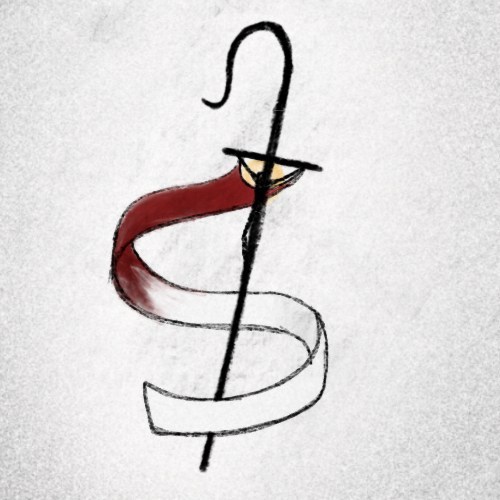
However as comforting as all of that is, it not our Lord’s focus when Jesus calls Himself the ‘good Shepherd’ here. The people who heard Jesus say these words figured He was a lunatic. Their response down in v. 20 is, “He has a demon and is insane; why listen to Him?”

In Jesus’ day and even now, shepherds keep sheep for their wool or their meat. Shepherds put food on the table and a roof over the heads of their family by sheering and slaughtering sheep. In the ways of the world, a ‘good shepherd’ is someone who is successful in making money off of his sheep. Imagine a cattle rancher saying, “I am the good rancher. I love the cows. I like to go out and pet them. And I let them live to a good old age in the field while I go and die for the cows.” You would not call that rancher ‘good.’ You’d call him a fool and a lunatic.

Here’s where this is going: Our translation has Jesus saying, “I am the good Shepherd,”and we use the word ‘good’ to describe all sorts of things that aren’t actually good. Teachers might write ‘good’ on assignments or tests when a student has actually done poor work. Some fathers are sleazy fornicators and only spend time with their children when it is convenient for them while treating their children’s mother like trash. But single mothers might still call them ‘good’ dads even though they scumbags. The word ‘good’ can be vague and simply don’t cut it when we think of Jesus as the ‘good Shepherd.’

On the one hand, ‘good’ is a perfectly legitimate way to translate the word (the adjective) Jesus uses to describe Himself as the Shepherd. But the word that Scripture gives us is much deeper than our word ‘good.’ So, you get to learn a Greek word today. Jesus calls Himself ‘the καλός Shepherd.’

1 Peter 2-24-25 - By His wounds Shepherd overseer of your soulsYes, it does mean ‘good’ but not in a subjective sense, not in a way that is open to anyone’s interpretation. Jesus is uniquely qualified to be the Shepherd of sinful sheep. Christ is the ‘good for you’ Shepherd. Kalos also means ‘right, fitting, true, beautiful, and competent.’ And Jesus Himself defines exactly what makes Him the kalos Shepherd. His the kalos Shepherd because of the fact that He lays down His life for the sheep.

In other words, Jesus, the kalos Shepherd, guards you, His flock, from the wolf no matter what. Jesus talks about the ‘hired hand’ who doesn’t own the sheep. A hired hand might not leave the flock if he sees a wolf way over there. In that situation, the hired hand might make a bunch of noise to scare away the wolf and save the flock he is watching over. A hired hand might even try to save the majority of the flock while a wolf picks off one or two sheep, and we’d still call him a good hired hand.

But Jesus, the kalos Shepherd, does something unimaginable. Jesus overcomes, defeats, and destroys the wolf by filling the wolf’s mouth with His own Body and thereby saves you from being lost and devoured by the wolf.

Right after our reading ends, Jesus goes on to say that the reason the Father loves Him is that He lays down His life for the sheep. Listen to this: Jesus says (v. 17-18), “For this reason the Father loves Me, because I lay down My life that I may take it up again. No one takes it from Me, but I lay it down of My own accord. I have authority to lay it down, and I have authority to take it up again. This charge (lit. “this command”) I have received from My Father.”

So, ask yourself, “If death cannot separate Him from me, what can?” If Jesus will go to the cross for you, and if Jesus will die for you, and if Jesus will come through death to be with you, He will always abide with you and will not leave you.

Hear this, you wandering sheep: When you had cut yourself off from God by your sin, Jesus, the kalos Shepherd, came down to die on the cross for you. Jesus could have run away like the hired hand, but He didn’t. If Jesus didn’t run away then, what would cause Him to run away from you now? The answer is nothing. There is nothing that will make Him throw up His hands and say, “Well, I’m done with that sheep.”

The Good ShepherdMy dear fellow sheep: Jesus is the kalos Shepherd; you are the sheep. You are not called to stand toe-to-toe with the devil. Satan, sin, and death are the wolves, and you are the sheep. Hide behind Jesus. Christ, your kalos Shepherd, places Himself in danger to rescue you from every threat. But even as you hide behind your kalos Shepherd, you do not cower in fear. Hide behind Jesus confidently knowing that He has overcome the wolf, won the victory, and His victory is your victory because you are His.

Alleluia! Christ is risen!
He is risen indeed! Alleluia!

Amen.

The peace of God, which surpasses all understanding, will guard your hearts and minds inChrist Jesus. Amen.

The Finger of God – Sermon for the Third Sunday in Lent on Luke 11:14-28

Listen here.

Luke 11:14–28

14 Now he was casting out a demon that was mute. When the demon had gone out, the mute man spoke, and the people marveled. Jesus Rebuking Demon15 But some of them said, “He casts out demons by Beelzebul, the prince of demons,” 16 while others, to test him, kept seeking from him a sign from heaven. 17 But he, knowing their thoughts, said to them, “Every kingdom divided against itself is laid waste, and a divided household falls. 18 And if Satan also is divided against himself, how will his kingdom stand? For you say that I cast out demons by Beelzebul. 19 And if I cast out demons by Beelzebul, by whom do your sons cast them out? Therefore they will be your judges. 20 But if it is by the finger of God that I cast out demons, then the kingdom of God has come upon you. 21 When a strong man, fully armed, guards his own palace, his goods are safe; 22 but when one stronger than he attacks him and overcomes him, he takes away his armor in which he trusted and divides his spoil. 23 Whoever is not with me is against me, and whoever does not gather with me scatters.

24 “When the unclean spirit has gone out of a person, it passes through waterless places seeking rest, and finding none it says, ‘I will return to my house from which I came.’ 25 And when it comes, it finds the house swept and put in order. 26 Then it goes and brings seven other spirits more evil than itself, and they enter and dwell there. And the last state of that person is worse than the first.”

27 As he said these things, a woman in the crowd raised her voice and said to him, “Blessed is the womb that bore you, and the breasts at which you nursed!” 28 But he said, “Blessed rather are those who hear the word of God and keep it!”

Grace, mercy, and peace be to you from God our Father and from our Lord and Savior, Jesus Christ. Amen.

Some people will never believe. Their hearts are so hardened that, no matter how great a sign they see from the hand of God Himself, they still refuse to believe. This doesn’t mean that we should stop proclaiming the Gospel to them or stop praying for them. It is just reality. And, in fact, it is a call to further prayer because we recognize that conversion is always, always a work of the Holy Spirit chiseling away at sin-hardened hearts.

Jesus casts a mute demon out of a man. Some marveled. Some were still seeking from a sign from heaven. And some accused Jesus of casting out the demon by the power of Beelzebul (which means ‘lord of the flies’ a derogatory title for Satan stating that the devil is the lord of the dung heap).

Now, as illogical as the accusation is, we need to see how that it infinitely more blasphemous. Jesus delivers a man from a demon that made him mute. But people say, “Jesus is doing the devil’s work.”

And we need to pause here because nothing has changed. This world still calls good evil and evil good. If you are pro-life, you are sexist who just wants to control women’s bodies. If you stand for marriage as God created it or believe that men are men and women are women, you are homophobic.

Believer, this world hates God and hates Jesus, and it hates you too because you are God’s child. We live in a world that constantly stands good and evil on their heads. And the sooner you admit it, the better.

Jesus shows how ludicrous the claim that He is casting out demons by the power of Beelzebul. Instead, Jesus says it is by the finger of God that He is casting out demons which means that the kingdom, the reign, of God has come among those who scoff at wheat Jesus is doing.

This expression Jesus uses “the finger of God” is interesting. That phrase is only used four times in the Bible. You heard it in our Old Testament lesson (Ex. 8:16-24). Pharaoh’s magicians recognize that the plague of gnats is the finger of God coming in judgment against them. In Exodus 31[:18] and Deuteronomy 9[:10], Scripture talks about God’s finger writing the Ten Commandments on the stone tablets. Now here, Jesus talks about God’s finger casting out demons. The point is that Jesus casting out demons is a fulfillment of the Law and a plague on hell. Jesus tells demons to go and they have to go.

Then, Jesus tells something like a parable. He says that when a strong man [the devil] who is fully armed guards (and keep that word ‘guards’ in the back of your mind because it comes up again in a little bit) his house [the world] his goods [sinners] are safely under his lordship. But Jesus says that when one stronger than him [Jesus] is going to come and attack him, take away his armor, and divide the spoil [you].

Jesus says that He has come to rob the devil’s house and you are the spoils, the treasure, the plunder that Jesus is taking out of the devil’s cellar. He has won, redeemed, purchased, and grabbed you from the devil’s clutches. All by the power of His finger.

He has pulled you out of darkness and into His marvelous light. And notice what Jesus says, “Whoever is not with Me is against me.” There is no spiritual neutral ground. You are either rescued by Jesus and delivered into His kingdom, or you are held captive in the devil’s domain. And if you are not filled by the Holy Spirit, then the demons come back, and your last state is worst than the first.

So how do you know if you are in the kingdom of God or in the kingdom of the devil? Well, Jesus answers that. A woman says to Jesus, “Blessed is the womb that bore you, and the breasts that nursed you.” Now, Mary was certainly blessed. She is the mother of our Lord. But Jesus says, even better than being His mother is to hear the Word of God and keep (there is that same word used about the devil ‘guard’) it.

Though you were guarded by Satan, Jesus has come and rescued you with His finger transferring you to His kingdom. Now, you guard the Word that Jesus used to deliver you from Satan.

Cross and CommunionGuard it. Keep it. Take it. Eat and drink it. Because Jesus joins that Word of deliverance and forgiveness of sins to bread and wine. With His little finger, He destroyers the stronghold and armor of the devil. He claims you as His own. And He guards and keeps you now and for all eternity. Amen.

The peace of God, which surpasses all understanding, will guard your hearts and minds in Christ Jesus. Amen.