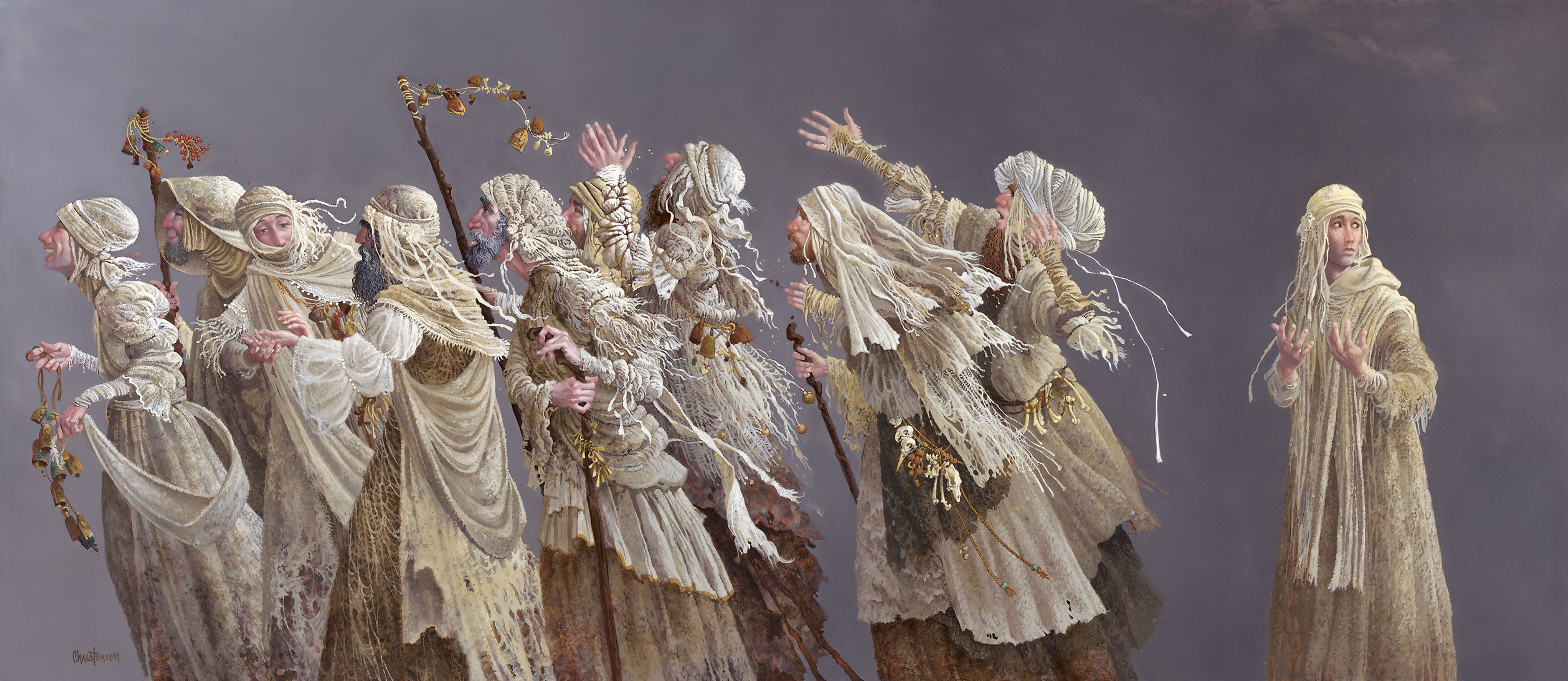
Cleansed & Thankful – Sermon on Luke 17:11-19 for the Fourteenth Sunday after Trinity

Luke 17:11-19

11 On the way to Jerusalem he was passing along between Samaria and Galilee. 12 And as he entered a village, he was met by ten lepers, who stood at a distance 13 and lifted up their voices, saying, “Jesus, Master, have mercy on us.” 14When he saw them he said to them, “Go and show yourselves to the priests.” And as they went they were cleansed. 15Then one of them, when he saw that he was healed, turned back, praising God with a loud voice; 16 and he fell on his face at Jesus’ feet, giving him thanks. Now he was a Samaritan. 17 Then Jesus answered, “Were not ten cleansed? Where are the nine? 18 Was no one found to return and give praise to God except this foreigner?” 19 And he said to him, “Rise and go your way; your faith has made you well.”

In the name of Jesus. Amen.

Trouble will often create fellowship. After the terrorist attacks on 9/11 our country had a strong sense of unity – at least for a bit. Those of you who lived here during the ’97 flood still have that fellowship. Maybe you’ve noticed having better fellowship with your family when a loved one has gone through lengthy medical treatments or died. Everyone bands together to get stuff done.

One of the reasons Alcoholics Anonymous or other support groups are so helpful is that struggling people can meet others have gone through similar situations. People gain strength and encouragement from others who have had similar experiences and struggles. All those are good examples of trouble creating fellowship. That kind of fellowship produces unity and focus, a renewed sense of purpose and drive, and hope in the midst of sorrow. Fellowship created by and through trouble can have a powerful positive effect. 

But trouble can also create bad fellowship – really bad fellowship. I’ve heard of support groups that morph into a kind of contest where some will try to show how much more pain they have endured than the rest of the individuals in that group. Or, when a group like that only focuses on their pain and struggle, some might start to think they’ll lose their connections if they begin to heal from the pain. So, everyone gets fixated on either being or, even worse, remaining a victim in an effort to not lose that camaraderie.

It seems like that fixation on victimhood is one of the tactics the devil is using to divide our culture today. There is so much conversation about privileged and the underprivileged. The super-rich and those who aren’t. The oppressors and the oppressed. Even if you aren’t initiating those conversations, the natural, knee-jerk reaction to that kind of talk is to view people who are introducing that kind of vocabulary as the enemy, so you put up walls and barriers. Dear saints, you must fight against that urge.

As a Christian, you know that all of humanity is much more united than we are divided. Whenever you have the urge to shove others away – and it doesn’t matter who the ‘others’ are – remember two things: First, you are united with every person you meet by the trouble of sin. We are all under the curse of sin and the sentence of death because of that sin. Second, you are united with every person you meet by the mercy of God that is only found in Christ. You know from the Word of God that every person you meet is someone from whom Christ died (Jn. 1:291 Tim. 2:6). Those two points of unity are desperately needed in our society and culture today.

In this text, the ten lepers were united by the trouble of their disease. Leprosy was a chronic skin disease caused sores, numbness, and the eventual loss of limbs. Because it was so contagious, leprosy also caused isolation from family and friends. Lepers had to live apart from others. But these ten found fellowship with each other because of their common trouble. The leprosy created a tight-knit community of ten that is more remarkable than we might realize. Apparently, most of these lepers were Jewish, but at least one was a Samaritan.

This is remarkable because this community of ten wouldn’t have formed unless they shared this disease. It wasn’t even conceivable. The disdain and divide between Jews and Samaritans was even bigger than between Vikings and Packers or Red Sox and Yankees fans. Or any other divide you want to insert here. But here they are in this little community of the suffering. And they are so united they do something very interesting.

When lepers encountered people who weren’t lepers, they would cry out, “Unclean, unclean” (Lev. 13:45). But that isn’t what these ten holler when they see Jesus. Instead, with a united voice (by the way, the Gk. for ‘voice’ there is singular not plural), these ten lepers cry out, “Jesus, Master, have mercy on us!” Jesus tells them to present themselves to the priests, and the only reason a leper would do that is if they had recovered from their leprosy. It’s only as they walk away from Jesus that they are healed from their leprosy. But only one, only the Samaritan, does an about-face and returns to give thanks to Jesus.

Once the leprosy that united them was miraculously healed by Christ, the unity they had was gone, so the group splits up. The Samaritan is now united through faith to Jesus. So, of course, this cleansed Samaritan returns to the One who cleaned him. The saved returns to his Savior. What happened to the nine? Were they just too excited to get back to their families that they forgot to thank the Son of God? Who knows?

We can ask this Samaritan in the Resurrection because, dear saints, you will meet him there. You will meet him because you have also been cleansed from the leprosy of your sin, just as he was. One day, you will join him in giving thanks and worshiping at the feet of your God and Savior, Jesus Christ. Maybe that Samaritan will tell us how he went and witnessed to the other nine and will introduce us to them.

From this Samaritan, we should learn that one of the characteristics of faith is thanksgiving and being a person of thankfulness. It’s interesting when Paul listed the fruit of the Spirit in our Epistle reading (Gal. 5:16-24) that he didn’tinclude thankfulness. But based on this account of the thankful Samaritan, we do see that thankfulness is one of the ways that faith is manifest.

As the Samaritan lies with his face on the ground giving thanks at Jesus’ feet, our Lord says to him, “Rise and go your way; your faith has (lit.) saved you” (not just ‘made you well’). In other words, the Samaritan’s thankfulness is the visible manifestation of faith because giving thanks is how he recognizes and acknowledges the Source of his cleansing.

Dear saints, be people of thanks, not just people of gratitude. There’s a lot of talk about gratitude today, and gratitude is good, but thankfulness is better. The distinction between the two is this (you’ve heard me say this before): Gratitude recognizes the goodness of the thing that has been given. But thankfulness goes a step further. Thankfulness recognizes the goodness of the giver. If a daughter asks her mom for a snack and is given a bowl of ice cream, the girl can be grateful, but if mom gives her a few sticks of celery, the kid won’t be grateful because celery is gross. But that same child can be thankful with either a bowl of ice cream or disgusting celery because it comes from her mom who loves her and knows what her daughter needs.

This distinction between gratitude and thankfulness helps us understand 1 Th. 5:18 which says, “Give thanks in all circumstances.” Not all circumstances are good, so how can you give thanks? Well, because thankfulness is not gratitude. Through faith you can give thanks whether God sends you joy or sorrow, pleasure or pain, goodness or even evil. Remember Job. After all his property and children were taken from him, Job said, “Naked I came from my mother’s womb, and naked shall I return. The Lord gave, and the Lord has taken away; blessed be the name of the Lord” (Job 1:21). Even after Job’s health was taken from him and his wife told him to curse God and die, Job said, “You speak as one of the foolish women would speak. Shall we receive good from God, and shall we not receive evil?” (Job 2:10). In both instances, Scripture says, “In all this Job did not sin with his lips” (Job 1:222:10).

In moments of loss and pain, you might not be able to be grateful, but you can be thankful. If nothing else, you can give thanks to God for what He has given, even if He takes it away. Through faith, you can give thanks – even when God takes His gifts from you because you know the goodness of the God who gave and removed those gifts. Through faith, you know that His goodness doesn’t fade or change. Only through faith can you give thanks in all circumstances (1 Th. 5:18).

Dear saints, in this world you have lots of trouble (Jn. 16:33), but even in and through that trouble, God unites you into the community of His Church. Christ has delivered you from your sin by the forgiveness He won and purchased with His blood on the cross. Because of that, you aren’t just united with others by trouble. You are united by something much, much stronger. You are united by His Blood, which cleanses you from all your sin.

Live now as God’s forgiven people, united in giving Him thanks. Your gracious, cleansing God and Savior, Jesus Christ, now invites you to His table to receive that cleansing through His Body and Blood. Come. Receive. And leave here with His thanks and praise on your lips. Let that thankfulness be on your tongue as you go about your business this week and every week because that thankfulness will point others to your Savior, who has cleansed you. Amen.

The peace of God, which surpasses all understanding, will guard your hearts and minds in Christ Jesus (Php. 4:7). Amen.

Dirty Work – Sermon on Ezekiel 34:11-16 for the Third Sunday of Easter

Ezekiel 34:11-16

11 “For thus says the Lord God: Behold, I, I myself will search for my sheep and will seek them out. 12 As a shepherd seeks out his flock when he is among his sheep that have been scattered, so will I seek out my sheep, and I will rescue them from all places where they have been scattered on a day of clouds and thick darkness. 13 And I will bring them out from the peoples and gather them from the countries, and will bring them into their own land. And I will feed them on the mountains of Israel, by the ravines, and in all the inhabited places of the country. 14 I will feed them with good pasture, and on the mountain heights of Israel shall be their grazing land. There they shall lie down in good grazing land, and on rich pasture they shall feed on the mountains of Israel. 15 I myself will be the shepherd of my sheep, and I myself will make them lie down, declares the Lord God. 16 I will seek the lost, and I will bring back the strayed, and I will bind up the injured, and I will strengthen the weak, and the fat and the strong I will destroy. I will feed them in justice.

Alleluia! Christ is risen! 
He is risen indeed! Alleluia!

In the name of Jesus. Amen.

One of the most common metaphors that the Bible uses for how we relate to God is the relationship between a shepherd and his sheep. It’s not the most common image, but it’s toward the top. It’s probably merciful that God didn’t make it the most common one because it isn’t overly complimentary. Sheep aren’t strong or fast or smart or impressive animals. Sheep are needy and, honestly, stupid. They get themselves into all kinds of dirty, sticky messes. The imagery isn’t meant to be flattering, but we don’t need to be flattered. God be praised that He doesn’t expect us to be anything more than His sheep.

When you’re the sheep, the image is very comforting. That’s why Psalm 23 is so popular. When you’re the Shepherd, it’s a lot of work – in fact a lot of dirty work. That’s why this text from Ezekiel 34 isn’t as well-known as Psalm 23. The context of this passage is that God is speaking against the shepherds (i.e. the rulers and religious leaders) whom He had called to shepherd His people. He is speaking against them because they hadn’t been faithful (Ezk. 34:1-10).

These shepherds failed to do what God called them to do. They had been feeding themselves instead of the sheep. They had fattened themselves by devouring the sheep. They had not strengthened the weak; they had not healed the sick; they had not bound up the injured, brought back the strayed, or sought the lost. Because of these failures, God’s sheep had been scattered over the face of the earth. God’s sheep had become food for the wild beasts, wandered all over the mountains, and were scattered with no one to search or seek them.

So right before our text starts, God says to those shepherds, “I am against you and will require My sheep from your hand.” God says that He’s going to put a stop to their neglect and lack of care for the sheep. He Himself will rescue them.

One of the classic children’s stories that I enjoy is “The Little Red Hen.” You remember how it goes. The little red hen finds some wheat seed and asks her friends, the dog, the cat, the duck, and the pig a series of questions. “Who will help me plant the seed, water the seed, harvest the wheat, grind the grain, bake the bread?” To each question, there’s the rhythmic reply, “’Not I,’ said the dog, ’Not I,’ said the cat, ’Not I,’ said the duck, ’Not I,’ said the pig.” So, the determined hen says, “Then I will do it myself.” Then, when the bread is finally out of the oven, the little red hen asks, “Who’s going to help me eat the bread?” And of course, the dog, the cat, the duck, and the pig are all eager and ready to eat, but she says, “No, you didn’t help me plant, water, harvest, grind, or bake. I will eat it myself.” And she did.

This passage has a similar tone to it. The shepherds had not done their job, and so God says, “Ok. I will do it Myself.” And He does. He did exactly what we needed as His sheep.

God says that He, Himself, seeks us, rescues us from all the places we’ve been scattered on a day of clouds and thick darkness. He brings us out from the peoples, gathers us from the countries, brings us into our own land, and feeds us with good pasture. He makes us lie down, seeks us when we’re lost, brings us back when we’re strayed, binds us up when we are injured, strengthens us when we are weak. He does all the dirty work that sheep need from their shepherd. God’s frustration here is not directed at the sheep – it’s directed to the shepherds. God willingly does all of these things out of His love, care, and compassion for you, His sheep.

When Jesus calls Himself the Good Shepherd in our Gospel reading today (Jn. 10:11-16), He says that He is that Shepherd. His work of seeking us lost ones, bringing back us strayed ones, binding up our injuries, and strengthening our weaknesses – all of this happens as He lays down His life for us. That is how He is your Good Shepherd.

You are His sheep. He cares for you and does all the dirty work of being your Good Shepherd. Christ does all of this dirty work for the joy set before Him (Heb. 12:2) of having you as His sheep. Your Good Shepherd fully knows that you need to be fed, found, brought back, bound up, and strengthened. In other words, He knows you are His sheep who need His care.

But don’t miss the fact that, as your Good Shepherd, He knows what tasks and responsibilities you can handle. So, He calls you to be His under-shepherds. Just because you are an under-shepherd doesn’t mean you are no longer His sheep. You are always a sheep. But He, as the Good Shepherd, entrusts the care of His sheep to you. Can you imagine a parent saying about their kid, “That’s God’s child, not mine”? Of course not! A parent recognizes, “That’s my child that God has given and entrusted to me.”

Dear saints, every relationship you have is a calling from God to care for His beloved sheep. Be faithful in those callings whether you are a parent, a worker, a student, a friend, a sibling, whatever. You are an under-shepherd.

In our Gospel reading, Jesus calls us hired hands (Jn. 10:12-13). Jesus doesn’t say that all the hired hands are cowards who run away at the sight of the wolf simply because they are hired hands. He says that the ones who flee do so because they don’t care about the sheep. Christ has given you callings and wants you to have the same care for His sheep that He has entrusted to you. Again, the context of this passage from Ezekiel is clear that God intends that His under-shepherds be faithful in doing the dirty work of caring for His sheep. So, be a good under-shepherd.

Dear saints, you have been called to follow Christ’s example (1 Pet. 2:21). Imitate and follow Him. Your Good Shepherd has joined you to His cause of bringing back the strayed to the Shepherd and Overseer of souls (1 Pet. 2:25). Jesus is the Shepherd who clears the path before you, His sheep. Christ is also the janitor who cleans up after you when you fail as His under-shepherd.

Dear saints, you are called to do the dirty work of being shepherds, caring for God’s flock, and ministering to all the different needs of God’s sheep. You are to bind up the injured, bring back the strayed, and strengthen the weak.

I want to close with these verses from 1 Pet. 5:2-4 where the Holy Spirit says to all of us, “Shepherd the flock of God that is among you, exercising oversight, not under compulsion, but willingly, as God would have you; not for shameful gain, but eagerly; not domineering over those in your charge, but being examples to the flock.” And listen to the conclusion, “And when the chief Shepherd appears, you will receive the unfading crown of glory.” 

God be praised that Christ Himself is our Good Shepherd who both leads us and follows after us as He cares for all His sheep. Amen.

Alleluia! Christ is risen! 
He is risen indeed! Alleluia!

The peace of God, which surpasses all understanding, will guard your hearts and minds in Christ Jesus. Amen.

Friend, Move up Higher – Sermon on Luke 14:1-11 for the Seventeenth Sunday after Trinity

Luke 14:1-11

In the name of Jesus. Amen.

The game is afoot. This prominent Pharisee and his friends had invited Jesus to a Sabbath dinner party. Our Lord is in hostile territory. The Pharisees want to investigate how Jesus will behave on the Sabbath, and their focus is especially on seeing if He will work because that was strictly forbidden by their additional rules. Ironically, this means that they are working by keeping a close watch on Jesus. And Luke draws our attention to this sick man, “Behold, there was a man before [Jesus] who had dropsy.”

Now, Luke doesn’t come flat out and say this, but everything points to the fact that these Pharisees have intentionally set this situation up as a trap. The clues all point to the fact that this sick man was invited so they could test Jesus and see what He would do.

The man was sick with dropsy. The term for his condition today is ‘edema.’ It means that he is retaining water which causes his limbs to swell up in a gross way. In other words, you’d visibly see that this man isn’t well. On top of that, his swelling meant that he was unclean according to Lev. 13:2. This man’s sickness would normally have meant he wouldn’t get an invite to this Sabbath meal. Again, Luke doesn’t come straight out and say it, but there’s little question that this whole situation is set up to trap Jesus. But it doesn’t go too well for the Pharisees.

Throughout the Gospels, we see that Jesus knows what people are thinking (Mt. 9:4; Mk. 2:8; Lk. 5:22; Jn. 2:24-25). So, Jesus turns the tables and traps them. Notice that He initiates the confrontation by asking, “Is it lawful to heal on the Sabbath or not?” Of course, the answer is, “Yes, it’s lawful.” There are zero biblical laws against healing on the Sabbath. The reason there aren’t laws against it is simple. Who alone can heal disease? Only God can. Sure, doctors can treat diseases, but they can’t heal them. Throughout Scripture, God doesn’t give any laws against parting the Red Sea, turning water into wine, feeding 5,000 people with five loaves and two fish, or raising the dead on the Sabbath. The Bible doesn’t have one word against doing those things because God is the only one who can do any of that.

So, the hunters become the hunted, and the trappers, the trappeese [sic.]. The Pharisees are silent. Jesus heals the man and sends him off with a body that is no longer gross and swollen. And Jesus isn’t done interrogating these folks. “Which of you, having a son or [even] an ox that has fallen into a well on the Sabbath, wouldn’t make sure to pull him or it out?” And, again, they don’t answer because they can’t. They would do that lesser thing of rescuing their son or animal from a well on the Sabbath, so of course God – who, again, is the only one who can heal – would deliver someone from a sickness and grant that relief on the Sabbath.

Then, Jesus tells a parable about seating arrangements against them. While they were watching Jesus, He had been watching them. They had all been trying to get themselves into best possible spot at the feast. They were all jockeying for positions to show everyone else how important they were. I’m sure this is not how they imagined this entrapment dinner party would play out. Jesus keeps coming at them but not to condemn them; instead, Jesus is calling them to repentance.

Yes, the Pharisees are always trying to condemn Jesus. Yes, throughout the Gospels, they are the enemies of our Lord. And yes, Jesus warns us to not become like the Pharisees. But we have to remember that Jesus died for them too. Jesus loves the Pharisees and wants them to repent, to believe in Him, and to receive His forgiveness. So, when Jesus exposes the foolishness of the Pharisees, we shouldn’t stand on the sidelines and hope they get injured. 

Remember, all of us have a little Pharisee living inside of us. Our sinful nature desires to be noticed and praised for our own goodness and holiness. The creed of the Pharisee, and all of us little Pharisees, is, “I’m a good person,” and we will do everything in our power to try and prove that to others. But if we are trying to impress others with our morality, the only accolades we will receive will be from other sinners. If we are outside of faith in Christ, the only thing we will hear from God is, “Depart from Me, you cursed workers of lawlessness, into the eternal fire prepared for the devil and his angels” (Mt. 7:23; 25:41). 

We take God’s Law and misuse it to try and make ourselves look better than others. This is completely wrong. God didn’t give the Law for us to measure how we compare to others. God has given the Law for three purposes, and we have covered the three biblical uses of God’s Law recently, but it is always good to review those.

First, God’s Law shows us how creation works. The Commandments reveal how God has ordered things in creation. The theologians will describe this first use of the Law as a ‘curb’ that keeps us from driving off the road and causing damage to us and to others. Second, because God’s Law is a curb, it also shows us how sinful we are. This second use of the Law is a ‘mirror’ that reveals how wicked, wretched, and sinful we are. It brings us to repentance and faith in Christ. Third, God’s Law is a ‘guide’ which shows us how God wants us to live and how to love Him and love our neighbor. These three uses of the Law are clearly taught in Scripture. And 1 Tim. 1:8 says, “the Law is good if one uses it lawfully.”

Our problem is that we are like the Pharisees and use the Law in other ways that are not lawful. They are outside of how God intended the Law to be used. Instead of a curb, guide, and mirror, the little Pharisee in us tries to use the Law as a ladder. We foolishly attempt to use Law as a way to climb up to God. We wrongly imagine that if we do enough good works or climb a little higher than others then God will reward us. We wrongly use the Law as a foam finger cheering ourselves on, “I’m #1.” We misuse the Law as a podium trying to claim a spot that elevates us above others. The Law wasn’t intended to do any of that, but that’s how our sinful nature tries to use the Law over and over and over. Repent.

The Law puts us in our place. Again, it shows us how creation is ordered and works. That, then, shows us how far out of step we are with what God intends us to be and drives us to Him for His mercy and forgiveness. The sooner we learn this, the better. Because the only thing that can elevate us isn’t the Law. No thing can elevate us. Only God Himself can. And when we sinners repent, turn from our wickedness, abandon our own good works, and turn to Him for our righteousness and holiness, then, and only then, we become God’s friend, and He calls us higher. He elevates us.

Here’s the thing. Once God calls you, “Friend,” it almost doesn’t matter what He says after that. He could say, “Friend, unload the dishwasher,” or, “Friend, go rake the leaves.” If God calls you, “Friend,” that’s all you need. He knows all your sin, but He comes to you today and says, “You are My friend.” And He lifts you up. That’s what the absolution is. Jesus lifts you up, out of your sin, and says to you, “Friend, move up higher.” In Holy Communion Jesus calls you higher, to sit with Him at His table. Even your death is Jesus saying to you, “Friend, move up higher because I’ve made a way for you to live forever with Me.” 

You probably know the hymn What a Friend We Have in Jesus, but do you know what Jesus sings? What a Friend I Have in You. Dear saints, Jesus, and Jesus alone, lifts you up by saying, “Friend, move up higher.” Amen.

The peace of God, which surpasses all understanding, will guard your hearts and minds in Christ Jesus. Amen.