In the name of Jesus. Amen.
Luke 15 is a well-known chapter with three parables. Even though you only heard the first two today, you know the third one—the parable often called “The Prodigal Son.” It would probably be better if it were called “The Merciful Father” or something along those lines. The three parables belong together as one unit.
One of the common misconceptions we can have about these parables is that they only deal with conversion. But Jesus makes it clear—especially when He makes His concluding comments on these first two—that they deal with repentance, not just conversion. Of course, repentance is present in conversion, but it is also present in the daily life of a Christian. Before the confession of sins in our service, we regularly refer to 1 John 1:8-9, “If we say we have no sin, we deceive ourselves, and the truth is not in us.” Not only is John writing that to Christians, he also includes himself in that statement. “If we say we have no sin…” The Apostle John recognizes that he has sin, and if he were to say otherwise would mean that the truth is not in him.
Today, I want to consider these two parables in that light because it helps us see that each and every day of our lives, we are that one lost sheep and one lost coin. We’re going to do that based on what we believe, teach, and confess from Luther’s Small Catechism from the section on Baptism. In your bulletin, you’ll find that I’ve printed the fourth question and answer. I’ll read the question, and I’d like all of us to read the answer that is drawn from Romans 6:4 and its context.
“What does such Baptizing with water signify? It signifies that the old Adam in us, together with all sins and evil lusts, should be drowned by daily sorrow and repentance and be put to death; and that the new man should daily come forth and rise to live before God in righteousness and holiness forever.”
The Christian life is marked by daily repentance. Christian, as long as you still have breath in your lungs, you have a need to repent. The old Adam in each of us needs to be drowned daily. These parables aren’t just about unbelievers; they are about us.
This is clear from v. 1 of the text, “The tax collectors and sinners were all drawing near to hear Him.” Notice why they are coming to Jesus. They aren’t just coming to be close to Jesus or have a meal with Him. They do get those things, but that isn’t the purpose of their coming to Jesus. They are coming to hear Him. What sort of things would they be hearing from Jesus?
Jesus wasn’t teaching only about love and acceptance. He was clearly showing and declaring God’s mercy. He taught that He was going to suffer, die, and rise for sinners (Lk. 9:22, 44-45; 12:50; 13:32-33; 17:25; 18:31-33). So, yes, He was teaching them the Gospel. But that wasn’t all He was teaching. Jesus was also clearly teaching the Law.
If you just look at the context of what Jesus had been teaching right before this chapter, you get a better idea of what these sinners and tax collectors were hearing from Jesus (Lk. 14:26-33). Christ was teaching, “If anyone comes to Me and does not hate his own father,” (happy Father’s Day) “If anyone comes to Me and does not hate his own father and mother and wife and children and even his own life, he cannot be My disciple” (Lk. 14:26). Jesus goes on to talk about counting the cost of following Him (Lk. 14:27-32). And He concludes by saying, “Any one of you who does not renounce all that he has cannot be My disciple” (Lk. 14:33).
A lot of people today—especially in the month of June—will say, “Jesus loves you just the way you are.” There is some truth there, but it’s only a half truth, which is very dangerous. Sure, Scripture teaches that Jesus loves you just the way you are, but the full truth is that Jesus has no intention of leaving you just the way you are. That full truth is much, much better news. Jesus loves you even though you are a sinner. Sinners are enemies of God, and Jesus came to reconcile sinners to become friends and sons of God who are made holy and blameless (Ro. 5:10; Col. 1:21-22).
The Pharisees and scribes were grumbling (Lk. 15:2) because they wrongly thought that Jesus was simply welcoming sinners without calling them to turn from their sin. But that wasn’t the case, was it? No! Not when we see these parables in their context. Jesus knew exactly what kind of people were coming to hear Him. That’s why He proclaimed both the Law and the Gospel. He knew the gravity of their sins—the cheating, the waste, the lies, the pain they caused others and God.
Take that idea into these two parables—especially as they describe how the shepherd and the woman seek to find the lost sheep and the lost coin. The shepherd doesn’t wait for the sheep to feel lost or to bleat for help. It’s possible that the sheep didn’t even know it was lost. The woman doesn’t wait for the coin to ask for help from the dusty crack in the floor. The coin definitely didn’t know it was lost. Both the shepherd and the woman do whatever is necessary to find what was missing. And they both do it with joy.
Again, this seeking and finding is not a one-time event for unbelievers. This is the daily rhythm of your life as a Christian. Jesus does whatever is necessary—again and again—to find you when you go missing in the wilderness and cracks of sin. He doesn’t wait for you to feel your lostness. He doesn’t sit back and wait for you to take the first step. He takes the initiative daily, and He does it with a divine heart full of mercy.
In Ezekiel, God asks, “Have I any pleasure in the death of the wicked, and not rather that he should turn from his way and live?” (Ezk. 18:23). In Jeremiah, God speaks about His wayward child, “As often as I speak against him, I do remember him still. Therefore my heart yearns for him; I will surely have mercy on him, declares the Lord” (Jer. 31:20).
Theologians will use a term to talk about how God calls sinners out for their sin through the Law. They call it God’s “alien” or “strange work” (Is. 28:21) because God describes Himself as merciful and gracious, slow to anger and abounding in steadfast love and faithfulness (Ex. 34:6-7). When God threatens, judges, and calls to repentance, He does that so He can do His “proper work” of forgiving, restoring, and delivering His mercy (1 Sam. 2:6), which is the work He delights to do. Even though His work through the Law is His “alien work,” He does it joyfully because His heart longs for you to be His own. He remembers you with mercy even though it means that He must speak against you and your sin through His Word.
That is what is happening every time you gather together here and every time you hear God’s Word. He is seeking you even while your old, sinful nature clings to you and needs daily drowning. He doesn’t wait for you to be sufficiently sorry or desperate. He comes to you in the preaching of His Word (Ro. 10:17). He seeks you out wherever you are—in whatever desolate wilderness or dusty corner your sins have led you. He picks you up, lays you on His shoulders, and rejoices to bring you home.
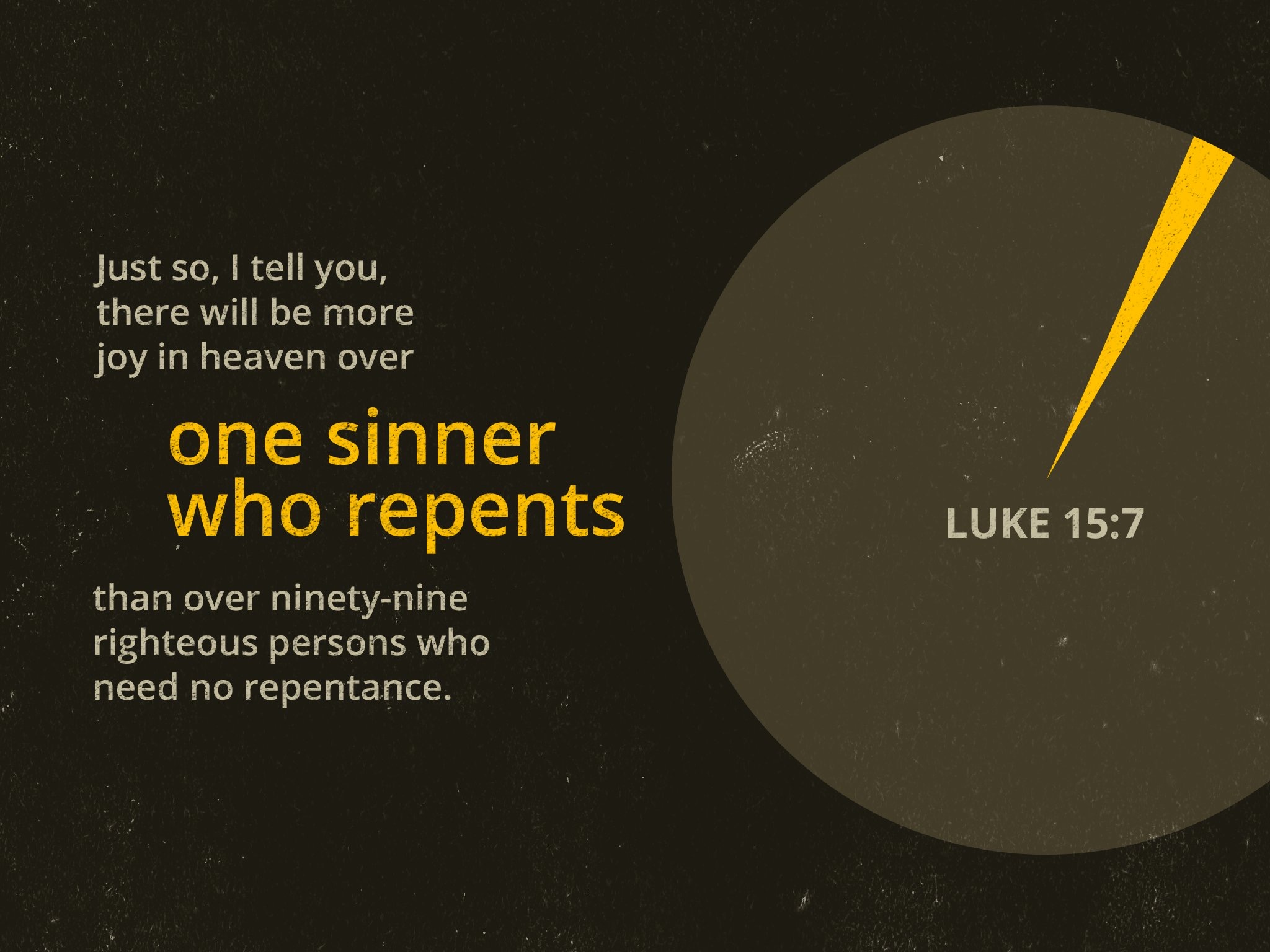
Dear saints, God does not expect you to become like the ninety-nine righteous persons who need no repentance (Lk. 15:7) or like the nine coins that never get lost. Those are the ones who falsely imagine they have moved beyond the need for daily repentance. Every day, you are the one. Every day, you are the lost sheep who is carried home. You are the coin He searches for diligently. And your Savior has great joy in daily seeking and restoring you.
Here, Jesus teaches that what brings joy to heaven is not your consistency or your record of good works—even though God delights in the fruit of faith. But what moves Christ and all of heaven to rejoicing is when you receive God’s forgiveness. When you believe the Absolution. When you receive Christ’s Body and Blood that forgive you and strengthen you.
Dear saints, your Savior does not merely tolerate your daily repentance, He seeks it. He gives it (Act. 11:18, 5:31; 2 Ti. 2:25). And He rejoices in it with exceeding joy. Amen.
The peace of God, which surpasses all understanding, will guard your hearts and minds in Christ Jesus (Php. 4:7). Amen.


You must be logged in to post a comment.