Comfort to the Heart – Sermon on Isaiah 40:1-8 for the Third Sunday of Advent

Isaiah 40:1-8

In the name of Jesus. Amen.

In your lowest moments – and even before those lowest moments arrive – God is there tenderly speaking, “Comfort, comfort,” to you, His people. He speaks that comfort to remove the burden of the debt of sin, and this changes everything for us sinners.

Just before our text, in Isaiah 39, Hezekiah, the king of Judah, welcomes an envoy of ambassadors from the king of Babylon. That empire was growing in strength and power, and Hezekiah wanted to have Babylon as an ally in case the Assyrian Empire attacked Judah. While those ambassadors were there, Hezekiah does what kings often do. He shows off. He gives the ambassadors a tour of his palace and shows them all of his treasure. He flaunted his silver, gold, and spices. Hezekiah displayed all the weapons of his armory – his entire treasury. He left nothing hidden. Basically, Hezekiah was boasting about himself and the greatness of his kingdom, but he doesn’t boast about his Lord and God who had given it all to him.

After the Babylonian delegation leaves, the prophet Isaiah visits the palace to confront Hezekiah about all this. Isaiah rebukes him for being so foolish and prophesies that the Babylonians will come again in a hundred years to strip the palace and the Temple of everything. All the gold and wealth and treasure and weaponry of Hezekiah’s kingdom – it will all be taken by the Babylonians because Hezekiah’s pride did nothing more than make himself a target by showing off. Isaiah says that Hezekiah’s descendants would pay the price of his foolish actions.

And Hezekiah’s response is, frankly, disgusting. Basically, he says, “Let me get this straight, Isaiah. You’re saying that I get to keep the treasure? Babylon isn’t going to come and ransack and pillage as long as I’m alive?” And Isaiah says, “Yeah, but listen. It’s going to happen to your descendants.” But Hezekiah doesn’t care. Instead, he says, “Cool. Everything will be safe and secure in my days.” That, of course, is the wrong response.

Hezekiah should have fallen to his knees and begged for God to forgive him or, at least, ask that the payment of his foolishness not fall upon his children and grandchildren. Instead, Hezekiah callously says, “This is great. I don’t have to deal with it.”

Just over 100 years later, the price of Hezekiah’s foolishness and pride was paid. Babylon came. They destroyed the Temple. Men, women, and children were slaughtered in the streets. The nation was torn apart. People were ripped from their country, their lands, and their homes. And they were taken into exile in Babylon (2 Kgs. 25:1-212 Ch. 36:17-21Jer. 52:1-30).

Imagine enduring all of that. Imagine being part of that generation who paid the debt of Hezekiah’s pride. They watched as all these things happened, and because they were familiar with the book of Isaiah, they knew that they were paying Hezekiah’s debt because he was totally fine with passing that debt of his sin off to a future generation.

If you were part of that generation who endured that destruction, how would you handle and process that? How could you be anything but bitter and resentful that your forefather had been totally willing to pass the punishment of his sin off to you? How would you cope? Where would you find comfort?

Well, you would find it here in these verses that come immediately after Isaiah recorded Hezekiah’s foolish and callous actions. And dear saints, these verses aren’t only for the people who were carried into exile in Babylon. They are also for you today. Now. “Comfort, comfort My people, says your God. Speak tenderly to Jerusalem.” And that phrase, ‘speak tenderly,’ is a lot stronger in Hebrew. It’s an idiom that is literally translated, “speak to the heart.” God isn’t just speaking cliché platitudes from a far, distant place. No. Your God leans in close to speak comforting words directly into the heart of you, His people.

These words of comfort here in Isaiah 40 are for you because you are God’s people through faith in Christ. And these words cut through the noise and chaos of sin and suffering to touch you where your ache is sharpest and deepest. In the midst of the pain that has come to you because of sin – both your sin and the sins of others – God speaks tenderly, He speaks directly to your heart, “Be comforted. Be comforted. [Your] warfare and hardship is ended; [your] iniquity is pardoned.”

This whole text is beautiful, and dozens sermons could be preached on each line of the text. We could focus on the lines concerning John the Baptizer who would proceed Jesus and make a straight, level highway in the wilderness for the coming of the God who brings this comfort. We could ponder the arrival of God’s glory that will be seen by all flesh for eternity.

Earlier this week, I considered focusing this sermon on the lines about all flesh being like grass. Remember how Adam and Eve – who, after the Fall, became like the grass that withers and fades – they tried to cover themselves with foliage when they heard the sound of God walking in the Garden of Eden (Gen. 3:7-8). But God had come to give them the comfort that He would send the Seed of the woman to crush the serpent’s head (Gen. 3:15). And that Word of promise endures forever. Maybe, I’ll preach that sermon sometime in the future. Anyway, there’s an eternity of sermons that could be preached from these nine verses.

But the thing I want to focus on today is that phrase from the last line of v. 2 about receiving, “from the Lord’s hand double for all [your] sins.” And I want to focus on it because, even though it sounds like Law, it is sweet, sweet Gospel spoken from God’s mouth directly into your heart. But we need to do a little groundwork first.

In Is. 40:2, Isaiah uses two of the three most common Hebrew words for breaking God’s Law – ‘iniquity’ and ‘sin.’ The third word that Isaiah doesn’t use here is ‘transgression.’ And each of these words give a slightly different picture of what sin is.

The Hebrew word that regularly gets translated ‘transgression’ means to cross a boundary. In each Commandment, God sets a line and crossing over that line is a ‘transgression’ or a ‘trespass.’ The Hebrew word that most often gets translated as ‘sin’ means to miss the mark. God has a standard for us, but we keep missing it. Think of an archer who never hits the target, let alone the bullseye. Finally, the Hebrew word that gets translated ‘iniquity’ refers to the guilt and shame caused by sin. Think of the weight and indebtedness you feel when you’ve wronged someone – that’s the iniquity. All three words deal with the same thing (our sin), but each one focuses on a different aspect of that sin.

Well, here God says that your iniquity, that debt and weight of sin, is pardoned and that you have received from His hand double for all your sins. Again, this should be comforting. God isn’t saying that He’s giving you double punishment for your sin. No!

Instead, God has taken that debt of sin. He pays for it. Imagine your sin as a pile debt on your account. Because of Jesus, the billions of debt that you owe because of your sin is all paid off. But God doesn’t stop and just get you to an even balance. In place of that massive debt, God credits your account with the righteous deeds and the perfect obedience of Jesus.

You can imagine a chalkboard where all your sins are written down. Through faith, Jesus comes and wipes every last speck of that chalk and dust off. But He doesn’t stop once your slate is wiped clean. He writes over that chalkboard all of the holy, righteous, and perfect works that He has done (see Mt. 25:31-40).

God knows the full debt of your sin down to the last penny. And when Jesus pours out His forgiveness, mercy, and salvation on you, it is in double measure of your debt.

In Jer. 31:34, God says that He forgives your iniquity and remembers your sin no more. Dear saints, be comforted. God doesn’t remember the kind or type of sins you have committed. He doesn’t remember the specific ways you have transgressed against Him and against your neighbor. The only thing that He remembers about your sin is the amount of debt you owe. And the only reason God remembers that is so He can give you a double portion of His grace and mercy (Jn. 1:16).

That is the comfort He gives to you. That is the comfort He speaks to directly into your heart today and every day. Your Redeemer will continue to speak that comfort to you, and His Word of grace, mercy, and comfort endures forever. Amen.

The peace of God, which surpasses all understanding, will guard your hearts and minds in Christ Jesus (Php. 4:7). Amen.

Encouragement – Sermon on Romans 15:4-13 for the Second Sunday of Advent

Romans 15:4-13

4 For whatever was written in former days was written for our instruction, that through endurance and through the encouragement of the Scriptures we might have hope. 5 May the God of endurance and encouragement grant you to live in such harmony with one another, in accord with Christ Jesus, 6 that together you may with one voice glorify the God and Father of our Lord Jesus Christ. 7 Therefore welcome one another as Christ has welcomed you, for the glory of God. 

8 For I tell you that Christ became a servant to the circumcised to show God’s truthfulness, in order to confirm the promises given to the patriarchs, 9 and in order that the Gentiles might glorify God for his mercy. As it is written, 

“Therefore I will praise you among the Gentiles, 
and sing to your name.” 

10 And again it is said, 

“Rejoice, O Gentiles, with his people.” 

11 And again, 

“Praise the Lord, all you Gentiles, 
and let all the peoples extol him.” 

12 And again Isaiah says, 

“The root of Jesse will come, 
even he who arises to rule the Gentiles;
in him will the Gentiles hope.” 

13 May the God of hope fill you with all joy and peace in believing, so that by the power of the Holy Spirit you may abound in hope.

In the name of Jesus. Amen.

If your mailbox is anything like ours, you’ve noticed it being fuller than normal over the last couple weeks. It happens each year – usually beginning sometime around Thanksgiving. You start getting advertisements for Black Friday sales. Different organizations and charities send requests for end of the year gifts. If you live in Polk County, you receive your estimate for next year’s property tax. Packages arrive with gifts that will be wrapped and placed under the tree. Family and friends start sending out their Christmas cards and newsletters. Some of this extra mail makes you excited; some of it makes you mad or, even, overwhelmed. You’re more likely to be excited to open a package or read a Christmas card than you are to open your property tax assessment. And you might be frustrated with how quickly some of that mail fills up your garbage can.

In these verses, Paul is talking about God’s mail to you. He’s referring to the Bible. And all of it has a purpose. He says, “Whatever was written in former days was written for our instruction, that through endurance and through the encouragement of the Scriptures we might have hope.” This verse (Ro. 15:4) is an extremely important verse for preachers. It and 2 Tim. 3:16-17 are where Scripture itself tells us what the purpose of Scripture is. Scripture teaches that there are five different ‘uses’ or ‘purposes’ of God’s Word. 2 Tim. 3:16-17 gives the first four when it says, “All Scripture is breathed out,” or ‘inspired,’ “by God and is profitable for 1) teaching, 2) reproof, 3) correction, and 4) training in righteousness, that the man of God may be complete, equipped for every good work.”

The fifth use/purpose of Scripture is here in Ro. 15:4 – encouragement. When preachers are taught this five-fold use/purpose of Scripture, the two that float to the top as the most important uses of Scripture, the ones that should probably always be in a sermon, are teaching and encouragement. The other three – reproof, correction, and training in righteousness – yes, they are important, but they don’t need to be part of every sermon. The text that’s being preached is what should guide the preacher as to which of the five ‘uses’ make it into the sermon because each text has a different focus. But teaching and encouragement are something that should happen in every sermon – at least, to some degree.

Dear saints, according to Scripture itself, God is encouraging us whenever we read the Scriptures. The Bible wasn’t written for the benefit of the authors so they could write a best-seller and earn a living. Neither are the Scriptures merely personal notes or stories or genealogical records. No. The Scriptures were inspired, written, recorded, and preserved by God to teach you and to give you hope, comfort, and encouragement.

The Holy Spirit inspired each author to write what they wrote to give you encouragement. God Himself is the author of all Scripture. So, He inspired Moses to write Genesis-Deuteronomy for you. He had David write the Psalms for you. The Holy Spirit inspired Isaiah and Jeremiah and Malachi to write so that you – along with all the saints who have come before you and will come after you – could learn and be encouraged. The Scriptures are God’s Word. The contain God’s promises that He gave to our brothers and sisters in Christ who came before us. But they are written and recorded for your sake. In other words, we all benefit from them. Every line of Scripture is written for your benefit.

Sadly, many think that the Bible is nothing more than an old book with dead authors and dead audiences. That wrong idea leads them to conclude that the contents and the subjects that Scripture addresses are dead as well. But they aren’t. The Bible is not a bunch of words for a former time that are intended for former people. As Christ’s children, you know better.

The Bible is God’s Word for you and to you. The Scriptures are written for your learning and mine. The applications that can be made from the Scriptures are for us – even when the things that occur in them happened to somebody else. The Scriptures are for your learning, reproof, correction, training in righteousness, and for your encouragement.

The word that Paul uses here for ‘encouragement’ is the same word that Jesus uses to refer to the Holy Spirit in Jn. 14-16. The Holy Spirit is the Comforter, the Helper, the Advocate of God’s people. The Holy Spirit uses that Word to point you to Jesus (Jn. 15:26), who is also your Comforter and Advocate (1 Jn. 2:1). And the Spirit uses that Word to bring you to faith in what is firm, certain, strong, and unchanging. Christian, you don’t have to speculate about God or wonder what He thinks about you. The Scriptures tell you exactly what God thinks and what He promises to give to you and to do for you. That is the source of your encouragement.

Comfort and encouragement is always for those who are troubled. There are all sorts of things in this world that might cause you to be troubled, but the Scriptures seem to divide the trouble you face into two main categories 1) a troubled conscience and 2) a troubled heart. And it’s helpful to keep a distinction between those two.

When we think about the encouragement that the Bible gives, we might think mostly about the comfort that has to do with our sin, which is probably good. Scripture is where God tells us all the things that we must do, all the things we must notdo. And as we hear that, we recognize that we are sinners because our conscience is troubled by our sin. Then, of course, God’s Word comes and tells us that for the sake of Jesus Christ, God removes our sin as far from us as the east is from the west (Ps. 103:12) because Christ is the Lamb of God who takes away the sin of the world (Jn. 1:29). Jesus died for those sins, bearing them to His now-empty tomb. All of us need the encouragement that our sins are forgiven so we would be comforted in our conscience.

But Scripture also wants to encourage your troubled heart, which is different from a troubled conscience. In Jn. 14:1, Jesus tells the disciples, “Let not your hearts be troubled.” There, Jesus isn’t addressing the disciples’ sin. Instead, He’s comforting and encouraging them because of what’s about to happen. He’s about to go to the cross and be parted from them. He’ll be in the tomb for three days. That fact is going to give the disciples troubled hearts.

So, the distinction between a troubled conscience and a troubled heart is the root cause. A troubled conscience is caused by sin. But a troubled heart is caused when you see the things going on in this dark, fallen, sinful world and recognize that things are not as they should be. They are not as God created and intended them to be.

This is why all of Scripture – every book, chapter, paragraph, verse, and word – all of it is for your encouragement. Sure, you might gravitate to certain comforting and reassuring passages. That is natural. It’s fine and, even, good. But all of it is for your encouragement. Even the Law portions of Scripture, the parts that tell you what you must do and must not do, even those are encouraging.

Think back to the idea of the different kinds of mail you receive this time of the year. You’d probably rather read the Christmas cards than open your property tax assessment for the upcoming year. Just like you’d probably prefer to read Ps. 23 about God being your Shepherd than, say, Lev. 14 about the laws for a person with leprosy. But both are for your encouragement.

Even God’s Law and Commands are comforting because you are clearly told what is required of you. God doesn’t hide anything from you. There will be no surprises on the Last Day when it comes to what God demands. He’s not shifty. He is open and clear. So, whenever you read Scripture, look for the encouragement. Sure, there are portions of Scripture that you might – at least not initially – think of as comforting, but that’s not a problem with the Scriptures. That’s a problem with our perspective of the Scriptures. In His holy Word, God has laid everything out on the table. Everything He wants you to know, He has told you in His Word. He hasn’t held anything back.

One of the most encouraging things in the Scriptures that should always be on your mind is that Jesus is coming back to rescue you. Our Gospel reading today (Lk. 21:25-36) makes that clear. Sure, some of the language in that reading is troubling. Jesus mentions all sorts of things that can cause a troubled heart – signs in the sun, moon, and stars; distress of nations; the roaring of the sea and waves; and the powers of the heavens being shaken. People will be fainting with fear and foreboding for all the things that are coming on in the world. And we see a lot of that going on today. We see the wars and hear rumors of wars. We see violence and division. We see evil people doing evil things. We hear reports and speculations of all sorts of bad things that might happen in the future. And all of this can cause our hearts to be troubled. But be encouraged. Jesus has plainly told you that these things will happen. So, He’s not surprised when they do. And because He’s not surprised, be encouraged because Christ is still on the throne, and He knows how to deal with all those things.

Your crucified and risen Savior, Jesus Christ, has ascended into heaven and now rules and reigns over all things for your benefit, believer. And He is coming back to rescue and deliver you from every trouble and every evil. That is your hope, that is your comfort, that is your encouragement each and every time your heart is troubled. Open the Scriptures and be reminded that Christ is coming to deliver and rescue you. 

When your heart is troubled because of all the evil that surrounds you, remember that Jesus promises that evil is the sign that His return is drawing closer. He says, “When these [troubling] things begin to take place, straighten up, raise your heads, because your redemption is drawing near” (Lk. 21:28). Not only is it drawing near, but it is here as our Savior comes and invites us to His table. Amen.

The peace of God, which surpasses all understanding, will guard your hearts and minds in Christ Jesus (Php. 4:7). Amen.
Unveiled – Sermon on Exodus 34:29-35; Matthew 17:1-9; and 2 Peter 1:16-21 for the Transfiguration of Our Lord

Exodus 34:29-35; Matthew 17:1-9; & 2 Peter 1:16-21

In the name of Jesus. Amen.

This is a glorious text, but even more glorious is that the beloved Son of God would give His life for you on the cross. Because Jesus has died for you, you, dear saints, will also shine like the sun (Mt. 13:43). To make that point, we’re going to consider all three of our Scripture readings and two other passages, 2 Cor. 3:4-18 and Mt. 13:43. A figure skater or a competitive diver will do a routine with a high degree of difficulty to get a higher score. Hopefully, my execution of the sermon will be good enough that the payoff will be worth it in the end.

A person’s face can tell you a lot. Just to be clear, I’m not talking about the mouth part of a person’s face – of course, the mouth can tell you a lot too. I’m talking about a person’s facial demeanor. Someone could be talking to you in a normal tone, but if you watch their face, you can tell if they are sad or happy, discouraged or excited, heartbroken or twitterpated. Sometimes you just enter a room, and a family member will ask, “What’s wrong?” or, “Why are you so happy?” Your word hole doesn’t have to be operating for your face to say a lot.

Between our Old Testament and Gospel readings today (Ex. 34:29-35 & Mt. 17:1-9), we heard about two different shining faces – Moses’ and Jesus’. And those two shining faces produced two very different responses.

Right before our OT text, Scripture says that Moses had been on Mt. Sinai for forty days and forty nights, and during that time he neither ate bread nor drank water (Ex. 34:28). How Moses survived that, I don’t know. Somehow, God miraculously kept Moses going. After being on a mountain for forty days and nights with nothing to eat or drink, you would expect Moses’ face to be weathered, worn, and weary. But when he arrives back in the camp, Moses’ face was shining because he had been talking with God. This made the people so afraid that they wouldn’t even approach Moses. Now, Moses admits here (because he wrote Exodus) that he had no idea that his face was shining. And this gives us a glimpse into what Moses must have seen and heard during those forty days and nights. Being in God’s presence and talking directly to God was so grand and glorious that the glory Moses saw continued to radiate from his face. And Moses was so used to being in that glory that he didn’t realize his face was shining.

In 2 Cor. 3:4-18, Paul contemplates on this. I would encourage you to read that passage later today, and you might want to turn there because we’re going to come back to it. In 2 Cor. 3:4-18, Paul says that the Law came with such splendor and glory that people were afraid to come near because of Moses’ shining face. Paul goes on to say how much more glorious is the ministry of the Gospel, and we see that glory on the Mount of Transfiguration.

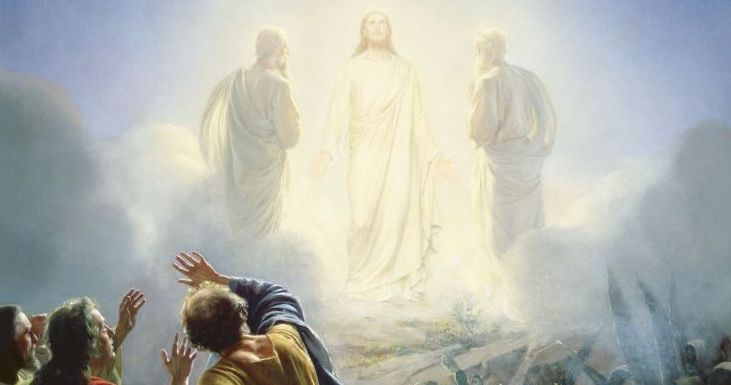
Jesus goes up a high mountain with Peter, James, and John and is transfigured. His clothes become white as light. Moses and Elijah appear and are talking with Jesus. And Jesus’ face shone like the sun. Now, Scripture doesn’t give us the total lumens of Moses’ face compared to Jesus’ face. It is interesting to note that the Greek translation of our Old Testament text uses a word that means ‘glow’ to refer Moses’ face while Matthew here uses the word λάμπω (lampō) which means ‘shine’ to refer to Jesus’ face. So, Moses’ face glowed with a radiant, reflected glory, but Jesus’ face shines like the sun with its own glory.

We do know that Moses’ face was bright enough that people could see it and were afraid, but a thin veil was enough to calm their fears. But here Jesus’ face shines like the sun, and I’m pretty sure a little veil wasn’t going to do much to dim that shining. Despite the brightness and glory, notice that Peter, James, and John don’t ask Jesus to veil His face. Instead, the reaction is completely different. Peter says, “Lord, it is good that we are here. In fact, let’s stay here. I’ll make three tents – one for You, one for Moses, and one for Elijah.” But while Peter is still speaking, the bright cloud of God’s glory overshadowed them, and God the Father said, “This is My beloved Son, with whom I am well pleased; listen to Him.” This terrifies the three disciples, but Jesus came and touched them saying, “Rise, and have no fear.”

In our Epistle text (2 Pet. 1:16-21), Peter reflects on the Transfiguration about thirty years later. There, Peter says that the Transfiguration does show Jesus’ glory, but even more so, it unveils the glory of the Bible. Peter says that it is better for you to have the Scriptures than for you to have witnessed the Transfiguration because every verse of the Scriptures unveils God’s great love for you. The shining face of Jesus points us to the bright lamp of the Scriptures that shines in a dark place. But what is this dark place?

Your initial thought is probably that the lamp of the Scriptures shines in the darkness of this world. The Bible certainly does talk about the world being full of darkness and sin. Psalm 119:105 says, “Your Word is a lamp to my feet and a light to my path.” God’s Word does enlighten this dark world so that we don’t stumble or go the wrong way. But here Peter is talking about a different dark place. He says to pay careful attention to the Scriptures as “a lamp shining in a dark place until the day dawns and the morning star rises” – and catch this – “the morning star rises in your hearts.”

You see, it’s not just the world and things outside of you that are a dark place. Your heart also has a darkness that needs the light of God’s Word. Peter doesn’t use the normal word for ‘dark’ here. The word Peter uses means, “foul and repulsive from a lack of care; neglected and filthy.” Here is the picture: Our sinful hearts are a filthy, murky, dark place. And we do well to pay attention to the Word of God shining in the dirty, neglected, dark place of our heart. When we pay attention to them, the lamp of the Scriptures shines in the darkness of our heart and pierces through the filth inside us. And the Gospel also changes us.

Even though you weren’t a witness to Jesus’ Transfiguration (lit. His ‘metamorphosis’), you have something better. Back to 2 Cor. 3:18, “And we all, with unveiled face, beholding the glory of the Lord, are being transfigured (same word used for Jesus’ transfiguration though the ESV translates it as ‘transformed’) we are being transfigured into the same image from one degree of glory to another.” Even now, already in this life, Christian, you are being transfigured into the same glory that Jesus had on the mountain. God brings about that transfiguration through His Word. By God’s gracious working through His Word, you are slowly being transfigured and metamorphosized into Jesus’ glory.

God has promised that you are being transfigured. And the picture of Jesus on the mountain today is what you are heading toward by the grace of God. In Mt. 13:43, Jesus says that you who are righteous through faith in Him will shine like the sun, just like Jesus did.

So that you could shine like the sun and be like Him, Jesus went down from the mount of Transfiguration. He descended from that glorious peak, so He could ascend another mountain, Mt. Calvary, where He laid down His life for Peter, for Moses and Elijah, and for you. He did this because He loves you and wants you to be transfigured and share in His unveiled glory. Lord Jesus, come soon and bring us to that glory. Amen.

The peace of God, which surpasses all understanding, will guard your hearts and minds in Christ Jesus. Amen.

No Empty Houses – Sermon on Luke 11:14-28 for the Third Sunday of Lent

Listen here.

Luke 11:14-28

14 Now he was casting out a demon that was mute. When the demon had gone out, the mute man spoke, and the people marveled. 15 But some of them said, “He casts out demons by Beelzebul, the prince of demons,” 16 while others, to test him, kept seeking from him a sign from heaven. 17 But he, knowing their thoughts, said to them, “Every kingdom divided against itself is laid waste, and a divided household falls. 18And if Satan also is divided against himself, how will his kingdom stand? For you say that I cast out demons by Beelzebul. 19 And if I cast out demons by Beelzebul, by whom do your sons cast them out? Therefore they will be your judges. 20 But if it is by the finger of God that I cast out demons, then the kingdom of God has come upon you. 21 When a strong man, fully armed, guards his own palace, his goods are safe; 22 but when one stronger than he attacks him and overcomes him, he takes away his armor in which he trusted and divides his spoil. 23 Whoever is not with me is against me, and whoever does not gather with me scatters.

24 “When the unclean spirit has gone out of a person, it passes through waterless places seeking rest, and finding none it says, ‘I will return to my house from which I came.’ 25 And when it comes, it finds the house swept and put in order. 26 Then it goes and brings seven other spirits more evil than itself, and they enter and dwell there. And the last state of that person is worse than the first.”

27 As he said these things, a woman in the crowd raised her voice and said to him, “Blessed is the womb that bore you, and the breasts at which you nursed!” 28 But he said, “Blessed rather are those who hear the word of God and keep it!”

In the name of Jesus. Amen.

In 2014, it had been about two years of me waking up feeling more tired than when I had gone to bed. At my loving wife’s urging, I went to the doctor to request a referral for a sleep study. I remember the doctor saying, “Well, you’re not old, and you’re not overweight. I don’t think you have apnea, but I’ll refer you for the sleep study.” A couple weeks later, I went down to Altru Specialty Center to spend the night. When I checked in, the nurse who would be monitoring me met me and said, “You’re not old, and you’re not overweight. I doubt you have apnea.” But she dutifully brought me to a room and proceeded to put all the little sensors on my body, head, and beard. A couple hours later, I went to sleep. Less than an hour after that, she woke me up and said, “Put this on.” It was a cushion that covered my nose and blasted air into my nostrils. I hated it. It took me about an hour to figure out how to breathe with it and another hour to fall asleep once again. I only slept for four more hours, but it was the best sleep I had had in years.

The next morning, she unhooked the wires from my head and body. The nurse said I could expect to hear from the doctor in a few days. When I went to that appointment, this new doctor said to me, “Well, you’re not old and you’re not overweight, but you definitely have sleep apnea. We will write things up and get everything to your insurance so you can have a CPAP machine.”

Finally, two weeks after that appointment, I was told I could go to Yorhom and get the machine. The technician who instructed me on its usage said, “You’re not old and you’re not overweight, but this should help you feel better.”

CPAP MaskThe CPAP means that a hose dictates how I can move when I turn at night. It means that, when I lie on my side, I have to adjust how the mask fits on my face and doesn’t get moved off my nose by my pillow. It means that I can’t fall asleep having a conversation with my wife. There are mornings that I wake up and have to unwrap the hose from around my neck. But in the six years since I started using that machine, there have only been just over a handful of nights that I have slept without that mask blasting air into my nostrils. I still don’t always like to use it. I wish there were some sort of medicine or a shot I could take, but such a thing doesn’t exist. Sometimes, I wish I could use the machine one night a month or one night a week and be fine, but it doesn’t work that way. I know that if I don’t use that mask and machine each night, I won’t rest or be able to function like I should.

Sorry for the long story, but there is a point and it is connected to the text. Here’s how:

Imagine how frustrated Jesus gets with us when we think that we can simply get a dose of His grace and mercy and then move on with our lives until we recognize or feel the need to take another dose. Imagine how frustrated Jesus gets with us when we think all we need is an occasional shot of the Holy Spirit when He desires that we have the daily and eternal presence of the Holy Spirit in our heart.

You see, your problem is not that you sin every now and then. Your problem is that the devil has essentially taken up residence in your heart. That’s what Jesus means when He says, “When an unclean spirit has gone out of a person, it seeks but finds no rest it says, ‘I will return to my house from which I came.’” The devil has led you into sin and possesses you. That problem can, obviously, be solved. Jesus, the one who is stronger than the strong man devil, expels Satan. And Jesus doesn’t leave you simply as an empty vessel because the house of your heart won’t stay empty. Instead, the Holy Spirit comes and resides within you, and this means that you need to continually receive the Holy Spirit because He can be pushed out. You can neglect God’s good gifts, and the Holy Spirit can be resisted so that He leaves.

Assailed by DemonsWhen this happens, your last state is worse than your first because as Jesus says, the demons come, it finds the house (you) swept and put in order. Then that evil spirit brings seven other spirits more evil than itself.

Throughout your lives, you find yourself in the position of thinking that it would be enough if God would just drive out the devil. And praise God that He does. However, that isn’t the end of the matter. Don’t forget that your house won’t stay empty. If you turn away from the Word that fills you with the Holy Spirit, the devil is going to come back worse then he was before. Don’t think that because you believe today that you will tomorrow.

Read. Study. Meditate on the Scriptures. Make the Bible more important to you today than it was yesterday. Don’t think that you can bring your kids to Sunday School and Confirmation and think they’ll be ok. Don’t be lulled into thinking that is enough Jesus for them.

The greatest threat to you and your children isn’t from terrorism, war, or a virus. The thousands of kids who grow up thinking that they were raised to be Christian because they were taken to church a few times a year. Those same people then go and read five out-of-context verses from some atheist blog thinking they know everything about what Christians believe. They are the very ones who are going to be the most likely to draw your children away from the faith.

But also be comforted because that is much less likely to happen if you train your children now to be in the Scriptures. To be in the very place that the Holy Spirit continues to work in their hearts and lives. That very Word of God is where God fills the house of your heart and theirs with the Holy Spirit and with treasures that cannot be spoiled.

You need to hear this today. There is a lot of uncertainty in our world and country right now. And while there are no plans to stop holding regular services here, it is possible that option might be taken from us. The devil is working very hard to bring enough uncertainty and fear to our society – and to Christians especially – that they would be tempted to think being at church and within the fellowship of the Body of Christ is not essential.

All Saints gathered around the throneRight now, we Christians need one another. Those who do not have faith in Christ need us as well. They need us to comfort them with the very same that we have in Christ. They need to know there is something more than this life. They need to know that Christ is coming back. They need to know that the One who is returning is the very one who shed His holy and precious blood for them. That very blood of Christ is the medicine they need to be freed from the devil’s tyranny over the house of their heart. They need to know that Jesus is the Lamb of God who takes away their sin.

Dear saints, today know that the house of your heart won’t stay empty. Know that the stronger man is on your side. And know that He desires all to be saved, and this may be the time He uses to call them to repentance and faith. Amen.

The peace of God, which surpasses all understanding, will guard your hearts and minds in Christ Jesus. Amen.

The Heart & the Helper – Sermon on Ezekiel 36:22-28; 1 Peter 4:7-14; John 15:26-16:4 for the Seventh Sunday of Easter and Confirmation Sunday

Listen here.

Alleluia! Christ is risen!
He is risen indeed! Alleluia!

The sermon today is from all three texts read: Ezekiel 36:22-28; 1 Peter 4:7-14; John 15:26-16:4

In the name of Jesus. Amen.

Dear Confirmands and dear Christians,

I have good news and I have bad news. First, the bad news: Being a Christian is difficult.

According to Jesus, to be a Christian is to be on the narrow path (Mt. 7:13-14), and Christ promises, “In this world you will have tribulation” (Jn. 16:33). In our Epistle text, Peter says, “Do not be surprised at the fiery trial when it comes upon you to test you, as though something strange were happening to you” (1 Pe. 4:12). God doesn’t promise that Christians get a detour around problems in this life. Instead, Scripture promises the exact opposite. In fact, in today’s Gospel text, Jesus says that there are people who are willing to kill you thinking that they are worshipping God by doing so (Jn. 16:2).

No, you don’t get a detour around problems in this world, but don’t be discouraged – here’s the good news. You do get a Guide through them. This past Thursday marked the Ascension of Jesus to the right hand of God the Father. Christ ascended into heaven in order to help you with the help you need the most. You, Christian, have been given the Holy Spirit who helps you in every trial, temptation, and tribulation.

Your Savior sends the Holy Spirit to be your Helper, your Aid, your Defender, your Comforter.

Andrew, Stephanie, Josiah, and all you saints, though you have enemies attacking you from the outside – the devil and the world – and enemies attacking you from the inside – you own sinful flesh and desires – you are not without help. You have the comfort of the Comforter and the help of the Helper.

When you are discouraged because of your constant sins and failure to keep God’s Law, the Holy Spirit is right there helping and comforting you with the Word of God. He says, “Yes, your sins are great. That is why you have a greater Savior, Jesus Christ. God is not disappointed with you. He is totally and completely pleased with you because of what Jesus has done for you.”

When the devil accuses you and throws your sins in your face, the Holy Spirit, your Comforter and Advocate, stands between you and the devil saying, “None of that, Satan! Those sins were already thrown in Jesus’ face, and He has taken the punishment for all of them.”

When the world calls you a hypocrite saying that you do not live the way you should, the Helper reminds you, “You bear God’s holy name. You have been Baptized in to Christ, so you have put on Christ” (Gal. 3:27).

Did you hear what God said in our Old Testament lesson? Were you listening? God promised that He would act for the sake of His holy name which you bear. Because God has defined Himself as a God who is merciful and gracious, slow to anger, and abounding in steadfast love and faithfulness (Ex. 34:6). God will make sure you have that mercy, grace, love, and care. God has sprinkled clean water on you, His people, and He has cleansed them from all your sins and idols. Holy Spirit New HeartGod given you a new heart and a new spirit. God has put His Holy Spirit within you, and He has caused you to walk in His statutes and rules. Again, God promised to do this for the sake of His name, His reputation, and your benefit because you are His.
God promised all of this, and because of what Christ has done, it is finished.

God acted. You were in desperate need of help. You weren’t just dying, you were dead in your trespasses and sins. And, even worse, you were dead and still actively and stone-heartedlyrebelling against God. But He gave you what He promised in our Old Testament lesson. Christ came and removed your heart of stone and gave you a heart of flesh.

Christian, you will struggle your entire life – Scripture promises it. Yet, there is a comfort in Christ saying that you will struggle because those very trials, tribulations, and persecutions mean that you belong to Him. Just a few verses before our Gospel text began, Jesus said this: “If the world hates you, know that it has hated Me before it hated you. If you were of the world, the world would love you as its own; but because you are not of the world, but I chose you out of the world, therefore the world hates you” (Jn. 15:18-19).

And know this, know this: You have help in your trials. The same Jesus who died and rose again for you is the same Jesus who helps you by ascending to the right hand of God the Father with all authority in all creation having been given to Him. And He has given you a new heart and the Holy Spirit, the Comforter and the Helper.

Each of the verses our Confirmands picked are Holy Spirit-sent to help and comfort you now and forever.

As Andrew’s verse (Jn. 3:16) promises: God loved you so that He sent Jesus to die and rise again for you. Believe in Him and you will never perish but have eternal life.

Josiah’s verse (Prov. 3:5) encourages you to trust in those promises of Christ and to not lean on your own understanding. Your own understanding will lead you nowhere. God’s ways and thoughts are higher than your ways and thoughts. Trust in those.

And Stephanie’s verse (Jer. 29:11) reminds you that God’s plans for you are for your welfare. God’s plans for you are to give you a solid future and hope for all eternity.

Christian, you have a new heart and the Helper. Go from here in that comfort and that certainty. God has promised, and He is faithful.

Alleluia! Christ is risen!
He is risen indeed! Alleluia!

Amen.

The peace of God, which surpasses all understanding, will guard your hearts and minds in Christ Jesus. Amen.

The Lamp & the Darkness – Sermon on 2 Peter 1:16-21 for the Sunday of the Transfiguration of Our Lord

Listen here.

2 Peter 1:16-21

transfiguration-icon16 For we did not follow cleverly devised myths when we made known to you the power and coming of our Lord Jesus Christ, but we were eyewitnesses of his majesty. 17 For when he received honor and glory from God the Father, and the voice was borne to him by the Majestic Glory, “This is my beloved Son, with whom I am well pleased,” 18 we ourselves heard this very voice borne from heaven, for we were with him on the holy mountain. 19 And we have the prophetic word more fully confirmed, to which you will do well to pay attention as to a lamp shining in a dark place, until the day dawns and the morning star rises in your hearts, 20 knowing this first of all, that no prophecy of Scripture comes from someone’s own interpretation. 21 For no prophecy was ever produced by the will of man, but men spoke from God as they were carried along by the Holy Spirit.

In the name of the Father and of the Son and of the Holy Spirit. Amen.

Peter, James, and John saw Jesus do many amazing things. Just think back on the sermons from the last few weeks. They were there when Jesus (according to John), “manifested His glory” by turning water into wine (Jn. 2:11). They saw Jesus touch a leper, and, instead of the disease spreading from the man and infecting Jesus, the cleanness of Jesus spreads to the man and his leprosy was gone (Mt. 8:1-4). They heard Jesus speak a word to heal a centurion’s paralyzed servant (Mt. 8:5-13). They were in a boat that was being swamped by the winds and the waves, and Jesus tells that storm to knock it off resulting in a great calm (Mt. 8:23-27). Peter, James, and John would see Jesus feed the masses, give sight to the blind, and raise the dead.

But, when Peter looks back on everything that Jesus did, and when Peter wants to let people know the truth of the Christian faith, Peter points the people to whom he wrote this letter to the Transfiguration. There on the holy mountain, Peter says he saw the power, the coming, and the majesty of Jesus with his own eyes. The Transfiguration is the greatest manifestation of the deity of Jesus. It is where Jesus’ divine nature, which He always had, shines through His human nature showing that He is God of God, Light of Light, very God of very God.

The truth that God Himself came down to die and rise again to save all mankind from sin is not some cleverly devised myth. It is rooted in historical fact. Peter was there. He saw with his own eyes. Peter’s own ears heard God the Father preach a very important but very brief sermon, “This is my beloved Son, with whom I am well pleased. Listen to Him” (Mt. 17:5).

So, we could summarize v. 16-18 here as Peter saying, “Listen up. Our preaching of God coming down to rescue us from sin and death is not some myth or fairy tale. We preach Jesus as the Savior of the world because we saw His glory and power and majesty. We preach Jesus because we heard the very voice of God from heaven when we were with Jesus on the holy mountain of Transfiguration.”

And the rest of this text, which is where we are going to focus most of our attention, is the meaning, the take-away, of why the Transfiguration is still important for us today. And the reason might surprise you.

Normally, we think of the Transfiguration as mainly showing us the glory of who Jesus is. The Transfiguration certainly does do that. But listen to Peter’s conclusion: Verse 19, “And we have the prophetic word more fully confirmed, to which you will do well to pay attention to as to a lamp shining in a dark place, until the day dawns and the morning star rises in your hearts.”

The Transfiguration of Jesus does show the glory of Jesus, but even more so, according to this text, the Transfiguration shows us the glory of the Bible. Peter says here that it is better for you to have the Scriptures than for you to have been there with Jesus, Peter, James, John, Moses, and Elijah. It is better for you because the Scriptures, every last verse, show you of God’s great love for you. The shining face and dazzling clothes of Jesus point us to the shining and dazzling lamp of the Scriptures that shine in a dark place.

So where is this dark place? We might think that the lamp of the Scriptures shines in the darkness of this world. The Bible certainly does talk about the world being full of darkness and sin. In the first chapter of the Gospel of John, John writes that in Jesus was life, and “the life was the light of men. The light shines in the darkness, and the darkness has not overcome it” (Jn. 1:4-5). That passage of Scripture says that the light of Jesus defeats the darkness of this world. Or consider Psalm 119:105, “Your Word is a lamp to my feet and a light to my path.” There, the Scriptures give a picture of the light of God’s Word giving us direction in this dark world so that we don’t stumble or go the wrong way.

But Peter seems to be saying something different here. He says to pay careful attention to the Scriptures as “a lamp shining in a dark place until the day dawns and the morning star rises” – now catch this – “the morning star rises in your hearts.”

Dark HeartYou see, it’s not just the world and things outside of you that are a dark place. Your heart also has a darkness that needs the light of God’s Word. Peter doesn’t use the normal word for ‘dark’ here. In fact, the word that gets translated here as ‘dark’ is the only time in all the Scriptures where this word gets used. When I looked Greek the word up, the first definition is ‘squalid’ which is a word I don’t think I’ve ever used in normal conversation. So, I looked up ‘squalid’ and it means this, ‘foul and repulsive from a lack of care; neglected and filthy.’

Here is the picture: Sinner, your heart and my heart is a filthy, murky, dark place. Peter says that we do well to pay attention to the Word of God shining in the filthy, dirty, neglected, dark place of our hearts.

Many celebrities and influential people have been saying for a long time, “Follow your heart.” It sounds nice. It sounds good. But it is totally unscriptural. Jeremiah 17:9 says, “The heart is deceitful above all things, and desperately sick.” Or maybe you have seen the little cartoon, it floats around social media from time to time. The picture is of a small child standing before Jesus and offering Jesus a red heart that looks like a nice valentine saying, “It’s all I have.” And Jesus is reaching out to take it replying, “It’s all I ever wanted.” That isn’t the picture that the Scriptures give us. It would be better if that heart were the color of dung. And Jesus says, “I’ll take that filthy, desperately sick thing from you and give you a new heart” (Ez. 36:26).

But back to Peter’s picture of the Scriptures shining like a lamp in the squalid (there, now I’ve used it), dank, neglected, filthy darkness of our hearts. We need the clear lamp of the Bible to shine through the dark places of our heart.

We walk around in a dark, dirty, and ugly house. We have all sorts of temptations within ourselves to sin. Whether it is more money, a better relationship, an image of something pleasant to look at, a bigger house, or accolades from others, we are tempted to think that those things will bring us happiness. And we are willing to do whatever it takes, whatever sin is necessary, to grab on to those things. But, when we pay attention, the lamp of the Scriptures shines in the darkness of our heart, we see – we clearly see – that those things are filthy. We see that those things are not worth comparing to the greatness of the treasures of God’s promises.

So, pay attention here because I’m going to read a long passage of the Scriptures to shine some of their light in your heart. It comes just a few verses before our text today. 2 Peter 1:3–11 (turn there if it will help you follow along) “[Christ’s] divine power has granted to us all things that pertain to life and godliness, through the knowledge of him who called us to his own glory and excellence, by which he has granted to us His precious and very great promises, so that through them you may become partakers of the divine nature, having escaped from the corruption that is in the world because of sinful desire. For this very reason, make every effort to supplement your faith with virtue, and virtue with knowledge, and knowledge with self-control, and self-control with steadfastness, and steadfastness with godliness, and godliness with brotherly affection, and brotherly affection with love. For if these qualities are yours and are increasing, they keep you from being ineffective or unfruitful in the knowledge of our Lord Jesus Christ. For whoever lacks these qualities is so Light shining in darknessnearsighted that he is blind, having forgotten that he was cleansed from his former sins. Therefore, brothers, be all the more diligent to confirm your calling and election, for if you practice these qualities you will never fall. For in this way there will be richly provided for you an entrance into the eternal kingdom of our Lord and Savior Jesus Christ.”

This is what the Scriptures do for you, believer. They shine in your heart to give you faith, virtue, knowledge, self-control, steadfastness, godliness, brotherly affection, and love.

Dear saints, don’t be blinded by neglecting your Bible. You have been cleansed from your former sins. Grow and abound in the godly qualities that are yours through your God and Redeemer, Jesus Christ. Amen.

The peace of God, which surpasses all understanding, will guard your hearts and minds in Christ Jesus. Amen.