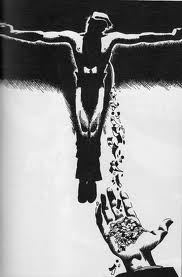
Innocent Blood – Sermon on Matthew 26:1-27:66 for Palm Sunday

Matthew 26:1-27:66

In the name of Jesus. Amen.

Matthew is the only one of the four Gospels that tells us what happened to Judas after Jesus was arrested and condemned (Mt. 27:3-10). Judas was overcome with regret and guilt because he knew that God had cursed anyone for taking a bribe to shed innocent blood (Dt. 27:25). Our translation says that Judas “changed his mind” (Mt. 27:3). In Greek, it’s one word (μεταμέλομαι) that is similar to the word for repentance (μετανοέω), but the change of mind Judas had was only one-sided. And here’s what the text conveys: Judas was very sorry. He wished that what he had done could be undone. He regretted his betrayal, but Judas did not repent the way Christians repent. Christian repentance has two parts. It includes the regret and change of mind Judas had. But saving repentance goes one step further. Christian repentance also trusts and believes in God’s grace and mercy given on account of Jesus’ death and resurrection (Mk. 1:15). Judas was lacking that faith and trust.

That lack of faith in God’s mercy is why Judas goes to the chief priests and elders. He doesn’t know where else to turn even though he had been taught better. Sadly, Judas brings his confession to the wrong place. Judas went to the Temple which had been the place of forgiveness (1 Kgs. 8:30), but the night before, Jesus had clearly told Judas and the rest of the disciples that He was instituting the New Covenant (Jer. 31:33-34) in His Blood for the forgiveness of sin (Mt. 26:26-29). The result was that Judas went to the very ones who had been seeking Jesus’ death (Mt. 26:14-15). Judas knew where he needed to go for forgiveness – he had been told just a few hours earlier. But instead of going to Jesus, he sought forgiveness where it could not be found.

Judas’ confession of sin and his action of returning the thirty pieces of silver were both right. He had betrayed innocent blood and returning the payment he received for his sin was what he should do. But his sorrow and penance could not undo what he had done; it could not remove the guilt of his sin. The chief priests and elders were supposed to be forgivers, absolvers, and ministers of atonement. Yet, after hearing Judas’ confession, they refuse to lift the burden of guilt from him. Instead, they bind Judas’ sin and betrayal on his head. “What is that to us? See to it yourself” (Mt. 27:4). What a chilling, horrific thing to say to someone who is crushed with guilt.

Throughout the Gospels, those religious leaders had tried to convict Jesus of sin. They would accuse Jesus and the disciples of eating with defiled hands (Mt. 15:1-20) and of eating and associating with tax collectors and sinners (Lk. 15:1-2). They were always trying to trap Jesus (Mt. 22:15-40). You would think that they would at least tell Judas something like, “Don’t worry, Jesus isn’t innocent. He’s a sinner. He’s dangerous. He’ll bring trouble to all of us with his teaching.” But they don’t. They don’t try to convince Judas that Jesus was guilty. They don’t even offer that little shred of comfort to Judas. It appears as though they also know that Jesus was innocent. Back in Mt. 23:2-4, Jesus rightly said of them, “They tie up heavy burdens, hard to bear, and lay them on people’s shoulders, but they themselves are not willing to move them with their finger.”

If the chief priests and elders had offered Judas forgiveness, it would have required them to admit their own guilt. Again, they were the ones who conspired with Judas to shed Jesus’ innocent blood. But instead of repenting, they insisted they were doing the right thing in condemning Jesus. So, they become absurdly hypocritical.

After Judas throws the pieces of silver in the Temple, they quickly work to get that money out of the Temple because it is blood money. They recognize they cannot put the bounty they had placed on Jesus’ head back in the holy treasury because it is unclean money (Dt. 23:18). But (here’s the hypocrisy) they were the ones who defiled that holy money. They were the ones who took it from the treasury. They were the ones who turned that silver into blood money using it to pay Judas for his betrayal (Mt. 26:15).

While it is tempting to despise the chief priests and Judas, in Christian humility we need to recognize that we do just as they did. Too often, we are filled with sinful desires and passions and make any excuse to attempt to justify them. Too often, we will do all sorts of horrific things and try to hide them under the guise of holiness while we ignore the carnage it wreaks on others. Too often, we are like Judas and don’t realize how destructive our behavior is until it’s too late. When we do, finally, realize the great harm we have done, it can lead us to despair. And despair is a dangerous place to walk. Judas despairs of all hope and kills himself. Judas is condemned, not because he kills himself, and not even because he betrayed Jesus. Jesus’ death covered even Judas’ sins of suicide and betrayal. Judas is condemned because he died outside of faith in Jesus’ grace and mercy. Jesus calls Judas the “son of destruction” (Jn. 17:12) and says that it would have been better for Judas if he had never been born (Mt. 26:24). Jesus never says anything like that about His sheep.

Please allow me a brief aside here: Suicide, self-murder, is not the unforgivable sin. Can people commit suicide and still be a Christian? Yes. To those of you who have lost someone to suicide, you can have comfort in the promises of Scripture. Christ Himself is the man of sorrows, acquainted with grief (Is. 53:3). When someone is walking in grief, depression, and even in the valley of the shadow of death, Jesus is with them (Ps. 23:4) and desires to save them (1 Tim. 2:4). In that deathly vale, Jesus calls to them, “Come to Me, all who labor and are heavy laden, and I will give you rest” (Mt. 11:28). All that being said, suicide is an evil death and is never the answer to despair.

The answer to all sin and despair is in the innocent Blood of Jesus which has been shed for you. His innocent Blood was shed to cleanse you of your guilty blood. Whenever you recognize your guilt and sin against God, bring those sins to Christ. Let Him deal with them because He has dealt with them in His death and resurrection. He is the Lamb of God who takes away the sin of the world (Jn. 1:29). 

The answer to sin is the innocent Blood of Jesus that He freely gives to you in Holy Communion. And now, Jesus invites you to His table to receive that Blood which He will put in your mouth. Here, Jesus’ innocent Blood becomes your blood. Dear saints, come, take, eat, and drink the perfect, innocent Blood of your Savior which He has shed for the forgiveness of all your sins. Amen.

The peace of God, which surpasses all understanding, will guard your hearts and minds in Christ Jesus. Amen.

A Mandate & a Meal – Sermon on John 13:1-15, 34-35 for Maundy Thursday

Listen here.

John 13:1-15, 34-35

In the name of Jesus. Amen.

Tonight is the night when Jesus was betrayed into the hands of evil men, but the plan had already been put into motion. The money had been counted and put in Judas’ pocket on Tuesday of Holy Week. That day, Satan entered into Judas Iscariot through a love of money (Lk. 22:3-6), and he agreed with the chief priests and officers to hand Christ over to them.

This is probably why we do not have any record of what Jesus did on Wednesday of Holy Week. Jesus probably didn’t do much that day. After Jesus entered into Jerusalem on Palm Sunday, He would enter the city and preach and teach publicly in the Temple. The Gospels record that these public appearances and teaching happened Sunday, Monday, and Tuesday. But there is no record of anything happening on Wednesday.

It is very possible that Jesus didn’t even enter into Jerusalem on Wednesday because He knew the plot. If He had entered into Jerusalem on Wednesday, He would be arrested. It is also probably why He didn’t appear to have a plan on where He and His disciples would celebrate the Passover. Jesus isn’t just a guy who doesn’t like to make plans. His plan was to keep the plan secret. The whole thing is carefully and deliberately orchestrated so that Judas can’t betray Jesus until He is ready.

It isn’t until sometime on Thursday that Jesus sends only two disciples, Peter and John, to find a certain man carrying a water jar, follow him into the house he enters, and tell the master of the house that Jesus would like to eat the Passover there (Lk. 22:7-13). So, until they get to that upper room, only Jesus, Peter, and John know where they will be that Thursday night. Again, Jesus orchestrates all of this so that Judas can’t betray Him secretly. Judas only betrays Jesus when Christ dismisses him to do it.

And Jesus times His betrayal so that He can give His Church a new commandment or ‘mandate’ (which is why tonight is called ‘Maundy Thursday’) and a meal.

The very same night Jesus was betrayed, our Lord washed His disciples’ feet. This foot washing isn’t a Sacrament. There is no word or promise of forgiveness attached to washing feet. This washing was, in a sense, a parable acted out. By serving His disciples in this way, Jesus is showing how He wants them and us to serve and love one another.

Foot washing was a common thing in those days. Anyone who was going to be a guest at a banquet would have their feet washed even if they had just bathed. The walk from one house to another would make a person’s feet dirty and dusty enough to need another washing. But the task of foot washing was always reserved for the lowest servants. A disciple would do many different chores for the rabbi he was following, but foot washing was never one of them. But here, in a beautiful reversal, Jesus, the Rabbi, the Teacher sent from God, and in fact God Himself in the flesh, humbles Himself to do the lowest of tasks for His disciples.

At this point in the supper, all twelve disciples were still there. Judas had not yet left to betray Jesus. So, yes, our Lord washed the feet of Judas and served His betrayer in this way. This foot washing was an act of vulnerability and intimacy. In this washing, Jesus takes their faith and, in return, gives them His righteousness and cleansing.

Judas does not benefit from this, but Jesus still does it for him. Judas rejected the righteousness of Jesus in place of the thirty pieces of silver. Later, Judas will reject forgiveness too. After the crucifixion, Judas seeks atonement in remorse and self-judgment, but he didn’t find it there.

With this foot washing of all the disciples including Judas, Jesus gives us an example that teaches us a very important lesson, and that lesson is this: Love isn’t always easy or clean. Love can often be one-sided and unanswered. Just because you love someone and do selfless acts for them does not mean they will love you in return. And know that you aren’t greater than Jesus. If His love was rejected and repaid with betrayal, yours will be too.

Yet, still Jesus would have you, His disciples, His Christians, love your enemies as you have been loved by Him. Bear one another’s burdens. Forgive and serve one another. That is this new commandment, this new mandate, that Jesus gives. Which, again, is why today is called Maundy Thursday.

But because you do and will fail in this mandate that Jesus gives, Maundy Thursday is more than that. It is the night that Jesus mandates and gives you a meal. Tonight is the night in which Jesus was betrayed, and Judas isn’t the only culprit. Even the disciples who do love Jesus fail Him, but He does not fail them. That is why Jesus gives the disciples more than a mandate. He also leaves them the enduring, continual gift and meal of His living Body and Blood.

We have considered Baptism the past several weeks in our Lenten services, and Baptism is who we are as Christians. In Baptism, we are given God’s name (Mt. 28:19), we are begotten as His children (Jn. 3:3-8), and we are clothed in Christ (Gal 3:27). Baptism defines who we are.

And the Lord’s Supper is what we do because it is what Jesus has given us to do. We are to eat and drink in remembrance of Jesus (1 Cor. 11:23-25) and whenever we celebrate the Lord’s Supper, according to Scripture, we proclaim His death until He comes (1 Cor. 11:26). In the Lord’s Supper, Jesus promises that we receive the forgiveness of sins. Is there anything more Christian than receiving Christ’s forgiveness?

When Jesus calls us to eat and drink in remembrance of Him, He doesn’t mean, “Do this while you think fondly about Me and what I did for you a long time ago.” Instead, this remembrance is about faith. Faith recalls and clings to what Jesus did and still does with this bread and cup. According to what Jesus says, this bread is His Body which was broken upon the cross for you, and this cup is His Blood which was shed for you. In faith, we celebrate the Lord’s Supper believing that all of this pertains to us and to our salvation.

Jesus’ death happened nearly 2,000 years ago on a cross outside Jerusalem, but the fruits of that redeeming death are given both before and after. Jesus gives His disciples His Body and Blood even before He makes the sacrifice. And He continues to give the same gifts in every congregation where two or three are gathered. His gift is not bound by time or place.

Both of these things go together – the mandate and the meal, the washing of feet and the Lord’s Supper. They are faith and love in action. With the sacrifice of His body and blood, Jesus loved them. And when He washed their feet, Christ showed them how to love each other as they place their trust in Him.

So, dear saints, follow Christ’s example and do as He has done to and for you (Jn. 13:15). Your Savior became your servant.

And know that when you come to this altar, to this table, you are, in fact, serving the world. The world benefits from you coming here to receive the true Body and Blood of Jesus. This Sacrament drives back the forces of darkness because in this meal, Jesus’ death in the place of sinners is proclaimed (1 Cor. 11:26). Here, Jesus comes to you as a Man, alive and out of the grave. He puts His Body and Blood into you to crucify you to the world and the world to you (Gal. 6:14). As you receive this meal and do this in remembrance of Him, you celebrate His victory over sin, death, and the devil. And those around you will benefit from this. As you are fed and strengthened in your faith, you will go back into the world knowing that God has forgiven you for the sake of Christ.

And, then, when you fail to be the servant Jesus calls you to be, when you fail to love as you have been loved, run back to Jesus. He is always ready to give you another washing and another serving.

Dear saint, you are declared by Jesus to be clean. Your Lord and Savior is here to be your Servant and clean you again. Come and receive what He gives you for your cleaning, for your comfort, for your strengthening. Amen.

The peace of God, which surpasses all understanding, will guard your hearts and minds in Christ Jesus. Amen.