Coming – Sermon on Matthew 21:1-9 for the First Sunday of Advent

Matthew 21:1–9

1 Now when they drew near to Jerusalem and came to Bethphage, to the Mount of Olives, then Jesus sent two disciples, 2saying to them, “Go into the village in front of you, and immediately you will find a donkey tied, and a colt with her. Untie them and bring them to me. 3 If anyone says anything to you, you shall say, ‘The Lord needs them,’ and he will send them at once.” 4 This took place to fulfill what was spoken by the prophet, saying, 

5 “Say to the daughter of Zion, 
‘Behold, your king is coming to you, 
humble, and mounted on a donkey, 
on a colt, the foal of a beast of burden.’” 

6 The disciples went and did as Jesus had directed them. 7 They brought the donkey and the colt and put on them their cloaks, and he sat on them. 8 Most of the crowd spread their cloaks on the road, and others cut branches from the trees and spread them on the road. 9 And the crowds that went before him and that followed him were shouting, “Hosanna to the Son of David! Blessed is he who comes in the name of the Lord! Hosanna in the highest!”

In the name of Jesus. Amen.

Dear saints, welcome to Advent. ‘Advent’ means ‘coming.’ One of my goals with this sermon and the rest of the sermons leading up to our Christmas Eve service is to deepen your appreciation for the season of Advent and cultivate the attitude Advent gives us. And I want to be clear: I’m not going to chide you if you put up your Christmas tree and decorations immediately after putting the Thanksgiving leftovers in your fridge, and I’m not going to call you to repent if you started watching Hallmark Christmas movies or listening to Christmas music weeks ago. Don’t worry about that.

So, about Advent. Yes, Advent precedes Christmas, but Advent isn’t “pre-Christmas.” The season of Advent isn’t meant to only prepare us to celebrate that Jesus was born. The dominant idea of Advent is the thought of our Lord’s coming in three ways. First, God has come in the flesh of Jesus. Second, God will come again; Jesus will return in His body to judge the living and the dead. And third – and maybe most importantly – God continually comes to us now in grace in His Body and Blood given in Holy Communion, in the preaching and hearing of His Word, and in the fellowship of the Church which is His body (Col. 1:24).

Dear saints, God came, God is coming, and God comes. And this is exceptionally Good News because, as Psalm 16:11 says, “In Your presence there is fullness of joy.” God’s coming brings joy. But too often, we prefer to substitute the joy of God’s presence with other things.

In his book Mere Christianity, C.S. Lewis wrote, “[H]uman history… [is] the long terrible story of man trying to find something other than God which will make him happy” (p. 49). We see this playing out at the beginning of human history. I know you know all of this, but it’s good to hear it again. The devil enticed Adam and the woman to take what God had forbidden. Rather than trusting God’s promise that gaining the knowledge of good and evil would turn out badly, the couple took the fruit and ate. They got the knowledge of evil, but it didn’t make them happy.

Instead, they realized their nakedness and shame, so they tried to cover themselves with fig leaves. Their own attempt at finding an answer to their sin and guilt apart from God providing a solution didn’t make them happy either. But something made the first couple even more unhappy. They heard God coming into the Garden. The all-powerful Creator of the universe was coming, and they thought He was coming for their destruction. Rather than running toward God, they ran away from Him. God was coming with power, but He was coming in mercy and grace to give them chance after chance to repent. This is why we need Advent; it helps us see that God’s coming is Good News because He comes to restore sinners unto Himself.

God asks, “Where are you?” (Gen. 3:9). God knew where they were, but God was coming in peace and love, begging them to confess and be forgiven. But Adam responded that he was afraid because he was naked. So, God asks, “Who told you were naked? Have you eaten the forbidden fruit?” (Gen. 3:11). In other words, “Adam, repent.” But Adam starts pointing his finger, “The woman, whom You gave to be with me, she gave me the fruit, and I ate” (Gen. 3:12). Basically, Adam is saying, “God, it’s all Your fault.” So, God turns to the bone of Adam’s bones and the flesh of Adam’s flesh, and asks her, “What did you do?” which is yet another call for repentance. But the woman also passes the buck, “The serpent deceived me, and I ate” (Gen. 3:13). All of this running from God, passing the blame for our own sin, and blaming God is, sadly, how we sinners naturally react to God’s coming.

In a real sense, the rest of Genesis 3 along with the rest of the Bible is God promising to restore the fullness of joy in His presence (Ps. 16:11). Yet still, we fallen sinners seek happiness apart from God and His coming because we wrongly think that God’s coming means our judgment and condemnation. Now, yes, on the Last Day when Jesus returns that will be true for unbelievers who keep seeking a false, temporary happiness apart from God’s gracious presence. But for you, while you still breathe, God comes in grace and mercy. That is why we read this Gospel text today to open the season of Advent. It occurred on Palm Sunday just days before Jesus’ crucifixion. Look how God comes:

King Jesus comes to His royal city, and there is power in His coming. The cattle on a thousand hills are His (Ps. 50:10), so is the donkey and its colt. If He needs them, they are His to use. This crowd of people welcomes Him as the King without anyone telling them what to do. Yes, His coming is an unstoppable force. But, unlike other kings, He comes humbly. He didn’t ride into the city as a regal conqueror on an impressive war horse. He came riding on a colt. He didn’t come with legions of armies. He came with crowds of lowly, common people crying out, “Hosanna,” which means, “Save us.” He didn’t enter a lavish palace with a high and lofty throne. His battered, beaten, bloodied body hiked up a hill carrying His own cross to the place where He gave His life for sinners. Even when Jesus came as King, He came to give His life for sinners to bring them back into the joy of His presence (Ps. 16:11).

And this kind of humble coming marked His entire life. During His ministry, Jesus dined and associated with tax collectors and sinners (Lk. 15:1-2, 7:39). He surrounded Himself with an entourage of fishermen. And, of course, His arrival in the flesh was also meek, lowly, and gracious. Conceived by a young fiancée of a carpenter from Nazareth, born in a barn, and laid in a feeding trough, God came in the flesh of a swaddled infant.

Until He comes again in glory, God comes to forgive, redeem, and purchase you from all your sins and trespasses against Him. God comes to you to restore you back into a right relationship with Himself.

Believer, in a sense, you have always been living in Advent. Until Jesus returns, you are always looking, waiting, and watching for His coming even as He comes to You now in His Word and Sacrament. Yes, He always comes in power, but He humbly uses His power to forgive, redeem, restore, and save you.

Christ came, He is coming, and Christ comes now inviting you to His table where He will show you His steadfast love and grant you His salvation (Ps. 85:7). Dear saints, Christ doesn’t to judge you. He comes to bring you forgiveness, life, salvation, and the joy of His presence. Amen.

The peace of God, which surpasses all understanding, will guard your hearts and minds in Christ Jesus. Amen.

The Garment-Giving King – Sermon on Matthew 22:1-14 for the Twentieth Sunday after Trinity

Matthew 22:1–14

1 And again Jesus spoke to them in parables, saying, 2 “The kingdom of heaven may be compared to a king who gave a wedding feast for his son, 3 and sent his servants to call those who were invited to the wedding feast, but they would not come. 4 Again he sent other servants, saying, ‘Tell those who are invited, “See, I have prepared my dinner, my oxen and my fat calves have been slaughtered, and everything is ready. Come to the wedding feast.” ’ 5 But they paid no attention and went off, one to his farm, another to his business, 6 while the rest seized his servants, treated them shamefully, and killed them. 7 The king was angry, and he sent his troops and destroyed those murderers and burned their city. 8 Then he said to his servants, ‘The wedding feast is ready, but those invited were not worthy. 9 Go therefore to the main roads and invite to the wedding feast as many as you find.’ 10 And those servants went out into the roads and gathered all whom they found, both bad and good. So the wedding hall was filled with guests.

11 “But when the king came in to look at the guests, he saw there a man who had no wedding garment. 12 And he said to him, ‘Friend, how did you get in here without a wedding garment?’ And he was speechless. 13 Then the king said to the attendants, ‘Bind him hand and foot and cast him into the outer darkness. In that place there will be weeping and gnashing of teeth.’ 14 For many are called, but few are chosen.”

In the name of Jesus. Amen.

What kind of king is this? Throughout most of this parable, he doesn’t look or act like a normal king.

His royal highness is throwing a wedding feast for his son and has already sent out invitations to his subjects. But when he sends his servants to call the guests, they don’t come. The king sends out a second batch of servants with a third invitation, “The feast is ready, the best food – the oxen and fattened calves – have been slaughtered and prepared. Come to the wedding feast.”

Here the king just looks desperate. He doesn’t look like a dignified, royal ruler. He looks more like the smelly, dorky kid in school who wants his classmates to come to his party. And that is how his subjects treat him. They don’t pay any attention to the invitation. They don’t care about his party. They have better things to do. Some go off to work in the dirt, others simply go about business as normal, but some get violent. They seize the servants, commit all kinds of atrocities against them, and even kill them.

What kind of king is this? He seems desperate, needy, whiny, and almost pathetic. That’s what his subjects seem to think of him. They have no interest in him. They don’t care about him, his son, the wedding, or the banquet. How is the king going to react? Well, he’s still the king. Even though he appears weak, he still has his army. After his three invitations have been despised and dismissed as an inconvenience, the king is done with these ungrateful, unworthy subjects. No more servants. Now, it’s time for the troops, the horses, chariots, battering rams, swords, and torches. Vengeance against these unworthy subjects is what is called for and is doled out. The ungrateful invitees are destroyed, and their city is burned to the ground.

But what happens next? Standing on the walls of his castle and overlooking the smoldering ruins that surround him, we would expect that the king would give up on this party and just have a small ceremony for his son. But still the king hasn’t given up. He sends out more servants to the highways and byways. “Bring in anyone you can find. I don’t care who they are. I don’t care if they are good or bad. Just bring as many as you can find into the palace. Fill the banquet hall. It’s time to feast.” All this king wants to do is celebrate the marriage of his son. And he wants people around him to enjoy what he provides.

So, the servants go out and find people. It doesn’t matter if they are noble or common peasants. It doesn’t matter if they are rich or beggars. If the servants can find them, they bring them in. This is a royal wedding and a “black tie” event, but none of these guests needed to rush home and find their best attire. No need to rent a tuxedo or evening gown. The king had them covered, literally. Upon their arrival, the king provided each one of these unprepared, unwashed guests with a wedding garment. He would clothe them from his own royal wardrobe. This king spares no expense when it comes to throwing this feast.

So, the hall is filled with guests. The food is served. The drinks are poured. The music starts. The dancing begins. And the king enters the banquet hall to finally enjoy his party. But what does he see? Another holdout, another person who despises him and his provisions. There in the corner is a man without a wedding garment, a man who decided his own stinky, smelly, unwashed clothes were just fine. He figured he didn’t need the king’s gift, so he refused it. But he miscalculated. Badly.

The king addresses this man, “Friend,” and this isn’t the normal word for ‘friend,’ so we could almost translate it, “Buster, how did you get in here without a wedding garment?” This king had provided everything that was needed. Everything was free. And the man has no excuse because there is none. So, the king has the man bound and tossed out – not just out of the party – out into the darkness where there is weeping and gnashing of teeth.

The parable ends there, but based on what the king has done so far in the story, what do you suppose he does after this rascal is thrown out? I would imagine he simply goes back to the wedding feast, back to the party, the food, the drink, the dancing, and the merry making. The king wanted his feast, so why wouldn’t he let the feast go on?

Seriously, what kind of king is this? Remember, according to Jesus, this is a parable about the kingdom of heaven. The King is God Himself. And this parable mirrors what you see and experience.

In this world, almost everywhere you look, people despise God, the true King. And it isn’t just His invitation they despise. People despise everything God has said. There is little or no respect for God or the authorities He has established – parents, police, leaders, etc. And the people in those positions of authority, who have been placed there by God (Ro. 13:1), don’t seem to deserve authority. You turn on the news, and you see killing, looting, riots, and stealing. Nations are at war. Terrorists are mercilessly attacking women and children. In our estimation, it looks like God doesn’t seem to care about the sin and wickedness that runs rampant throughout the kingdom of His creation. But our understanding of the situation is not correct.

In our Old Testament reading (Is. 55:1-9), we heard what God desires, “Come, everyone who thirsts, come to the waters; and he who has no money, come, buy and eat! Come, buy wine and milk without money and without price. Why do you spend your money for that which is not bread, and your labor for that which does not satisfy? Listen diligently to me, and eat what is good, and delight yourselves in rich food.” God desires that everyone would be His guest at His table; He desires that all would be saved and at His banquet (1 Tim. 2:4).

When we look at the state of this world, we are tempted to think that God doesn’t care, or that He can’t or won’t do anything about it. We are wrong. Whenever God delays judgment on the wicked, any time we imagine that He is overlooking sin, it is a display of His mercy and grace. God delays His judgment because He wants His banquet filled. God wants to clothe all sinners in the robe of Christ’s righteousness won on the cross. You don’t know better than God. Your ways are not better than His ways. Your thoughts are not higher than His thoughts (Is. 55:8-9).

God is King. He rules and reigns over all things. He isn’t ignoring the sin and wickedness in this world. No. God’s being patient. He wants as many as possible at His feast; He wants His banquet to be filled. To us, His promises seem to be slow, and even forgotten. But they aren’t. He wishes all to reach repentance and faith (2 Pet. 3:9). He is merciful and gracious, slow to anger and abounding in steadfast love and faithfulness (Ex. 34:6).

Dear saints, the banquet is prepared. The King has invited you and clothed you in Christ’s righteousness. The garment-giving King has given you a seat at His feast. His patience in judgment is for your good and for the good of others. In His timing, everything that is wrong will be put to right. Stand in the garment of righteousness that you have been given, and be patient. The feast will begin soon. Amen.

The peace of God, which surpasses all understanding, will guard your hearts and minds in Christ Jesus. Amen.

The King’s Test – Sermon on John 6:1-15 for the Fourth Sunday of Lent

John 6:1-15

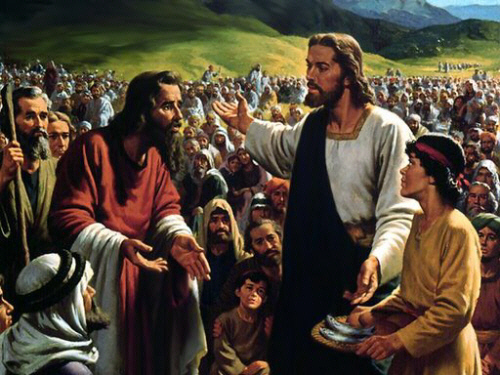
1 After this Jesus went away to the other side of the Sea of Galilee, which is the Sea of Tiberias. 2 And a large crowd was following him, because they saw the signs that he was doing on the sick. 3 Jesus went up on the mountain, and there he sat down with his disciples. 4 Now the Passover, the feast of the Jews, was at hand. 5 Lifting up his eyes, then, and seeing that a large crowd was coming toward him, Jesus said to Philip, “Where are we to buy bread, so that these people may eat?” 6He said this to test him, for he himself knew what he would do. 7 Philip answered him, “Two hundred denarii worth of bread would not be enough for each of them to get a little.” 8 One of his disciples, Andrew, Simon Peter’s brother, said to him, 9 “There is a boy here who has five barley loaves and two fish, but what are they for so many?” 10 Jesus said, “Have the people sit down.” Now there was much grass in the place. So the men sat down, about five thousand in number. 11Jesus then took the loaves, and when he had given thanks, he distributed them to those who were seated. So also the fish, as much as they wanted. 12 And when they had eaten their fill, he told his disciples, “Gather up the leftover fragments, that nothing may be lost.” 13 So they gathered them up and filled twelve baskets with fragments from the five barley loaves left by those who had eaten. 14 When the people saw the sign that he had done, they said, “This is indeed the Prophet who is to come into the world!” 

15 Perceiving then that they were about to come and take him by force to make him king, Jesus withdrew again to the mountain by himself.

In the name of Jesus. Amen.

Jesus asks Philip, “Where are we to buy bread, so that these people may eat?” And John gives us insight as to why Jesus asks the question. It was to test Philip. Now, Jesus didn’t just find Himself in the midst of the wilderness surrounded 5,000 men plus women and children – in all likelihood a crowd of ten to twenty thousand people – with no food and sees an opportunity for a test. No, Christ sets the entire thing up.

The feeding of the 5,000 is one of the few events recorded in all four Gospels (Mt. 14:13-21; Mk. 6:30-44; Lk. 9:10-17; and Jn. 6:1-15). The picture the texts collectively paint is that Jesus intentionally draws this crowd out into the wilderness (Mk. 6:31). He takes the time to heal many of them (Mt. 14:14) and preaches late into the evening (Mk. 6:34-35). In other words, Jesus means to bring them to that desolate place where there is no food, but food is needed. On top of that, He is the King who created everything (Jn. 1:1-2, 14). Jesus can cause rain to fall in one place but not another (Am. 4:7). Throughout the entire world, Jesus was the One providing bread and food for all mankind (Ps. 145:15-16), but Christ brought this massive crowd out into the wilderness to this particular mountain in order to set this test up for Philip. And the test has one question, “Where are we to buy bread, so that these people may eat?” Jesus isn’t looking for information. He’s not asking Philip to devise a plan or order something through Door Dash. The text tells us, “[Jesus] knew what He would do” (Jn. 6:6).

Now, put yourself in Philip’s position. It isn’t hard to imagine. When was the last time you were in a seemingly impossible situation? Your bank account got low, and suddenly your car needs significant, expensive repairs. You wonder, “Where’s the money going to come from?” Your kid or your spouse gets sick, and while you are doing everything you can to care for them, you get sick too. You don’t know where you will get the strength care for yourself much less your kid. You’re in a really busy time at work, then there is a blizzard, so you have to dig yourself out and help your aging parents clear out their driveway too. You don’t know where you will find the time to do everything that needs to be done. How often do you look at your calendar or think through all the things you need to accomplish and have no idea how you are going to make it through the week? Whether it is resources and money, strength and endurance, time and skills, there are moments in your life where you are buried under the expenses, responsibilities, and tasks, and all you can see is what you don’t have.

That is why Philip fails Jesus’ test. He sees what they have, and he concludes it isn’t enough. His response is, basically, “You’re jumping the gun, Jesus. Look around. We’re in the wilderness, not the marketplace. Even if we were surrounded by stores fully stocked with bread, we don’t have enough money. Two-hundred denarii wouldn’t be enough for all of them to even get a bite.”

The test was for Philip, but Andrew, Peter’s brother, takes a shot at the exam. This is just an aside, but this text really shows how similar Andrew and Peter are. Peter will jump into situations like a madman (Mt. 14:28-29) and will speak when he should just be silent (Mk. 9:5-6). Andrew does the same when he says, “This boy has five barley loaves and two fish, but that’s not going to cut it with this crowd.”

Both Philip and Andrew fail the test even though they knew the answer. The correct answer was, “I don’t know where we will buy bread, Jesus. But I do know You are here. You have provided food in bleaker situations than this, so You’ve got it all under control.” Philip and Andrew knew that Jesus was the Messiah (Jn. 1:41). They knew He was the fulfillment of what Moses and the prophets wrote (Jn. 1:45). In other words, they both knew that Jesus was the one who rained bread from heaven and sent quail in abundance for His people in the wilderness (Ex. 16:4, 13). They knew Jesus was the one who sent the ravens to feed Elijah by the brook (1 Kgs. 17:3-7) and through the widow’s jars of oil and flour that never ran out during the drought (1 Kgs. 17:14-16). They know that God promises in Psalm 34:10 which says, “Those who seek the Lord lack no good thing.”

Both Philip and Andrew know all of this, but they still fail the test, just like you and I do. They fail, notbecause they don’t know enough, weren’t taught well, or needed to go back to Sunday School. They fail for the same reasons we do – because we are sinners. All of us sinners fail to trust God’s promises to provide everything we need. Instead, we fall into despair, weakness, unbelief, and a ‘woe-is-me’ attitude.

Dear saints, repent and then rejoice.

When God brings tests and trials your way, remember that He is with you. And because He is with you, it doesn’t matter what you have or don’t have. Jesus doesn’t need soil and seed and rain and time and the right weather conditions and combines and grain elevators and flour mills and factories and bakers and truck drivers and grocers to give people bread. Jesus doesn’t need boats and bait and poles and nets and processing plants or even water to feed people fish. Just because those are the normal methods God delivers bread and meat to us, that doesn’t mean that is the only way He does it. Jesus is always free and able to cut all of that out and give exactly what is needed when it is needed – just like He does here.

Christ provides what Philip, Andrew, and all the disciples could not buy, bake, grow, earn, catch, or deserve. He provides this meal to the crowds and enough to last His flunked disciples for days afterward.

But most importantly, Jesus lavishly pours out His mercy and grace on His sinful disciples. We see it here as He doesn’t scold them for their unbelief and sin. In fact after this, Jesus will feed another crowd – four thousand that time (Mk. 8:1-10). And right after that the disciples are with Jesus in a boat, and they realize they only have one loaf of bread, and they will worry about their lack of food again (Mk. 8:14-21).

Jesus is always in control of every situation. The crowds here are about to try and take Christ by force to make Him king, but Jesus simply withdraws. And one year later, at the next Passover, the crowds will come with force to arrest Jesus, but He will not withdraw. They will put a royal purple robe on Him, crown Him with thorns (Jn. 19:2-3), crucify Him, and place a placard above His head that says, “Jesus of Nazareth, King of the Jews” (Jn. 19:19). There, on the cross, He will give and shed His blood for the forgiveness of sinners who fail the tests.

But the cross is no test. Instead, it is where Jesus, your Savior and King, demonstrated and proved His love and mercy for you, and for all us failures. Here and now, He delivers that mercy to you as He gives you His kingly Body and His royal Blood given and shed for the forgiveness of all your sins and failures.

Dear saints, come and receive. Amen.

The peace of God, which surpasses all understanding, will guard your hearts and minds in Christ Jesus. Amen.

Enthroned – Sermon on Luke 24:44-53 for the Ascension of Our Lord (Observed)

Luke 24:44-53

44 Then [Jesus] said to them, “These are my words that I spoke to you while I was still with you, that everything written about me in the Law of Moses and the Prophets and the Psalms must be fulfilled.” 45 Then he opened their minds to understand the Scriptures, 46 and said to them, “Thus it is written, that the Christ should suffer and on the third day rise from the dead, 47 and that repentance for the forgiveness of sins should be proclaimed in his name to all nations, beginning from Jerusalem. 48 You are witnesses of these things. 49And behold, I am sending the promise of my Father upon you. But stay in the city until you are clothed with power from on high.”

50 And he led them out as far as Bethany, and lifting up his hands he blessed them. 51 While he blessed them, he parted from them and was carried up into heaven. 

52 And they worshiped him and returned to Jerusalem with great joy, 53 and were continually in the temple blessing God.

Alleluia! Christ is risen!
He is risen indeed! Alleluia!

And today, we will add.

Alleluia! Christ is ascended!
He is ascended indeed! Alleluia!

In the name of Jesus. Amen.

Back in our epistle reading (Act. 1:1-11), Luke gave us a few more details about Jesus’ ascension than he gave us in this Gospel reading. I still have some questions about how this took place. How fast did Jesus ascend? Was it a constant speed from start to finish, or did He accelerate? If so, how fast did He go from 0-60, and what was His top speed? Of course, those details don’t really matter; if they did, Scripture would have told us. Once Jesus is out of sight, both Acts and this account of Jesus’ ascension shift our focus to the disciples.

As the disciples watch Jesus ascend, they gaze into heaven as a cloud takes Him out of their sight (Act. 1:9). Even though Jesus’ isn’t visible, they continue to stare into the sky. This leaves us with more questions. How long did they stare, was it minutes or hours? Did they talk with each other? Did anyone pass by and look up with them trying to see what they were gazing at? Again, we don’t know, and Scripture leaves us to have a holy, sanctified curiosity about those details. What is important is what the angels say when they arrive, “This Jesus, who was taken up from you into heaven, will come in the same way as you saw Him go into heaven.” Then, the disciples return to Jerusalem with great joy, and were continually in the Temple blessing God.

For three years, they had followed Jesus, enjoying His presence and teaching. They had watched Him heal the sick and raise the dead. Now, He is gone, and they didn’t know how long He will be away. But there they are in the Temple filled with joy and blessing God. You would think that the disciples would have felt lonely, abandoned, or even afraid – similar to how they felt between Jesus’ crucifixion and when He appeared to them after the resurrection, but they aren’t. They aren’t because their minds have been opened to understand all the Old Testament (Lk. 24:44-45), so they know Jesus’ ascension means that He is enthroned over all creation.

Jesus doesn’t ascend to heaven because He is leaving or abandoning us. He ascends to take His rightful seat next to God the Father on the throne of creation. Dear saints, right now your Savior rules and reigns over all things. But too often, we think that Jesus’ ascension is similar to how sleazy dads will say they are going out for cigarettes but never return. That isn’t the case. The ascension is not a farewell, it’s a coronation. Jesus has not left you as orphans (Jn. 14:16-18). When Jesus ascended, He didn’t desert you and vacate the world; instead, Christ was enthroned as King of all creation with all authority in heaven and on earth (Mt. 28:18). This is true even though it doesn’t always feel like it.

Down here on earth, we see Christians being persecuted in China, Egypt, and all over the planet. We see churches that used to proclaim the forgiveness of sins but now abandon every single doctrine of the Scriptures and even actively promote sin. We see all this and ask, “What kind of a king would allow this to happen?” And the devil whispers in our ear that the reason these things happen is because Jesus is an absent king.

We see wars and hear rumors of wars. We watch as economies and cultures crumble and collapse. We see a large portion of our nation fighting with all their strength to be able to kill their own children in the womb. We see evil, violent people shooting in our cities and schools in Buffalo and Uvalde. And the devil lies to you saying, “If your King Jesus were still here, this wouldn’t be happening. He would whip these wicked people into shape. But He’s gone and I get to have my way down here.”

You see and feel your sins. You dive back into those transgressions of lust, greed, pride, and covetousness. You know that you should joyfully bow your head in thankfulness for all the gifts God has given you. You know you should open your Bible and bathe in God’s promises of mercy and grace. Yet, you’re perpetually unhappy and dissatisfied. You know you should be at peace, but you are always filled with anxiety because it appears as though Jesus isn’t listening to your prayers. And in all of this, you think, “If Jesus were here, I wouldn’t be struggling with these things. If I could just see Jesus, I wouldn’t give into these temptations and fears.”

Dear saints, repent. The truth is that even if Jesus were physically present and visible on earth, your life wouldn’t be any different. During His earthly ministry, Jesus healed the sick, cast out demons, and raised the dead. Jesus preached the Gospel to the lost souls of this world. For three years, God in the flesh proclaimed His kingdom to those under the devil’s power. And yet, they still didn’t recognize or acknowledge Him. Instead, they persecuted Him, spit on Him, and put Him to death. And during that same time, Jesus’ own disciples, who stood next to Him and touched Him, they denied Him, betrayed Him, and fled from Him.

Even though your doubt and sorrow scream otherwise, and even though the devil pushes you to discontentment and nudges you toward the cliff of unbelief, know that you wouldn’t be any better off if Jesus were standing right here in front of your eyes. And that is why Jesus ascended into heaven and went to His coronation and is, even now, enthroned over all things.

Jesus, the eternal Son of God, has ascended and brought His human flesh into God’s presence. Through faith, you are a co-heir of His glory and a brother to the King Himself. Christ is seated at God’s right and is telling His Father that you are worthy of eternal life because He has buried every sin you could ever commit through His death and resurrection. Jesus has fulfilled His promise to send the Holy Spirit, and whenever you hear His Word, the Holy Spirit is present with you. Now you, Christian, bring evidence of the saving power of Jesus wherever you go, tearing lost souls out of Satan’s grip.

As the Gospel spreads throughout the earth in every generation, Christ has been and continues to be present with His church. Even though He is hidden from our eyes, He is here claiming us as His own and delivering us into His kingdom. In the Absolution, Jesus is shredding and destroying the devil’s claim over you. Christ is present in His Supper healing and restoring you with His true Body and Blood (1 Cor. 10:16, 11:29-30). And because of His ascension, Jesus is able to do this in more than one place at one time. Because Jesus is ascended, He can unite every patch of His kingdom throughout the world and all time. Through His Word and Sacrament, Jesus brings you to Mt. Zion, the heavenly Jerusalem. He unites you with innumerable angels in festal gathering and with the whole assembly of the firstborn who are enrolled in heaven (Heb. 12:22-23). And from His throne, Jesus, your Savior, is the King who hears every one of your prayers.

So, when the devil and the world are screaming at you that Jesus is absent, come to your church, and here you will find your King. Come, receive His gifts, and stand in His promised, though invisible, presence. Whenever you see evil and darkness, remember it isn’t happening because Christ has abandoned you; it is happening because He is with you and has claimed you as His own. This makes you a target for the devil, but Satan will always fail in his futile, vain attempts to snatch you from the nail-scarred hands of Jesus, your Savior.

Dear saints, you have been raised with Christ, so seek the things that are above, where Christ is, seated at the right hand of God. Set your minds on things that are above, not on things that are on earth. For you have died, and your life is hidden with Christ in God. And when Christ, who is your life, when He appears, then you also will appear with Him in eternal, splendid glory (Col. 3:1-4).

Jesus, your Savior and brother, ascended with His hands raised in blessing, and He still blesses you from His eternal throne. And He will return again in blessing to usher you into His eternal kingdom.

Alleluia! Christ is risen!
He is risen indeed! Alleluia!

Alleluia! Christ is ascended!
He is ascended indeed! Alleluia! Amen.

The peace of God, which surpasses all understanding, will guard your hearts and minds in Christ Jesus. Amen.
A Different King with a Different Glory – Sermon on John 12:12-19 and Matthew 26:1-27:66 for Palm Sunday

John 12:12-19 & Matthew 26:1-27:66

In the name of Jesus. Amen.[1]

October 21st and 22nd 331 BC, Alexander the Great of Greece made his triumphal entry into the city of Babylon after conquering it. And we have a historical account of Alexander’s entry into the city.[2]

While Alexander was approaching Babylon, some went up on the walls of the city to watch their new king enter, but most went out to meet him. For miles, the road into Babylon was carpeted with flowers. At regular intervals, silver altars were placed on both sides of the road heaped with frankincense and perfumes. Herds of cattle and horses were in the procession as well as lions and leopards in cages. Large choirs sang the praises of Alexander. The Babylonian cavalry marched along with all their equipment and horses. Alexander himself was surrounded by an armed guard as he rode in his chariot, and the people of the city followed him. Finally, this massive, impressive parade approached the gates, and Alexander entered the palace. Now that is a triumphal entry. Miles of people, soldiers, animals, and all sorts of pageantry following the king. It was a display of might, power, and authority.

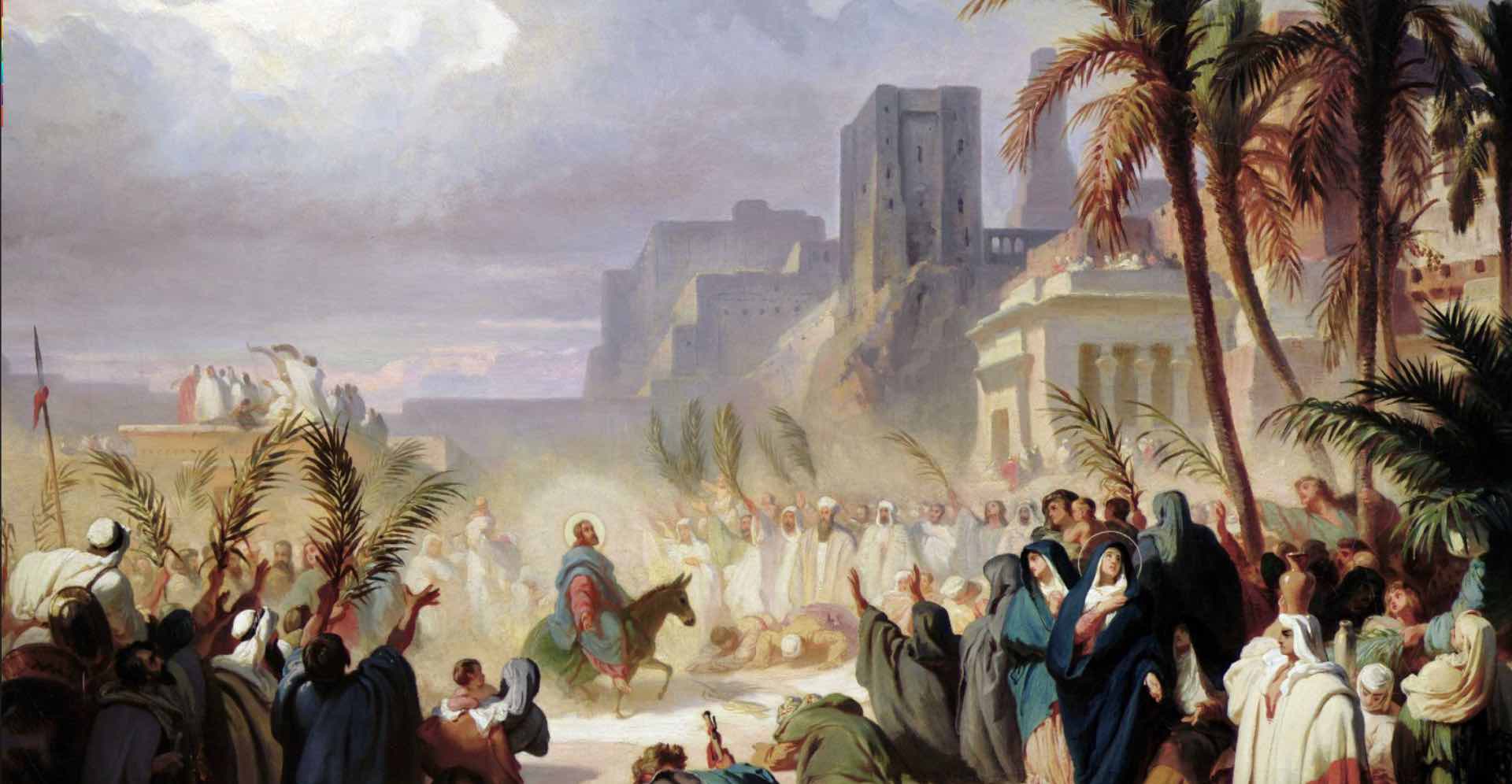
Have Alexander’s entry into Babylon in mind as you consider the entry of Jesus into Jerusalem. On Palm Sunday, the crowds went out to meet Jesus. They waved palm branches and laid them and their cloaks (Mt. 21:7) on the road before Jesus. They cried out, “Hosanna,” which means “Save us now! Blessed is he who comes in the name of the Lord, even the King of Israel!”

They find Jesus sitting – not on a chariot, war horse, camel, or elephant. Jesus sits and rides a donkey – a beast that helped people carry burdens and was used for normal, everyday work. And this fulfilled the prophecy of Zechariah 9:9, “Rejoice greatly, O daughter of Zion! Behold, your king is coming to you; righteous and having salvation is he, humble and mounted on a donkey.”

This entrance of Jesus into Jerusalem is His triumphal entry. But unlike Alexander’s entry, it is humble, lowly, and peaceful. Jesus arrives in Jerusalem as King but not as a normal king. He certainly has power, strength, and glory, but He isn’t intimidating, either to the citizens of His kingdom or to those outside His kingdom. Jesus does not come to demonstrate His might. He comes to demonstrate His love. He comes not to conquer Jerusalem or the world; instead, He comes to conquer your sin and death by His own death on the cross.

Jesus told Pilate, “My kingdom is not of this world” (Jn. 18:36). Jesus is a different kind of king with a different kind of glory. He is a king who has come to die for His subjects – for you. Christ’s glory is to be humble and take the form of a servant. Jesus is a king who is obedient to the point of death, even death on a cross (Php. 2:5-8). And the cross is His triumph. Because Jesus has given Himself unto death for you, God has highly exalted Him and given Him the name above all names. Dear saints, Jesus comes with mercy, and He comes for you. Welcome to Holy Week. Amen.

The peace of God, which surpasses all understanding, will guard your hearts and minds in Christ Jesus. Amen.


[1] This sermon has been adapted from a sermon by Pr. Bryan Wolfmueller.

[2] The account was written by Quintus Certius Rufus and can be found here.

Humble – Sermon for Palm Sunday on Matthew 21:1-9 & Matthew 27:11-54

Listen here.

Our service today included the Rite of Confirmation.

In the name of Jesus. Amen.

Palm Sunday King of GloryThe first words of Scripture you heard in today’s service told how Jesus rode into Jerusalem. Matthew tells us that it happened this way to fulfill what was spoken by the prophet, “Behold, your king is coming to you, humble, and mounted on a donkey” (Zech. 9:9 quoted in Mt. 21:5). That word that gets translated as ‘humble’ means ‘of no importance.’

But then, people welcome Jesus with shouts of, “Hosanna” which means, “save us now.” The people spread their cloaks and palm branches as a royal runner. The people welcome Jesus as their King. And for the first time in His life, Jesus accepts their praises.

If Zechariah prophesized that when Jesus comes that He is considered to be of no importance, why do the crowds welcome Him the way they do?

Well, King Jesus’ humility was much lower than simply riding on a donkey. And because of that the people despise Him and reject Him. They considered Him of no importance (Is. 53:3). And that is exactly what we heard in the Gospel lesson (Mt. 27:11-54).

Jesus Cross Heaven & EarthKing Jesus didn’t come to sit as judge. Instead, He came to be judged. He didn’t have subjects who shout, “Long live the king!” Instead, they holler, “Crucify Him!” He didn’t come to command armies. Instead, He came to be beaten by soldiers. He didn’t come to be clothed in the finest garments and crowned with gold and jewels. Instead, He came to have a robe ripped from Him and be thorns pressed into His head. He didn’t come to drink fine wine from a golden chalice. Instead, He came to be offered wine mixed with gall. He didn’t come to sit in a fine hall with nobles surrounding Him. Instead, He came to hang on a splintered cross between two thieves. He didn’t come to execute justice. Instead, He came to die an unjust death.
But most importantly, He didn’t come to be blessed by God the Father. Instead, He came to be forsaken by God the Father because, there on the cross, He took all of your sin and became sin for you.

Bethany, Naomi, Siobhan, Wyatt, Gavin, Grady, Zach, Elijah, Gabriel, and all of you here: Because of the humility of Jesus, the eternal Son of God, you are made righteous. You are declared innocent, righteous, and blameless.

Yet, the world still does not recognize this. The world still sees Jesus as being of no importance. So, the world will reject you because you bear the name ‘Christian.’

The world looks at what Jesus has done and what He has given the Church, and they say it has no importance. They see the Church gathering Sunday mornings to hear the Word of God and say, “Don’t those silly Christians have anything better to do than to listen to those old-fashioned ideas?” They see Baptism and say, “What good can a little water sprinkled on a head do?” They see the Lord’s Supper and say, “What’s the big deal about a little cracker and wine?”

Word and Sacrament IconBut Christian, by God’s grace, you know better. You know that those are the very things that God has given and uses to complete the good work of faith that He began in you.

You hold fast to that Word because even though it convicts you, you know that those very Words give life. You rejoice in your Baptism because you know that God has said that it joins you to Jesus’ death and resurrection and saves you. You hunger and thirst for the Lord’s Supper because you know that God has promised that it delivers Christ’s living Body and Blood given and shed for the forgiveness of your sins.

Your King comes humbly, but He brings your salvation with Him. And He is coming again. Then, every knee will bow. Every tongue will confess that He is Lord. He is King. He is Savior, your Savior. Amen.

The peace of God, which surpasses all understanding, will guard your hearts and minds in Christ Jesus. Amen.