1 Now concerning the times and the seasons, brothers, you have no need to have anything written to you. 2 For you yourselves are fully aware that the day of the Lord will come like a thief in the night. 3 While people are saying, “There is peace and security,” then sudden destruction will come upon them as labor pains come upon a pregnant woman, and they will not escape. 4 But you are not in darkness, brothers, for that day to surprise you like a thief. 5 For you are all children of light, children of the day. We are not of the night or of the darkness. 6 So then let us not sleep, as others do, but let us keep awake and be sober. 7 For those who sleep, sleep at night, and those who get drunk, are drunk at night. 8 But since we belong to the day, let us be sober, having put on the breastplate of faith and love, and for a helmet the hope of salvation. 9 For God has not destined us for wrath, but to obtain salvation through our Lord Jesus Christ, 10 who died for us so that whether we are awake or asleep we might live with him. 11 Therefore encourage one another and build one another up, just as you are doing.
1 “Then the kingdom of heaven will be like ten virgins who took their lamps and went to meet the bridegroom. 2 Five of them were foolish, and five were wise. 3 For when the foolish took their lamps, they took no oil with them, 4 but the wise took flasks of oil with their lamps. 5 As the bridegroom was delayed, they all became drowsy and slept. 6 But at midnight there was a cry, ‘Here is the bridegroom! Come out to meet him.’ 7 Then all those virgins rose and trimmed their lamps. 8And the foolish said to the wise, ‘Give us some of your oil, for our lamps are going out.’ 9 But the wise answered, saying, ‘Since there will not be enough for us and for you, go rather to the dealers and buy for yourselves.’ 10 And while they were going to buy, the bridegroom came, and those who were ready went in with him to the marriage feast, and the door was shut. 11 Afterward the other virgins came also, saying, ‘Lord, lord, open to us.’ 12 But he answered, ‘Truly, I say to you, I do not know you.’ 13 Watch therefore, for you know neither the day nor the hour.
In the name of Jesus. Amen.
The older I get, the more realize the truth that time is relative. Don’t get me wrong. There are still 60 seconds in a minute; 60 minutes in an hour; 24 hours in a day; and 365 days in a year. That doesn’t change. But sixty minutes is nothing when you are doing something you enjoy compared to sixty minutes of something you don’t. One day at work could fly by, while the next might seem to drag on for an eternity even though you clocked in at 9 AM and out at 5 PM both days.
Our Gospel text today is about Jesus’ return, and Jesus plainly tells you what your attitude and approach to His return should be, “Watch therefore, for you know neither the day nor the hour.” Jesus is returning on the Last Day, but we don’t know when the Last Day is.
We do know that Scripture teaches that we are – currently, right now – in the last days. At Pentecost, Peter preaches that humanity is living in the last days (Act. 2:17). The many signs that Jesus says will mark His return are seen in our time (2 Tim. 3:1-9; Heb. 1:1-2; 2 Pet. 3:3). The Bible says that the end of all things and Jesus’ return is at hand (Jam. 5:8; 1 Pet 4:7). The Apostle John even says that we are living in “the last hour” in his first letter, which was written before 100 AD (1 Jn. 2:18). On top of this, Jesus repeatedly tells us that He is coming ‘soon’ (Rev. 22:7, 12, 20). Soon. What does He mean by ‘soon’? ‘Soon’ is a bit vague especially when with the Lord a day is as a thousand years and a thousand years as one day (1 Pet. 3:8). Come on, Jesus, can’t You give us a little better timeline than that? But His only response is, “Watch therefore, for you know neither the day nor the hour.”
Jesus could come today – even before I’m done preaching this sermon. He could come before your Thanksgiving leftovers go bad or need to be frozen. Christ could return before you need to do your Christmas shopping and wrapping. Wouldn’t that be great! But Jesus could also come in twenty years, five-hundred years, or thousands of years from now. We only know two things about Christ’s return: 1) He is coming again soon so we need to be ready now, and 2) because we don’t how soon ‘soon’ is, we need to be ready if He delays and comes later.
That is why Jesus wants us to have the wisdom of the five wise virgins who go into the marriage feast. They are doubly ready. By being at the door of the banquet hall, they are ready if the bridegroom comes now. And by having enough oil to light their lamps, they are ready if the bridegroom comes later.
We should be excited and ready for Jesus to come now. If you are, that’s good. But we also need to be ready to wait. We can’t be so obsessed with what is happening right now that we do not plant and build up God’s kingdom for the next generation and the one after that and the one after that and the one fifty generations from now. In other words, we need to have enough oil for later.
But Jesus doesn’t tell us what the oil is. Is the oil God’s Word, faith, grace, the Holy Spirit, or the Sacraments? Jesus doesn’t say. But the Scriptures teach that we can think of the oil as all of those. My guess is that Jesus doesn’t tell us exactly what the oil is so that we seek after all those things because each of them – the Bible, faith, grace, absolution, and the Sacraments – are kingdom of heaven things. And Christ tells us to, “Seek first the kingdom of God and His righteousness” (Mt. 6:33).
Here, today, right now, you are storing up oil. You don’t have to save up your money, go to the marketplace, and find the best deal on oil. It’s given away here for free. In this place, you hear God’s Word, are absolved of all your sins, and receive Christ’s risen Body and Blood. In this place, you are supported by your brothers and sisters in Christ, and your presence ministers to them. Here, you unite in prayer making intercessions for yourselves and others, for our nation and this world. This is how faith is given, sustained, and strengthened.
But also, don’t be a fool and think that a couple hours at church each week (or two to three times each month) is enough. You need more. And parents, listen up: your children can’t share your oil and can’t walk in the light of your lamp. Each one needs his or her own lamp lit. So, if it hasn’t been your family’s practice in the past, make the reading of Scripture, prayer, and fellowship around God’s Word together as a family your top priority each day. Start today. Fathers, God calls you to take the lead on this. Wives, if he doesn’t do it on his own, pester and nag him until he does.
Family time in the Bible doesn’t need to be complicated or fancy. Start simple. Start with the Gospel of John and read one paragraph each day. After you read, pray for your friends and family. It can be as simple as, “Bless grandma and help uncle Phil. Amen.” Then, pray the Lord’s Prayer. That will take five minutes. You can do that. You have the time to do that.
If you don’t have enough time, eliminate something from your schedule. If your job makes it impossible, quit. Find a new career – even if it means a pay cut and you have to get a smaller, cheaper house. This is eternally serious. Your salvation and the salvation of your children, grandchildren, and great-great-great-great-grandchildren depends on it. If you miss a day, don’t give up. Start again the next. Make it a habit for you and your kids to pray together on the way to school or practice or wherever. All of this will fill your oil reserves and make God’s Word part of your regular conversations as you watch and remain ready for His return. It will help make you ready now and later.
Then, as soon as you have worked yourself into a tizzy about the dire urgency of Christ’s return, step back, take a breath, and remember: Christ’s return is not something scary or horrific that you need to fear. No, Jesus’ return means that you will be in eternal bliss, happiness, contentment, and joy. There will be no more pain, tears, or sorrow. Christ’s return is something to anticipate – more than a child anticipates the arrival of her favorite aunt and cousins. That excited expectation is what Jesus is highlighting with this parable.
Yes, this parable is a warning. Our lamps can run dry. Faith must be continually fed by God’s Word and the Sacraments. Repent. Believe. Have faith in Christ. Sure, Scripture teaches that as the end draws near the signs of Jesus’ return become more and more alarming (1 Th. 5:1-11). There will be wars and rumors of wars, nation rising up against nation, earthquakes, persecution, hatred, false teaching, and love growing cold (Mt. 24:4-12).
But, when you see those things, remember what that means for you. Christ says it means your redemption is drawing near (Lk. 21:28). The bridegroom is coming, and you are His bride without spot, wrinkle, or blemish (Eph. 5:27).
Dear saints, this world is ending. Good riddance. You have Christ. Your redemption is secure and your eternity certain. So, look forward to that day. Stay awake. Keep eagerly anticipating and looking for the resurrection of the dead and the life of the world to come. Amen.
The peace of God, which surpasses all understanding, will guard your hearts and minds in Christ Jesus. Amen.
1 [Jesus says,] “Then the kingdom of heaven will be like ten virgins who took their lamps and went to meet the bridegroom. 2 Five of them were foolish, and five were wise. 3 For when the foolish took their lamps, they took no oil with them, 4 but the wise took flasks of oil with their lamps. 5 As the bridegroom was delayed, they all became drowsy and slept. 6 But at midnight there was a cry, ‘Here is the bridegroom! Come out to meet him.’ 7 Then all those virgins rose and trimmed their lamps. 8 And the foolish said to the wise, ‘Give us some of your oil, for our lamps are going out.’ 9 But the wise answered, saying, ‘Since there will not be enough for us and for you, go rather to the dealers and buy for yourselves.’ 10 And while they were going to buy, the bridegroom came, and those who were ready went in with him to the marriage feast, and the door was shut. 11Afterward the other virgins came also, saying, ‘Lord, lord, open to us.’ 12 But he answered, ‘Truly, I say to you, I do not know you.’ 13 Watch therefore, for you know neither the day nor the hour.”
In the name of Jesus. Amen.
One year ago, I preached on this text. After that service, we decorated the sanctuary for the Advent and Christmas season just like we will today. The following Sunday, Lindsay, Siobhan, and Stephanie came up to do our Advent candle lighting. After they did the readings and prayer, Lindsay went to light the first candle. The wick held the flame for a fraction of a second then went out because… there was no oil in that candle. And the wick would not hold a flame.
I bring that up for two reasons: First, whoever brings out the Advent candles today, please check the oil levels so we don’t repeat that this year. The second reason I bring that up is that this parable can seem so trivial. Last year, we were perfectly capable of having our worship service without that candle being lit. We didn’t need its light or the heat created by it. We just moved on. Not having oil seems like such a minor thing. In the parable, five girls are unable to light lamps because they didn’t have oil. Did all ten virgins need to have lit lamps? Was it really that important?
Apparently, yes. In the parable, not having oil to keep a lamp lit makes the difference between being in the feast and being left out. In fact, according to Jesus, having oil makes a person wise, while not having oil makes a person a moron. That’s literally the word Jesus uses; the word translated ‘foolish’ in our text is the Greek word μωρός where we get our word ‘moron.’
Now, we don’t know enough about wedding customs in Jesus’ day to know why it was so important for all the ten virgins to have enough oil to keep a lamp lit. The groom didn’t need those lamps to be able to see his way into the marriage feast. He had already made his way through the town to get to the location. All we know is that once the groom arrives, the lamp must be lit.
Jesus teaches that there will be a final cut off point. There is a moment when your status of being in or out will not and can not change. While the five morons are off trying to buy oil from the sellers – and remember this is at midnight, so those sellers would have closed up their shops and had probably gone to bed hours earlier – while the five morons are off on their futile errand, the groom arrives. The feast starts. The door is shut. And that door will not open again. Those who aren’t ready will be left outside forever.
The coming of the groom made a division. Those who were prepared poured oil in their lamps and went into the wedding feast with him. But the morons start scrambling around trying to find oil, and when they return, they find they are out in the darkness where there is only weeping and gnashing of teeth. And the last words they hear from their Savior, the groom, are, “I don’t know you.”
Let’s consider a few things about that door that gives entrance to the wise and excludes the morons.
First, notice that when the groom arrives, those who were ready go through that door immediately (v. 10). When Jesus returns, you won’t have to do any convincing or proving of yourself. You won’t have to go somewhere to be purified. Your worthiness to enter is established. There is nothing left for you to do. Christian, your entrance is immediate. If you die today, you will be escorted by the angels directly into Jesus’ presence where your soul will await the resurrection. And if Jesus comes before you die, you will go straight into the banquet of the eternal wedding feast.
That brings me to the second thought about the door. Remember what is behind that door. It’s a wedding feast. Wedding feasts are fun. At your wedding feast, you had family, friends, classmates, and coworkers – a bunch of people who are special and important to you – they all were in the same room mingling, eating, laughing, dancing, and celebrating with you. Your wedding reception was filled with people who will probably never be in the same room again – at least not in this life. Your cousin from Nebraska, your college roommate from California, and your boss will never be in the same room again, but at your wedding feast, they all enjoyed each other’s company. Now imagine that laughter, joy, and merriment times infinity.
The third thought about this door is that it gets shut. Normally, we think about this as a horrifying thing, and for the unbeliever it is. Absolutely, it is. For those outside there will be no entering once the door is shut. But you, Christian, are not left outside. You are inside. How do you suppose Noah and his family felt about God shutting the door and closing them in the ark as the rains came down and the floods went up? They would have felt safe and secure. It’s the same for you. When God shuts that door, He will close out any bit of danger or evil so that it will never touch you.
Finally, the door being shut means that you, Christian, will be forever with Jesus. In the parable, how many entered into the wedding feast? It wasn’t just the five wise virgins. There are six. The bridegroom is inside with them, with the five wise virgins. The groom doesn’t say, “Go on in.” No, they go in with him. It’s so obvious, but don’t miss that.
Dear saints, now is the time to fill your flasks with oil! You do not know how much you will need. The five morons knew they needed oil all along. As soon as the cry went out, that was their only focus, but it was too late. Everyone knows they need oil. Get it now. Why, why would you ever think you have enough oil?
The oil isn’t expensive – in fact it’s free! But you don’t have eternity to get the oil. There is a deadline, and you do not know when that deadline will come. Don’t procrastinate. Receive the gift of faith through the ways God has promised to give it. Go ahead and hoard it. Why would you become complacent and think you don’t need more of God’s Word, God’s mercy, God’s grace, and God’s Sacraments?
Jesus is coming. The Bridegroom said He would return to take you to where He is. But you do not know when. Today feels like a lot like yesterday, and yesterday felt like the day before. And because Jesus didn’t come yesterday or the day before, it can be easy to think that Christ is not coming today. Don’t become a moron, repent! It is easy to fall asleep. It is easy to get distracted with many things and think the time to get oil will last forever. But it won’t.
Yes, this parable is a warning. Yes, it is a call to endure and persevere because being left outside would be horrific. But. But at the same time let’s all take a deep breath and laugh because we are waiting for a party where there is gladness, peace, and joy.
When Jesus warns about His coming, He doesn’t tell a parable about ten soldiers – five wise who always kept their swords within reach and five morons who couldn’t remember where they set their weapons down. Then, the enemy attacked, and the five morons were utterly defeated. No. It’s the parable of the ten virgins waiting for a party.
Jesus is coming, and we wait for that day with expectation, hope, and joy. And, now, Jesus your Savior comes to you to meet you at this altar to have a feast of forgiveness and mercy. Communion is the closest we will get to the party before Jesus returns. It’s a foretaste of the feast to come.
So, dear saints, come. Your bridegroom is here with you now. Trim your lamps because you have the oil of salvation. Amen.
The peace of God, which surpasses all understanding, will guard your hearts and minds in Christ Jesus. Amen.
1 “Then the kingdom of heaven will be like ten virgins who took their lamps and went to meet the bridegroom. 2 Five of them were foolish, and five were wise. 3 For when the foolish took their lamps, they took no oil with them, 4 but the wise took flasks of oil with their lamps. 5 As the bridegroom was delayed, they all became drowsy and slept. 6 But at midnight there was a cry, ‘Here is the bridegroom! Come out to meet him.’ 7Then all those virgins rose and trimmed their lamps. 8 And the foolish said to the wise, ‘Give us some of your oil, for our lamps are going out.’ 9 But the wise answered, saying, ‘Since there will not be enough for us and for you, go rather to the dealers and buy for yourselves.’ 10 And while they were going to buy, the bridegroom came, and those who were ready went in with him to the marriage feast, and the door was shut. 11 Afterward the other virgins came also, saying, ‘Lord, lord, open to us.’ 12 But he answered, ‘Truly, I say to you, I do not know you.’ 13 Watch therefore, for you know neither the day nor the hour.”
In the name of Jesus. Amen.
The five foolish virgins had one problem. They were “morons.” That’s literally the word Jesus uses – μωρός. So that’s how I’ll refer to them; if you have a problem with me calling them morons, you can take it up with Jesus. Being morons was their only problem. The fact that they had lamps but no oil is problematic, but their problem is that they are morons. Having an oil lamp but no oil is silly. Wicks without oil can only burn for a few seconds before disappearing in a choking mess of smoke.
We might think that the wise virgins not sharing their oil with the morons is a problem. It doesn’t seem very charitable. Why don’t the wise just offer to let the morons walk in the light of their lamps? Well, we don’t know enough about the customs of Jesus’ day to know why each girl needed to have her own lamp. And who knows? Maybe that arrangement would have been acceptable. But notice what the morons did. When the call rings out, “Here is the bridegroom! Come out to meet him,” they moronically wander away from the banquet hall to try and buy some “midnight oil.” What shop would be open at that hour?
While the morons are gone on their hopeless shopping trip, the bridegroom arrives. The five wise virgins go in to the marriage feast, and the door is shut. When the five morons finally return begging to be allowed in to the feast, they are met with the horrifying reply, “Truly, I say to you, I do not know you.”
Jesus tells this parable as a warning for us to be ready for His return. The moral of the parable is, “Watch therefore, for you know neither the day nor the hour.” Jesus will return to judge the living and the dead. But Jesus didn’t tell us when He would return. So, He commands us to watch and be ready. Wake up from your sleep today. Wake up now. When the feast begins, Jesus wants you there. Have oil. Don’t be left outside.
But now, we have a problem. Jesus doesn’t tell us what the oil is. Is it the Bible, faith, grace, the Holy Spirit, or the Sacraments? Jesus doesn’t say. But the Scriptures would indicate that it can be and is all of those. I’m open to other suggestions that you might have, but my guess is that Jesus doesn’t tell us what the oil is so that we seek after all those things because each of them – Bible, faith, grace, absolution, and the Sacraments – are kingdom of heaven things. And Christ tells us to, “Seek first the kingdom of God and His righteousness” (Mt. 6:33).
That is why you are here today. God has gathered you here around His Word and Sacrament. This is where you need to be and where you belong. In this place, you hear God’s Word, are absolved of your sins, and receive Christ’s risen Body and Blood. In this place, you are supported by your brothers and sisters in Christ, and your presence ministers to them. Here, you unite in prayer making intercessions for yourselves and others, for our nation and this world. This is how faith is given, sustained, and strengthened. The Church is the well-fortified barracks where you are fitted with the whole armor of God (Eph. 6:11). And, here, you help others prepare for the battle.
But you don’t get to stay here. You will return to the battlefield of the world. It is necessary, and it is, in fact, what God has called you to do. You are called by God to go into the world and deal with lazy coworkers and incompetent supervisors and bosses. You will have to endure your children’s temper tantrums, your spouse’s failures and shortcomings, the loneliness of a widowed house, and your relatives’ problems. You will go back to school and classes with boring teachers, pointless homework, and bullies. God calls you to face all of that even while you struggle with your own sins of anger, lust, gossip, and envy.
In each of those places, each of those callings and vocations, the devil has laid all sorts of traps and snares for you; he prowls around like a roaring lion seeking to devour you (1 Pet. 5:8). Satan attacks you in those arenas because everywhere you go, you carry God’s light to a darkened world. Christian, every relationship you have is a holy, divine calling. And because you are God’s child, everything you do has spiritual value. How you handle work, school, chores, laundry, dishes, and whatever else has both temporal and eternal consequences. That is why you come to church and get what is necessary for your salvation. But what happens here must extend to the rest of your week.
Don’t be a moron thinking that a couple hours at church each week (or two to three times each month) is enough to prepare you for what you will face out there. You need more. And parents, listen up. Your children can’t share your oil and can’t walk in the light of your lamp. Each one needs his or her own lit lamp. So, if it hasn’t been your family’s practice in the past, start today. Make the reading of Scripture, prayer, and fellowship around God’s Word together as a family your top priority each day. Fathers, God calls you to take the lead on this. Wives, if he doesn’t do it on his own, pester and nag him until he does.
Family time in the Bible doesn’t need to be complicated or fancy. Start simple. Start with the Gospel of John and read one paragraph each day. After you read, pray for your friends and family. It can be as simple as, “Bless grandma and help Phil. Amen.” Then, pray the Lord’s Prayer. That will take five minutes. You can do that. You have the time to do that. And if you don’t have enough time, rip something out of your schedule. If your job makes it impossible, quit. Find a new one – even if it means a pay cut and you have to buy a smaller, cheaper house. This is eternally serious. Your salvation and the salvation of your children depends on it. If you miss a day, don’t give up. Start again the next. Make it a habit for you and your kids to pray together on the way to school or practice or wherever. All of this will help to begin to make God’s Word part of your regular conversations as you watch and remain ready for His return.
Ok. That was the Law part of the sermon. And, I hope was a bucket of ice water to awaken you from slumber. Now, we need the Gospel. And there is one more problem to address: Now, be honest. Does this parable strike fear into you?
Honestly, if you summarize the parable, it is a story of ten silly girls who fall asleep waiting for a party. Five are able to light a lamp and get to go into the party. Five can’t, so they have to go away. And if your high school experience was like mine, if you aren’t at the party, you just end up at home sulking and feeling a bit lonely and sorry for yourself.
So, when Jesus tells us that the purpose of this parable is to get us to watch for the day of His return, why did He use this analogy of a wedding party and ten silly, sleepy girls? If being ready for His return is so important, why not tell a parable with more urgency and more horrific consequences? Why not a parable of ten fishermen – five who wear life jackets and five morons who don’t and drown when the storm comes and the boat sinks? How about ten soldiers – five who carry their sword at all times and five morons who leave their swords lying around and get slaughtered when the enemy ambushes them?
Well, that is precisely why Jesus’ parable is different. In either of the parables I just suggested, the return of Jesus is depicted as a terrible, tragic event – a storm at sea, or a sudden attack by an enemy army. But in Jesus’ parable, the thing we need to be ready for, well, it’s the greatest day ever – the day of the arrival of Jesus, the Bridegroom and Savior of all mankind. A day of feasting, joy, laughter, and blessedness for those who are ready to enter with Him. It is the very thing we are looking forward to and longing for.
Once we have worked ourselves into a tizzy about the dire urgency of Christ’s return, we need to step back, take a deep breath, and remember: Christ’s return is not something horrific that you need to be scared of. Jesus’ return means that you will be in eternal bliss, happiness, contentment, and joy. There will be no more pain, tears, or sorrow. Christ’s return is something to anticipate – more than a child anticipates the arrival of her favorite aunt and cousins. That excited expectation is what Jesus is highlighting with this parable.
Yes, this parable is a warning. Our lamps can run dry. Faith must be continually fed by God’s Word and the Sacraments. Repent. Believe. Have faith in Christ.
And yes, Jesus teaches that as the end draws near the signs of His return are alarming: wars and rumors of wars, nation rising up against nation, earthquakes, persecution, hatred, false teaching, and love growing cold (Mt. 24:4-12). But, when you see those things, remember what that means for you. Christ says it means your redemption is drawing near (Lk. 21:28). The bridegroom is coming, and you are His bride without spot, wrinkle, or blemish (Eph. 5:27).
Dear saints, this world is ending. Good riddance. You have Christ. Your redemption is secure and your eternity certain. So, look forward to that day. Stay awake. Keep eagerly anticipating and looking for the resurrection of the dead and the life of the world to come. Amen.
The peace of God, which surpasses all understanding, will guard your hearts and minds in Christ Jesus. Amen.
1 “Then the kingdom of heaven will be like ten virgins who took their lamps and went to meet the bridegroom. 2 Five of them were foolish, and five were wise. 3 For when the foolish took their lamps, they took no oil with them, 4 but the wise took flasks of oil with their lamps. 5 As the bridegroom was delayed, they all became drowsy and slept. 6 But at midnight there was a cry, ‘Here is the bridegroom! Come out to meet him.’ 7Then all those virgins rose and trimmed their lamps. 8 And the foolish said to the wise, ‘Give us some of your oil, for our lamps are going out.’ 9 But the wise answered, saying, ‘Since there will not be enough for us and for you, go rather to the dealers and buy for yourselves.’ 10 And while they were going to buy, the bridegroom came, and those who were ready went in with him to the marriage feast, and the door was shut. 11 Afterward the other virgins came also, saying, ‘Lord, lord, open to us.’ 12 But he answered, ‘Truly, I say to you, I do not know you.’ 13 Watch therefore, for you know neither the day nor the hour.”
In the name of Jesus. Amen.
I promise we’ll get to the parable; it’ll be in a roundabout way. But first…
Four days from now, our nation will pause and dedicate a day to giving thanks. Friends and families will gather. Tables will be set. Turkeys will be cooked. (By the way, if you’re in charge of the turkey, make sure you brine it first – use kosher salt, 24 hours. Talk to me after the service.) Potatoes will be mashed. Stuffing will be fluffed. Pies will be baked. Cream will be whipped. Football will be watched. And couches and recliners will be tested for structural integrity.
Having a day for Thanksgiving is good, right, and important – probably more important than we could ever realize. Even though it is in the name – “Thanksgiving” – most people probably miss the whole meaning of the day. Thanksgiving is a day to give thanks, and that means there must be a recipient of our thanks – someone to whom we give thanks. And, dear Christian, I hope Thanksgiving Day is different for you than it is for many in our country because you know to Whom you give thanks. Let me parse that out.
Many people today will talk about gratitude. Some people finish each day by crawling into bed and thinking of five things for which they can be grateful. That is a good exercise, but it only goes so far. While there are similarities between the two, gratitude is not always the same as thanksgiving.
Let me try this on you, and you can tell me what you think. Gratitude tends to look at the goodness of the thing received. But thanksgiving, yes it recognizes the goodness of the thing, but it looks past that and sees the goodness of the giver of the thing. This is why Christians can give thanks in all circumstances (1 Th. 5:18). Even in the tough stuff, even in difficult times, in sorrow, and in afflictions that come to us in this broken world, you can know that everything comes to you from the very same hands that were nailed to the cross for you.
Christians give thanks. Scripture even goes so far as to say that not giving thanks is one of the marks of the unbeliever. Romans 1:21-23 says of idolators, “Although they knew God, they did not honor Him as God or give thanks to Him, but they became futile in their thinking and their foolish hearts were darkened. Claiming to be wise, they became fools,” (see there a connection to the parable), “and exchanged the glory of the immortal God for images resembling mortal man and birds and creeping things.” In other words, people fall into idolatry because they foolishly do not give thanks to God.
Think back to Eden and the Fall when sin was being born: Eve rightly told the serpent that they could eat of any tree in the garden except the Tree of the Knowledge of Good and Evil. Nothing was forbidden to Adam and Eve except learning what evil is. But the devil awakened the desire to become more. Remember, the devil lied, “You will not surely die. God knows when you eat of it your eyes will be opened, and you will be like God, knowing good and evil.”
Instead of being content and thankful for everything God had given, the desire for something more was awakened. Then, those fateful words, “When the woman saw that the tree was good for food, and that it was a delight to the eyes, and that the tree was to be desired to make one wise, she took of its fruit and ate, and she gave some to her husband who was with her, and he ate” (Gen. 3:6).
In the account of the Fall, we can see how thanklessness is the root of every sin. When we aren’t giving thanks, we are lured and enticed by misguided and false desires. The Epistle of James warns us about this (1:14-15), “Each person is tempted when he is lured and enticed by his own desire. Then desire when it has conceived gives birth to sin, and sin when it is fully grown brings forth death.”
All of this is to say that one of the most important things for us to do to fight against sin is to give thanks. When we are giving thanks, we are looking at the goodness of our God and fighting against the false desires that lead to sin which grows and matures into death. So, again, as Scripture says, “Give thanks in all circumstances” (1 Th. 5:18). For many in our community – you farmers especially – this is important. Many of you have to leave your crops in the ground, and not only that you have to pay to do so. Lord, have mercy. It is awful and horrible.
Yet, in the midst of this suffering, God is giving you a chance to grow in your faith. Remember when Job had his oxen, donkeys, sheep, camels, children, and his health taken away? His wife tells him to curse God and die. But Job responds, “You speak as one of the foolish women. Shall we receive good from God, and shall we not receive evil?” (Job 2:9-10).
You farmers who are suffering now, everyone else who is suffering in other ways, and those of you who will suffer in the future, remember that God is your Heavenly Father. He will never withhold anything good from you. Psalm 84:11, “The Lord bestows favor and honor. No good thing does he withhold from those who walk uprightly.” Psalm 34:9–10, “Oh, fear the Lord, you his saints, for those who fear him have no lack! Those who seek the Lord lack no good thing.” Any suffering you experience is an opportunity for your faith in God’s goodness to grow and mature (1 Pet. 1:7, 4:12-16). He will not fail you.
Now, to the parable. Honestly, it is very difficult, and the difficulty mainly lies in the fact that we don’t know enough about Jewish wedding customs in Jesus’ day to know why it was so important that these virgins have lit lamps when the groom arrived.
I would love to be able to tell you exactly what the oil represents, but Jesus doesn’t tell us. Is it the fear of the Lord which is the beginning of wisdom (Ps. 111:10; Prov. 1:7)? Since the fear of the Lord is the beginning of wisdom do we need to also add God’s Word, faith, grace, the Holy Spirit, the Sacraments, or thanksgiving? The safest answer is that it is probably all of them, because they are all tied together to make a sinner ready for the Day of the Lord. There are two things we can say for sure – the first is about the oil and the second about the lamps.
First, the oil is not something that can be shared. When the foolish ask the wise to share their oil, they say, “No,” because, even though the groom is around the corner, they will not have enough for both themselves and the foolish. The second thing we can say is about the lamps that no one can walk by the light of another’s lamp, each must have their own.
Also, we know for sure that all of these girls are failures. They all sleep. They all need to be awakened. They all need to quickly trim their lamps to be ready to meet the groom, but not all are able. Five are wise and get into the feast. And five are foolish and are left outside like strangers. We also know the purpose of the parable. Jesus wants us to be wise as we watch for His return. We need to have faith that God’s promises are sure and certain. He will return. He will come back. And He wants you at the feast.
Dear saints, the One who was born for you; the One who lived a life of perfect obedience for you; the One who suffered, bled, and died for you is the same One who is coming for you. Jesus will return and take you to be with Himself.
So, be wise. Continue even now to be where your Lord has promised to be. Be in His Word. Be here where He gives you His mercy and grace in the Supper. Be in the fellowship of your fellow believers. Be fed by His promises because those promises will never fail you. And be fighting against the foolishness of sin. Your Lord and Savior is coming. Amen.
The peace of God, which surpasses all understanding, will guard your hearts and minds in Christ Jesus. Amen.
1 “Then the kingdom of heaven will be like ten virgins who took their lamps and went to meet the bridegroom. 2 Five of them were foolish, and five were wise. 3 For when the foolish took their lamps, they took no oil with them, 4 but the wise took flasks of oil with their lamps. 5 As the bridegroom was delayed, they all became drowsy and slept. 6 But at midnight there was a cry, ‘Here is the bridegroom! Come out to meet him.’ 7 Then all those virgins rose and trimmed their lamps. 8 And the foolish said to the wise, ‘Give us some of your oil, for our lamps are going out.’ 9 But the wise answered, saying, ‘Since there will not be enough for us and for you, go rather to the dealers and buy for yourselves.’ 10 And while they were going to buy, the bridegroom came, and those who were ready went in with him to the marriage feast, and the door was shut. 11 Afterward the other virgins came also, saying, ‘Lord, lord, open to us.’ 12 But he answered, ‘Truly, I say to you, I do not know you.’ 13 Watch therefore, for you know neither the day nor the hour.”
In the name of the Father and of the Son and of the Holy Spirit. Amen.
It’s the end of the world as we know it… It’s the end of the world as we know it… It’s the end of the world as we know it… And I feel fine.
That feeling fine ended up being a problem for the five foolish virgins. A big problem. They came to the bridegroom’s house feeling fine, but for no good reason. They were totally unprepared. They took no oil which meant that when the bridegroom was delayed, they could not light their lamps. And their fine feeling faded very quickly when the call came to come meet the bridegroom.
They go to trim their lamps, but they realize they don’t have any oil. So, they end up making a midnight run to the market to try and buy oil from the dealers who would had all closed up shop and gone to bed hours before. For these five foolish virgins, it was too late. While they were away, the bridegroom came, those who were ready went in with him to the marriage feast, the door was shut, and the five fools were left on the wrong side of the door.
Their knocking and begging and pleading for the bridegroom to let them in is met with the cold response, “Truly, I say to you, I do not know you.” Their foolishness meant that they were kept from entering the feast. They had felt fine, but when the end came, they were left outside in the cold.
Jesus tells this parable as a warning for us to be ready for His return. Jesus has promised that He will return and that we believers will live forever with Him. But Jesus didn’t tell us when He would return. So, in this parable, He commands us to watch because we do not know the day or the hour. Jesus wants us to be ready. When the feast begins, Jesus wants us there. Jesus wants you there. So be ready. Have oil. Don’t be left outside.
But be honest. This parable probably doesn’t strike that much fear in you. If you summarize the parable, it is a story of ten silly girls who fall asleep waiting for a party. Five of them are able to light an oil lamp and get to go into the party. And five can’t, so they don’t get into the party and have to go away. And if your high school experience was like mine, if you aren’t at the party, you just end up at home sulking and feeling a little lonely.
So, when Jesus tells us that the purpose of this parable is to get us to watch for the day of His return, why did He use this analogy of a wedding party and ten silly girls? If being ready for His return is so important, why not tell a parable with more urgency and more horrific consequences than simply missing out on a party? If I were Jesus, I’d tell a parable like this:
There were ten fishermen – five wise who wore their life jackets the whole time they were on the boat and five foolish who drown because they figured they would have enough time to put them on when the storm hit.
Or, I’d tell a parable about ten soldiers – five wise who kept their hands on their sword hilt at all times and five foolish who got slaughtered when the enemy attacked because they left their sword lying around all the time.
Or, there were ten single parents – five wise who had instructions about where their children should live if something were to happen and five foolish who don’t leave any instructions so their children end up in terrible living situations.
In any of my parables, there is no good reason to be unprepared. The foolishness of the fools in each of those parables is much more apparent than in the parable Jesus tells, and the consequences are much more dire and horrific. But that is precisely why Jesus’ parable is different.
In each of my parables, the return of Jesus is a terrible, tragic, evil event – a storm at sea, an ambush by an enemy army, a death of a parent. But in Jesus’ parable, the thing to be ready for is the greatest day ever – the day of the arrival of Jesus, the Bridegroom and Savior of all mankind. A day of feasting, joy, merriment, and bliss for those who are ready to enter with Him. It is a day of escape, and the day we are looking forward to.
Christian, Christ’s return is not something you need to be worried about. Not at all! Christ’s return means that you will be in eternal bliss, happiness, joy, and contentment. There will be no more pain, no more tears, no more sorrow. Christ’s return is something anticipate – more than a child anticipates the arrival of her favorite aunt and cousins. Christian, your prayer is always, “Come, Lord Jesus. Come quickly” (Rev. 22:20). And it is that same anticipation that Jesus highlights in this parable.
In our Epistle lesson (1 Thess. 5:1-11), we do hear both sides – both the dire consequences of unbelief and the joy of deliverance. Paul says that the day of the Lord will come upon unbelievers like a thief in the night. People will think they have peace and security, but then sudden destruction will come upon them like labor pains come upon a pregnant woman. And Paul warns, “They will not escape.”
But Paul continues. You, believer, are not in darkness. And that day will not surprise you like a thief. You are children of the light. And God has not destined you for wrath. Instead, He has destined, chosen you to obtain salvation though our Lord Jesus Christ.
So, yes, Jesus’ parable is a warning for us. Our lamps can run dry. Faith must be continually fed. Your faith will not survive without the Word and the Sacraments. Repent and believe. Have faith in Christ.
Faith trusts God to do what He says He will do, but without God’s Word, that faith will dry up and go out. You need, constantly you need, God’s Word. You need to hear God’s Law which calls you to repentance, and you need to hear God’s Gospel which tells you of Christ’s love, His sacrifice, His cross, His death, His resurrection. You need to be in fellowship with your brothers and sisters in Christ. You need to be built up and you need to build others up and encourage one another.
And remember that as the end approaches, as you continually see signs of Christ’s return, remember what that means for you. Christ says it means your redemption is drawing near (Lk. 21:28). The bridegroom is coming, and you are His bride. Jesus has purchased and redeemed you so that you are without spot, wrinkle, or blemish (Eph. 5:27).
This world is ending, good riddance. You have Christ. Your redemption is secure. Your eternity is certain. So, yes, it’s the end of the world as we know it. But you, you Christian, you believer, you saint, you feel fine. Amen.
The peace of God, which surpasses all understanding, will guard your hearts and minds in Christ Jesus. Amen.


 6 But at midnight there was a cry, ‘Here is the bridegroom! Come out to meet him.’ 7Then all those virgins rose and trimmed their lamps. 8 And the foolish said to the wise, ‘Give us some of your oil, for our lamps are going out.’ 9 But the wise answered, saying, ‘Since there will not be enough for us and for you, go rather to the dealers and buy for yourselves.’ 10 And while they were going to buy, the bridegroom came, and those who were ready went in with him to the marriage feast, and the door was shut. 11 Afterward the other virgins came also, saying, ‘Lord, lord, open to us.’ 12 But he answered, ‘Truly, I say to you, I do not know you.’ 13 Watch therefore, for you know neither the day nor the hour.”
 But thanksgiving, yes it recognizes the goodness of the thing, but it looks past that and sees the goodness of the giver of the thing. This is why Christians can give thanks in all circumstances (1 Th. 5:18). Even in the tough stuff, even in difficult times, in sorrow, and in afflictions that come to us in this broken world, you can know that everything comes to you from the very same hands that were nailed to the cross for you.
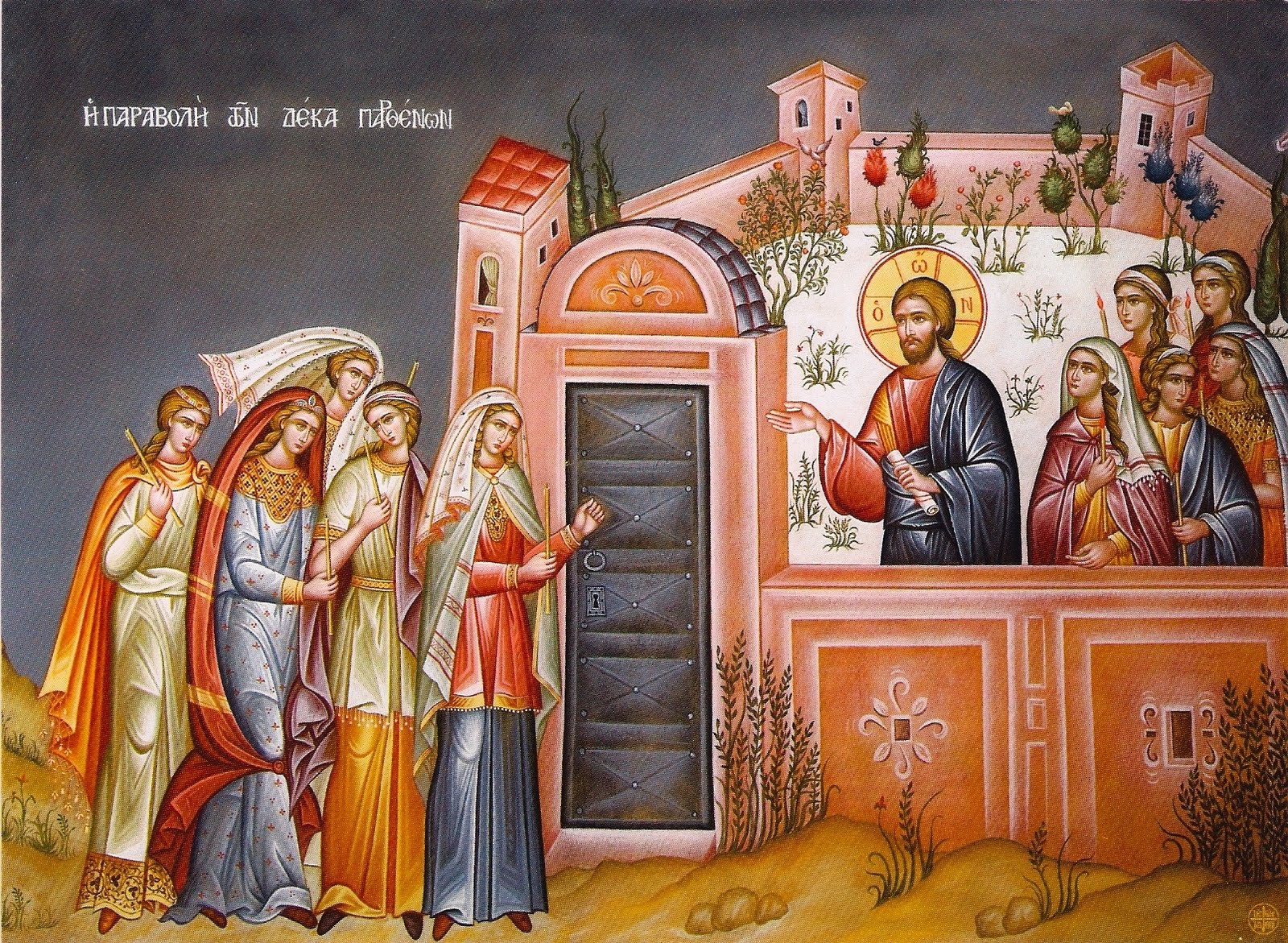 Now, to the parable. Honestly, it is very difficult, and the difficulty mainly lies in the fact that we don’t know enough about Jewish wedding customs in Jesus’ day to know why it was so important that these virgins have lit lamps when the groom arrived.
 There were ten fishermen – five wise who wore their life jackets the whole time they were on the boat and five foolish who drown because they figured they would have enough time to put them on when the storm hit.
 And remember that as the end approaches, as you continually see signs of Christ’s return, remember what that means for you. Christ says it means your redemption is drawing near (Lk. 21:28). The bridegroom is coming, and you are His bride. Jesus has purchased and redeemed you so that you are without spot, wrinkle, or blemish (Eph. 5:27).
 Pastorsamwise
You must be logged in to post a comment.